Unbalanced
We’ve looked at a couple of ways a romantic story can go wrong: for example, an unsympathetic romantic interest, or too much deception. Here’s another failure mode: the two characters don’t seem to be evenly matched. They’re not on the same level. We may accept the romance, but we feel a little unsatisfied, because one of the lovers isn’t quite up to the other’s weight, so to speak. We may feel the one doesn’t quite deserve the other; but it’s not so much a matter of goodness as of stature.
An Array of Mismatches
We can spot the kind of thing I’m thinking of in a wide variety of genres.
 One of my favorite Georgette Heyer Regencies is The Grand Sophy (1950). Our heroine, Sophia Stanton-Lacy, has grown up following her diplomat father around the world. She’s tall, high-spirited, and outgoing; doesn’t worry about the conventions but is very elegant; always good-humored; and quite capable of taking over a household full of tangled relationships and straightening things out in her own inimitable way—a classic master contriver. The title is an accurate description: Sophy is a magnificent and delightful character.
Her cousin Charles Rivenhall, though a relatively young man, had to take charge of his hapless relatives and, as Wikipedia puts it, “has assumed since a young age the role of the adult in the household.” As a result, he’s autocratic and rather harsh. Having decided to settle down, Sophy sets her sights on him—and we kind of wonder why. Charles is a dominant, if not domineering character, to be sure; he can literally stand up to Sophy, although she’s perpetually outmaneuvering him. But he’s not nearly as engaging and interesting a character as she is. The weakest part of the book, to my mind, is that Charles seems rather dull compared to the colorful, ebullient Sophy.
 Sophy’s carefree campaign to corral Charles reminds me a bit of how Dolly Levi scoops up Horace Vandergelder in Hello, Dolly! (1964)—and there’s another example. Dolly is also rather magnificent—charming and clever, if devious. But what does she see in stuffy Horace? He has his points, of course. He’s not a bad guy, at heart. But he seems rather too tame for Dolly—unless perhaps the point is that she needs a stabilizing force at this time of her life.
 The “too tame” problem is a possibility whenever we get an especially strong-willed and noteworthy heroine. (And it often seems to be the heroes that are an inadequate match for the heroines—perhaps because a match between an overpowering man and a weak woman would tend to collapse into a stereotype and forfeit our interest.) Take Wonder Woman. She’s a hard act to follow, and a hard match to make. Her 2017 movie barely steers clear of the pitfall. Romantic interest Steve Trevor isn’t her equal in terms of power, but he is a soldier; he has courage, initiative, and independence. Still, he’s not really in her league, and while their brief love affair has an important softening and motivating role in the story, it’s almost a relief that he dies heroically, removing himself from contention. I believe the comics sometimes pair Diana up with Superman, which seems almost too pat; we get a match not just of equally powerful persons, but of equally iconic figures.
At the opposite end from the comic books, we have the classics. Some readers of Little Women, I believe, are disappointed when the lively Jo ends up with undistinguished middle-aged Professor Bhaer, particularly after having been teased with the more dashing Laurie throughout. He’s a nice guy, and he makes an important difference in Jo’s career, but he’s not exactly a romantic hero—which is in some degree the whole point. Or take The Merchant of Venice (ca. 1596-99). Portia is a wonderful character, but by comparison, her husband Bassanio seems a bit ineffectual and drab.
Further Variations
Heyer actually makes the uneven match a plot element in her novel Bath Tangle (1955). (Incidentally, the title refers to the town of Bath; a more literal reading would suggest a degree of raciness entirely foreign to Heyer.) The willful and quick-tempered Serena Carlow (the incongruity of “Serena” with her personality is no doubt intentional) has recently jilted the rough and domineering Lord Ivo Rotherham, and instead become engaged to the more moderate and kindly Major Hector Kirkby. But it becomes apparent that Serena is rather too much for Hector to handle. He gradually falls for Serena’s younger and sweeter widowed stepmother Fanny, who reciprocates his sentiments but is aghast at the thought of betraying her dear Serena. The story shows very effectively that the caustic Serena and Ivo are a proper fit for each other, tempestuous though their relationship may be; while the milder Hector and Fanny work much better as a couple.
 Have we been giving science fiction short shrift? Consider Joan Vinge’s Hugo-winning novel The Snow Queen (1980). In an adult SF version of the Hans Christian Andersen tale, Arienrhod, Queen of the planet Tiamat, has extended her life using local resources and offworld technology throughout the planet’s generations-long winter period; but as Tiamat moves toward high summer, the black hole gateway used for interstellar travel will be disrupted. As a way of perpetuating her rule in some sense, Arienrhod clones herself, giving up young Moon to be raised among the Summer clans to become the Summer Queen. Moon grows up kinder and gentler than her clone-mother. But she is also determined and dedicated, as becomes evident when she is accidentally transported offworld, interrupting her childhood romance with the boy Sparks (they correspond to Gerda and Kay in the Andersen fairy tale). In Moon’s absence, Sparks becomes Arienrhod’s hardened, debased enforcer “Starbuck.” When they are reunited, Moon’s sheer goodness causes Sparks to return to his true self and renounce the Winter Queen. It’s a great story—but Moon is so genuinely heroic and loving that Sparks, with his long, sordid fall into corruption, doesn’t seem to deserve her; his conversion is a little too convenient.

Little Dorrit
This “deserving” issue comes up a lot with the more saintly heroines; for instance, in Dickens, who was fond of such characters. Maybe it’s just that I’m hopelessly in love with the titular heroine of Little Dorrit (1857), but I don’t think her romantic interest Arthur Clennam is good enough for her; he’s a little too weak-willed and hapless. Similiarly, the character we remember from A Tale of Two Cities (1859) is the lovely grief-stricken Lucie Manette, not the somewhat stiff Charles Darnay. On the other hand, Dickens plays and then averts the uneven-match trope in David Copperfield (1850): David’s first wife, the ethereal and rather air-headed Dora, dies tragically and is replaced by the much more steady and substantial Agnes, David’s childhood friend.
I recall hearing that the ending of The Hunger Games (2008-2010) was disappointing, but when I reached the conclusion, I thought it wasn’t actually so bad. It developed that my informant was on “Team Gale,” favoring the more dashing of Katniss’s romantic interests, rather than “Team Peeta,” who were rooting for the more plodding and retiring guy who actually wins out in the end. Personally, I was content to have Peeta succeed; but I can see why some readers might find him too dull for the formidable Katniss.
The Seasoning of Pepper
In this connection, it’s interesting to look at the evolution of Virginia “Pepper” Potts, Tony Stark’s perpetual romantic interest from Iron Man. Originally Pepper was Tony’s secretary—one of a number of cases in 1960s Marvel comics, somewhat disturbing in retrospect, where superheroes had crushes on their employees (see Don Blake and Jane Foster, Matt Murdock and Karen Page). As a redhead, Pepper was of course supposed to be fiery, but as a standard-issue would-be girlfriend, she was actually a bit bland.
 In the Iron Man movies, however, responding to the tastes of a different era, Pepper has a much larger role. She replaces Tony as CEO of Stark Industries while the latter is gallivanting around the universe (and arguably does a better job at actually running the company). In Iron Man 3 (2013), she temporarily wields a superpower herself; and in Avengers: Endgame (2019), she fights in the final battle in a powered armor suit of her own.
As with a lot of the routine girlfriends of 1960s superheroes, Pepper might originally have been considered too minor a character to be on Iron Man’s level. But her character has grown over the years—not so much in the sense of character development, as in being given larger and more significant roles by later writers—to a point where we’re quite willing to see them as equals in Endgame, where their marriage seems fully balanced.
The Well-Matched
In contrast to the unevenly matched couples noted above, a lot of classic romances show their main characters to be well-matched. The ever-popular Pride and Prejudice (1813), for instance, is especially satisfying because we do feel that Elizabeth and Darcy are made for each other—if they can only be brought to realize it. Their families differ in wealth and status, but the couple themselves seem to be on a par in terms of intelligence, determination, and decency, not to mention stiff-necked standoffishness.
Or take an example quite different in tone, Wuthering Heights (1847). No matter how much we may dislike both characters (I certainly do), you can’t deny they’re well-suited: one is mad and the other’s crazy. Across the pond, Gone With the Wind (1936) suffers a similar problem with difficult main characters, but the romances work (even when they tragically fail): everyone but Scarlett can see that she belongs with the roguish Rhett, not the mild-mannered Ashley, who is a much better fit with the angelic Melanie, who could have walked right out of Dickens. Even in Anne of Green Gables, which is not exactly a classic romance, we do feel that mischievous but affectionate Gilbert Blythe can hold his ground, as a character, even by the side of the extravagantly lively Anne.
Miles and Ekaterin
I’m particularly fascinated by the way Lois McMaster Bujold handles her signature character, Miles Naismith Vorkosigan, and his eventual mate Ekaterin Vorsoisson.
You have to know Miles to appreciate why he’s such a difficult man to match. He hails from an aristocratic family on the planet Barrayar, which has recently thrown off conquering invaders and is still organized along military lines. Miles desperately wants to become a soldier, but he’s not physically fitted for the role, due to a bioweapon attack on his parents while he was in utero that left him undersized, with brittle bones that will break under any serious strain.
As a result, he has to use brains, not brawn. And what a brain it is! Miles has a positive genius for getting himself into completely untenable situations, and then having to frantically improvise his way out. He always finds the unexpected third way out of a dilemma; at least one other SF character makes it a practice, in a tough spot, to ask herself “What would Miles Vorkosigan do?” He’s hyperactive, honorable, very persuasive, and devious. In his first excursion he ends up leading a mercenary army, without ever quite intending to. To call him a dominant personality would be a laughable understatement.
 So how do you find this extraordinary character a mate? We might be inclined to develop an equally forceful and flamboyant female to equal him. And Miles does, over the course of various stories in the series, carry on sincere if temporary affairs with several military officers (Brothers In Arms), warrior women (“Labyrinth”), and at least one brilliant scientist (Mirror Dance). But none of these proves sufficient. Miles is quite ready to settle down—if he can find a woman who’s prepared to take on his complex and Barrayaran heritage.
When he meets Ekaterin in the novel Komarr (1998), she’s struggling to make an unhappy marriage work and take care of her young son. In personality, Ekaterin is practically Miles’ polar opposite: she’s quiet and reserved, although she shows more brightness as they begin to interact. She’s made a conventional Barrayaran marriage and is skittish about causing a disturbance. Yet the action-adventure climax (which conveniently leaves her a widow) shows she can act decisively and even brilliantly, little as she may think of herself that way. And, being a member of the same Vor class as Miles, she gets his sense of honor and responsibility.
But is she up to his weight? Against all appearances, she is. Her depth matches his “forward momentum.” Her good sense and willingness to act beyond her comfort zone in a crisis is both a foil and a counterpart to Miles’ conventional loyalties and unconventional tactics (I don’t think he has a comfort zone). Bujold manages to show us a woman whose strength shows in radically different ways, but whose well-concealed firmness of character puts her on Miles’ plane. We can have the classic pairing of opposites, and still make them equal opposites. The result is one of the best SF romances I’ve seen.
The example of Miles and Ekaterin points us to the question underlying the examples above: In what way is it necessary for a couple to be well-matched, to prevent the pairing from seeming unbalanced to the reader?
An Internal Reason: Force of Character
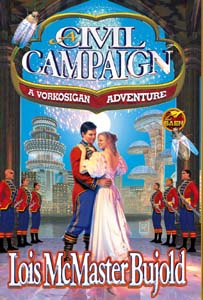 It’s clear the lovers can be unequal in many ways without generating the uneven-match problem—and that’s a good thing, since those differences are a primary source of dramatic tension and romantic interest. (And humor, where the differences trigger comic incongruity; the sequel to Komarr, A Civil Campaign, which carries on Miles’ and Ekaterin’s courtship, is one of the great SF romantic comedies and an all-time favorite of mine.)
The pair can represent rags and riches, as in the traditional Cinderella story or Disney’s Aladdin; they don’t need to be matched in wealth. Nor is it social status; on the contrary, differences in social status are frequently emphasized, as a proof of just how strong the characters’ love is. See, for example, Titanic, or Han and Leia (“You think a princess and a guy like me . . . ?”). Both Star Wars characters are sufficiently distinctive and forceful personalities that their social standing doesn’t matter.
Clearly, we’re not talking about equality in physical prowess. That works (the Wonder Woman-Superman example above), but we’re equally content with a pairing of brains and brawn, or brawn and beauty, or the like.
Nor is it a matter (in fiction) of similar moral character. The girl (or guy) in love with the bad boy (or girl) is a classic trope—often ending with the better character redeeming the worse. To be sure, in the end the couple has to come out at least on the same moral plane of lasting devotion to each other.
But in terms of what we see as making a well-matched romance work internally, within the story, the key dimension seems to be mostly force of character. The couple has to be able to stand up to one another; neither is entirely dominant.
Hence the obedient Cinderella is matched with a low-key (sometimes to the point of blandness) prince. A highly assertive Serena or Scarlett O’Hara gets paired with an equally forceful male. Ekaterin may be less visible than the flamboyant Miles, but she’s not dominated by him.
 It’s not simply a matter of equal aggressiveness: the less assertive of the two may morally overawe the other, so to speak, as in the traditional archetype of the knight and the lady. Undefeatable or angelic innocence can itself be a sort of power or force of character. One thinks of Christine Daae in The Phantom of the Opera (at least in the operatic movie version, the one with which I’m familiar), a “hero of compassion,” willing to sacrifice herself and genuinely love the Phantom in order to save her true beloved.
An External Reason: Distinctive Character
Force of character is an internal reason for considering a couple evenly matched: a personality characteristic that would be visible to the people in the story themselves. But I think there’s also an external reason—the author’s or reader’s reason.
What makes a pairing seem well-balanced from the outside is, I think, at least partly a matter of how distinctive the character is. We’re dissatisfied when a fully developed, well-rounded character is matched up with a mere cardboard cutout or stereotype. Steve Trevor, or Professor Bhaer, is not quite as fully realized a character as Diana or Jo, whom we’ve seen grow up from childhood, knowing their thoughts and feelings.
This is a narrative reason, so to speak—what makes a good story, as distinct from what makes a good relationship. And yet the two are closely linked. I’m not sure you can make a good romantic story (in the sense of one where the romance satisfies us) out of a bad romantic relationship; although one can always, through incompetent storytelling, make a bad story out of good relationship. A really successful romantic story requires both.
A romance is essentially a meeting of equal-but-differents. And if it isn’t, it isn’t a real romance.





 Rick Ellrod's Observatory