More Than Human
Kevin Wade Johnson’s comments on my recent post about The Good Place raised a couple of issues worth a closer look. Here’s one:
Lots of science fiction, and some fantasy, deals with characters who are greater, or more intelligent, or more gifted in some way, than mere humans. But we the authors and readers are mere humans. How do we go about showing a character who’s supposed to be more sublime than we can imagine?
 It’s one thing to have characters whose capabilities are beyond us. Superman can leap tall buildings with a single bound; I can’t. But I can easily comprehend Superman’s doing so. (I can even see it at the movies.) On the other hand, if a character is supposed to be so intelligent I can’t grasp their reasoning, or has types of knowledge that are beyond me, that’s harder to represent. I can simply say so: “Thorson had an intelligence far beyond that of ordinary men.” But how can I show it?
Long-Lived Experience
There are a number of ways this can come up. For example, if a character lived a very long time, would their accumulated experience allow for capabilities, or logical leaps in thinking, beyond what we can learn in our short lives?
I’m thinking of a Larry Niven story—I’m blanking on the name: maybe one of the “Gil the Arm” stories?—in which a character who appears to be a young woman turns out to be centuries old, and when she drops the deception, she moves with uncanny grace—she doesn’t bump into anything or trip over her own feet, because she’s had that long to train herself in how to move (without the limitations imposed by our bodies’ degeneration from aging).
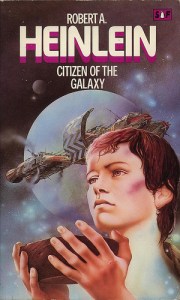
Of course, a story about long-lived people doesn’t have to take long-lived learning into account. The depiction of the “Howard Families” in Heinlein’s Methuselah’s Children and Time Enough for Love almost seem dedicated to the opposite proposition, that no matter how long we live, we’re basically the same kinds of personalities; we don’t learn much.
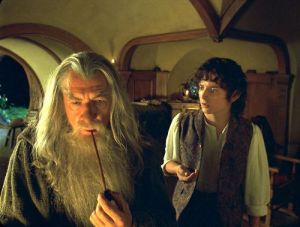
 In a similar way, Tolkien’s immortal elves may seem ineffably glorious to us, but their behavior often seems all too human—especially if you read The Silmarillion, where elves make mistakes, engage in treachery, and allow overweening pride to dictate their actions in ways that may surprise those of us familiar only with LotR. On the other hand, the books and movies do succeed in convincing us that characters like Galadriel and Gandalf are of a stature that exceeds human possibility.
Logic and Language
There are other ways to have transhuman abilities. As Kevin observes, Niven’s “Protectors” fit the description. Niven imagines a further stage of human development—something that comes after childhood, adolescence, and adulthood—that we’ve never seen, because when our remote ancestors arrived on Earth from elsewhere, they lacked the plants hosting the symbiotic virus necessary for transition to that final stage. The “trans-adult” Protectors are stronger, faster, and more durable than ordinary humans. They also think faster. Thus Niven shows them as following out a chain of logic with blinding speed to its conclusion, allowing them to act long before regular humans could figure out what to do. Because this is a matter of speed, not incomprehensible thinking, Niven can depict a Protector as acting in ways that are faster than normal, but are explainable once we sit down and work out the reasoning.
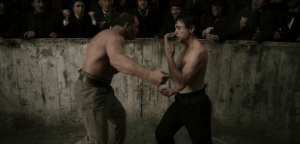 A visual analogue is used in the 2009 and 2011 Sherlock Holmes films starring Robert Downey, Jr. Unlike most other treatments of the character, Guy Ritchie’s version supposes that Holmes’ incredible intelligence can be used not only for logical deduction, but to predict with lightning speed how a hand-to-hand combat may develop. Holmes thus becomes a ninja-like melee fighter, so effective as to confound all opponents. The movie shows us this by slowing down the process that to Holmes is instantaneous: we see a very short montage of positions and moves as they would occur, or could occur, before we see Holmes carry out the final “conclusion” of his martial reasoning. This allows us to appreciate what the quasi-superhuman character is doing and why, without actually having to execute the same process ourselves.
Preternatural intelligence may be more subtle in its effects. Such a person may, for example, be able to understand things fully from what, to us, would be mere hints and implications. So, for example, when Isaac Asimov introduces the members of the Second Foundation in his Foundation series, he tells us that their tremendous psychological training allows them to talk among themselves in a manner so concise and compressed that entire paragraphs require only a few words.
Speech as known to us was unnecessary. A fragment of a sentence amounted almost to long-winded redundancy. A gesture, a grunt, the curve of a facial line—even a significantly timed pause yielded informational juice. (Second Foundation, end of chapter 1, “First Interlude,” p. 16)
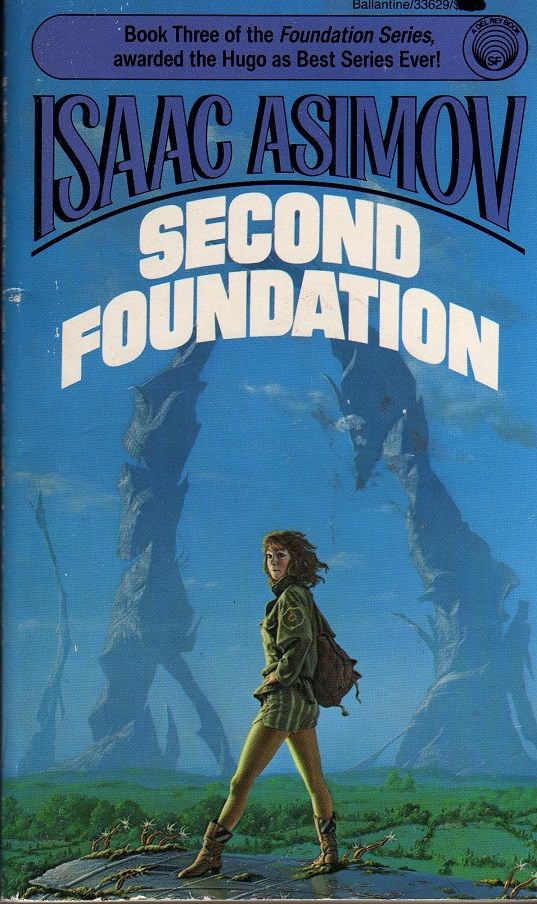 Breaking the fourth wall, Asimov warns us that his account is “about as far as I can go in explaining color to a blind man—with myself as blind as the audience.” (same page) He then adroitly avoids showing us any of the actual conversation; instead, he says he’s “freely translating” it into our ordinary language. This move illustrates one of the classic ways of presenting the incomprehensible in a story: point out its incomprehensibility and “translate” into something we can understand. (Note that this is much more easily done in writing than in a visual medium such as TV or the movies.)
A similar technique is used by Poul Anderson in his 1953 novel Brain Wave, which starts with the interesting premise that in certain regions of space, neurons function faster than in others. When Earth’s natural rotation around the center of the galaxy brings it into a “faster” area, the brains of every creature with a central nervous system speed up, and human beings (as well as other animals) all become proportionately smarter. Anderson notes that the speech of the transformed humans would be incomprehensible to us and, like Asimov, “translates” it for our convenience. When a couple of the characters, in a newly invented faster-than-light spaceship, accidentally cross the border back into the “slow zone,” they are unable to understand the controls they themselves designed until the ship’s travel brings them out and lets their intelligence return to its new normal. (Anderson’s concept may have been the inspiration for the “Zones of Thought” universe later developed in several fascinating stories by Vernor Vinge.)
Showing and Telling
We can glean some general principles from these examples. If the extraordinary acts don’t actually have to be shown in the medium I’m using, I can simply point to them and tell the reader they’re there. In a written story, I can say my main character is a world-class violinist without having to demonstrate that level of ability myself. (Although if I have some experience in that particular art, I’ll be able to provide some realistic details, to help make my claim sound plausible.) But if the supernormal achievement is something that can be shown in our chosen medium, we have to be able to demonstrate it: a movie about the great violinist will have to exhibit some pretty masterful violin-playing, or those in the audience who know something about the art will laugh themselves silly.
 We should note that there are good and bad ways of telling the audience about a character’s superiority. In the unforgettable short story “Flowers for Algernon,” which consists entirely of diary entries by Charlie Gordon, the main character, the text vividly shows us the effects of an intelligence-raising treatment on a man of initially lower-than-normal intelligence. The entries improve so radically in writing competence and understanding that when Charlie describes how his brainpower is beginning to exceed that of ordinary humans, we believe him, because we’re already riding on the curve of rising ability up to our own level that is apparent in the text—a true tour de force of writing. On the other hand, in the drastically worse movie version, Charly (1968), the screenwriters are reduced to having Charly stand in front of an audience of experts and scornfully dismiss the greatest intellectual achievements from human history—a weak and ineffective technique at best for conveying superiority.
Summary
This quick review of the problem turns up several methods for handling supernormal abilities in a story.
- If the superior ability is intelligible to us ordinary people in the audience—maybe it’s just doing normal things faster—we can have the wiser or super-enabled person explain it to someone less wise: our last post’s Ignorant Interlocutor.
- If the advantage is mainly a matter of speed, we can slow it down to a speed at which regular people can follow the action.
- If we can get away without actually showing the ability in question, we may be able to point toward it, or “translate” it into something we can understand, and convincingly tell the audience about it—if we can achieve the necessary suspension of disbelief.
- If a character is supposed to be, let us say, preternaturally wise, and there’s simply no way to avoid showing that in the dialogue, the best we can do is to evoke the best we can do—have the character be as wise as possible—and imply ‘like this, only more so.’ This method—like “projecting” a line or a curve—is the method of “supereminence,” which is sometimes employed in theological talk about things that are inherently beyond our full understanding.
Kicking around this question makes us aware that portraying the more-than-human character is only a special case of a more general problem. When our stories try to incorporate anything that’s indescribable, incomprehensible, how do we handle that? Our F&SF stories frequently want to reach out beyond the boundaries of human experience, yet in a tale written for ordinary humans. We’ll talk about the more general question next time.


 Rick Ellrod's Observatory