Civilization and the Rule of Law (reprise)

Another rerun, adapted from a post from seven years ago.

We’ve talked about how the Star Trek-Star Wars divide reflects preferences for a more lawful or more chaotic world; how F&SF stories often show us a defense of civilization against chaos; and how civilization makes science possible and rests in turn on human technology.  But both order and technology can be oppressive.  The missing element is the rule of law.

Universal Laws

It’s a crucial element of right governance that there are rules applying to everyone, as opposed to the arbitrary wishes of a dictator, who can make decisions based on favoritism, political preferences, or personal relationships.  The Wikipedia article describes rule of law as “the legal principle that law should govern a nation, as opposed to being governed by decisions of individual government officials.”
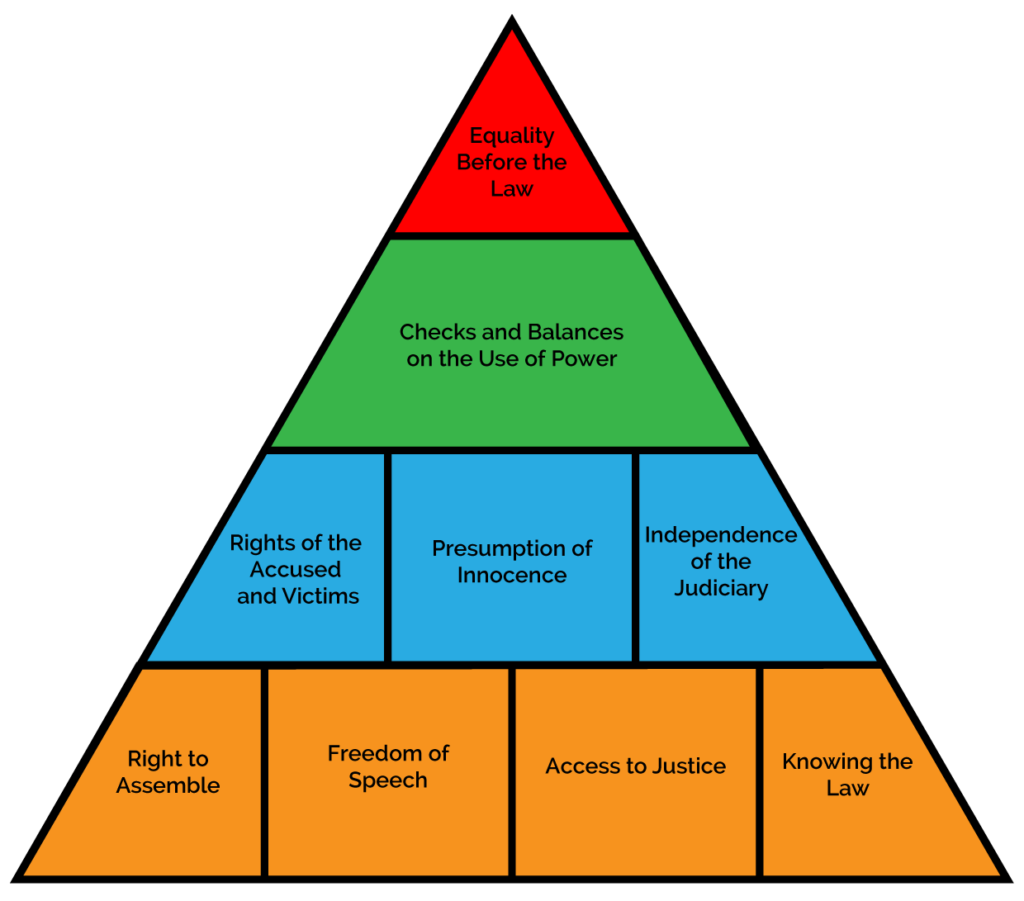
Rule of Law pyramid
(Rule of Law Institute of Australia)

As we saw in the recently updated post The Good King (reprise), the concept of the rule of law goes back at least to Aristotle.  It became a central principle of the American founders via the English tradition of John Locke.  “Rule of law implies that every citizen is subject to the law, including lawmakers themselves” (Wikipedia again).  It is thus in tension with kingship, where rule is almost by definition arbitrary and personal.  But one can have mixed cases—kings who are bound by certain laws, as in the British constitutional monarchy.

Without the rule of law, we depend on the good behavior of those who have power of some sort—physical, military, economic.  We slide toward the “war of each against all,” where might makes right and the vulnerable are the pawns of the strong.  Autocracy soon follows, as people look for any means to find safety from those who are powerful but unscrupulous.  Hence the quotation from John Christian Falkenberg, which I’ve used before:  “The rule of law is the essence of freedom.”  (Jerry Pournelle, Prince of Mercenaries (New York:  Baen 1989), ch. 21, p. 254.)  Strength itself, a good thing, is only safe under laws.

Test Cases

It’s easy to miss the importance of the rule of law.  We’re typically born into a society with better or worse laws, and criticize them from the inside.  It’s less common to find ourselves in straits where lawfulness as such has collapsed.  Regrettably, sizable numbers of people are exposed to such conditions in the world today.  But many of us are fortunate enough not to see them ourselves.  As always, fantasy and science fiction provide useful “virtual laboratories” for examining the possibilities.
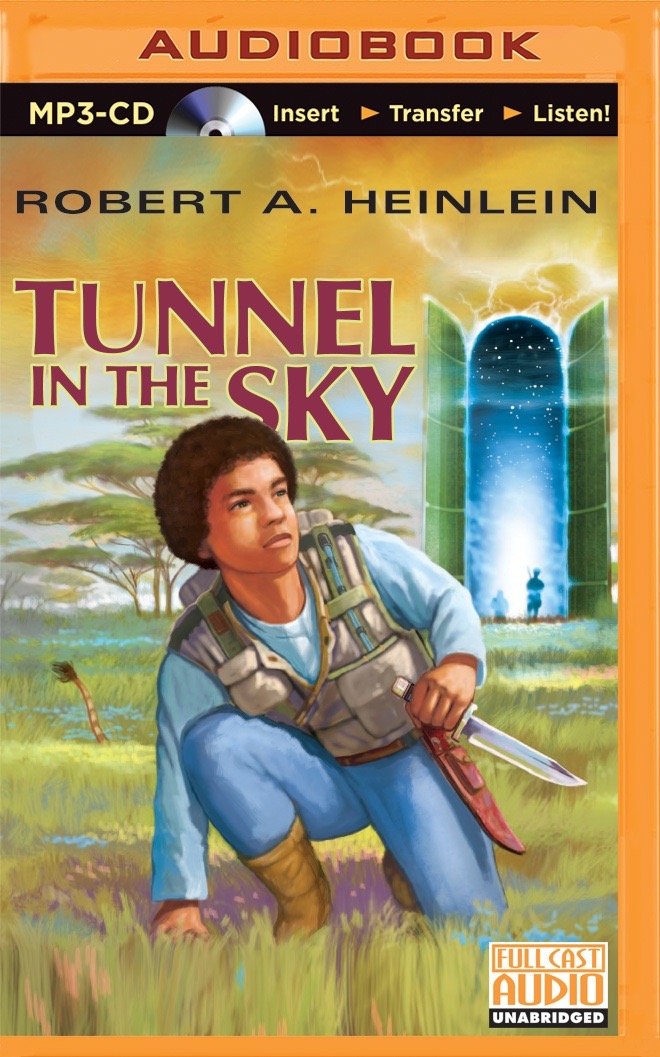
Tunnel in the Sky (audiobook) cover

A classic SF case is where a group thrown into a “state of nature” attempts to set up a lawful society.  For example, in Heinlein’s Tunnel in the Sky (1955), students from a high-school class on survival techniques are given a final exam in which they are dropped onto an unspecified planet to survive for up to ten days.  When an astronomical accident leaves them stranded, they need to organize for the long term.  Rod Walker, the hero, becomes the leader-by-default of a growing group of young people.  The tension between this informal leadership and the question of forming an actual constitution—complete with committees, regulations, and power politics—makes up a central theme of the story.

The Postman movie poster

David Brin’s post-apocalyptic novel The Postman (1985), later made into a 1997 movie with Kevin Costner, illustrates the power of civil order, the unstated practices of a culture, as recalling—and perhaps fostering—the rule of law.  The hero, a wanderer who happens to have appropriated a dead postman’s uniform and mail sack, presents himself as a mail carrier for the “Restored United States of America” to gain shelter in one of the isolated fortress-towns, ruled by petty tyrants, that remain.  His desperate imposture snowballs into a spreading movement in which people begin to believe in this fiction, and this belief puts them on the road toward rebuilding civilization.  The result is a sort of field-test not only of civil order and government, but of what Plato famously imagined as the “noble lie.”

In Niven & Pournelle’s Lucifer’s Hammer (1977), a small community headed by a United States Senator hopes to serve as a nucleus for reconstructing civilization after a comet strike.  We see at the end the strong pull of personal rule or kingship:  as the Senator lies dying, the future of the community will be determined by which of the competing characters gains the personal trust and endorsement of the people—and the hand of the Senator’s daughter, a situation in which she herself recognizes the resurfacing of an atavistic criterion for rule.  Unstated, but perhaps implicit, is the nebulous idea that deciding in favor of scientific progress may also mean an eventual movement back toward an ideal of rule by laws, not by inherited power.

Seeking a Balance

The “laboratory” of F&SF is full of subversions, variations, and elaborations on the rule of law.  In particular, we should note the counter-trend previously discussed as “chaotic good.”  Laws can be stifling as well as liberating.

The Moon is a Harsh Mistress cover

Heinlein’s The Moon Is A Harsh Mistress (1966) imagines how the “rational anarchy” of a lunar prison colony is mobilized to throw off autocratic rule.  The healthy chaos of the libertarian Loonies is hardly utopian, but the story does make it seem appealing.  Interestingly, Heinlein returned to this setting with a kind of critique twenty years later in The Cat Who Walks Through Walls (1985), where the post-revolution lunar anarchy seems much less benign, seen from an outsider’s perspective.

Taran Wanderer book cover

While fantasy seems to concern itself with this issue much less than science fiction, consider the region called the “Free Commots” in Lloyd Alexander’s Chronicles of Prydain.  When protagonist Taran visits this area in the fourth book (Taran Wanderer), he finds a society of independent villages, where the most prominent citizens are master-craftspeople.  They neither have nor need a lord to organize them.  The Commots contrast favorably to the feudal or wilderness regions through which Taran travels.  A kind of anarchic democracy, as an ideal, thus sneaks into what otherwise seems to be a traditional aristocratic high fantasy.

One way of managing the tension between a government of laws and a culture of liberty is the principle of subsidiarity:  the notion that matters should be governed or controlled at the lowest possible organizational level where they can be properly handled.  It’s frequently illustrated in G.K. Chesterton’s ardent defenses of localism.  In The Napoleon of Notting Hill (1904), extreme localism is played for laughs—“half fun and full earnest,” to borrow Andrew Greeley’s phrase.  The more mature Tales of the Long Bow (1924), which might qualify as a sort of proto-steampunk story, treats the idea more seriously, in the form of an oddly high-tech (for 1924) revolt of local liberty against overweening and arbitrary national rule.

It remains true that we need good people as well as sound laws.  “Good men can make poor laws workable; poor men will wreak havoc with good laws” (James M. Landis, 1960; see this article at 432 & n.107).  The quality of a civilization can also be assessed by whether it fosters citizens who act with decency and good judgment even when there isn’t a law to constrain them (as in David Brin’s “Ritual of the Street Corner”).  After all, we neither can nor should try to create laws to govern everything.

But being willing to improvise well in situations where no law applies is different from considering oneself above the law, disdaining the constraints that apply to everybody else.  This is doubly and triply true of rulers, who are constantly tempted to arrogate power and dodge accountability to accomplish their ends.  If a ruler is allowed to get away with law-breaking, we’re headed for trouble.

Brin has noted that the stories that fill and shape our culture—movies, books, television—encourage a broad “suspicion of authority” that tells us all institutions are corrupt or useless, and so are most other people—so that the heroes and heroines of the stories can face and overcome challenges by their heroic actions.  Like most attitudes, suspicion of authority is helpful in moderation, but corrosive when it gets out of hand.  If that attitude leads us to throw over laws and institutions altogether in the hope that individual heroes or autocrats will save us, we need to keep in mind that benevolent dictatorship, unconstrained by law, is just one step away from despotism.

The Fragility of Civilization

When we grow up taking for granted the rule of law, we can fail to see how vulnerable it is—along with the civilization that it reflects and makes possible.

“The Establishment,” as they used to say in the 1960s, seems vast and invulnerable.  When we’re trying to make a change, it seems insuperable, so rigid that nothing can be done about it.  But this is an illusion.  The structure of civilization, good and bad, is fragile.  It’s easier than we think to throw away the rule of law, so painfully constructed (as Rod Walker found), in favor of shortcuts or easy answers to our problems.

One thing F&SF have brought us is a better sense of this vulnerability.  The spate of post-apocalyptic tales in recent years—zombie apocalypses, worldwide disasters, future dystopias like The Hunger Games, going all the way back to the nuclear-war stories of the 1950s—do help us appreciate that our civilization can go away.

But that collapse doesn’t require a disaster.  Civilization, and the rule of law, can erode gradually, insidiously, as in the “Long Night” stories we’ve talked about earlier.

Historically, the Sixties counterculture fostered anarchists who felt “the Establishment” was invulnerable.  Often with the best of intentions, they did more to undermine civil order than they expected.  Those who now see no better aim than breaking up the structures of democratic government and civil life—whether from the side of government, or from the grass roots—also fray the fabric of civilization.  The extrapolations of science fiction and fantasy illustrate why eroding the rule of law should not be taken lightly.

Near the bottom of Brin’s Web home page, he places the following:

I am a member of a civilization

It’s good that we have a rambunctious society, filled with opinionated individualists. Serenity is nice, but serenity alone never brought progress. Hermits don’t solve problems. The adversarial process helps us to improve as individuals and as a culture. Criticism is the only known antidote to error — elites shunned it and spread ruin across history. We do each other a favor (though not always appreciated) by helping find each others’ mistakes.

And yet — we’d all be happier, better off and more resilient if each of us were to now and then say:

“I am a member of a civilization.” (IAAMOAC)

Step back from anger. Study how awful our ancestors had it, yet they struggled to get you here. Repay them by appreciating the civilization you inherited.

It’s incumbent on all of us to cherish and defend the rule of law.  Give up civilization lightly, and we may not have the choice again.

The Good King (reprise)

Watching The Lord of the Rings movies again recently, to share the experience with my wife, brought to mind this post from eight years ago.  Here it is again, with minor updates.

I began to wonder some years back about the curious preference for monarchy in futuristic settings.  In the world at large, monarchies have been retreating in favor of republics and democracies, at least in theory, since 1776.  Why are SF writers so fond of equipping future societies with kings, emperors, and aristocracies?

Star Kingdoms

We can pass lightly over the old-time, pulp-type stories where royal rule is merely part of the local color:  Burroughs’ A Princess of Mars (1912), Edmond Hamilton’s The Star Kings (1949), E.E. Smith’s The Skylark of Space (1928) with its Osnomian royal families.  Here, like flashing swords and exotic costumes, monarchy is simply part of a deliberately anachronistic setting.  Similarly in high fantasy, where aristocracy comes naturally in the typical pseudo-medieval milieu.

But we see royal or aristocratic governments in more modern stories too.  Asimov’s Foundation stories are centered around a Galactic Empire. (See also the more recent Apple+ series of the same name.)  Since that series was based on Gibbons’ The History of the Decline and Fall of the Roman Empire, an Empire was inevitable.  Similarly in Star Wars, which draws heavily on Asimov.  Jerry Pournelle’s CoDominium future history has a First and a Second “Empire of Man.”  David Weber’s heroine Honor Harrington serves the “Star Kingdom of Manticore” (later “Star Empire”), modeled closely on England around 1810.  Lois McMaster Bujold’s Vorkosigan Saga contains a number of polities with different forms of government, but many of the stories focus on Barrayar, which has an Emperor.  Anne McCaffrey’s popular Pern series has no monarch, but has two parallel aristocracies (the feudal Holders and the meritocratic dragonriders).  It got to the point where I began to feel a decided preference for avoiding monarchical or imperial governments in SF storytelling.

The Lure of Kingship

Aragorn with crown

There’s something that attracts us in royalty—or we wouldn’t see so much of it.  I encountered this puzzlement directly.  As a kid reading The Lord of the Rings, I was as moved as anyone by the return of the true King.  I asked myself why.  If I don’t even approve of kingship in theory, why am I cheering for Aragorn?

The reasons we’re drawn to monarchy seem to include—

  • Kings are colorful. (So are princesses.)
  • Stability
  • Personal loyalty
  • Individual agency

The first point is obvious, but the others are worth examining.

Stability

It’s been pointed out that even in a constitutional government, a monarch provides a symbolic continuity that may help to hold a nation together.  British prime ministers may come and go, but the King, or Queen, is always there.  This gives some plausibility to the idea of a future society’s returning to monarchy.

Something like this stabilizing function is behind commoner Kevin Renner’s half-embarrassed harangue to Captain Rod Blaine, future Marquis of Crucis, in Niven & Pournelle’s The Mote in God’s Eye:  “maybe back home we’re not so thick on Imperialism as you are in the Capital, but part of that’s because we trust you aristocrats to run the show.  We do our part, and we expect you characters with all the privileges to do yours!”  (ch. 40)

Unfortunately, relying on the noblesse oblige of the aristocrats doesn’t always work out well.  It depends on who they are.  For every Imperial Britain, there’s a North Korea.  When the hereditary succession breaks down, you get a War of the Roses or Game of Thrones.

Too much depends on getting the right monarch.  By the law of averages, it doesn’t take long before you get a bad ruler, whether by inheritance or by “right of conquest”—and you’re up the well-known creek.

Personal Loyalty

Personal loyalty appeals to us more strongly than loyalty to an institution.  One can pledge allegiance to a state—but even the American Pledge of Allegiance starts with a symbol:  the flag, and then “the Republic for which it stands.”  Loyalty to an individual moves us more easily.

This kind of loyalty doesn’t have to be to a monarch.  Niven & Pournelle’s Oath of Fealty explores how loyalty among, and to, a trusted group of managers can form a stronger bond than the mere institutional connections of a typical modern bureaucracy.  One can be faithful to family (the root of the hereditary element in kingship), to friends, or even an institution or a people.  But it’s easiest with an individual.  This loyalty is the basis for the stability factor above.

Individual Agency

The vast machinery of modern government sometimes seems to operate entirely in the abstract, without real people involved.  “Moscow said today . . .”

In fact it’s always people who are acting.  But it’s easier to visualize this when you have a single person to focus on.  “When Grant advanced toward Richmond . . .”  In the extreme case, we have the ruler who claims to embody the state in his own person:  “L’état, c’est moi” (attributed to Louis XIV, the “Sun King” of France).

In a fascinating 2008 essay, Jo Walton quotes Bujold on political themes in SF:  “In fact, if romances are fantasies of love, and mysteries are fantasies of justice, I would now describe much SF as fantasies of political agency.”  A science fiction character is frequently involved in effecting a revolution, facing down a potential dictator, or establishing a new order—exercising autonomous power.  Walton links this notion of political agency to the fact that SF illustrates change:  “SF is the literature of changing the world.”  The world-changers can be outsiders, or they can be the rulers themselves—as in a number of the examples above.

It’s not surprising that we’re attracted to characters who act outside the normal rules.  We (especially Americans, perhaps) are fond of the idea that good people can act in ways that are untrammeled by the usual conventions.  I’ve already mentioned Robin Hood.  And the whole concept of the superhero—the uniquely powerful vigilante who can be relied on to act for the good—is powered by this attraction.

But this idealization of individual initiative is also dangerous.  Too much depends on getting the right hero—or the right monarch.  It can only work if the independent agent is seriously and reliably good:  virtuous, in the classical sense of virtue as a well-directed “habit” or fixed character trait.  Even then, we may be reluctant to give any hero unlimited power.  Too much is at stake if it goes wrong.

The Rule of Law

Our admiration for the powerful ruler is always in tension with our dedication to the rule of law:  “a government of laws, not of men,” in the well-known phrase attributed to John Adams.  We can see this as far back as Aristotle:  “law should rule rather than any single one of the citizens.  And following this same line of reasoning . . . even if it is better that certain persons rule, these persons should be appointed as guardians of the laws and as their servants.”  (Politics book III, ch. 16, 1287a)

No human being can be trusted with absolute authority.  This is the kernel of truth in the aphorism that “power tends to corrupt and absolute power corrupts absolutely.”  But we can’t get along without entrusting some power to someone.  When we do, it had better be someone who’s as trustworthy as possible.

The Ideal of the Good King

Thus the true king must be a virtuous person—a person of real excellence.  This is the ideal of an Aragorn or a King Arthur, whose return we’re moved to applaud (even against our better judgment).  It should be obvious that the same principles apply to the good queen—or emperor, empress, princess, prince, president, prime minister:  the leader we follow.  But I’ll continue using “king” for simplicity’s sake.

What virtues do we look for in a good monarch—aside from the obvious ones of justice, wisdom, courage, self-control?

If the ruler or rulers are going to be “servants of the laws,” they require humility.  A king who serves the law can’t claim to be its master.  Arrogance and hubris are fatal flaws in a ruler.  For example, we should always beware of the leader who claims he can do everything himself and is unable to work with others.

The good king is also selfless—seeking the common good of the people, not his own.  Self-aggrandizement is another fatal flaw.

In effect, what we’re looking for is a ruler who doesn’t want to rule:  a king who believes in the sovereignty and the excellence of common people.

Aragorn defers to Frodo

It’s significant that Aragorn, our model of the good king, is introduced in LotR as “Strider,” a scruffy stranger smoking in a corner of a common inn.  Even when he’s crowned in victory, he remembers to exalt the humble.  The movie has him tell the four hobbits, “You kneel to no one.”  Tolkien’s text is more ceremonious:  “And then to Sam’s surprise and utter confusion he bowed his knee before them; and taking them by the hand . . . he led them to the throne, and setting them upon it, he turned . . . and spoke, so that his voice rang over all the host, crying:  ‘Praise them with great praise!’”  (Book VI, ch. 4, p. 232)

We see the same essential humility and selflessness in other admirable leaders, kings or not:  Taran in the Chronicles of Prydain, and the revolutionary princess in Lloyd Alexander’s Westmark trilogy; Niven & Pournelle’s Rod Blaine; Jack Ryan in Tom Clancy’s novels; “Dev” Logan, head of Omnitopia Inc. in Diane Duane’s Omnitopia Dawn—the unpretentious opposite of the “imperial CEO.”  America was fortunate enough to have such an example in the pivotal position of first President, George Washington.

The Alternative

At the other end of the spectrum, the most dangerous person to trust is an unprincipled and unscrupulous autocrat—someone convinced of his personal superiority and infallibility.  Giving power to an individual who has no interest in serving the common good, but only in self-aggrandizement, puts a nation in subjection to a Putin, a Mussolini, a Kim Jong-un.

The antithesis of the good king is the tyrant, who, however innocently he may start out, figures in our stories mainly as the oppressor to be overthrown.  It’s much better, if possible, to intercept such a potentially ruinous ruler before the tyranny comes into effect:  Senator Palpatine before he becomes Emperor, Nehemiah Scudder before he wins his first election.  Allowing the tyrant to gain power may make for good stories, but it generates very bad politics.

If we must have strong leaders, then in real life as well as in stories, character is key—and hubris is deadly.

VOTE!

Representation

In America, we have a presidential and congressional election coming up in November.  I want to take a moment out to incite every American to vote.

Every now and then, it’s helpful to remind ourselves of first principles.  In a democratic polity—a “republic” in the sense used in American law and political theory—the people of the polity govern themselves.  (Please note that these terms are “small d” democracy and “small r” republic.)  The way we do this, in a representative government, is to elect representatives.  Since those representatives make most decisions as to law and government, voting in elections is the primary way in which we govern ourselves.  It’s kind of a big deal.

The Crucial Hero(es)

In America, voter turnouts, even in presidential elections, tend to be relatively low.  Why would people skip their key chance to take charge of their government?  I suspect much of this failure to take part in governing ourselves stems from a combination of things:  inertia (it takes some little trouble to register and vote), plus a pervasive sense that my one vote doesn’t affect the outcome.  Why make the effort if it doesn’t matter?

The logical flaw in this understandable attitude is that things can matter in the aggregate, even if any one item is not the sole decisive element that changes the outcome.

Will Smith and Jeff Goldblum deliver the virus in Independence Day (the movie)The stories that inspire us, and help form our attitudes, tend to undermine this recognition and subliminally support our reluctance to participate.  A story is more dramatic if everything comes down to the actions of one, or a few, people.  If James Bond doesn’t pull off this next stunt, the World Will Come To An End.  Will Smith and Jeff Goldblum, alone, deliver the computer virus that takes down the mother ship in Independence Day, which conveniently disables all the rest; the entire tension of the plot is funneled through that one bottleneck, as it were.  A few superheroes save the universe—well, half of it—in the Avengers movies.  In Netflix’s just-released Enola Holmes movie (mild spoiler), the heroine’s actions save the one person who casts the deciding vote on a British reform act.  We love this trope.

The desire to make everything come down to a few people’s desperate actions can even warp the adaptation of a story.  A number of small, but annoying, changes in the plot of Peter Jackson’s Lord of the Rings movies seem to stem from a tendency to have every crucial point depend on the actions of the nine members of the Fellowship.  For example, in the books, the Ents meet and decide the time has come to attack Isengard.  In the movies, the Ents decide not to act—until Pippin and Merry maneuver Treebeard to where he can see Saruman’s wanton destruction of the forests (on the absurd assumption that the Shepherd of the Trees didn’t know about that already).

Pippin lights the beaconIn the books, Denethor sensibly sends a messenger from Minas Tirith to Rohan to call for help.  But the movies leave it to Gandalf and Pippin to fire up a beacon that transmits the call to Rohan.  (The fact that the lighting of the beacons is one of the most terrific scenes in the whole series doesn’t entirely mitigate the plot diversion.)  When the Corsair ships sailing up the Great River to Minas Tirith turn out to contain relief for the city rather than further invaders, the movie makes this just Aragorn, Legolas, and Gimli, along with the faceless army of the Dead—rather than a whole array of human reinforcements from South Gondor, as in the books.

Aggregates and Bottlenecks

But when we return to the mundane world, we have to put aside this tempting way of telling a story.  We don’t often see this pattern of world-saving heroic acts.  We find instead that crucial changes depend on the combined actions of innumerable people, all doing the right (or wrong) things.

Milo Manara honors heroic women

Milo Manara honors heroic women

The present moment can provide us a heightened appreciation of these unnoticed individual actions.  The early days of the COVID-19 pandemic saw an outpouring of support rightly directed to the unsung heroes—doctors and nurses and medical technicians, grocery store clerks, people who make toilet paper—unsung because they are too many to spotlight individually.  (Although individual acts of appreciation are still a just way to honor those continuing acts of undemonstrative service.)  Indeed, everyone has to act in concert if the pandemic is to be contained.

Peter Jackson’s Gandalf gets the underlying point right in one of the Hobbit movies:

I have found it is the small things, everyday deeds of ordinary folk, that keeps [sic] the darkness at bay.  Simple acts of kindness and love.  (The Hobbit:  An Unexpected Journey (2012), at about 1:42)

We must all be heroes now.

Of course, going in and making some marks on a piece of paper doesn’t feel much like heroism—even less so than wearing a facemask.  Perhaps it feels a little more dramatic when we’re braving the chance of coronavirus infection to cast our ballots.  And if that way of viewing our action as a daring deed spurs us to act, by all means indulge!

But in this kind of case, the only way to achieve anything is by small actions, each of which contributes to a whole.  The entire set makes a difference; but there can’t be an entire set unless there are individual acts.  In voting, as in picking up one’s trash, or in the innumerable actions that make up a free market, we must carry out the individual actions to produce the aggregate effect.

Turning the Tide in Real Life

If we need further encouragement, we can look to the additional fact that even one vote, or a few, can sometimes make the crucial difference.

Virginia Board of Elections draws lots to decide tied electionRight here in Virginia, we had an election in 2017 that resulted in a literal tie:  an equal number of votes for each candidate.  A purely random action had to be used to break the tie.  “Each candidate’s name was placed in a film canister; those were then placed into a bowl and one name was drawn.”  (NPR, 1/4/2018)

Even a few votes, even one, can make the critical difference, as recounted here and here—notably including “the year 2000 U.S. presidential election, decided by a few hundred votes in the state of Florida”  (Jared Diamond, Collapse:  How Societies Choose to Fail or Succeed (2005), “Further Readings” for ch. 16, p. 556)  Over and above my contribution to the whole, I cannot know in advance whether my vote might not be, in fact, the deciding factor in a hotly contested election.

Moreover, even if the outcome of an election might be clear without my vote, adding to the total is not pointless.  In today’s atmosphere of distrust and suspicion, the clearer and more decisive the result, the less opportunity there will be to cast doubt on the results.  Every vote added to the total reduces the number of people who will be convinced that the results are false, and thus directly supports the rule of law.

This concern also bears on the notion of voting for a third-party candidate.  In the upcoming election, many people may be sufficiently dissatisfied with both major parties to be motivated to cast their ballots for a third-party contender.  It might feel virtuous to spurn both parties and “vote one’s conscience” in favor of a candidate who cannot win.  But in practice, that action will only serve to make the results less clear, at a time when clarity is vitally needed.

L’Envoi

Voting is much trickier—even perhaps a heroic act, as noted above—in these pandemic times.  Nevertheless, there are avenues available by which all of us can safely exercise the franchise.

Drop box for ballotsFor my own locality in Virginia, here’s a guide to voting early, voting by mail, and voting on Election Day.  The local paper has a Web site on How to Vote, by state; I haven’t researched that reference in detail, but it may be useful.  Here are three articles on drop boxes for ballots.

I urge every eligible voter to take part in this crucial action of self-government.  Unless you’re actually in the hospital in a coma (or the like), there’s no excuse not to participate.

Hallmark and the Small Business

Running a bit behind here.  It’s been a busy couple of weeks.  But at least I’m getting this out in time for Christmas . . .

Countless Christmases

Countdown to Christmas logoI believe this is my fourth year of following the Hallmark channels’ gallery of Christmas romance movies (“Countdown to Christmas”).  Not that it’s humanly possible to see them all.  I believe Hallmark is introducing twenty-three new films this year; and that doesn’t take into account the similar plenitude of programs from the nine previous years of “Countdown.”  In this torrent of trysts, it would be easy for the more traditional fare to get lost entirely, from White Christmas to Mr. Magoo’s Christmas Carol (the truly canonical video version of that story, I’m convinced).

And Hallmark is only the bellwether of an entire subgenre.  Netflix has its own array of seasonal video, so similar to the Hallmarks that you’d mistake one for the other if the branding were absent.  Subscribe to Amazon Prime instead of Netflix?  You can still find plenty of holiday fare, whether traditional flicks or newer Amazon productions.

The trend may be reaching some kind of limit.  The plots are starting to recur faster and faster.  Of course, that repetition makes these movies ripe for satire.  My children pointed me to a Christmas movie script allegedly written by a computer (“Someone Made a Bot Watch 1,000 Hours of Hallmark Christmas Movies and Write a Script”; here’s the original tweet from Keaton Patti).  I doubt this was really a bot at work; it’s too funny.

In any case, it turns out these plot generators are spawning as fast as the movies themselves.  For example, just at the top of my search results I found samples from WrongHands, E! Online, and The Odyssey Online.  Lots of articles remark on the phenomenon.  For example, here’s NPR’s snark-fest on the 2019 Christmas romance crop, Hallmark and otherwise.

Among other things, this mass of Christmas cheer does make the field a useful laboratory for looking at some tropes and storytelling points.  One could probably do a statistically valid survey with this large a universe of data.  Here, I’m just going to focus on one favorite trope:  the small business (or, as NPR labels it, the “adorable small business”).

Small Businesses Are Adorable

The Christmas Ornament coverSmall businesses, especially family businesses, frequently play a role in genre romance movies.  For example, in A Christmas Melody (2015), the heroine has just lost her clothing boutique and spends time in a cozy local coffee shop.  We also go from one small business to another in The Christmas Ornament (2013), where the heroine has been trying to keep her late husband’s bike shop open, but discovers her real passion is baking cookies (courtesy of a new romantic interest who has a Christmas tree shop).  The female lead in The Christmas Secret  (2014) has just been fired from her job, but gets a new one in a local bakery.  (There are a lot of bakers in these tales.  Christmas is cookie season.)

Sometimes the issue is the temptation to “sell out.”  For example, in Let It Snow (2013), the female lead is an executive assigned to overhaul a newly acquired family business, Snow Valley Lodge, into a modernized hipster paradise.  She sees the error of her ways, of course.

The trope isn’t confined to Christmas, or to Hallmark.  For instance, Coffee Shop (2014) gives us a shop that’s an important gathering place in the community, but financially troubled; her former boyfriend wants to bail her out by selling the property to a mall developer.

The sellout motif reaches a sort of reductio ad absurdum in this year’s Hallmark feature Merry and Bright.  Our heroine Cate is doing a good job of running her grandmother’s candy cane company, but candy canes aren’t as big a deal as they used to be.  The romantic interest, a “corporate recovery consultant,” proposes gaining a venture capitalist’s support by expanding the business into other Christmasy candy—chocolates and such.  That’s such a logical idea that it seemed this story would avoid the trope.  But no:  as she’s poised to sign the contract, Cate stops and declares that her grandmother founded a candy cane business, nothing else, and Cate’s determined to stick with it.

I sat there open-mouthed (since I had no chocolates to eat, alas) at the notion that manufacturing candy canes was virtuous, but expanding into chocolates was some kind of betrayal.  The resolution, in which Cate succeeds by interesting an investor in candy canes with new and innovative flavors, failed to convince me that her scruples made any kind of sense.

A Houston Press article from last year snarks up the trope:  “Oh, and every little book store or bakery or community theater can be turned into a resounding success with a little love.”

Variations

On the other hand, we do see some aversions of the trope.  A couple of examples from this year’s batch:

In Picture a Perfect Christmas, our heroine is a photographer who travels all around the world for her work.  She arrives in a small town for the holidays to look after her aging grandmother, and falls for a local guy.  But it’s kind of a relief to find that neither of them has to give up their careers, or found a small business.  It appears she can go right on globe-trotting and picture-taking; she’s just going to come home periodically to a new base of operations.  In fact, the guy and his semi-adopted nephew are going to join her on her next shoot, in Switzerland, a very sensible plan.  It’s kind of refreshing.

Tree bagging from Christmas Under the Stars

Christmas Under the Stars

The male main character in Christmas Under the Stars is fired abruptly (at Christmas!) from his soulless investment banking job, and ends up working in a little local Christmas tree lot that’s going to be razed for development.  He and the female main character save the lot from the bulldozer, as well as solving everyone’s other problems.  But the hero doesn’t become a career Christmas tree salesman; he goes back into finance—only this time it’s in a non-soulless company that specializes in ethical investing.  So an endearing and Christmasy local business is involved, but it isn’t the ultimate destination of either of the main characters.

The Purpose of a Business

What is it that these cute home-town businesses are supposed to have that makes them so adorable?

We have a widespread sense that a small operation is more likely to have integrity than a larger enterprise:  less likely to sell out, more dedicated to its original mission.  We tend to feel that a small business will have less discontinuity between its ostensible purposes—making coffee, selling books, offering Christmas trees—and the way it treats people in practice, along with the necessary purpose of making money.

The Incredibles (2004) shows a comically exaggerated version of this divide.  Bob Parr works for an insurance company, which is theoretically established to help its customers in times of difficulty.  Instead, the institution is so dedicated to denying customer claims that Bob practically has to use guerilla tactics to get a claim honored.  For someone with the heart of a superhero—a “helping profession” if there ever was one—this stultifying job is a peculiar kind of hell.

To be sure, a business aims to make money, or it won’t last long.  But those who begin it, or join it, generally do so because they aspire to make an excellent product, or provide a useful service.  Not many lines of business are pure scams.  The trouble is that as the operation gets bigger and older, it seems often to develop a single-minded devotion to making more and more money, even at the expense of the excellence of the product or service.  A small enterprise, by contrast, where the owner may come into daily contact with the persons being served, is less likely to be seduced by that particular temptation.  It’s easier to keep focus on a product that pleases and benefits people—like cookies.

It's A Wonderful Life housewarming sceneAn older Christmas movie, It’s A Wonderful Life (1946), lives on that contrast.  The quirky and adorable Bailey Building and Loan helps people acquire their own homes, though it’s not as profitable as Mr. Potter’s cruel cost-cutting firm.

This idealization of small firms is easy for the cynic to sneer at.  Big business is the way of the world, sloppy sentiment aside.  But storytellers are tapping into a genuine issue here.

The Stumbling-Blocks of Largeness

We’re generally told that bigness allows for economies of scale that reduce prices and improve services.  To take an example at random, this article by Ken Doctor (12/6/19) states as obvious (even in a critique of mergers) that “McDonald’s can make burgers a lot more efficiently than mom-and-pop joints in every town can.”  But this truism needs closer examination.

First, not enough attention is paid to diseconomies of scale.  For example, mergers can result in ill-assorted pieces that don’t really work together, offsetting gains that might be achieved by volume discounts.  I’m acquainted with one large company, for example, that is still producing separate reports and maintaining separate books for a subsidiary it absorbed at least ten years ago.

A more direct issue with largeness is that as an organization grows, it seem to require more and more generalized policies and inflexible rules.  A firm of twenty-five people can make room for individualized exceptions; an organization of ten thousand, not so much.  The principle seems to hold true in any kind or organization, whether it’s a private business, a nonprofit, a government, or even a church.  Universal rules aren’t all bad; they can be a necessary bulwark against personal discrimination.  But as the system grows, we have more and more the sense of dealing with mindless machinery, rather than on a person-to-person basis.

Google Dragonfly graphicIt seems a company often starts with enthusiasm about a cool product; but as it grows, the bean-counters take over, and that original spark recedes in favor of merely finding ways to pump up the quarterly reports.  Google, for example, may (sadly) be in the process of making this transition.  The company started out with the innocent motto “Don’t be evil”; it’s now  in trouble for helping China with its totalitarian surveillance state via “Project Dragonfly” (though it seems to have backed away from that project as of July).  It may be significant that Google’s founders have just departed—perhaps signaling the end of that original enthusiasm for making things better.

Mergers and Their Discontents

In addition, as a business gets bigger, it tends to crowd out competitors; and an exclusive concentration on increased profits without a corresponding attention to fairness and decency gives rise to a deliberate drive for monopoly, or oligopoly (market power exercised by a few firms rather than only one).

As fewer and larger firms amass market power, the lack of competition results in higher prices, as well as worse customer service.  If the combination actually reduces costs, none of the benefits actually flow through to the customer.  In my field (telecommunications), I can think of no examples where a merger actually resulted in lower prices for consumers.  And it’s hard to think of any where customer service improved as a result; normally, customer service gets worse.  For an example from another field, the airlines, consider this aggrieved customer’s horror story.

A less obvious disadvantage is that mergers can result in a loss of institutional memory.  A merger frequently seeks to cut costs by dropping redundant staff.  Aside from the minor difficulty of people’s losing their jobs (which seems a common anxiety at Christmastime, right back to Scrooge’s threat to Cratchit about “losing your situation”), this means the people who knew the history may be gone.  More than once I’ve run into a company that can’t find records of what its own pre-merger components did in the past.

You might say that the legal version of the Hallmark preference for smallness is antitrust law, which is designed to keep large entities from abusing their market power in some of the ways mentioned above.  Some contemporary examples of how the antitrust laws are not currently being enforced can be found in a recent article (12/19/19) by Steven Pearlstein.

Bigness is not necessarily bad.  But problems such as these are the characteristic flaws of the large organization, against which one must constantly be on guard.  In the way that a particular profession may have its “occupational hazards”—say, the temptation of lawyers to fall into a barren legalism—an entity may, simply by its scale, be vulnerable to typical failure modes.  The sentimental attachment to small entities is not simply nostalgia; there’s something to it.

The Appeal of the Small Business

We know some of the disadvantages of the small business:  for instance, the local shops in the Hallmark romances are frequently on the verge of failing—reflecting, along with the narrative demand of drama, their more limited resources and hence vulnerability to problems, such as a business downturn.  But what are the advantages such stories play on?

The Christmas List posterFamiliarity.  The direct contact between businesspeople and customers allows for personal relationships.  We see it with George Bailey, making kind-hearted adjustments in payment schedules to help individual customers (a practice for which the hard-charging Potter rakes him over the coals).  An older Christmas romance, The Christmas List (1997), apparently not from Hallmark but fitting the mold, features a perfume saleswoman who knows how to figure out the perfect scent for a customer—an unusual sort of personal connection, but a helpful one for the buyer.  If I recall correctly, the proprietor in Coffee Shop had a similar talent for determining the perfect drink for someone.  You can’t give that kind of personal attention when you’re a faceless cog in a call center working from a fixed script.

To be sure, it’s possible to have this sort of personal relationship in a large organization.  A number of the pharmacists at my local CVS, where I show up every couple of weeks for prescriptions, actually know my name.  But on the whole, the further away management is from the actual customers, the easier it is for them to regard customers solely in terms of ARPU—“average revenue per unit.”

Community.  Thus, there’s a certain warmth and welcome—classic Christmas themes—to the bar “where everybody knows your name.”  The local shop can actually engender a close-knit community (the current term seems to be “found family”) capable of mutual support and reassurance.  That was a theme in Coffee Shop; it was also at work in another recent non-Christmas romantic comedy, The Bookish Life of Nina Hill (Abbi Waxman, 2019).

Tales of the Long Bow coverConcreteness.  While the intellect has its joys, there’s a particular satisfaction in making something with our hands:  a tangible product whose excellence can seen and felt by anyone.  The types of small businesses featured in the Christmas romances—bakeries, bookshops, farms—do this a lot.  By contrast, a large business often seems to end up dealing in abstractions.  Chapter Five of G.K. Chesterton’s Tales of the Long Bow (1924) contrasts the small farmer who actually raises pigs with the wheeler-dealer who merely trades in them.  You can read the passage here, though you really need the whole book to fully appreciate the force of Chesterton’s point.

One of the key developments in Pretty Woman (1990) is Edward’s transformation from a soulless transactional businessman to someone who can put his assets and expertise behind what is, in effect, a family business.  Initially, his method is to swoop in, acquire a company, split it up and sell off the pieces at a profit—like a stolen car at a “chop shop,” as Vivian pungently observes (see under “Not So Different” at the TV Tropes entry).  But he gets to know the father-and-son owners of the current target and their pride in building ships for the Navy.  And as Vivian softens his heart, Edward changes his mind:  he’s going to support them in building ships for a good cause.  He’s going to make something, not just move money around.

Putting ourselves into our work.  Along with the pride in building something concrete goes the sense that we’re contributing to the good in the world.  The work both expresses oneself and leaves something tangible behind.  Small-town construction company owner Jamie Houghton, in Christmas List (Hallmark 2016, not to be confused with “The Christmas List” above), at 1:47, speaks of “…creating something that means something to you—leaving a bit of yourself in the world.”  The satisfaction of this kind of work is something the Hallmarks are trying to bring back to our attention.  You can put yourself into work for a large organization, too, if the organization allows that much individuality; but it’s harder, for the reasons noted above.

These virtues are so out of fashion that they have an antique feel to us today.  That in itself makes them especially useful for a Christmas story.  As Hallmark incessantly tells us, Christmas looks backward—to traditions, to memories, to childhood.  Ultimately, of course, it looks back two thousand years to the original Christmas.

Small Businesses Help the Plot Thicken

Because of the features we’ve discussed above, the heroine’s bakery or bookshop can serve as a linchpin for the plot.  A financial crisis or other threat to the business, or a decision about how what road it’ll take in the future, gives the characters something to be concerned about.  How each person responds shows their real character.  The heroine’s unsatisfactory current or ex-boyfriend, for example, shows his true colors by endorsing the sellout   He has completely failed to understand the heroine, and thus disqualified himself.  Or the true romantic interest may take off in a similar big-business direction, leading to tension or a temporary rupture between the main characters; but he can change his mind and thus prove he’s really on her wavelength after all.

You've Got Mail, bookshop scene

You’ve Got Mail

There’s an interesting semi-aversion (outside the Hallmark orbit) in You’ve Got Mail (1998).  It’s Tom Hanks’ large bookstore that threatens Meg Ryan’s lovable community bookshop, “The Shop Around the Corner.”  In the end she loses the bookshop; the economic forces at hand are too great.  But as she wanders through Hanks’ larger establishment, she seems to come to terms with it, in a way.  The big-box store can also be a place where children encounter beloved books and people can congregate.  Maybe if the story had taken place at Christmastime, the ending would have been different . . .

Smallness and Christmas

It’s not exactly a new departure, even in economic circles, to observe that “small is beautiful.”  And, as we’ve seen, there are some significant reasons to value smallness and be careful about unlimited growth, even in economic circles.  But it makes sense that this motif keeps turning up in stories that appeal to our homelier sentiments too.

It’s also fitting that the trope comes up so frequently in Christmas stories.  Christmas, in itself, represents the triumph of the small over the large.  One poor couple, without even a home or an inn to have their baby, are ranged against Herod and all his soldiers, and behind them, the Roman Empire.  Yet the child has outlasted them all.  In the Christmas story we see the divine and universal focused down to an intensely personal scene.  Every other small personal triumph can find a home there—even a romance.

At Christmastime, prizing the small may be a cliché – but it’s no accident.

The Good King

I began to wonder some years back about the curious preference for monarchy in futuristic settings.  In the world at large, monarchies have been retreating in favor of republics and democracies, at least in theory, since 1776.  Why are SF writers so fond of equipping future societies with kings, emperors, and aristocracies?

Star Kingdoms

We can pass lightly over the old-time, pulp-type stories where royal rule is merely part of the local color:  Burroughs’ A Princess of Mars (1912), Edmond Hamilton’s The Star Kings (1949), E.E. Smith’s The Skylark of Space (1928) with its Osnomian royal families.  Here, like flashing swords and exotic costumes, monarchy is simply part of a deliberately anachronistic setting.  Similarly in high fantasy, where aristocracy comes naturally in the typical pseudo-medieval milieu.

But we see royal or aristocratic governments in more modern stories too.  Asimov’s Foundation stories are centered around a Galactic Empire.  (Since that series was based on Gibbons’ The History of the Decline and Fall of the Roman Empire, an Empire was inevitable.)  Similarly in Star Wars, which draws heavily on Asimov.  Jerry Pournelle’s CoDominium future history has a First and a Second “Empire of Man.”  David Weber’s heroine Honor Harrington serves the “Star Kingdom of Manticore” (later “Star Empire”), modeled closely on England around 1810.  Lois McMaster Bujold’s Vorkosigan Saga contains a number of polities with different forms of government, but many of the stories focus on Barrayar, which has an Emperor.  Anne McCaffrey’s popular Pern series has no monarch, but has two parallel aristocracies (the feudal Holders and the meritocratic dragonriders).  It got to the point where I began to feel a decided preference for avoiding monarchical or imperial governments in SF storytelling.

The Lure of Kingship

Aragorn with crownThere’s something that attracts us in royalty—or we wouldn’t see so much of it.  I encountered this puzzlement directly.  As a kid reading The Lord of the Rings, I was as moved as anyone by the return of the true King.  I asked myself why.  If I don’t even approve of kingship in theory, why am I cheering for Aragorn?

The reasons we’re drawn to monarchy seem to include—

  • Kings are colorful. (So are princesses.)
  • Stability
  • Personal loyalty
  • Individual agency

The first point is obvious, but the others are worth examining.

Stability

It’s been pointed out that even in a constitutional government, a monarch provides a symbolic continuity that may help to hold a nation together.  British prime ministers may come and go, but Queen Elizabeth is always there.  (Literally, at least within my lifetime.)  This gives some plausibility to the idea of a future society’s returning to monarchy.

Something like this stabilizing function is behind commoner Kevin Renner’s half-embarrassed harangue to Captain Rod Blaine, future Marquis of Crucis, in Niven & Pournelle’s The Mote in God’s Eye:  “maybe back home we’re not so thick on Imperialism as you are in the Capital, but part of that’s because we trust you aristocrats to run the show.  We do our part, and we expect you characters with all the privileges to do yours!”  (ch. 40)

Unfortunately, relying on the noblesse oblige of the aristocrats doesn’t always work out well.  It depends on who they are.  For every Imperial Britain, there’s a North Korea.  When the hereditary succession breaks down, you get a War of the Roses or Game of Thrones.

Too much depends on getting the right monarch.  By the law of averages, it doesn’t take long before you get a bad ruler, whether by inheritance or by “right of conquest”—and you’re up the well-known creek.

Personal Loyalty

Personal loyalty appeals to us more strongly than loyalty to an institution.  One can pledge allegiance to a state—but even the American Pledge of Allegiance starts with a symbol:  the flag, and then “the Republic for which it stands.”  Loyalty to an individual moves us more easily.

This kind of loyalty doesn’t have to be to a monarch.  Niven & Pournelle’s Oath of Fealty explores how loyalty among, and to, a trusted group of managers can form a stronger bond than the mere institutional connections of a typical modern bureaucracy.  One can be faithful to family (the root of the hereditary element in kingship), to friends, or even an institution or a people.  But it’s easiest with an individual.  This loyalty is the basis for the stability factor above.

Individual Agency

The vast machinery of modern government sometimes seems to operate entirely in the abstract, without real people involved.  “Washington said today . . .”

In fact it’s always people who are acting.  But it’s easier to visualize this when you have a single person to focus on.  “When Grant advanced toward Richmond . . .”  In the extreme case, we have the ruler who claims to embody the state in his own person:  “L’état, c’est moi” (attributed to Louis XIV, the “Sun King” of France).

In a fascinating 2008 essay, Jo Walton quotes Bujold on political themes in SF:  “In fact, if romances are fantasies of love, and mysteries are fantasies of justice, I would now describe much SF as fantasies of political agency.”  A science fiction character is frequently involved in effecting a revolution, facing down a potential dictator, or establishing a new order—exercising autonomous power.  Walton links this notion of political agency to the fact that SF illustrates change:  “SF is the literature of changing the world.”  The world-changers can be outsiders, or they can be the rulers themselves—as in a number of the examples above.

It’s not surprising that we’re attracted to characters who act outside the normal rules.  We (especially Americans, perhaps) are fond of the idea that good people can act in ways that are untrammeled by the usual conventions.  I’ve already mentioned Robin Hood.  And the whole concept of the superhero—the uniquely powerful vigilante who can be relied on to act for the good—is powered by this attraction.

But this idealization of individual initiative is also dangerous.  Too much depends on getting the right hero—or the right monarch.  It can only work if the independent agent is seriously and reliably good:  virtuous, in the classical sense of virtue as a well-directed “habit” or fixed character trait.  Even then, we may be reluctant to give any hero unlimited power.  Too much is at stake if it goes wrong.

The Rule of Law

Our admiration for the powerful ruler is always in tension with our dedication to the rule of law:  “a government of laws, not of men,” in the well-known phrase attributed to John Adams.  We can see this as far back as Aristotle:  “law should rule rather than any single one of the citizens.  And following this same line of reasoning . . . even if it is better that certain persons rule, these persons should be appointed as guardians of the laws and as their servants.”  (Politics book III, ch. 16, 1287a)

No human being can be trusted with absolute authority.  This is the kernel of truth in the aphorism that “power tends to corrupt and absolute power corrupts absolutely.”  But we can’t get along without entrusting some power to someone.  When we do, it had better be someone who’s as trustworthy as possible.

The Ideal of the Good King

Thus the true king must be a virtuous person—a person of real excellence.  This is the ideal of an Aragorn or a King Arthur, whose return we’re moved to applaud (even against our better judgment).  (It should be obvious that the same principles apply to the good queen—or emperor, empress, princess, prince:  the leader we follow.  But I’ll continue using “king” for simplicity’s sake.)

What virtues do we look for in a good monarch—aside from the obvious ones of justice, wisdom, courage, self-control?

If the ruler or rulers are going to be “servants of the laws,” they require humility.  A king who serves the law can’t claim to be its master.  Arrogance and hubris are fatal flaws in a ruler.  For example, we should always beware of the leader who claims he can do everything himself and is unable to work with others.

The good king is also selfless—seeking the common good of the people, not his own.  Self-aggrandizement is another fatal flaw.

In effect, what we’re looking for is a ruler who doesn’t want to rule:  a king who believes in the sovereignty and the excellence of common people.

Aragorn defers to FrodoIt’s significant that Aragorn, our model of the good king, is introduced in LotR as “Strider,” a scruffy stranger smoking in a corner of a common inn.  Even when he’s crowned in victory, he remembers to exalt the humble.  The movie has him tell the four hobbits, “You kneel to no one.”  Tolkien’s text is more ceremonious:  “And then to Sam’s surprise and utter confusion he bowed his knee before them; and taking them by the hand . . . he led them to the throne, and setting them upon it, he turned . . . and spoke, so that his voice rang over all the host, crying:  ‘Praise them with great praise!’”  (Book VI, ch. 4, p. 232)

We see the same essential humility and selflessness in other admirable leaders, kings or not:  Taran in the Chronicles of Prydain, and the revolutionary princess in Lloyd Alexander’s Westmark trilogy; Niven & Pournelle’s Rod Blaine; Jack Ryan in Tom Clancy’s novels; “Dev” Logan, head of Omnitopia Inc. in Diane Duane’s Omnitopia Dawn—the unpretentious opposite of the “imperial CEO.”  America was fortunate enough to have such an example in the pivotal position of first President, George Washington.

The Alternative

At the other end of the spectrum, the most dangerous person to trust is an unprincipled and unscrupulous autocrat—someone convinced of his personal superiority and infallibility.  Giving power to an individual who has no interest in serving the common good, but only in self-aggrandizement, puts a nation in subjection to a Putin, a Mussolini, a Kim Jong-un.

The antithesis of the good king is the tyrant, who, however innocently he may start out, figures in our stories mainly as the oppressor to be overthrown.  It’s much better, if possible, to intercept such a potentially ruinous ruler before the tyranny comes into effect:  Senator Palpatine before he becomes Emperor, Nehemiah Scudder before he wins his first election.  Allowing the tyrant to gain power may make for good stories, but it generates very bad politics.

If we must have strong leaders, then in real life as well as in stories, character is key—and hubris is deadly.