Civilization and the Rule of Law (reprise)

Another rerun, adapted from a post from seven years ago.

We’ve talked about how the Star Trek-Star Wars divide reflects preferences for a more lawful or more chaotic world; how F&SF stories often show us a defense of civilization against chaos; and how civilization makes science possible and rests in turn on human technology.  But both order and technology can be oppressive.  The missing element is the rule of law.

Universal Laws

It’s a crucial element of right governance that there are rules applying to everyone, as opposed to the arbitrary wishes of a dictator, who can make decisions based on favoritism, political preferences, or personal relationships.  The Wikipedia article describes rule of law as “the legal principle that law should govern a nation, as opposed to being governed by decisions of individual government officials.”
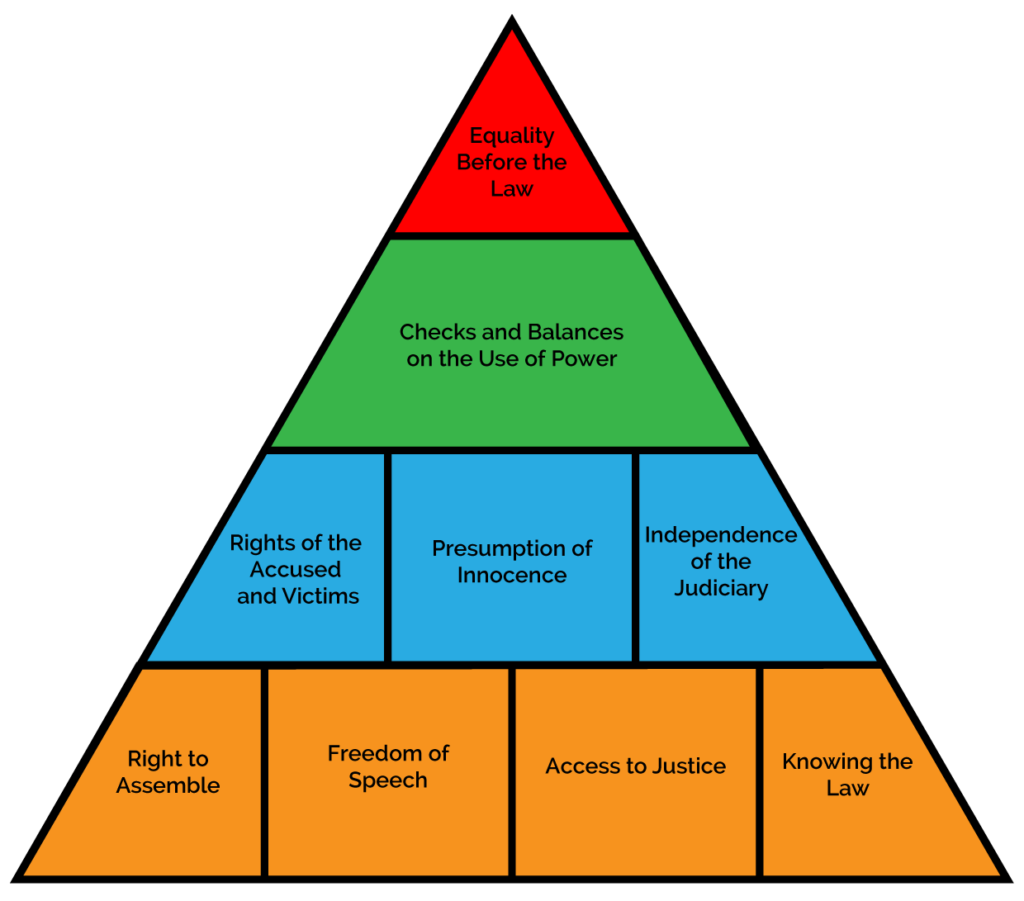
Rule of Law pyramid
(Rule of Law Institute of Australia)

As we saw in the recently updated post The Good King (reprise), the concept of the rule of law goes back at least to Aristotle.  It became a central principle of the American founders via the English tradition of John Locke.  “Rule of law implies that every citizen is subject to the law, including lawmakers themselves” (Wikipedia again).  It is thus in tension with kingship, where rule is almost by definition arbitrary and personal.  But one can have mixed cases—kings who are bound by certain laws, as in the British constitutional monarchy.

Without the rule of law, we depend on the good behavior of those who have power of some sort—physical, military, economic.  We slide toward the “war of each against all,” where might makes right and the vulnerable are the pawns of the strong.  Autocracy soon follows, as people look for any means to find safety from those who are powerful but unscrupulous.  Hence the quotation from John Christian Falkenberg, which I’ve used before:  “The rule of law is the essence of freedom.”  (Jerry Pournelle, Prince of Mercenaries (New York:  Baen 1989), ch. 21, p. 254.)  Strength itself, a good thing, is only safe under laws.

Test Cases

It’s easy to miss the importance of the rule of law.  We’re typically born into a society with better or worse laws, and criticize them from the inside.  It’s less common to find ourselves in straits where lawfulness as such has collapsed.  Regrettably, sizable numbers of people are exposed to such conditions in the world today.  But many of us are fortunate enough not to see them ourselves.  As always, fantasy and science fiction provide useful “virtual laboratories” for examining the possibilities.
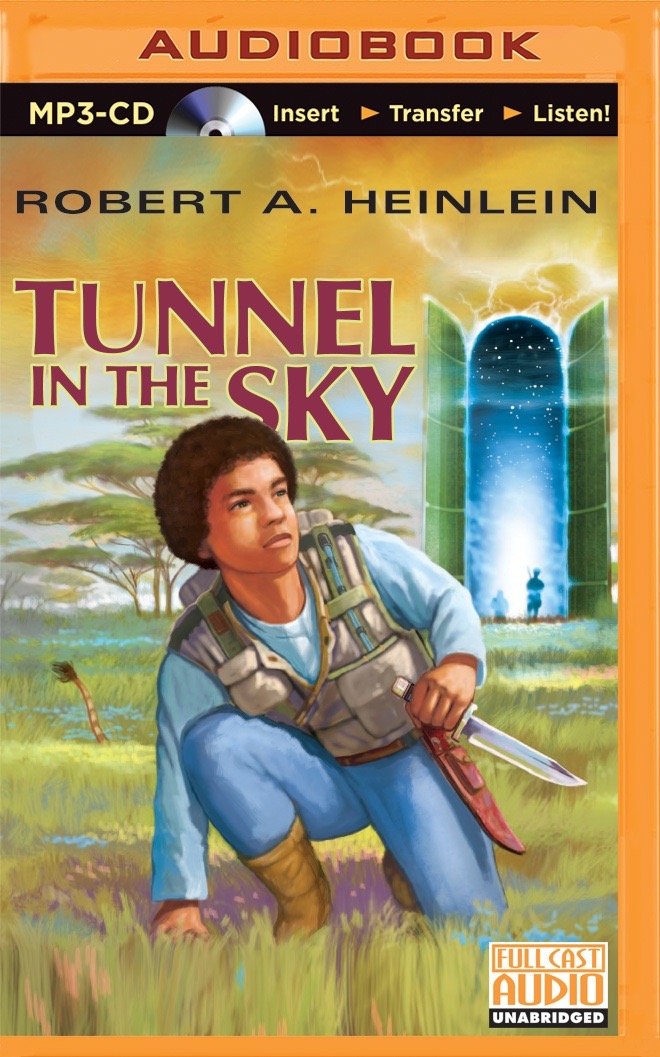
Tunnel in the Sky (audiobook) cover

A classic SF case is where a group thrown into a “state of nature” attempts to set up a lawful society.  For example, in Heinlein’s Tunnel in the Sky (1955), students from a high-school class on survival techniques are given a final exam in which they are dropped onto an unspecified planet to survive for up to ten days.  When an astronomical accident leaves them stranded, they need to organize for the long term.  Rod Walker, the hero, becomes the leader-by-default of a growing group of young people.  The tension between this informal leadership and the question of forming an actual constitution—complete with committees, regulations, and power politics—makes up a central theme of the story.

The Postman movie poster

David Brin’s post-apocalyptic novel The Postman (1985), later made into a 1997 movie with Kevin Costner, illustrates the power of civil order, the unstated practices of a culture, as recalling—and perhaps fostering—the rule of law.  The hero, a wanderer who happens to have appropriated a dead postman’s uniform and mail sack, presents himself as a mail carrier for the “Restored United States of America” to gain shelter in one of the isolated fortress-towns, ruled by petty tyrants, that remain.  His desperate imposture snowballs into a spreading movement in which people begin to believe in this fiction, and this belief puts them on the road toward rebuilding civilization.  The result is a sort of field-test not only of civil order and government, but of what Plato famously imagined as the “noble lie.”

In Niven & Pournelle’s Lucifer’s Hammer (1977), a small community headed by a United States Senator hopes to serve as a nucleus for reconstructing civilization after a comet strike.  We see at the end the strong pull of personal rule or kingship:  as the Senator lies dying, the future of the community will be determined by which of the competing characters gains the personal trust and endorsement of the people—and the hand of the Senator’s daughter, a situation in which she herself recognizes the resurfacing of an atavistic criterion for rule.  Unstated, but perhaps implicit, is the nebulous idea that deciding in favor of scientific progress may also mean an eventual movement back toward an ideal of rule by laws, not by inherited power.

Seeking a Balance

The “laboratory” of F&SF is full of subversions, variations, and elaborations on the rule of law.  In particular, we should note the counter-trend previously discussed as “chaotic good.”  Laws can be stifling as well as liberating.

The Moon is a Harsh Mistress cover

Heinlein’s The Moon Is A Harsh Mistress (1966) imagines how the “rational anarchy” of a lunar prison colony is mobilized to throw off autocratic rule.  The healthy chaos of the libertarian Loonies is hardly utopian, but the story does make it seem appealing.  Interestingly, Heinlein returned to this setting with a kind of critique twenty years later in The Cat Who Walks Through Walls (1985), where the post-revolution lunar anarchy seems much less benign, seen from an outsider’s perspective.

Taran Wanderer book cover

While fantasy seems to concern itself with this issue much less than science fiction, consider the region called the “Free Commots” in Lloyd Alexander’s Chronicles of Prydain.  When protagonist Taran visits this area in the fourth book (Taran Wanderer), he finds a society of independent villages, where the most prominent citizens are master-craftspeople.  They neither have nor need a lord to organize them.  The Commots contrast favorably to the feudal or wilderness regions through which Taran travels.  A kind of anarchic democracy, as an ideal, thus sneaks into what otherwise seems to be a traditional aristocratic high fantasy.

One way of managing the tension between a government of laws and a culture of liberty is the principle of subsidiarity:  the notion that matters should be governed or controlled at the lowest possible organizational level where they can be properly handled.  It’s frequently illustrated in G.K. Chesterton’s ardent defenses of localism.  In The Napoleon of Notting Hill (1904), extreme localism is played for laughs—“half fun and full earnest,” to borrow Andrew Greeley’s phrase.  The more mature Tales of the Long Bow (1924), which might qualify as a sort of proto-steampunk story, treats the idea more seriously, in the form of an oddly high-tech (for 1924) revolt of local liberty against overweening and arbitrary national rule.

It remains true that we need good people as well as sound laws.  “Good men can make poor laws workable; poor men will wreak havoc with good laws” (James M. Landis, 1960; see this article at 432 & n.107).  The quality of a civilization can also be assessed by whether it fosters citizens who act with decency and good judgment even when there isn’t a law to constrain them (as in David Brin’s “Ritual of the Street Corner”).  After all, we neither can nor should try to create laws to govern everything.

But being willing to improvise well in situations where no law applies is different from considering oneself above the law, disdaining the constraints that apply to everybody else.  This is doubly and triply true of rulers, who are constantly tempted to arrogate power and dodge accountability to accomplish their ends.  If a ruler is allowed to get away with law-breaking, we’re headed for trouble.

Brin has noted that the stories that fill and shape our culture—movies, books, television—encourage a broad “suspicion of authority” that tells us all institutions are corrupt or useless, and so are most other people—so that the heroes and heroines of the stories can face and overcome challenges by their heroic actions.  Like most attitudes, suspicion of authority is helpful in moderation, but corrosive when it gets out of hand.  If that attitude leads us to throw over laws and institutions altogether in the hope that individual heroes or autocrats will save us, we need to keep in mind that benevolent dictatorship, unconstrained by law, is just one step away from despotism.

The Fragility of Civilization

When we grow up taking for granted the rule of law, we can fail to see how vulnerable it is—along with the civilization that it reflects and makes possible.

“The Establishment,” as they used to say in the 1960s, seems vast and invulnerable.  When we’re trying to make a change, it seems insuperable, so rigid that nothing can be done about it.  But this is an illusion.  The structure of civilization, good and bad, is fragile.  It’s easier than we think to throw away the rule of law, so painfully constructed (as Rod Walker found), in favor of shortcuts or easy answers to our problems.

One thing F&SF have brought us is a better sense of this vulnerability.  The spate of post-apocalyptic tales in recent years—zombie apocalypses, worldwide disasters, future dystopias like The Hunger Games, going all the way back to the nuclear-war stories of the 1950s—do help us appreciate that our civilization can go away.

But that collapse doesn’t require a disaster.  Civilization, and the rule of law, can erode gradually, insidiously, as in the “Long Night” stories we’ve talked about earlier.

Historically, the Sixties counterculture fostered anarchists who felt “the Establishment” was invulnerable.  Often with the best of intentions, they did more to undermine civil order than they expected.  Those who now see no better aim than breaking up the structures of democratic government and civil life—whether from the side of government, or from the grass roots—also fray the fabric of civilization.  The extrapolations of science fiction and fantasy illustrate why eroding the rule of law should not be taken lightly.

Near the bottom of Brin’s Web home page, he places the following:

I am a member of a civilization

It’s good that we have a rambunctious society, filled with opinionated individualists. Serenity is nice, but serenity alone never brought progress. Hermits don’t solve problems. The adversarial process helps us to improve as individuals and as a culture. Criticism is the only known antidote to error — elites shunned it and spread ruin across history. We do each other a favor (though not always appreciated) by helping find each others’ mistakes.

And yet — we’d all be happier, better off and more resilient if each of us were to now and then say:

“I am a member of a civilization.” (IAAMOAC)

Step back from anger. Study how awful our ancestors had it, yet they struggled to get you here. Repay them by appreciating the civilization you inherited.

It’s incumbent on all of us to cherish and defend the rule of law.  Give up civilization lightly, and we may not have the choice again.

The Malleability of Myth

Our stories are always built on other stories.  We draw not only on real life, but on all the other tales, tropes, and archetypes that we’ve encountered.

Some of those stories are especially powerful.  They express patterns that seem particularly meaningful to us.  Tolkien and Lewis called these “myth”—not in the sense of something false,  a “lie breathed through silver,” but in the sense of something fundamental.

Some mythologies are works of imagination:  the Greek or Norse gods, Superman, Star Wars.  Some may be built on elements of truth:  the fall of Troy, King Arthur.  Some may be literally true, though we can select parts of the overall story and express them in imaginative terms—for example, the tales of the American Revolution (Hamilton or 1776,) or what Lewis called the Christian myth (The Prince of Egypt, The Nativity Story).

Whatever their sources, all these tales make up a reservoir of plots, characters, themes, and locales on which authors draw—our cultural inheritance.  In his famous essay On Fairy-Stories, J.R.R. Tolkien described it this way:  “Speaking of the history of stories and especially of fairy-stories we may say that the Pot of Soup, the Cauldron of Story, has always been boiling, and to it have continually been added new bits . . .”  (Pp. 26-27 as reprinted in The Tolkien Reader (Ballantine, 1966); p. 10 in this online reproduction of the full text.)

A good storyteller does not simply repeat a story verbatim.  We give it our own spin or flavor.  In doing so, we draw from the Cauldron elements from all sorts of other tales.  As they say, “When you take stuff from one writer it’s plagiarism, but when you take from many writers it’s called research.”

This is true even when we purport to be retelling an existing story.  The great tales tend to be open to reshaping.  But how far can we go with this sort of adaptation, and still claim to be retelling the original tale?  How much stretching and twisting can a given story take before it becomes something else altogether?


The best example may be the Arthuriad, the mythology of the Arthurian tales.  But that’s so large a subject that it deserves a discussion of its own.  A more manageable example is the story of Robin Hood.

One thing that helps us feel free to adapt is the lack of a single, “canonical” original version of the story.  Any presentation of The Lord of the Rings—the movie, for example—will be judged against Tolkien’s book.  But there is no unique original source for Robin Hood.  The earliest sources are a variety of medieval ballads, according to Wikipedia’s extensive discussion.

Cover, Roger Lancelyn Green, Adventures of Robin HoodWhen I went in search of a standard version of the Robin Hood tale for my children’s library, there was no single obvious choice.  There is an influential Howard Pyle version, The Merry Adventures of Robin Hood—I haven’t read it, but apparently it’s written in an invented antique English idiom that might not be ideally accessible to young people.  I ended up with Roger Lancelyn Green’s 1956 The Adventures of Robin Hood, which struck me as a good, middle-of-the-road retelling on which to start a young person.


There are enough different elements in the Robin Hood story to allow for a range of  interpretations.  On the surface, there’s the sheer romance of a band of rough but virtuous rogues living cheerfully in the forest:  the “Merry Men” theme. There is the legendary adept or quasi-superhero element:  Best Bowman Ever.  (At least, “best” until you get to Katniss Everdeen, Hawkeye, (Green) Arrow, and other successors — all of whom owe something to the Robin Hood archetype.)

There are also political themes.  The conflict between underdog Saxons and Norman aristocrats got tossed into the Cauldron in the nineteenth century, according to Wikipedia.  More specifically, Robin is often seen as defending the absent Richard the Lionhearted against Prince John’s machinations.  And of course one can focus on the economic aspect, robbing from the rich to give to the poor, and make Robin a hero of the 99% against the 1%.  The tale generally includes a strong romantic element as well.

We can see how these elements can be differently mixed in some of the movie versions, all of which are fairly successful.


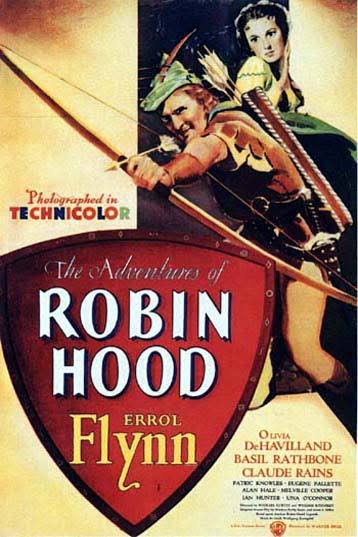
Poster, Errol Flynn, Adventures of Robin HoodIn the Errol Flynn classic The Adventures of Robin Hood (1938), Robin is good-humored and high-spirited.  Merriment abounds; the dashing Robin treats much of the action almost frivolously—“Where’s your love of fights, risk, adventure?”  He fights with a smile, like John Carter.  Marian says:  “he’s brave and he’s reckless, and yet he’s gentle and kind.”  In keeping with this light touch, much of the soundtrack music has an antic air.  Robin is an expert bowman, of course; we see this especially in the tournament/trap sequence (which seems to have been too frivolous to be used in the later movies, below).

The plot gives us Saxons versus Normans, with Robin a Saxon nobleman (though he had traditionally been portrayed as a yeoman).  In this version, the Sheriff of Nottingham is a fat fool; the villains are Prince John and Guy of Gisborne.  Richard is a noble and honorable king, though he has to be reminded of his homeland duties by Robin.  His return is protracted, and the politics is internal.  Robin (and Marian) speak for one England, not Normans against Saxons, under the one true king.  The climactic battle scene is essentially a civil war—John’s supporters against Richard’s.

Maid Marian is a pampered Londoner, a royal ward, though she comes over to Robin’s side promptly when he shows her the sufferings of the poor.  As usual, there is a competitor for her hand—in this case, Guy.  This Marian is not an action heroine.  She arranges the plan to save Robin from hanging after his capture, but it’s his men who execute the rescue.  The love story is a central thread, and the film ends with Robin and Marian rushing off from the celebration together.


Poster, Kevin Costner, Robin Hood - Prince of ThievesRobin Hood:  Prince of Thieves, starring Kevin Costner (1991), presents a more serious treatment.  Wikipedia describes it, accurately, as a “romantic action adventure.”  The Merry Men angle appears only vestigially, befitting Costner’s somewhat dour screen presence.  The Expert Archer trope certainly makes its appearance, as Robin makes progressively more unlikely bowshots to save the day.

Costner’s Robin is again an aristocrat, allying himself with the downtrodden when he returns from the Crusades.  (The notion that Robin had been on crusade with Richard is unusual:  he is usually seen as being driven to outlawry while Richard is away.)  We have the traditional Saxon-Norman conflict, complicated by throwing in a batch of wild-card Celts as well.  But the ethnic or class difference is not prominent; it is expressed primarily as a revolt against the weirdly evil and almost demented Sheriff of Nottingham.  Curiously, Prince John is not mentioned at all.  But King Richard does make an appearance at the very end, to bless the romance.  (In an entertaining nod to film history, Richard is played by Sean Connery, who had himself played Robin Hood in 1976’s Robin and Marian.)

Prince of Thieves leans heavily on the romance.  Marian, a local aristocrat, was acquainted with Robin when they were children—she despised him.  She takes a shine to him, however, after Robin returns to find the Sheriff has murdered Robin’s father.  Here it is the Sheriff who has designs on Marian’s virtue.  The romantic drama rides on Michael Kamen’s epic score for the music—with a main theme so good that Disney has come to use it as the generic musical cue for Disney’s logo.


Poster, Russell Crowe, Robin HoodThe most recent movie version is called simply Robin Hood, directed in 2010 by Ridley Scott, starring Russell Crowe.

Crowe’s Robin is serious-to-grim; no frivolous japes here.  Like Costner’s version, Crowe’s is returning from the Crusades with Richard.  But this Robin is a common archer, not a nobleman.  He does some fancy shooting, but he spends more time swordfighting.  In the climactic battle, he leads a more traditional cavalry charge—and on a beach, not in a forest.  (He does, however, deliver the final coup de grace to Godfrey the villain with a bowshot.)

This film’s whole atmosphere is more cynical than in either of the two versions described above.  For example, where Errol Flynn’s Robin gives King Richard some home truths and is honored for it, Crowe’s Robin gets put in the stocks for giving Richard an honest evaluation, even though Richard specifically asked for honesty.  The movie makes a few more nods to actual history, in the relationships of John, Richard, and Walter Marshal—though with a few minor tweaks, such as an imaginary French invasion.  (The Wikipedia page lists several criticisms on the history.)  Richard is killed near the beginning, in France, rather than returning triumphantly to England.  The focus is more on international politics than in the two preceding versions:  the big final battle here is against the French.

For most of the story, this Robin doesn’t live in the forest.  Nor is he precisely an outlaw, though he and his friends do stop one shipment of grain as “men of the hood.”  Rather, his central role is as a somewhat anachronistic voice for democracy.  Robin’s father Thomas Longstride was a “visionary” who believed in raising up all people; the repeated slogan is “Rise, and rise again, until lambs become lions.”  Thomas wrote a charter of rights, signed even by barons.   In one of the few nods to the Merry Men, these rights include the right for each man “to be as merry as he can”—a livelier form of “the pursuit of happiness.”  There’s a reference to “liberty by law,” as opposed to the despotism of a “strongman” tyrant.  Marion too, though she’s a lady, is shown doing mundane chores alongside the farmers (Robin originally mistakes her for a farm girl).

In this version, the Sheriff is practically a nonentity.  John and the character representing Guy, who has mutated into “Godfrey,” are the villains.  Here John is a much more ambiguous character, rising to an almost heroic role at the climax.  But he then throws that role away by refusing to sign the Magna Carta—a historically dubious twist—and condemning Robin.

The romance element is also strong here, though to some extent it takes a back seat to politics (Wikipedia describes the movie as an “epic historical war film”).  Robin finds himself pretending to be the deceased Sir Robert of “Loxley” on his return to England.  At the real Robert’s father’s insistence, he steps into Robert’s shoes—including becoming (for public relations purposes) “husband” to Robert’s wife Marion.  This puts us somewhere in the region of the “Marriage Before Romance” trope, and allows for some endearing scenes as the two begin to fall for each other.

Marion herself is stronger and more assertive here than either of her film predecessors above (harking back to Green’s description of Marian as an “expert fighter,” p. 222).  She’s competent with sword and bow work; she frees her villagers; she even joins the final battle, in an Eowyn-style armor disguise.  At the same time, she still needs to be rescued occasionally, and is again pursued by unwanted romantic attention from the Sheriff.

In place of the usual happy ending, Robin is finally declared an outlaw at the very end—riding off into the sunset, as it were, as a perennial spirit of rebellion.  “And so the legend begins,” a title tells us.


As noted above, my view is that all of these movie treatments work, despite their varied treatments of Robin’s character, his martial prowess, the political angles, the villains, and the romance.  They all seem to be acceptable ways of telling the Robin Hood story.  One can appreciate the same tale rendered in a number of different ways, mutually inconsistent in their details, but able to coexist in the viewer’s mind.

On the other hand, there are limits to this variability.

The Robin Hood subgenre also offers an example of distorting the underlying myth too far — stretching the rubber band till it breaks.  Robin McKinley’s novel The Outlaws of Sherwood tries so hard to avoid the usual tropes that, in my estimation, it fails as a Robin Hood story.


Cover, Robin McKinley, Outlaws of SherwoodMcKinley’s Robin is anything but merry—he’s a gloomy, plodding yeoman forest ranger.  The Norman-Saxon conflict is active, but Robin has no political awareness at all; he has to be chivvied into revolt by Marian and Much the miller’s son, who handle most of the overall strategy.  Adding insult to injury, he can’t hit the broad side of the barn with an arrow.  All the fancy shooting is done by others, including Marian.  This is a pleasant nod to female action-hero equality, but leaves our image of Robin himself sadly lacking.

About the only thing McKinley’s Robin is good at is provisioning a comfortable forest home for his followers and their families.  You might say he makes a fine quartermaster, but he’s hardly a leader.

The political themes are muted.  Guy and the Sheriff are the villains, and larger national or international issues are not prominent.  Richard the Lionheart does appear, to receive the main characters’ fealty and thus end their outlawry, though he then takes them to the Crusades as a sort of penance.

The Robin-and-Marian romance is integral to the story, but it proceeds in slower and more complex ways than in the movies.  Robin is hesitant and tongue-tied, the opposite of the dashing Errol Flynn.  Only when Marian is injured, after taking Robin’s place in the famous tournament, does he admit to loving her.

McKinley is aware of the way in which authors construct tales in different shapes as they draw their preferred elements from the Cauldron of Story.  She notes in an afterword that “[m]any people have strong ideas about who Robin was and what he was like; and a lot of our ideas are as incompatible with each other as they are with history” (p. 277).  Her version has its points; but to my mind, it stretches the main themes and tropes too far to be a satisfactory iteration of the Robin Hood legend.


We can adapt a myth in any number of ways, but not infinitely many.  There are boundaries that must be observed if the story is to remain recognizable at all.  A story seems to have an “essence,” and violating that essence makes it into something different.  The something different may be valuable in itself; it isn’t necessarily a bad thing to adapt familiar bits from the Cauldron of Story into a new tale.  But that—of course—is another story.