Self-Spoofing

Visions of Sugarplums

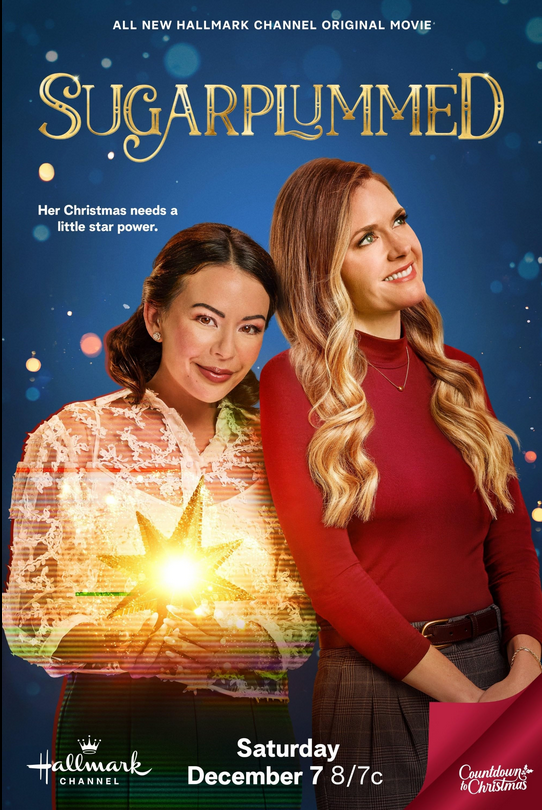
Among the Hallmark Channel’s Christmas season offerings this year is a comedy called Sugarplummed, which has the distinction of being a spoof of the Hallmark Channel itself.

Satirizing the recurring tropes of the innumerable Hallmark Christmas movies isn’t a new game.  As noted in my 2019 post, takeoffs on this subgenre are legion.  Just today, a “Sally Forth” newspaper cartoon rang yet another change on the meta-tradition of Hallmark spoofery.

Sugarplummed movie poster (from https://www.imdb.com/title/tt33900751/mediaviewer/rm361928706/?ref_=tt_ov_i)

But it’s particularly entertaining to watch someone make fun of themselves.  In Sugarplummed, Emily, the harried mother in a family of four, is devoted to a schmaltzy series of TV movies featuring a woman named “Sugarplum.”  She’s thrown off the rails when the Sugarplum character magically materializes in the real world, determined to fulfill Emily’s wish for a perfect Christmas.  Sugarplum carries around a thick book that contains The Rules.  The Rules are a collection of mandates that embody all the Hallmark clichés we know so well.  Sugarplum’s world, in her home town of (naturally) “Perfection,” lives by these rules.  Why shouldn’t they work in Emily’s life as well?

For a while, they do, and we’re treated to a series of implausible “Christmas miracles” where everything works out perfectly.  Then, as the Hallmark plot summary puts it, “when Sugarplum’s magical fixes start to backfire one by one, Emily begins to question what an ideal holiday really is.”  The moral of the story is not to pursue perfection to the detriment of our ordinary relationships and joys—or, to put it another way, the familiar adage that “the perfect is the enemy of the good.”  That’s an apt reminder.

Enchantment and Reality

The Disney canon is another inviting target for satire.  The long history of Disney movies and shows contains plenty of well-worn recurring tropes and themes.  And, since much of Disney’s original focus was on children, those motifs tend to be on the sentimental or upbeat side, making the repetition even more attractive for satire.  (For some reason, the repetition of ugly or grimdark tropes, as in the plethora of dystopian fantasies now flooding the market, doesn’t attract as much jeering.)

Shrek (2001) did a pretty good job of spoofing Disney, the theme parks as well as the movies—not just in the details, but in the overall plot.  Instead of having the prince or princess turned into a monster or critter and restored in the end, Beauty and the Beast-style, Shrek’s inamorata Fiona turns out to be an ogre who’s been turned into a princess, and the happy ending ensues once she’s been restored to her natural homely form.

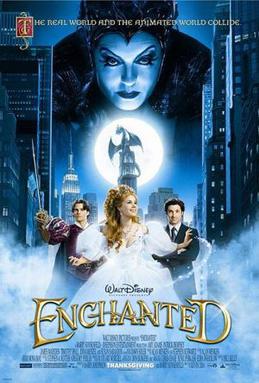
Of course, there’s a certain sniggering almost-hostility in making fun of somebody else’s clichés.  We can undermine that attitude when we make fun of ourselves.  Disney one-upped Shrek when it released the movie Enchanted in 2007.  Here, an animated character named Giselle, a perfect exaggeration of a Disney fairy tale heroine, is sent by a wicked witch to a terrible foreign land that works by entirely different rules:  New York City.  Now in live-action, we see Giselle try to cope with the grittier world we live in, where her set of Rules don’t apply.  (In one classic inversion, the climax sees Giselle attacking the monster to save the man she loves, rather than the other way around.)  We do get a happy ending, but it’s much more along the lines of learning to be a grown-up and living with (while improving on) imperfection.

The Science Fiction Version

The self-spoof approach isn’t limited to fantasy, or to the big screen.  Consider E.E. Smith’s Lensman series, the very model of classic space opera.  Satires of the space opera genre are also common, from Harry Harrison’s Star Smashers of the Galaxy Rangers to the 1980 Flash Gordon movie.  But in one case, Smith did it to himself.

In the last Lensman book, Children of the Lens (1947), Smith’s redoubtable hero Kimball Kinnison goes undercover as—of all things—a science fiction writer, Sybly White (see chapter 3).  We see a couple of excerpts from the SF novel Kinnison writes, which (of course) “was later acclaimed of one of Sybly White’s best.”  The excerpts parody, not just space opera generally, but Smith’s own ebullient, melodramatic style.  It’s charming to see Smith good-naturedly bringing onstage a caricature of himself.

Taking Ourselves Lightly

As I’ve noted elsewhere, humor can often involve a kind of meanness toward the target of the humor.  The charm of the self-satire is that the temptation toward meanness or hostility is absent.  Spoofing oneself is almost bound to be an affectionate parody, the kind where the humorist really likes the subject of the humor.  These often make for the best satires, untainted by any sourness or smugness and genuinely understanding how the satirized thing works.

I give Hallmark credit for Sugarplummed, then, especially because it shows the showrunners are not taking themselves too seriously.  That genial attitude is in tune with the Christmas season Hallmark is celebrating.  As Chesterton put it in Orthodoxy (ch. 8):  “Angels can fly because they can take themselves lightly.”

The Good King (reprise)

Watching The Lord of the Rings movies again recently, to share the experience with my wife, brought to mind this post from eight years ago.  Here it is again, with minor updates.

I began to wonder some years back about the curious preference for monarchy in futuristic settings.  In the world at large, monarchies have been retreating in favor of republics and democracies, at least in theory, since 1776.  Why are SF writers so fond of equipping future societies with kings, emperors, and aristocracies?

Star Kingdoms

We can pass lightly over the old-time, pulp-type stories where royal rule is merely part of the local color:  Burroughs’ A Princess of Mars (1912), Edmond Hamilton’s The Star Kings (1949), E.E. Smith’s The Skylark of Space (1928) with its Osnomian royal families.  Here, like flashing swords and exotic costumes, monarchy is simply part of a deliberately anachronistic setting.  Similarly in high fantasy, where aristocracy comes naturally in the typical pseudo-medieval milieu.

But we see royal or aristocratic governments in more modern stories too.  Asimov’s Foundation stories are centered around a Galactic Empire. (See also the more recent Apple+ series of the same name.)  Since that series was based on Gibbons’ The History of the Decline and Fall of the Roman Empire, an Empire was inevitable.  Similarly in Star Wars, which draws heavily on Asimov.  Jerry Pournelle’s CoDominium future history has a First and a Second “Empire of Man.”  David Weber’s heroine Honor Harrington serves the “Star Kingdom of Manticore” (later “Star Empire”), modeled closely on England around 1810.  Lois McMaster Bujold’s Vorkosigan Saga contains a number of polities with different forms of government, but many of the stories focus on Barrayar, which has an Emperor.  Anne McCaffrey’s popular Pern series has no monarch, but has two parallel aristocracies (the feudal Holders and the meritocratic dragonriders).  It got to the point where I began to feel a decided preference for avoiding monarchical or imperial governments in SF storytelling.

The Lure of Kingship

Aragorn with crown

There’s something that attracts us in royalty—or we wouldn’t see so much of it.  I encountered this puzzlement directly.  As a kid reading The Lord of the Rings, I was as moved as anyone by the return of the true King.  I asked myself why.  If I don’t even approve of kingship in theory, why am I cheering for Aragorn?

The reasons we’re drawn to monarchy seem to include—

  • Kings are colorful. (So are princesses.)
  • Stability
  • Personal loyalty
  • Individual agency

The first point is obvious, but the others are worth examining.

Stability

It’s been pointed out that even in a constitutional government, a monarch provides a symbolic continuity that may help to hold a nation together.  British prime ministers may come and go, but the King, or Queen, is always there.  This gives some plausibility to the idea of a future society’s returning to monarchy.

Something like this stabilizing function is behind commoner Kevin Renner’s half-embarrassed harangue to Captain Rod Blaine, future Marquis of Crucis, in Niven & Pournelle’s The Mote in God’s Eye:  “maybe back home we’re not so thick on Imperialism as you are in the Capital, but part of that’s because we trust you aristocrats to run the show.  We do our part, and we expect you characters with all the privileges to do yours!”  (ch. 40)

Unfortunately, relying on the noblesse oblige of the aristocrats doesn’t always work out well.  It depends on who they are.  For every Imperial Britain, there’s a North Korea.  When the hereditary succession breaks down, you get a War of the Roses or Game of Thrones.

Too much depends on getting the right monarch.  By the law of averages, it doesn’t take long before you get a bad ruler, whether by inheritance or by “right of conquest”—and you’re up the well-known creek.

Personal Loyalty

Personal loyalty appeals to us more strongly than loyalty to an institution.  One can pledge allegiance to a state—but even the American Pledge of Allegiance starts with a symbol:  the flag, and then “the Republic for which it stands.”  Loyalty to an individual moves us more easily.

This kind of loyalty doesn’t have to be to a monarch.  Niven & Pournelle’s Oath of Fealty explores how loyalty among, and to, a trusted group of managers can form a stronger bond than the mere institutional connections of a typical modern bureaucracy.  One can be faithful to family (the root of the hereditary element in kingship), to friends, or even an institution or a people.  But it’s easiest with an individual.  This loyalty is the basis for the stability factor above.

Individual Agency

The vast machinery of modern government sometimes seems to operate entirely in the abstract, without real people involved.  “Moscow said today . . .”

In fact it’s always people who are acting.  But it’s easier to visualize this when you have a single person to focus on.  “When Grant advanced toward Richmond . . .”  In the extreme case, we have the ruler who claims to embody the state in his own person:  “L’état, c’est moi” (attributed to Louis XIV, the “Sun King” of France).

In a fascinating 2008 essay, Jo Walton quotes Bujold on political themes in SF:  “In fact, if romances are fantasies of love, and mysteries are fantasies of justice, I would now describe much SF as fantasies of political agency.”  A science fiction character is frequently involved in effecting a revolution, facing down a potential dictator, or establishing a new order—exercising autonomous power.  Walton links this notion of political agency to the fact that SF illustrates change:  “SF is the literature of changing the world.”  The world-changers can be outsiders, or they can be the rulers themselves—as in a number of the examples above.

It’s not surprising that we’re attracted to characters who act outside the normal rules.  We (especially Americans, perhaps) are fond of the idea that good people can act in ways that are untrammeled by the usual conventions.  I’ve already mentioned Robin Hood.  And the whole concept of the superhero—the uniquely powerful vigilante who can be relied on to act for the good—is powered by this attraction.

But this idealization of individual initiative is also dangerous.  Too much depends on getting the right hero—or the right monarch.  It can only work if the independent agent is seriously and reliably good:  virtuous, in the classical sense of virtue as a well-directed “habit” or fixed character trait.  Even then, we may be reluctant to give any hero unlimited power.  Too much is at stake if it goes wrong.

The Rule of Law

Our admiration for the powerful ruler is always in tension with our dedication to the rule of law:  “a government of laws, not of men,” in the well-known phrase attributed to John Adams.  We can see this as far back as Aristotle:  “law should rule rather than any single one of the citizens.  And following this same line of reasoning . . . even if it is better that certain persons rule, these persons should be appointed as guardians of the laws and as their servants.”  (Politics book III, ch. 16, 1287a)

No human being can be trusted with absolute authority.  This is the kernel of truth in the aphorism that “power tends to corrupt and absolute power corrupts absolutely.”  But we can’t get along without entrusting some power to someone.  When we do, it had better be someone who’s as trustworthy as possible.

The Ideal of the Good King

Thus the true king must be a virtuous person—a person of real excellence.  This is the ideal of an Aragorn or a King Arthur, whose return we’re moved to applaud (even against our better judgment).  It should be obvious that the same principles apply to the good queen—or emperor, empress, princess, prince, president, prime minister:  the leader we follow.  But I’ll continue using “king” for simplicity’s sake.

What virtues do we look for in a good monarch—aside from the obvious ones of justice, wisdom, courage, self-control?

If the ruler or rulers are going to be “servants of the laws,” they require humility.  A king who serves the law can’t claim to be its master.  Arrogance and hubris are fatal flaws in a ruler.  For example, we should always beware of the leader who claims he can do everything himself and is unable to work with others.

The good king is also selfless—seeking the common good of the people, not his own.  Self-aggrandizement is another fatal flaw.

In effect, what we’re looking for is a ruler who doesn’t want to rule:  a king who believes in the sovereignty and the excellence of common people.

Aragorn defers to Frodo

It’s significant that Aragorn, our model of the good king, is introduced in LotR as “Strider,” a scruffy stranger smoking in a corner of a common inn.  Even when he’s crowned in victory, he remembers to exalt the humble.  The movie has him tell the four hobbits, “You kneel to no one.”  Tolkien’s text is more ceremonious:  “And then to Sam’s surprise and utter confusion he bowed his knee before them; and taking them by the hand . . . he led them to the throne, and setting them upon it, he turned . . . and spoke, so that his voice rang over all the host, crying:  ‘Praise them with great praise!’”  (Book VI, ch. 4, p. 232)

We see the same essential humility and selflessness in other admirable leaders, kings or not:  Taran in the Chronicles of Prydain, and the revolutionary princess in Lloyd Alexander’s Westmark trilogy; Niven & Pournelle’s Rod Blaine; Jack Ryan in Tom Clancy’s novels; “Dev” Logan, head of Omnitopia Inc. in Diane Duane’s Omnitopia Dawn—the unpretentious opposite of the “imperial CEO.”  America was fortunate enough to have such an example in the pivotal position of first President, George Washington.

The Alternative

At the other end of the spectrum, the most dangerous person to trust is an unprincipled and unscrupulous autocrat—someone convinced of his personal superiority and infallibility.  Giving power to an individual who has no interest in serving the common good, but only in self-aggrandizement, puts a nation in subjection to a Putin, a Mussolini, a Kim Jong-un.

The antithesis of the good king is the tyrant, who, however innocently he may start out, figures in our stories mainly as the oppressor to be overthrown.  It’s much better, if possible, to intercept such a potentially ruinous ruler before the tyranny comes into effect:  Senator Palpatine before he becomes Emperor, Nehemiah Scudder before he wins his first election.  Allowing the tyrant to gain power may make for good stories, but it generates very bad politics.

If we must have strong leaders, then in real life as well as in stories, character is key—and hubris is deadly.

Human Extraterrestrials

Introduction

Even though science fiction is often focused on the future, its assumptions are tied to the present.

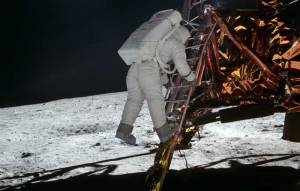
Aldrin descends from Apollo 11In some respects this is obvious.  A story about the near future can become dated by history itself.  Every SF story prior to 1969 that describes the first moon landing in detail (happy 51st anniversary, last week!) is obsolete.  And every story that predicted a smooth reach out into colonizing the solar system directly after that first landing, unfortunately, is also defunct.  Stories can also be rendered unbelievable by scientific advance:  all the delightful tales based on a habitable Venus or Mars are gone with the, er, vacuum.

But there’s also a subtler way.  Even though F&SF specialize in examining our assumptions about the universe, the assumptions that seem plausible shift over time.  Fashions change.  To take a heartening example:  SF stories from the late 1940s and the 1950s tended to take it for granted that there would shortly be a nuclear world war.  (Hence it’s spot-on characterization when the 1955 version of Doc Brown in “Back to the Future” accepts Marty’s recorded appearance in a hazmat suit as logical because of the “fallout from the atomic wars.”)  But for over seventy years, we’ve managed to avoid that particular catastrophe.

One assumption that’s always intrigued me is whether we are likely to meet people like ourselves—and I mean, exactly like ourselves—on another planet.  If we discovered an Earthlike planet of another sun, might we climb down the ladder from our spaceship to shake hands with a biologically human alien?

Not Really Alien

I’m talking about a “convergent evolution” hypothesis—the notion that the human species might have developed independently more than once.  And, incidentally, the standard biological definition of “species” as “interfertile” (a more precise definition can be found on Wikipedia) is what I’m using here; because, obviously, one of the potential uses of the assumption in a story is to make possible a romance between two characters from different worlds, and romance is not unrelated to sex and reproduction.

The Cometeers coverSo we want to set aside, to begin with, a class of stories in which people from different planets are all human because they have a common ancestry.  For example, in Jack Williamson’s classic space opera The Cometeers (1936), Bob Star finds his true love Kay Nymidee among the human subjects of the decidedly nonhuman masters of an immense assemblage of space-traveling planets, the “comet.”  But the reason there are human beings present is that a research ship from Earth was captured by the Cometeers long ago, and these are the descendants of the crew.

It’s not uncommon for the inheritance to work the other way around.  David Weber’s “Mutineers’ Moon” (1991) starts with the eye-opening assumption that our Moon is actually a long-inert giant spaceship—and reveals that the humanity of Earth is descended from the original crew members of that spaceship.  Thus, it’s perfectly plausible when hero Colin MacIntyre falls for a preserved member of the original crew; they’re from the same stock.  Similarly, in at least the original 1978 version of Battlestar Galactica, the human survivors of the “rag-tag fugitive fleet” are human because Earth itself was one of their original colonies, which apparently fell out of touch.

The Era of Planetary Romance

In the early days of modern SF—say, from about 1912 through the 1930s—it was commonly assumed that the answer was yes:  human beings (with minor variations) might be found independently on other planets.  Arguably, this may have been because the early planetary romances—melodramas set on exotic worlds, heavy on adventure and love stories—were less interested in science than in plot devices.  But biology was less advanced in those days; recall that DNA was not identified as the basis of genetic inheritance until 1952.  It’s easy to forget how little we knew about things we take for granted today, even in relatively recent periods.

A classic early case is that of Edgar Rice BurroughsBarsoom.  In A Princess of Mars (1912), Earthman John Carter is transported by obscure means to Mars, called by its inhabitants “Barsoom.”  Those inhabitants include the nonhuman “Green Martians,” but also people identical to humans in several colors, particularly the “Red Martians” among whom Carter finds his lady-love, Dejah Thoris.  As a Red Martian, Dejah is human enough for Carter to mate with, and they have a son, Carthoris, thus meeting the “interfertile” criterion.

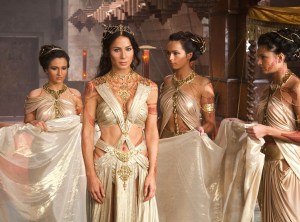
Lynn Collins as Dejah Thoris in John Carter of Mars

Lynn Collins as Dejah Thoris

To be sure, the biology here is a little mysterious.  Dejah looks entirely human, and even, to borrow a Heinlein phrase, “adequately mammalian” (see, for example, Lynn Collins’ portrayal in the loosely adapted movie John Carter (2012)).  But Martians don’t bear their young as Earth-humans do; they lay eggs, which then develop for ten years before hatching.  It’s not easy to imagine the genetics that could produce viable offspring from an individual whose genes direct live birth and one whose genes result in egg-laying.  But that didn’t stop Burroughs.

E.E. Smith, whose initial SF writing goes back just about as far as that of Burroughs, was willing to accept this trope as well.  In The Skylark of Space (published 1928, but written between 1915 and 1921), our intrepid heroes travel to a planet inhabited by two nations of essentially human people—although the double wedding in the story does not involve any interplanetary romances, but is between two pairs of characters from Earth.  Smith’s later Lensman series (1948-1954), which features one of the most diverse arrays of intelligent creatures in SF, also allows for apparently interfertile humans from a variety of planets.  My impression is that this sort of duplication was also true of some of the nonhuman species in the Lensman unverse—there might be, say, Velantian-types native to planets other than Velantia.

This approach wasn’t universal in old-time SF.  The more scientifically-minded John W. Campbell’s extraterrestrial character Torlos in Islands of Space (1930) was generally humanoid in form, but quite different in makeup:  his iron bones, for instance.  It’s been argued that a roughly humanoid form has some advantages for an intelligent species, and hence that we might find vaguely humanoid aliens on different planets—though this is pure speculation.  But “humanoid” is a far cry from biologically human.

Darkover Landfall coverWe see some persistence of this tradition into the second half of the twentieth century.   Marion Zimmer Bradley’s iconic planet Darkover, for instance (first novel published 1958), is populated by the descendants of Terran humans from a colony ship and also by the elf-like indigenous Chieri, who, despite minor differences like six fingers and golden eyes, not to mention the ability to change sex at will, have interbred with the Terran immigrants.

An interesting variation can be seen in Julian May’s Saga of Pliocene Exile (first story published in 1981).  When modern humans are sent on a one-way trip into the distant past, they are enslaved by the Tanu, aliens from another galaxy who have settled on Earth.  The story indicates that the Tanu were specifically searching for a place where the local gene pool was similar to theirs—which might also account for why they came all the way from another galaxy (also a somewhat antique trope) to get here.

It’s slightly odd that, even where basically identical human beings turn up on other planets, other animals never seem to be similarly duplicated.  On Burroughs’ Barsoom, one doesn’t ride horses, but thoats; is menaced not by tigers, but by banths; and keeps a calot, not a dog, as a pet.  In a planetary romance or science fantasy setting, one is less likely to see Terran-equivalent fauna than parallel creatures with exotic names and slight differences—whence the SF-writing gaffe “Call a Rabbit a Smeerp” (see TV Tropes and the Turkey City Lexicon).

At the Movies

The all-too-human trope is carried on into the present day in video media—movies and TV.  Again, this may be partly because the science is often subordinated to the plot; but the cost and difficulty of putting convincing nonhuman characters on-screen is surely another factor.  Filmmakers’ ability to depict exotic creatures, however, has changed immensely in the last forty years, to a point where almost any imaginable creature can be created if the budget is sufficient.  Thus, the original Star Trek series of the 1960s stuck largely to slightly disguised humanoid aliens, perhaps relying on the ‘universal humanoid’ hypothesis mentioned above, while later series were able to branch out a bit.  Similarly, the Star Wars movies could readily give us nonhuman characters like Jabba the Hutt, Chewbacca, and C3PO; they, too, grew in variety as the capabilities of CGI and other techniques expanded.

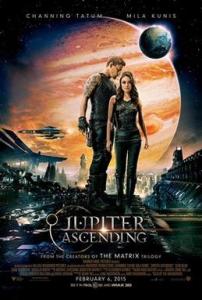
Jupiter Ascending movie posterStill, it may be harder for us to adjust to interactions among characters where we can see their nonhumanity, rather than just reading about it.  So we still tend to see extraterrestrial humans on-screen.  The Kree in Captain Marvel (2019), for example, are indistinguishable from humans—an actual plot point, since this makes it possible for Yon-Rogg to tell Carol that she’s an enhanced Kree rather than a kidnapped human.  The Kree do have blue blood, in the movie; it’s not clear what kind of biological difference (hemocyanin?) might result in that feature.  We also see a number of alien humans in Jupiter Ascending (2015), though I think of that tale as a deliberate throwback to pulpish science fantasy or planetary romance.

A Match Made in Space, fictional coverI keep wanting to cite the fictional novel written by George McFly as shown in the closing scenes of Back to the Future, “A Match Made in Space,” since the cover seems to suggest an interplanetary romance (and one thinks of George as a nerdy romantic); but it isn’t actually clear whether that’s the case.  All we have to go on is the title and the cover, and that could just as easily depict a match between two humans, fostered by an alien matchmaker (or vice versa).

The Modern Era

We don’t see nearly as many extraterrestrial humans in modern SF, and for good reason.

The more we understand about genetics, the less likely it seems that another human species, so closely similar as to be interfertile, could evolve independently.  What we know about evolution suggests that there are just too many random chances along the way—cases where the prevailing mutations might have turned out differently.  Even if we assume that humanoid form is probable, why not have six fingers, or hemocyanin rather than hemoglobin?  While I’m not well enough educated in biology to venture any actual probabilities, I think our growing sense of the complexity of the human body and its workings, over the last seventy years or so, has simply made it seem vanishingly unlikely that an independently evolved intelligence would come out that close to the human genotype.

For example, the scientifically-minded Arthur C. Clarke depicted a galaxy in which each intelligent species, including humans, was unique:  The City and the Stars (1956, developed from an earlier story published in 1948).  In one of the unused story fragments he wrote while working on 2001:  A Space Odyssey (1968), his hero, well along on his journey into mystery, thinks:

He did not hesitate to call them people, though by the standards of Earth they would have seemed incredibly alien.  But already, his standards were not those of Earth; he had seen too much, and realized by now that only a few times in the whole history of the Universe could the fall of the genetic dice have produced a duplicate of Man.  The suspicion was rapidly growing in his mind—or had something put it there?—that he had been sent to this place because these creatures were as close an approximation as could readily be found to Homo sapiens, both in appearance and in culture.  (Clarke, The Lost Worlds of 2001, ch. 39, p. 220)

Contemporary SF writers who are really adept at building interesting and coherent aliens—David Brin and Becky Chambers, to name two of the best—give us a wide range of wildly exotic creatures from other planets, but not humans.

The Uplift War, coverIf we are still fond of the idea of interplanetary romance, we might find a possible work-around in the shapeshifter.  The Tymbrimi female Athaclena in Brin’s The Uplift War (1987) uses her species’ unusual abilities to adjust her appearance closer to that of a human female—but of course she has an entirely different genetic heritage, as that ability itself demonstrates.  The result wouldn’t meet our criterion of interfertility, no matter how close the similarity in physical structure.  To adjust one’s genes in the same way would be another order of change altogether.

Starman movie posterThe 1984 movie Starman, in a way, plays off this idea.  The alien in this case is apparently an entity made of pure energy, without a physical structure of its own.  Using hair from the female lead’s deceased husband, it creates a new body with a human genetic structure.  The two do, eventually, prove to be interfertile.  If we’re willing to accept the notion of an energy being in the first place, this approach is actually more plausible than, say, mating with the oviparous Dejah Thoris.

If one were writing a SF story today, it would be rash to assume that Earthborn characters could run across independently evolved humans elsewhere.  The idea may not be entirely inconceivable.  But it’s out of fashion for good reasons.  Attractive as the notion of interplanetary romance may be, at this point we’d best confine it to the kind of case noted above, where some common ancestry—no matter how far-fetched—can account for the common humanity.

The Select Society of Protectors

Sorry about the delay between posts—I’ve been under the weather lately.


I was recently reading a new “Sharing Knife” story by Lois McMaster Bujold, and it suddenly occurred to me that the relationship of Bujold’s Lakewalkers to Farmers is exactly that of Anne McCaffrey’s Dragonriders to Holders.

But let me back up a bit.

The Sharing Knife

The world of Bujold’s Sharing Knife series is a difficult and dangerous one.  Most people live in a basically agrarian culture, a sort of cross between the traditional medieval fantasy world and the Wild West.  They fear the enigmatic “Lakewalkers,” men and women who wander about the countryside in “patrol” groups and are rumored to have magical powers.  The Lakewalkers claim to be searching for what ordinary people call “blight bogles,” but some consider these to be a mere myth.

They’re not a myth, of course.  In reality the Lakewalkers, who have the ability to use a kind of magic they call “groundwork” (an extremely interesting and well-developed idea in itself), are constantly on the watch to destroy “malices” as they arise.  These malices are truly nasty beings that can mentally enthrall normal humans and mutate animals into humanoid minions.  If the Lakewalkers weren’t killing them off (via the grim “sharing knife” methd of the title), the malices would overrun the whole world.

Many Lakewalkers tend to look down on the people they are defending, whom they refer to generally as “farmers.”  Much of the interest of the story has to do with the prickly relationship between these two interdependent groups, explored through the romance between a farm girl, Fawn, and a Lakewalker patroller, Dag.

The Dragonriders of Pern

As I mentioned in an earlier post, Anne McCaffrey’s Dragonriders of Pern is a science fiction series that reads like fantasy.  The planet Pern is protected by men and women riding flying dragons.  The dragons breathe fire to destroy an alien organic “Thread” that falls from the sky and, if allowed to spread, would multiply to consume the planet.  To qualify as a full-fledged dragonrider, one must have the potential for a certain kind of telepathy that allows rider and dragon to bond at the dragons’ birth.

Dragonflight coverOne of the things that makes the Pern stories sound like fantasy is the quasi-medieval political structure.  A “Lord Holder” resembles a feudal monarch ruling over a sizable population of farmer/serfs, crafters, and minor nobility.  But here the dragonriders form a separate hierarchy.  The riders’ internal pecking order is a combination of aristocracy and meritocracy:  the rider of the senior gold (female) dragon is a kind of queen; the rider whose bronze dragon mates with the gold becomes leader of the entire group that constitutes a Weyr; and those who lack the telepathic talent are servitors (at the lowest level, “drudges”).

While the depiction of Pernese society mellowed a good bit over the course of the series—both holders and riders were pretty high-handed and violent at the beginning, less so later—one consistent theme is the uneasy relationship between the dragonriders and the common folk.  Everyone knows (though they may forget in the generations between periodic Thread attacks) that the riders are essential to preserve the planet:  “Worlds are lost or worlds are saved / From those dangers dragon-braved.”  But the holders often resent the taxes imposed to support the Weyrs and the “searches” in which the dragonriders carry off likely young people to see if they can “impress” a dragon.  Managing this tension consumes a good deal of the main characters’ time in the early books.

The Protectors and the Protected

Now I can make clear the analogy I noticed.  In each case we have a relatively small society of people set apart from ordinary folks, in a good cause:  they are dedicated to protecting the larger population.  The select group of protectors are genuine heroes who possess special talents that fit them for the role.  But the protectors are not stainless; they can abuse their powers.  And the grateful population they defend aren’t always grateful; they may resent the special powers and privileges of the defenders, even aside from the possible abuse of those advantages.

It seems to be a fruitful trope for storytelling.

Rangers and Protectors

Strider with pipe at the Prancing PonyWe can find a similar structure, though not so dominant, back in The Lord of the Rings.  You’ll recall that Strider—Aragorn—is one of a mysterious group of wanderers who travel the countryside, the Dúnedain or Rangers.  They are regarded with suspicion by the ordinary folks in Bree; Barliman Butterbur the innkeeper warns Frodo about the suspicious-looking stranger sitting in the corner.  Yet all the time the Rangers are patrolling the borders of the peaceful lands of Bree and the Shire, fending off possible threats.  Aragorn says at the Council of Elrond:

‘Strider’ I am to one fat man who lives within a day’s march of foes that would freeze his heart, or lay his little town in ruin, if he were not guarded ceaselessly.  Yet we would not have it otherwise.  If simple folk are free from care and fear, simple they will be, and we must be secret to keep them so.  (Fellowship of the Ring, II.2, p. 261)

Aragorn’s fond, if slightly aggrieved, remark brings out a difference.  Pern’s dragonriders are a public society of defenders; everyone knows of their special role.  But Tolkien’s Dúnedain, like the Lakewalkers in Bujold’s more recent fantasy, play a less public role.  They are set apart, but because their heroism is unrecognized, they are objects more of suspicion than of admiration.

Pak protector (by Christopher Bretz)

Pak protector – illustration courtesy of Christopher Bretz (bretz@bretz.ca)

For a more science-fictional take, consider Larry Niven’s Protectors, which figure in the novel Protector (naturally) and in the Ringworld stories.  Niven imagines that humanity is descended from a species called the Pak, which matures through three life stages:  child, breeder, and protector.  The transition from the not-very-bright breeder stage to the highly intelligent and formidable protector stage is triggered by eating a root the characters call “tree-of-life.”  When a Pak colony arrived on Earth ages ago, however, the soil lacked a chemical necessary for the tree-of-life root to function.  The “breeders” could not change into protectors; instead, they evolved on their own into modern-day humans.  Niven’s intriguing conceit is what we see as symptoms of old age actually represent the incomplete transition to the gaunt, tough, hairless protector stage.

Niven depicts the protectors as genetically compelled to protect the members of their own family or clan—the ones who “smell right.”  A functioning Pak colony wouldn’t be as much like a human society as on Pern or Middle-Earth or Bujold’s imaginary world:  it would consist of carefree, barely-sentient breeders watched over by creatures ruthlessly dedicated to their preservation.  Think of it as an extreme case of the separation of defenders from defended.

Counter-Examples

On the other hand, a number of stories depict defenders who are much more thoroughly integrated into their broader societies.

Nita and Kit ascend over New York, from Young Wizards

Young Wizards

In Diane Duane’s Young Wizards series, youngsters with the potential for wizardry are called, not by receiving a letter from Hogwarts, but in more obscure ways—for example, running across a library book called So You Want To Be A Wizard.  There are more wizards around than one might think, because on our planet they don’t advertise their powers:  young wizards still go to school, grown-up wizards might be writers or sell advertising.  (And not all of them are human; there are some very entertaining books about feline wizards.)  But all of them are dedicated to the preservation and fostering of Life, by way of the Wizard’s Oath each must take.  In this setup, there’s no resentment of the society of protectors because no one knows they exist; and abuse of wizardly powers is almost unheard-of, since violating the Oath tends to result in forgetting that wizardry even exists.

Lensman image

Kim Kinnison, Gray Lensman

By contrast, the elite corps of Lensmen in E.E. Smith’s famous series are publicly known and highly respected.  They play the role of galactic policemen and secret agents, with particular attention to the mysterious pirates and drug-runners called “Boskone.”  Like the Young Wizards, the Lensmen are (conveniently) incorruptible, being screened at the outset by the equally mysterious but benevolent Arisians.  (This whole business of incorruptibility is something we need to examine more closely on another occasion.)  But they don’t mind mixing in ordinary society—Gray Lensman includes a scene set at a formal ball—although their grave responsibilities often make them feel set apart in their lonely dedication.

Superheroes, as a class, may occupy the same position.  They live as part of the general public, though their identities are usually secret.  They tend to act as individuals rather than as a whole society, though they do come in small groups (and may occasionally take part in mega-battles that engage the whole range of heroes).  But the modern superhero does show the ambivalence that often characterizes the select defender (Mr. Incredible’s remark that he sometimes wishes the world would just stay saved for a while).  And some graphic novels take up the question of what it’s like for the ordinary person to live in a world full of superheroes—notably Kurt Busiek’s thoughtful Marvels (1994).

Narrative Tensions

The select society of protectors is a fine place for heroes.  But it’s also dangerous.  What if the protectors aren’t incorruptible, and turn bad?  What if they become contemptuous of the people they protect, and come to think of themselves as better than the “rabble”?  In many of the scenarios above, it takes special talents to qualify as one of the defenders.  How likely is it that those who see themselves as specially qualified will end up thinking of themselves as superior?  These questions form fertile ground for various plotlines.

The notion of the select (if not superior) set of defenders may even be seen as applying to a military organization, whose purpose is to protect the general public.  “Citizen soldiers,” or draftees, may see themselves as primarily part of the overall society, temporarily detailed to do their civic duty; but a professional military, which can form its own tightly-knit society with its families and dependents, may be more easily tempted to think of itself as a group apart, with its own loyalties and camaraderie.  In fiction, the entire genre of military SF borders the trope we’re examining here.  In real life, the American military, at least, seems to have avoided that trap; we have not yet seen anything like a military coup.

Everyone Is a Tuvela

It’s interesting to contemplate the opposite trope:  the citizen soldier model taken to its limit.

The Demon Breed, coverIn James Schmitz’s 1968 novel The Demon Breed, a biochemist named Nile Etland on the human colony world Nandy-Cline discovers that independent researcher Ticos Cay has been captured by cruel and formidable aliens called the Parahuans.  Ticos has played on the Parahuans’ own near-superstitious fears to convince them that Nile is a Tuvela, a member of a secret society of superhumans that are the real rulers of human civilization.  All Nile has to do is convince the invaders that she is, in fact, a superior being it would be death to tangle with.  And, with the help of Ticos, two mutant otters, and her own encyclopedic knowledge of the unique biology of Nandy-Cline, she does a marvelous job of pulling the wool over the Parahuans’ eyes and sending them fleeing back to their own worlds.

But there are no Tuvelas.  Nile is a brilliantly resourceful and competent woman, but she’s not superhuman.  Neither is Ticos, nor any of the other inhabitants who are involved at the end in dispersing the Parahuans.  They’re simply ordinary humans.  And there is no secret organization.  Rather, Schmitz’s hypothesis is that a significant fraction of ordinary people (Ticos calls them “antipredators”) can take on that defensive role when extraordinary circumstances require them to do so.  As one character remarks, the Parahuans would have run into “Tuvela” behavior no matter where they sought to attack.

The title The Demon Breed doesn’t refer to the Parahuans.  It refers, from the unfortunate Parahuans’ point of view, to the uncannily resilient humans.  Like the sturdy hobbits of the Shire, human beings are capable of rising to the occasion.  At the end of the story, when the local Nandy-Cline military forces have mobilized to make sure the fleeing Parahuans don’t escape, Nile reflects:  “The human demon was awake and snarling on Nandy-Cline” (ch. 9).

The select society of defenders is a potent storytelling trope; but so is the distributed resourcefulness of the ordinary person.  And both may be useful to keep in mind as we act where we are needed.

Meet Cute and Meet Hard

Two Ways to Meet

In The Holiday, Kate Winslet’s character Iris comes upon an old man who’s hobbling about his own neighborhood, having forgotten where his house is.  (He’s a once-famous movie screenwriter, but she doesn’t know that yet.)  When she takes him home, he remarks, “Well, this was some meet-cute.”  And, having lampshaded the trope by name, he introduces Iris to one of the classic conventions of romantic comedy:  the main characters’ first meeting is awkward, confusing, adorable, or just plain cute.

On the other hand, the romantic couple in adventure stories is often thrown together by the adventure itself.  The meeting is not so much cute as conflict-driven:  let’s call it a “meet-hard.”  The two types of encounters are both unusual—not your average first date—and, though they are opposites in some sense, they have some features in common.

Bumping Into Each Other

The simplest case for the meet-cute, as TV Tropes notes, is for the characters literally to crash into each other by accident—coming around a corner, for instance.  This gives us physical contact, the resulting embarrassment, and a way to get the characters interacting at once.

Notting Hill movie posterIn Notting Hill (1999), Hugh Grant’s bookstore owner chats briefly with Julia Roberts’ movie star when she browses around his bookshop.  But he kicks off the relationship when he later collides with her outside and (naturally) spills his drink on her, necessitating a costume change.  In the Good Old Summertime, the musical version of the “Shop Around the Corner” story (1949), also has the main characters meet in a collision, causing them to take an instant dislike to each other (a sure sign of impending romance in a rom-com).  The embarrassment factor is amplified by the fact that he then accidentally shreds her skirt.

But of course a couple can also “bump into” each other less literally.  For my money, the most adorable meet ever may be in the Hollies’ 1966 song “Bus Stop” (hear it here).  The singer offers to share his umbrella with a cute girl at the bus stop.  They then continue using the umbrella throughout the summer, rain or shine, as a kind of running joke, not to mention a pretext for standing close together.  I’d love to see this played out onscreen.  P.G. Wodehouse’s Leave It To Psmith (1923) has another umbrella scene, but even sillier:  Psmith sees an attractive girl stranded by the rain and, in classic insouciant Psmith manner, steals someone else’s umbrella to offer her gallantly.
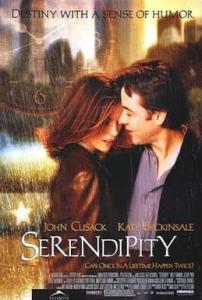
Serendipity posterThe recent Netflix rom-com Set It Up (2018) has the main characters deliberately arranging a meet-cute in an elevator as part of a plot to get their bosses to fall for each other.  (It fails spectacularly.)  In Serendipity (2001), one of my holiday-season favorites, the pair meet fighting over the last pair of black cashmere gloves at a department store.

From the Ridiculous to the Sublime (And Back Again)

Resisting the temptation to highlight innumerable other favorite examples, I’ll point out some more exotic cases.  The earnest trash-compactor robot in WALL-E (2008) meets the girl robot of his dreams, EVE, when she is dropped nearby to scout the long-defunct Earth for plant growth.  He spends the next several sequences frantically dodging the suspicious droid’s laser blasts, before they get more comfortable with each other.  Once EVE finds a sample and goes inert, we even see WALL-E gallantly shielding her from the rain with an ancient bumbershoot.  There’s just something about umbrellas; most likely it’s that they represent a very mild way of depicting a damsel in distress.

In the best of Heinlein’s juveniles, Have Spacesuit—Will Travel (1958), high-schooler Clifford Russell is trying out a working spacesuit he’s won in a contest when he gets a distress call from someone who’s escaped from hostile aliens in their flying saucer.  When he’s captured himself, he meets the caller, Peewee, a genius-level eleven-year-old.  Given the characters’ respective ages, there is no actual romance in the usual sense, though they become fast friends—and there’s no question but that they’ll fall for each other when they get old enough.  I’d classify this as a meet-cute on an intergalactic scale.

Arabella, coverVehicular breakdown is almost as good a way as umbrellas to create unexpected pairings.  In Georgete Heyer’s Arabella (1949), the eponymous Arabella’s carriage breaks down near the country “hunting box” of the (formerly) jaded Robert Beaumaris.  A recent romance in Wild Rose Press’s Deerbourne Inn series, Amber Daulton’s Lyrical Embrace (2019), has Erica Timberly’s car break down, in the rain, no less, occasioning her rescue by her rock-group idol, Dylan Haynes.  (Unaccountably, he doesn’t offer an umbrella.)  Angela Quarles’ steampunk romance Steam Me Up, Rawley (2015) drops the hero into the heroine’s lap in a malfunctioning balloon, this being steampunk.

The Meeting of Adventure

By the time we get to carriage or automobile mishaps (not to mention flying saucers), we’re edging into the territory of the adventure romance.  (Which may be where I should have classified Have Spacesuit, except that the incident, the setting, and the characters are just so darn cute.)  The “meet-hard” in an adventure story puts romantic interests together in exigent circumstances, defining their initial relationship in a different way.

There’s an entire subgenre of adventure romance stories.  Goodreads lists (at this writing) 1,344 entries in the category “Popular Adventure Romance Books.”  And that’s just the popular ones, apparently.  However, that’s not precisely what I’m referring to here.  In some cases—The Hunger Games is near the top of Goodreads’ list—the eventual lovers already know each other before the adventure begins.  Here, I’m classifying an “adventure romance” as a romance in which the characters meet on or because of the adventure.
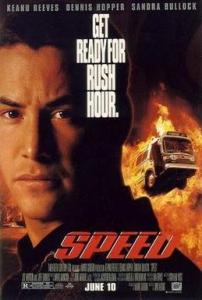
Speed movie posterI think of the movie Speed (1994) as a classic example.  Most of the action takes place on a bus equipped with a bomb that’ll go off if the bus’s speedometer drops below 50 miles per hour.  Keanu Reeves’ character Jack Traven gets on the bus because he’s a police officer.  His opposite number, Annie Porter (Sandra Bullock), is merely a passenger who ends up driving the bus.  They bond over the course of the incident and are ready for a real date by the finale.

The adventure romance may shade over into a rescue romance, in which one character saves the other from some unfortunate fate, minor or major.  But this doesn’t have to be the case; it’s just as likely the protagonists will end up cooperating in achieving their goal, becoming what TV Tropes calls a “Battle Couple.”

A Precarious Bond

Speed neatly illustrates (and lampshades) the great strength of the adventure romance:  the stress and camaraderie of the adventure brings the couple together as “Fire-Forged Friends.”  I’m especially fond of this trope (see The World Around the Corner and Rescue Redux).  At the end of Speed, Jack tells Annie he’s heard that relationships “based on intense experiences” don’t work out, although they go ahead anyway.  Interestingly, the sequel bears that out; Annie has a new boyfriend—though that seems to have been a function of actor issues (Reeves declined to appear).
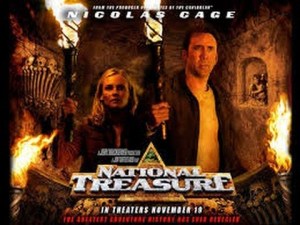
National Treasure trailer sceneA similar issue about the stability of adventure romances comes up in the sequel to National Treasure (2004), in which characters played by Nicholas Cage and Diane Kruger came together over a plot to steal the original Declaration of Independence.  Their relationship has fallen apart by the time National Treasure 2 (1007) rolls around, but a new adventure gives them an opportunity to rekindle the spark.

Extraordinary Adventures

Since F&SF specializes in adventure, we see the meet-hard frequently in science fiction or fantasy works.  In the first of Edgar Rice Burroughs’ Barsoom books, A Princess of Mars (1912), John Carter meets Dejah Thoris when she is captured by the green Martians among whom Carter is living, and he becomes her defender.

The principal couple in E.E. Smith’s The Skylark of Space (first published 1928, revised book ed. 1946), Dick Seaton and Dorothy Vaneman, are already engaged when the story starts.  However, when Dorothy is kidnapped and Dick sets out in pursuit accompanied by his fast friend, Martin Crane, it turns out that Dorothy has a lovely fellow captive, Margaret Spencer.  Peggy and Martin form their own bond in the course of their epic space trip, and under these stressful conditions, it develops quickly enough that we get to see a double wedding on the planet Osnome.

The boy Shasta in The Horse and His Boy (1954), one of C.S. Lewis’s Narnian chronicles, meets an aristocratic Calormene girl, Aravis, on the road (ch. 2), and they share the adventures from then on.  These characters are also too young for an actual romance, but Lewis dryly tells us at the end that “years later, when they were grown up they were so used to quarrelling and making it up again that they got married so as to go on doing it more conveniently.”

Eilonwy and TaranAnother independent heroine, Eilonwy, has grown up living with a formidable witch, which is where Taran the young hero meets her in Lloyd Alexander’s The Book of Three (1964).  She engineers Taran’s escape, which in only the start of five novels’ worth of achievements and escapades, with a marriage at the end (once they’ve grown up).  Don’t even look at the Disney movie version of the story, but I do highly recommend Dawn Davidson’s graphic-novel adaptation, only partway through but very promising.

And, for an example that’s had a wider audience, in the Marvel movie Thor (2011) Jane Foster discovers the hero in the desert, where he’s just been dropped by an Einstein-Rosen wormhole.  Their adventures continue through two movies, although by the third episode, lamentably, they seem to have broken up.

Only Slightly Extraordinary Adventures

Not all stories of adventure need to have fantastic elements—although by definition an adventure takes us out of ordinary, mundane life.  The dangers and thrills of the real world are quite enough.

Romancing the Stone posterOne of my favorite comedy-romance-adventures is the 1984 movie Romancing the Stone, in which romance novelist Joan Wilder ventures out of her quiet writer’s world to come to the aid of her sister, captured by smugglers in South America.  The bus she’s riding in Colombia crashes into a jeep driven by an exotic-bird smuggler, Jack T. Colton.  (I will leave to the reader the task of deciding whether this should count as a bump-into-each-other encounter, or a vehicular failure.)  Jack and Joan end up as unlikely partners in a progressively (sorry, I can’t avoid it) wilder series of escapades that end in a romance—although this couple, too, will have to wait for a sequel to fully seal the deal.

As noted above, there are lots of romance novels in this category as well.  Many of them start with the mundane and develop complications as they go; for example, Jennifer Crusie & Bob Mayer’s Don’t Look Down (2006), which starts out filming a movie and ends up with (as Goodreads puts it) “trying to find out who’s taking ‘shooting a movie’ much too literally.”

There is a sort of degenerate form of the adventure romance (in the mathematical, not the moral, sense) in which characters that are thrown together in a thriller automatically pair up, whether there’s a reason for it or not.  A writer can lean on the “forged in fire” trope without doing the work of showing how the characters are actually drawn together by the excitement.  For example, I have on my shelf Gardner F. Fox’s The Hunter Out of Time (1965), which made an impression on me as a kid but which, in retrospect, I have to think of as a potboiler.  When the time agent from the future who meets “adventurer” Kevin Cord turns out to be a beautiful girl, one is hardly surprised they end up falling for each other, basically because they’re there.

The Wedding Planner posterSome of these examples illustrate the gray area between the meet-cute and the meet-hard.  Whether cuteness or crisis predominates depends on the context of the story.  For example, the leads in The Wedding Planner (2001) meet when Mary (Jennifer Lopez) gets her high-heeled shoe stuck in a manhole cover and “Eddie” Edison pulls her out of the way of a speeding dumpster.  It’s a genuine danger, but it doesn’t lead to a series of adventures; the overall setting is comic (as is the danger).  On the other hand, the leads in Ready Player One (2011) meet in a gaming context, but their developing relationship is action-driven.

Where the Meets Meet

The meet-cute and the meet-hard share some features with respect to how they function in a story.
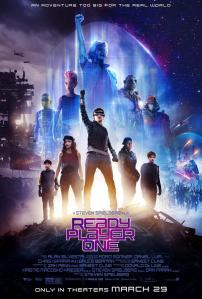
Ready Player One posterThe style of the meeting can help set the tone for the story:  comic, adventurous, or something else.  This is true even in the mixed cases.  Mary’s predicament in The Wedding Planner is slightly silly:  she’s pinned down by getting her heel stuck, and the onrushing menace is not a Mack truck but a mundane dumpster.  Similarly, Wade and Samantha in Ready Player One meet via action games; that tone is maintained when the action spills over into real life and real danger.

Both meet-cute and meet-hard have the effect of accelerating a relationship.  They put the characters in contact with each other in a distinctive and memorable way.  The quirkiness of the encounter, something the characters have in common, cuts short the process of “getting to know you” with which ordinary relationships begin.  This is especially useful in movies, or short stories, where a limited time is available for a “slow burn” relationship to form.  In that respect, these devices are similar to the love-at-first-sight convention (the “stroke of lightning”).

Finally, these non-ordinary meetings reveal something about the characters:  how they deal with unusual situations.  Are they self-conscious or self-confident?  Do they come up with quick solutions to problems (whether or not involving umbrellas)?  Do they know how to take action in a crisis?  And, not least, do they have a sense of humor?  The exceptional nature of the first meeting shows us more about the participants than we’d see if they simply met at work, say, or introduced themselves in a bar.

Either the meet-cute or the meet-hard, then, can kick off a romance with style—though very different types of romance may develop.