War of the Rohirrim

I finally got around to watching the 2024 film The Lord of the Rings: The War of the Rohirrim.  Missed it in the theatres, but I caught it on streaming video while my wife (who is not quite so headlong a Tolkien fan as I am) was off on a storytelling adventure.

The movie is very good.  Grim, but good.  Of course, this came out recently enough that I should issue a

Spoiler Alert!

Canon and Its Discontents

I refrained from reading about the plot until I had seen the film, so as not to spoil anything for myself.  When I went back to the source material—the tale of Helm Hammerhand, King of Rohan, about 200 years before the War of the Ring—I was surprised to see how closely the screenwriters had actually followed what Tolkien provided in Appendix A to The Lord of the Rings (section II, The House of Eorl).  This isn’t essential—but it’s helpful.

At this point LotR has become a mythological wellspring of its own.  I think it’s legitimate to treat the Tolkien materials as a basic canon that may still allow for some improvisation and variation, just as the stories around King Arthur are open to a variety of individual interpretations, and, generally, a powerful myth can be “malleable” in the right hands.

In other words, I’m not going to be scandalized just because a Middle-Earth tale isn’t entirely consistent with the canon.  Firing salvos back and forth about canonicity isn’t very productive.  What matters is what we do with the canon (or without it).

At the same time, if a work is worth adapting in the first place—book into movie, for example—then the adapters would do well to understand what made the source appealing.  We can use a source simply as a convenient hook on which to hang a different story, but we’d be wasting what’s worthwhile in the original.  Merely arbitrary or casual departures from the canon often degrade the result, rather than enhancing it.  We have to look at the changes case by case.  (The Peter Jackson Lord of the Rings movies themselves are full of examples both good and bad—but that’s a subject for a much longer dissection, one of these days.)

Thus—to take an SF example—when Gregory Benford wrote one of the sequels to Isaac Asimov’s Foundation series, Foundation’s Fear, Benford threw in a new means of interstellar travel—via wormholes—in addition to the “hyperspatial jump” that was standard in Asimov’s works.  This addition made the story seem a little more up-to-date, since wormholes had come into fashion in SF after Asimov wrote the original stories.  But inserting these wormholes into the background  created unnecessary tensions in the worldbuilding, since events in the original series might have played out quite differently if these wormholes had been around as Benford assumes.  And it added nothing much to the actual interest of the novel.  It wasn’t a big deal, but it was an annoyance.

Thus, we can evaluate War of the Rohirrim fairly by looking at how well it used the original Tolkien material, and how effectively it went beyond.

Adding and Expanding

Poster for The War of the Rohirrim

I thought the screenwriters here did a good job.  The Riders of Rohan as pictured in the movie are recognizably the same civilization we saw in the book and the LotR movies.  Helm Hammerhand is not at all the same character as Theoden, but he comes from the same culture.  Rohan’s relationship with Gondor is consistent with what we see in the books, allowing for two hundred years’ difference.

When the movie brings in LotR’s “oliphaunts,” or mûmakil (appropriately, only the latter name is used, since the former is more of a hobbitish coinage), that may seem an anticipation of the LotR storyline, but it’s plausible enough, drawing on Tolkien’s worldbuilding to add a danger and a challenge to the bare-bones tale of Helm in the books’ appendix.  The Wikipedia article on the movie makes some good observations here, and I’m inclined to agree.

The writers’ key decision, I think, was to use Helm’s daughter as the primary viewpoint character for this story.  She’s mentioned in the book, but her name is never given.  The screenwriters’ choice of “Héra” rather unfortunately invites confusion with the Greek goddess of the same name (less an accent), but it does fit her appropriately into a family containing Helm, Haleth, and Hama.

Telling the story as Héra’s tale allows the movie to create a sense of continuity that would be hard to achieve otherwise, since Helm and his two sons all die in the course of this war, one by one.  None of them survive to carry the viewer through to the end.  It is plausible, though, for Héra to come out alive.  And that also enables the screenwriters to give us something more like a happy ending than would have been possible if the focus had been on, for example, Helm himself.  Helm’s nephew Fréaláf takes the throne, and that’s fine.  Héra, however, can continue forward unconstrained and free.  The writers have wisely left her tale open-ended, rather than resolving it with a romance or other specific commitment.  That open prospect—“the Road goes ever on”—seems an appropriate conclusion for a story that is wound almost too tightly around one set of royal family conflicts and geographic environments.

I’ve found Amazon’s The Rings of Power somewhat disappointing; I’m cheered by this modest, but enjoyable, alternative venture into Middle-Earth.  Who knows:  someday (if the intellectual property rights align) we might even see the stories of the First Age, the Silmarillion, come to the big screen—and wouldn’t that be a sight to see!

The Good King (reprise)

Watching The Lord of the Rings movies again recently, to share the experience with my wife, brought to mind this post from eight years ago.  Here it is again, with minor updates.

I began to wonder some years back about the curious preference for monarchy in futuristic settings.  In the world at large, monarchies have been retreating in favor of republics and democracies, at least in theory, since 1776.  Why are SF writers so fond of equipping future societies with kings, emperors, and aristocracies?

Star Kingdoms

We can pass lightly over the old-time, pulp-type stories where royal rule is merely part of the local color:  Burroughs’ A Princess of Mars (1912), Edmond Hamilton’s The Star Kings (1949), E.E. Smith’s The Skylark of Space (1928) with its Osnomian royal families.  Here, like flashing swords and exotic costumes, monarchy is simply part of a deliberately anachronistic setting.  Similarly in high fantasy, where aristocracy comes naturally in the typical pseudo-medieval milieu.

But we see royal or aristocratic governments in more modern stories too.  Asimov’s Foundation stories are centered around a Galactic Empire. (See also the more recent Apple+ series of the same name.)  Since that series was based on Gibbons’ The History of the Decline and Fall of the Roman Empire, an Empire was inevitable.  Similarly in Star Wars, which draws heavily on Asimov.  Jerry Pournelle’s CoDominium future history has a First and a Second “Empire of Man.”  David Weber’s heroine Honor Harrington serves the “Star Kingdom of Manticore” (later “Star Empire”), modeled closely on England around 1810.  Lois McMaster Bujold’s Vorkosigan Saga contains a number of polities with different forms of government, but many of the stories focus on Barrayar, which has an Emperor.  Anne McCaffrey’s popular Pern series has no monarch, but has two parallel aristocracies (the feudal Holders and the meritocratic dragonriders).  It got to the point where I began to feel a decided preference for avoiding monarchical or imperial governments in SF storytelling.

The Lure of Kingship

Aragorn with crown

There’s something that attracts us in royalty—or we wouldn’t see so much of it.  I encountered this puzzlement directly.  As a kid reading The Lord of the Rings, I was as moved as anyone by the return of the true King.  I asked myself why.  If I don’t even approve of kingship in theory, why am I cheering for Aragorn?

The reasons we’re drawn to monarchy seem to include—

  • Kings are colorful. (So are princesses.)
  • Stability
  • Personal loyalty
  • Individual agency

The first point is obvious, but the others are worth examining.

Stability

It’s been pointed out that even in a constitutional government, a monarch provides a symbolic continuity that may help to hold a nation together.  British prime ministers may come and go, but the King, or Queen, is always there.  This gives some plausibility to the idea of a future society’s returning to monarchy.

Something like this stabilizing function is behind commoner Kevin Renner’s half-embarrassed harangue to Captain Rod Blaine, future Marquis of Crucis, in Niven & Pournelle’s The Mote in God’s Eye:  “maybe back home we’re not so thick on Imperialism as you are in the Capital, but part of that’s because we trust you aristocrats to run the show.  We do our part, and we expect you characters with all the privileges to do yours!”  (ch. 40)

Unfortunately, relying on the noblesse oblige of the aristocrats doesn’t always work out well.  It depends on who they are.  For every Imperial Britain, there’s a North Korea.  When the hereditary succession breaks down, you get a War of the Roses or Game of Thrones.

Too much depends on getting the right monarch.  By the law of averages, it doesn’t take long before you get a bad ruler, whether by inheritance or by “right of conquest”—and you’re up the well-known creek.

Personal Loyalty

Personal loyalty appeals to us more strongly than loyalty to an institution.  One can pledge allegiance to a state—but even the American Pledge of Allegiance starts with a symbol:  the flag, and then “the Republic for which it stands.”  Loyalty to an individual moves us more easily.

This kind of loyalty doesn’t have to be to a monarch.  Niven & Pournelle’s Oath of Fealty explores how loyalty among, and to, a trusted group of managers can form a stronger bond than the mere institutional connections of a typical modern bureaucracy.  One can be faithful to family (the root of the hereditary element in kingship), to friends, or even an institution or a people.  But it’s easiest with an individual.  This loyalty is the basis for the stability factor above.

Individual Agency

The vast machinery of modern government sometimes seems to operate entirely in the abstract, without real people involved.  “Moscow said today . . .”

In fact it’s always people who are acting.  But it’s easier to visualize this when you have a single person to focus on.  “When Grant advanced toward Richmond . . .”  In the extreme case, we have the ruler who claims to embody the state in his own person:  “L’état, c’est moi” (attributed to Louis XIV, the “Sun King” of France).

In a fascinating 2008 essay, Jo Walton quotes Bujold on political themes in SF:  “In fact, if romances are fantasies of love, and mysteries are fantasies of justice, I would now describe much SF as fantasies of political agency.”  A science fiction character is frequently involved in effecting a revolution, facing down a potential dictator, or establishing a new order—exercising autonomous power.  Walton links this notion of political agency to the fact that SF illustrates change:  “SF is the literature of changing the world.”  The world-changers can be outsiders, or they can be the rulers themselves—as in a number of the examples above.

It’s not surprising that we’re attracted to characters who act outside the normal rules.  We (especially Americans, perhaps) are fond of the idea that good people can act in ways that are untrammeled by the usual conventions.  I’ve already mentioned Robin Hood.  And the whole concept of the superhero—the uniquely powerful vigilante who can be relied on to act for the good—is powered by this attraction.

But this idealization of individual initiative is also dangerous.  Too much depends on getting the right hero—or the right monarch.  It can only work if the independent agent is seriously and reliably good:  virtuous, in the classical sense of virtue as a well-directed “habit” or fixed character trait.  Even then, we may be reluctant to give any hero unlimited power.  Too much is at stake if it goes wrong.

The Rule of Law

Our admiration for the powerful ruler is always in tension with our dedication to the rule of law:  “a government of laws, not of men,” in the well-known phrase attributed to John Adams.  We can see this as far back as Aristotle:  “law should rule rather than any single one of the citizens.  And following this same line of reasoning . . . even if it is better that certain persons rule, these persons should be appointed as guardians of the laws and as their servants.”  (Politics book III, ch. 16, 1287a)

No human being can be trusted with absolute authority.  This is the kernel of truth in the aphorism that “power tends to corrupt and absolute power corrupts absolutely.”  But we can’t get along without entrusting some power to someone.  When we do, it had better be someone who’s as trustworthy as possible.

The Ideal of the Good King

Thus the true king must be a virtuous person—a person of real excellence.  This is the ideal of an Aragorn or a King Arthur, whose return we’re moved to applaud (even against our better judgment).  It should be obvious that the same principles apply to the good queen—or emperor, empress, princess, prince, president, prime minister:  the leader we follow.  But I’ll continue using “king” for simplicity’s sake.

What virtues do we look for in a good monarch—aside from the obvious ones of justice, wisdom, courage, self-control?

If the ruler or rulers are going to be “servants of the laws,” they require humility.  A king who serves the law can’t claim to be its master.  Arrogance and hubris are fatal flaws in a ruler.  For example, we should always beware of the leader who claims he can do everything himself and is unable to work with others.

The good king is also selfless—seeking the common good of the people, not his own.  Self-aggrandizement is another fatal flaw.

In effect, what we’re looking for is a ruler who doesn’t want to rule:  a king who believes in the sovereignty and the excellence of common people.

Aragorn defers to Frodo

It’s significant that Aragorn, our model of the good king, is introduced in LotR as “Strider,” a scruffy stranger smoking in a corner of a common inn.  Even when he’s crowned in victory, he remembers to exalt the humble.  The movie has him tell the four hobbits, “You kneel to no one.”  Tolkien’s text is more ceremonious:  “And then to Sam’s surprise and utter confusion he bowed his knee before them; and taking them by the hand . . . he led them to the throne, and setting them upon it, he turned . . . and spoke, so that his voice rang over all the host, crying:  ‘Praise them with great praise!’”  (Book VI, ch. 4, p. 232)

We see the same essential humility and selflessness in other admirable leaders, kings or not:  Taran in the Chronicles of Prydain, and the revolutionary princess in Lloyd Alexander’s Westmark trilogy; Niven & Pournelle’s Rod Blaine; Jack Ryan in Tom Clancy’s novels; “Dev” Logan, head of Omnitopia Inc. in Diane Duane’s Omnitopia Dawn—the unpretentious opposite of the “imperial CEO.”  America was fortunate enough to have such an example in the pivotal position of first President, George Washington.

The Alternative

At the other end of the spectrum, the most dangerous person to trust is an unprincipled and unscrupulous autocrat—someone convinced of his personal superiority and infallibility.  Giving power to an individual who has no interest in serving the common good, but only in self-aggrandizement, puts a nation in subjection to a Putin, a Mussolini, a Kim Jong-un.

The antithesis of the good king is the tyrant, who, however innocently he may start out, figures in our stories mainly as the oppressor to be overthrown.  It’s much better, if possible, to intercept such a potentially ruinous ruler before the tyranny comes into effect:  Senator Palpatine before he becomes Emperor, Nehemiah Scudder before he wins his first election.  Allowing the tyrant to gain power may make for good stories, but it generates very bad politics.

If we must have strong leaders, then in real life as well as in stories, character is key—and hubris is deadly.

Little Did I Know

Foreshadowing

Stories vary in how they hint at what’s to come.  “Foreshadowing” provides the reader with more or less vague clues about things that will happen later on.  As the Wikipedia article notes, even the title of a chapter or an entire work can give us such a hint.  (I once changed the title of a novel—House of Stars, currently seeking a publisher—because the original working title gave away too much of the plot.)

One particularly overt way of foreshadowing is to have the narrator tell us straight out about something they didn’t find out until later.  I think of this as the “little did I know” trope, based on the hackneyed formula for introducing such a hint in old-time books.  That method strikes me as rather heavy-handed, and I’m dubious about whether it’s really a good idea.

”I Was Soon To Find That Out”

Stranger in a Strange Land, coverA classic example occurs in Heinlein’s Stranger in a Strange Land (1961).  Mentor-figure Jubal Harshaw (not the titular Martian), as a side business, ghost-writes the kind of ‘confessional’ novels popular in the early twentieth century.  Every now and then in Stranger, he’s motivated to dictate a bit of purple prose for such a tale.  So in ch. 17 (p. 157 in my battered old paperback copy), we hear, as part of the opening for “I Married a Martian”:  “In those carefree childhood days I did not dream to what strange bittersweet fate my tomboy ambition would . . .”

The fragmentary example is classic because it’s supposed to be a sample of hack writing; Harshaw is contemptuous of the potboilers he turns out.  Of course, not every “little did I know” example needs to be so trite.

Summer of the Dragon, coverRomantic suspense novels are given to this trope, since a primary purpose of the foreshadowing is to build anticipation and suspense.  For example, Elizabeth Peters was a master of the witty, light-hearted romantic suspense story.  In Summer of the Dragon (1979), we see a whole series of such hints.

It was like a game.
But it wasn’t a game, and I was soon to find that out.”  (ch. 7, p. 150)

I know now what it was that woke me at the crack of dawn next morning; but at the time I was amazed at myself.  (ch. 9, p. 181)

Every passing moment made me more and more uneasy; it was as if some part of my mind knew something awful was about to happen, something I couldn’t prevent.  (ch. 9, p. 194)

The fact is, my compassion was stupid.  I didn’t know how stupid until it was almost too late  (ch. 10, p. 213)

If I believed in premonitions I would claim that I knew the next day was going to see some sort of climax.  Since I don’t believe in them, I will only claim I was nervous.  (ch. 11, p. 249)

“My second impulse canceled the first; and I still maintain, in spite of what resulted, that it was a rational decision.”  (almost at very end:  ch. 12, p. 285)

After being hit over the head repeatedly with such ominous notes, one feels they’ve begun to lose their effectiveness.  And, although the individual lines are well written, the cumulative effect is to give the story a sort of “pulp” atmosphere.  In fact, that may have been just what the author was going for.  (Her laugh-out-loud description of the cover of a Gothic romance at the beginning of The Camelot Caper shows that she knew exactly what she was poking fun at.)

Some authors are particularly fond of this technique.  Andrew Greeley, for example, regularly warns us that something bad’s going to happen.  In A Christmas Wedding (2000), the hero and heroine agree that her father is a sick man, and the hero adds:  “And, as we would later find out to our dismay, dangerous too.”  (ch. 19, p. 235)  In a later book in the same series, September Song (2001), ch. 5 ends bluntly with:  “The future would be a lot worse than I expected.”  Oddly enough, in many cases the foreshadowing seems to overstate the result:  what ultimately happens is less awful than we’ve been led to expect.

Medusa in the Graveyard, coverThe “little did I know” trope isn’t confined to older works.  Emily Devenport’s fascinating Medusa in the Graveyard (2019) seems to concentrate such hints in the midsection of the story:  “That was about to change, but I didn’t know it” (ch. 14).  “I didn’t know we were about to be confronted by . . .” (ch. 14).  Or, deploying one of my favorite stock phrases:  “Famous last words” (ch. 15).

As the examples indicate, this particular type of open foreshadowing by the narrator tends to occur especially in first-person narratives.  It can also be used in the third person (“Little did she know…”), but in that case the quasi-presence of a narrator other than the main character becomes apparent—almost like “breaking the fourth wall.”

Similar Techniques

There are less obvious methods than “little did I know” to telegraph what’s coming up in a story, sharing some of the same weaknesses and strengths.

When the Fellowship of the Ring reaches Lothlorien, Frodo sees Aragorn lost in memory of meetings with Arwen there in days long past.  He comes out of his reverie and, taking Frodo’s hand, “left the hill of Cerin Amroth and came there never again as living man.”  (end of Book Two, ch. 6, p. 367)  We wonder whether this third-person statement by the narrator means that Aragorn will die on the quest.  But that doesn’t happen.  (I think everyone is familiar with that spoiler.)  Aragorn survives; but there’s no particular reason why he should come back to that particular spot (unless he and Arwen wanted to reminisce on their honeymoon), and it happens that he never does.  When we reread the story, we may wonder why Tolkien makes such a point of telling us that Aragorn doesn’t come there again “as living man,” when nothing comes of it.  (We’re not told that he visits as a ghost, either.)

We see a similar effect when an author doesn’t merely hint at, but shows us, the future:  when a story starts at a later point and ‘doubles back’ to earlier events.  This is a classic technique, as for example in The Aeneid; the fact that the story opens with Aeneas telling Dido about his escape from Troy means that we don’t have any suspense about whether he escapes when we later read those scenes.  But sometimes the later-placed-earlier scene seems to be designed to set up our expectations, more or less explicitly.
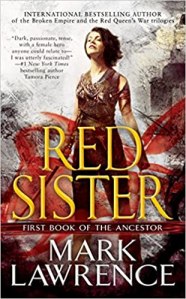
Red Sister, cover

First volume of Book of the Ancestor

For example, in Mark Lawrence’s Book of the Ancestor series, the very first book of the trilogy suggests that certain things are going to happen before the end.  But (minor spoiler here) that scene, which is presented in several places during the story, is always incomplete and carefully limited; and when it finally occurs, the context makes it quite different from what we were led to expect.  I found myself feeling that the author had sort of cheated – although that didn’t diminish my enjoyment of the story; it led me to wonder whether the foreshadowing scenes were really necessary at all.

In the limiting case, any first-person story gives us a pretty good idea that the narrator will survive at least to the end of the story, as noted in TV Tropes’ article on First-Person Perspective.  Although it’s been known to happen that the hero dies at the end; the tale may conclude there, or may drop back to a third-party coda for the conclusion.

Similarly, the spoiler effect is already present in any classic tale where one already knows the conclusion—the Arthuriad, for example.  Most ancient literature was written this way; Homer’s readers already knew that Troy lost the war.  In such cases, our anticipation is not to learn the outcome of the story, but to find out how the author is going to get us there—as is also the case with many genre stories, such as romances and mysteries, and with historical fiction.

The Function of Foreshadowing

As noted above, foreshadowing of any type serves the purpose of shaping our expectations and building suspense.  The mere glimpse attracts more attention than a complete revelation—a principle every fashion designer knows.  The Wikipedia article also suggests that foreshadowing can make later events seem more plausible, since we’re already conditioned to expect them.

Plausibility can also be served by the lampshading function of a character’s anticipatory retrospective reflections.  When Peters’ heroine in Summer of the Dragon comments on her own reaction—“ my compassion was stupid.  I didn’t know how stupid until”—we are a little less inclined to excoriate the character for being an idiot, since the reflection makes clear that they now know they were an idiot.

So, if “little did I know” has legitimate functions, what’s the problem with it?

Looking Through a Character’s Eyes

Woman sits on wall looking out over a city

Viewpoint
(Image by Pexels from Pixabay)

There’s a strong trend these days toward choosing the viewpoint of a story to encourage the reader to identify as closely as possible with the main character(s).  If a story isn’t told in first person, then one is advised to use “close” or “deep” third person, where the reader’s point of view is tightly limited to that of a particular character.  There may be more than one viewpoint character, but while we’re in a given person’s head, we see only what they see, know only the things they know, experience their feelings as we face their challenges with them.

Presumably this is intended to make the reading experience more engaging and immersive.  The frequent use today of present tense (“I open the door”) rather than the usual “narrative past” (“I opened the door”)—for example, in the Hunger Games trilogy—appears to be another means to the same end.

Now, I’m not slavishly devoted to the “close third” option.  Plenty of the stories I read growing up were told in “omniscient” third person, where the author felt free to give the reader information the characters were not privy to.  In the lost world-ship story Orphans of the Sky, for example, Heinlein fills us in on things that the characters, given the boundaries of their experience, cannot understand.  Or consider Victor Hugo’s notorious disquisition on the Paris sewer system in Book the Second of Volume Five in Les Misérables.  I’m comfortable with a more ‘distant’ viewpoint; I can read The Silmarillion as well as The Lord of the Rings.

The Downside of Knowing

Image of eye, shadowed

Image by Helmut Strasil from Pixabay

But to my mind, the heavy-handed “little did I know” sort of foreshadowing does tend to pull one out of the story.  We now know something the viewpoint character doesn’t; we are no longer sharing their feelings in the moment, but rather their retrospective evaluation based on later knowledge.  We are not quite in the internal time of the story, but viewing it sub specie aeternitatis, from a point of view that is not time-bound.  This distances us to some degree from the story.

The specific foreshadowing typical of these hints, as distinct from a general air of ominousness, builds dramatic tension; but it also reduces surprise.  Of course, this kind of surprise is lost the second time you read any book.  We already know what’s going to happen.  Still, the building up of expectations proportionately reduces even the apparent freshness of the experience when the foreshadowed event finally takes place.  We may find ourselves thinking more about the later events that are being implied than being “mindful” about the current action.

That diversion from the ‘narrative present’ may be particularly distracting when we don’t feel that the author makes good on the implied threat of the foreshadowing.  If we’re told that something terrible is in the offing, and then it turns out not to be so bad after all, we may feel disappointed or cheated.  Greeley’s stories are especially subject to this problem; on the second read-through, we may feel we’re being manipulated when the author earnestly warns us to expect something awful, but we know the outcome won’t live up to the warning.  After a while, we may begin to take the author’s insinuations with a grain of salt, since we know their habit of overthreatening and not delivering.

The not-delivering can actually be a relief, rather than a letdown:  ‘Whew, that wasn’t as bad as I thought it was going to be.’  That reaction makes me ambivalent about the faux foreshadowing.  The release of dramatic tension in a positive way may be as satisfying as the fulfillment in a negative way.  Perhaps overthreatening actually is a useful device—particularly if we want the reader to be relieved rather than appalled.

My sense, in the end, is that “little did I know” is a technique to be used with care.  Foreshadow away; but be sure of exactly what you’re trying to achieve and how the language used will accomplish it.

Portraying the Transhuman Character

More Than Human

Kevin Wade Johnson’s comments on my recent post about The Good Place raised a couple of issues worth a closer look.  Here’s one:

Lots of science fiction, and some fantasy, deals with characters who are greater, or more intelligent, or more gifted in some way, than mere humans.  But we the authors and readers are mere humans.  How do we go about showing a character who’s supposed to be more sublime than we can imagine?

It’s one thing to have characters whose capabilities are beyond us.  Superman can leap tall buildings with a single bound; I can’t.  But I can easily comprehend Superman’s doing so.  (I can even see it at the movies.)  On the other hand, if a character is supposed to be so intelligent I can’t grasp their reasoning, or has types of knowledge that are beyond me, that’s harder to represent.  I can simply say so:  “Thorson had an intelligence far beyond that of ordinary men.”  But how can I show it?

Long-Lived Experience

There are a number of ways this can come up.  For example, if a character lived a very long time, would their accumulated experience allow for capabilities, or logical leaps in thinking, beyond what we can learn in our short lives?

I’m thinking of a Larry Niven story—I’m blanking on the name:  maybe one of the “Gil the Arm” stories?—in which a character who appears to be a young woman turns out to be centuries old, and when she drops the deception, she moves with uncanny grace—she doesn’t bump into anything or trip over her own feet, because she’s had that long to train herself in how to move (without the limitations imposed by our bodies’ degeneration from aging).

Of course, a story about long-lived people doesn’t have to take long-lived learning into account.  The depiction of the “Howard Families” in Heinlein’s Methuselah’s Children and Time Enough for Love almost seem dedicated to the opposite proposition, that no matter how long we live, we’re basically the same kinds of personalities; we don’t learn much.

Galadriel, radiantIn a similar way, Tolkien’s immortal elves may seem ineffably glorious to us, but their behavior often seems all too human—especially if you read The Silmarillion, where elves make mistakes, engage in treachery, and allow overweening pride to dictate their actions in ways that may surprise those of us familiar only with LotR.  On the other hand, the books and movies do succeed in convincing us that characters like Galadriel and Gandalf are of a stature that exceeds human possibility.

Logic and Language

There are other ways to have transhuman abilities.  As Kevin observes, Niven’s “Protectors” fit the description.  Niven imagines a further stage of human development—something that comes after childhood, adolescence, and adulthood—that we’ve never seen, because when our remote ancestors arrived on Earth from elsewhere, they lacked the plants hosting the symbiotic virus necessary for transition to that final stage.  The “trans-adult” Protectors are stronger, faster, and more durable than ordinary humans.  They also think faster.  Thus Niven shows them as following out a chain of logic with blinding speed to its conclusion, allowing them to act long before regular humans could figure out what to do.  Because this is a matter of speed, not incomprehensible thinking, Niven can depict a Protector as acting in ways that are faster than normal, but are explainable once we sit down and work out the reasoning.

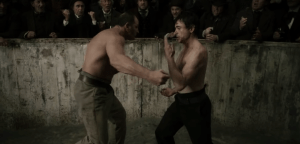
Sherlock Holmes, arena fight sceneA visual analogue is used in the 2009 and 2011 Sherlock Holmes films starring Robert Downey, Jr.  Unlike most other treatments of the character, Guy Ritchie’s version supposes that Holmes’ incredible intelligence can be used not only for logical deduction, but to predict with lightning speed how a hand-to-hand combat may develop.  Holmes thus becomes a ninja-like melee fighter, so effective as to confound all opponents.  The movie shows us this by slowing down the process that to Holmes is instantaneous:  we see a very short montage of positions and moves as they would occur, or could occur, before we see Holmes carry out the final “conclusion” of his martial reasoning.  This allows us to appreciate what the quasi-superhuman character is doing and why, without actually having to execute the same process ourselves.

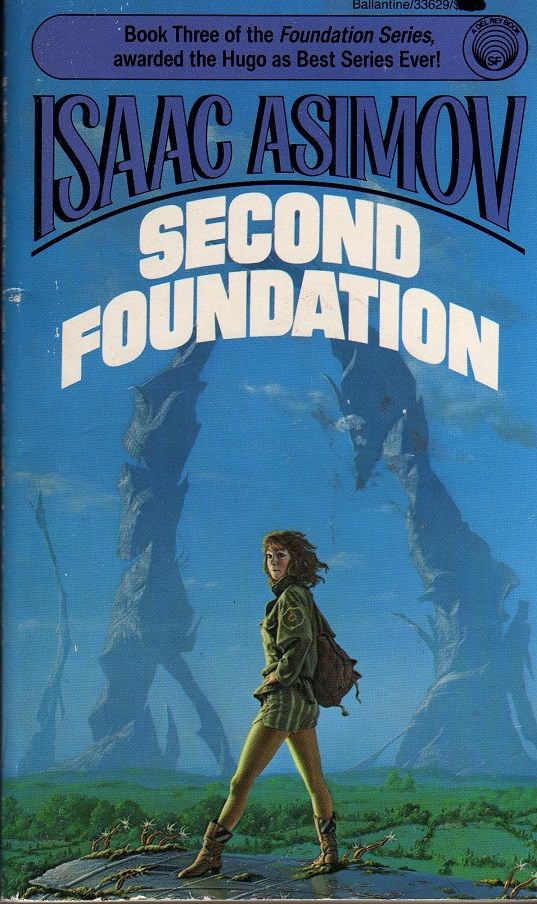
Preternatural intelligence may be more subtle in its effects.  Such a person may, for example, be able to understand things fully from what, to us, would be mere hints and implications.  So, for example, when Isaac Asimov introduces the members of the Second Foundation in his Foundation series, he tells us that their tremendous psychological training allows them to talk among themselves in a manner so concise and compressed that entire paragraphs require only a few words.

Speech as known to us was unnecessary.  A fragment of a sentence amounted almost to long-winded redundancy.  A gesture, a grunt, the curve of a facial line—even a significantly timed pause yielded informational juice.  (Second Foundation, end of chapter 1, “First Interlude,” p. 16)

Second Foundation coverBreaking the fourth wall, Asimov warns us that his account is “about as far as I can go in explaining color to a blind man—with myself as blind as the audience.”  (same page)  He then adroitly avoids showing us any of the actual conversation; instead, he says he’s “freely translating” it into our ordinary language.  This move illustrates one of the classic ways of presenting the incomprehensible in a story:  point out its incomprehensibility and “translate” into something we can understand.  (Note that this is much more easily done in writing than in a visual medium such as TV or the movies.)

A similar technique is used by Poul Anderson in his 1953 novel Brain Wave, which starts with the interesting premise that in certain regions of space, neurons function faster than in others.  When Earth’s natural rotation around the center of the galaxy brings it into a “faster” area, the brains of every creature with a central nervous system speed up, and human beings (as well as other animals) all become proportionately smarter.  Anderson notes that the speech of the transformed humans would be incomprehensible to us and, like Asimov, “translates” it for our convenience.  When a couple of the characters, in a newly invented faster-than-light spaceship, accidentally cross the border back into the “slow zone,” they are unable to understand the controls they themselves designed until the ship’s travel brings them out and lets their intelligence return to its new normal.  (Anderson’s concept may have been the inspiration for the “Zones of Thought” universe later developed in several fascinating stories by Vernor Vinge.)

Showing and Telling

We can glean some general principles from these examples.  If the extraordinary acts don’t actually have to be shown in the medium I’m using, I can simply point to them and tell the reader they’re there.  In a written story, I can say my main character is a world-class violinist without having to demonstrate that level of ability myself.  (Although if I have some experience in that particular art, I’ll be able to provide some realistic details, to help make my claim sound plausible.)  But if the supernormal achievement is something that can be shown in our chosen medium, we have to be able to demonstrate it:  a movie about the great violinist will have to exhibit some pretty masterful violin-playing, or those in the audience who know something about the art will laugh themselves silly.

Flowers For Algernon coverWe should note that there are good and bad ways of telling the audience about a character’s superiority.  In the unforgettable short story “Flowers for Algernon,” which consists entirely of diary entries by Charlie Gordon, the main character, the text vividly shows us the effects of an intelligence-raising treatment on a man of initially lower-than-normal intelligence.  The entries improve so radically in writing competence and understanding that when Charlie describes how his brainpower is beginning to exceed that of ordinary humans, we believe him, because we’re already riding on the curve of rising ability up to our own level that is apparent in the text—a true tour de force of writing.  On the other hand, in the drastically worse movie version, Charly (1968), the screenwriters are reduced to having Charly stand in front of an audience of experts and scornfully dismiss the greatest intellectual achievements from human history—a weak and ineffective technique at best for conveying superiority.

Summary

This quick review of the problem turns up several methods for handling supernormal abilities in a story.


  • If the superior ability is intelligible to us ordinary people in the audience—maybe it’s just doing normal things faster—we can have the wiser or super-enabled person explain it to someone less wise: our last post’s Ignorant Interlocutor.
  • If the advantage is mainly a matter of speed, we can slow it down to a speed at which regular people can follow the action.
  • If we can get away without actually showing the ability in question, we may be able to point toward it, or “translate” it into something we can understand, and convincingly tell the audience about it—if we can achieve the necessary suspension of disbelief.
  • If a character is supposed to be, let us say, preternaturally wise, and there’s simply no way to avoid showing that in the dialogue, the best we can do is to evoke the best we can do—have the character be as wise as possible—and imply ‘like this, only more so.’ This method—like “projecting” a line or a curve—is the method of “supereminence,” which is sometimes employed in theological talk about things that are inherently beyond our full understanding.


Kicking around this question makes us aware that portraying the more-than-human character is only a special case of a more general problem.  When our stories try to incorporate anything that’s indescribable, incomprehensible, how do we handle that?  Our F&SF stories frequently want to reach out beyond the boundaries of human experience, yet in a tale written for ordinary humans.  We’ll talk about the more general question next time.

The Select Society of Protectors

Sorry about the delay between posts—I’ve been under the weather lately.


I was recently reading a new “Sharing Knife” story by Lois McMaster Bujold, and it suddenly occurred to me that the relationship of Bujold’s Lakewalkers to Farmers is exactly that of Anne McCaffrey’s Dragonriders to Holders.

But let me back up a bit.

The Sharing Knife

The world of Bujold’s Sharing Knife series is a difficult and dangerous one.  Most people live in a basically agrarian culture, a sort of cross between the traditional medieval fantasy world and the Wild West.  They fear the enigmatic “Lakewalkers,” men and women who wander about the countryside in “patrol” groups and are rumored to have magical powers.  The Lakewalkers claim to be searching for what ordinary people call “blight bogles,” but some consider these to be a mere myth.

They’re not a myth, of course.  In reality the Lakewalkers, who have the ability to use a kind of magic they call “groundwork” (an extremely interesting and well-developed idea in itself), are constantly on the watch to destroy “malices” as they arise.  These malices are truly nasty beings that can mentally enthrall normal humans and mutate animals into humanoid minions.  If the Lakewalkers weren’t killing them off (via the grim “sharing knife” methd of the title), the malices would overrun the whole world.

Many Lakewalkers tend to look down on the people they are defending, whom they refer to generally as “farmers.”  Much of the interest of the story has to do with the prickly relationship between these two interdependent groups, explored through the romance between a farm girl, Fawn, and a Lakewalker patroller, Dag.

The Dragonriders of Pern

As I mentioned in an earlier post, Anne McCaffrey’s Dragonriders of Pern is a science fiction series that reads like fantasy.  The planet Pern is protected by men and women riding flying dragons.  The dragons breathe fire to destroy an alien organic “Thread” that falls from the sky and, if allowed to spread, would multiply to consume the planet.  To qualify as a full-fledged dragonrider, one must have the potential for a certain kind of telepathy that allows rider and dragon to bond at the dragons’ birth.

Dragonflight coverOne of the things that makes the Pern stories sound like fantasy is the quasi-medieval political structure.  A “Lord Holder” resembles a feudal monarch ruling over a sizable population of farmer/serfs, crafters, and minor nobility.  But here the dragonriders form a separate hierarchy.  The riders’ internal pecking order is a combination of aristocracy and meritocracy:  the rider of the senior gold (female) dragon is a kind of queen; the rider whose bronze dragon mates with the gold becomes leader of the entire group that constitutes a Weyr; and those who lack the telepathic talent are servitors (at the lowest level, “drudges”).

While the depiction of Pernese society mellowed a good bit over the course of the series—both holders and riders were pretty high-handed and violent at the beginning, less so later—one consistent theme is the uneasy relationship between the dragonriders and the common folk.  Everyone knows (though they may forget in the generations between periodic Thread attacks) that the riders are essential to preserve the planet:  “Worlds are lost or worlds are saved / From those dangers dragon-braved.”  But the holders often resent the taxes imposed to support the Weyrs and the “searches” in which the dragonriders carry off likely young people to see if they can “impress” a dragon.  Managing this tension consumes a good deal of the main characters’ time in the early books.

The Protectors and the Protected

Now I can make clear the analogy I noticed.  In each case we have a relatively small society of people set apart from ordinary folks, in a good cause:  they are dedicated to protecting the larger population.  The select group of protectors are genuine heroes who possess special talents that fit them for the role.  But the protectors are not stainless; they can abuse their powers.  And the grateful population they defend aren’t always grateful; they may resent the special powers and privileges of the defenders, even aside from the possible abuse of those advantages.

It seems to be a fruitful trope for storytelling.

Rangers and Protectors

Strider with pipe at the Prancing PonyWe can find a similar structure, though not so dominant, back in The Lord of the Rings.  You’ll recall that Strider—Aragorn—is one of a mysterious group of wanderers who travel the countryside, the Dúnedain or Rangers.  They are regarded with suspicion by the ordinary folks in Bree; Barliman Butterbur the innkeeper warns Frodo about the suspicious-looking stranger sitting in the corner.  Yet all the time the Rangers are patrolling the borders of the peaceful lands of Bree and the Shire, fending off possible threats.  Aragorn says at the Council of Elrond:

‘Strider’ I am to one fat man who lives within a day’s march of foes that would freeze his heart, or lay his little town in ruin, if he were not guarded ceaselessly.  Yet we would not have it otherwise.  If simple folk are free from care and fear, simple they will be, and we must be secret to keep them so.  (Fellowship of the Ring, II.2, p. 261)

Aragorn’s fond, if slightly aggrieved, remark brings out a difference.  Pern’s dragonriders are a public society of defenders; everyone knows of their special role.  But Tolkien’s Dúnedain, like the Lakewalkers in Bujold’s more recent fantasy, play a less public role.  They are set apart, but because their heroism is unrecognized, they are objects more of suspicion than of admiration.

Pak protector (by Christopher Bretz)

Pak protector – illustration courtesy of Christopher Bretz (bretz@bretz.ca)

For a more science-fictional take, consider Larry Niven’s Protectors, which figure in the novel Protector (naturally) and in the Ringworld stories.  Niven imagines that humanity is descended from a species called the Pak, which matures through three life stages:  child, breeder, and protector.  The transition from the not-very-bright breeder stage to the highly intelligent and formidable protector stage is triggered by eating a root the characters call “tree-of-life.”  When a Pak colony arrived on Earth ages ago, however, the soil lacked a chemical necessary for the tree-of-life root to function.  The “breeders” could not change into protectors; instead, they evolved on their own into modern-day humans.  Niven’s intriguing conceit is what we see as symptoms of old age actually represent the incomplete transition to the gaunt, tough, hairless protector stage.

Niven depicts the protectors as genetically compelled to protect the members of their own family or clan—the ones who “smell right.”  A functioning Pak colony wouldn’t be as much like a human society as on Pern or Middle-Earth or Bujold’s imaginary world:  it would consist of carefree, barely-sentient breeders watched over by creatures ruthlessly dedicated to their preservation.  Think of it as an extreme case of the separation of defenders from defended.

Counter-Examples

On the other hand, a number of stories depict defenders who are much more thoroughly integrated into their broader societies.

Nita and Kit ascend over New York, from Young Wizards

Young Wizards

In Diane Duane’s Young Wizards series, youngsters with the potential for wizardry are called, not by receiving a letter from Hogwarts, but in more obscure ways—for example, running across a library book called So You Want To Be A Wizard.  There are more wizards around than one might think, because on our planet they don’t advertise their powers:  young wizards still go to school, grown-up wizards might be writers or sell advertising.  (And not all of them are human; there are some very entertaining books about feline wizards.)  But all of them are dedicated to the preservation and fostering of Life, by way of the Wizard’s Oath each must take.  In this setup, there’s no resentment of the society of protectors because no one knows they exist; and abuse of wizardly powers is almost unheard-of, since violating the Oath tends to result in forgetting that wizardry even exists.

Lensman image

Kim Kinnison, Gray Lensman

By contrast, the elite corps of Lensmen in E.E. Smith’s famous series are publicly known and highly respected.  They play the role of galactic policemen and secret agents, with particular attention to the mysterious pirates and drug-runners called “Boskone.”  Like the Young Wizards, the Lensmen are (conveniently) incorruptible, being screened at the outset by the equally mysterious but benevolent Arisians.  (This whole business of incorruptibility is something we need to examine more closely on another occasion.)  But they don’t mind mixing in ordinary society—Gray Lensman includes a scene set at a formal ball—although their grave responsibilities often make them feel set apart in their lonely dedication.

Superheroes, as a class, may occupy the same position.  They live as part of the general public, though their identities are usually secret.  They tend to act as individuals rather than as a whole society, though they do come in small groups (and may occasionally take part in mega-battles that engage the whole range of heroes).  But the modern superhero does show the ambivalence that often characterizes the select defender (Mr. Incredible’s remark that he sometimes wishes the world would just stay saved for a while).  And some graphic novels take up the question of what it’s like for the ordinary person to live in a world full of superheroes—notably Kurt Busiek’s thoughtful Marvels (1994).

Narrative Tensions

The select society of protectors is a fine place for heroes.  But it’s also dangerous.  What if the protectors aren’t incorruptible, and turn bad?  What if they become contemptuous of the people they protect, and come to think of themselves as better than the “rabble”?  In many of the scenarios above, it takes special talents to qualify as one of the defenders.  How likely is it that those who see themselves as specially qualified will end up thinking of themselves as superior?  These questions form fertile ground for various plotlines.

The notion of the select (if not superior) set of defenders may even be seen as applying to a military organization, whose purpose is to protect the general public.  “Citizen soldiers,” or draftees, may see themselves as primarily part of the overall society, temporarily detailed to do their civic duty; but a professional military, which can form its own tightly-knit society with its families and dependents, may be more easily tempted to think of itself as a group apart, with its own loyalties and camaraderie.  In fiction, the entire genre of military SF borders the trope we’re examining here.  In real life, the American military, at least, seems to have avoided that trap; we have not yet seen anything like a military coup.

Everyone Is a Tuvela

It’s interesting to contemplate the opposite trope:  the citizen soldier model taken to its limit.

The Demon Breed, coverIn James Schmitz’s 1968 novel The Demon Breed, a biochemist named Nile Etland on the human colony world Nandy-Cline discovers that independent researcher Ticos Cay has been captured by cruel and formidable aliens called the Parahuans.  Ticos has played on the Parahuans’ own near-superstitious fears to convince them that Nile is a Tuvela, a member of a secret society of superhumans that are the real rulers of human civilization.  All Nile has to do is convince the invaders that she is, in fact, a superior being it would be death to tangle with.  And, with the help of Ticos, two mutant otters, and her own encyclopedic knowledge of the unique biology of Nandy-Cline, she does a marvelous job of pulling the wool over the Parahuans’ eyes and sending them fleeing back to their own worlds.

But there are no Tuvelas.  Nile is a brilliantly resourceful and competent woman, but she’s not superhuman.  Neither is Ticos, nor any of the other inhabitants who are involved at the end in dispersing the Parahuans.  They’re simply ordinary humans.  And there is no secret organization.  Rather, Schmitz’s hypothesis is that a significant fraction of ordinary people (Ticos calls them “antipredators”) can take on that defensive role when extraordinary circumstances require them to do so.  As one character remarks, the Parahuans would have run into “Tuvela” behavior no matter where they sought to attack.

The title The Demon Breed doesn’t refer to the Parahuans.  It refers, from the unfortunate Parahuans’ point of view, to the uncannily resilient humans.  Like the sturdy hobbits of the Shire, human beings are capable of rising to the occasion.  At the end of the story, when the local Nandy-Cline military forces have mobilized to make sure the fleeing Parahuans don’t escape, Nile reflects:  “The human demon was awake and snarling on Nandy-Cline” (ch. 9).

The select society of defenders is a potent storytelling trope; but so is the distributed resourcefulness of the ordinary person.  And both may be useful to keep in mind as we act where we are needed.