Civilization and the Rule of Law (reprise)

Another rerun, adapted from a post from seven years ago.

We’ve talked about how the Star Trek-Star Wars divide reflects preferences for a more lawful or more chaotic world; how F&SF stories often show us a defense of civilization against chaos; and how civilization makes science possible and rests in turn on human technology.  But both order and technology can be oppressive.  The missing element is the rule of law.

Universal Laws

It’s a crucial element of right governance that there are rules applying to everyone, as opposed to the arbitrary wishes of a dictator, who can make decisions based on favoritism, political preferences, or personal relationships.  The Wikipedia article describes rule of law as “the legal principle that law should govern a nation, as opposed to being governed by decisions of individual government officials.”
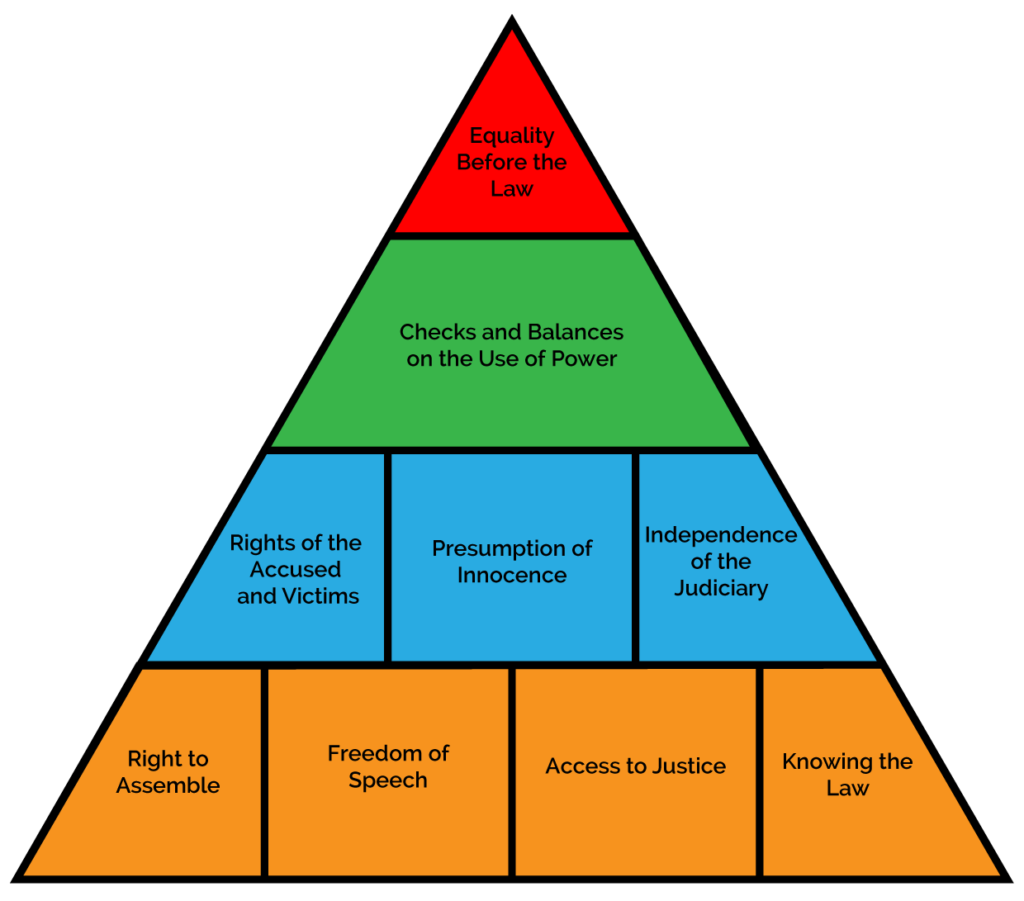
Rule of Law pyramid
(Rule of Law Institute of Australia)

As we saw in the recently updated post The Good King (reprise), the concept of the rule of law goes back at least to Aristotle.  It became a central principle of the American founders via the English tradition of John Locke.  “Rule of law implies that every citizen is subject to the law, including lawmakers themselves” (Wikipedia again).  It is thus in tension with kingship, where rule is almost by definition arbitrary and personal.  But one can have mixed cases—kings who are bound by certain laws, as in the British constitutional monarchy.

Without the rule of law, we depend on the good behavior of those who have power of some sort—physical, military, economic.  We slide toward the “war of each against all,” where might makes right and the vulnerable are the pawns of the strong.  Autocracy soon follows, as people look for any means to find safety from those who are powerful but unscrupulous.  Hence the quotation from John Christian Falkenberg, which I’ve used before:  “The rule of law is the essence of freedom.”  (Jerry Pournelle, Prince of Mercenaries (New York:  Baen 1989), ch. 21, p. 254.)  Strength itself, a good thing, is only safe under laws.

Test Cases

It’s easy to miss the importance of the rule of law.  We’re typically born into a society with better or worse laws, and criticize them from the inside.  It’s less common to find ourselves in straits where lawfulness as such has collapsed.  Regrettably, sizable numbers of people are exposed to such conditions in the world today.  But many of us are fortunate enough not to see them ourselves.  As always, fantasy and science fiction provide useful “virtual laboratories” for examining the possibilities.
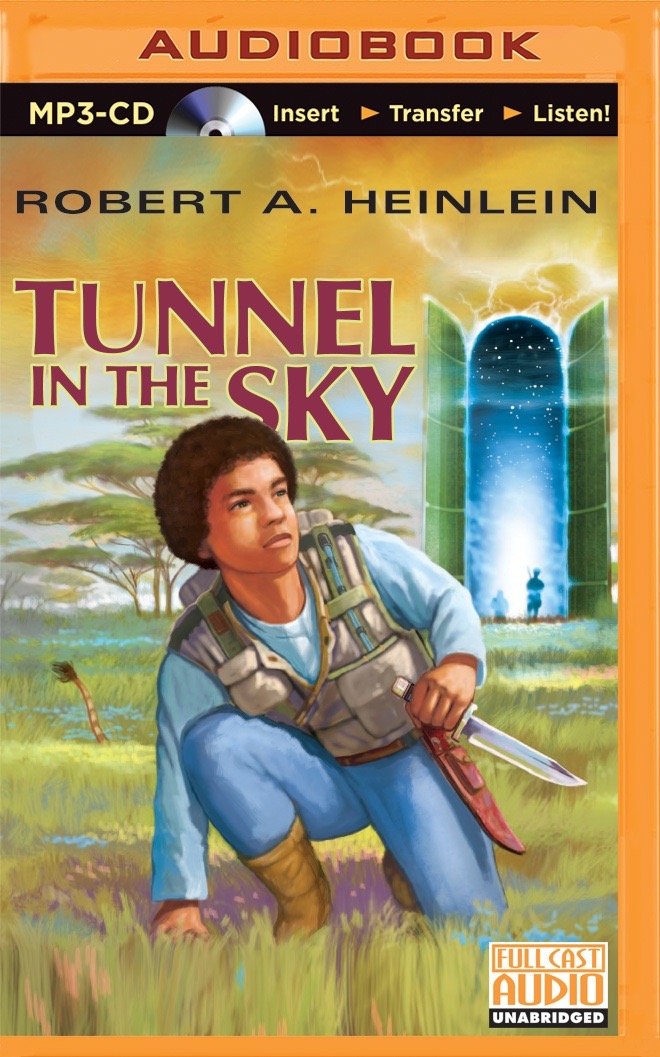
Tunnel in the Sky (audiobook) cover

A classic SF case is where a group thrown into a “state of nature” attempts to set up a lawful society.  For example, in Heinlein’s Tunnel in the Sky (1955), students from a high-school class on survival techniques are given a final exam in which they are dropped onto an unspecified planet to survive for up to ten days.  When an astronomical accident leaves them stranded, they need to organize for the long term.  Rod Walker, the hero, becomes the leader-by-default of a growing group of young people.  The tension between this informal leadership and the question of forming an actual constitution—complete with committees, regulations, and power politics—makes up a central theme of the story.

The Postman movie poster

David Brin’s post-apocalyptic novel The Postman (1985), later made into a 1997 movie with Kevin Costner, illustrates the power of civil order, the unstated practices of a culture, as recalling—and perhaps fostering—the rule of law.  The hero, a wanderer who happens to have appropriated a dead postman’s uniform and mail sack, presents himself as a mail carrier for the “Restored United States of America” to gain shelter in one of the isolated fortress-towns, ruled by petty tyrants, that remain.  His desperate imposture snowballs into a spreading movement in which people begin to believe in this fiction, and this belief puts them on the road toward rebuilding civilization.  The result is a sort of field-test not only of civil order and government, but of what Plato famously imagined as the “noble lie.”

In Niven & Pournelle’s Lucifer’s Hammer (1977), a small community headed by a United States Senator hopes to serve as a nucleus for reconstructing civilization after a comet strike.  We see at the end the strong pull of personal rule or kingship:  as the Senator lies dying, the future of the community will be determined by which of the competing characters gains the personal trust and endorsement of the people—and the hand of the Senator’s daughter, a situation in which she herself recognizes the resurfacing of an atavistic criterion for rule.  Unstated, but perhaps implicit, is the nebulous idea that deciding in favor of scientific progress may also mean an eventual movement back toward an ideal of rule by laws, not by inherited power.

Seeking a Balance

The “laboratory” of F&SF is full of subversions, variations, and elaborations on the rule of law.  In particular, we should note the counter-trend previously discussed as “chaotic good.”  Laws can be stifling as well as liberating.

The Moon is a Harsh Mistress cover

Heinlein’s The Moon Is A Harsh Mistress (1966) imagines how the “rational anarchy” of a lunar prison colony is mobilized to throw off autocratic rule.  The healthy chaos of the libertarian Loonies is hardly utopian, but the story does make it seem appealing.  Interestingly, Heinlein returned to this setting with a kind of critique twenty years later in The Cat Who Walks Through Walls (1985), where the post-revolution lunar anarchy seems much less benign, seen from an outsider’s perspective.

Taran Wanderer book cover

While fantasy seems to concern itself with this issue much less than science fiction, consider the region called the “Free Commots” in Lloyd Alexander’s Chronicles of Prydain.  When protagonist Taran visits this area in the fourth book (Taran Wanderer), he finds a society of independent villages, where the most prominent citizens are master-craftspeople.  They neither have nor need a lord to organize them.  The Commots contrast favorably to the feudal or wilderness regions through which Taran travels.  A kind of anarchic democracy, as an ideal, thus sneaks into what otherwise seems to be a traditional aristocratic high fantasy.

One way of managing the tension between a government of laws and a culture of liberty is the principle of subsidiarity:  the notion that matters should be governed or controlled at the lowest possible organizational level where they can be properly handled.  It’s frequently illustrated in G.K. Chesterton’s ardent defenses of localism.  In The Napoleon of Notting Hill (1904), extreme localism is played for laughs—“half fun and full earnest,” to borrow Andrew Greeley’s phrase.  The more mature Tales of the Long Bow (1924), which might qualify as a sort of proto-steampunk story, treats the idea more seriously, in the form of an oddly high-tech (for 1924) revolt of local liberty against overweening and arbitrary national rule.

It remains true that we need good people as well as sound laws.  “Good men can make poor laws workable; poor men will wreak havoc with good laws” (James M. Landis, 1960; see this article at 432 & n.107).  The quality of a civilization can also be assessed by whether it fosters citizens who act with decency and good judgment even when there isn’t a law to constrain them (as in David Brin’s “Ritual of the Street Corner”).  After all, we neither can nor should try to create laws to govern everything.

But being willing to improvise well in situations where no law applies is different from considering oneself above the law, disdaining the constraints that apply to everybody else.  This is doubly and triply true of rulers, who are constantly tempted to arrogate power and dodge accountability to accomplish their ends.  If a ruler is allowed to get away with law-breaking, we’re headed for trouble.

Brin has noted that the stories that fill and shape our culture—movies, books, television—encourage a broad “suspicion of authority” that tells us all institutions are corrupt or useless, and so are most other people—so that the heroes and heroines of the stories can face and overcome challenges by their heroic actions.  Like most attitudes, suspicion of authority is helpful in moderation, but corrosive when it gets out of hand.  If that attitude leads us to throw over laws and institutions altogether in the hope that individual heroes or autocrats will save us, we need to keep in mind that benevolent dictatorship, unconstrained by law, is just one step away from despotism.

The Fragility of Civilization

When we grow up taking for granted the rule of law, we can fail to see how vulnerable it is—along with the civilization that it reflects and makes possible.

“The Establishment,” as they used to say in the 1960s, seems vast and invulnerable.  When we’re trying to make a change, it seems insuperable, so rigid that nothing can be done about it.  But this is an illusion.  The structure of civilization, good and bad, is fragile.  It’s easier than we think to throw away the rule of law, so painfully constructed (as Rod Walker found), in favor of shortcuts or easy answers to our problems.

One thing F&SF have brought us is a better sense of this vulnerability.  The spate of post-apocalyptic tales in recent years—zombie apocalypses, worldwide disasters, future dystopias like The Hunger Games, going all the way back to the nuclear-war stories of the 1950s—do help us appreciate that our civilization can go away.

But that collapse doesn’t require a disaster.  Civilization, and the rule of law, can erode gradually, insidiously, as in the “Long Night” stories we’ve talked about earlier.

Historically, the Sixties counterculture fostered anarchists who felt “the Establishment” was invulnerable.  Often with the best of intentions, they did more to undermine civil order than they expected.  Those who now see no better aim than breaking up the structures of democratic government and civil life—whether from the side of government, or from the grass roots—also fray the fabric of civilization.  The extrapolations of science fiction and fantasy illustrate why eroding the rule of law should not be taken lightly.

Near the bottom of Brin’s Web home page, he places the following:

I am a member of a civilization

It’s good that we have a rambunctious society, filled with opinionated individualists. Serenity is nice, but serenity alone never brought progress. Hermits don’t solve problems. The adversarial process helps us to improve as individuals and as a culture. Criticism is the only known antidote to error — elites shunned it and spread ruin across history. We do each other a favor (though not always appreciated) by helping find each others’ mistakes.

And yet — we’d all be happier, better off and more resilient if each of us were to now and then say:

“I am a member of a civilization.” (IAAMOAC)

Step back from anger. Study how awful our ancestors had it, yet they struggled to get you here. Repay them by appreciating the civilization you inherited.

It’s incumbent on all of us to cherish and defend the rule of law.  Give up civilization lightly, and we may not have the choice again.

The Good King (reprise)

Watching The Lord of the Rings movies again recently, to share the experience with my wife, brought to mind this post from eight years ago.  Here it is again, with minor updates.

I began to wonder some years back about the curious preference for monarchy in futuristic settings.  In the world at large, monarchies have been retreating in favor of republics and democracies, at least in theory, since 1776.  Why are SF writers so fond of equipping future societies with kings, emperors, and aristocracies?

Star Kingdoms

We can pass lightly over the old-time, pulp-type stories where royal rule is merely part of the local color:  Burroughs’ A Princess of Mars (1912), Edmond Hamilton’s The Star Kings (1949), E.E. Smith’s The Skylark of Space (1928) with its Osnomian royal families.  Here, like flashing swords and exotic costumes, monarchy is simply part of a deliberately anachronistic setting.  Similarly in high fantasy, where aristocracy comes naturally in the typical pseudo-medieval milieu.

But we see royal or aristocratic governments in more modern stories too.  Asimov’s Foundation stories are centered around a Galactic Empire. (See also the more recent Apple+ series of the same name.)  Since that series was based on Gibbons’ The History of the Decline and Fall of the Roman Empire, an Empire was inevitable.  Similarly in Star Wars, which draws heavily on Asimov.  Jerry Pournelle’s CoDominium future history has a First and a Second “Empire of Man.”  David Weber’s heroine Honor Harrington serves the “Star Kingdom of Manticore” (later “Star Empire”), modeled closely on England around 1810.  Lois McMaster Bujold’s Vorkosigan Saga contains a number of polities with different forms of government, but many of the stories focus on Barrayar, which has an Emperor.  Anne McCaffrey’s popular Pern series has no monarch, but has two parallel aristocracies (the feudal Holders and the meritocratic dragonriders).  It got to the point where I began to feel a decided preference for avoiding monarchical or imperial governments in SF storytelling.

The Lure of Kingship

Aragorn with crown

There’s something that attracts us in royalty—or we wouldn’t see so much of it.  I encountered this puzzlement directly.  As a kid reading The Lord of the Rings, I was as moved as anyone by the return of the true King.  I asked myself why.  If I don’t even approve of kingship in theory, why am I cheering for Aragorn?

The reasons we’re drawn to monarchy seem to include—

  • Kings are colorful. (So are princesses.)
  • Stability
  • Personal loyalty
  • Individual agency

The first point is obvious, but the others are worth examining.

Stability

It’s been pointed out that even in a constitutional government, a monarch provides a symbolic continuity that may help to hold a nation together.  British prime ministers may come and go, but the King, or Queen, is always there.  This gives some plausibility to the idea of a future society’s returning to monarchy.

Something like this stabilizing function is behind commoner Kevin Renner’s half-embarrassed harangue to Captain Rod Blaine, future Marquis of Crucis, in Niven & Pournelle’s The Mote in God’s Eye:  “maybe back home we’re not so thick on Imperialism as you are in the Capital, but part of that’s because we trust you aristocrats to run the show.  We do our part, and we expect you characters with all the privileges to do yours!”  (ch. 40)

Unfortunately, relying on the noblesse oblige of the aristocrats doesn’t always work out well.  It depends on who they are.  For every Imperial Britain, there’s a North Korea.  When the hereditary succession breaks down, you get a War of the Roses or Game of Thrones.

Too much depends on getting the right monarch.  By the law of averages, it doesn’t take long before you get a bad ruler, whether by inheritance or by “right of conquest”—and you’re up the well-known creek.

Personal Loyalty

Personal loyalty appeals to us more strongly than loyalty to an institution.  One can pledge allegiance to a state—but even the American Pledge of Allegiance starts with a symbol:  the flag, and then “the Republic for which it stands.”  Loyalty to an individual moves us more easily.

This kind of loyalty doesn’t have to be to a monarch.  Niven & Pournelle’s Oath of Fealty explores how loyalty among, and to, a trusted group of managers can form a stronger bond than the mere institutional connections of a typical modern bureaucracy.  One can be faithful to family (the root of the hereditary element in kingship), to friends, or even an institution or a people.  But it’s easiest with an individual.  This loyalty is the basis for the stability factor above.

Individual Agency

The vast machinery of modern government sometimes seems to operate entirely in the abstract, without real people involved.  “Moscow said today . . .”

In fact it’s always people who are acting.  But it’s easier to visualize this when you have a single person to focus on.  “When Grant advanced toward Richmond . . .”  In the extreme case, we have the ruler who claims to embody the state in his own person:  “L’état, c’est moi” (attributed to Louis XIV, the “Sun King” of France).

In a fascinating 2008 essay, Jo Walton quotes Bujold on political themes in SF:  “In fact, if romances are fantasies of love, and mysteries are fantasies of justice, I would now describe much SF as fantasies of political agency.”  A science fiction character is frequently involved in effecting a revolution, facing down a potential dictator, or establishing a new order—exercising autonomous power.  Walton links this notion of political agency to the fact that SF illustrates change:  “SF is the literature of changing the world.”  The world-changers can be outsiders, or they can be the rulers themselves—as in a number of the examples above.

It’s not surprising that we’re attracted to characters who act outside the normal rules.  We (especially Americans, perhaps) are fond of the idea that good people can act in ways that are untrammeled by the usual conventions.  I’ve already mentioned Robin Hood.  And the whole concept of the superhero—the uniquely powerful vigilante who can be relied on to act for the good—is powered by this attraction.

But this idealization of individual initiative is also dangerous.  Too much depends on getting the right hero—or the right monarch.  It can only work if the independent agent is seriously and reliably good:  virtuous, in the classical sense of virtue as a well-directed “habit” or fixed character trait.  Even then, we may be reluctant to give any hero unlimited power.  Too much is at stake if it goes wrong.

The Rule of Law

Our admiration for the powerful ruler is always in tension with our dedication to the rule of law:  “a government of laws, not of men,” in the well-known phrase attributed to John Adams.  We can see this as far back as Aristotle:  “law should rule rather than any single one of the citizens.  And following this same line of reasoning . . . even if it is better that certain persons rule, these persons should be appointed as guardians of the laws and as their servants.”  (Politics book III, ch. 16, 1287a)

No human being can be trusted with absolute authority.  This is the kernel of truth in the aphorism that “power tends to corrupt and absolute power corrupts absolutely.”  But we can’t get along without entrusting some power to someone.  When we do, it had better be someone who’s as trustworthy as possible.

The Ideal of the Good King

Thus the true king must be a virtuous person—a person of real excellence.  This is the ideal of an Aragorn or a King Arthur, whose return we’re moved to applaud (even against our better judgment).  It should be obvious that the same principles apply to the good queen—or emperor, empress, princess, prince, president, prime minister:  the leader we follow.  But I’ll continue using “king” for simplicity’s sake.

What virtues do we look for in a good monarch—aside from the obvious ones of justice, wisdom, courage, self-control?

If the ruler or rulers are going to be “servants of the laws,” they require humility.  A king who serves the law can’t claim to be its master.  Arrogance and hubris are fatal flaws in a ruler.  For example, we should always beware of the leader who claims he can do everything himself and is unable to work with others.

The good king is also selfless—seeking the common good of the people, not his own.  Self-aggrandizement is another fatal flaw.

In effect, what we’re looking for is a ruler who doesn’t want to rule:  a king who believes in the sovereignty and the excellence of common people.

Aragorn defers to Frodo

It’s significant that Aragorn, our model of the good king, is introduced in LotR as “Strider,” a scruffy stranger smoking in a corner of a common inn.  Even when he’s crowned in victory, he remembers to exalt the humble.  The movie has him tell the four hobbits, “You kneel to no one.”  Tolkien’s text is more ceremonious:  “And then to Sam’s surprise and utter confusion he bowed his knee before them; and taking them by the hand . . . he led them to the throne, and setting them upon it, he turned . . . and spoke, so that his voice rang over all the host, crying:  ‘Praise them with great praise!’”  (Book VI, ch. 4, p. 232)

We see the same essential humility and selflessness in other admirable leaders, kings or not:  Taran in the Chronicles of Prydain, and the revolutionary princess in Lloyd Alexander’s Westmark trilogy; Niven & Pournelle’s Rod Blaine; Jack Ryan in Tom Clancy’s novels; “Dev” Logan, head of Omnitopia Inc. in Diane Duane’s Omnitopia Dawn—the unpretentious opposite of the “imperial CEO.”  America was fortunate enough to have such an example in the pivotal position of first President, George Washington.

The Alternative

At the other end of the spectrum, the most dangerous person to trust is an unprincipled and unscrupulous autocrat—someone convinced of his personal superiority and infallibility.  Giving power to an individual who has no interest in serving the common good, but only in self-aggrandizement, puts a nation in subjection to a Putin, a Mussolini, a Kim Jong-un.

The antithesis of the good king is the tyrant, who, however innocently he may start out, figures in our stories mainly as the oppressor to be overthrown.  It’s much better, if possible, to intercept such a potentially ruinous ruler before the tyranny comes into effect:  Senator Palpatine before he becomes Emperor, Nehemiah Scudder before he wins his first election.  Allowing the tyrant to gain power may make for good stories, but it generates very bad politics.

If we must have strong leaders, then in real life as well as in stories, character is key—and hubris is deadly.

Portraying the Transhuman Character

More Than Human

Kevin Wade Johnson’s comments on my recent post about The Good Place raised a couple of issues worth a closer look.  Here’s one:

Lots of science fiction, and some fantasy, deals with characters who are greater, or more intelligent, or more gifted in some way, than mere humans.  But we the authors and readers are mere humans.  How do we go about showing a character who’s supposed to be more sublime than we can imagine?

It’s one thing to have characters whose capabilities are beyond us.  Superman can leap tall buildings with a single bound; I can’t.  But I can easily comprehend Superman’s doing so.  (I can even see it at the movies.)  On the other hand, if a character is supposed to be so intelligent I can’t grasp their reasoning, or has types of knowledge that are beyond me, that’s harder to represent.  I can simply say so:  “Thorson had an intelligence far beyond that of ordinary men.”  But how can I show it?

Long-Lived Experience

There are a number of ways this can come up.  For example, if a character lived a very long time, would their accumulated experience allow for capabilities, or logical leaps in thinking, beyond what we can learn in our short lives?

I’m thinking of a Larry Niven story—I’m blanking on the name:  maybe one of the “Gil the Arm” stories?—in which a character who appears to be a young woman turns out to be centuries old, and when she drops the deception, she moves with uncanny grace—she doesn’t bump into anything or trip over her own feet, because she’s had that long to train herself in how to move (without the limitations imposed by our bodies’ degeneration from aging).

Of course, a story about long-lived people doesn’t have to take long-lived learning into account.  The depiction of the “Howard Families” in Heinlein’s Methuselah’s Children and Time Enough for Love almost seem dedicated to the opposite proposition, that no matter how long we live, we’re basically the same kinds of personalities; we don’t learn much.

Galadriel, radiantIn a similar way, Tolkien’s immortal elves may seem ineffably glorious to us, but their behavior often seems all too human—especially if you read The Silmarillion, where elves make mistakes, engage in treachery, and allow overweening pride to dictate their actions in ways that may surprise those of us familiar only with LotR.  On the other hand, the books and movies do succeed in convincing us that characters like Galadriel and Gandalf are of a stature that exceeds human possibility.

Logic and Language

There are other ways to have transhuman abilities.  As Kevin observes, Niven’s “Protectors” fit the description.  Niven imagines a further stage of human development—something that comes after childhood, adolescence, and adulthood—that we’ve never seen, because when our remote ancestors arrived on Earth from elsewhere, they lacked the plants hosting the symbiotic virus necessary for transition to that final stage.  The “trans-adult” Protectors are stronger, faster, and more durable than ordinary humans.  They also think faster.  Thus Niven shows them as following out a chain of logic with blinding speed to its conclusion, allowing them to act long before regular humans could figure out what to do.  Because this is a matter of speed, not incomprehensible thinking, Niven can depict a Protector as acting in ways that are faster than normal, but are explainable once we sit down and work out the reasoning.

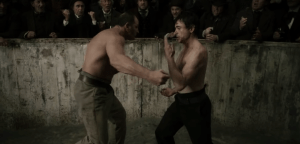
Sherlock Holmes, arena fight sceneA visual analogue is used in the 2009 and 2011 Sherlock Holmes films starring Robert Downey, Jr.  Unlike most other treatments of the character, Guy Ritchie’s version supposes that Holmes’ incredible intelligence can be used not only for logical deduction, but to predict with lightning speed how a hand-to-hand combat may develop.  Holmes thus becomes a ninja-like melee fighter, so effective as to confound all opponents.  The movie shows us this by slowing down the process that to Holmes is instantaneous:  we see a very short montage of positions and moves as they would occur, or could occur, before we see Holmes carry out the final “conclusion” of his martial reasoning.  This allows us to appreciate what the quasi-superhuman character is doing and why, without actually having to execute the same process ourselves.

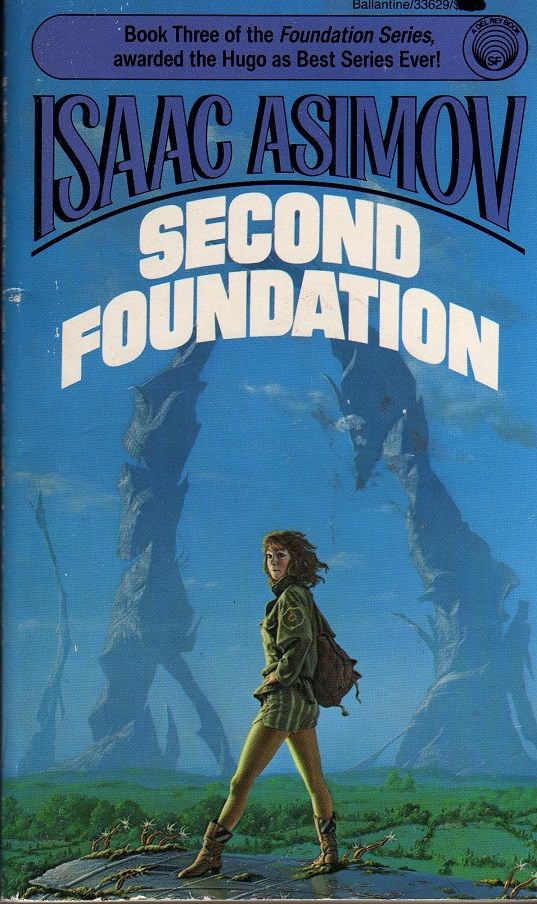
Preternatural intelligence may be more subtle in its effects.  Such a person may, for example, be able to understand things fully from what, to us, would be mere hints and implications.  So, for example, when Isaac Asimov introduces the members of the Second Foundation in his Foundation series, he tells us that their tremendous psychological training allows them to talk among themselves in a manner so concise and compressed that entire paragraphs require only a few words.

Speech as known to us was unnecessary.  A fragment of a sentence amounted almost to long-winded redundancy.  A gesture, a grunt, the curve of a facial line—even a significantly timed pause yielded informational juice.  (Second Foundation, end of chapter 1, “First Interlude,” p. 16)

Second Foundation coverBreaking the fourth wall, Asimov warns us that his account is “about as far as I can go in explaining color to a blind man—with myself as blind as the audience.”  (same page)  He then adroitly avoids showing us any of the actual conversation; instead, he says he’s “freely translating” it into our ordinary language.  This move illustrates one of the classic ways of presenting the incomprehensible in a story:  point out its incomprehensibility and “translate” into something we can understand.  (Note that this is much more easily done in writing than in a visual medium such as TV or the movies.)

A similar technique is used by Poul Anderson in his 1953 novel Brain Wave, which starts with the interesting premise that in certain regions of space, neurons function faster than in others.  When Earth’s natural rotation around the center of the galaxy brings it into a “faster” area, the brains of every creature with a central nervous system speed up, and human beings (as well as other animals) all become proportionately smarter.  Anderson notes that the speech of the transformed humans would be incomprehensible to us and, like Asimov, “translates” it for our convenience.  When a couple of the characters, in a newly invented faster-than-light spaceship, accidentally cross the border back into the “slow zone,” they are unable to understand the controls they themselves designed until the ship’s travel brings them out and lets their intelligence return to its new normal.  (Anderson’s concept may have been the inspiration for the “Zones of Thought” universe later developed in several fascinating stories by Vernor Vinge.)

Showing and Telling

We can glean some general principles from these examples.  If the extraordinary acts don’t actually have to be shown in the medium I’m using, I can simply point to them and tell the reader they’re there.  In a written story, I can say my main character is a world-class violinist without having to demonstrate that level of ability myself.  (Although if I have some experience in that particular art, I’ll be able to provide some realistic details, to help make my claim sound plausible.)  But if the supernormal achievement is something that can be shown in our chosen medium, we have to be able to demonstrate it:  a movie about the great violinist will have to exhibit some pretty masterful violin-playing, or those in the audience who know something about the art will laugh themselves silly.

Flowers For Algernon coverWe should note that there are good and bad ways of telling the audience about a character’s superiority.  In the unforgettable short story “Flowers for Algernon,” which consists entirely of diary entries by Charlie Gordon, the main character, the text vividly shows us the effects of an intelligence-raising treatment on a man of initially lower-than-normal intelligence.  The entries improve so radically in writing competence and understanding that when Charlie describes how his brainpower is beginning to exceed that of ordinary humans, we believe him, because we’re already riding on the curve of rising ability up to our own level that is apparent in the text—a true tour de force of writing.  On the other hand, in the drastically worse movie version, Charly (1968), the screenwriters are reduced to having Charly stand in front of an audience of experts and scornfully dismiss the greatest intellectual achievements from human history—a weak and ineffective technique at best for conveying superiority.

Summary

This quick review of the problem turns up several methods for handling supernormal abilities in a story.


  • If the superior ability is intelligible to us ordinary people in the audience—maybe it’s just doing normal things faster—we can have the wiser or super-enabled person explain it to someone less wise: our last post’s Ignorant Interlocutor.
  • If the advantage is mainly a matter of speed, we can slow it down to a speed at which regular people can follow the action.
  • If we can get away without actually showing the ability in question, we may be able to point toward it, or “translate” it into something we can understand, and convincingly tell the audience about it—if we can achieve the necessary suspension of disbelief.
  • If a character is supposed to be, let us say, preternaturally wise, and there’s simply no way to avoid showing that in the dialogue, the best we can do is to evoke the best we can do—have the character be as wise as possible—and imply ‘like this, only more so.’ This method—like “projecting” a line or a curve—is the method of “supereminence,” which is sometimes employed in theological talk about things that are inherently beyond our full understanding.


Kicking around this question makes us aware that portraying the more-than-human character is only a special case of a more general problem.  When our stories try to incorporate anything that’s indescribable, incomprehensible, how do we handle that?  Our F&SF stories frequently want to reach out beyond the boundaries of human experience, yet in a tale written for ordinary humans.  We’ll talk about the more general question next time.

Changing the Past – Or Avenging It

Introduction

Avengers Endgame posterI set out to do an analytical essay on Three Theories of Time Travel—until I realized that Larry Niven’s astute and entertaining brief article “The Theory and Practice of Time Travel” (1971) had already covered those theories pretty well.  (You can find that article in Niven’s All the Myriad Ways, and a couple other locations.)  So I decided instead to comment on how they’re used in Avengers:  Endgame, which seems to invoke at least two and possibly three different theories.

Maybe I’d have been better off sticking with the original plan; this post has turned out to be considerably longer than I’d planned.

Endgame came out on April 26, 2019, and was released on disc August 13, so it’s still new enough at this writing that I should issue a

Spoiler Alert!

I’m not going to address the mechanics of how one might travel into the past—whether via Tipler machines, or wormholes, or simply thinking oneself into the past à la Jack Finney.  (Endgame manages it via what the movies refer to as the “Quantum Realm,” which is completely incoherent in one way but rather fascinating in another—a side issue I won’t go into here.)  I’m interested in what happens if you let causality turn back on itself.  I can think of three main ways of handling the question of changing the past.  Each has its pros and cons, from a storytelling point of view.

“Make It Didn’t Happen”

First, let’s suppose we can change the past (and, by extension, the present and future).  The idea arises because we often wish we could go back and undo something—either our own actions, or the broader course of history.  Niven observes, “When a child prays, ‘Please, God, make it didn’t happen,’ he is inventing time travel in its essence.”  He goes on to note, “The prime purpose of time travel is to change the past; and the prime danger is that the Traveler might change the past.”  These twin aspects of the idea generate plot tensions and conflicts immediately, on both a personal and a historical scale, so it’s not surprising they’re so popular.

Back to the Future posterThe most familiar example, of course, is Back to the Future (1985-1990).  In the three movies, Zemeckis played several variations on the idea of making history come out differently.  The cultural reference is so well-known that Marvel was able to riff off it for a comic moment in Endgame.  Scott Lang, the young and relatively naïve Ant-Man, says they’ll be okay if they obey the ‘rules of time travel’ (at about 0:35).  Tony Stark, the all-round genius of the Marvel movies, derides Scott for having gotten his “rules” from BTTF, and proceeds to shoot the notion down as hopelessly unscientific.

And Tony’s right, in the sense that building a theory of time travel purely on the assumptions made in fictional stories is silly.  We don’t know what would happen if it were possible to change the past; we haven’t done it.  That would make time travel really dangerous if it could be attempted in real life.  On the other hand, that same lack of knowledge leaves a wide field open for the fiction writer.  We can make whatever assumptions we like, as long as they’re consistent.  We can imagine that you can only go back in time a certain distance, at a certain geographical location, as in Julian May’s Saga of Pliocene Exile (1981-84).  We can imagine that the transition requires vast energies, as in Arthur C. Clarke’s story “Technical Error” (1950).  Or we can invoke the imaginary “Pym particles” of Ant-Man lore and time-travel at will.

This first theory of time travel generates the paradoxes we know and love.  We have the “grandfather paradox,” in which an effect removes its own cause.  (I go back in time and kill my grandfather.)  We have what Wikipedia calls the “ontological paradox,” in which an effect becomes its own cause.  (I go back but my grandfather fails to show up, so I marry my grandmother instead and name my son after my dad…)  I talked about these a bit in a 2016 post on the TV series Timeless.

One thing that’s not always obvious is that the idea of changing the past requires a second time dimension.  There’s the familiar one that’s typically represented by a “timeline,” a one-dimensional line ordering events from past to future.  But if someone changes the past, then the old line has to be replaced by a new one:  imagine a second timeline lying next to the first.  Every time a change is made, another timeline gets added.  The set of lines forms a plane, extending through a second dimension, in which each new timeline happens after (in some Pickwickian sense) the last.  Otherwise, it wouldn’t make any sense to say that we’d changed history.  Marty can’t rejoice in having “fixed” his family unless the new timeline succeeds the first, just as events along the timeline succeed each other.  Hence, a second time dimension, to accommodate the sequence of timelines.  (This may, or may not, be related to what TV Tropes calls “San Dimas Time,” a reference from Bill and Ted’s Excellent Adventure (1989).

As a narrative device, the chance to change the past creates suspense.  But it only works if you don’t look too closely.  The author has to stage-manage things carefully so that changes of all sorts don’t start happening in all directions, and this means that time travel must be rare.  If we imagine a period of hundreds or thousands of years, during which people invent time machines every so often and start changing the past, it would become impossible to make sense of what was happening.  Different changes, each with their rippling “butterfly effects,” would take place, one after another—or even at the same, er, time.  (I tried playing around with that idea in an as-yet-unpublished story called Getting to Gettysburg.)  So I’m skeptical about stories based on letting time travel become routine, as in “Time Patrol” scenarios or Asimov’s The End of Eternity.

Avengers Disassemble

Does Endgame, after all Tony’s disclaimers, involve changing the past?  Maybe not; but it’s hard to see how the story can avoid it.

Thanos with Infinity GauntletThe screenwriters chose to set themselves an interesting dilemma that makes the simple time-travel solution (go back and kill Thanos) unusable.  When the time-travel possibility arises, five years have passed since the Snap, in which Thanos killed off half the people in the universe.  Life has gone on.  Tony and Pepper, for example, have an adorable little girl.  But eliminating the Snap would also eliminate Tony’s little daughter Morgan, along with everything else that’s happened since.  That’s unacceptable (at least to Tony).  So the Avengers are not trying to avert the Snap; instead, they want to bring back, in the present time, all those who disintegrated.

The reason they have to go into the past is to retrieve the six Infinity Stones, which Thanos destroyed after the Snap.  The Avengers will need to use the Stones for a Snap of their own to bring back all the people Thanos destroyed.  But in order to avoid changing the past, they will have to put the Stones back in their earlier times after they’ve been used.  This is a clever idea, but it’s going to be really tricky to execute in practice, as we’ll discuss below.

It’s Already Happened

Meanwhile, the business of a second time dimension may make us start to wonder about the whole idea of changing the past.  Maybe we’ve forgotten to take into account the integrity of the original time dimension.  After all, if something happened in the past, it has already happened.  The effects of past events should be baked into the present that follows from them.  If I go back to 1800 and leave a hidden time capsule, let’s say, I should be able to dig it up in 2019.  You might say that the change I wish to make has already taken place.

Kate and Leopold posterBut it follows that if I can find the evidence in the present, then I know the event occurred in the past.  (That’s what “evidence” means.)  If I find the time capsule, I know that it was buried.  This may allow me to predict or “retrodict” my future changes to the past on the basis of what’s known now. If I find the time capsule, I know I’m going to bury it—or someone else will.  A key scene in Kate and Leopold (2001) relies on just such a discovery about a future event that changes the past.  (Have we mixed up the tenses enough yet?)  Bill and Ted makes even more comically inventive use of this aspect.

But on this theory, the event in the past isn’t really a change.  It was always that way.  The time capsule persisted through all the intervening time.  You can’t change the past, because your change is already included in the past we know and thus embedded in the present.  As Niven puts it, “any attempt on the part of a time traveler to change the past has already been made, and is a part of the past.”

This approach deprives us of the fun of changing history, but I rather like it.  It ensures the timeline remains consistent with itself.  In fact, one version of this postulate is referred to as the “Novikov self-consistency principle,” named for Russian physicist Igor Dmitriyevich Novikov.  We avoid grandfather paradoxes:  we already know I didn’t succeed in traveling into the past and killing my grandfather, because here I am.  If I try, something will go wrong.  On the other hand, ontological paradoxes are still allowed, as in Heinlein’s classic novella By His Bootstraps (1941).  In fact, I tend to think of this as ‘Heinlein’s theory of time travel,’ because he used it extensively—not only in Bootstraps and the even more baffling  “—All You Zombies—” (1959), but also in the delightful The Door Into Summer (1957).  Of course, Heinlein’s by no means the only writer using a Novikov-type theory.

One reason I like this type of time travel story is that everything fits neatly together, like a puzzle.  The fun of the story is in seeing how they’ll fit.  In that sense, the enjoyment of you-already-changed-the-past stories resembles that of the Greek tragedies, in which an oracular pronouncement tells what’s going to happen, and the story shows how it happens.  No matter how Oedipus tries to avoid the awful future foretold, he can’t.  The efforts to avoid the predicted outcome may themselves produce it.

In such a tragedy, where time travel isn’t involved (except to the extent the oracle itself is future information acting on the past), the Greek tragedy tends to suggest that the outcome is determined by some kind of Fate, whether we like it or not.  (Niven puts this view under the heading of “determinism.”)  But the Novikov-type theory can also be seen as compatible with free will.  Even actions freely taken, once they are complete, become part of the fabric of history, not subject to further change afterwards—except to the extent that backward causation via time travel is possible, which alters the whole meaning of “afterwards.”

The Door Into Summer, coverA subclass of these stories assumes that the time continuum somehow defends itself against change.  It may automatically “self-heal” to swallow up minor changes, or all changes:  Edison doesn’t invent the light bulb, but someone else does.  Or the time stream may simply be designed so that with “fail-safes” that prevent catastrophic causality failures.  At the end of The Door Into Summer, the engineer hero seems to be speculating in this direction:  if time travel could be used commercially, he thinks,

it will be because the Builder designed the universe that way.  He gave us eyes, two hands, a brain; anything we do with them can’t be a paradox.  He doesn’t need busybodies to “enforce” His laws; they enforce themselves.  (p. 158)

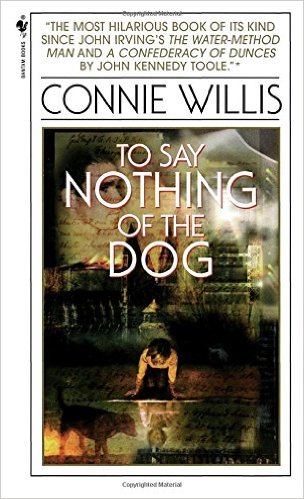
To Say Nothing of the Dog coverIn a modern context, God seems to take over the role of Fate—not by predetermining everything, but by designing the system (i.e., the universe) so nothing can go fatally wrong with causality.  Something similar, I think, lies behind the way the time travel “net” portal functions in Connie Willis’s time travel stories.  If allowing something through the net would create a paradox, the net simply won’t open—which leads to some tortuous reasoning by the characters as to what is keeping the net from openingaat  a particular moment.  Something like Providence seems to be at work.  The only causal loops allowed are what we might call ‘virtuous loops’—those that work out right.

What makes this confusing is that we’re used to analyzing causality by looking at the conditions preceding the effect.  Here, we don’t see the ‘virtuous loop’ conditions being set at any particular point in time.  The conditions have to apply to the continuum as a whole—from outside it, in effect.

You Can’t Avenge the Future

When Tony initially declares Scott’s proposed “time heist” impossible, the remaining Avengers bring in Bruce Banner as a substitute scientific resource.  Banner (who now combines his own brain with the Hulk’s body) does make a nod to the fact that his scientific expertise is primarily in biology, not physics, but the story remains basically true to the comic-book idea that a scientific genius is a genius in every science.  At about 0:59, Banner says something that sounds rather like the Novikov principle we’ve been discussing:  if you kill someone in the past, that doesn’t erase their later selves.  Apparently causality doesn’t propagate down the world lines of already-existing characters to wipe them out when their original causes go away.  On this theory, Marty wouldn’t have had to worry about disappearing even if he couldn’t get his parents back together.

On the other hand, Bruce doesn’t seem to be saying you can’t kill the person in the past; he seems to be saying that if you did kill them, it wouldn’t make any difference.  This may have more to do with what TV Tropes calls “ontological inertia” (see here, but also here).  Bruce’s approach seems to allow for wild inconsistency in the timeline, because I can be alive in 2019 even after being killed in 1971.

The simplest answer may be to conclude that Bruce wasn’t a very good physicist; maybe Tony silently corrected Bruce’s theory when Tony finally did agree to join the party.

Branching Timelines

At some point in SF history, people realized that the whole paradox thing could be avoided by introducing a third theory, the notion of multiple branching timelines.  Niven’s phrase is “multiple time tracks.”  If you change the past, the original future going forward from that point remains unchanged, but a new future comes into existence, branching off to take into account the change.  (The character making the change always seem to end up in the new branch, not the old.)  We can have our cake and eat it too:  one version of me devours the cake, but another, equally real, version of me prudently saves the cake for later.

The multiple-timeline approach gains some headway from the general popularity of alternate-history stories, and some plausibility from the fact that physicists take seriously the suggested “many-worlds” interpretation of quantum mechanics.  It appears to solve the problem of time paradoxes.  However, it runs very close to an assumption that would make it impossible to tell a good story at all.

Stories are about action and choice.  A mere recounting of a series of experiences that happen to someone wouldn’t be much of a story (which is one reason the ending of 2001:  A Space Odyssey is so weak).  James Michener’s introduction to the novel Hawaii (1959), which describes the geological formation of the islands, is only part of a story because it lays the groundwork for what the characters later say and do.

All the Myriad Ways coverIf every possible alternative branched off a new timeline whenever there were options, there would be no point in making a choice, because whichever choice I made, another version of me would make the opposite choice.  Niven captures the problem exactly:

. . . did you ever sweat over a decision?  Think about one that really gave you trouble, because you knew that what you did would affect you for the rest of your life.  Now imagine that for every way you could have jumped, one of you in one universe did jump that way.

Now don’t you feel silly?  Sweating over something so trivial, when you were going to take all the choices anyway.  And if you think that’s silly, consider that one of you still can’t decide . . .  (p. 117)

The title story in All the Myriad Ways explores exactly that issue—what would happen if people really started to believe that all alternatives were equally real.

But suppose we assume that every choice doesn’t spawn alternate universes—just the changes caused by time travel, by backward causality.  That doesn’t destroy all narrative in the way just described.  It just ruins the story you’re trying to tell.  The main characters move heaven and earth to get into the past and make the necessary change.  They succeed!  Whew.  Victory.  —Except that in another universe, the original one, they didn’t succeed.  Somewhere, the sad failures who are Marty McFly’s parents still languish by the TV.  That’s not a really satisfying conclusion.

Alternating Avengers

The multiple-timeline approach certainly comes up in Endgame.  What I can’t make out is whether it prevails in the end, or is averted.

Ancient One and Banner with timeline simulationAt about 1:24 in the movie, Bruce Banner is having a tense conversation with the Ancient One (Dr. Strange’s mentor) about the plan to return the stones to their original places in time.  The idea is that if he takes the Time Stone from the Ancient One at (let’s say) 1:03:12 p.m. on January 31, 2010, and eventually Steve Rogers returns it to her at 1:03:13 p.m. on January 31, 2010, there won’t be a need for a branch to form.  History continues on as it had always been.  (Steve describes his mission concisely at 2:43 in the movie:  “I know.  Clip all the branches.”)  Thus, the timeline of the movie, in which Thanos Snapped half the universe away, and five years later the assembled Avengers brought them back and did away with Thanos, remains the one-and-only timeline.  There’s a helpful description of this procedure in an article from July 2019 (which is also full of spoilers, by the way).

If we leave aside how hard it would have been to put things back exactly as they were, given the butterfly effect—not all the Stone retrievals were as simple as Bruce’s—does this work?  Did the screenwriters (Christopher Markus and Stephen McFeely) come up with a way to manage the dizzying time loops and still save the story?

I’m still not quite sure.  One glaring plot hole, as various people have pointed out, is that we have to account for Thanos himself.  In order to give us a great battle at the end (and what a battle it is!), the movie has Thanos in pre-Snap 2014 discover what’s going to happen and time-travel forward to 2019, where he’s ultimately disintegrated by the Avengers.  He never returns to 2014.  That seems to mean that the disappearance of Thanos did create a branch, since if he vanished from 2014 and never came back, the Snap would never have occurred.

At least that reduces us to two timelines, the one we see in the movie and another where Thanos does not continue to exist after 2014.  And, interestingly enough, the Avengers’ actions saved both of those timelines from the Snap.  The people who lived through the movie timeline experienced the Snap, but the lost people were eventually returned.  Meanwhile, in the new alternate timeline, Thanos never came back, he never got the Infinity Stones, and the Snap never occurred.  That’s not such a bad (dual) ending.

I don’t know.  All these causal loops produce a kind of shell game in which I’m not quite sure how things came out.  Nonetheless, it’s a great movie, if you like the Marvel characters at all.  If you haven’t seen it, you shouldn’t have been reading this (but maybe the circuitous account above will be helpful).  If you have—see it again!  Just don’t try to go back to April to catch the premiere a second time; who knows what that would do to the space-time continuum.

The Select Society of Protectors

Sorry about the delay between posts—I’ve been under the weather lately.


I was recently reading a new “Sharing Knife” story by Lois McMaster Bujold, and it suddenly occurred to me that the relationship of Bujold’s Lakewalkers to Farmers is exactly that of Anne McCaffrey’s Dragonriders to Holders.

But let me back up a bit.

The Sharing Knife

The world of Bujold’s Sharing Knife series is a difficult and dangerous one.  Most people live in a basically agrarian culture, a sort of cross between the traditional medieval fantasy world and the Wild West.  They fear the enigmatic “Lakewalkers,” men and women who wander about the countryside in “patrol” groups and are rumored to have magical powers.  The Lakewalkers claim to be searching for what ordinary people call “blight bogles,” but some consider these to be a mere myth.

They’re not a myth, of course.  In reality the Lakewalkers, who have the ability to use a kind of magic they call “groundwork” (an extremely interesting and well-developed idea in itself), are constantly on the watch to destroy “malices” as they arise.  These malices are truly nasty beings that can mentally enthrall normal humans and mutate animals into humanoid minions.  If the Lakewalkers weren’t killing them off (via the grim “sharing knife” methd of the title), the malices would overrun the whole world.

Many Lakewalkers tend to look down on the people they are defending, whom they refer to generally as “farmers.”  Much of the interest of the story has to do with the prickly relationship between these two interdependent groups, explored through the romance between a farm girl, Fawn, and a Lakewalker patroller, Dag.

The Dragonriders of Pern

As I mentioned in an earlier post, Anne McCaffrey’s Dragonriders of Pern is a science fiction series that reads like fantasy.  The planet Pern is protected by men and women riding flying dragons.  The dragons breathe fire to destroy an alien organic “Thread” that falls from the sky and, if allowed to spread, would multiply to consume the planet.  To qualify as a full-fledged dragonrider, one must have the potential for a certain kind of telepathy that allows rider and dragon to bond at the dragons’ birth.

Dragonflight coverOne of the things that makes the Pern stories sound like fantasy is the quasi-medieval political structure.  A “Lord Holder” resembles a feudal monarch ruling over a sizable population of farmer/serfs, crafters, and minor nobility.  But here the dragonriders form a separate hierarchy.  The riders’ internal pecking order is a combination of aristocracy and meritocracy:  the rider of the senior gold (female) dragon is a kind of queen; the rider whose bronze dragon mates with the gold becomes leader of the entire group that constitutes a Weyr; and those who lack the telepathic talent are servitors (at the lowest level, “drudges”).

While the depiction of Pernese society mellowed a good bit over the course of the series—both holders and riders were pretty high-handed and violent at the beginning, less so later—one consistent theme is the uneasy relationship between the dragonriders and the common folk.  Everyone knows (though they may forget in the generations between periodic Thread attacks) that the riders are essential to preserve the planet:  “Worlds are lost or worlds are saved / From those dangers dragon-braved.”  But the holders often resent the taxes imposed to support the Weyrs and the “searches” in which the dragonriders carry off likely young people to see if they can “impress” a dragon.  Managing this tension consumes a good deal of the main characters’ time in the early books.

The Protectors and the Protected

Now I can make clear the analogy I noticed.  In each case we have a relatively small society of people set apart from ordinary folks, in a good cause:  they are dedicated to protecting the larger population.  The select group of protectors are genuine heroes who possess special talents that fit them for the role.  But the protectors are not stainless; they can abuse their powers.  And the grateful population they defend aren’t always grateful; they may resent the special powers and privileges of the defenders, even aside from the possible abuse of those advantages.

It seems to be a fruitful trope for storytelling.

Rangers and Protectors

Strider with pipe at the Prancing PonyWe can find a similar structure, though not so dominant, back in The Lord of the Rings.  You’ll recall that Strider—Aragorn—is one of a mysterious group of wanderers who travel the countryside, the Dúnedain or Rangers.  They are regarded with suspicion by the ordinary folks in Bree; Barliman Butterbur the innkeeper warns Frodo about the suspicious-looking stranger sitting in the corner.  Yet all the time the Rangers are patrolling the borders of the peaceful lands of Bree and the Shire, fending off possible threats.  Aragorn says at the Council of Elrond:

‘Strider’ I am to one fat man who lives within a day’s march of foes that would freeze his heart, or lay his little town in ruin, if he were not guarded ceaselessly.  Yet we would not have it otherwise.  If simple folk are free from care and fear, simple they will be, and we must be secret to keep them so.  (Fellowship of the Ring, II.2, p. 261)

Aragorn’s fond, if slightly aggrieved, remark brings out a difference.  Pern’s dragonriders are a public society of defenders; everyone knows of their special role.  But Tolkien’s Dúnedain, like the Lakewalkers in Bujold’s more recent fantasy, play a less public role.  They are set apart, but because their heroism is unrecognized, they are objects more of suspicion than of admiration.

Pak protector (by Christopher Bretz)

Pak protector – illustration courtesy of Christopher Bretz (bretz@bretz.ca)

For a more science-fictional take, consider Larry Niven’s Protectors, which figure in the novel Protector (naturally) and in the Ringworld stories.  Niven imagines that humanity is descended from a species called the Pak, which matures through three life stages:  child, breeder, and protector.  The transition from the not-very-bright breeder stage to the highly intelligent and formidable protector stage is triggered by eating a root the characters call “tree-of-life.”  When a Pak colony arrived on Earth ages ago, however, the soil lacked a chemical necessary for the tree-of-life root to function.  The “breeders” could not change into protectors; instead, they evolved on their own into modern-day humans.  Niven’s intriguing conceit is what we see as symptoms of old age actually represent the incomplete transition to the gaunt, tough, hairless protector stage.

Niven depicts the protectors as genetically compelled to protect the members of their own family or clan—the ones who “smell right.”  A functioning Pak colony wouldn’t be as much like a human society as on Pern or Middle-Earth or Bujold’s imaginary world:  it would consist of carefree, barely-sentient breeders watched over by creatures ruthlessly dedicated to their preservation.  Think of it as an extreme case of the separation of defenders from defended.

Counter-Examples

On the other hand, a number of stories depict defenders who are much more thoroughly integrated into their broader societies.

Nita and Kit ascend over New York, from Young Wizards

Young Wizards

In Diane Duane’s Young Wizards series, youngsters with the potential for wizardry are called, not by receiving a letter from Hogwarts, but in more obscure ways—for example, running across a library book called So You Want To Be A Wizard.  There are more wizards around than one might think, because on our planet they don’t advertise their powers:  young wizards still go to school, grown-up wizards might be writers or sell advertising.  (And not all of them are human; there are some very entertaining books about feline wizards.)  But all of them are dedicated to the preservation and fostering of Life, by way of the Wizard’s Oath each must take.  In this setup, there’s no resentment of the society of protectors because no one knows they exist; and abuse of wizardly powers is almost unheard-of, since violating the Oath tends to result in forgetting that wizardry even exists.

Lensman image

Kim Kinnison, Gray Lensman

By contrast, the elite corps of Lensmen in E.E. Smith’s famous series are publicly known and highly respected.  They play the role of galactic policemen and secret agents, with particular attention to the mysterious pirates and drug-runners called “Boskone.”  Like the Young Wizards, the Lensmen are (conveniently) incorruptible, being screened at the outset by the equally mysterious but benevolent Arisians.  (This whole business of incorruptibility is something we need to examine more closely on another occasion.)  But they don’t mind mixing in ordinary society—Gray Lensman includes a scene set at a formal ball—although their grave responsibilities often make them feel set apart in their lonely dedication.

Superheroes, as a class, may occupy the same position.  They live as part of the general public, though their identities are usually secret.  They tend to act as individuals rather than as a whole society, though they do come in small groups (and may occasionally take part in mega-battles that engage the whole range of heroes).  But the modern superhero does show the ambivalence that often characterizes the select defender (Mr. Incredible’s remark that he sometimes wishes the world would just stay saved for a while).  And some graphic novels take up the question of what it’s like for the ordinary person to live in a world full of superheroes—notably Kurt Busiek’s thoughtful Marvels (1994).

Narrative Tensions

The select society of protectors is a fine place for heroes.  But it’s also dangerous.  What if the protectors aren’t incorruptible, and turn bad?  What if they become contemptuous of the people they protect, and come to think of themselves as better than the “rabble”?  In many of the scenarios above, it takes special talents to qualify as one of the defenders.  How likely is it that those who see themselves as specially qualified will end up thinking of themselves as superior?  These questions form fertile ground for various plotlines.

The notion of the select (if not superior) set of defenders may even be seen as applying to a military organization, whose purpose is to protect the general public.  “Citizen soldiers,” or draftees, may see themselves as primarily part of the overall society, temporarily detailed to do their civic duty; but a professional military, which can form its own tightly-knit society with its families and dependents, may be more easily tempted to think of itself as a group apart, with its own loyalties and camaraderie.  In fiction, the entire genre of military SF borders the trope we’re examining here.  In real life, the American military, at least, seems to have avoided that trap; we have not yet seen anything like a military coup.

Everyone Is a Tuvela

It’s interesting to contemplate the opposite trope:  the citizen soldier model taken to its limit.

The Demon Breed, coverIn James Schmitz’s 1968 novel The Demon Breed, a biochemist named Nile Etland on the human colony world Nandy-Cline discovers that independent researcher Ticos Cay has been captured by cruel and formidable aliens called the Parahuans.  Ticos has played on the Parahuans’ own near-superstitious fears to convince them that Nile is a Tuvela, a member of a secret society of superhumans that are the real rulers of human civilization.  All Nile has to do is convince the invaders that she is, in fact, a superior being it would be death to tangle with.  And, with the help of Ticos, two mutant otters, and her own encyclopedic knowledge of the unique biology of Nandy-Cline, she does a marvelous job of pulling the wool over the Parahuans’ eyes and sending them fleeing back to their own worlds.

But there are no Tuvelas.  Nile is a brilliantly resourceful and competent woman, but she’s not superhuman.  Neither is Ticos, nor any of the other inhabitants who are involved at the end in dispersing the Parahuans.  They’re simply ordinary humans.  And there is no secret organization.  Rather, Schmitz’s hypothesis is that a significant fraction of ordinary people (Ticos calls them “antipredators”) can take on that defensive role when extraordinary circumstances require them to do so.  As one character remarks, the Parahuans would have run into “Tuvela” behavior no matter where they sought to attack.

The title The Demon Breed doesn’t refer to the Parahuans.  It refers, from the unfortunate Parahuans’ point of view, to the uncannily resilient humans.  Like the sturdy hobbits of the Shire, human beings are capable of rising to the occasion.  At the end of the story, when the local Nandy-Cline military forces have mobilized to make sure the fleeing Parahuans don’t escape, Nile reflects:  “The human demon was awake and snarling on Nandy-Cline” (ch. 9).

The select society of defenders is a potent storytelling trope; but so is the distributed resourcefulness of the ordinary person.  And both may be useful to keep in mind as we act where we are needed.