Visions of Sugarplums
Among the Hallmark Channel’s Christmas season offerings this year is a comedy called Sugarplummed, which has the distinction of being a spoof of the Hallmark Channel itself.
Satirizing the recurring tropes of the innumerable Hallmark Christmas movies isn’t a new game. As noted in my 2019 post, takeoffs on this subgenre are legion. Just today, a “Sally Forth” newspaper cartoon rang yet another change on the meta-tradition of Hallmark spoofery.
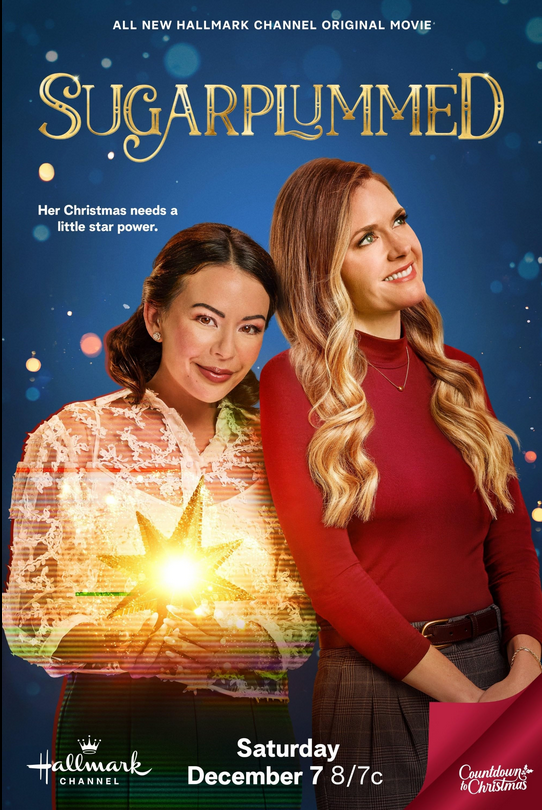
But it’s particularly entertaining to watch someone make fun of themselves. In Sugarplummed, Emily, the harried mother in a family of four, is devoted to a schmaltzy series of TV movies featuring a woman named “Sugarplum.” She’s thrown off the rails when the Sugarplum character magically materializes in the real world, determined to fulfill Emily’s wish for a perfect Christmas. Sugarplum carries around a thick book that contains The Rules. The Rules are a collection of mandates that embody all the Hallmark clichés we know so well. Sugarplum’s world, in her home town of (naturally) “Perfection,” lives by these rules. Why shouldn’t they work in Emily’s life as well?
For a while, they do, and we’re treated to a series of implausible “Christmas miracles” where everything works out perfectly. Then, as the Hallmark plot summary puts it, “when Sugarplum’s magical fixes start to backfire one by one, Emily begins to question what an ideal holiday really is.” The moral of the story is not to pursue perfection to the detriment of our ordinary relationships and joys—or, to put it another way, the familiar adage that “the perfect is the enemy of the good.” That’s an apt reminder.
Enchantment and Reality
The Disney canon is another inviting target for satire. The long history of Disney movies and shows contains plenty of well-worn recurring tropes and themes. And, since much of Disney’s original focus was on children, those motifs tend to be on the sentimental or upbeat side, making the repetition even more attractive for satire. (For some reason, the repetition of ugly or grimdark tropes, as in the plethora of dystopian fantasies now flooding the market, doesn’t attract as much jeering.)
Shrek (2001) did a pretty good job of spoofing Disney, the theme parks as well as the movies—not just in the details, but in the overall plot. Instead of having the prince or princess turned into a monster or critter and restored in the end, Beauty and the Beast-style, Shrek’s inamorata Fiona turns out to be an ogre who’s been turned into a princess, and the happy ending ensues once she’s been restored to her natural homely form.
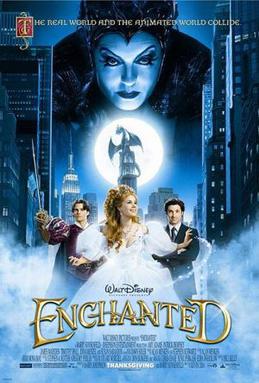
Of course, there’s a certain sniggering almost-hostility in making fun of somebody else’s clichés. We can undermine that attitude when we make fun of ourselves. Disney one-upped Shrek when it released the movie Enchanted in 2007. Here, an animated character named Giselle, a perfect exaggeration of a Disney fairy tale heroine, is sent by a wicked witch to a terrible foreign land that works by entirely different rules: New York City. Now in live-action, we see Giselle try to cope with the grittier world we live in, where her set of Rules don’t apply. (In one classic inversion, the climax sees Giselle attacking the monster to save the man she loves, rather than the other way around.) We do get a happy ending, but it’s much more along the lines of learning to be a grown-up and living with (while improving on) imperfection.
The Science Fiction Version
The self-spoof approach isn’t limited to fantasy, or to the big screen. Consider E.E. Smith’s Lensman series, the very model of classic space opera. Satires of the space opera genre are also common, from Harry Harrison’s Star Smashers of the Galaxy Rangers to the 1980 Flash Gordon movie. But in one case, Smith did it to himself.

In the last Lensman book, Children of the Lens (1947), Smith’s redoubtable hero Kimball Kinnison goes undercover as—of all things—a science fiction writer, Sybly White (see chapter 3). We see a couple of excerpts from the SF novel Kinnison writes, which (of course) “was later acclaimed of one of Sybly White’s best.” The excerpts parody, not just space opera generally, but Smith’s own ebullient, melodramatic style. It’s charming to see Smith good-naturedly bringing onstage a caricature of himself.
Taking Ourselves Lightly
As I’ve noted elsewhere, humor can often involve a kind of meanness toward the target of the humor. The charm of the self-satire is that the temptation toward meanness or hostility is absent. Spoofing oneself is almost bound to be an affectionate parody, the kind where the humorist really likes the subject of the humor. These often make for the best satires, untainted by any sourness or smugness and genuinely understanding how the satirized thing works.
I give Hallmark credit for Sugarplummed, then, especially because it shows the showrunners are not taking themselves too seriously. That genial attitude is in tune with the Christmas season Hallmark is celebrating. As Chesterton put it in Orthodoxy (ch. 8): “Angels can fly because they can take themselves lightly.”
 Rick Ellrod's Observatory