Foreshadowing
Stories vary in how they hint at what’s to come. “Foreshadowing” provides the reader with more or less vague clues about things that will happen later on. As the Wikipedia article notes, even the title of a chapter or an entire work can give us such a hint. (I once changed the title of a novel—House of Stars, currently seeking a publisher—because the original working title gave away too much of the plot.)
One particularly overt way of foreshadowing is to have the narrator tell us straight out about something they didn’t find out until later. I think of this as the “little did I know” trope, based on the hackneyed formula for introducing such a hint in old-time books. That method strikes me as rather heavy-handed, and I’m dubious about whether it’s really a good idea.
”I Was Soon To Find That Out”
 A classic example occurs in Heinlein’s Stranger in a Strange Land (1961). Mentor-figure Jubal Harshaw (not the titular Martian), as a side business, ghost-writes the kind of ‘confessional’ novels popular in the early twentieth century. Every now and then in Stranger, he’s motivated to dictate a bit of purple prose for such a tale. So in ch. 17 (p. 157 in my battered old paperback copy), we hear, as part of the opening for “I Married a Martian”: “In those carefree childhood days I did not dream to what strange bittersweet fate my tomboy ambition would . . .”
The fragmentary example is classic because it’s supposed to be a sample of hack writing; Harshaw is contemptuous of the potboilers he turns out. Of course, not every “little did I know” example needs to be so trite.
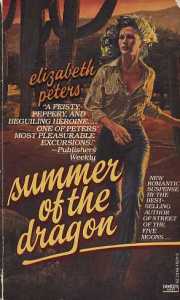 Romantic suspense novels are given to this trope, since a primary purpose of the foreshadowing is to build anticipation and suspense. For example, Elizabeth Peters was a master of the witty, light-hearted romantic suspense story. In Summer of the Dragon (1979), we see a whole series of such hints.
It was like a game.
But it wasn’t a game, and I was soon to find that out.” (ch. 7, p. 150)I know now what it was that woke me at the crack of dawn next morning; but at the time I was amazed at myself. (ch. 9, p. 181)
Every passing moment made me more and more uneasy; it was as if some part of my mind knew something awful was about to happen, something I couldn’t prevent. (ch. 9, p. 194)
The fact is, my compassion was stupid. I didn’t know how stupid until it was almost too late (ch. 10, p. 213)
If I believed in premonitions I would claim that I knew the next day was going to see some sort of climax. Since I don’t believe in them, I will only claim I was nervous. (ch. 11, p. 249)
“My second impulse canceled the first; and I still maintain, in spite of what resulted, that it was a rational decision.” (almost at very end: ch. 12, p. 285)
After being hit over the head repeatedly with such ominous notes, one feels they’ve begun to lose their effectiveness. And, although the individual lines are well written, the cumulative effect is to give the story a sort of “pulp” atmosphere. In fact, that may have been just what the author was going for. (Her laugh-out-loud description of the cover of a Gothic romance at the beginning of The Camelot Caper shows that she knew exactly what she was poking fun at.)
Some authors are particularly fond of this technique. Andrew Greeley, for example, regularly warns us that something bad’s going to happen. In A Christmas Wedding (2000), the hero and heroine agree that her father is a sick man, and the hero adds: “And, as we would later find out to our dismay, dangerous too.” (ch. 19, p. 235) In a later book in the same series, September Song (2001), ch. 5 ends bluntly with: “The future would be a lot worse than I expected.” Oddly enough, in many cases the foreshadowing seems to overstate the result: what ultimately happens is less awful than we’ve been led to expect.
 The “little did I know” trope isn’t confined to older works. Emily Devenport’s fascinating Medusa in the Graveyard (2019) seems to concentrate such hints in the midsection of the story: “That was about to change, but I didn’t know it” (ch. 14). “I didn’t know we were about to be confronted by . . .” (ch. 14). Or, deploying one of my favorite stock phrases: “Famous last words” (ch. 15).
As the examples indicate, this particular type of open foreshadowing by the narrator tends to occur especially in first-person narratives. It can also be used in the third person (“Little did she know…”), but in that case the quasi-presence of a narrator other than the main character becomes apparent—almost like “breaking the fourth wall.”
Similar Techniques
There are less obvious methods than “little did I know” to telegraph what’s coming up in a story, sharing some of the same weaknesses and strengths.
When the Fellowship of the Ring reaches Lothlorien, Frodo sees Aragorn lost in memory of meetings with Arwen there in days long past. He comes out of his reverie and, taking Frodo’s hand, “left the hill of Cerin Amroth and came there never again as living man.” (end of Book Two, ch. 6, p. 367) We wonder whether this third-person statement by the narrator means that Aragorn will die on the quest. But that doesn’t happen. (I think everyone is familiar with that spoiler.) Aragorn survives; but there’s no particular reason why he should come back to that particular spot (unless he and Arwen wanted to reminisce on their honeymoon), and it happens that he never does. When we reread the story, we may wonder why Tolkien makes such a point of telling us that Aragorn doesn’t come there again “as living man,” when nothing comes of it. (We’re not told that he visits as a ghost, either.)
We see a similar effect when an author doesn’t merely hint at, but shows us, the future: when a story starts at a later point and ‘doubles back’ to earlier events. This is a classic technique, as for example in The Aeneid; the fact that the story opens with Aeneas telling Dido about his escape from Troy means that we don’t have any suspense about whether he escapes when we later read those scenes. But sometimes the later-placed-earlier scene seems to be designed to set up our expectations, more or less explicitly.
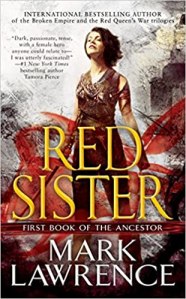
First volume of Book of the Ancestor
For example, in Mark Lawrence’s Book of the Ancestor series, the very first book of the trilogy suggests that certain things are going to happen before the end. But (minor spoiler here) that scene, which is presented in several places during the story, is always incomplete and carefully limited; and when it finally occurs, the context makes it quite different from what we were led to expect. I found myself feeling that the author had sort of cheated – although that didn’t diminish my enjoyment of the story; it led me to wonder whether the foreshadowing scenes were really necessary at all.
In the limiting case, any first-person story gives us a pretty good idea that the narrator will survive at least to the end of the story, as noted in TV Tropes’ article on First-Person Perspective. Although it’s been known to happen that the hero dies at the end; the tale may conclude there, or may drop back to a third-party coda for the conclusion.
Similarly, the spoiler effect is already present in any classic tale where one already knows the conclusion—the Arthuriad, for example. Most ancient literature was written this way; Homer’s readers already knew that Troy lost the war. In such cases, our anticipation is not to learn the outcome of the story, but to find out how the author is going to get us there—as is also the case with many genre stories, such as romances and mysteries, and with historical fiction.
The Function of Foreshadowing
As noted above, foreshadowing of any type serves the purpose of shaping our expectations and building suspense. The mere glimpse attracts more attention than a complete revelation—a principle every fashion designer knows. The Wikipedia article also suggests that foreshadowing can make later events seem more plausible, since we’re already conditioned to expect them.
Plausibility can also be served by the lampshading function of a character’s anticipatory retrospective reflections. When Peters’ heroine in Summer of the Dragon comments on her own reaction—“ my compassion was stupid. I didn’t know how stupid until”—we are a little less inclined to excoriate the character for being an idiot, since the reflection makes clear that they now know they were an idiot.
So, if “little did I know” has legitimate functions, what’s the problem with it?
Looking Through a Character’s Eyes

There’s a strong trend these days toward choosing the viewpoint of a story to encourage the reader to identify as closely as possible with the main character(s). If a story isn’t told in first person, then one is advised to use “close” or “deep” third person, where the reader’s point of view is tightly limited to that of a particular character. There may be more than one viewpoint character, but while we’re in a given person’s head, we see only what they see, know only the things they know, experience their feelings as we face their challenges with them.
Presumably this is intended to make the reading experience more engaging and immersive. The frequent use today of present tense (“I open the door”) rather than the usual “narrative past” (“I opened the door”)—for example, in the Hunger Games trilogy—appears to be another means to the same end.
Now, I’m not slavishly devoted to the “close third” option. Plenty of the stories I read growing up were told in “omniscient” third person, where the author felt free to give the reader information the characters were not privy to. In the lost world-ship story Orphans of the Sky, for example, Heinlein fills us in on things that the characters, given the boundaries of their experience, cannot understand. Or consider Victor Hugo’s notorious disquisition on the Paris sewer system in Book the Second of Volume Five in Les Misérables. I’m comfortable with a more ‘distant’ viewpoint; I can read The Silmarillion as well as The Lord of the Rings.
The Downside of Knowing

Image by Helmut Strasil from Pixabay
But to my mind, the heavy-handed “little did I know” sort of foreshadowing does tend to pull one out of the story. We now know something the viewpoint character doesn’t; we are no longer sharing their feelings in the moment, but rather their retrospective evaluation based on later knowledge. We are not quite in the internal time of the story, but viewing it sub specie aeternitatis, from a point of view that is not time-bound. This distances us to some degree from the story.
The specific foreshadowing typical of these hints, as distinct from a general air of ominousness, builds dramatic tension; but it also reduces surprise. Of course, this kind of surprise is lost the second time you read any book. We already know what’s going to happen. Still, the building up of expectations proportionately reduces even the apparent freshness of the experience when the foreshadowed event finally takes place. We may find ourselves thinking more about the later events that are being implied than being “mindful” about the current action.
That diversion from the ‘narrative present’ may be particularly distracting when we don’t feel that the author makes good on the implied threat of the foreshadowing. If we’re told that something terrible is in the offing, and then it turns out not to be so bad after all, we may feel disappointed or cheated. Greeley’s stories are especially subject to this problem; on the second read-through, we may feel we’re being manipulated when the author earnestly warns us to expect something awful, but we know the outcome won’t live up to the warning. After a while, we may begin to take the author’s insinuations with a grain of salt, since we know their habit of overthreatening and not delivering.
The not-delivering can actually be a relief, rather than a letdown: ‘Whew, that wasn’t as bad as I thought it was going to be.’ That reaction makes me ambivalent about the faux foreshadowing. The release of dramatic tension in a positive way may be as satisfying as the fulfillment in a negative way. Perhaps overthreatening actually is a useful device—particularly if we want the reader to be relieved rather than appalled.
My sense, in the end, is that “little did I know” is a technique to be used with care. Foreshadow away; but be sure of exactly what you’re trying to achieve and how the language used will accomplish it.




 Rick Ellrod's Observatory