Civilization and the Rule of Law (reprise)

Another rerun, adapted from a post from seven years ago.

We’ve talked about how the Star Trek-Star Wars divide reflects preferences for a more lawful or more chaotic world; how F&SF stories often show us a defense of civilization against chaos; and how civilization makes science possible and rests in turn on human technology.  But both order and technology can be oppressive.  The missing element is the rule of law.

Universal Laws

It’s a crucial element of right governance that there are rules applying to everyone, as opposed to the arbitrary wishes of a dictator, who can make decisions based on favoritism, political preferences, or personal relationships.  The Wikipedia article describes rule of law as “the legal principle that law should govern a nation, as opposed to being governed by decisions of individual government officials.”
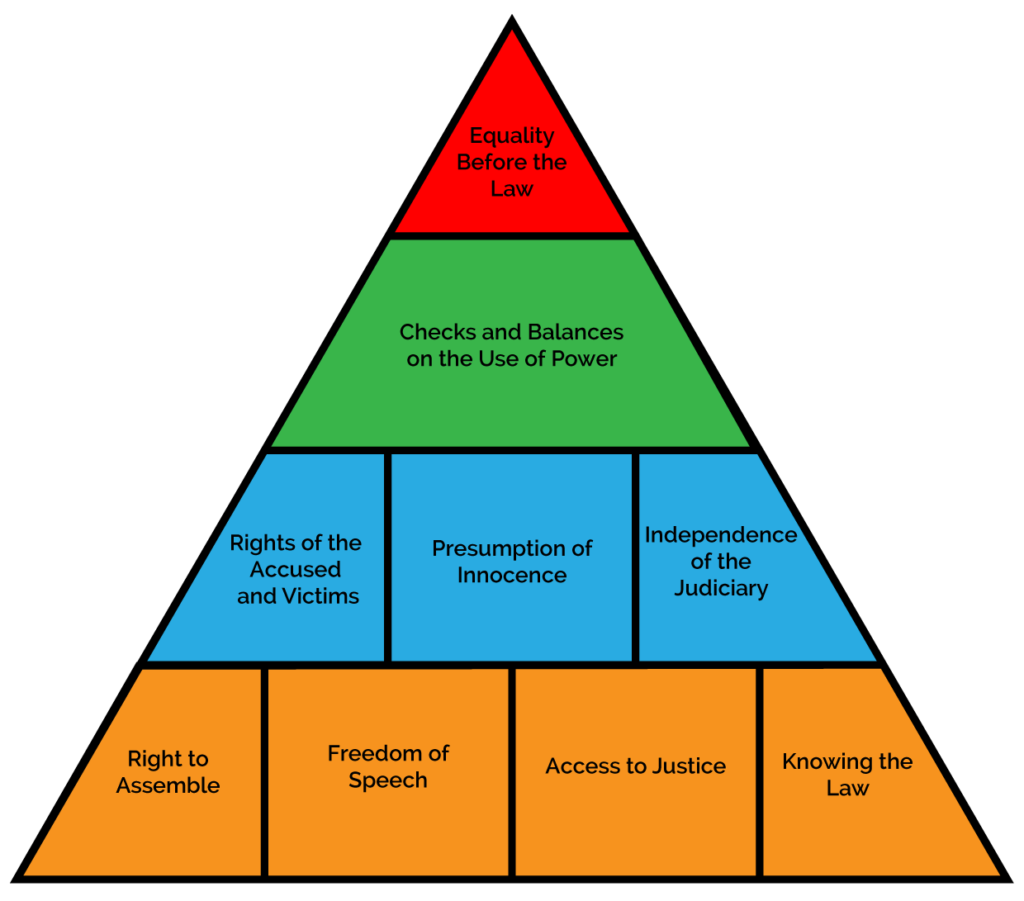
Rule of Law pyramid
(Rule of Law Institute of Australia)

As we saw in the recently updated post The Good King (reprise), the concept of the rule of law goes back at least to Aristotle.  It became a central principle of the American founders via the English tradition of John Locke.  “Rule of law implies that every citizen is subject to the law, including lawmakers themselves” (Wikipedia again).  It is thus in tension with kingship, where rule is almost by definition arbitrary and personal.  But one can have mixed cases—kings who are bound by certain laws, as in the British constitutional monarchy.

Without the rule of law, we depend on the good behavior of those who have power of some sort—physical, military, economic.  We slide toward the “war of each against all,” where might makes right and the vulnerable are the pawns of the strong.  Autocracy soon follows, as people look for any means to find safety from those who are powerful but unscrupulous.  Hence the quotation from John Christian Falkenberg, which I’ve used before:  “The rule of law is the essence of freedom.”  (Jerry Pournelle, Prince of Mercenaries (New York:  Baen 1989), ch. 21, p. 254.)  Strength itself, a good thing, is only safe under laws.

Test Cases

It’s easy to miss the importance of the rule of law.  We’re typically born into a society with better or worse laws, and criticize them from the inside.  It’s less common to find ourselves in straits where lawfulness as such has collapsed.  Regrettably, sizable numbers of people are exposed to such conditions in the world today.  But many of us are fortunate enough not to see them ourselves.  As always, fantasy and science fiction provide useful “virtual laboratories” for examining the possibilities.
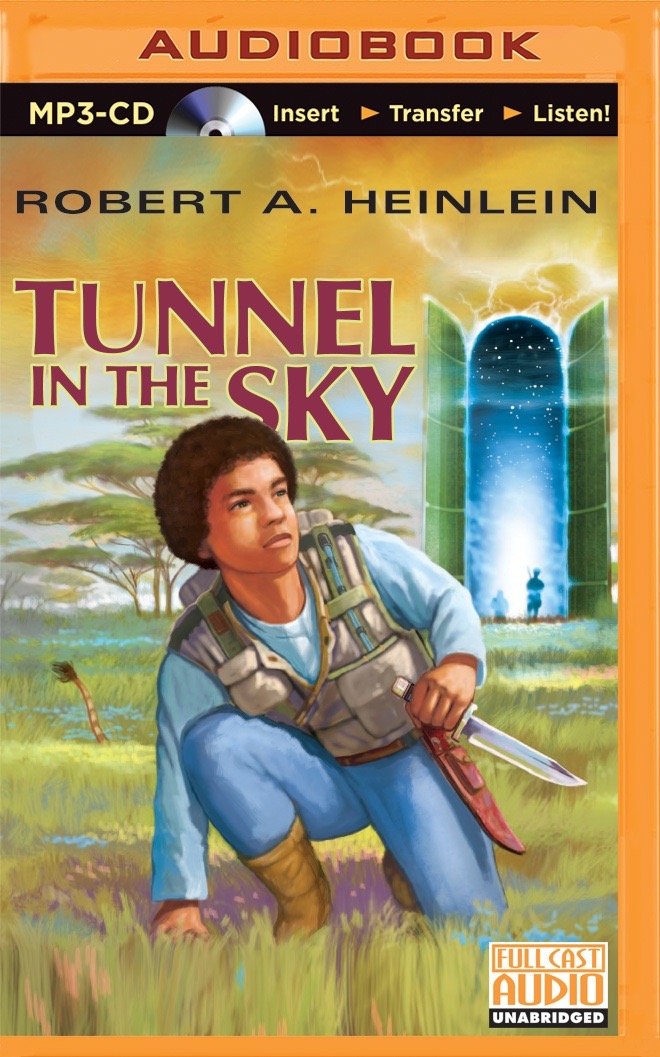
Tunnel in the Sky (audiobook) cover

A classic SF case is where a group thrown into a “state of nature” attempts to set up a lawful society.  For example, in Heinlein’s Tunnel in the Sky (1955), students from a high-school class on survival techniques are given a final exam in which they are dropped onto an unspecified planet to survive for up to ten days.  When an astronomical accident leaves them stranded, they need to organize for the long term.  Rod Walker, the hero, becomes the leader-by-default of a growing group of young people.  The tension between this informal leadership and the question of forming an actual constitution—complete with committees, regulations, and power politics—makes up a central theme of the story.

The Postman movie poster

David Brin’s post-apocalyptic novel The Postman (1985), later made into a 1997 movie with Kevin Costner, illustrates the power of civil order, the unstated practices of a culture, as recalling—and perhaps fostering—the rule of law.  The hero, a wanderer who happens to have appropriated a dead postman’s uniform and mail sack, presents himself as a mail carrier for the “Restored United States of America” to gain shelter in one of the isolated fortress-towns, ruled by petty tyrants, that remain.  His desperate imposture snowballs into a spreading movement in which people begin to believe in this fiction, and this belief puts them on the road toward rebuilding civilization.  The result is a sort of field-test not only of civil order and government, but of what Plato famously imagined as the “noble lie.”

In Niven & Pournelle’s Lucifer’s Hammer (1977), a small community headed by a United States Senator hopes to serve as a nucleus for reconstructing civilization after a comet strike.  We see at the end the strong pull of personal rule or kingship:  as the Senator lies dying, the future of the community will be determined by which of the competing characters gains the personal trust and endorsement of the people—and the hand of the Senator’s daughter, a situation in which she herself recognizes the resurfacing of an atavistic criterion for rule.  Unstated, but perhaps implicit, is the nebulous idea that deciding in favor of scientific progress may also mean an eventual movement back toward an ideal of rule by laws, not by inherited power.

Seeking a Balance

The “laboratory” of F&SF is full of subversions, variations, and elaborations on the rule of law.  In particular, we should note the counter-trend previously discussed as “chaotic good.”  Laws can be stifling as well as liberating.

The Moon is a Harsh Mistress cover

Heinlein’s The Moon Is A Harsh Mistress (1966) imagines how the “rational anarchy” of a lunar prison colony is mobilized to throw off autocratic rule.  The healthy chaos of the libertarian Loonies is hardly utopian, but the story does make it seem appealing.  Interestingly, Heinlein returned to this setting with a kind of critique twenty years later in The Cat Who Walks Through Walls (1985), where the post-revolution lunar anarchy seems much less benign, seen from an outsider’s perspective.

Taran Wanderer book cover

While fantasy seems to concern itself with this issue much less than science fiction, consider the region called the “Free Commots” in Lloyd Alexander’s Chronicles of Prydain.  When protagonist Taran visits this area in the fourth book (Taran Wanderer), he finds a society of independent villages, where the most prominent citizens are master-craftspeople.  They neither have nor need a lord to organize them.  The Commots contrast favorably to the feudal or wilderness regions through which Taran travels.  A kind of anarchic democracy, as an ideal, thus sneaks into what otherwise seems to be a traditional aristocratic high fantasy.

One way of managing the tension between a government of laws and a culture of liberty is the principle of subsidiarity:  the notion that matters should be governed or controlled at the lowest possible organizational level where they can be properly handled.  It’s frequently illustrated in G.K. Chesterton’s ardent defenses of localism.  In The Napoleon of Notting Hill (1904), extreme localism is played for laughs—“half fun and full earnest,” to borrow Andrew Greeley’s phrase.  The more mature Tales of the Long Bow (1924), which might qualify as a sort of proto-steampunk story, treats the idea more seriously, in the form of an oddly high-tech (for 1924) revolt of local liberty against overweening and arbitrary national rule.

It remains true that we need good people as well as sound laws.  “Good men can make poor laws workable; poor men will wreak havoc with good laws” (James M. Landis, 1960; see this article at 432 & n.107).  The quality of a civilization can also be assessed by whether it fosters citizens who act with decency and good judgment even when there isn’t a law to constrain them (as in David Brin’s “Ritual of the Street Corner”).  After all, we neither can nor should try to create laws to govern everything.

But being willing to improvise well in situations where no law applies is different from considering oneself above the law, disdaining the constraints that apply to everybody else.  This is doubly and triply true of rulers, who are constantly tempted to arrogate power and dodge accountability to accomplish their ends.  If a ruler is allowed to get away with law-breaking, we’re headed for trouble.

Brin has noted that the stories that fill and shape our culture—movies, books, television—encourage a broad “suspicion of authority” that tells us all institutions are corrupt or useless, and so are most other people—so that the heroes and heroines of the stories can face and overcome challenges by their heroic actions.  Like most attitudes, suspicion of authority is helpful in moderation, but corrosive when it gets out of hand.  If that attitude leads us to throw over laws and institutions altogether in the hope that individual heroes or autocrats will save us, we need to keep in mind that benevolent dictatorship, unconstrained by law, is just one step away from despotism.

The Fragility of Civilization

When we grow up taking for granted the rule of law, we can fail to see how vulnerable it is—along with the civilization that it reflects and makes possible.

“The Establishment,” as they used to say in the 1960s, seems vast and invulnerable.  When we’re trying to make a change, it seems insuperable, so rigid that nothing can be done about it.  But this is an illusion.  The structure of civilization, good and bad, is fragile.  It’s easier than we think to throw away the rule of law, so painfully constructed (as Rod Walker found), in favor of shortcuts or easy answers to our problems.

One thing F&SF have brought us is a better sense of this vulnerability.  The spate of post-apocalyptic tales in recent years—zombie apocalypses, worldwide disasters, future dystopias like The Hunger Games, going all the way back to the nuclear-war stories of the 1950s—do help us appreciate that our civilization can go away.

But that collapse doesn’t require a disaster.  Civilization, and the rule of law, can erode gradually, insidiously, as in the “Long Night” stories we’ve talked about earlier.

Historically, the Sixties counterculture fostered anarchists who felt “the Establishment” was invulnerable.  Often with the best of intentions, they did more to undermine civil order than they expected.  Those who now see no better aim than breaking up the structures of democratic government and civil life—whether from the side of government, or from the grass roots—also fray the fabric of civilization.  The extrapolations of science fiction and fantasy illustrate why eroding the rule of law should not be taken lightly.

Near the bottom of Brin’s Web home page, he places the following:

I am a member of a civilization

It’s good that we have a rambunctious society, filled with opinionated individualists. Serenity is nice, but serenity alone never brought progress. Hermits don’t solve problems. The adversarial process helps us to improve as individuals and as a culture. Criticism is the only known antidote to error — elites shunned it and spread ruin across history. We do each other a favor (though not always appreciated) by helping find each others’ mistakes.

And yet — we’d all be happier, better off and more resilient if each of us were to now and then say:

“I am a member of a civilization.” (IAAMOAC)

Step back from anger. Study how awful our ancestors had it, yet they struggled to get you here. Repay them by appreciating the civilization you inherited.

It’s incumbent on all of us to cherish and defend the rule of law.  Give up civilization lightly, and we may not have the choice again.

VOTE!

Representation

In America, we have a presidential and congressional election coming up in November.  I want to take a moment out to incite every American to vote.

Every now and then, it’s helpful to remind ourselves of first principles.  In a democratic polity—a “republic” in the sense used in American law and political theory—the people of the polity govern themselves.  (Please note that these terms are “small d” democracy and “small r” republic.)  The way we do this, in a representative government, is to elect representatives.  Since those representatives make most decisions as to law and government, voting in elections is the primary way in which we govern ourselves.  It’s kind of a big deal.

The Crucial Hero(es)

In America, voter turnouts, even in presidential elections, tend to be relatively low.  Why would people skip their key chance to take charge of their government?  I suspect much of this failure to take part in governing ourselves stems from a combination of things:  inertia (it takes some little trouble to register and vote), plus a pervasive sense that my one vote doesn’t affect the outcome.  Why make the effort if it doesn’t matter?

The logical flaw in this understandable attitude is that things can matter in the aggregate, even if any one item is not the sole decisive element that changes the outcome.

Will Smith and Jeff Goldblum deliver the virus in Independence Day (the movie)The stories that inspire us, and help form our attitudes, tend to undermine this recognition and subliminally support our reluctance to participate.  A story is more dramatic if everything comes down to the actions of one, or a few, people.  If James Bond doesn’t pull off this next stunt, the World Will Come To An End.  Will Smith and Jeff Goldblum, alone, deliver the computer virus that takes down the mother ship in Independence Day, which conveniently disables all the rest; the entire tension of the plot is funneled through that one bottleneck, as it were.  A few superheroes save the universe—well, half of it—in the Avengers movies.  In Netflix’s just-released Enola Holmes movie (mild spoiler), the heroine’s actions save the one person who casts the deciding vote on a British reform act.  We love this trope.

The desire to make everything come down to a few people’s desperate actions can even warp the adaptation of a story.  A number of small, but annoying, changes in the plot of Peter Jackson’s Lord of the Rings movies seem to stem from a tendency to have every crucial point depend on the actions of the nine members of the Fellowship.  For example, in the books, the Ents meet and decide the time has come to attack Isengard.  In the movies, the Ents decide not to act—until Pippin and Merry maneuver Treebeard to where he can see Saruman’s wanton destruction of the forests (on the absurd assumption that the Shepherd of the Trees didn’t know about that already).

Pippin lights the beaconIn the books, Denethor sensibly sends a messenger from Minas Tirith to Rohan to call for help.  But the movies leave it to Gandalf and Pippin to fire up a beacon that transmits the call to Rohan.  (The fact that the lighting of the beacons is one of the most terrific scenes in the whole series doesn’t entirely mitigate the plot diversion.)  When the Corsair ships sailing up the Great River to Minas Tirith turn out to contain relief for the city rather than further invaders, the movie makes this just Aragorn, Legolas, and Gimli, along with the faceless army of the Dead—rather than a whole array of human reinforcements from South Gondor, as in the books.

Aggregates and Bottlenecks

But when we return to the mundane world, we have to put aside this tempting way of telling a story.  We don’t often see this pattern of world-saving heroic acts.  We find instead that crucial changes depend on the combined actions of innumerable people, all doing the right (or wrong) things.

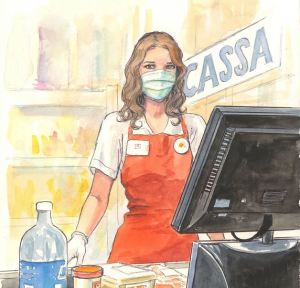
Milo Manara honors heroic women

Milo Manara honors heroic women

The present moment can provide us a heightened appreciation of these unnoticed individual actions.  The early days of the COVID-19 pandemic saw an outpouring of support rightly directed to the unsung heroes—doctors and nurses and medical technicians, grocery store clerks, people who make toilet paper—unsung because they are too many to spotlight individually.  (Although individual acts of appreciation are still a just way to honor those continuing acts of undemonstrative service.)  Indeed, everyone has to act in concert if the pandemic is to be contained.

Peter Jackson’s Gandalf gets the underlying point right in one of the Hobbit movies:

I have found it is the small things, everyday deeds of ordinary folk, that keeps [sic] the darkness at bay.  Simple acts of kindness and love.  (The Hobbit:  An Unexpected Journey (2012), at about 1:42)

We must all be heroes now.

Of course, going in and making some marks on a piece of paper doesn’t feel much like heroism—even less so than wearing a facemask.  Perhaps it feels a little more dramatic when we’re braving the chance of coronavirus infection to cast our ballots.  And if that way of viewing our action as a daring deed spurs us to act, by all means indulge!

But in this kind of case, the only way to achieve anything is by small actions, each of which contributes to a whole.  The entire set makes a difference; but there can’t be an entire set unless there are individual acts.  In voting, as in picking up one’s trash, or in the innumerable actions that make up a free market, we must carry out the individual actions to produce the aggregate effect.

Turning the Tide in Real Life

If we need further encouragement, we can look to the additional fact that even one vote, or a few, can sometimes make the crucial difference.

Virginia Board of Elections draws lots to decide tied electionRight here in Virginia, we had an election in 2017 that resulted in a literal tie:  an equal number of votes for each candidate.  A purely random action had to be used to break the tie.  “Each candidate’s name was placed in a film canister; those were then placed into a bowl and one name was drawn.”  (NPR, 1/4/2018)

Even a few votes, even one, can make the critical difference, as recounted here and here—notably including “the year 2000 U.S. presidential election, decided by a few hundred votes in the state of Florida”  (Jared Diamond, Collapse:  How Societies Choose to Fail or Succeed (2005), “Further Readings” for ch. 16, p. 556)  Over and above my contribution to the whole, I cannot know in advance whether my vote might not be, in fact, the deciding factor in a hotly contested election.

Moreover, even if the outcome of an election might be clear without my vote, adding to the total is not pointless.  In today’s atmosphere of distrust and suspicion, the clearer and more decisive the result, the less opportunity there will be to cast doubt on the results.  Every vote added to the total reduces the number of people who will be convinced that the results are false, and thus directly supports the rule of law.

This concern also bears on the notion of voting for a third-party candidate.  In the upcoming election, many people may be sufficiently dissatisfied with both major parties to be motivated to cast their ballots for a third-party contender.  It might feel virtuous to spurn both parties and “vote one’s conscience” in favor of a candidate who cannot win.  But in practice, that action will only serve to make the results less clear, at a time when clarity is vitally needed.

L’Envoi

Voting is much trickier—even perhaps a heroic act, as noted above—in these pandemic times.  Nevertheless, there are avenues available by which all of us can safely exercise the franchise.

Drop box for ballotsFor my own locality in Virginia, here’s a guide to voting early, voting by mail, and voting on Election Day.  The local paper has a Web site on How to Vote, by state; I haven’t researched that reference in detail, but it may be useful.  Here are three articles on drop boxes for ballots.

I urge every eligible voter to take part in this crucial action of self-government.  Unless you’re actually in the hospital in a coma (or the like), there’s no excuse not to participate.

The Distilled Adaptation

Shortening

The translation of a story from book to stage or screen always involves some degree of change.  The two arts are different; what works to communicate a story in one medium may not work in another.

A book can accommodate relatively long sequences of events, because we read a book in segments on our own schedule.  But a stage play or movie has to be geared to the limitations of the human body.  Watching a full-scale version of The Wheel of Time, say, at one sitting would require both an IV and a catheter—and a “pause” button for sleep.

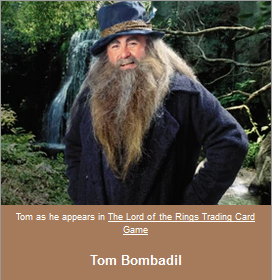
Tom Bombadil (from card game)Thus, the live-action rendition of a novel generally has to leave things out, and the ability to condense the story smoothly is vital.  For example, the three-film Lord of the Rings omits the book’s entire side trip through the Old Forest, Tom Bombadil, and the Barrow-Downs.  Even with three long films, something had to be cut.  (This omission, incidentally, was a good choice and well-executed.)

The limitations of time have eased a bit with the introduction of multi-episode and bingeworthy screen formats, along with viewers’ increasing willingness to follow long-running stories (a curious counterpoint to the frequent suggestion that our attention span is eroding).  An eight-season Game of Thrones video production can cover much of what occurs in a very long book series.  But the writer or director must still gauge what can be included and what can be omitted.

Reorienting

Sometimes, when condensing a book for the theatre, the writers may take the opportunity to narrow the focus of the original story—particularly when the novel is a broad, rambling, discursive sort of tale.  In the process, they may also convey a meaning (what we might cautiously call the “moral of the story”) that’s different from that of the original.  Depending on what the rewrite chooses to emphasize, the new version may point in a different, or more definite, direction than the old.

Reorienting a tale this way can improve it—depending on what the new direction is.  Let’s look at a couple of examples.

Man of La Mancha

Man of La Mancha posterWe recently looked at the staging of the 1965 play Man of La Mancha; and a couple of years back we talked about what it says to us.  When I first saw the show back in 1970, its basic theme fit right in with what had become a widespread idea back in the 1960s:  that we are too prone to think of ourselves as unworthy of love, and that becomes a self-fulfilling handicap.

To recap:  The fantasy-ridden Don Quixote finds his ideal lady Dulcinea in a barmaid and part-time prostitute named Aldonza.  Aldonza despises herself as well as the men who use her.  She is at first baffled, and then enraged, by Quixote’s persistent attempts to idolize her and praise her ladylike virtues.  She feels she has no virtues; he is refusing to see her as she really is.  (Audio / Movie video)

Against her will, under Quixote’s gentle persistent courtesy, she begins to believe she can be better than the way she’s always thought of herself.  She is promptly and brutally disillusioned when the muleteers attack her.  The play pulls no punches:  being “nice” or showing generosity is no guarantee against mistreatment.  Yet, in the face of all evidence to the contrary, Quixote continues to treat her as a noble lady.

Dulcinea, at Don Quixote's deathbedAt the end of the play (7:42 in the clip), after Quixote’s death, she finally accepts that she is more than a nobody, “born on a dungheap”:  she will honor Quixote’s memory by living his impossible dream.  “My name . . . is Dulcinea.”

I'm Lovable buttonMan of La Mancha forcefully illustrates what in the ’60s became a truism.  We must see what is potentially lovable in someone before it is evident; and sometimes that premature faith and hope can help the person realize they are lovable—and free them to love.  This is more than the mere psychology of self-esteem; it’s an insight about how human beings work that is still worth recognizing.

Yet this isn’t exactly what Cervantes had in mind.  It’s been a long time since I read his immense rambling novel, but I don’t recall that this theme of convincing people they are lovable was evident there.  The novel speaks to a lot of other issues, such as the interplay of realism and idealism, but it isn’t focused on this.  Rather, the authors of the play selected and adapted material from Cervantes to address a theme characteristic of their own time.

One might complain that the modern playwrights have hijacked an existing story for a purpose the novel’s author never had in mind.  But as I see it, the concentrated, powerful Man of La Mancha is a great deal more interesting than the long and diffuse original.  The adapting writers have distilled a potent new wine from familiar grapes.

Les Misérables

Victor Hugo’s Les Misérables is also a massive novel, covering many years’ time and an array of main characters.  It’s also prone to digression, including among other side trips a chapter on the history of the Paris sewer system (part 5, Book Second, chapter II).  When I read the book, I made myself a whole list of sections that could be skipped, without loss, on a second reading.

Les Miserables (opera) logo

By Source, fair use (Wikipedia)

Obviously, this discursive work can’t be transformed directly into a play or a movie.  Nonetheless, there are quite a few film or stage versions.  The one I find most powerful is the opera Les Misérables by Claude-Michel Schönberg, Alain Boublil, and Jean-Marc Natel, with English libretto by Herbert Kretzmer (1980).  It’s a long show, just under three hours, but of course it can’t begin to reproduce the entire book.

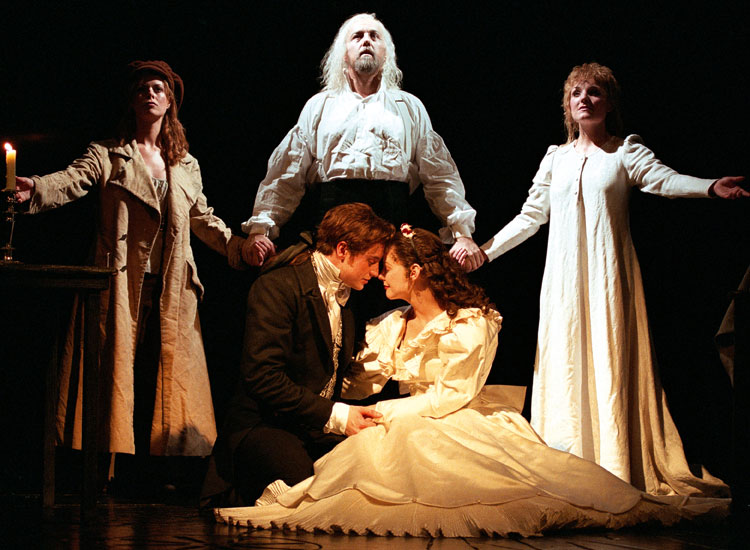
Thus, again, the playwrights are selective.  The novel tells the story of a group of people caught up in the Paris revolt of 1832, extending backward as far as 1815 to depict the backstory of Jean Valjean, the central character.  The play starts almost as far back.  After being imprisoned for nineteen years for stealing a loaf of bread, Valjean is overcome by the mercy of God when a kind bishop refuses to turn him in for a new theft, and resolves to make a better man of himself.  He adopts the orphaned girl Cosette and raises her in secret, avoiding public notice so as not to be imprisoned again.  The grown-up Cosette falls in love with Marius, a young student involved in the short-lived and futile revolt.  To save Cosette’s beloved, Valjean joins the rebels and, as the barricade falls, rescues the fallen Marius.  At the end, with Cosette and Marius married, Valjean dies at peace, received into heaven by the spirits of Fantine, Cosette’s mother, and Eponine, a reformed girl who also loved Marius and died on the barricades.

The music is extraordinarily powerful.  I’ve seen the play twice.  Each time was an intensely moving experience.  The opera was finally made into a movie in 2012, with Hugh Jackman, Russell Crowe, Anne Hathaway, and Amanda Seyfried.

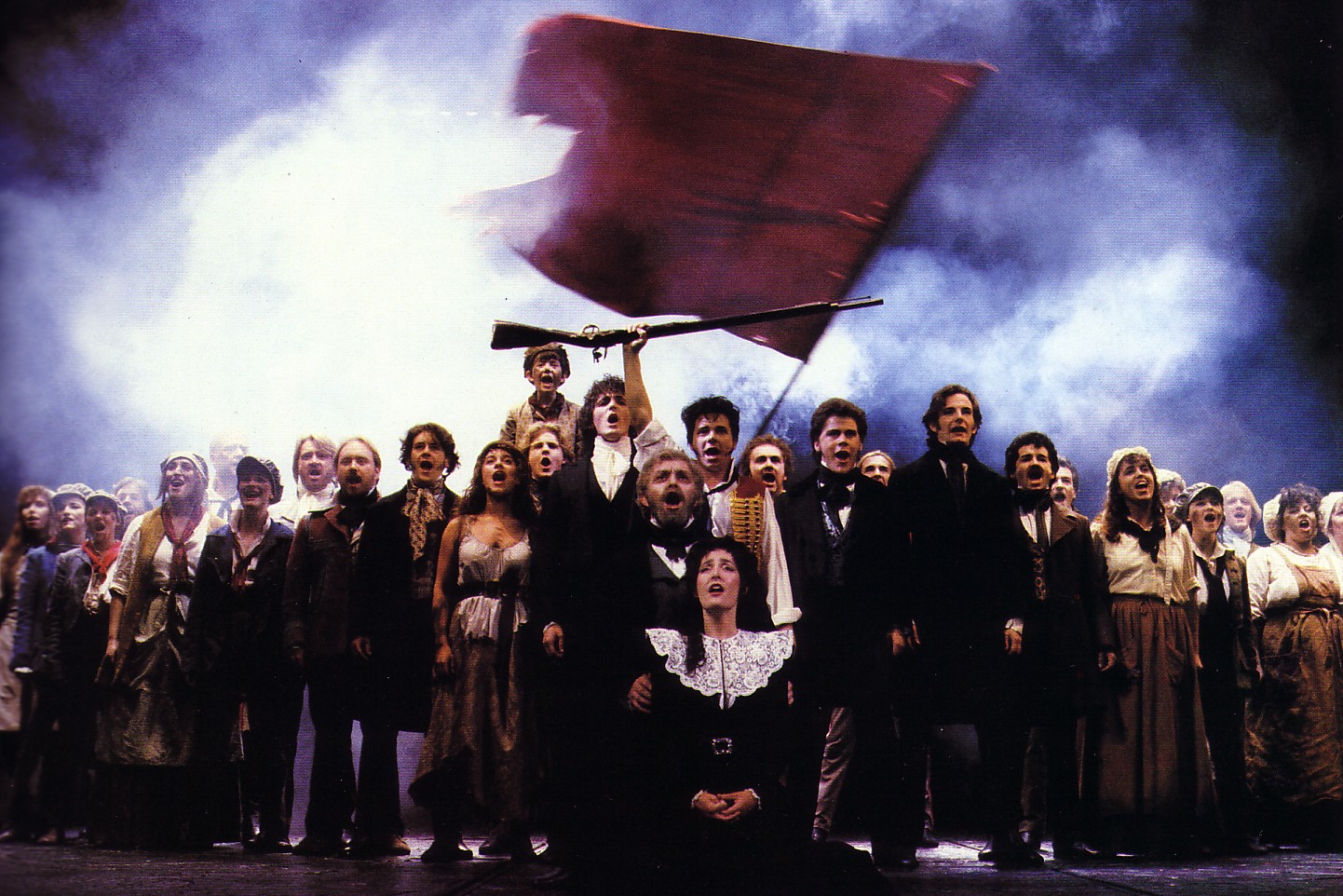
One Day More, from Les MiserablesA political motif is essential to the story—the tragic plight of the poor of France and the injustice that drove them so often to rebellion.  And as a political drama, it’s a bitter tale.  The student activists, confident that the people of Paris will rally to their side, put themselves on the line.  And no one comes to join them.  The revolt is snuffed out at once, barely a footnote in history.  The only triumph that can be found is a visionary one in the indefinite future:


Will you join in our crusade?

Who will be strong and stand with me?

Somewhere beyond the barricade

Is there a world you long to see?

Do you hear the people sing?

Say, do you hear the distant drums?

It is the future that they bring

When tomorrow comes!    (Finale)


Les Miserables - To love another person is to see the face of GodThen why is the play so uplifting?  We don’t care so much about the revolt’s failure because the characters transcend their miseries.  Cosette and Marius marry; they’ve earned their happy ending.  Valjean, Fantine, and Eponine die, but they ascend to eternal bliss.  The revolt accomplishes nothing, but the heroism and love of the principal characters makes that detail seem irrelevant.

The theme of the opera might be summarized as:  ‘Politics comes and goes, but people are forever.’  How we treat other people is vastly more important, in the long run, than the rise and fall of political regimes.  Of course, the two are not unrelated:  the purpose of a sound political regime is to make it possible for people to live good lives.  But this particular story places all its weight on the personal side.

I’m not sure that that’s what Hugo had in mind.  He might have; he certainly does emphasize the heroic compassion of Valjean and contrasts the ironies of the abortive revolution.  But it seems to me Hugo’s novel had considerably more of a political axe to grind than the opera does.  It’s a matter of degree, but I don’t know that Hugo would have sympathized entirely with the adaptation’s relative downplaying of the political.

Conclusion

In both these cases, it seems to me the adaptation has taken a particular thread from a very large original and woven it into a much more condensed, more focused story.  In doing so, the adapters have chosen to bring out themes that may be different from the bent of the original tale.

When it’s successful, such an adaptation gives us a derivative work drawing on untapped potentials in the original.  The relationship is not unlike what I’ve called the “malleability of myth.”  A root story can be reinterpreted in many ways—and some of them may be greater than the original.

Star Trek vs. Star Wars

Hatfields and McCoys, Marvel and DC, Star Trek and Star Wars.  One never knows how seriously to take these deadly rivalries.  Personally, I like both of the science-fiction series, so I see the Trek-Wars wars more as a difference in tastes.  Sometimes you feel like a hamburger, sometimes a pizza.

The particular difference I see in SW and ST has to do with their atmospheres or sensibilities.

Good Order

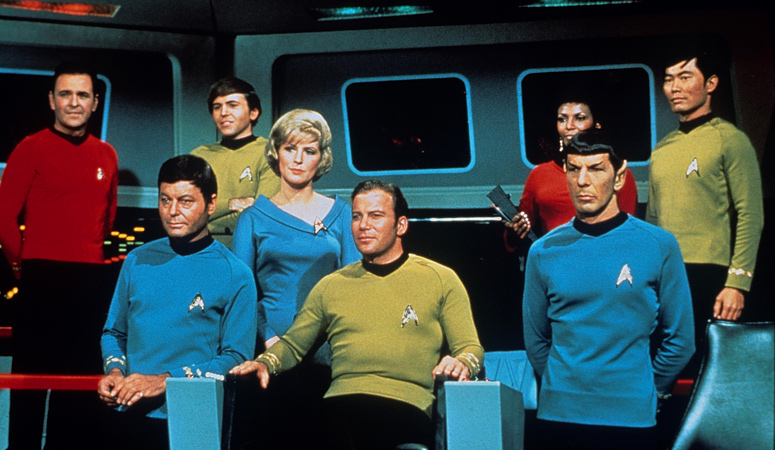
Star Trek TOS bridge crewThe Star Trek universe—I’m focusing especially on the original series (“TOS”) and movies here—is civilized.  There are plenty of things that go wrong, and going where no one has gone before frequently brings us into situations of conflict.  But the Federation itself is organized and mostly decent.  There’s an actual chain of command.  Authority figures are typically respected.

That’s the first approximation.  To be sure, Captain Kirk and his successors don’t mind defying Starfleet orders now and then.  But when Our Heroes turn out to be right, they’re back on amicable terms with their superiors in short order.  At the end of Star Trek IV:  The Voyage Home, Admiral Kirk, after stealing and destroying the Enterprise (among other things), is demoted to Captain again as his “punishment.”  But everyone understands this as simply restoring him to the role he prefers and serves so well.

There’s enough divergence among Starfleet personnel to make the stories interesting, but actual villains in the corps are relatively rare.  Starfleet and the Federation are the orderly defenders of liberty and individual (in our parochial world we say “human”) rights.  That Gene Roddenberry optimism is embedded in the show’s DNA.

Fruitful Disorder

In Star Wars, it’s the villainous Vader who wants to “bring order to the galaxy” (as he says around 1:38 in this clip), and it’s the motley, disorganized rebels who fight for freedom.  Our Heroes are rebels who defy the authorities.  Their chain of command is informal, and pretty much anyone, even the carefree Han Solo, can become a general.

Though the swashbuckling, colorful Star Wars universe may seem lighthearted, it’s actually a rather distressing place.  The nearest outpost of civilization to Luke’s uncle and aunt’s farm is Mos Eisley, a “wretched hive of scum and villainy.”  Slavery has flourished on Tatooine from a generation ago (little Anakin) to Luke’s era (Jabba’s servitors)—and apparently neither the Empire nor the old Republic did anything to stop it.  Intelligent droids are second-class citizens.  In the latter days of the Republic, trade combines were permitted to conduct outright warfare against whole planets (Phantom Menace), with no more than tardy, ineffective intervention by the Jedi Knights.  It seems a much less comfortable universe to live in than Star Trek’s Federation.  Both have their flaws, but the Star Wars ’verse seems much more unstable—if colorfully so.

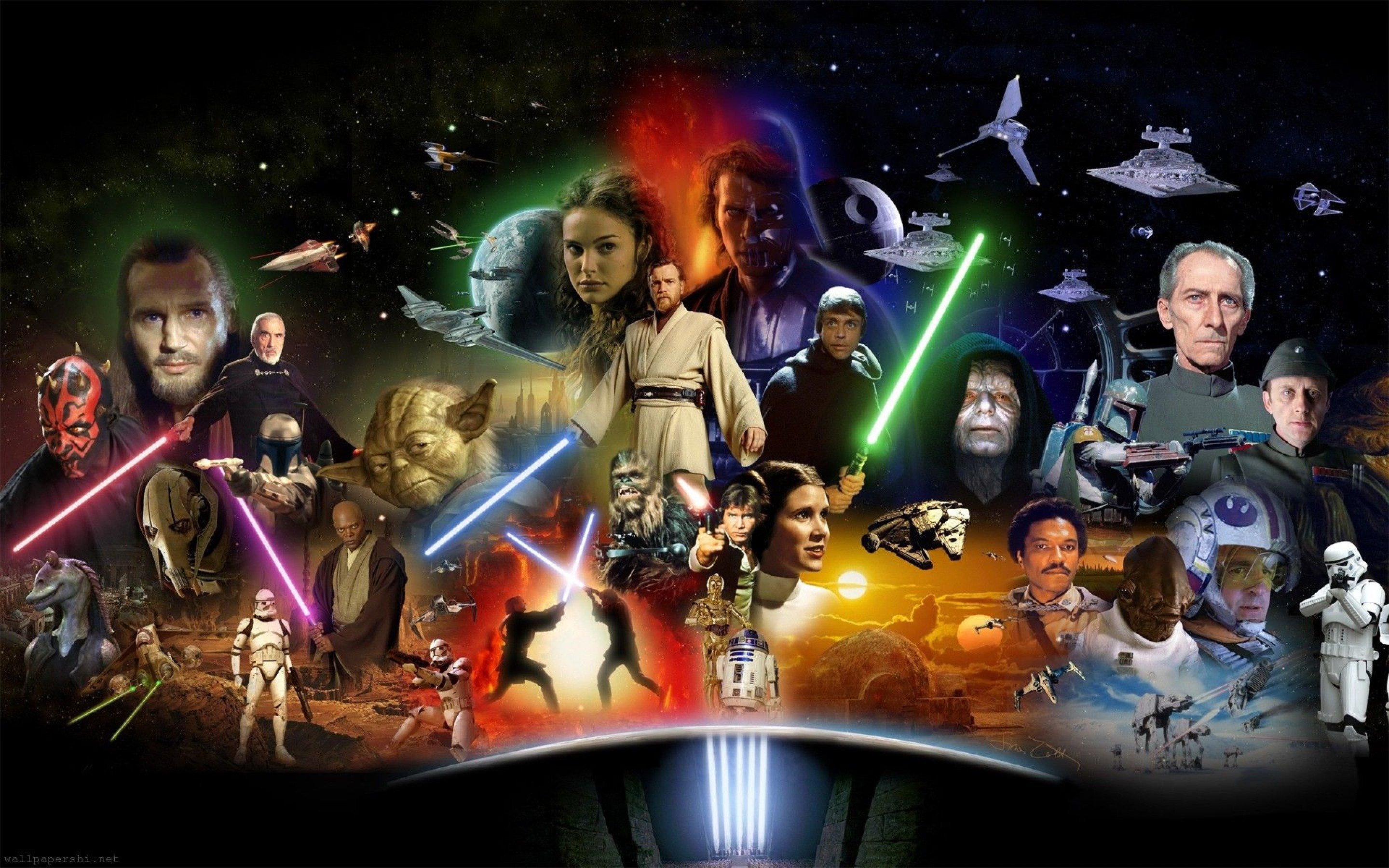
Star Trek composite posterThere’s nothing wrong with this as a story setting.  A varied world full of dangers makes for more exciting stories than a placid utopia.  But the Star Wars setting calls out to a different kind of fan than that of the Trekkies.

Vader’s desire for order actually has good character-based reasons—one of the things the prequel trilogy got right.  In a world where you’ve been held as a slave, your mother has been tortured to death by barbarians, and your beloved is menaced by assassins at every turn, a desire for law and order is extremely understandable.  But it’s the lively Rebels with whom the viewer’s sympathies lie.  In this democratic milieu, quirky individuals and inspired improvisation flourish.

Both the SW and ST approaches represent ’60s sensibilities, but one is slightly later than the other.  Roddenberry’s Star Trek expresses the firm American optimism of the Kennedy era (1960-1963); it isn’t accidental that in the follow-up movies, Roddenberry kept wanting to tell a story about time-traveling to meet JFK.  Star Wars, on the other hand, evokes the counterculture of the late ’60s, which distrusted authority and prized rebellion—not to mention colorful chaos.

The Abrams Factor

It’s instructive to see how J.J. Abrams handled the two, since he has had the opportunity to reboot both Star Trek and Star Wars franchises.  My sense is that he’s handled SW much better than ST.  Abrams’ Star Trek movies show us a distinctly grittier, more chaotic world than Roddenberry’s.  It is, in fact, more like the Star Wars universe.  And I don’t think I’m alone in feeling that, entertaining as Abrams’ ST movies may be, he doesn’t quite “get” what Star Trek is about.  His Star Wars continuation, The Force Awakens, however, is to my mind an excellent (if not flawless) extension of the SW universe.

In other words, making Star Wars more like Star Wars is a good thing, right up to the point where it begins to get slightly repetitious.  Making Star Trek more like Star Wars runs the risk of losing the very things that makes Roddenberry’s creation distinctive.  Both are good things; but they’re not good in quite the same way.

Alignment

One of the interesting things about the Dungeons & Dragons (D&D) game system is the notion of alignment.  D&D is built on ideas from a whole range of fantasy stories.  Many of those stories involve a conflict between good and evil.  Some, however, make the central conflict one of law vs. chaos.  D&D’s creators took the surprising step of adopting both oppositions, but keeping them distinct.  The result is a three-by-three, nine-cell matrix.  A character’s personality and ethical stance can be lawful good or chaotic good, or straddle the two as neutral good.  The being can also be lawful or chaotic evil—the evil of 1984 or of Beowulf, let’s say—or an intermediate neutral evil.  Finally, someone can be lawful neutral (think an OCD personality), chaotic neutral (low impulse control), or “true neutral” double-neutral (an unprincipled pragmatist, perhaps).  The range of combinations allows for shorthand expression of quite an array of character types.Nine alignments example, F&SF

I wouldn’t necessarily buy into this particular classification of famous fictional characters . . . but it gives us an idea how the alignment scheme works in practice.

The alignment chart also yields a neat way to encapsulate the ST/SW difference we’re examining.  Star Trek honors the lawful good:  the interstellar police force, the scientific explorer, the careful defender.  Star Wars admires the chaotic good:  the lovable rogue, the solitary guru, the loosely organized band of allies.

Political theory

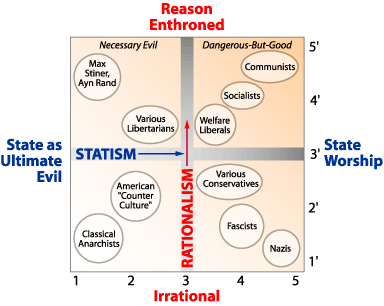
Pournelle political axes chartHere’s yet another way to put it.  Science fiction writer Jerry Pournelle, whose doctorate is in political science, laid out in 1963 a map of political “alignments” with two axes, producing a far more useful classification of positions than the usual left-right continuum.  (Pournelle’s 1986 essay provides a detailed explanation.)  The two dimensions in Pournelle’s scheme are “attitude toward the state” (from state as evil to state worship), and “attitude toward planned social progress” (from rationalism to irrationalism).

If we think of these axes as applying to the character of a culture, not necessarily to politics per se, we can express the ST/SW divide in Pournellean terms.  I’d put TOS-era Star Trek somewhere around 3/4’ or 3.5/4’ on the chart, believing pretty strongly in reason and ambivalent about state power.  Star Wars, by contrast, seems to live in the 2/2’ region, not far from the “American ‘Counter Culture’” to which I compared its ambiance above.  Each milieu will tend to attract viewers who are sympathetic to the points of view expressed in its neighborhood on the grid.

Civilization

What it comes down to, I think, is whether we see the best conditions for free and fruitful lives primarily in order or in disorder.  Both are arguably necessary.  But is what’s best for people a basically orderly society with a healthy modicum of chaos; or a wild-and-crazy culture with just enough organization to hang together?

The Star Trek/Star Wars contrast thus leads us up to the question of what makes for a good society, a true civilization.  There’s a good deal more to be said about this, and I’ll take another crack at it next time.