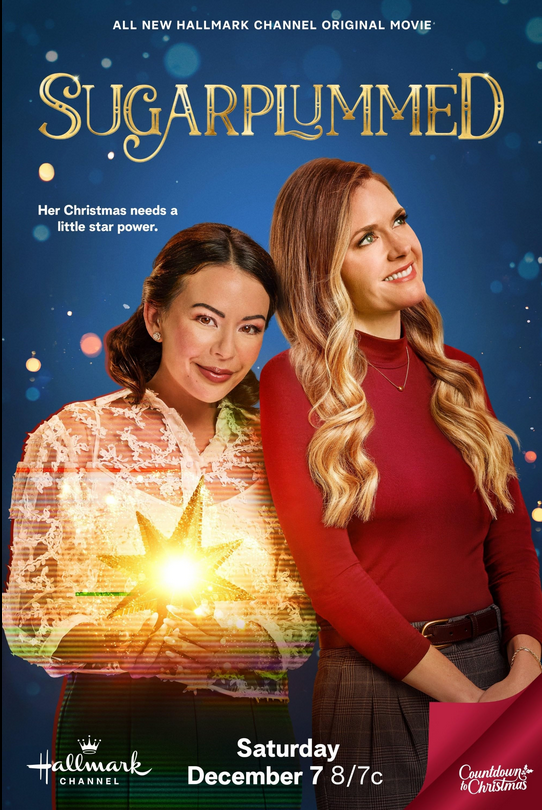
Among the Hallmark Channel’s Christmas season offerings this year is a comedy called Sugarplummed, which has the distinction of being a spoof of the Hallmark Channel itself.
Satirizing the recurring tropes of the innumerable Hallmark Christmas movies isn’t a new game. As noted in my 2019 post, takeoffs on this subgenre are legion. Just today, a “Sally Forth” newspaper cartoon rang yet another change on the meta-tradition of Hallmark spoofery.
But it’s particularly entertaining to watch someone make fun of themselves. In Sugarplummed, Emily, the harried mother in a family of four, is devoted to a schmaltzy series of TV movies featuring a woman named “Sugarplum.” She’s thrown off the rails when the Sugarplum character magically materializes in the real world, determined to fulfill Emily’s wish for a perfect Christmas. Sugarplum carries around a thick book that contains The Rules. The Rules are a collection of mandates that embody all the Hallmark clichés we know so well. Sugarplum’s world, in her home town of (naturally) “Perfection,” lives by these rules. Why shouldn’t they work in Emily’s life as well?
For a while, they do, and we’re treated to a series of implausible “Christmas miracles” where everything works out perfectly. Then, as the Hallmark plot summary puts it, “when Sugarplum’s magical fixes start to backfire one by one, Emily begins to question what an ideal holiday really is.” The moral of the story is not to pursue perfection to the detriment of our ordinary relationships and joys—or, to put it another way, the familiar adage that “the perfect is the enemy of the good.” That’s an apt reminder.
Enchantment and Reality
The Disney canon is another inviting target for satire. The long history of Disney movies and shows contains plenty of well-worn recurring tropes and themes. And, since much of Disney’s original focus was on children, those motifs tend to be on the sentimental or upbeat side, making the repetition even more attractive for satire. (For some reason, the repetition of ugly or grimdark tropes, as in the plethora of dystopian fantasies now flooding the market, doesn’t attract as much jeering.)
Shrek (2001) did a pretty good job of spoofing Disney, the theme parks as well as the movies—not just in the details, but in the overall plot. Instead of having the prince or princess turned into a monster or critter and restored in the end, Beauty and the Beast-style, Shrek’s inamorata Fiona turns out to be an ogre who’s been turned into a princess, and the happy ending ensues once she’s been restored to her natural homely form.
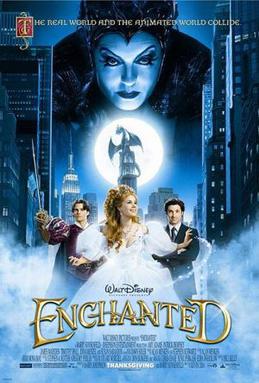
Of course, there’s a certain sniggering almost-hostility in making fun of somebody else’s clichés. We can undermine that attitude when we make fun of ourselves. Disney one-upped Shrek when it released the movie Enchanted in 2007. Here, an animated character named Giselle, a perfect exaggeration of a Disney fairy tale heroine, is sent by a wicked witch to a terrible foreign land that works by entirely different rules: New York City. Now in live-action, we see Giselle try to cope with the grittier world we live in, where her set of Rules don’t apply. (In one classic inversion, the climax sees Giselle attacking the monster to save the man she loves, rather than the other way around.) We do get a happy ending, but it’s much more along the lines of learning to be a grown-up and living with (while improving on) imperfection.
In the last Lensman book, Children of the Lens (1947), Smith’s redoubtable hero Kimball Kinnison goes undercover as—of all things—a science fiction writer, Sybly White (see chapter 3). We see a couple of excerpts from the SF novel Kinnison writes, which (of course) “was later acclaimed of one of Sybly White’s best.” The excerpts parody, not just space opera generally, but Smith’s own ebullient, melodramatic style. It’s charming to see Smith good-naturedly bringing onstage a caricature of himself.
Taking Ourselves Lightly
As I’ve noted elsewhere, humor can often involve a kind of meanness toward the target of the humor. The charm of the self-satire is that the temptation toward meanness or hostility is absent. Spoofing oneself is almost bound to be an affectionate parody, the kind where the humorist really likes the subject of the humor. These often make for the best satires, untainted by any sourness or smugness and genuinely understanding how the satirized thing works.
I give Hallmark credit for Sugarplummed, then, especially because it shows the showrunners are not taking themselves too seriously. That genial attitude is in tune with the Christmas season Hallmark is celebrating. As Chesterton put it in Orthodoxy (ch. 8): “Angels can fly because they can take themselves lightly.”
A song—especially a love song—often implies a story.
Some songs, it’s true, just express a state of things: say, being in love. The Beatles’ “Here, There and Everywhere” talks about things that happen (“Someone is speaking, but she doesn’t know he’s there”)—but nothing actually changes in the song. It’s a snapshot of a relationship.
But frequently the song refers to a sequence of events, and this sequence is at least a fragment of a story. “She Loves You,” after the refrain, starts out “You think you lost your love” (addressing someone who had been in love, but they seem to have broken up). The lyric continues: “Well, I saw her yesterday” (the singer/friend brings new information)—and eventually looks to the future (“Apologize to her”). The song describes a progression in a relationship.
The Story of the Video
When the modern music video came into vogue in the 1960s, and picked up steam with the advent of MTV in 1981, a new factor was added. If the video simply showed the band performing the song, then the story implied by the song didn’t change. But if the video began to incorporate other elements, such as actors or band members acting out things that occurred in the song, then new possibilities opened up. Is the story we hear always the same as the story we see?
“The Great Adventure”
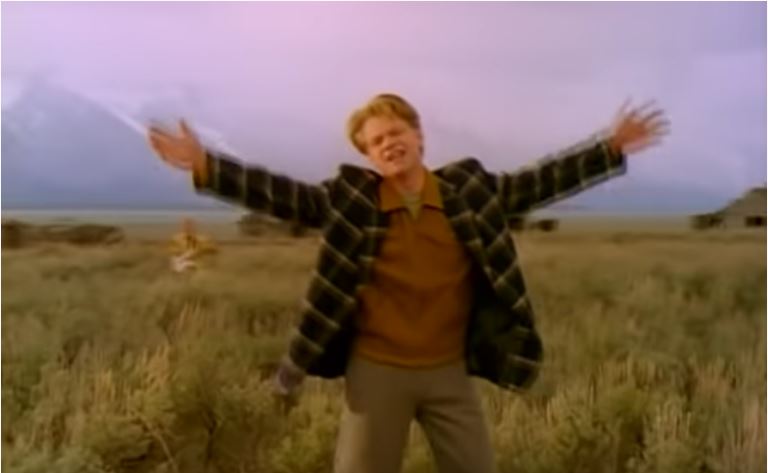
The pure performance video represents what we might call the null case—just the song, illustrated by imagery of the band. The next step is represented by a video that provides a sort of impressionistic imagery the illustrates themes or ideas in the song, without altering the storyline. For example, the video of Peter Cetera’s “One Good Woman” shows clips of Cetera singing the song, interspersed with roses and bottles on tables, kisses and embraces, the faces of women who might be the one referred to in the title, plus other images whose relevance is less clear (clocks, hats, a metronome, abstract shapes). The concept video for “The Great Adventure” riffs on the lyrics (“Saddle up your horses / We’ve got a trail to blaze”) with Western ranch scenery, as well as images of walls falling that express the movement of the song. For similar examples, check out “True Believers” and “Once in a Lifetime.”
Showing the Story
“Austin”
In the most literal sense, the video can amplify the impact of a song by simply depicting the events described in the lyrics. For example, Blake Shelton’s song “Austin” tells a rather charming tale in which a woman has gone off to Austin, but realizes from the answering-machine messages of the man she left behind that he still loves her. The video actually shows us clips of the events the song is talking about, interspersed with shots of Shelton singing, making the story more vivid.
Such a visual rendition in effect replaces our imagination of the story with a particular interpretation, in the same way that a movie makes visible in a particular way the action of the book it was based on. Of course, this runs the risk of disrupting the viewer’s appreciation, if the filmmaker’s idea is distinctly different from the viewer’s: “I didn’t picture it like that at all.” But it can also bring out the story more forcefully by providing lifelike imagery where our imaginations might not have been so vivid.
The video can also intensify the effect of a song by providing a visual mini-story that doesn’t exactly correlate with what the song is about, but reinforces it thematically. Take, for instance, Martina McBride’s “Ride,” which is about an overall attitude toward life. The video gives us a sequence about young people stuck in a traffic jam, who (watching a projection of McBride’s performance on a billboard) start having fun with each other in the spirit of the music. There’s nothing specific about traffic jams in the song, but the video sequence does add a further element of enjoyment to the effect of the song alone. Or take a look at the video of Carrie Underwood’s “Love Wins,” which very effectively underlines the song’s message through images of people making their way to a celebration.
Expanding the Story
“Mine”
The video can also take a slightly different direction by sticking to the original storyline, but adding elements. For example, in “Mine,” Taylor Swift describes her character as “a flight risk with a fear of falling,” and her boyfriend tells her that “we’ll never make my parents’ mistakes”—but the actual backstory isn’t specific. In the video, we see footage of her parents quarreling while Swift’s character as a child looks on, and this adds weight to the fight described in the song’s bridge—and thus to the uplift of her lover’s refusal to give up: we actually see them marrying and having a baby at the end. The story has expanded.
Similarly, in the video of Gloriana’s “(Kissed You) Good Night,” we get some opening dialogue adding context that may not have been contemplated in the song itself: the boy is in the Army and leaving the next day. The titular kiss goodnight is a more definitive farewell than we could have guessed from the lyrics alone. In Dierks Bentley’s reflective “Home,” the variety of the faces of America appearing in the video add depth to the song. The music video of Brad Paisley’s “Welcome to the Future” actually incorporates brief clips of children explaining what they want to be when they grow up—reinforcing the sense of possibility and achievement that makes the song compelling.
Changing the Story
Sometimes, however, the video seems to take off in a different direction from that of the original song.
“I Know You’re Out There Somewhere”
I’m fond of the late Moody Blues song “I Know You’re Out There Somewhere” (1988). (In fact, I have a sketch for a novel partly inspired by the song, but that’s another story.) As the title suggests, the lyrics depict a man searching for the girl he once loved. The video isn’t entirely inconsistent with that idea: the singer is clearly looking back to a love affair in the ’60s. But the singer is depicted in his actual persona, as a budding rock star, hustled away from her by the demands of the music business. As a result, we see much more of her longing for him than of him longing for her. The regret is mutual, but the emphasis is different.
Taking the discrepancy further, Céline Dion’s “It’s All Coming Back To Me Now” evokes a pair of lovers who had broken up but are now getting back together. At least, that’s what the lyric sounds like to me. But in the video it appears that Céline’s lover rode off on a motorcycle and died in an accident. Unless she’s being visited by a very substantial ghost—which would actually fit the rather Gothic tone of the video—they don’t actually seem to be reunited at all. (It gets weirder: according to the notes at the bottom of the lyrics page, the song was actually written for a play based on the Peter Pan story, and the lyrics were inspired by Wuthering Heights. As for the motorcycle, who knows where that came from.)
Gary Allan’s “Every Storm Runs Out of Rain” appears to be addressed to someone who’s lost their love, encouraging them to last through their pain and find someone new (“And walk out that door, go find a new rose, don’t be afraid of the thorns”). The video features a woman who’s clearly suffering (in a rainstorm), but at the end her soldier husband comes back. They were separated, true, but she’s not finding a “new rose,” just watering (as it were) one that was drooping.
Adding a Comic Note
The temptation to make the music video more of a humorous riff on the original song—a spoof of itself—must be strong. In a number of cases, the video makers seem to have decided just to have fun with the concept.
“Heaven is a Place on Earth”
We started with the Beatles; their movies A Hard Day’s Night (1964) and Help! (1965) consist largely of song performances, but the accompanying video clip often has little to do with the subject of the song; sometimes it’s simply surreal. There’s a similar feel to the video of Belinda Carlisle’s “Heaven Is A Place On Earth,” which opens with a bunch of masked children carrying lighted globes. We see these globes, apparently inspired by the mention of “Earth” in the title, splashing into water, or lying on a dark reflective surface. There are also shots of Carlisle singing and embracing a lover, but we keep coming back to these kids and their globes. Often they appear to be running in place. If that means something deep, I’m missing it.
“Shadows of the Night,” best known for a Pat Benatar recording in 1982, is one of those songs in which a pair of lovers is escaping into the darkness from some unspecified amorous angst. Might be an interesting story, though the lyric doesn’t provide much detail. Apparently it was actually composed for a movie about two young runaways in New York City, as discussed here, here, and here, and what seem to be the original lyrics were distinctly different. None of them, however, refer to anything like what we see in Benatar’s wacky music video, in which she seems to be playing the part of a World War II aviator/spy—or perhaps Rosie the Riveter, daydreaming.
“I Got You”
The filmmakers for Thompson Square’s “I Got You” decided to take off on the fact that the song has almost the same title as, and develops the same theme as, Sonny & Cher’s iconic hit “I Got You Babe.” The duo is performing the song on a TV variety show hosted by themselves dressed up like Sonny & Cher. The video has fun with the gap between the two time periods: the pair hands “Sonny & Cher” their CD, but since that format didn’t exist in the ’60s, the hosts have no idea what to do with it, biting it like a donut, using it as a mirror, finally employing it as a coaster.
The video of “Take On Me,” by a-ha, starts with drawings of a motorcycle race, apparently part of a graphic book a girl sitting in a diner is reading. When the boy in the drawing reaches out a three-dimensional sketched hand to her, she takes it, and is literally pulled into the story as a line drawing. As far as I can see, the video has nothing to do with the song, but it is good wacky fun.
At times it isn’t clear whether the humor is intended or inadvertent. Bonnie Tyler’s “Total Eclipse of the Heart” is a fine song, but the video takes the Gothic further than Céline and the random further than Carlisle. We see stained-glass windows, doves fluttering, Tyler looking out at the moon. A man walks in, and, apparently because Tyler’s backup singer refers to her as “Bright Eyes,” the man has literally glowing eyes. Boys sit in a classroom and toast around a table. Dancers with wings cavort around the singer. There’s literally an invasion of ninjas; at least, I think that’s what they are. The effect is so surreal that someone called “dascottjr” did a “literal video” version, having a woman sing lyrics that actually describe what’s happening on-camera. It’s hilarious.
Conclusion
The music video is a distinct art form, building on music but adding a new dimension. The two aspects may cohere, collide, or simply spin off in different directions. The result is a combination that we can enjoy on its own merits.
So, okay, I gave in and signed up for Disney+. It’s not as if I needed the streaming service to see the Disney fairy tales, or Star Wars, or the Marvel movies; I have those on disc. But there were these other things. First, I wanted to see the Hamilton movie (just as impressive as it’s cracked up to be). Then, since I was already subscribed for a month, I figured I’d check out The Mandalorian, if only to keep up my geek cred—it had taken me a while just to figure out where all the “Baby Yoda” memes were coming from.
By the end of the first month, I’d scanned the offerings and marked down a bunch of other things that I’d sort of wanted to see, or that I hadn’t known about but looked interesting, and now could get without paying more than I already was. And I was off and streaming . . .
One of the unanticipated things I turned up was a set of ancillary videos related to the 2010 fairy-tale adaptation Tangled, Disney’s version of the Rapunzel story. And thereby hangs a blog post.
A Tangle of Sequels
I’ve always been fond of the Tangled movie. But the continuing story also turned out to be remarkably good. As a rule, sequels to Disney princess movies tend to be humdrum affairs dashed off to exploit the movie’s popularity—though I must admit that I say this without having seen very many of them; ventures like The Little Mermaid II or Cinderella II: Dreams Come True never seemed to deserve even a look. (Frozen II is a decided exception.)
But the Tangled folks managed to pull off some impressive work in the follow-up media. To discuss it in detail, of course, I’m going to have to deploy detailed spoilers.
In 2012 Disney released a six-minute cartoon, Tangled Ever After, which is basically a comic bit about the exploits of the animal characters during the wedding of Rapunzel and her romantic interest, Eugene Fitzherbert (who previously used the name of legendary rogue-hero “Flynn Rider”). Nothing of interest there.
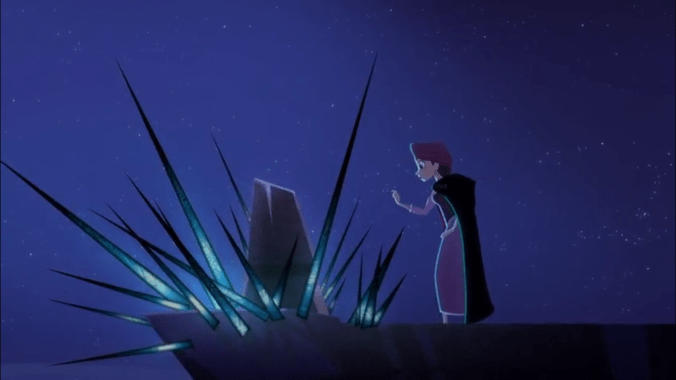
However, in 2017 the Disney Channel debuted a 55-minute short film, Tangled: Before Ever After. As the title indicates, this story takes place before the wedding sequence. The day before Rapunzel’s coronation, her lady-in-waiting, a tough-minded and capable girl named Cassandra, helps her sneak out beyond the kingdom’s walls to get away from the stress and chaos of the preparations. At the site of the magic flower that originally gave Rapunzel’s hair its healing powers, they find a stand of mysterious pointed black rocks. When Rapunzel touches one, more rocks suddenly sprout from the ground, forcing them to flee. But Rapunzel’s hair, which was cut short and returned to its natural brown in the original movie, suddenly turns blonde again and reverts to its 70-foot tower length.
This business with the black rocks is the story’s “One Ring,” the MacGuffin that links the old story to the new and provides the plot driver going forward. It isn’t explained or resolved in Before Ever After, but serves as the hook for the three-season TV series (2016-2020) that followed. The series was initially labeled “Tangled: The Series,” but in its second season was rechristened Rapunzel’s Tangled Adventure. Season 1 follows Rapunzel’s experiences in her parents’ kingdom; Seasons 2 and 3 take her and her companions on the road on a long-running quest. Wikipedia has a handy list of the episodes.
The series is where most of the plot and character development occurs. It concluded in March 2020. At this point it’s pretty clear that no further follow-ons are necessary, though one can’t rule out the possibility (“never say never again”). There’s also a stage musical (a version of the movie) and a video game, which I haven’t seen and assume are not in the continuity. Wikipedia’s convenient overall reference for the Tangled franchise is here.
Opening Out the Ever After
The first challenge in making a sequel to a fairy-tale movie is what to do about the ending. Traditionally, these stories end in a romantic happily-ever-after. If the main characters marry at the end (or immediately afterward), we’ve resolved the romantic tension. In addition, it may be hard to reconcile the vague vision of enduring happiness with the kinds of perilous adventures that would give life to a sequel.
The “before ever after” notion is thus productive. The characters can have further adventures even before their happiness is, as it were, sealed. We can stave off the fairy-tale ending, without subverting it entirely. To ruin the romance would be opprobrious, diminishing the appeal of the original story; but there’s no reason it has to come to fruition (presumably in a wedding) at once.
It’s particularly easy to take advantage of this idea if the couple hasn’t actually become engaged in the original story (even though the audience knows perfectly well that’s going to happen). Some reduced degree of romantic tension remains if the character still has to work up the nerve to propose, though the issue becomes more comical than dramatic. (A similar tactic was used in Frozen II.)
Thus, Eugene proposes to Rapunzel several times in the course of the sequels. She doesn’t accept at once. She wants to marry Eugene, but she isn’t quite ready yet. This brings out the familiar “moral” that a girl’s future is not solely bound up in marriage. It also makes psychological sense—and this is one of the ways in which the Tangled sequels intelligently carry forward the original storyline. As other characters point out, Rapunzel has spent almost all her life locked up in a tower, never meeting another human being but her “mother” captor. It seems hardly appropriate to expect her immediately to enter into a marriage.
Of course, Rapunzel could marry and still have adventures. The story thus plays around with the notion that “happily ever after” means the end of adventures and of our interest in the characters—a notion I’ve criticized elsewhere. It both dodges, and runs into, that trap.
The World and the Plot
Varian
Since the continuing story takes Rapunzel into new territory, both within and later beyond the Kingdom of Corona (which turned out to be a somewhat infelicitous name for this year, however appropriate for a princess), it was also necessary to expand the world. The writers carry out this worldbuilding exercise with enough novelty to earn some credit. For example, one of the new secondary characters is a young alchemist named Varian. Although his alchemy is technically magic, he firmly takes the position that it’s science, not fantasy. He thus adds a sort of steampunk vibe to the whole business.
Adira
The second season of the series introduces a secret society of crack warriors who are in some way protecting or defending the source of the black rocks. An enigmatic woman named Adira provides them with clues, along with ominous nonspecific warnings, and occasionally ends up sparring with the suspicious Cassandra. She and other members of the “Brotherhood of the Dark Kingdom” sometimes end up opposing or challenging the main characters, though they are basically on the same side. This secret society’s stance is reminiscent of the Brotherhood of the Cruciform Sword from Indiana Jones and the Last Crusade.
The most striking element of the plot is the long-running plot arc, which begins with the black-rock episode in Before Ever After and isn’t completed until the final episode of the series. The black rocks are tied in with the “sundrop flower” that originally gave Rapunzel her powers, so they link back neatly into the original movie. Keeping such an über-plot going over sixty episodes is a challenge, and the writers lay in enough complications and reversals to make it work.
This long-term development isn’t perfectly uniform. There are one-off episodes sandwiched in, often with throwaway plots (Max the noble steed is threatened by a competing evil horse! The queen’s annoying sister shows up for a visit!). Nor do the “side quest” episodes always make sense. In one show (Season 2 Episode 6), Rapunzel and Eugene decide to go off on a “date” while the group is encamped on the road in the middle of nowhere. (Butterbur in The Lord of the Rings: “Well, you do want looking after and no mistake: your party might be on a holiday!”) At the same time, these one-offs do sometimes have a point. The “date” introduces some characters who eventually turn out to be crucial to the plot. For another example, in a primarily silly episode (S2 E18) which turns most of the characters into toddlers, we get a fairly interesting lecture on parenting styles, courtesy of Rapunzel and Eugene.
The metaphysics, the “theory of magic,” is somewhat murky. Rapunzel’s “sundrop” and the “Moonstone” source of the black rocks have a sort of yin-yang relationship, but the Moonstone power is sometimes presented as evil, and sometimes as merely complementary. Rapunzel’s long hair, as restored in Before Ever After, has lost its power to heal, but has now arbitrarily become invulnerable—uncuttable—just like the black rocks. The conclusion of the story does make some degree of sense, though, so this particular worldbuilding weakness isn’t fatal.
Captain Quaid’s return
The story is willing to deal with serious issues. For example, the story introduces some genuine moral dilemmas, as when Rapunzel has to break a promise to Varian in S1 E16, which leads to no end of trouble for everyone. Some cogent sociopolitical points are raised, unlikely though that seems in a cartoon, in the second and third episodes of Season 2. Rapunzel and her followers want to reform the city of Vardaros, whose citizens have collapsed into a state of mutual distrust and predation. Rapunzel’s effort to use sheer niceness to show the inhabitants a better way doesn’t work: the locals don’t trust these strangers. Instead, Rapunzel and company have to convince the former “sheriff” everyone trusted to come back out of retirement and lead the reform. The success of this strategy is still a bit cut-and-dried, but for two 24-minute episodes, it’s handled pretty well.
Other character developments can also be surprisingly sophisticated. The scheming girl Eugene was supposed to marry ends up being reformed—but she still steals the party’s money; she doesn’t suddenly become sweetness and light. An entire episode (S1 E2) is devoted to showing that, even though Rapunzel is so adorable that everyone loves her, there’s one old guy in Corona who doesn’t—and he’s a good guy, respected by everyone, kind and helpful; he just doesn’t especially care for Rapunzel. And the moral of this story is that you don’t have to make everyone like you—a good thing for a young viewer (or even an older one) to recognize.
The sequels are thoroughly genre-savvy—a good platform for ringing new changes on the stock fairy-tale conventions. In S2 E 23, the characters are threatened by “…lethal, inescapable traps.” An array of nasty spikes springs up—and immediately crumble into ruin. “They’re old,” one character remarks, pinpointing one of the silly aspects of Indiana Jones-type adventures where centuries-old mechanical devices work perfectly without deterioration. And at the end of the second season, the characters walk into a whole series of classic Star Wars and Lord of the Rings tropes in succession—surely on purpose.
Carrying On the Characters: Rapunzel
The most interesting aspect of the Tangled sequels is the treatment of Rapunzel herself.
Rapunzel’s role in the movie is that of a “fish out of water” character—the naïve newcomer to the world, to whom everything is new and fascinating. That’s one of the things I like about the movie. Another is that she faces this brave new world outside the tower with kindness and wonder, though not without a sensible caution that’s sometimes deployed against the wrong targets, for comic effect. It isn’t by accident that Eugene calls her “Sunshine.”
Although she has to deal with progressively more fearsome and even heartbreaking problems as the series goes on, Rapunzel doesn’t lose that essential innocence. Yet, imperceptibly—and that’s the artistry—through the second and third seasons, she develops into the genuine leader of the group. She becomes capable of making difficult decisions. She isn’t intimidated by threats. When she has to take over governance of the kingdom, she falters at first, but later on becomes perfectly capable of running things without her parents. The changes are highlighted in the “dream trap” episode, S2 E19, where the matured Rapunzel speaks with her earlier self.
She even becomes a capable fighter in her own right. Rapunzel uses her long, indestructible hair like Indiana Jones’ whip, as both a weapon and a tool. Of course, this is cartoon physics. This slender girl hurls around what’s essentially a 70-foot rope without any issues of strength or leverage; it catches onto things and releases them just as she wishes, like Indy’s whip. The hair only gets in her way, or is used against her, when the plot requires it. It never frizzes or becomes unruly (fortunately for everyone nearby). Nonetheless, her trademark feature, which seems a romantic beauty mark at first glance, transforms her into a melee fighter, who can hold her own in a scrap.
While Rapunzel is no longer a magical healer, she does gain the ability to use ‘sundrop power’ over time. This power is erratic and not dependable, but it does rise to cosmic levels at the point where she can blow up an entire landscape at the end of Season 2. TV Tropes rightly cites her under the Films–Animation section of Badass Adorable.
The really remarkable thing about this maturing process is that Rapunzel is not altered out of recognition. She retains that essential sweetness of character that made her so likable in the movie. To depict a character who is both powerful and “nice” is difficult, and rare. When we have a chance to see the character visibly grow into that maturity, with both continuity and change, the writers’ achievement is noteworthy.
Romantic interest Eugene, in the sequels, gets somewhat dumbed down or, in TV Tropes’ term, “Flanderized”: turned into a caricature of himself. His vanity, a nicely balanced flaw in the movie, becomes tiresome when played out in every episode. His capability is uneven: sometimes he’s clever, sometimes clueless; sometimes he’s a formidable fighter, sometimes ineffective—as the plot may require. This is a classic problem in a continuing series, where different writers may produce inconsistent characterization.
Rapunzel’s parents, also, are not too well managed. In the movie, they’re merely props: the welcoming family to which Rapunzel can finally return at the end. In the series, we’re told that her mother, Queen Arianna, was once a sort of adventurer herself—but we see little of that. Her father, King Frederic (what a promising name!), tends to play the overbearing, irrationally restrictive father, generally as an obstacle to Rapunzel’s self-assertion. The two of them tend to fade out almost entirely toward the end of the series to give Rapunzel sole center stage.
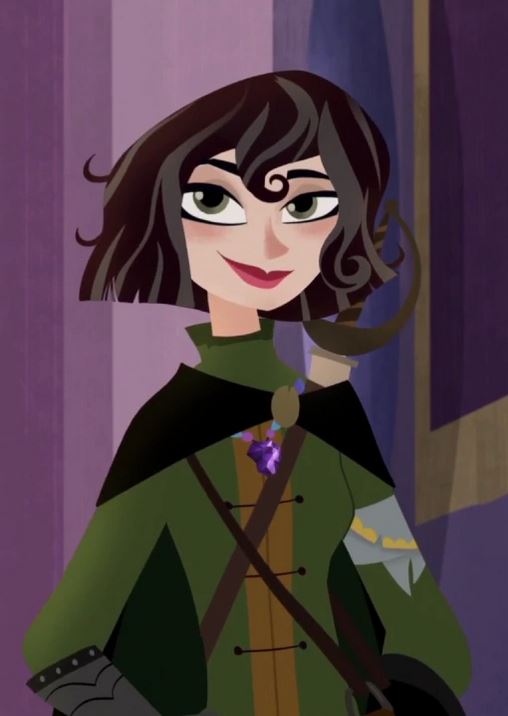
Cassandra
The great prize among the new characters is Cassandra. Her edgy but loyal personality makes her a perfect foil for the sunny Rapunzel. That same sardonic cynicism makes it plausible when she veers from the path of righteousness and aligns herself with the enemies at the end of Season 2, a development that is carefully shaped over much of that season. In particular, she highlights an aspect of hero-stories that doesn’t get much attention. What happens if you’re not the Chosen One? If the whole motion of the plot is toward Rapunzel’s destiny, how does the henchperson feel whose role is simply to support the main character? Doesn’t she have a destiny too?
The series as a whole shows a certain bias toward what we might call the “Arthas Effect,” a plot staple in the World of Warcraft game: an initially good character becomes corrupted and turns into a major villain. The two most prominent secondary characters, Cassandra and Varian, are both subject to this kind of transformation at different times. The basically positive tone of the Tangled story is borne out by the fact that each eventually repents and returns to the side of good. But the “turn to the Dark Side” motif helps keep the tale from becoming too optimistic or Pollyanna-ish.
The Romance
The Tangled sequels honor the original movie’s romance. We see from the very beginning that Rapunzel and Eugene do get married eventually. But that aspect is sidelined in such a way that the impetus of the romantic interest is largely lost.
During the entire first season, Rapunzel and Eugene hang around the castle, waiting for—what? We noted above that Rapunzel puts off the wedding, and there’s nothing wrong with that. But her reasons remain rather vague, and we don’t see much of the longing or attraction I’d expect from a couple of young people who are very much in love. It’s as if the writers every now and then remember that there’s supposed to be a love affair going on, but mostly take that to be understood.
The diverging development of the two characters also creates a somewhat unsatisfying disparity. While Rapunzel develops in power, competence, and maturity, Eugene has no comparable character arc. As a result, by the end we may ask ourselves whether he’s really sufficient for her. The lovers are “unevenly matched,” a problem I’ve noted before.
Conclusion
The key theme of the extended Tangled story, as I see it, is that power and innocence are compatible. You can be a consummately nice, caring, pretty, cheerful sort—and still have the determination, endurance, capability, and courage to fight what needs fighting.
Rapunzel is not the only example of such a seemingly-paradoxical character. But the writers were able to take advantage of the extended development of the TV series to showcase in detail how a person can grow to take on that mantle. It’s something we always need to see more of.
Even though science fiction is often focused on the future, its assumptions are tied to the present.
In some respects this is obvious. A story about the near future can become dated by history itself. Every SF story prior to 1969 that describes the first moon landing in detail (happy 51st anniversary, last week!) is obsolete. And every story that predicted a smooth reach out into colonizing the solar system directly after that first landing, unfortunately, is also defunct. Stories can also be rendered unbelievable by scientific advance: all the delightful tales based on a habitable Venus or Mars are gone with the, er, vacuum.
But there’s also a subtler way. Even though F&SF specialize in examining our assumptions about the universe, the assumptions that seem plausible shift over time. Fashions change. To take a heartening example: SF stories from the late 1940s and the 1950s tended to take it for granted that there would shortly be a nuclear world war. (Hence it’s spot-on characterization when the 1955 version of Doc Brown in “Back to the Future” accepts Marty’s recorded appearance in a hazmat suit as logical because of the “fallout from the atomic wars.”) But for over seventy years, we’ve managed to avoid that particular catastrophe.
One assumption that’s always intrigued me is whether we are likely to meet people like ourselves—and I mean, exactly like ourselves—on another planet. If we discovered an Earthlike planet of another sun, might we climb down the ladder from our spaceship to shake hands with a biologically human alien?
Not Really Alien
I’m talking about a “convergent evolution” hypothesis—the notion that the human species might have developed independently more than once. And, incidentally, the standard biological definition of “species” as “interfertile” (a more precise definition can be found on Wikipedia) is what I’m using here; because, obviously, one of the potential uses of the assumption in a story is to make possible a romance between two characters from different worlds, and romance is not unrelated to sex and reproduction.
So we want to set aside, to begin with, a class of stories in which people from different planets are all human because they have a common ancestry. For example, in Jack Williamson’s classic space opera The Cometeers (1936), Bob Star finds his true love Kay Nymidee among the human subjects of the decidedly nonhuman masters of an immense assemblage of space-traveling planets, the “comet.” But the reason there are human beings present is that a research ship from Earth was captured by the Cometeers long ago, and these are the descendants of the crew.
It’s not uncommon for the inheritance to work the other way around. David Weber’s “Mutineers’ Moon” (1991) starts with the eye-opening assumption that our Moon is actually a long-inert giant spaceship—and reveals that the humanity of Earth is descended from the original crew members of that spaceship. Thus, it’s perfectly plausible when hero Colin MacIntyre falls for a preserved member of the original crew; they’re from the same stock. Similarly, in at least the original 1978 version of Battlestar Galactica, the human survivors of the “rag-tag fugitive fleet” are human because Earth itself was one of their original colonies, which apparently fell out of touch.
The Era of Planetary Romance
In the early days of modern SF—say, from about 1912 through the 1930s—it was commonly assumed that the answer was yes: human beings (with minor variations) might be found independently on other planets. Arguably, this may have been because the early planetary romances—melodramas set on exotic worlds, heavy on adventure and love stories—were less interested in science than in plot devices. But biology was less advanced in those days; recall that DNA was not identified as the basis of genetic inheritance until 1952. It’s easy to forget how little we knew about things we take for granted today, even in relatively recent periods.
A classic early case is that of Edgar Rice Burroughs’ Barsoom. In A Princess of Mars (1912), Earthman John Carter is transported by obscure means to Mars, called by its inhabitants “Barsoom.” Those inhabitants include the nonhuman “Green Martians,” but also people identical to humans in several colors, particularly the “Red Martians” among whom Carter finds his lady-love, Dejah Thoris. As a Red Martian, Dejah is human enough for Carter to mate with, and they have a son, Carthoris, thus meeting the “interfertile” criterion.
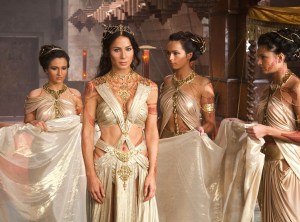
Lynn Collins as Dejah Thoris
To be sure, the biology here is a little mysterious. Dejah looks entirely human, and even, to borrow a Heinlein phrase, “adequately mammalian” (see, for example, Lynn Collins’ portrayal in the loosely adapted movie John Carter (2012)). But Martians don’t bear their young as Earth-humans do; they lay eggs, which then develop for ten years before hatching. It’s not easy to imagine the genetics that could produce viable offspring from an individual whose genes direct live birth and one whose genes result in egg-laying. But that didn’t stop Burroughs.
E.E. Smith, whose initial SF writing goes back just about as far as that of Burroughs, was willing to accept this trope as well. In The Skylark of Space (published 1928, but written between 1915 and 1921), our intrepid heroes travel to a planet inhabited by two nations of essentially human people—although the double wedding in the story does not involve any interplanetary romances, but is between two pairs of characters from Earth. Smith’s later Lensman series (1948-1954), which features one of the most diverse arrays of intelligent creatures in SF, also allows for apparently interfertile humans from a variety of planets. My impression is that this sort of duplication was also true of some of the nonhuman species in the Lensman unverse—there might be, say, Velantian-types native to planets other than Velantia.
This approach wasn’t universal in old-time SF. The more scientifically-minded John W. Campbell’s extraterrestrial character Torlos in Islands of Space (1930) was generally humanoid in form, but quite different in makeup: his iron bones, for instance. It’s been argued that a roughly humanoid form has some advantages for an intelligent species, and hence that we might find vaguely humanoid aliens on different planets—though this is pure speculation. But “humanoid” is a far cry from biologically human.
We see some persistence of this tradition into the second half of the twentieth century. Marion Zimmer Bradley’s iconic planet Darkover, for instance (first novel published 1958), is populated by the descendants of Terran humans from a colony ship and also by the elf-like indigenous Chieri, who, despite minor differences like six fingers and golden eyes, not to mention the ability to change sex at will, have interbred with the Terran immigrants.
An interesting variation can be seen in Julian May’s Saga of Pliocene Exile (first story published in 1981). When modern humans are sent on a one-way trip into the distant past, they are enslaved by the Tanu, aliens from another galaxy who have settled on Earth. The story indicates that the Tanu were specifically searching for a place where the local gene pool was similar to theirs—which might also account for why they came all the way from another galaxy (also a somewhat antique trope) to get here.
It’s slightly odd that, even where basically identical human beings turn up on other planets, other animals never seem to be similarly duplicated. On Burroughs’ Barsoom, one doesn’t ride horses, but thoats; is menaced not by tigers, but by banths; and keeps a calot, not a dog, as a pet. In a planetary romance or science fantasy setting, one is less likely to see Terran-equivalent fauna than parallel creatures with exotic names and slight differences—whence the SF-writing gaffe “Call a Rabbit a Smeerp” (see TV Tropes and the Turkey City Lexicon).
At the Movies
The all-too-human trope is carried on into the present day in video media—movies and TV. Again, this may be partly because the science is often subordinated to the plot; but the cost and difficulty of putting convincing nonhuman characters on-screen is surely another factor. Filmmakers’ ability to depict exotic creatures, however, has changed immensely in the last forty years, to a point where almost any imaginable creature can be created if the budget is sufficient. Thus, the original Star Trek series of the 1960s stuck largely to slightly disguised humanoid aliens, perhaps relying on the ‘universal humanoid’ hypothesis mentioned above, while later series were able to branch out a bit. Similarly, the Star Wars movies could readily give us nonhuman characters like Jabba the Hutt, Chewbacca, and C3PO; they, too, grew in variety as the capabilities of CGI and other techniques expanded.
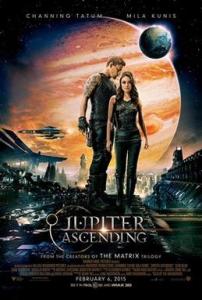
Still, it may be harder for us to adjust to interactions among characters where we can see their nonhumanity, rather than just reading about it. So we still tend to see extraterrestrial humans on-screen. The Kree in Captain Marvel (2019), for example, are indistinguishable from humans—an actual plot point, since this makes it possible for Yon-Rogg to tell Carol that she’s an enhanced Kree rather than a kidnapped human. The Kree do have blue blood, in the movie; it’s not clear what kind of biological difference (hemocyanin?) might result in that feature. We also see a number of alien humans in Jupiter Ascending (2015), though I think of that tale as a deliberate throwback to pulpish science fantasy or planetary romance.
I keep wanting to cite the fictional novel written by George McFly as shown in the closing scenes of Back to the Future, “A Match Made in Space,” since the cover seems to suggest an interplanetary romance (and one thinks of George as a nerdy romantic); but it isn’t actually clear whether that’s the case. All we have to go on is the title and the cover, and that could just as easily depict a match between two humans, fostered by an alien matchmaker (or vice versa).
The Modern Era
We don’t see nearly as many extraterrestrial humans in modern SF, and for good reason.
The more we understand about genetics, the less likely it seems that another human species, so closely similar as to be interfertile, could evolve independently. What we know about evolution suggests that there are just too many random chances along the way—cases where the prevailing mutations might have turned out differently. Even if we assume that humanoid form is probable, why not have six fingers, or hemocyanin rather than hemoglobin? While I’m not well enough educated in biology to venture any actual probabilities, I think our growing sense of the complexity of the human body and its workings, over the last seventy years or so, has simply made it seem vanishingly unlikely that an independently evolved intelligence would come out that close to the human genotype.
For example, the scientifically-minded Arthur C. Clarke depicted a galaxy in which each intelligent species, including humans, was unique: The City and the Stars (1956, developed from an earlier story published in 1948). In one of the unused story fragments he wrote while working on 2001: A Space Odyssey (1968), his hero, well along on his journey into mystery, thinks:
He did not hesitate to call them people, though by the standards of Earth they would have seemed incredibly alien. But already, his standards were not those of Earth; he had seen too much, and realized by now that only a few times in the whole history of the Universe could the fall of the genetic dice have produced a duplicate of Man. The suspicion was rapidly growing in his mind—or had something put it there?—that he had been sent to this place because these creatures were as close an approximation as could readily be found to Homo sapiens, both in appearance and in culture. (Clarke, The Lost Worlds of 2001, ch. 39, p. 220)
Contemporary SF writers who are really adept at building interesting and coherent aliens—David Brin and Becky Chambers, to name two of the best—give us a wide range of wildly exotic creatures from other planets, but not humans.
If we are still fond of the idea of interplanetary romance, we might find a possible work-around in the shapeshifter. The Tymbrimi female Athaclena in Brin’s The Uplift War (1987) uses her species’ unusual abilities to adjust her appearance closer to that of a human female—but of course she has an entirely different genetic heritage, as that ability itself demonstrates. The result wouldn’t meet our criterion of interfertility, no matter how close the similarity in physical structure. To adjust one’s genes in the same way would be another order of change altogether.
The 1984 movie Starman, in a way, plays off this idea. The alien in this case is apparently an entity made of pure energy, without a physical structure of its own. Using hair from the female lead’s deceased husband, it creates a new body with a human genetic structure. The two do, eventually, prove to be interfertile. If we’re willing to accept the notion of an energy being in the first place, this approach is actually more plausible than, say, mating with the oviparous Dejah Thoris.
If one were writing a SF story today, it would be rash to assume that Earthborn characters could run across independently evolved humans elsewhere. The idea may not be entirely inconceivable. But it’s out of fashion for good reasons. Attractive as the notion of interplanetary romance may be, at this point we’d best confine it to the kind of case noted above, where some common ancestry—no matter how far-fetched—can account for the common humanity.
Six weeks ago I complained about the lack of happily-ever-after romances in the Star Wars series. It occurred to me that it would be useful to take a look at what exactly makes for a “happy ever after” ending (“HEA” in genre romance code). What do we really mean by that, anyway?
The Thrill of the Chase
“All the world loves a lover.” We enjoy seeing stories about people falling in love, whether it’s with someone they’ve just met or by discovering someone who was always “right before my eyes.” (Unless, of course, we’re too cynical to give any credence to so vulgar and sentimental an idea; in which case it’s the trope we love to hate.) I’d call it the courtship phase of a relationship, if that term weren’t so archaic. But “courtship” does express in a useful way the stage I’m referring to, when the lovers-to-be are maneuvering around each other, trying to figure each other out, and (almost invariably, in fiction) overcoming initial obstacles to their mutual attraction.
“Forever Mine” by welshdragon at DeviantArt
It’s not hard to see why this is. The courtship phase includes a lot of fun stuff. We get to see the thrill of discovery, the novelty, the tentative reaching-out and missing connections, the achievement of initially establishing a base of trust and affection. There’s uncertainty and thus suspense in those first contacts. The process reminds me of the “handshaking” by which communications systems establish a protocol for exchange of information (anybody remember that windy ‘modem connecting’ sound on a dial-up connection?).
And this process is both tricky and essential. The relationship can’t move forward until the common foundation is established. I’ve quoted Lois McMaster Bujold before:
The question a romance plot must pose, and answer (showing one’s work!) is not “Do these two people get together?” but rather “Can I trust you?” Which is most certainly not a trivial problem, in art or in life. (Response to a reader question on Goodreads (10/30/2017).)
And the relationship does have to move forward. Courtship is only a prelude. It inherently looks forward to something else: a life together. (Even to “forever,” but that’s another subject.) We feel something is missing in a case like that of Romeo and Juliet, where circumstances cheat the lovers of that opportunity.
Falling in love is fun to watch. But if that’s all a character is interested in, we get the self-centered thrill addict who keeps wanting to have the same experience over and over again—as if they wanted to relive high school graduation repeatedly, Groundhog Day-style. We can’t fall in love indefinitely; eventually we have to land somewhere. Whether the story ends with a wedding or just a commitment, there has to be a conclusion.
“Happily ever after” doesn’t mean the initial thrill of falling in love lasts forever. That simply isn’t possible; human emotions can’t remain at that fever pitch. At some point, the “dizzy dancing way you feel” is going to ebb. If we expect to feel the same way always, as I’ve just noted, we’re setting ourselves up for disappointment and unnecessary disillusion. On the other hand, that thrill can always reappear from time to time. Wise couples will take steps to encourage and renew that early glamour throughout their marriage.
Even the vision of a couple facing adversity staunchly side by side isn’t always going to be valid. We’re told that even healthy couples have their arguments and disagreements. Indeed, a couple that never disagrees may be harboring unresolved issues under the surface.
It seems to me that all these flaws or troubles can still be accommodated in the “happily ever after” archetype. Couples can recover from adversity; it can make them stronger. Even crises in a lifelong love affair can be healed or overcome. It’s the overall trend or direction, and the overall tenor of the romance, that leads us to call it “happy.” Of course, when we wish someone happiness forever, we hope that their troubles will be relatively few and their recoveries maximally joyous. But a life together need not be perfect to be “happy.”
What It Is
If the ever-after need not be perpetual bliss to count as HEA, what is it made up of? I am hardly so wise as to prescribe sure-fire ingredients for a happy marriage. But if we think about what we’d expect to see in a story that depicted a happy couple, we can point to a few things.
Carly Simon sings “The Stuff That Dreams Are Made Of”
If it’s going to compete with the initial falling in love, being in love has to gain in depth and resonance what it loses in surface intensity and thrill. It’s “the slow and steady fire.”
What can a couple that’s been together a while do that lovers who’ve just met can’t? Consider the cumulative pleasures and joys of two people who know each other well and have learned how to please and help each other. If they continue faithful to each other and to their union, their mutual trust will grow and deepen. And the more they trust each other, the more each can express their individual strengths (and admit their individual weaknesses).
Since loving someone doesn’t consist only in having a feeling about them, but in enacting love for them, we can learn to love someone better through experience and attentive learning. I may start by giving you a gift I would like—but eventually I learn how to give you the gift you would like. Meanwhile, the sharing of memories and experiences, families, running jokes, can enrich and strengthen the bond.
All these things are compatible with the imperfections and difficulties noted above. They make up what we’d expect to see, down the road, in a story that goes beyond the courtship—a happy-ever-after.
How We Tell the Story
Because the HEA lacks the surface glitter of the falling-in-love story, we see far fewer stories depicting it. But for purposes of example and illumination, it’s very useful to see depictions of ongoing marriages.
Such mature romances can crop up in odd places. For example, in a series that goes on beyond the resolution of initial relationships, or perhaps longer than the author expected, we may see the original lovers ‘age out’ of the focus, but still have the chance to watch them practice the art of love.
Exhibit A is Bujold’s Vorkosigan saga. The first two books in the main sequence, Shards of Honor and Barrayar, deal with Aral Vorkosigan and Cordelia Naismith, whose son, Miles, is the principal character in most of the stories. So we see Cordelia and Aral fall in love—but then we see them continue through a whole series of other tales as both parents and political prime movers on Miles’ homeworld of Barrayar. We get to see them working together in common causes, both personal and cosmic. We see their continuing affection and evident harmony. Each is so distinctive a personality that we never think of either Aral or Cordelia as merely an extension of the other; rather, they provide an ongoing example of the kind of relationship we wanted to see in their initial stories—and to which Miles aspires for himself, having that example always before him.
Anne McCaffrey’s Dragonriders of Pern give us another example. In the first book (as published, not chronologically), Dragonflight, we see the rocky road of the strong-willed main characters, Lessa and F’lar, to love. Both of them are so stubborn and willful that it’s hard to picture them in a peaceful marriage. And indeed, on Pern, nothing is ever entirely peaceful for long. But as more couples come and go through the long series of sequels, F’lar and Lessa remain onstage a good bit of the time. Neither is ever tamed, though they both mellow a bit. The scrappy young Lessa becomes a little steadier and more mature as she gets older and has a child, but she still retains the original fire.
I frequently refer to the classic Lensman series, but I don’t think I’ve mentioned that the final novel, Children of the Lens, shows us the lovers whose activities dominated the three middle books, Kim Kinnison and Clarissa MacDougall, as middle-aged parents a generation later. The story is so action-oriented that we don’t get to see much of the family in peace, but what we do see gives us the satisfaction of knowing that Kim and Cris have lived a happy life together (and will continue to do so). And since the surclimax (if I may invent a word for a secondary climax occurring after the main one) involves Clarissa’s use of the power of their mutual love to retrieve Kim from an otherwise unsolvable trap, it’s clear that the romantic connection consummated at the wedding in the previous volume (twenty years earlier) has not lost its fire.
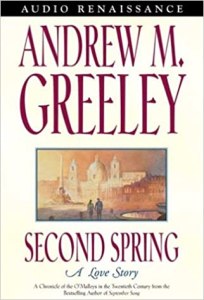
Andrew Greeley wrote a whole series of novels in which the romance is generally about falling in love. But in his O’Malley family saga, in which the titles all refer to seasons (of life), he continues the story of one such couple from the post-WWII era right through their “Golden Years.” The young lovers of A Midwinter’s Tale have to grapple with some pretty serious psychological issues themselves, as well as family drama, over the course of years. But the “crazy O’Malleys” emerge stronger from their troubles as they go on, giving us a picture of people who are always becoming more themselves as they adjust to changing circumstances.
There is a subgenre of family sagas—the kinds of long-running, multicharacter stories that always make me think of TV mini-series—and some of these also give us extended looks at maturing romances. In some such stories, the conflicts arise from the dysfunctionality of the family itself; Mazo de la Roche’s Jalna novels are a case in point. But in others, we can see a couple holding strong. I recently reread R.F. Delderfield’s God Is An Englishman, the first book of his “Swann saga.” His central couple, Adam and Henrietta, grow in significant ways over the course of the story. Their love waxes and wanes, but after it wanes, it always comes back. I’d count that as a HEA.
The novella I’m just finishing up, Time Signature, takes place in the Deerbourne Inn common setting created by the Wild Rose Press. This gave me the chance to show how a secondary couple who were engaged in Amber Daulton’s Lyrical Embrace was getting along, a little later. While their appearance is brief, I enjoyed the opportunity to represent a growing post-courtship romance, even in its early years.
Real Life
For purposes of inspiration and example, of course it’s even more helpful to be acquainted with real-life successful relationships. My parents, for instance, lived long and happy lives, and despite religious and political differences, they always remained in harmony. Though they argued about many subjects, they never, so far as I know, quarreled. While their lives could not be said to be untroubled (after all, I was one of their children), I’d say they qualified as a happy-ever-after. I’m privileged to know a number of other couples whose romances have flourished over many years, on whom I’d be glad to bestow the accolade of HEA.
The accumulation of such real and fictional examples gives us the wherewithal to refute those who scoff at the happily-ever-after ending. None of the characters of our favorite romances will have perfect later lives unmarred by any suffering or any down times in their love affairs. But if we’re willing to accept that solid happiness can be consistent with life’s inevitable troubles, we can look forward with hope to a satisfactory ending for those couples who approach their lives with both realism and love.

















 Rick Ellrod's Observatory