The Distilled Adaptation

Shortening

The translation of a story from book to stage or screen always involves some degree of change.  The two arts are different; what works to communicate a story in one medium may not work in another.

A book can accommodate relatively long sequences of events, because we read a book in segments on our own schedule.  But a stage play or movie has to be geared to the limitations of the human body.  Watching a full-scale version of The Wheel of Time, say, at one sitting would require both an IV and a catheter—and a “pause” button for sleep.

Tom Bombadil (from card game)Thus, the live-action rendition of a novel generally has to leave things out, and the ability to condense the story smoothly is vital.  For example, the three-film Lord of the Rings omits the book’s entire side trip through the Old Forest, Tom Bombadil, and the Barrow-Downs.  Even with three long films, something had to be cut.  (This omission, incidentally, was a good choice and well-executed.)

The limitations of time have eased a bit with the introduction of multi-episode and bingeworthy screen formats, along with viewers’ increasing willingness to follow long-running stories (a curious counterpoint to the frequent suggestion that our attention span is eroding).  An eight-season Game of Thrones video production can cover much of what occurs in a very long book series.  But the writer or director must still gauge what can be included and what can be omitted.

Reorienting

Sometimes, when condensing a book for the theatre, the writers may take the opportunity to narrow the focus of the original story—particularly when the novel is a broad, rambling, discursive sort of tale.  In the process, they may also convey a meaning (what we might cautiously call the “moral of the story”) that’s different from that of the original.  Depending on what the rewrite chooses to emphasize, the new version may point in a different, or more definite, direction than the old.

Reorienting a tale this way can improve it—depending on what the new direction is.  Let’s look at a couple of examples.

Man of La Mancha
Man of La Mancha posterWe recently looked at the staging of the 1965 play Man of La Mancha; and a couple of years back we talked about what it says to us.  When I first saw the show back in 1970, its basic theme fit right in with what had become a widespread idea back in the 1960s:  that we are too prone to think of ourselves as unworthy of love, and that becomes a self-fulfilling handicap.

To recap:  The fantasy-ridden Don Quixote finds his ideal lady Dulcinea in a barmaid and part-time prostitute named Aldonza.  Aldonza despises herself as well as the men who use her.  She is at first baffled, and then enraged, by Quixote’s persistent attempts to idolize her and praise her ladylike virtues.  She feels she has no virtues; he is refusing to see her as she really is.  (Audio / Movie video)

Against her will, under Quixote’s gentle persistent courtesy, she begins to believe she can be better than the way she’s always thought of herself.  She is promptly and brutally disillusioned when the muleteers attack her.  The play pulls no punches:  being “nice” or showing generosity is no guarantee against mistreatment.  Yet, in the face of all evidence to the contrary, Quixote continues to treat her as a noble lady.
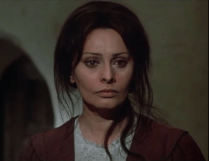
Dulcinea, at Don Quixote's deathbedAt the end of the play (7:42 in the clip), after Quixote’s death, she finally accepts that she is more than a nobody, “born on a dungheap”:  she will honor Quixote’s memory by living his impossible dream.  “My name . . . is Dulcinea.”

I'm Lovable buttonMan of La Mancha forcefully illustrates what in the ’60s became a truism.  We must see what is potentially lovable in someone before it is evident; and sometimes that premature faith and hope can help the person realize they are lovable—and free them to love.  This is more than the mere psychology of self-esteem; it’s an insight about how human beings work that is still worth recognizing.

Yet this isn’t exactly what Cervantes had in mind.  It’s been a long time since I read his immense rambling novel, but I don’t recall that this theme of convincing people they are lovable was evident there.  The novel speaks to a lot of other issues, such as the interplay of realism and idealism, but it isn’t focused on this.  Rather, the authors of the play selected and adapted material from Cervantes to address a theme characteristic of their own time.

One might complain that the modern playwrights have hijacked an existing story for a purpose the novel’s author never had in mind.  But as I see it, the concentrated, powerful Man of La Mancha is a great deal more interesting than the long and diffuse original.  The adapting writers have distilled a potent new wine from familiar grapes.

Les Misérables

Victor Hugo’s Les Misérables is also a massive novel, covering many years’ time and an array of main characters.  It’s also prone to digression, including among other side trips a chapter on the history of the Paris sewer system (part 5, Book Second, chapter II).  When I read the book, I made myself a whole list of sections that could be skipped, without loss, on a second reading.

Les Miserables (opera) logo

By Source, fair use (Wikipedia)

Obviously, this discursive work can’t be transformed directly into a play or a movie.  Nonetheless, there are quite a few film or stage versions.  The one I find most powerful is the opera Les Misérables by Claude-Michel Schönberg, Alain Boublil, and Jean-Marc Natel, with English libretto by Herbert Kretzmer (1980).  It’s a long show, just under three hours, but of course it can’t begin to reproduce the entire book.

Thus, again, the playwrights are selective.  The novel tells the story of a group of people caught up in the Paris revolt of 1832, extending backward as far as 1815 to depict the backstory of Jean Valjean, the central character.  The play starts almost as far back.  After being imprisoned for nineteen years for stealing a loaf of bread, Valjean is overcome by the mercy of God when a kind bishop refuses to turn him in for a new theft, and resolves to make a better man of himself.  He adopts the orphaned girl Cosette and raises her in secret, avoiding public notice so as not to be imprisoned again.  The grown-up Cosette falls in love with Marius, a young student involved in the short-lived and futile revolt.  To save Cosette’s beloved, Valjean joins the rebels and, as the barricade falls, rescues the fallen Marius.  At the end, with Cosette and Marius married, Valjean dies at peace, received into heaven by the spirits of Fantine, Cosette’s mother, and Eponine, a reformed girl who also loved Marius and died on the barricades.

The music is extraordinarily powerful.  I’ve seen the play twice.  Each time was an intensely moving experience.  The opera was finally made into a movie in 2012, with Hugh Jackman, Russell Crowe, Anne Hathaway, and Amanda Seyfried.
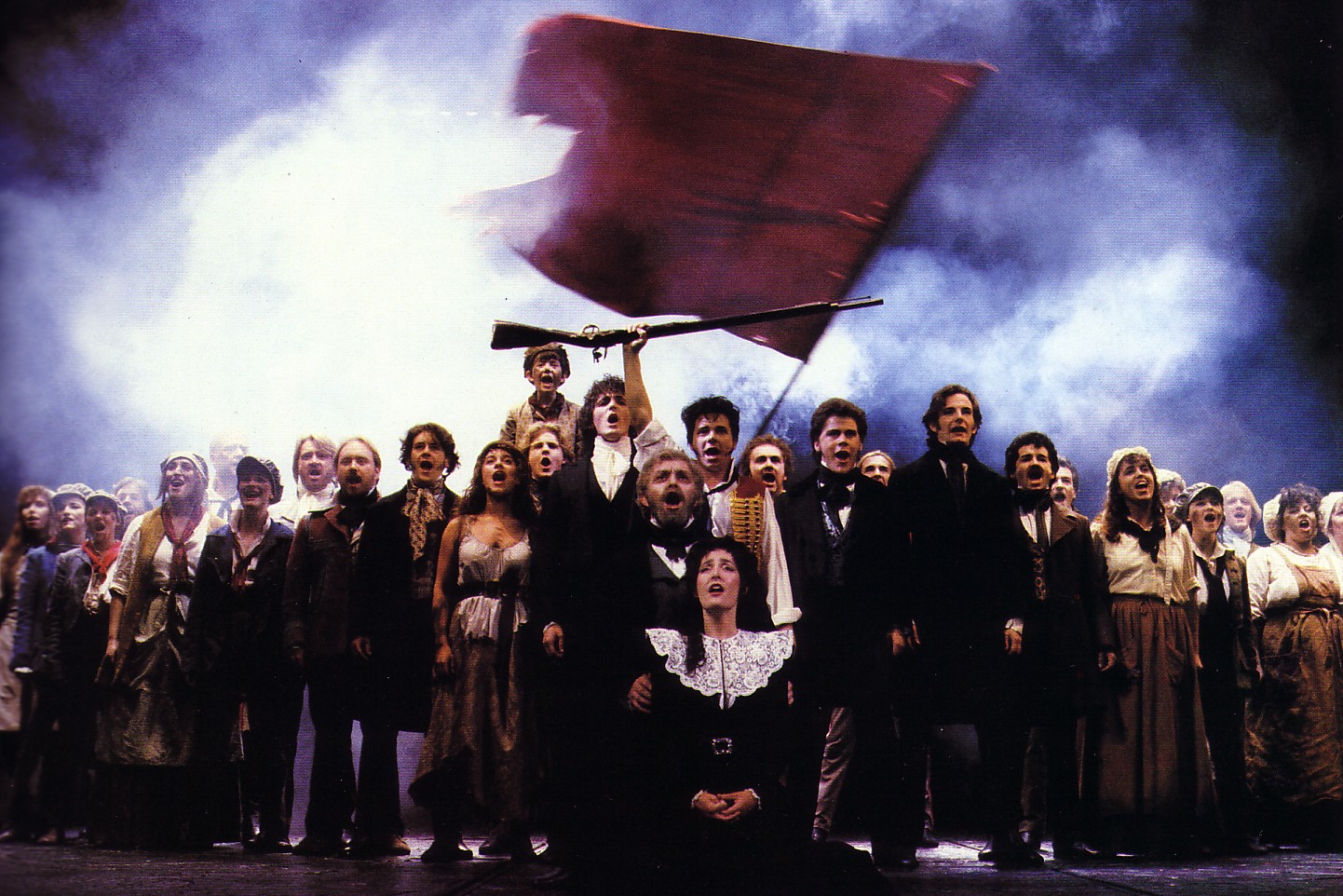
One Day More, from Les MiserablesA political motif is essential to the story—the tragic plight of the poor of France and the injustice that drove them so often to rebellion.  And as a political drama, it’s a bitter tale.  The student activists, confident that the people of Paris will rally to their side, put themselves on the line.  And no one comes to join them.  The revolt is snuffed out at once, barely a footnote in history.  The only triumph that can be found is a visionary one in the indefinite future:


Will you join in our crusade?

Who will be strong and stand with me?

Somewhere beyond the barricade

Is there a world you long to see?

Do you hear the people sing?

Say, do you hear the distant drums?

It is the future that they bring

When tomorrow comes!    (Finale)
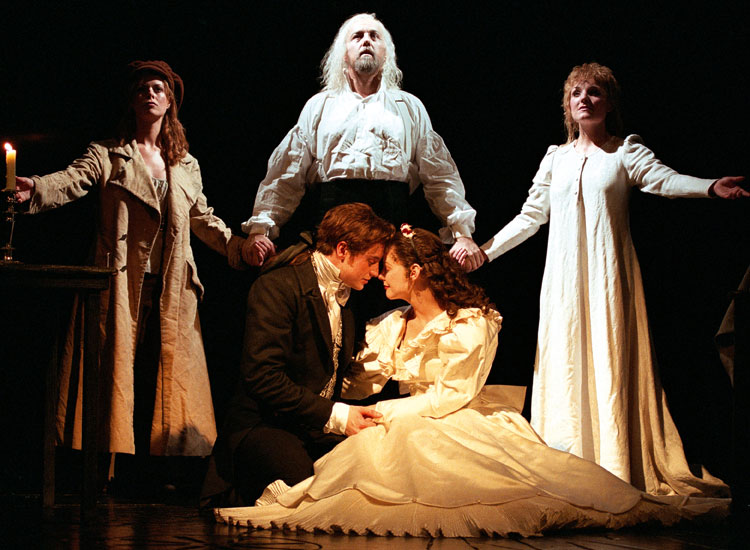
 

Les Miserables - To love another person is to see the face of GodThen why is the play so uplifting?  We don’t care so much about the revolt’s failure because the characters transcend their miseries.  Cosette and Marius marry; they’ve earned their happy ending.  Valjean, Fantine, and Eponine die, but they ascend to eternal bliss.  The revolt accomplishes nothing, but the heroism and love of the principal characters makes that detail seem irrelevant.

The theme of the opera might be summarized as:  ‘Politics comes and goes, but people are forever.’  How we treat other people is vastly more important, in the long run, than the rise and fall of political regimes.  Of course, the two are not unrelated:  the purpose of a sound political regime is to make it possible for people to live good lives.  But this particular story places all its weight on the personal side.

I’m not sure that that’s what Hugo had in mind.  He might have; he certainly does emphasize the heroic compassion of Valjean and contrasts the ironies of the abortive revolution.  But it seems to me Hugo’s novel had considerably more of a political axe to grind than the opera does.  It’s a matter of degree, but I don’t know that Hugo would have sympathized entirely with the adaptation’s relative downplaying of the political.

Conclusion

In both these cases, it seems to me the adaptation has taken a particular thread from a very large original and woven it into a much more condensed, more focused story.  In doing so, the adapters have chosen to bring out themes that may be different from the bent of the original tale.

When it’s successful, such an adaptation gives us a derivative work drawing on untapped potentials in the original.  The relationship is not unlike what I’ve called the “malleability of myth.”  A root story can be reinterpreted in many ways—and some of them may be greater than the original.

The End of Timeless

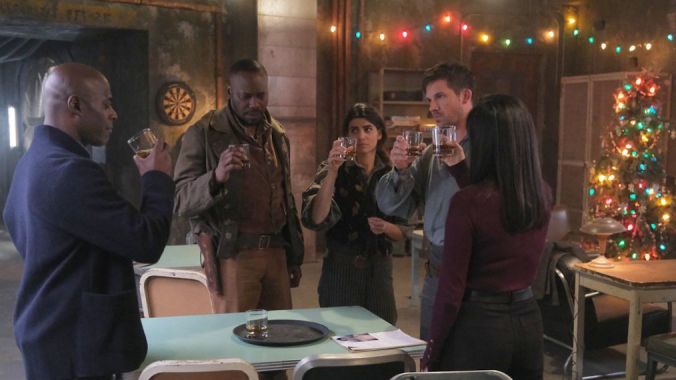
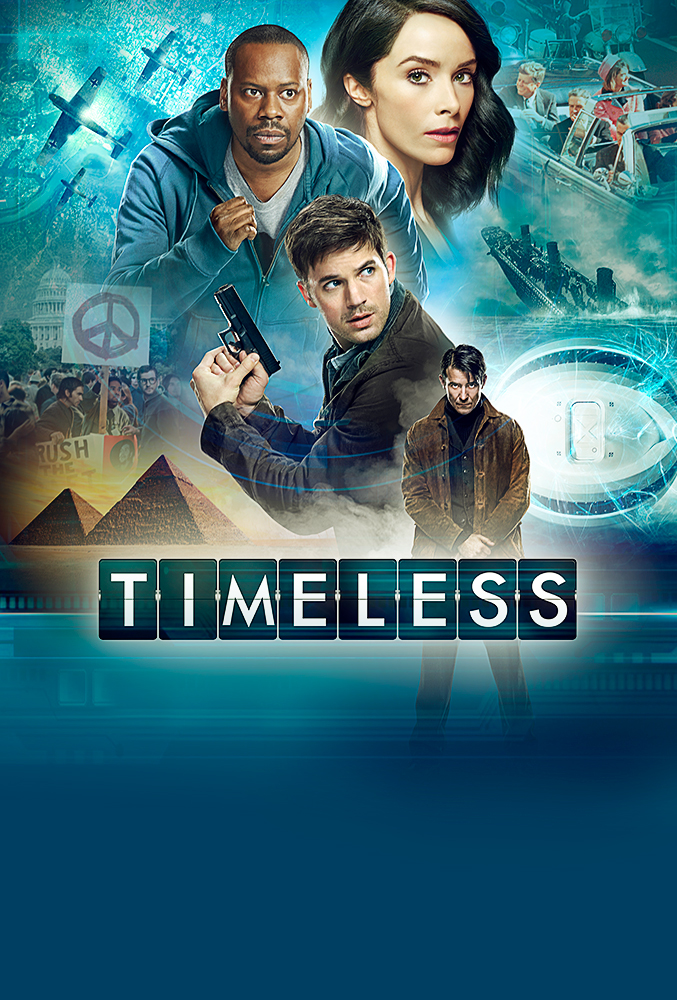
Poster for TimelessOver the holidays (Dec. 20) we saw the two-hour series finale of the time travel TV show Timeless, seasonally titled “The Miracle of Christmas.”  We were there at the beginning for this two-season series; let’s take a brief look at how it ended.

While I suspect everyone who’s followed this series will by now have seen the finale, just in case I’ll issue aSpoiler Alert!

An Appropriate Time

While we hate to see a good series go, sometimes closing down is the right thing to do.  Not every series can go on forever; we’ve all seen shows that linger on long past when they should have died.

Timeless was built around a wide-ranging conspiracy—an evil organization called “Rittenhouse.”  Such stories have a certain inherent instability.  If the secret enemy simply keeps going, with the good guys never making any progress against it, then we’re stuck with a fixed situation that lacks the tension of possible resolution or serious arc development—take The Man From U.N.C.L.E. or any similar 1960s-type spy series.  On the other hand, if the heroes do succeed in making headway against their opponents, they eventually win, and the show can find itself at a loss for what the heroes are going to do next (I’m looking at you, Chuck).  So a struggle against a secret conspiracy is a good candidate for a limited series.

In this sense, I liked the Timeless wrap-up.  The show wrapped before it could lose momentum.

The Pointless Conspiracy

This limited lifetime is particularly important here, because even the short run of the series was enough to reveal some significant weaknesses in the “Rittenhouse” idea.

Timeless character portraitsYou’ll recall that the principal characters are Lucy Preston, a history professor; Wyatt Logan, a U.S. Army Delta Force operative; and Rufus Carlin, the technical expert and pilot of the “Lifeboat” time ship used by the good guys—along with Jiya Marri, a programmer who isn’t initially part of the traveling team but grows into the role.  They skip around from time period to time period, trying to prevent two groups of opponents from changing history for the worse.

The time travelers gradually discover that a secret organization, passed down along family lines, has been dominating American history since the Founding.  A NSA renegade, Garcia Flynn, and his henchmen steal the experimental time machine in order to stop Rittenhouse by changing history.  There’s an interesting ambiguity from the beginning about who is actually the villain, since we see Flynn’s machinations before we find out about Rittenhouse.  But we’re never quite sure either what Rittenhouse is about or how Flynn expects to stop it.

The secret society is supposed to derive from an actual historical figure, David Rittenhouse (1732-1796).  Wikipedia describes him as “an American astronomer, inventor, clockmaker, mathematician, surveyor, scientific instrument craftsman, and public official . . . a member of the American Philosophical Society and the first director of the United States Mint.”  This Rittenhouse seems an odd choice for a sinister mastermind.  He actually sounds more like a hero (of science) to me.  So, right from the start, we’re a little at sea as to what Rittenhouse’s motives or goals are supposed to be.

Omniscient Council of Vagueness illustration from TV TropesTV Tropes has a hilarious discussion of what it calls the “Omniscient Council of Vagueness.”  Rittenhouse is a perfect example.  We don’t know what the organization wants.  We don’t know why.  If it’s been manipulating American society or politics, we don’t know when or where.  We don’t know how it exercises its influence or what historical events can be ascribed to that influence.  We know it’s bad, because its agents are ruthless.  Maybe the goal has something to do with master-race breeding (a favorite go-to way to characterize villains since the Nazis):  in the episode where David Rittenhouse actually appears as an old man (Season 1, episode 10), he declares that Lucy is a fine healthy specimen and orders her taken to his bedroom (a procedure which is of course timely interrupted before we can overstep the bounds of network TV).  But even the idea of some eugenic program isn’t really developed.

It’s easy to postulate some vast secret organization like Marvel’s Hydra or U.N.C.L.E.’s THRUSH, and equally simple to plaster them with enough repellent traits that we’re happy to take them for granted as The Bad Guys.  But given how sophisticated Timeless was in some respects, I was sort of surprised it never went further in fleshing out this premise.

Suppressing Technology

On the other hand, Timeless gets points for recognizing that you can’t wipe out a technology forever just by destroying all the prototypes.

Science fiction has frequently dealt with the difficulty of putting the genie back in the bottle.  If a scientific principle or technology can be discovered once, then even destroying all the existing examples won’t permanently prevent it from being used.  What can be discovered can be rediscovered.  (See, for example, Robert A. Heinlein’s 1941 story “Solution Unsatisfactory.”)

Doc Brown's time-traveling trainSo, at the end of Back to the Future, Doc Brown soberly declares that Marty must destroy the time-traveling DeLorean once he returns to his own time, since time travel is too dangerous to be allowed.  (In an appropriately comic conclusion, Doc then promptly negates his own directive by showing up with a wonderful time-traveling steam engine.)  But even if we suppose that the secret of Marty and Doc’s adventures is kept quiet forever, somebody else is eventually going to come up with a flux capacitor (whether or not the idea is occasioned by falling off a toilet and hitting your head).

The characters recognize this issue at the end of the Timeless finale.  Rather than destroying the “Lifeboat” prototype, they decide to hang onto it, just in case.  This is not just a good way to leave a thread hanging in case anybody decides to make a sequel someday; it’s smart thinking.  And, in a clever final twist, the last scene does suggest—in the innocuous setting of a science fair—that some years later, a high-school STEM student, in a program started by Rufus and Jiya themselves, is about to stumble upon the time travel principle again.

Character Development by Substitution

The most important part of the story’s end, though, is about the characters.

Timeless action scene in hallwayI was glad to see that, after a number of twists and turns, the romances worked out satisfyingly.  Lucy and Wyatt, as we always suspected, do end up together.  So do Rufus and Jiya—but their situation is a little more complicated.  There’s more going on than meets the eye in the resolution of these relationships.

A key part of Wyatt’s motivation throughout had been his guilt and grief over the death of his wife Jessica.  When Jessica turns up alive, after a particular historical change (Season 2, episode 3), this naturally throws a wrench into the budding romance between Lucy and Wyatt.  But Jessica, it turns out, is alive because Rittenhouse (now in possession of a time machine) has changed history to save her, and in the new history has inculcated Jessica into Rittenhouse’s plans from the beginning.  This is not, in other words, the Jessica that Wyatt originally new:  this is a Rittenhouse Jessica, subverted from childhood (Season 2, episodes 7, 9).

The plot complications that ensue are one thing.  But the setup produces a rather novel view of character.  To what extent is this alternate version of Jessica the same person that Wyatt fell in love with?  And if loving someone means loving her “for who she is,” what happens when she’s now someone else?

In a case of brainwashing or mind control or the like, one can at least imagine going back to the ‘branch point’ and recurring somehow to the original state of the person.  But if (in this timeline) Jessica has always been a Rittenhouse recruit, there is no such original state to return to.  (If there had never been Back to the Future sequels, one might imagine Marty similarly having some trouble coming to terms with his new, more assertive parents.)

The same issue is played out more subtly with Rufus and Jiya.  In the last regular episode, Rufus is killed.  Since this is a time travel story, the other characters are naturally bent on changing things to prevent that from happening.  In the finale, this is achieved:  but the Rufus who’s now alive is from a timeline different from the one originally inhabited by Wyatt and Lucy.  He hasn’t had all the same experiences.

Rufus and Jiya, San FranciscoMeanwhile, Jiya has experienced a much more traumatic change.  In the last regular episode, she is stranded in 1888 Chinatown and must survive by her wits alone for three years.  The Jiya who meets the revised Rufus has gone through things Rufus has never imagined.  We see that they nonetheless stay in love; but they will have to work through some major issues together.

This identity issue is not unique to time travel.  We have a much longer history of stories about experiences that significantly change a person:  for example, a man goes off to war and comes back “a changed man.”  For example, in the movie Sommersby (1993), a Civil War veteran’s wife is not entirely sure whether the man who came back is the one who left, or a near-identical twin.

But in this normal case, continuity is still expected:  the change is from an already-known branch point.  Laurel Sommersby ultimately concludes the man before her cannot be her husband—“because I never loved him the way I love you!”  Character development happens, if not always gradually, at least in some kind of organic way.  She does not believe her husband could have become the man she now loves.

If time travel can rewrite someone’s entire history, is that still true?  We’re almost back at the nature-nurture debate:  to what extent is my character fated at birth, and to what extent created through life?  Timeless gives us subliminally convincing evidence of continuity:  a new timeline’s version of Rufus or Jiya is played by the same actor, speaks with the same voice, wears the same persona—except to the extent specifically varied for purposes of the plot.  But the story of the finale raises disconcerting issues of how much continuity is necessary to remain “the one I love.”

Stories generally involve the kind of character development that comes through the accumulation of experience.  But Timeless gives us kind of character development by substituting a new version of a person, with a new history of experience—a deft use of the “what-ifs” for which time travel tales are famous.


Timeless has been a cool series to follow.  I don’t know that I’d have wanted it to go on indefinitely, but it sparked some stimulating thoughts in its brief run.

Timeless finale scene with Christmas lights

The World Around the Corner

The World Premiere

The World Around the Corner coverI’m excited to have my romantic comedy novella The World Around the Corner in print as of last week.  Or in virtual print, at least; it’s out as an e-book from the Wild Rose Press.  (Details are available on the story’s page.)

Uncharacteristically for me, TWATC isn’t science fiction or fantasy.  The only potential SF elements are some very minor advances in gaming technology (and perhaps in automobile design).  Some parts read a little like fantasy, because there’s an online role-playing game (an MMORPG) involved.  In that respect there’s a faint resemblance to Ready Player One (book and movie), where an online game plays a major part in a much more serious SF story.  But TWATC isn’t really about games or technology; it’s all about having fun with the characters.

You’re Who?

I’ve always liked the kind of romance where a character has to make a discovery about who their romantic interest really is.  Jasmine isn’t immediately aware that Disney’s Aladdin, when he visits the palace as a prince, is the same street urchin she’s already met—though she isn’t fooled for long.  In Shakespeare’s venerable Twelfth Night, nobody is quite sure who “Cesario” (Viola) really is.  The same is true in the modernized high-school variant of the Shakespeare comedy, She’s the Man.  Playing around with two ways of knowing the same person is also put to good use in the case of super-heroes (or heroes generally) who have secret identities, from the Scarlet Pimpernel to El Zorro to Superman.

The Shop Around the Corner posterBut in all these tales, one member of the couple has the advantage of knowing the truth.  It puts the couple on more even terms if neither of them is aware of what’s really going on.  There’s a whole series of variations on a single story where the main characters meet indirectly and fail to connect up the two different ways they’re communicating with the same person.  This plot seems to have been invented by Hungarian playwright Miklós László in the form of a play called Illatszertár or Parfumerie (1937).  It was adapted in English into the Jimmy Stewart-Margaret Sullavan film The Shop Around the Corner (1940), which in turn gave rise to a musical treatment with Judy Garland, In the Good Old Summertime (1949), and again with She Loves Me (1963).  In these versions, the main characters are pen pals, and also co-workers.  Nora Ephron updated the treatment by making them e-mail correspondents in You’ve Got Mail (1998).

Romance And—

When we tell the story of a romance, we’re often telling a story about something else at the same time.  To be sure, this isn’t always the case.  In Georgette Heyer’s Cotillion, for example, or in Must Love Dogs, and in a lot of high-school rom-coms, the personal relationships are pretty much all that’s going on.  But generally, we don’t spend our lives doing nothing but looking for love.  We go on about our daily business, meeting our daily challenges, and stumble upon love as we go.

To Say Nothing Of The Dog coverSo a lot of romantic tales also have a storyline dealing with something that brings the couple together.  In Heyer’s The Toll-Gate, there’s an involved plot having to do with a theft of currency.  The main characters in Connie Willis’s To Say Nothing of the Dog are searching for the bishop’s bird-stump.  (It’s a long story.)  Gaudy Night is the Dorothy Sayers novel where Harriet Vane and Lord Peter Wimsey finally get together, but they do it while trying to resolve a crisis at her alma mater.  The redoubtable Amelia Peabody and her future husband Radcliffe Emerson meet in the context of archaeological investigations (Crocodile on the Sandbank).

I like the idea of a couple’s bonding by cooperating in some shared endeavor.  And we may be able to amplify that motif by having it happen twice, in parallel, like the parallel identities in the “Shop” stories.

The Camaraderie of the Quest

One of the things I’ve always enjoyed about the group quests of role-playing games, whether in D&D or World of Warcraft, is the bonding and sense of camaraderie that develops in a group working together for a common purpose.  Most traditional games like chess or Risk have the players competing against each other.  But the role-playing games typically pit a band of True Companions against third-party monsters or other opponents.

This is a whole different dynamic.  And seeing it play out in a game makes the tone both more light-hearted and more detached than, for example, in a real-life business relationship.  But for that very reason, it lacks a certain gravitas.  Suppose a couple used to fighting side-by-side in a game found they had to work together on something important in real life as well?

The Fun of the Shared Adventure

All this contributed to the idea of The World Around the Corner.  Other aspects also played their roles—for instance, a chance to share some favorite music and books.  And let us not forget the occasional opportunity, sheerly by happenstance, to achieve a truly dreadful pun, without even setting it up on purpose beforehand.  You’ll know it when you see it . . .

I hope you’ll have as much fun reading TWATC as I did writing it!

Third-Party Love Songs

The Third Party

Girl at door, from "(Kissed You) Good Night"

“(Kissed You) Good Night”

Typically a love song is sung by one lover to another, just as you’d expect.  The lyrics are some combination of first and second person:  “I love you.”  (Oddly enough, there’s only one song on my playlists entitled “I Love You”; you’d think it would be a more common title.)  Or the lovers may sing to each other in a duet—from “People Will Say We’re In Love” to “(Kissed You) Good Night.”

But every now and then we get a case where the singer is a third person.  The song is still about love, but the singer isn’t one of the lovers.  Rather, they’re talking to someone else’s lover, or potential lover.  What kind of story is implied by moving the focus to a third party?

Wonderful Counselor

The most appealing case is where the singer is giving good advice to the lover.  The attitude may be paternal or maternal, fraternal or sisterly (sororal?).  Or the informal counselor may just be a friend putting in a good word at the right moment.

Chronologically, Melissa Manchester’s “You Should Hear How She Talks About You” stands at the very beginning of a love affair.  Melissa’s telling a guy that the nameless “she” is sweet on him:  “she’s half out of her head.”  Hence her encouragement is right there in the opening line:  “you should break the ice.”  Take the first step, fella, she’s waiting for you.

A similar encouragement, a little later in the relationship, is offered by Billy Joel in “Tell Her About It.”  The guy he’s addressing has already found his mate (“let a good thing slip away”).  But a punk kid from New York is likely to be inarticulate, or too macho to let emotions show, or both—like Danny in Grease.  If he doesn’t want to lose her, he’s going to have to learn to talk to her about how he feels.  The contrast between the singer (“a man who’s made mistakes”) and the addressee yields a nice contrast of worldly-weariness and blundering innocence.

Mending the Rift

Another good time for a wise advisor to drop in is during a lover’s quarrel—a “rift in the lute,” as Wodehouse’s Bertie Wooster likes to say.  In the Beatles’ early classic “She Loves You,” the singer is actually carrying messages for a couple who aren’t speaking to each other:  “She says you hurt her so . . . But now she says . . .”  He’s also forthright enough to express his own opinion:  “I think it’s only fair . . . Apologize to her.”

Roxette performing Listen to Your Heart

“Listen to Your Heart”

The complementary female-to-female version is exemplified by Roxette’s Listen To Your Heart:  “Sometimes you wonder if this fight is worthwhile” . . . but the person sung to should consider carefully “before you tell him goodbye.”  While Billy Joel or the Beatles advise actual conversation, Roxette suggests the first step is simply to consult your own deeper feelings or gut reaction.

Amy Grant’s slightly offbeat but arresting “Love Can Do” is a bit more pointed about sticking around rather than giving up.  “Sometimes love means we have to stand and fight . . . Everybody runs, everybody hides.”  In particular, she puts her finger on a ubiquitous misunderstanding:  the idea that love simply evaporates of itself.  “It’s not like that.”  What we do has a crucial role to play.  If you want those feelings back, “no running.”

Carly Simon sings "The Stuff That Dreams Are Made Of" at Martha's Vineyard

Carly Simon sings “The Stuff That Dreams Are Made Of” at Martha’s Vineyard

The perceptive Carly Simon targets a still later point—that midterm period when a couple has been together long enough to get bored with each other.  In “The Stuff That Dreams Are Made Of,” Simon advises a Chestertonian re-imagining or re-envisioning of the relationship:  “What if the prince on the horse in your fairytale / Is right here in disguise, / And what if the stars you’ve been reaching so high for / Are shining in his eyes?”

Rather than providing advice for a particular relationship, another family of third-party songs makes a more general recommendation of an individual.  Alabama’s “She Ain’t Your Ordinary Girl” tells us at length how extraordinary “she” is—“No empty promises; proof is what it takes to win her heart.”  Yet “when you see her smile, nothing seems to matter any more.”  It isn’t quite clear whether the singer is speaking to a particular friend, or to the world at large.

We see this generality more often when we come to the negative examples.

The Prudent Warning

The third-party intervention isn’t always to encourage.  Sometimes it’s negative:  a sort of warning to the general public against an unreliable lover—generally based on the singer’s unhappy experience.

She's So Mean, girl smashes guitar

“She’s So Mean”

There are quite a few of these too.  From the early rock-and-roll era we have Dion’s “Runaround Sue,” which cautions us that “Sue goes . . . out with other guys.”  Hall & Oates want us to watch out for the “Man-Eater.”  Over on the country side, Eric Church tells an aspiring suitor that the object of his affections is “heaven on the eyes,” but “Hell on the Heart.”  Matchbox Twenty explains in vivid detail how “She’s So Mean.”

There ought to be a comparable category of songs by a woman warning about a hard-hearted man, but for some reason the only example that comes to mind is the old Three Dog Night tune “Eli’s Coming,” which issues a general alert about an irresistible guy who appears to be a sort of force of nature.  You can probably think of better examples.

Nostalgic Advice

Sometimes the kindly advisor is a parent or relative.  In that case, the advice is often freighted with nostalgia, looking back on the days when the person spoken about was in the singer’s care.  The country band Heartland has a ballad called “I Loved Her First” that sounds at first like a rejected lover commending “my girl” to a new romantic interest, but turns out to be her father giving her away at her wedding.

Rod Stewart’s “Forever Young” (not to be confused with the earlier Bob Dylan song of the same name) speaks to the young person’s romantic future (“And may you never love in vain . . .”), but in general terms, a kind of open-ended hope.  (Incidentally, that was the song we picked for the father-daughter dance at my daughter’s wedding.)

In these examples, the third-party love song shades into a more open-ended field of advice songs.  Somewhere in that vicinity is a category of reflective “sadder but wiser” songs about love generally, addressed to a particular listener or listeners.  “Some Enchanted Evening” from South Pacific falls roughly into this category.  Even though Émile is singing it directly to his beloved, Nellie, he words it as if he’s talking to someone else:  “Once you have found her, never let her go.”

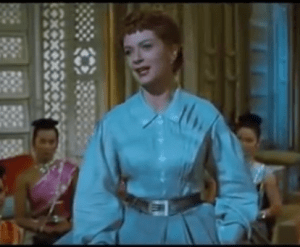
Anna sings Hello, Young Lovers in The King and I

“Hello, Young Lovers”

This kind of reflection seems to have been a favorite of Rodgers & Hammerstein.  In The King and I, Anna sings “Hello, Young Lovers” (which has perhaps the most beautiful introduction of any song from a musical) to an array of Siamese princesses.  “Cling very close to each other tonight /  I’ve been in love like you.”

Conclusion

I find the third-party advice and encouragement songs especially enjoyable.  They gain points for a kind of genial altruism.  An I-love-you song generally expresses care for the other person—we want our beloved to be happy.  But there’s inevitably a certain self-interest involved, too:  a healthy exchange of love will also make me happy.  (“And I wish you all the love in the world / But most of all, I wish it from myself”—Fleetwood Mac’s “Songbird.”)

The third-party advisor is in that sense disinterested.  Like the Master Contriver in a romance, he or she has the generosity of the matchmaker.  The smiling friend’s endorsement reflects and redoubles, as it were, the appeal of the underlying romance.

Arthur’s Eternal Triangle

Assessing the Problem

The “Eternal Triangle” gets its name from its reliable omnipresence as a romantic trope.  Two men love the same woman, or two women love the same man; and the two may themselves be friends.

Triangle illustration (Pixabay)There’s endless fuel for drama here.  As Wikipedia observes, “The term ‘love triangle’ generally connotes an arrangement unsuitable to one or more of the people involved.”  As a result, some kind of resolution seems to be needed.  (In the Western tradition, at least, simply setting up a menage à trois isn’t generally regarded as an option.)

Typically, a storyteller resolves the situation by having one “leg” of the triangle win out.  It’s easier to do this if the third party, the one left out, is painted as undesirable or disreputable—they deserve to lose.  But, on the other hand, the dramatic effect is heightened when the competing persons are each worthy of respect.  Thus Aragorn says of Éowyn in The Lord of the Rings:  “Few other griefs among the ill chances of this world have more bitterness and shame for a man’s heart than to behold the love of a lady so fair and brave that cannot be returned.”  (Return of the King, V.8, “The Houses of Healing)

We’ve touched lightly before on the central role of the Eternal Triangle in the Arthurian tales.  One of the reasons we continue to be fascinated with the Arthuriad is the unresolvable romance at its center.  Typically we like and admire all three characters—Arthur, Guinevere, Lancelot.  But there seems to be no way to bring about a happy ending for everybody.  This part of the tragedy tends to preoccupy modern audiences more than the political or social tragedy of the fall of Camelot; it’s more personal.

The ways in which various authors have tried to manage the matter thus provides a useful survey of ways to address a romantic triangle generally.

Tragedy

Camelot movie posterOne perfectly viable option is to give up the idea of a happy ending and treat the story as an unresolvable tragedy.  This is how the basic Arthurian story works in Malory.  T.H. White’s The Once and Future King (1958) follows the same path.  White’s sympathy for all three characters is evident.  But he doesn’t allow them an easy out.  The story concludes as a tragedy—and a very good one.  I believe the musical Camelot (1960), based on White, follows a similar course:  no romance survives the ending.

The thoroughly weird movie Excalibur (1981) also follows Malory in this respect and accepts the tragic ending.  Lancelot dies.  Arthur, of course, dies too—or at least sails off to Avalon; as usual, whether Arthur will actually return in some fashion remains a mystery.  (In C.S. Lewis’s Perelandra (1943), Arthur is mentioned as residing with other luminaries on the paradisiacal planet Venus, awaiting his return at the Second Coming.)  Guinevere joins a nunnery, as per the basic legend.  The characters are disposed of, but no romance remains.

There is, however, a curious scene toward the end of Excalibur, at about 1:59, in which Arthur visits Guinevere in her nunnery, just before the final battle.  She says she loved him as a king, sometimes as a husband.  He says that someday, when he has finished his kingly duty of making a myth that will inspire later generations, he likes to think that he could come back to her, to meet her merely as a man.  She nods.  The scene hints that the romance might somehow be resolved after their deaths.  We’ll consider that idea further below.

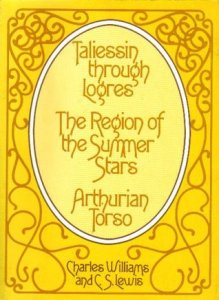
Taliessin Through Logres coverBut the distinction between Arthur’s roles as king and as husband also illustrates a different approach:  one can write the story in such a way that Arthur transcends romance.  This seems to have been Charles Williams’ view in his uncompleted essay The Figure of Arthur (published in 1974 in the combined volume Taliessin through Logres; The Region of the Summer Stars; Arthurian Torso).  In Williams’ view of the myth, Arthur “was not to love, in that kind, at all” (p. 230).  Arthur may be destined purely to serve as a model of the Good King, not to fall in love.

Yet the romancers continue to treat Arthur’s and Guinevere’s marriage as a love story.  The triangle is not so easily disposed of.

Saving a Romance

First Knight (movie) - Arthur, Guinevere, LancelotIf we do want a genuine romance, one way is to give Lancelot and Guinevere a happy ending, and essentially write off Arthur.  We see this in First Knight (1995).  Arthur, played by the redoubtable Sean Connery, seems genuinely fond of Guinevere (Julia Ormond).  But he’s much older than she is (Connery was 65 at the time, Ormond 30).  Lancelot (Richard Gere), much nearer her age, plays his usual role in rescuing Guinevere from various distresses.  When Arthur dies, he commends Guinevere to Lancelot’s care.  At the conclusion, contrary to the usual storyline, those two seem free to pair off, giving the audience the qualified satisfaction of a fulfilled romance.  (Exactly what would have happened to the polity of Camelot in this alternate Arthurian history isn’t discussed.)

Another way is to dodge the issue entirely by simply leaving Lancelot out of the triangle.  King Arthur (2004) depicts Arthur and Guinevere as true lovers, what TV Tropes calls a “Battle Couple.”  After adventures, heroic last stands, and the arrival of The Cavalry, the movie ends with the wedding of Arthur and Guinevere.  Lancelot is in the band of knights, but he doesn’t yet have a crush on Guinevere, or vice versa; so we have the rare case where the Arthur-Guinevere relationship is preserved.  It’s a conventional happy ending, but it requires a considerable departure from the basic Arthurian story.

Arthur’s Alternative

A different way to resolve the triangle is to add a fourth party, who can take over the member of the triangle who’s left behind.  I’ve seen a couple of cases where the author gives Arthur an alternative love, letting Lancelot and Guinevere fall where they may.  Ideally, the alternative is really Arthur’s first love, predating the whole Guinevere-Lancelot thing.  Joan Wolf’s The Road to Avalon (1988) has Arthur growing up with a strong and admirable girl named Morgan—a complete rewrite of Morgan le Fay, who usually serves as a villain.  Arthur falls in love with this Morgan, and she with him.  Things look bright until, just after pledging their troth, they discover that Morgan is actually his half-aunt, too closely related for marriage.  Oops.

Arthur’s marriage to Guinevere is a political necessity; it’s not a betrayal, because he cannot marry Morgan.  In this version, Guinevere (Gwenhwyfar) is a not-especially-likable nonentity, who finds her love with Bedwyr (or Bedivere), a historically earlier version of Lancelot.  While the story cleaves close enough to the myth to prohibit a really happy ending, Arthur does at least find his true love, of sorts, with Morgan.

Mary Jo Putney takes a more romantic tack with her short story Avalon (1998).  This time “Morgana” is identified with the Lady of the Lake, the mysterious personage frequently depicted as giving Arthur Excalibur.  She dwells in Avalon, a faerie realm set apart from the mundane world.  In this story, Arthur sleeps with Morgana at the beginning, long before his political marriage to Guinevere, and returns to her at the end, at his “death.”  But he can be healed in Avalon, as some of the older tales suggest, and thus survives to a genuine “happy ever after” with Morgana.

The Fionavar Tapestry

I’ve saved for last this powerful and daunting trilogy (1984-86) by Guy Gavriel Kay, who helped Christopher Tolkien prepare The Silmarillion for publication.  Kay’s approach is unique:  he takes up the tragedy head-on, but offers a strange kind of hope at the end.

Fionavar Trilogy covers (Tor)

Five college students from our world are transported to another universe, Fionavar, which is said to be the first or most fundamental of all worlds—a little like Roger Zelazny’s Amber.  To win the battle against evil in Fionavar, they must summon “The Warrior.  Who always dies, and is not allowed to rest” (Summer Tree, p. 123).  He fights in many worlds, because of “a great wrong done at the very beginning of his days,” but can only be called at darkest need, by magic, by his secret name.  This Warrior is Arthur, and his secret name (rather unexpectedly) is “Childslayer”—based on an episode from Malory (Chapter I.XXVII) that is usually omitted from an Arthurian tale, in which the young Arthur, panicked at discovering that Mordred has been born, orders a whole set of newborns sent off in a ship to their deaths, rather like Herod.

It’s revealed in the second volume, The Wandering Fire, that one of the five students, Jennifer Lowell, is actually a reincarnation of Guinevere.  Moreover, it becomes necessary to summon Lancelot, as well, awakened from an enchanted sleep.  These three have met and fought the Dark heroically in many worlds, but always suffering in their doomed triangular relationship, as a punishment for their several sins (Arthur here is guilty of an even worse crime than his betrayal by the other two).  All three love each other; “making all the angles equal, shaped most perfectly for grief” (Wandering Fire, p. 122).  Indeed, theirs is the “[s]addest story of all the long tales told” (Wandering Fire, p. 187).

Kay doesn’t blink the tragedy.  It would be an understatement to say that there’s enormous suffering and sorrow in this story.  But there is astonishing moral and physical courage and heroism as well—as in The Lord of the Rings and The Silmarillion.  And Kay stresses (in his idiosyncratic way) the factor of free will in the “weaving” of the universe.  Even the fate of Arthur and his companions is not forever foredoomed.

Once the threat to Fionavar has been vanquished, a new way opens.  All three of them can leave the worlds forever, together, and fight no more.  In the most Tolkien-like moment of the story, the three sail off into eternity, rising along what Tolkien called the Straight Road into the West (The Darkest Road, p. 332).

The scene is so moving that one hardly notices Kay has not actually resolved the romantic triangle at all.  Arthur, Guinevere, and Lancelot are surely worthy of Paradise—but we have no clue as to who ends up with whom.  Is the only way to resolve this triangle to transcend it to some conclusion beyond mortal comprehension?

Lancelot’s Alternative?

I want to mention one possibility that I haven’t seen tried in a modern story (although, in the innumerable variations on the Arthuriad, it’s quite possible that there’s an instance out there).  Instead of coming up with an alternative for Arthur, one might try presenting an alternative for Lancelot, allowing Arthur and Guinevere to come back together as true lovers—perhaps sadder and wiser after what, in such a plot, would be a temporary breach of faith among the three of them.

The concept can in fact be found in a very old source:  Williams mentions a French lay called Lanval (ca. 1170-1215), in which a Lancelot-equivalent, desired by the queen, ends up himself riding off to Avalon with a fairy mistress.  But this is a quite different version of the Arthurian story.  Is there an opening for a Lancelot-mate in the more canonical range of variations?

Lancelot and ElaineThere’s Elaine.  In Malory, Elaine falls in love with Lancelot and tricks him into sleeping with her thinking she’s Guinevere.  Their son is Galahad, and in Malory they actually live together for some time as man and wife.  Could something be made of this?

White’s Once and Future King treats Elaine as a weak and helpless character, hardly worthy of Lancelot.  But she could easily be amped up to modern standards as a stronger individual.  If Guinevere can be a Celtic warrior maid or a Canadian college student, Elaine could certainly be revised to an inventive author’s taste.  Her relationship with Lancelot need not be the failed, one-sided romance depicted by White; she could become Lancelot’s real love.

Actually, there’s an interesting hint in The Fionavar Tapestry.  A seemingly pointless side story concerns a kind of Luthien-figure, the supernally beautiful elf Leyse of the Swan Mark.  She meets Lancelot briefly in the woods and falls in love with him—but of course he’s otherwise occupied.  Leyse then herself sails off into the West (The Darkest Road, p. 233).  It occurred to me that the name “Leyse” faintly resembles “Elaine”; and in preparing this post, I noticed her description on Wikipedia specifically refers to Elaine—although not necessarily the same Elaine (there are several characters by that name in the Arthuriad).  If she too ends up in the West, the Isles of the Blest, or whatever unearthly paradise Kay’s world accommodates—is it conceivable that she provides a quadrilateral solution to the Eternal Triangle?

There always seem to be more possibilities to be explored—which is what makes this myth so fruitful.