High School Musical: Or, Artful Trope-Wrangling

High School Musical posterIn this season of festive frivolity (and guilty pleasures), what could be more frivolous than the Disney Channel TV movie “High School Musical”?

Yet there may be a few interesting words to say about it.

The Phenomenon

If by some chance you’re not familiar with HSM, the Wikipedia article has a detailed description of the production, plot, and characters.  You can brush up there; I’ll wait.

Since the early 1980s, the Disney Channel has produced a formidable list of original made-for-TV movies, generally aimed at a tween-to-teen audience.  Few of them make much impact on the general moviegoing public, though a number of actors and musicians have gotten their start in the “DCOM” venue.  But every now and then one finds something more substantial among the fluff.

Such surprise successes are not unknown among more adult movies.  No one expected Casablanca to become a film classic when it came out in 1942.  It’s A Wonderful Life, with disappointing results in its original 1946 release, became a beloved holiday heartwarmer in the 1970s.

Disney didn’t expect anything extraordinary from HSM, either.  But the movie was a whirlwind success in its target age group.  Disney, always ready to strike when the iron turns out to be hot, followed up the original HSM not only with the conventional TV sequel but also with a third episode that was released in theatres—“the first and only DCOM to have a theatrical sequel,” according to Wikipedia.

When HSM premiered in 2006, I had a daughter at the right age to be interested; that’s how I came to see the show.  But I was favorably impressed.  As lighthearted romantic fluff goes, this venture was pretty enjoyable.

Clearly, the HSM team did something right.

The Chemistry
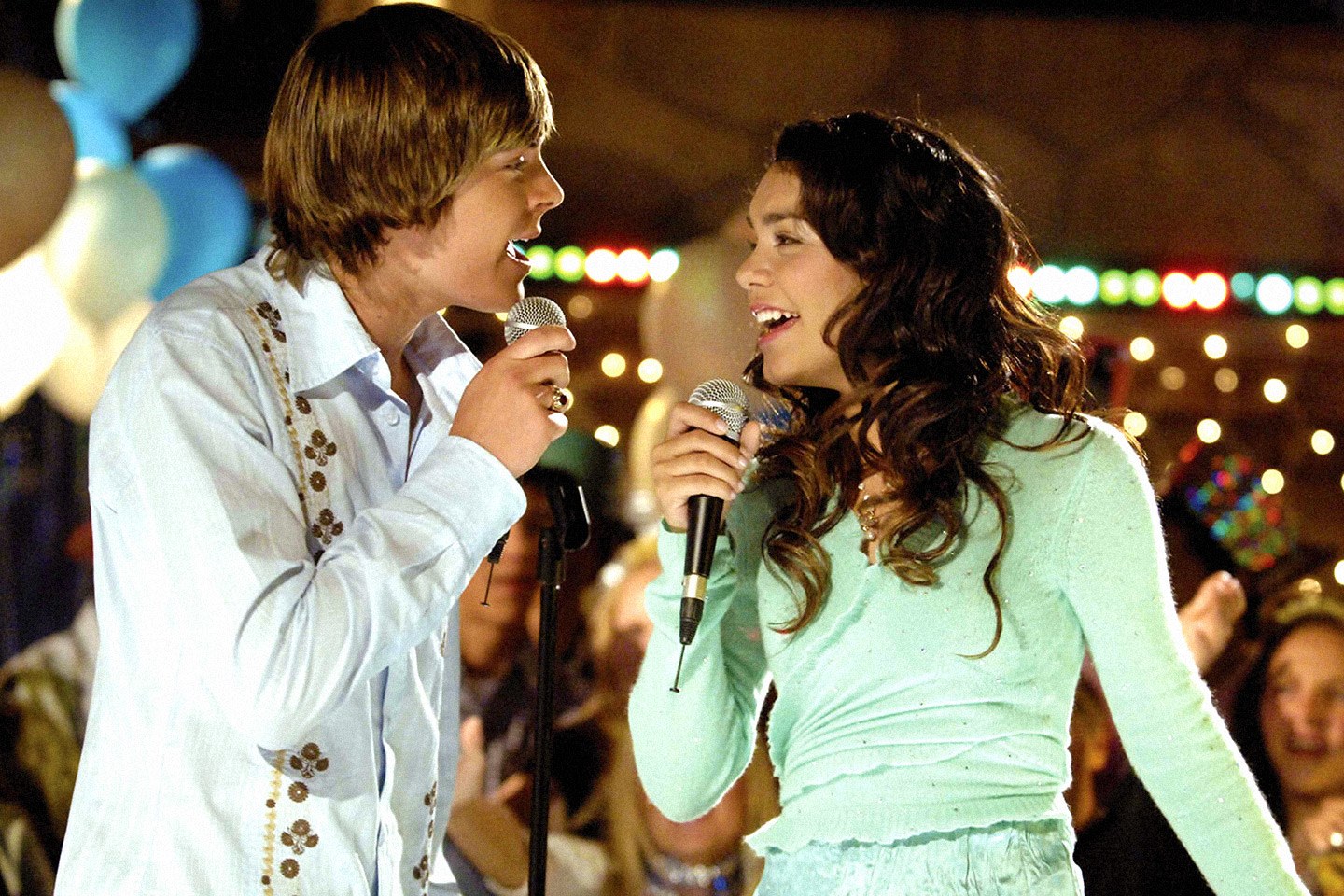
High School Musical, karaoke scene, Troy and GabriellaA romantic comedy can’t work unless the couple appeals to us.  In this respect, HSM hits the right note from the initial meet-cute.  Teenage strangers Troy Bolton (basketball star) and Gabriella Montez (science-oriented A student) are propelled onstage at random by a boisterous karaoke crowd at a resort’s New Year’s Eve party.  By the usual musical-theatre convention, they sing the required duet perfectly, without any prompting, though they act as if they’re amateurs trying this for the first time.  We watch them gradually loosen up, exchange shy glances, and get into the song with enthusiasm.  It’s entirely adorable.  The song itself, with the refrain “This could be the start of something new,” fits neatly with the beginning of a relationship.

Romantic chemistry is to some extent in the eye of the beholder.  But I felt the actors and filmmakers did a good job of making the romantic interest both credible and enjoyable.  (To mention only one example of a film that fails in this respect:  Star Wars fans will wince in unison when reminded of the fact that the prequel trilogy requires us to treat Anakin and Padmé as heroes of an epic romance, but the actors have no chemistry whatsoever.)

The Tropes

HSM is a gallery of familiar tropes—but it does some interesting things with them.

The idea of star-crossed lovers whose groups are at odds goes back to Romeo and Juliet—or Pyramus and Thisbe.  Using the traditional high-school dichotomy of jocks and nerds to create this opposition makes the situation ripe for comedy.  But what makes HSM interesting is that there’s a third force involved:  the drama club.

While the sports championship and the scholastic decathlon preoccupy the basketball team and the brainy types, Troy and Gabriella are really trying to succeed at a third thing—trying out for the spring musical.  Their real opposition is the reigning drama queen, Sharpay, with her acquiescent brother and dance partner Ryan.  Having three factions in play complicates the standard “Two houses, both alike in dignity” plotline.  It also allows for a satisfying alliance of the sports and science factions at the climax, when they conspire to create simultaneous disruptions so that Troy and Gabriella can appear at the all-important (I’m trying to say that with a straight face) callback auditions.
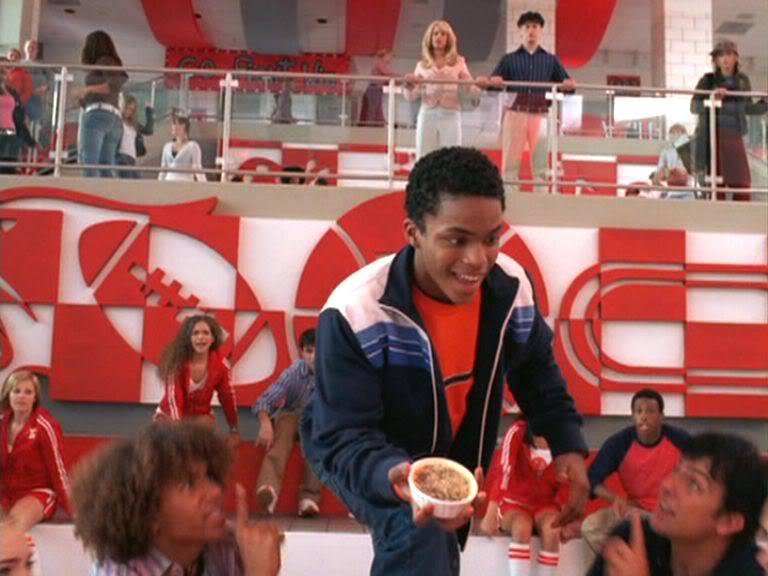
High School Musical, creme bruleeSimilarly, the basic theme of the show is a classic (especially for teenagers) “do your own thing” or “be yourself” message.  But the three-party problem points this up in a slightly unexpected way.  Troy and Gabriella don’t need to recognize each other’s existing strengths; they’re each trying to do something that’s new to both of them.  The same theme works its way down through the minor characters.  In a song about sticking to the status quo, various people confess their unorthodox ambitions.  To me there seems to be something whimsically specific about a basketball player’s dream of cooking the perfect crème brulée, which becomes a running joke.

The HSM characters are typical high-school stereotypes, but with a little more to them.  They are, at least, multi-talented; and they’re capable (in the end) of appreciating each other’s disparate abilities.  It’s just enough of a spin to lift HSM out of the run of teenage comedies.

The Music

The musical numbers are pretty good pop-rock songs, IMHO.  The comic pieces are well done, and they’re carried off with great joie de vivre by the enthusiastic cast.  The love songs—“Start of Something New,” “What I’ve Been Looking For,” “Breaking Free”—are enjoyable enough that they’re worth listening to even aside from the video.  The big finale, “We’re All In This Together,” is just the kind of rousing, energetic closer one wants for an entertainment of this sort.

Conclusion

High School Musical, finaleThere are, of course, flaws.  Characters don’t always act consistently; for instance, the drama club moderator Miss Darbus is sometimes flagrantly biased in favor of her pet prodigies Sharpay and Ryan, while at other times she goes out of her way to give the newbies a fair chance.  The final wrap-up, in which everyone from all factions become friends (temporarily, until the next episode), is endearing but just too neat.

But to my mind, HSM succeeds at being good light entertainment—and that’s not something to sneeze at.  It can be harder to bring off a light comedy than to craft a drama or an action-adventure flick, just as it can be easier to broil a steak than to make a good soufflé.  (Or crème brulée, perhaps.)

Kelsi Nielsen, HSM's "composer"

Olesya Rulin as Kelsi Nielsen

I also have a particular fondness for HSM’s acknowledgement of the composer of the musical as an unsung hero.  The drama club’s musical is being written by a younger student, Kelsi Nielsen.  The senior drama people act superior with Kelsi, but Troy points out to her that in basketball terms she’s the “playmaker”—the one who makes everybody else look good.  That’s an especially satisfying observation to those of us whose activities lie more in the writing and composition areas than in onstage performance.  It’s another welcome subtlety I wouldn’t necessarily have expected in a casual Disney Channel production.

No one will mistake HSM for high drama.  But it’s undeniably fun, and it reminds us that even the most well-worn tropes can be fresh if you throw in a few new twists.
The Master Contriver

Some stories—especially comedies—include a character who seems to have the job of making sure everything comes out right in the end.  Let’s call them the Master Contrivers.

“I manage things a little”

The Contriver doesn’t force things into place.  Rather, she pulls strings.  A good deal of finagling, a certain amount of chicanery, and a talent for talking people into things are generally involved.

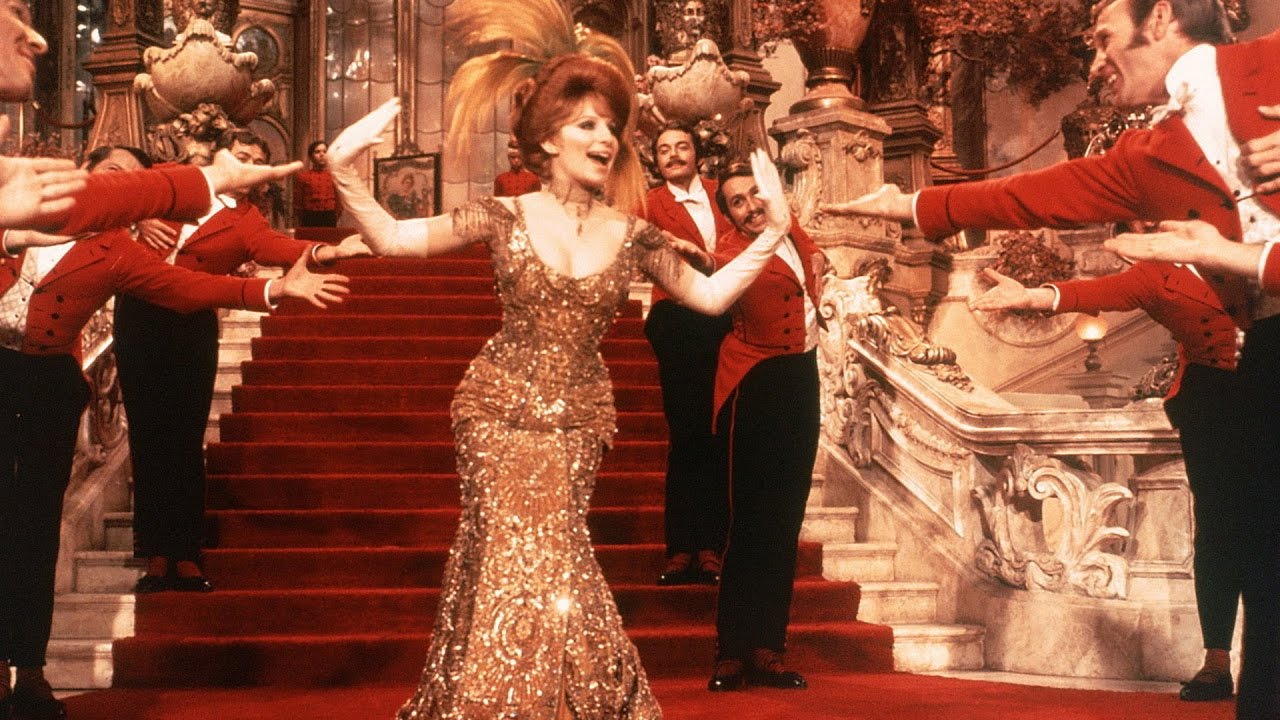
Dolly Levi dances with waitersDolly Levi of Hello, Dolly! is a familiar example.  The show starts with an array of dissatisfied characters.  Horace Vandergelder wants a wife.  His niece Ermengarde wants to marry impecunious artist Ambrose Kemper.  Horace’s clerks, Cornelius Hackl and Barnaby Tucker, want to escape their humble jobs for a day—and maybe fall in love.  Their opposite numbers, Irene Molloy and her assistant Minnie Fay, are also eager for a spree and a romance.  Dolly herself, a self-proclaimed meddlesome widow, is ready to settle down with a new husband.

With magnificent confidence, the ebullient Dolly takes on the task of resolving all these plotlines.  She suggests, cajoles, misdirects, confuses, and manipulates until everything works out.  We enjoy how all this frivolity and chaos converges magically to a neatly satisfying outcome, like a sleight-of-hand trick.

Hardly anyone else knows quite what they’re doing at any given time, but Dolly has everything under control.  Even where she lacks a specific plan, she is an expert improviser.  The other characters can safely rely on her to solve all problems.

Wodehouse’s Maestros

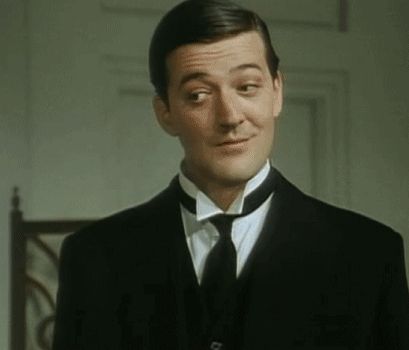
Stephen Fry as JeevesThe Master Contriver frequently pops up in P.G. Wodehouse’s comedies.  The best-known example is the imperturbable gentleman’s gentleman Jeeves.  No matter what sort of absurd scrape Bertie Wooster gets into, Jeeves can always find a way to get him out again.  Half the fun is watching to see exactly how Jeeves will pull it off this time.  (The other half is simply listening to Bertie narrate, which is a joy in itself.)

But Jeeves is far from the only Wodehouse example.  At Blandings Castle, the fiftyish but dapper Galahad Threepwood lives up to his name by spreading sweetness and light in the form of good fun, lovers united, and overbearing aunts thwarted.  The lively and irreverent Uncle Fred (Earl of Ickenham) plays a similar role in other tales, to the alarm and embarrassment of his nephew Pongo Twistleton; sometimes these adventures also take place at Blandings.  (It’s too bad Wodehouse never brought Gally and Uncle Fred onstage at the same time—ideally with Bertie and Jeeves as well.  The mind boggles at what wackiness might develop with three Master Contrivers simultaneously at work.)

All the above examples are middle-aged men or women.  The sublime Rupert Psmith (“The p . . . is silent, as in phthisis, psychic, and ptarmigan”) represents a rare younger version of the merry manipulator.  He actually becomes a protagonist, with his own romantic plotline, in Leave It To Psmith (1923)—at Blandings, naturally.

SF Contrivers

Science fiction abounds in exceedingly clever manipulators, but most of them fit the mold of the trickster-hero rather than the master contriver:  they are frequently the protagonists, and their stories tend to be more serious.  Miles Naismith Vorkosigan, Salvor Hardin, Gandalf the Grey (in The Hobbit), and Seth Dickinson’s Baru Cormorant are good examples.

But the comic contriver is not unknown.  In Heinlein’s rollicking family yarn The Rolling Stones (1952), Hazel Stone, the superficially crusty grandmother figure, is often the one who “arranges things”—including appearing in court to get her grandsons off the hook in a tax case on Mars.

Masters and Matchmakers

The Grand Sophy, coverThe Master Contriver is perhaps most at home in romantic comedies.  Georgette Heyer’s Regency romances feature a few such characters.  Sometimes they’re the romantic interests of female protagonists, since genre romances are fond of dominant “alpha male” heroes.  But one of the most enjoyable is the titular female lead in The Grand Sophy (1950).  Like Psmith and Dolly, young Sophy cheerfully arranges a romance for herself at the same time as she resolves other characters’ star-crossed affairs.

In the musical Oklahoma! we have Aunt Eller, the spiritual counterpart of Uncle Fred.  She’s perfectly capable of pulling a gun to halt a burgeoning brawl (see this clip at about 3:05), but her main job is to guide her niece Laurey to a happy resolution of her uneven romance with the expansive cowboy Curly.

The Warrior's Apprentice, coverAs the third-party plot manager for a romantic comedy, the Master Contriver often functions as a matchmaker.  Hello Dolly! was based on a Thornton Wilder play literally titled The Matchmaker.  Even Miles Vorkosigan, in a gently comic scene in The Warrior’s Apprentice, briefly burlesques the role of a traditional Barrayaran matchmaker for his own lifelong crush Elena and the man she’s fallen in love with.  (Miles’ own romance does not develop until several novels later.)

The Character of the Contriver

A third-party Master Contriver naturally falls into the niche of the benevolent uncle or aunt—a kindly older person who isn’t typically a player himself, but an enabler of other characters’ fulfillment (though we’ve seen some counter-examples above).  In fact, this position is not unlike the role of the fairy godmother in Cinderella.

The role resembles that of a mentor, although, unlike the Missing Mentor of whom we’ve spoken before, this mentor-manager is generally very much present, in the thick of the action.  Yet the Contriver is a little detached, not as directly involved as the principals; she can take things a little lightly.  She can thus be more jolly, less earnest.

Since the Contriver is generally working toward other characters’ happy endings, not her own, she lends the story a sense of generosity.  This is why we don’t mind a character who might otherwise seem manipulative.  We typically think of “maniuplative” as a troublesome trait, not an appealing one.  But an avuncular figure who can be trusted to manipulate people only for their own good becomes an asset rather than a problem.

The Atmosphere of the Story

It helps make a comedy pleasant when there are people disinterestedly spreading sweetness and light.  This is why the Contrivers play so well in comedies of manners and romantic comedies, where the plots have to be intricate, but light-hearted.

Since we’re typically dealing with interpersonal relations, not slam-bang action plots, Master Contrivers achieve much of their effectiveness by influencing other people.  For this reason, they generally possess considerable personal magnetism or “charisma.”  This, again, adds to the general air of genial good-fellowship in a comedy.

But the greatest effect on the atmosphere of the story, I think, is that it’s reassuring to have someone around who can be trusted to untangle all plotlines to a happy ending:  “till by turning, turning we come ’round right.”  We come into a comedy expecting things to turn out well.  The more the happy ending is in question, the more the story begins to look like a thriller rather than a comedy.  If Dolly or Gally is on the scene, we can rest easy on that score, and enjoy the ride.

This One’s For the Boys

Sometimes a song offers an archetype or a role model for persons to emulate.  I recently heard the phrase “motivational rock.”  More commonly I think of such a song as “aspirational.”

 “This One’s For the Girls”

Martina McBride had a 2003 hit with “This One’s For the Girls,” written by Chris Lindsey, Hillary Lindsey and Aimee Mayo.  If you don’t know it, check out the music video and the lyrics.

This One's For the Girls - young girl and older womanAs Wikipedia puts it, “The song’s lyrics are a salute to women of various ages (early teens, middle twenties and approaching middle age) dealing with the struggles of different phases of life—starting high school and facing new pressures, coping with uncertainty about a career, and reaching middle age—and tells them ‘You’re beautiful the way you are.’”  It’s addressed to “girls” of all ages, “from one to ninety-nine.”  (The varying usage of the term “girl” over the last fifty years is a whole separate subject.)  The song is explicit about expressing an archetype, or an ideal, for women of any age:  “we’re all the same inside.”

This One's For the Girls - girls w.soccer ball singingIt’s interesting to see what characteristics are asserted of this common core identity.  The refrain implies that women are characterized by wholehearted love—“who love without holdin’ back.”  They’re sentimental:  “who’ve wished upon a shooting star.”  They’re idealists—or maybe just striving for some lofty goal:  “who dream with everything they have.”  And this willingness to put oneself on the line is courageous, because they’re also vulnerable:  “who’ve ever had a broken heart.”  Each verse portrays integrity and being true to oneself.  All these characteristics are commended:  “beautiful.”

There could be vigorous debate about any or all of these specific ideals.  But the popularity of the song testifies to the notion that at least some listeners can identify with this vision of womanhood.  More generally, “Girls” a member in good standing of the large family of female empowerment songs.  Just as a sampling of recent hits, we could instance “Fight Song,” “The Road Less Traveled,” “Scars To Your Beautiful” . . .  There’s no lack of inspiring characterizations for women.

The Missing Complement

It’s less clear what the corresponding archetype is for men or boys.  We’ve been challenging traditional stereotypes of masculinity for several decades.  That’s not necessarily a bad thing.  But we seem to be having trouble figuring out what should replace those stereotypes.

There are plenty of general-purpose motivational songs about—which makes sense, because most of what we are, we have in common as human beings.  But what would a comparable song for guys look like—a “This One’s For the Boys”?  We don’t see a whole lot of candidates stepping up for that position.

I’m thinking of good role models for boys.  We have plenty of bad ones, to be sure.  We can discard at once the overly violent, the nihilistic, or the tedious “bro-country” stereotype (to which “Girl in a Country Song” made an entertaining response).  But what do we want young men to take as an ideal?  Are they supposed to be really sensitive?  Really tough?  Down-to-earth?  Geeky?  It seems to me there’s a significant gap here, or at least a state of considerable confusion about masculine ideals.

This isn’t as trivial as it sounds.  Sure, one song isn’t going to make the difference between a world of well-developed mature men and the reverse.  But we do need the subtle guidance our stories and our songs provide as we grow.  So I’ve been on the lookout for the kind of song that would say to men the kind of things “This One’s For the Girls” says to women.

“Never Enders”

Never Enders, band performingEarlier this year I ran across the title song from Lonestar’s 2016 album “Never Enders,” written by Dean Sams, Richie McDonald, and Marv Green.  I liked the full-speed-ahead energy of the music, but I loved the lyrics:  one of those cases where you say to yourself, “yes, that’s just right, I’ve been wanting to hear someone say that!”

At first hearing, the song struck me as evoking an ideal that anyone could sign onto.  And so it does.  Just as men, not only women, could perfectly well aspire to the wholehearted love and “dream big” of McBride’s song; in the same way, both women and men could identify with Lonestar’s lyrics.

In fact, some of the same characteristics appear in both.  In “Never Enders,” the unidentified “we” are, among other things, “crazy wild dreamers” and “long shot believers,” and we “wear our hearts out on our sleeves.”

But it also occurred to me that this song might be especially well keyed to guys.  The song commends some traits that seem particularly suited for young men’s aspirations.

Never Enders, soldier embracing wifeOne major theme is faithfulness.  The singers are, in the lovably idiosyncratic phrasing of the song, “make-a-promise keepers.”  We “ain’t never gonna walk away.”  “We are now, we are forever / We are in this thing together / We don’t give up or surrender.”  Here traditional masculine qualities of steadiness and persistence are embodied in loyalty and standing by one’s partner—“for worse or better.”  Since unfaithfulness or lack of commitment (to a relationship) is a traditional male shortfall, the song’s assertion seems all the more decisive—embodied in the very title.

What’s even more interesting is a notion of balance and growth.  The first words are:  “We’re lettin’ goers, we’re hold-on-ers”—someone who knows when to hold tight and when to allow space.  Moreover, we’re “changers with the timers.” “We are the fire that keeps on burning / Always living, always learning.”  The notion of lifelong learning is a somewhat surprising meme to hear, considering how often country music devotes itself to standing by traditions—but “always learning” is an excellent lodestar for someone who’s trying to become a real man.

Never Enders, astronaut kid on bikeThe music video depicts the band itself cruising around, seeing sights that evoke a healthy sentiment—like a kid on a bike pretending to be an astronaut—and occasionally participating.  If we focus on this, we could read the “we” very narrowly to mean the band members.  But it’s clear the song is aiming for a wider applicability than this.

So on this Father’s Day, I recommend “Never Enders” as a song we can all join in on to help point ourselves in the right direction—especially, perhaps, us boys.

Arthurian Variations (Part II)

We’ve seen that the Arthuriad has generated a wide variety of retellings over the years.  What makes these legends so adaptable, and so congenial to storytellers of all kinds?

To begin with . . .

A few reasons leap out at us.

As we’ve seen before, it helps if there’s no one canonical version of a story.  Without a single clear source, later authors are free from the need to conform to the “classic” tale.  The Wikipedia article says outright, “there is no one canonical version” (¶ 3).

It’s true that Malory’s Le Morte d’Arthur is the central reference point, at least in English.  But his version is so far from current norms that it would be hard to try and reproduce it faithfully—as Steinbeck perhaps found.  Malory serves more as a library or resource for story elements that can be adapted and recombined at will.

The sheer breadth of that source material is a second factor.  All those knights, all those adventures, even the numerous events of the main storyline:  the Arthuriad is its own ‘Pot of Story,’ a stew full of nutritious narrative elements.  “It held a treasure for every seeker.”  (The Mabinogion, tr. Gwyn Jones and Thomas Jones, Everyman’s Library, 1949, 1974, Introduction, p. xxx.)

The story also occupies a colorful historical setting, whether in the plate-mail-and-castles “high road” approach, or in the more historically plausible “low road” approach.  Many readers have a fondness for this quasi-medieval environment—which is why versions of that milieu are used in so many fantasy stories and games.

A Plethora of Characters

In particular, the Arthuriad is filled with strong and interesting characters.  An author can focus on, say, the character of Percival, or Morgan le Fay, or Gawain, and take off from there.  Or she can ring the changes on the main story by redefining the characters and their relationships, as we saw in the examples from Part I.

Arthur himself can be played in many ways.  Generally he tends to have a certain innocence, a certain earnestness and candor about him.  But this can be realized in the psychologically wounded but charismatic leader of Wolf’s tale, in the essential simplicity of the idealist in White’s Once and Future King, or in the clever but dedicated warleader of “King Arthur.”  (It can also be seen in the weak and waffling character of Lerner & Loewe’s “Camelot”—if we include what I consider a failed implementation.)

Other characters are equally mutable.  Mordred is subtle and evil in White; he’s an innocent and rather likable kid in Wolf.  Lancelot contains enough contradictions in himself—loyal friend, betrayer of a marriage, devoted lover, peerless warrior—that an intense character study of this champion is almost unavoidable if we let him into the story at all.

Guinevere is a particularly tricky case.  It’s hard to play her as truly admirable—since so much of her traditional role lies in being untrue, at least after a fashion.  (She’s untrue to Arthur, but true to Lancelot, and the story seems largely willing to forgive the first in light of the second.)  If she isn’t handled carefully, she’s likely to default into being silly, or weak, or fickle.  The challenge of giving her a better role may appeal to an author.  Both books and films have taken up that challenge, though I’m not familiar with those treatments.

Compelling Drama

The story of Arthur contains many events that lend themselves to high drama.  For example—

His origin.  It seems essential for Arthur’s ascent to the throne to exemplify the theme of the lowly raised high, the rise from humble beginnings to glory.  His childhood is modest, in one way or another.  In the traditional formulation, Arthur doesn’t know who he is until he is almost grown, and it may take a magic token (the sword in the stone) to demonstrate his true nature.  As a result, Arthur generally has the humility that I’ve argued characterizes our archetype of the Good King.

This Cinderella-type story appeals to our fondness for the underdog, and the reversal of fortunes is inherently dramatic.  There are a lot of possibilities for how that revelation occurs, and how Arthur and those around him react.

Lancelot, Guinevere, Arthur (King Arthur)The love stories.  An eternal triangle necessarily involves passion, betrayal, and drama.  But there are a lot of possible ways to construe the relations among Arthur, Guinevere, and Lancelot (along with Morgan and other possible players, as we saw last time).

In the central love story, Arthur tends to lose out.  As White puts it (Book Three, beginning of ch. 45):  “Merlyn had not intended him for private happiness.  He had been made for royal joys, for the fortunes of a nation.”

Since Arthur is on the scene first, Lancelot must share some strong bond with Guinevere in order to draw her away from Arthur—unless the Arthur-Guinevere bond isn’t that strong to begin with, as in Wolf.  If we idealize Lancelot and Guinevere’s romance, we have to push Arthur away.

There’s a strong impulse to rescue the love story somehow.  We have three characters, each of whom we love and admire, trapped in this untenable situation.  We don’t want any of them to lose out, but someone has to.

So we get retellings that pare down the triangle.  In The Road to Avalon, Arthur and Morgan are the real romance; it doesn’t matter if Guinevere seeks solace elsewhere (except for political reasons).  In “First Knight,” Arthur is too old for Guinevere; after his inevitable death, Lancelot and Guinevere seem to be left free to marry.  “King Arthur” ends early, in terms of the overall myth, and skips the entire triangular problem.  Arthur and Guinevere marry at the end in a traditional romantic consummation, and Lancelot remains a minor character.

Moreover, if we choose as our main character someone other than the Big Three—one of the numerous other knights or ladies of the Arthurian court—the possibilities for love stories are endless.

The Holy Grail (Indiana Jones)The Holy Grail.  It’s hard to know what to make of the Holy Grail as a storytelling hub.  The Grail’s religious origins (although they are subject to dispute by some literary historians) may cause this part of the story to be bypassed entirely by those writers who prefer to dodge the Christian aspects of the Arthuriad.  White introduces the Grail quest rather ignobly as a distraction to keep the knights busy when there are no wars for them to fight.

Nonetheless, the mythic resonances of this ultimate quest MacGuffin have let it play a role in a surprising number of modern treatments—from “Monty Python and the Holy Grail” to “Indiana Jones and the Last Crusade”—even where, as in the last example, the Arthurian tales are not otherwise involved.  For those who want an air of mystery and the numinous, rather than just clashing swords, the Grail is a natural choice.

Key Themes

Finally, the Arthuriad carries a number of themes of lasting interest.  These themes can also draw storytellers to the court of Camelot.

Knights of the Round Table (Excalibur)True companions.  For Western culture, Arthur’s Round Table knights may be the archetypal example of the tight-knit group of comrades fighting together for the right.  The basic story also includes some inversions of this band-of-brothers relationship—betrayals of several kinds—but that only serves to make the ideal seem more dramatic and memorable.  The Round Table is explicitly portrayed in “First Knight” and (without the table) in “King Arthur.”  It’s satirized, yet mourned, in White.  It does not play a major role in Wolf’s version.  But if an author wants to invoke the ideal of comradeship to the death, Arthur’s court is as likely a touchstone as the Three Musketeers or Robin Hood’s woodland band.

Chivalry.  The Arthurian knights represent the archetype of the ideal of chivalry.  Now, our era has a love-hate relationship with this notion.  We frequently prefer to satirize or criticize the ideals that were held up as models for the Arthurian knights.  Yet there remains a certain appeal to what TV Tropes calls Old-School Chivalry, a less literal version that can turn up in cases as varied as Captain America and “Kate and Leopold.”  These later varieties look back to the hazy memory of a medieval ideal that we associate with Arthur’s court.

Civilization is at stake.  Almost all versions of the tale depict Arthur as standing in some sense for the defense of imperiled civilization against the chaotic forces that threaten it.  The opposition may be literal, as in The Road to Avalon, where Arthur leads armies against the invading Saxons.  Or it may be more subtle, as when The Once and Future King shows Arthur striving to achieve the rule of law as a principle to contain the depredations of warlords.  Not Might makes Right, but Right makes Might, protecting the weak from the strong, ordinary people from the powerful:  this is the chivalric ideal Arthur pursues under the tutelage of Merlyn.

You could call it civilization.  What I meant by civilization when I invented it, was simply that people ought not to take advantage of weakness—not violate maidens, and rob widows, and kill a man when he was down.  People ought to be civil.  (Book Two, chapter 9)

The most poignant aspect of the Arthurian tale is that he achieves this ideal, for a fleeting moment—an island of light in an age of darkness—yet it fails.  The Round Table is broken, Camelot goes down in war and betrayal, Arthur does not found a virtuous dynasty.  This chiaroscuro of success and failure has a dramatic appeal that is hard for a storyteller to resist.

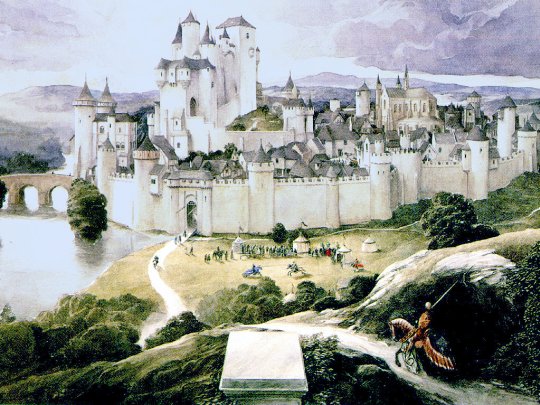
CamelotCamelot falls.  And yet, the story does not quite end in despair.  Arthur may die—but he is not entirely lost; he will somehow return.  In White’s touching ending, Arthur hands on the story itself, the memory of Camelot, to a young page named Tom—Tom Malory.  The ideal remains an ideal, and we are reassured that someday Arthur and the ideals he champions will reawaken.

It is no wonder that this kind of ambiguous, yet hopeful, ending attracts storytellers.  It attracts readers too.  All but the most hardened cynics would like to look forward to such a return.  Arthur’s story, like Arthur himself, never quite dies.

Comfort Reading

Reading for Reassurance

Chicken soupYou’ve heard of “comfort food,” right?

In Robert A. Heinlein’s The Number of the Beast (1980), one character asks the others:  “Write down the twenty stories you have enjoyed most. . . . Make them stories you reread for pleasure when you are too tired to tackle a new book.”  (ch. 33, p. 349)

I’d never actually thought about it before I read that passage, but there is such a category.  There are times, especially toward the end of the day, when we want to immerse ourselves in a story, but not an arduous story.  Even if we’re currently reading something new that we like, we may not feel we can fully appreciate it when we’re tired out.  We’d rather relax into something less demanding.

The same can be true when we’re feeling emotionally drained.  Sometimes we pine for what we might call “comfort reading” on the analogy of “comfort food.”

We might be tempted to regard this urge for the familiar and reassuring as craven or self-indulgent.  But there’s nothing wrong with giving way to that impulse—some of the time.  We can welcome a new book as a challenge; but we don’t always have to be challenged.  Sometimes we simply need to recoup our energies for a while.

This is true in general, I think, but especially at Christmastime—so today seemed like a good time to bring up the subject.

Good Comfort Reading

What kind of stories one likes for “cocooning” will vary, culturally and individually—as the Wikipedia article cited above makes clear for comfort food.  In TV Tropes terms, “your mileage may vary.”  By way of example, here’s some of what I find myself looking for.

When I relax, I want something relatively light, not a matter of life and death.  A fan of adventure fiction spends a lot of time embroiled in saving the world, or the galaxy—or at least the imperiled main characters.  And a lot of science fiction deals with world-changing issues and problems.  That’s pretty strenuous.  It’s nice to be able follow a narrative where the stakes are not quite so high.

At the same time, there has to be enough substance to engage our interest.  A story in which nothing is at stake won’t hold our attention.  So pure farce or silliness doesn’t always fill the bill.

And for me, at least, it helps if the story is fairly “warm-hearted.”  Happy endings, sympathetic characters, a certain degree of kindness and encouragement in the air.  A cynic might have a quite different preference here:  a happy ending may not be congenial to his world-view.  But we sentimentalists want some of the milk of human kindness in our chicken soup.  (Well, maybe not literally.)

For this reason, romances make good hunting grounds for comfort reading.  Not necessarily genre romances; I’m put in mind of Chesterton’s Tales of the Long Bow, which is almost uncategorizable (social comedy? political commentary? science fiction?) but incorporates no fewer than seven separate romances in a scant 217 pages, possibly a world’s record.

In a good love story, something that matters very much is at issue—but generally only for the main characters.  This is why P.G. Wodehouse’s comedies are almost always romantic comedies.  His amiable main characters are never in very great danger, but rooting for their love affairs keeps us focused through the plot’s succession of hilarious absurdities.

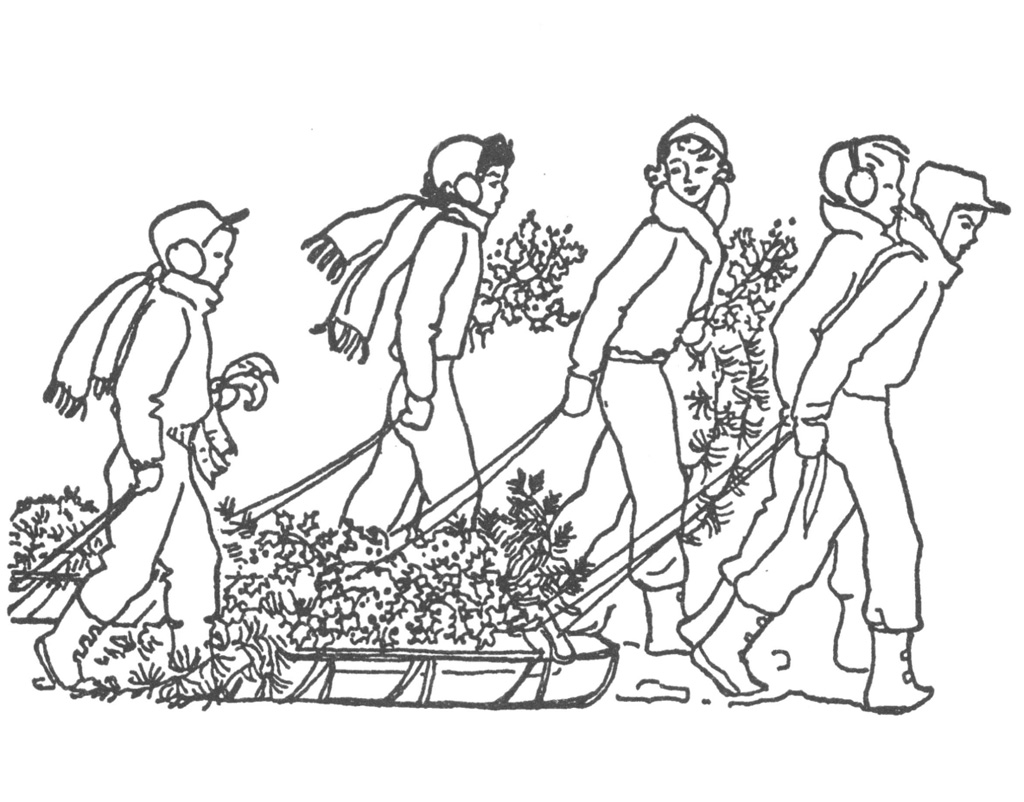
Melendy children with Christmas greensPersonally, I also like children’s stories to relax with.  There’s a category of what I call “family adventures,” where preadolescent children get into a series of scrapes or difficulties that are interesting but never too serious.  Elizabeth Enright’s Melendy Quartet (starting with The Saturdays, 1941) is my paradigm example.  Some of E. Nesbit’s books, such as Five Children and It, have a similar air, but with a fantasy component.  (I’d cite Eleanor Estes and Edward Eager as well, but that would raise the mysterious question of why so many writers in this category have the initials E.E.  Same reason Superman’s girlfriends all have the initials L.L., I suppose.)

Christmastide Reading

Of all the times of the year, the Christmas season may be when one most wants to be reading something engaging but pleasant.  There are probably people who want to stage a “Game of Thrones” marathon on Christmas Day, but I’m not one of them.

There are of course the traditional comforting stories that are specifically about Christmas.  A Christmas Carol is one obvious choice (though the actual book is a bit spookier and more tough-minded than some of the adaptations)

Interim Errantry coverLess obvious favorites of mine include “A good-humoured Christmas chapter” from Dickens’ The Pickwick Papers (ch. 28); “How Lovely Are Thy Branches” from Diane Duane’s Interim Errantry; chapter 5 of The Wind in the Willows (“Dulce Domum”); Madeleine L’Engle’s Dance in the Desert and The Twenty-Four Days Before Christmas; Elizabeth Scarborough’s Carol for Another Christmas; chapters 12-13 of Kate Seredy’s The Good Master; and Manly Wade Wellman’s “On the Hills and Everywhere,” in the collection John the Balladeer.  The only trouble is that some of these are quite short; they’ll barely last you through lunch.

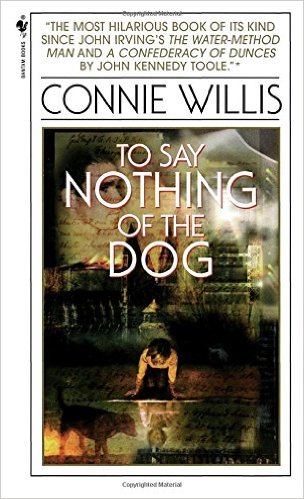
To Say Nothing of the Dog coverBut even at Yuletide, we may not want to marinate in Christmas quite to that extent.  So I also cultivate a selection of books that strike (or encourage) the right mood, but don’t have anything specific to do with Christmas.  I’ve mentioned Wodehouse; Georgette Heyer’s Regency romances have a similar combination of light-heartedness and warm-heartedness (I’ve often thought of her as Wodehouse crossed with Jane Austen).  Other kindly and entertaining tales not specifically about the season include Lois McMaster Bujold’s A Civil Campaign—one of my all-time favorites for all seasons—Connie Willis’s To Say Nothing of the Dog, and Diane Duane’s Omnitopia Dawn.

Have any favorites of your own for Christmastime, or comfort reading generally?