A Character By Any Other Name

Last time we talked about the complications of naming babies.  Of course, parents have only a few children.  But writers have to name a lot of characters.  Coming up with the right names is tricky; some writers are better at it than others.  Let’s look at how they meet the challenge.

The Familiar

If you’re writing a contemporary story, you’re in much the same position as a proud parent—except that you know how the person turns out, and you can pick a name that carries the implications you want for the character.  Dickens can name one pleasant pair the Cheeryble Brothers and a less prepossessing soul Scrooge to underline their personalities, in case the reader needs to be hit over the head with a sledgehammer to get the point.  Not all authors have to be quite so explicit about it.

As we noted, there are plenty of books and pamphlets to suggest character names, as well as sites like Behind the Names, BabyNameWizard, or Nameberry.  The pamphlets have become a bit more international over the years:  today’s versions contain names from more countries and languages than they used to.  This can help us avoid what you might call “WASP Name Syndrome,” in which all the names tend to be blandly Anglo-Saxon.

Kamala Khan, Ms. Marvel

Kamala Khan, Ms. Marvel

Consider, for example, early super-heroes, who tended to have white-bread names like Clark Kent, Lois Lane, Bruce Wayne, Barry Allen—not to mention the compulsively alliterative Marvel characters like Reed Richards, Peter Parker, Sue Storm, Bruce Banner…  We see at least a little more cultural variety these days, even if it’s still hard to shake the alliteration, as with the current Ms. Marvel, Kamala Khan.

We’re still in pretty familiar territory when we visit the realm of the historic, or faux-historic—legendary figures living in real or imagined ancient times.  In the Arthurian tales we get ordinary-sounding names like, well, Arthur, as well as less common names (at least at this point in history) like Lancelot, Galahad, Tristan and Isolde, which may at least be familiar through repetition.  An author who wants to be (perhaps) historically more accurate as well as exotic can go for Celtic-style spellings:  Bedwyr instead of Bedivere, for example.  I’ve seen such imaginative renditions of “Guinevere” that you can get halfway through the book before you realize who the author is talking about.  (“Gwenhwyfar,” anyone?)

The Semi-Fantastic

We can do the same thing in F&SF—name our hero Luke, our wizard Ben, pedestrian names like that.  We may want the effect of the plain, traditional name for a particular character—for example, to suggest homeliness or familiarity.  (“His real name is Obi-Wan, but I know him as Ben.”)  This is fine if the story is set, say, twenty years from now, when you’d expect names to be relatively unchanged.  But it’s harder to justify—to make believable—if we’re thousands of years in the future, or in a completely separate alternate world, as with much heroic fantasy.

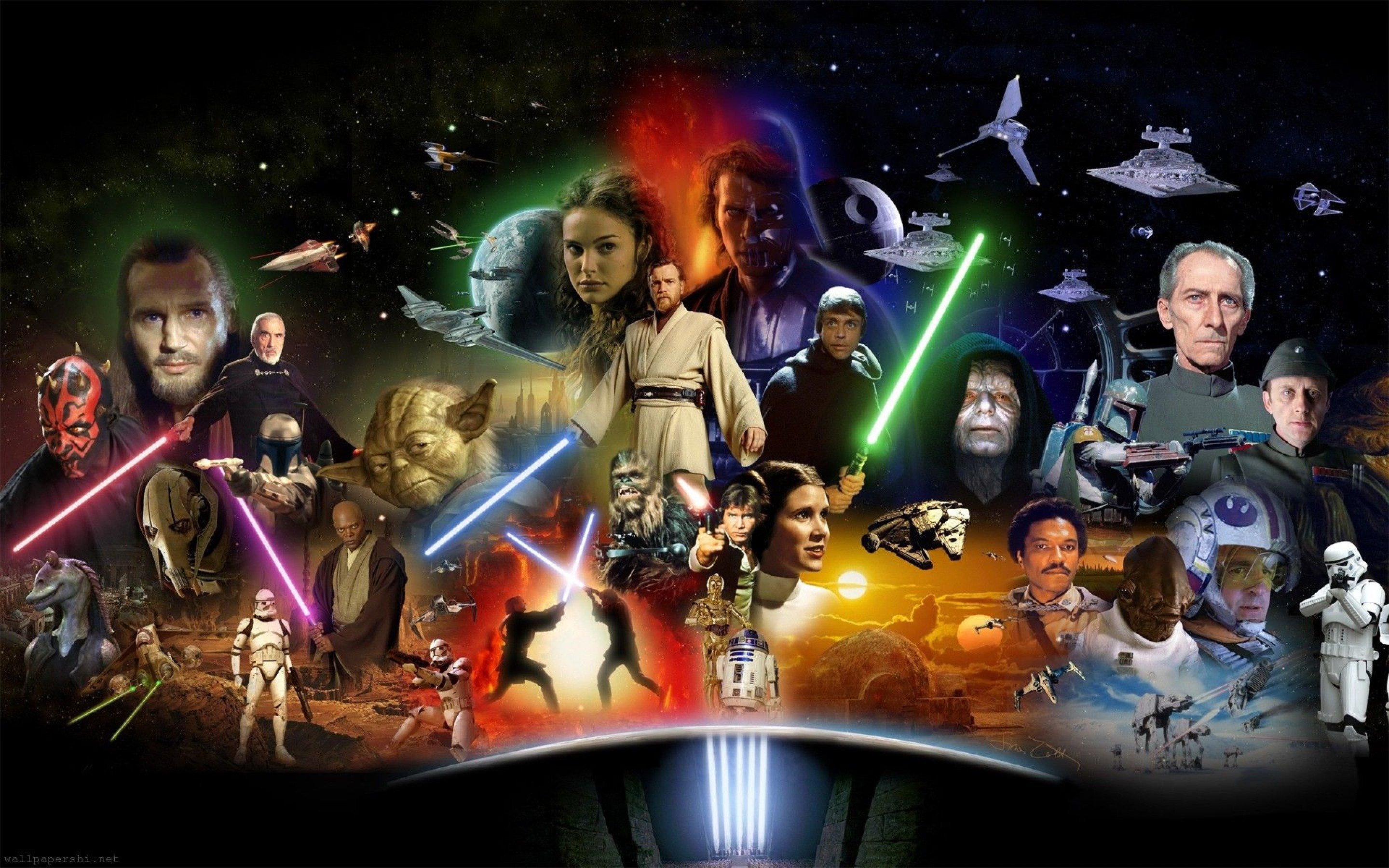
Note this can also be true in SF:  Star Wars looks futuristic, but we’re clearly asked to dissociate ourselves from any specific connection to the present when we’re told, “Once upon a time, in a galaxy far, far away…”  The curious reader is likely to wonder, how did these people happen to come up with exactly the same names we use, even without any common (recent) history or heritage?

Pilgrimage: The Book of the People, coverIn Zenna Henderson’s stories of The People, refugees from another planet come to Earth and struggle to fit in.  The stories are excellent, but the names sometimes give me pause.  In a story set on the home planet, before they’ve had any contact with Earth, the characters have names such as David, Eve, and Timmy—as well as the less familiar Lytha and ‘Chell (Michelle?).  Why so similar to common Terrestrial names?

Or take the hobbits.  Alongside Sam, Bob, and Rosie we have characters like Frodo, Bilbo, Meriadoc and Pippin.  Tolkien, the master linguist, can explain this—exhaustively (see Appendix F to The Lord of the Rings).  From a narrative point of view, the name-mixture gives us a sense of earthy rustic culture, but also of something a little different from Merrie Olde England.  Tolkien succeeds by being both quaint and quirky.

I’m less sympathetic to George R.R. Martin, who seems determined to give his characters in A Song of Ice and Fire names that are mostly familiar, but misspelled.  If we’re going to have people named Eddard, Catelyn, and Rickard, why not just call them Edward, Cathleen, and Richard—or are we expected to believe that languages in Westeros evolved in almost exact parallel to ours, but not quite?  (I have the same problem with the pseudo-Latin spells in Harry Potter—if you’re going to use Latin, just do it, don’t fake it—though I recently read an article by someone who’s examined Rowling’s quasi-Latin more closely than I and is more forgiving.)

Inventing Fantasy Names

If we’re going for traditional semi-medieval high fantasy, we may want names that are somewhat familiar, but have an antique ring to them.  How do I come up with a fitting title for the mighty barbarian I just rolled up for Dungeons and Dragons?  There are a number of tried-and-true approaches.  As it turns out, TV Tropes has a gallery of naming tropes that cover much of the territory (there’s a list-of-lists at Naming Conventions).

A descriptive name picks out some distinguishing feature:  Erik the Red, Catherine the Great.  Or Charles the Bald, or Pepin the Short, if I’m aiming for humorous or mundane rather than grand and dramatic.  If we don’t like “the,” we can fix on a name like Blackbeard.  Or Bluebeard.  (TV Tropes summarizes the pattern as Captain Colorbeard.)

Naming someone by place of origin (especially in place of a last name) also has a healthy yeomanlike sound to it.  I fondly recall a sturdy D&D character I named John of Redcliff.  A lot of ordinary last names, like Lake or Hill or Rivers, probably started out that way.  If the background allows for it, we can vary the effect by using French (de) or German (von) or other languages’ equivalents.

Occupations also gave us a lot of familiar last names.  “William the Farmer” (to distinguish him from the three other Williams in the village) easily becomes “William Farmer.”  Some of these are less obvious than others:  we may not recall that “sawyer” is what you call someone who wields a saw.

Names that indicate one’s parents—patronymics and matronymics—occur in many languages.  The English have their Josephsons and Richardsons, the Russians their Petrovs and Ivanovnas.

Random alphabet diceScorning these expedients, we can also strike off into the unknown by inventing a name purely from scratch, just for its sound.  This can produce semi-random results—but not entirely random, since speakers of a given language will tend toward combinations of letters and sounds that “make sense” in their language.  TV Tropes’ Law of Alien Names makes some interesting observations about how writers in different genres often approach name generation.

A doctor friend of mine, feeling he wasn’t up to the task of coining a lot of names, used a novel expedient in his D&D campaign:  he used the names of drugs.  This strategy works surprisingly well as long as you stick to obscure pharmaceuticals, which often seem to have been named by plucking letters out of the air (“erenumab”) or by phonetically respelling a chemical term (“Sudafed”).  On the other hand, a fierce warrior character named “Xanax” is going to create some cognitive dissonance for those who know the term in question.

A Variety of Effects

Different writers take different approaches to naming, which contribute to the distinctiveness of their worlds.

At the extreme end of systematic invention stands Tolkien, who once said that he invented his stories and realms only as a place to put his invented languages.  His names add noticeably to the integrity of his imagined world; they hold together so well because they really were derived from a number of separate, fully-developed languages.  We have a pretty good idea whether a name is hobbitish, elven, or dwarven from the sound alone.
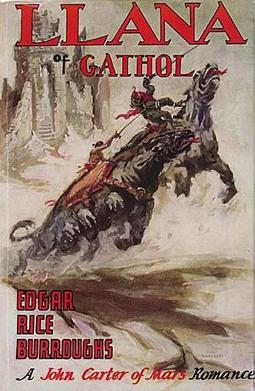
Llana of Gathol, coverOr take Edgar Rice Burroughs’ Barsoom (Mars) stories.  Martian heroes and heroines (especially the heroines) tend to have relatively graceful names:  Dejah Thoris, Gahan of Gathol (a place-reference name), Carthoris, Llana.  Male supporting characters and savage green Martians are tougher-sounding:  Tars Tarkas, Mors Kajak, Kantos Kan, Xodar.  Villains’ names are still less graceful:  Phor Tak, Tul Axtar, Luud, U-Dor.  There’s no clear linguistic background for the names, but there’s enough commonality to give us a sense that Barsoomian nomenclature does hold together on a cultural basis.

Telzey Amberdon, book coverThe far future of SF writer James Schmitz yields a completely different style of naming.  Rather than being mellifluously Elvish, like Galadriel or Aragorn, or barbarically guttural, like Tars Tarkas, Schmitz’s names strike me as quintessentially American:  with a contemporary English sound and a sort of casual feel—yet unfamiliar enough to remind us we’re not in Kansas any more.  Recurring character Telzey Amberdon is a good example.  “Telzey,” with the diminutive –ey ending, sounds like a nickname somebody today might bear, but as far as I know, no one actually does.

This laid-back style is characteristic of Schmitz’s Federation of the Hub.  The names have a familiar contemporary sound, but they aren’t actually familiar.  The first names also tend to give few gender clues—which might be related to the fact that Schmitz stories often featured strong female leads.  Nile Etland and Heslet Quillan, along with the single-named Captain Pausert and Goth of The Witches of Karres or Iliff and Pagadan of Agent of Vega, all sound like people we might run into on any street—until we bypass the familiarity of sound and realize we’ve never heard these names before.  The names give Schmitz’s stories a unique feel.

Consistency

We can see how the names help establish the mood and ambiance of a story.  It says something about The Lord of the Rings that it contains both Gandalf the Grey and Freddy Bolger.  As with other aspects of worldbuilding, the names contribute to the “willing suspension of disbelief” when they help us feel the believable solidity of a consistent background—even if it’s a consistency that includes species or cultural variation.

TV Tropes lists a number of ways anomalies can crop up.  There’s “Aerith and Bob,” where familiar conventional names are mixed in unaccountably with unusual ones.  If a particular character’s name is unlike any of the others, we have “Odd Name Out.”  Using a mix of Earthly languages as sources for names gives us “Melting-Pot Nomenclature”—which may be justified if we envision a future in which today’s nations and ethnic groups have intermixed, as in H. Beam Piper’s future history.

The most thoroughgoing way of establishing a solid background for your names is Tolkien’s:  invent your own languages.  But few of us have the time, patience and talent for that kind of detail.  In practice, we don’t need to go that far.  It’s possible to do the same thing on a small scale by starting from the grass roots:  come up with an interesting name or two and decide to emphasize certain sounds or forms for that language’s words, inventing the rules and common elements (like “de” or “von”) as we go along.

However writers may go about the business of naming, we can appreciate the distinctive flavor given to their stories by how they choose names for their “children”—and if we’re so inclined, we can try out that creative wordplay for ourselves.
Mind Powers

Mental powers are a staple of both science fiction and fantasy—and even quasi-SF genres like paranormal romance.  The idea’s like the traditional iceberg:  easy to put into a story, but with some major assumptions lurking under the surface.

The Physical and the Non-Physical

In SF, it became fashionable to use the invented term “psionics” to refer to powers of the mind.  The term seems to have originated by analogy to “electronics,” giving it a scientific (or pseudo-scientific) cast, and using the Greek letter psi, the first character of psyche, “soul” or “mind.”  Sometimes simply “psi” is used, as in “psi powers.”  It’s a useful coinage.

There are two broad approaches to psionics.  One treats mental power as acting purely on other minds—what we can loosely call nonphysical:  for example, telepathy.  The other approach allows mental powers to act directly on matter:  the most familiar example is telekinesis, moving things by mind power.

Note that distinguishing “physical” from “nonphysical” already involves some pretty big assumptions—but we’ll get to that.

Mind-to-Mind

Professor Xavier using telepathyQuite a few science fiction stories postulate mental powers that have only mental effects, such as talking mind-to-mind.

The “Lens” worn by the “Lensmen” of E.E. Smith’s classic series is essentially a psionic amplifier.  It gives the wearer telepathic abilities.  This is extremely useful in making contact with unfamiliar species—especially in interstellar law enforcement, with instant communication an essential for “lawmen” that might be pursuing criminals into unknown regions of space.  The Lens also serves as a means of identification that cannot be faked, since an individual’s custom-made Lens will kill anyone who touches it if it’s not in contact with the designated wearer.

But Lensmen can’t make things physically happen by mind power alone; they have to use the conventional space-opera gear of ray guns and such.  The Lensmen can communicate mentally; they can influence or even take over the mind of another person; they can erase or implant memories.  But a Lensman can’t lift objects and throw them around without flexing his muscles in classic action-hero fashion.

There are some odd borderline cases.  The main character, Kimball Kinnison, gains a “sense of perception,” allowing him to perceive nearby objects without using the standard five senses.  He can “see” through solid objects, for example.  That does involve interaction with inanimate matter, of course; but the interaction is all one way—he can’t affect the things he perceives.

Now, a contemporary scientist physicist would find this paradoxical, since it’s fundamental to quantum physics that you can’t perceive an object without interacting with it—bouncing photons off it to see with, for example.  But the Lensman stories were planned out in the 1940s, when we were not so acutely aware of quantum-type theories of perception.  The anomaly does illustrate the difference between these two theories of knowledge:  one in which the knower is the passive recipient of information, and the other in which knowledge is always the product of interaction.

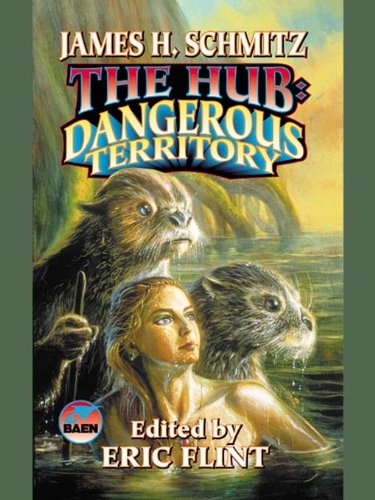
James Schmitz, The Hub - Dangerous Territory, coverJames H. Schmitz’s numerous stories set against the background of the interstellar “Federation of the Hub” use a similar theory of psionics.  Telzey Amberdon, one of the main characters, can communicate telepathically with nonhuman creatures such as her massive “pet,” the crest cat TT (who turns to be a formidably intelligent being in his own right).  Hub psis like Telzey can influence other minds and can be extremely dangerous—whether in a good cause or a bad.  But physical objects aren’t affected.

A similar sort of psionics is assumed in A.E. van Vogt’s classic mutation novel Slan, and in one of my childhood favorites, Star Rangers (The Last Planet), by Andre Norton.  For a more well-known example, the movie Independence Day showed the inimical aliens using mind control to speak through a captive human to communicate with other humans.  But to properly destroy humanity, they used conventional physical weapons.  (Well, “conventional” as science fiction goes; the alien weapons were dismayingly novel for the embattled Earthlings.)

Fantasy, too, can feature purely mental abilities.  There are references in The Lord of the Rings to the ability of elves and wizards to speak mind-to-mind.  (This was shown more explicitly, as I recall, in the movie versions of The Hobbit.)  An analogue might even be found in ghost stories.  Ghosts are often portrayed as acting only through influence on human minds, whether through terror or telepathy—as in A Christmas Carol:  the various spirits do not act except on Scrooge’s own consciousness.

Sometimes telepathy is imagined as “hearing” only what people verbalize—what’s put into words; for example, in Al Macy’s novels about mind-reading detective Eric Beckman.  In other cases, telepathy allows direct access to other people’s feelings and inchoate thoughts, somehow getting behind the speech-forming function.  The notion that one can think without words would itself be anathema to many a twentieth-century linguistic philosopher—consider the linguistic relativism or “Sapir-Whorf hypothesis” so adroitly used in the movie Arrival.  The difference raises basic questions about the relation between speech and thought, and how thinking works.

The divide between mental and physical powers gets further eroded when the story includes telepathic machines.  The Psychology Service in Schmitz’s Hub routinely uses mechanical detectors to monitor psis.  In Slan, “Porgrave broadcasters” can send “recordings” telepathically.  Even aside from the Lens itself, which is a quasi-living physical device, the Lensman series eventually gives us machine-generated mental screens, analogous to the physical force-fields of space-opera lore.  If psionics were confined to minds alone, how can machines handle it?

I’ve spoken loosely about this sort of mind-on-mind power as “nonphysical”; but that involves a very significant assumption—that the mind is not a physical thing.  If the mind were wholly reducible to the brain, there would be no reason in principle why mind powers would only affect matter in the form of other brains.  By analogy, microwaves can be used for communications, but also for cooking dinner.  On this assumption, mind powers would constitute just another kind of physical force, the analogy often being a different “wavelength” of energy.  Second Stage Lensman refers to the “frequency-range of thought” (ch.14), and Smith’s Skylark series presents thought as a “sixth-order wave”—whatever that may be.

Mind Over Matter

We’ve gotten so used to things like telekinesis nowadays that the mind-only abilities discussed above may seem oddly constrained to us.

Vader uses the Force to fling objects at Luke (Empire)The original Star Wars film, A New Hope, showed us that the Force could mediate mental communication, even with the dead (“Use the Force, Luke”), and some degree of mind-control or mental influence (“These aren’t the droids you’re looking for”).  But it was only in the sequel that we saw that it could also enable telekinesis.  I still recall the moment when Luke, ice-cemented to the ceiling in the wampaa’s cave, strains fruitlessly to reach his light-saber—then relaxes and closes his eyes; and I thought with some excitement, so, we’re going to get telekinesis too!  By the end of the episode, we’re watching Darth Vader use mental power to throw objects to distract Luke and keep him off-balance.  You can even use this matter-moving power to move yourself, or in effect to fly without wings—as we saw in one memorable scene in The Last Jedi.

Yoda lifts the X-wing (Empire Strikes Back)By now this sort of mind-over-matter is familiar territory.  But there are still aspects that aren’t obvious on the surface.  For one thing, telekinesis is apparently reactionless.  It’s unclear whether it obeys Newton’s laws of motion, under which action requires an equal and opposite reaction.  It would have been a great comic scene in Empire when Yoda impressively lifts Luke’s X-wing fighter into the air—and Luke had looked over to see Yoda rapidly sinking into the muck, with the entire weight of the X-wing bearing down on his diminutive form.

The simplest fantasy version of telekinesis is the poltergeist, an immaterial spirit which (rather bafflingly) is capable of throwing around physical objects.  Levitation, whether of oneself or of something else, is a commonplace for magicians.  In fantasy, however, mental powers tend to bleed over into magical powers, which we don’t think of in quite the same way—although one way of conceiving magic is as a kind of mind over matter.

There are other kinds of (fictional) mental interactions with matter, over and above mere movement.  A common trope is the ability to start fires, or “pyrokinesis,” as in Stephen King’s Firestarter.  This might be interpreted as a subtle form of telekinesis—since heat consists of motion at the molecular level, maybe a telekinetic could create heat by causing an object’s molecules to move faster.  Such an explanation leaves open the question of where the added energy is coming from; but that’s an issue common to any form of telekinesis.  There may be a certain nerdy satisfaction in supposing that a physically puny specimen like, er, yours truly could throw things around by sheer power of mind, even though one’s muscles aren’t up to it.  But whether things are moving by mind or by muscle, there has to be energy coming from somewhere.

The Golden Torc, second volume of Julian May's Saga of Pliocene Exile, coverThere are other things you can do with matter besides just moving it around.  Julian May’s Saga of Pliocene Exile, and related stories, postulate “metapsychic powers” that include “creativity,” allowing metapsychics to change the form of matter and thus materialize or convert physical objects.  Other stories imagine psionic abilities to “read” the history of an object or a place.

Teleportation—instantaneous movement from one place to another—represents a kind of in-between.  Physical objects are obviously affected, but the physical object in question is typically the practitioner’s own body, and perhaps other objects physically connected (such as clothing—but clothing doesn’t always come along, depending on the story, which can be inconvenient).  Does it count if your mind affects only your own body—the one locus where even theories that sharply separate mind and matter have to assume some crossover between the two?

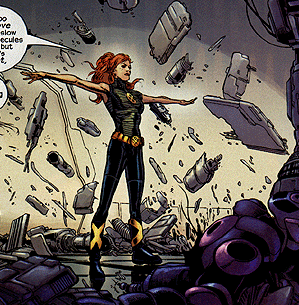
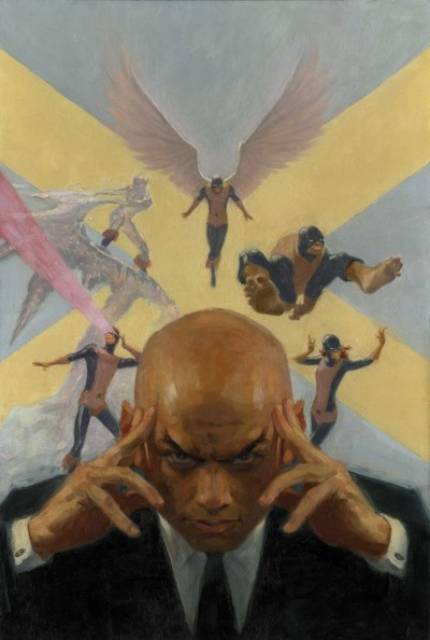
Jean Grey (Marvel Girl) using telekinesisThere’s a long tradition of mental powers in comic books too.  But given the visual nature of the medium, physically effective mental powers tend to predominate over the purely mental.  We do see some of the latter—pure telepathy in Marvel’s Professor Xavier or DC’s Saturn Girl.  But much more popular is Marvel Girl (Jean Grey), whose telekinetic powers make for much more striking imagery.

Minds and Bodies

Considering these two approaches to mind powers raises the philosophical question of whether minds affect matter only in and through a person’s body, or can do so independently.

If we exclude direct physical effects from the scope of (fictional) mental powers, this suggests parallel realms, with thought proceeding on one level while physical actions occur on another, linked only through the minds of humans or other intelligent beings.  It’s almost a Cartesian approach (that is, a theory similar to that of René Descartes) of mind-body dualism, and sinks roots into the long-standing debates over the “mind-body problem.”

The “sense of perception” concept, similarly, functions as if there were two independent metaphysical levels, mental and physical, and this mental sense could allow a person to go “around” the physical senses and inspect an object directly.  The philosophical notion of intentionality (not to be confused with the usual sense of “intentional” or deliberate) is adaptable to such non-sensory knowledge.  But the trend in both philosophy and physics over the last couple hundred years has been to focus on the physical connection between the knower and the known.

It’s become a standard assumption that we can’t know or do anything without a physical connection.  Anything else seems “unscientific.”  What’s interesting is that we seem to be willing to accept the now-unpopular postulate of non-physical knowledge and events when we’re dealing with fiction.

Of course, it’s also possible to meld the two back together by taking the position that mental powers really only reflect physical events taking place at a level we can’t yet detect—as with Smith’s “frequency range.”  But that isn’t the only way to conceive of the relationship.  There is still a certain imaginative appeal, at least, to the notion that mind can act independent of the constraints of the physical body.

I think such stories are helpful.  We’re apt to rush to conclude “science has proven” that the mind equals the brain and the brain is just a particularly subtle form of matter.  Science has not, in fact, proven any such thing.  The physical sciences assume, understandably, that only physics is involved.  But they have by no means demonstrated that all observable phenomena can be wholly explained by physics.  The arguments on this subject are still live.  We should still apply sound standards of evidence, and not leap to conclusions—but that applies in both directions, whether to materialism or to its alternatives.

In other words, there may still be more things in heaven and earth than are dreamt of in our physics, and one of the uses of speculative stories is to help us keep an open mind on these subjects.

Star Trek vs. Star Wars

Hatfields and McCoys, Marvel and DC, Star Trek and Star Wars.  One never knows how seriously to take these deadly rivalries.  Personally, I like both of the science-fiction series, so I see the Trek-Wars wars more as a difference in tastes.  Sometimes you feel like a hamburger, sometimes a pizza.

The particular difference I see in SW and ST has to do with their atmospheres or sensibilities.

Good Order

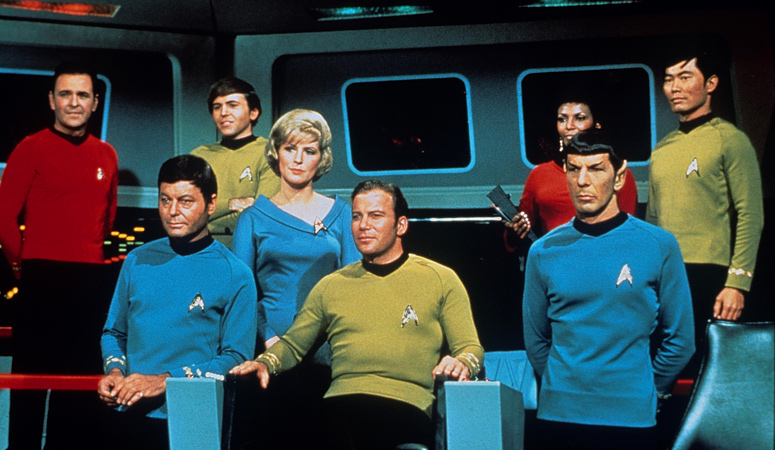
Star Trek TOS bridge crewThe Star Trek universe—I’m focusing especially on the original series (“TOS”) and movies here—is civilized.  There are plenty of things that go wrong, and going where no one has gone before frequently brings us into situations of conflict.  But the Federation itself is organized and mostly decent.  There’s an actual chain of command.  Authority figures are typically respected.

That’s the first approximation.  To be sure, Captain Kirk and his successors don’t mind defying Starfleet orders now and then.  But when Our Heroes turn out to be right, they’re back on amicable terms with their superiors in short order.  At the end of Star Trek IV:  The Voyage Home, Admiral Kirk, after stealing and destroying the Enterprise (among other things), is demoted to Captain again as his “punishment.”  But everyone understands this as simply restoring him to the role he prefers and serves so well.

There’s enough divergence among Starfleet personnel to make the stories interesting, but actual villains in the corps are relatively rare.  Starfleet and the Federation are the orderly defenders of liberty and individual (in our parochial world we say “human”) rights.  That Gene Roddenberry optimism is embedded in the show’s DNA.

Fruitful Disorder

In Star Wars, it’s the villainous Vader who wants to “bring order to the galaxy” (as he says around 1:38 in this clip), and it’s the motley, disorganized rebels who fight for freedom.  Our Heroes are rebels who defy the authorities.  Their chain of command is informal, and pretty much anyone, even the carefree Han Solo, can become a general.

Though the swashbuckling, colorful Star Wars universe may seem lighthearted, it’s actually a rather distressing place.  The nearest outpost of civilization to Luke’s uncle and aunt’s farm is Mos Eisley, a “wretched hive of scum and villainy.”  Slavery has flourished on Tatooine from a generation ago (little Anakin) to Luke’s era (Jabba’s servitors)—and apparently neither the Empire nor the old Republic did anything to stop it.  Intelligent droids are second-class citizens.  In the latter days of the Republic, trade combines were permitted to conduct outright warfare against whole planets (Phantom Menace), with no more than tardy, ineffective intervention by the Jedi Knights.  It seems a much less comfortable universe to live in than Star Trek’s Federation.  Both have their flaws, but the Star Wars ’verse seems much more unstable—if colorfully so.

Star Trek composite posterThere’s nothing wrong with this as a story setting.  A varied world full of dangers makes for more exciting stories than a placid utopia.  But the Star Wars setting calls out to a different kind of fan than that of the Trekkies.

Vader’s desire for order actually has good character-based reasons—one of the things the prequel trilogy got right.  In a world where you’ve been held as a slave, your mother has been tortured to death by barbarians, and your beloved is menaced by assassins at every turn, a desire for law and order is extremely understandable.  But it’s the lively Rebels with whom the viewer’s sympathies lie.  In this democratic milieu, quirky individuals and inspired improvisation flourish.

Both the SW and ST approaches represent ’60s sensibilities, but one is slightly later than the other.  Roddenberry’s Star Trek expresses the firm American optimism of the Kennedy era (1960-1963); it isn’t accidental that in the follow-up movies, Roddenberry kept wanting to tell a story about time-traveling to meet JFK.  Star Wars, on the other hand, evokes the counterculture of the late ’60s, which distrusted authority and prized rebellion—not to mention colorful chaos.

The Abrams Factor

It’s instructive to see how J.J. Abrams handled the two, since he has had the opportunity to reboot both Star Trek and Star Wars franchises.  My sense is that he’s handled SW much better than ST.  Abrams’ Star Trek movies show us a distinctly grittier, more chaotic world than Roddenberry’s.  It is, in fact, more like the Star Wars universe.  And I don’t think I’m alone in feeling that, entertaining as Abrams’ ST movies may be, he doesn’t quite “get” what Star Trek is about.  His Star Wars continuation, The Force Awakens, however, is to my mind an excellent (if not flawless) extension of the SW universe.

In other words, making Star Wars more like Star Wars is a good thing, right up to the point where it begins to get slightly repetitious.  Making Star Trek more like Star Wars runs the risk of losing the very things that makes Roddenberry’s creation distinctive.  Both are good things; but they’re not good in quite the same way.

Alignment

One of the interesting things about the Dungeons & Dragons (D&D) game system is the notion of alignment.  D&D is built on ideas from a whole range of fantasy stories.  Many of those stories involve a conflict between good and evil.  Some, however, make the central conflict one of law vs. chaos.  D&D’s creators took the surprising step of adopting both oppositions, but keeping them distinct.  The result is a three-by-three, nine-cell matrix.  A character’s personality and ethical stance can be lawful good or chaotic good, or straddle the two as neutral good.  The being can also be lawful or chaotic evil—the evil of 1984 or of Beowulf, let’s say—or an intermediate neutral evil.  Finally, someone can be lawful neutral (think an OCD personality), chaotic neutral (low impulse control), or “true neutral” double-neutral (an unprincipled pragmatist, perhaps).  The range of combinations allows for shorthand expression of quite an array of character types.Nine alignments example, F&SF

I wouldn’t necessarily buy into this particular classification of famous fictional characters . . . but it gives us an idea how the alignment scheme works in practice.

The alignment chart also yields a neat way to encapsulate the ST/SW difference we’re examining.  Star Trek honors the lawful good:  the interstellar police force, the scientific explorer, the careful defender.  Star Wars admires the chaotic good:  the lovable rogue, the solitary guru, the loosely organized band of allies.

Political theory

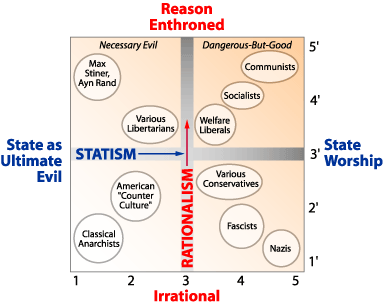
Pournelle political axes chartHere’s yet another way to put it.  Science fiction writer Jerry Pournelle, whose doctorate is in political science, laid out in 1963 a map of political “alignments” with two axes, producing a far more useful classification of positions than the usual left-right continuum.  (Pournelle’s 1986 essay provides a detailed explanation.)  The two dimensions in Pournelle’s scheme are “attitude toward the state” (from state as evil to state worship), and “attitude toward planned social progress” (from rationalism to irrationalism).

If we think of these axes as applying to the character of a culture, not necessarily to politics per se, we can express the ST/SW divide in Pournellean terms.  I’d put TOS-era Star Trek somewhere around 3/4’ or 3.5/4’ on the chart, believing pretty strongly in reason and ambivalent about state power.  Star Wars, by contrast, seems to live in the 2/2’ region, not far from the “American ‘Counter Culture’” to which I compared its ambiance above.  Each milieu will tend to attract viewers who are sympathetic to the points of view expressed in its neighborhood on the grid.

Civilization

What it comes down to, I think, is whether we see the best conditions for free and fruitful lives primarily in order or in disorder.  Both are arguably necessary.  But is what’s best for people a basically orderly society with a healthy modicum of chaos; or a wild-and-crazy culture with just enough organization to hang together?

The Star Trek/Star Wars contrast thus leads us up to the question of what makes for a good society, a true civilization.  There’s a good deal more to be said about this, and I’ll take another crack at it next time.

The Large Spaceship Competition

Enormity

We space opera fans like big things:  sweeping plots and intrigues, larger-than-life characters, huge explosions.  And big spaceships.  The bigger, the better.

You remember the opening of the original Star Wars.  At the top of the frame, the Imperial Star Destroyer looms into view.  And keeps coming, for what seems like forever.  With this visual cue, Lucas communicates immediately the sheer scale of his story.

In a long story, this can lead to a Lensman Arms Race in terms of spaceship size—each new construct eclipsing the last.  One might wonder:  How far can we go with this?  Who holds the record for Largest Spaceship of All?

Traditional spacecraft

Saturn V-Apollo on transporterOrdinary, garden-variety depictions of spaceships are long since out of the running—not just real vehicles like the Saturn V-Apollo, but fictional ones that are meant to be big.  Kate Wilhelm’s title “The Mile-Long Spaceship” (1957) doesn’t sound even slightly impressive any more.  According to Wikipedia, those Star Destroyers range up to 2,915 meters, almost two miles.  The famous size comparison chart by Dirk Loechel displays these, along with the Independence Day mothership, the Dune Spacing Guild Heighliner, the Borg cube, and many more—but Loechel set his cutoff for the image, arbitrarily, at 24,000 meters:  “I had to draw the line somewhere.”

That’s just getting started.

“That’s no moon”

The alien probe in Clarke’s Rendezvous with Rama, which I’ve mentioned a couple of times before, is 50 kilometers long and 16 wide (31 by 10 miles).  That’s bigger than a lot of Earthly cities.

Death StarStar Wars’ Death Star, famously misidentified as a moon, has been estimated at between 100 and 160 kilometers in diameter (62 to 100 miles), at least three times larger.  The second Death Star, from Return of the Jedi, spanned somewhere between 200 and 400 kilometers (up to 250 miles), according to the same Wikipedia article.

Skylark of Valeron coverFor a long time I idolized E.E. Smith’s Skylark of Valeron as the epitome of spaceship scale.  The ship (not the novel of the same name), “almost of planetary dimensions,” is a sphere one thousand kilometers in diameter—about 621 miles (ch. 20).  That’s over twice the size of the large economy-size Death Star.  (A blogger going under the title Omnivorenz has done a detailed analysis of the various Skylark series spaceships.)

However, we’re still in the moon category, not yet up to planet-sized.  (Of course, if astronomers keep changing the rules on what counts as a planet, the two size ranges can overlap.)

Planets in motion

At this stage, we need to think about what counts as a “spaceship.”  Surely one requirement is that it be able to move in a directed fashion—otherwise the International Space Station would count.  But does it have to be a construct, a made thing?  Or can you take an existing mass and equip it with motive power?

Quite a few science fiction writers have depicted mobile planets (not simply in the sense of moving in an orbit, but of guided, directed motion).  In Blish’s Cities in Flight series, the characters twice use spindizzy drives to send whole worlds careening through the heavens.  E.E. Smith’s Lensmen, after a point, deploy “dirigible” planets almost routinely—not to mention antimatter objects (“negaspheres”) of comparable mass.  In The Wanderer, Fritz Leiber has not one, but two, traveling planets approach the Earth.  (The original source of the word “planet” is a Greek word meaning “wanderer.”)

There’s a series of stories by Robert Reed about something called “the Greatship,” but I haven’t managed to read them yet.  The blurbs describe the Greatship as “larger than worlds” and “apparently built from a re-engineered gas giant” – which would put us into a distinctly different size class from even an Earth-type planet.

And beyond

Here’s a question:  Does a “spaceship” have to be a single contiguous object?  Or can it be an array of objects that travel together, but are not physically connected?

In Larry Niven’s Known Space universe, the species known as Puppeteers flees a coming galactic disaster, not by leaving their homeworld, but by taking their planet with them—along with four others, arranged in a “Klemperer rosette” around their common center of gravity.  That’s traveling in style!  This “Fleet of Worlds” moves slower than light, but not much—and it’s five times larger, altogether, than a Blish or Smith flying planet.

The Cometeers coverBut Niven was writing hard science fiction, with some attempt at scientific plausibility.  The great space operas of earlier eras weren’t constrained by such trivial considerations.  For a long time, my list of giant spacecraft was topped by the so-called “comet” piloted by the adversaries in Jack Williamson’s 1936 classic The Cometeers.  It’s not a comet at all, but a green force-field shell enclosing an entire system of worlds:  the heroes count 143 planets, plus an artificial sun (ch. 13).  The eponymous alien Cometeers sail this congeries of worlds about the universe like space pirates on a grand scale.  It’s the biggest guided space-traveling object I’m run across that’s described with any precision.

The real prize, however, belongs to Arthur C. Clarke.  In the unthinkably far future of The City and the Stars (1956), a reconstruction of history shows the leading intelligences of a galactic civilization leaving the Milky Way on a voyage of exploration in what is apparently an entire star cluster, set into motion by energies on a galactic scale:

They had assembled a fleet before which imagination quailed.  Its flagships were suns, its smallest vessels, planets.  An entire globular cluster, with all its solar systems and all their teeming worlds, was about to be launched across infinity.

The long line of fire smashed through the heart of the Universe [i.e., the Galaxy], leaping from star to star.  In a moment of time a thousand suns had died, feeding their energies to the monstrous shape that had torn along the axis of the Galaxy, and was now receding into the abyss. . . .  (ch. 24)

That’s about as far as my imagination will go, to be sure.

The pursuit of wonder

TV Tropes collects a number of these references, and more, under the heading Planet Spaceship.

As we contemplate these logarithmic jumps in scale, we may note that after a point, the whole exercise can become meaningless.  If your “ship” includes whole planets and solar systems, why go anywhere?  It’s rather mysterious why Williamson’s Cometeers would need to roam the universe preying on other star systems (other than to provide a challenge for our dauntless heroes).  What are they getting that they haven’t already got ‘on board’?

The one likely answer may be, to see what’s out there (assuming you need this large a vessel to take you).  This is the primary reason Clarke’s far-future intelligences set out on their journey:

All we know is that the Empire made contact with—something—very strange and very great, far away around the curve of the Cosmos, at the other extremity of space itself.  What it was we can only guess, but its call must have been of immense urgency, and immense promise.  (ch. 24)

In a way, the exploration motive—“new life and new civilizations”—brings us back to where we started this exercise in scope.  Simply contemplating larger and larger objects brings us some degree of awe—a touch of that “sense of wonder” for which science fiction and fantasy are famous.  But a much greater wonder springs from the idea of meeting wholly new experiences—“very strange and very great.”

The grandest justification for leaving our world may be sheer discovery—even if we end up, like the Puppeteers, taking our world with us when we go.

Strangeness

One of the specialties of science fiction—and to some extent fantasy—is to evoke a sense of strangeness.  In dealing with the alien, the cosmic, that which is far away in space or time, SF can make us feel we are encountering something that passes the limits of our knowledge or understanding.

This isn’t as easy as it looks.

The Used and the Unusual

Since at least the original Star Wars (1977), it’s been good practice to portray a “Used Future.”  Star Wars gave us a world full of beaten-up, grimy equipment that looked as if it had been duct-taped together.  This is generally a good technique.  It adds realism.  We feel at home in a world where everything is not perfectly cleaned and aligned; it’s like where we actually live.  There’s a sense of familiarity.

One opposite to the “used future,” of course, is the kind of earlier SF movie that was full of shiny, spotless spaceships and immaculate gizmos.  But the sense of familiarity also has its own opposite:  the thrill of unfamiliarity.

One way the challenge arises is with extraterrestrials.  Suppose a story has us meeting intelligent aliens.  If they seem just like us—“rubber-forehead aliens”—they won’t be convincing.  We expect something from another world to be different.  The writer or director has to show creatures, technologies, behaviors that are unlike anything we’ve seen on Earth.

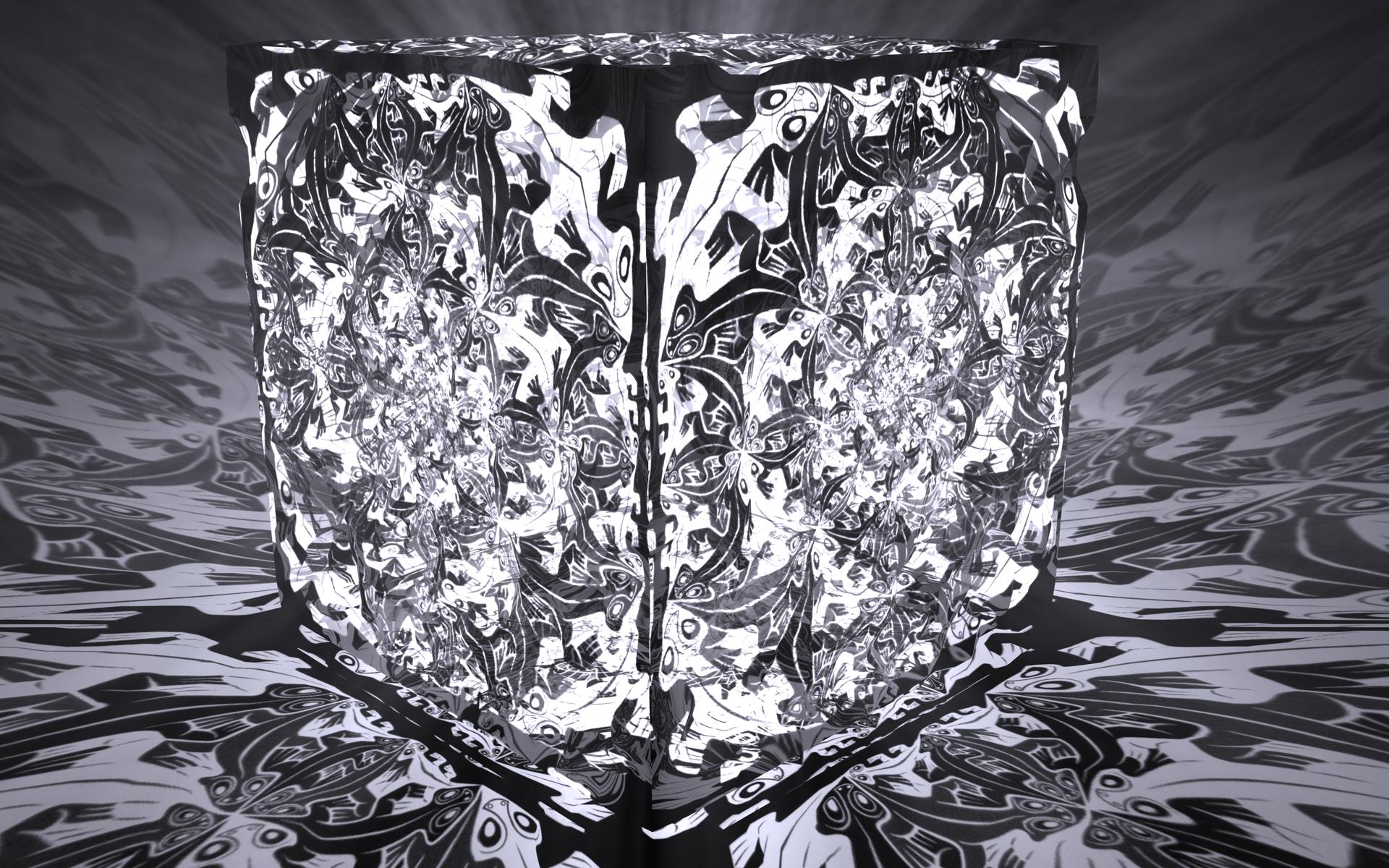
Escher: Wallpaper CaveYet these things must also be believable.  Something that simply looks random or arbitrary, like an abstract swirl of colors, won’t convince us we’re seeing a real thing at all.  How do we thread the needle between the too-familiar and the unintelligible?

Just Alien Enough

Natural laws do enforce certain constraints on physical objects.  But other characteristics are a matter of custom, design choices, or aesthetics.  To show something convincingly alien, we need to know the difference.

Alien ship from movie ArrivalSometimes a single feature can be odd enough to alert us that we’re “not in Kansas any more.”  The alien ship that appears in the movie Arrival looks strange at once, because it’s smaller at the bottom than at the top.  It looks as if it’s upside-down or sideways. Not the way we’d build, yes.  But is it physically impossible?  Nope.  The ship isn’t on the ground, balanced implausibly on a narrow end.  It’s floating in the air.  This not only frees the ship from the usual need for wheels or other supports; it also introduces a second, subtler strangeness.  When we humans land somewhere, we expect to land, to set ourselves down securely on a surface.  These folks seem quite comfortable floating just above the ground.

A classic example is Arthur C. Clarke’s Rendezvous with Rama.  A massive spacecraft—a spinning O’Neill cylinder—enters the solar system, apparently inert.  A human crew matches course to explore it before its hyperbolic orbit takes it out into interstellar space again.  The ship begins to “come alive” around them—but there’s no sign of intelligent life aboard.  The explorers find one strange and amazing feature after another.  The purpose of some becomes clear:  the long, shallow rectangular valleys turn out to be immense lights that illuminate the interior.  But they never find out the reasons for many other objects.  In the end they have to cut loose from the vessel, letting it go on its mysterious way.

Rendezvous with Rama interior illustrationClarke’s mastery of clear detail—how the airlock doors open, for instance—gives us the necessary sense of realism.  But leaving many things mysterious evokes the sense of mystery and wonder that is among the most distinctive experiences in science fiction.  The unfamiliar is clearly and concretely depicted, but the purpose remains obscure.

(Parenthetically, I advise paying no attention at all to the dreadful sequels Gentry Lee wrote to Rama under Clarke’s direction.  They make the classic mistake of erasing the mystery without replacing it with anything at all interesting.  As with certain other sequels, the only thing for a conscientious reader to do is declare them non-canonical and pretend they never happened.)

For another Clarke treatment, remember 2001:  A Space Odyssey.  The mundane and even humdrum character of the long space voyage makes the psychedelic sequence at the end feel even weirder than it is in itself.

Sufficiently Advanced Technology

Extraterrestrials need not be involved.  Distance in time or space, and the concurrent advances in technology, can also provide a good foundation for the sense of strangeness.  (It was, after all, Clarke’s Third Law that “any sufficiently advanced technology is indistinguishable from magic.”)

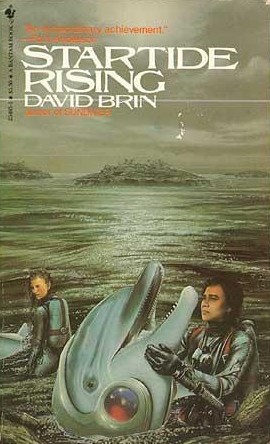
Among the numerous virtues of David Brin’s Hugo-winning novel Startide Rising is that sense of entering a new and unaccountable world.  His Earthly spaceship crew of “uplifted” dolphins, with their small group of human companions, use advanced techniques that are still recognizable to us.  But they’re dealing with galactic cultures that draw on hundreds of millions of years of accumulated science.  The results can be mind-boggling.  One species, for example, travels by using a captive creature that creates portals “by the adamant power of its ego—by its refusal to concede anything at all to Reality.”  This isn’t your grandmother’s hyperdrive.

Toy stack of ringsThe body of another species, the Jophur, consists of a stack of distinct rings, like a child’s toy.  The Brothers of the Ebony Shadows employ a probability weapon that sends out “waves of uncertainty.”  The fact that these species are nonhuman is incidental to the fact that their immense background of far-advanced science lets them use techniques that seem to surpass our understanding.

For a purely human example, let’s look at Arthur C. Clarke’s The City and the Stars.  (Clarke really had the knack for this sort of thing.)  The main character, who bears the pedestrian name of Alvin, lives in Diaspar, the last city on Earth, billions of years in our future.  The city’s structure does not erode or decay; it’s maintained by “eternity circuits” according to the model held in its master computers.  The people do not die in a conventional sense.  After living for a thousand years, each individual walks back into the Hall of Creation and is dissolved—but is also retained in the memory circuits, to be rematerialized eons later.  Thus the population of the city is always changing, but the individuals continue.  And that’s only the beginning . . .

The City and the Stars, illustration

Exotic Ways of Life

Technology is one thing; behavior is another.  The City and the Stars does a terrific job of imagining how the society of Diaspar is shaped by the extraordinary conditions under which its people live.

When I read Yoon Ha Lee’s Ninefox Gambit, it was billed as ‘military science fiction’—but it’s nothing like the general run of military SF.  The six factions in the story make use of technologies that create real-world effects based on “formations” of people and their consensus beliefs.  Much of the plot revolves around a revolt based on “calendrical heresy”—which is just what it sounds like:  deviation from the standard calendars.  In Lee’s world, calendrical uniformity isn’t just a matter of convenience, but of crucial importance.  The resulting society is correspondingly peculiar.  Reading the story makes you feel as if you’re constantly being knocked sideways.

Greg Bear’s City at the End of Time combines present-day characters with those living in a city one hundred trillion years in the future.  The far-future people consist of “noötic” or virtual mass, are defended by “reality generators,” and are trying to fight a cosmic entity that’s trying to destroy the universe by disintegrating its history, acting backward through time.  The present-day people in mundane Seattle keep us grounded, but trying to understand the end-of-time characters and what they are doing requires a constant stretching of the imagination.

Strangeness and Wonder

The sense of strangeness or mystery is one form of the “sense of wonder” often used to characterize science fiction.  It takes us out of the mundane, makes us strain to conceive the inconceivable.  We’re often told that world travel expands our horizons by exposing us to different places and cultures.  Science fiction goes further:  it exposes us to ideas and places and people that don’t exist in the world at all.  At its limits, SF seeks to show us more than we can even comprehend.  The lack of reality is compensated by the greater impetus to go beyond our mental limitations.

To achieve that experience, we seem to need the right combination of the familiar and the exotic.  The weird stuff at the end of 2001 isn’t entirely successful, in my view:  it’s too strange.  Not only do we not understand what’s happening; we don’t quite feel there is anything to understand.  You have to read the book to figure out what’s going on.

But when we have enough groundedness to effect the “willing suspension of disbelief,” yet enough mystery to defeat (in part) our attempt to understand, the combination is uniquely fascinating.  As I noted at the beginning, this isn’t an easy balance to strike.  But the payoff makes it worth attempting.