How Large Is Your World?

Perceived distance

A story may tell you it covers vast distances—but the reader’s or viewer’s experience doesn’t always bear that out.

Star Wars, for example, opens with the announcement that we’re in “a galaxy far, far away,” leading us to expect events on an immense galactic scale.  And of course the story does involve travel among numerous star systems.

Yet to me, at least, the Star Wars galaxy feels so small as to be almost cozy.  It never seems to take more than a day or two to get from one planet to another.  (Often the trips are made in X-wing fighters or other ships that don’t even seem to be large enough for a bathroom.)  In The Force Awakens, we even have weapons on one planet targeting other planets, as if they were right next door.  We may be instructed that the beam is traversing vast distances via hyperspace—but there’s no visceral sense of great expanses.

This situation isn’t limited to visual media.  I recently read Yoon Ha Lee’s Ninefox Gambit, which has been billed as a space opera—a category that suggests vast scope.  Yet almost all the story’s action takes place within a couple of spacecraft or space stations, lending an almost claustrophobic feel to the tale.  On the other hand, the movie 2001:  A Space Odyssey devotes a good deal of time to communicating a sense of the vastness of space.

In contrast to these surprisingly pocket-size space adventures, consider a fantasy like The Lord of the Rings.  To my mind, Tolkien’s epic does suggest great distances and broad landscapes.  But the actual distances involved are infinitesimal on a Star Wars scale.  Middle-Earth is about the same size as western Europe.  The Millennium Falcon could traverse the whole expanse from the Shire to Mordor in seconds (even without hyperdrive).  But Tolkien’s world feels bigger.  By the time we get to the end of it, we feel as if we’ve been on a journey.

Map of Middle-Earth

The same is true of most high fantasies, which at most work on a continental scale, given their technologies.  Paradoxically, the low-tech locales seem to be better at giving us a sense of epic scope.  Why?

Getting there is half the challenge

The most important factor, I think, is travel time.  We experience distances not in terms of their metric size, but in terms of how long it takes for us to cross them.  This is the sense in which technology has “made the world smaller.”

Tolkien’s world seems large because we cross it, with the characters, on foot.  All that walking!  (It’s not for nothing that the Fellowship is sometimes referred to as the “Nine Walkers.”)  This means that it takes weeks to get anywhere.  Frodo and Sam leave the Shire on September 23 and arrive at Mount Doom on March 24, a six-month journey—albeit with some stops along the way.

Strictly speaking, this factor may be time-relative-to-lifespan, rather than days or years directly.  A six-month trip would be brief for the star-traveling characters in Blish’s Cities in Flight stories; they live for centuries.  It bulks much larger in our own lives.

A related factor is difficulty.  A journey may take a long time, not just because our transportation is slow, but also because we have to grapple with trouble on the way.  Even an uneventful sea voyage from, say, England to America in the 1700s might take seven weeks on average.  But the dangers of storms, limited food and water, and being becalmed made the trip more daunting.  One didn’t do it casually.
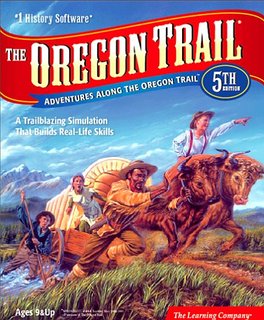
Oregon Trail game, coverSimilarly, the wagon trains of the American West took the settlers through unknown countries full of dangers and delays.  (Recall that Star Trek was originally sold to studios as a “wagon train to the stars.”)  Even aside from the sheer travel time, these perils made the journey a more formidable challenge.  Anyone remember playing “The Oregon Trail”?  It wasn’t easy to survive the strenuous 2,170-mile trip.

The spice of travel

The wagon-train trek illustrates a third factor.  Variety in the places we pass through also makes a trip more consequential.  An Atlantic crossing might be relatively boring, aside from the weather, if you’re not on the Titanic.  But the different kinds of places we experience on the way—terrains, climates, habitations, cultures—also helps give us a sense of distance, of having come a long way.

To some extent this depends on the unfamiliarity of far places.  If another locale has the same chain stores, the same advertisements, the same customs and fashions, we’ll hardly feel as if we’ve gone anywhere.  Passing through a series of identical places will not give us the sense of transition that we gain from different environments.  But as Tolkien’s heroes traverse the Old Forest, the Barrow-downs, Bree, the Wilderlands, Rivendell, Moria, the Anduin . . .  we feel they’ve really traveled.

This unfamiliarity is itself a function of travel time and difficulty.  If it’s hard to get somewhere, not many people in my area will have been there, or know much about it.  Technology also plays a subtler role here.  If we don’t have the technology for recordings—photos, audio, video—then we are dependent on travelers’ tales, less vivid and less exact.  On the other hand, if we’ve immersed ourselves in the imagery and culture of, say, Japan before we visit, the culture shock will be less.  This is another way advanced technology makes the world smaller.
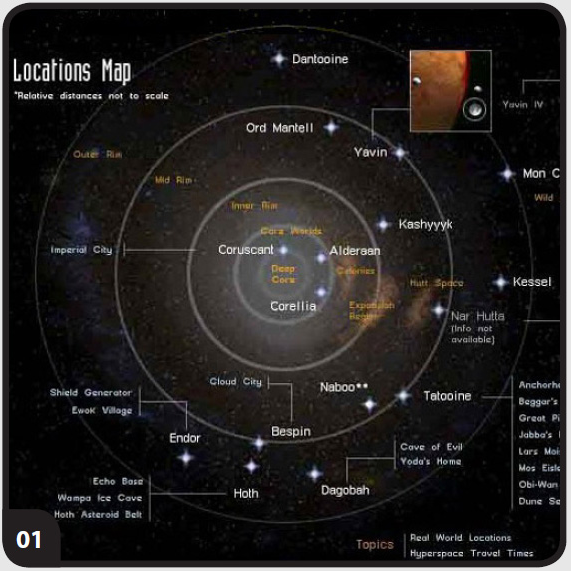
Star Wars universe mapIn a similar way, the different environments we meet on Star Wars planets do provide some sense of genuine travel—though the fact that each planet seems to have a single climate and terrain makes this variety less effective than it might be.

Taken together, the difficulty and variety factors suggest that the number of incidents on an expedition contribute a lot to our sense of size.  A very long trip may seem trivial if nothing happens.  But a quite brief excursion can seem extensive if it’s packed with important occurrences.

Generation ships, inside and out

The generation ship, of which we’ve spoken before, provides an interesting example of both types of journey.  Externally, such a vessel covers vast distances—and taking generations to make a voyage is certainly one way to make the reader feel the distance involved.  But the voyage typically proceeds with very little external change:  the ship bores on through space, for years on end.  If events within the ship are not described, the reader or viewer may not gain much sense of distance.  If the people on board are in suspended animation, there won’t be much sense of time or distance at all.  In the 2016 movie Passengers, for example, it’s only once something goes wrong that the story begins.  (Once it does, the passage of time for the characters who are awake is a major plot element.)
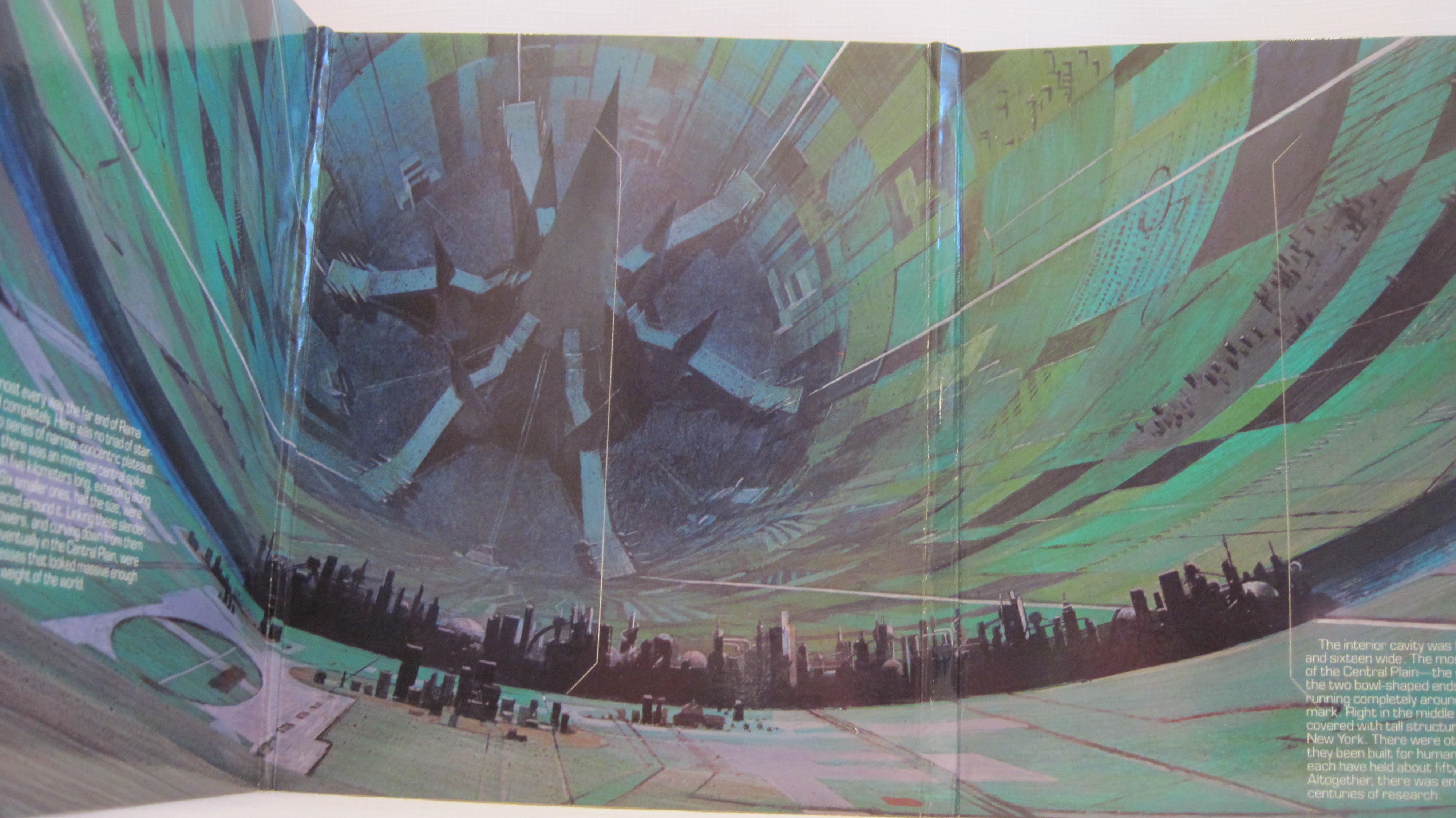
Rendezvous with Rama interior illustration

Interior of starship from Arthur C. Clarke’s Rendezvous with Rama (staticflickr.com)

On the other hand, internally, the world-ship itself may seem a vast environment to the inhabitants.  This is especially true if events have deprived the inhabitants of any high-tech means of travel from place to place within the ship.  A long journey or quest inside the traveling world may thus be a major plot element, as we saw in The Star Seekers or Non-Stop.  Here, again, it’s essential that the characters encounter different cultures or locales within the ship if the reader is to have a sense of scale.

Epic scope

To create a story with epic scope, as in space opera or high fantasy, it’s useful to keep this size issue in mind.  If you want to write an epic, make sure you give it room to breathe.  If that sense of scale is lacking, our grand, sweeping conflict may come across looking like a mere tempest in a teapot.
Science and Swordplay

Bringing a Sword to a Blaster Fight

Since advanced weapons are available in much science fiction—the famous “ray gun” is iconic—it’s surprising how often a fight comes down to the humble, and archaic, sword.

You’d think this would be a classic case of “brings a knife to a gunfight.”  Why doesn’t the blade-wielding attacker get wiped out immediately by an opponent with, say, advanced automatic weapons?  How does a science fiction setting justify the continued usefulness of swords—and why?

Let’s look at some examples.

Swordsmen of Mars

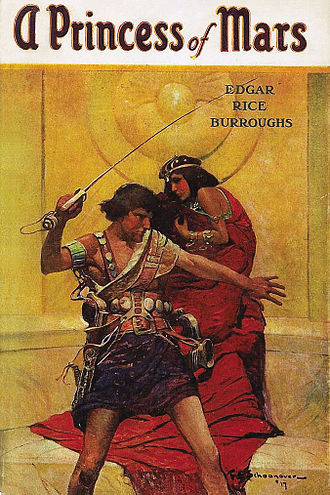
A Princess of Mars coverEdgar Rice Burroughs’ Barsoom stories are full of noble heroes engaging in swashbuckling swordfights with the foul villains.  (Those who haven’t read the books may have seen the flawed, but underrated, movie adaptation “John Carter [of Mars]” a few years ago.)  This is despite the fact that most of these warriors are also equipped with guns firing explosive radium bullets.  Why don’t they use their guns?

As the Wikipedia article points out, on Barsoom (Mars) “it is considered unchivalrous to defend with any weapon but the one used in an attack (or a lesser one).”  This allows the good guys to stick to their swords, and also let the bad guys show their unchivalrous villainy by trying to use more advanced weapons.  Since Burroughs’ characters do tend to behave in ways that reflect what we think of as an archaic code of honor, there’s some plausibility to this explanation.  (The first book was published in 1912; there’s been a lot of cultural water under the bridge since then.)

Glory Road

Glory Road coverIn Robert A. Heinlein’s tongue-in-cheek Glory Road (1963), a recently-discharged veteran, whose expertise happens to include fencing, is recruited by “the most beautiful woman in any world” for a mission in one of the “Twenty Universes.”  In that particular universe, the laws of nature are different:  firearms and explosives don’t work.  But blades do.  This gives us a traditional sword-swinging hero (whom Heinlein can then merrily deconstruct throughout the story).

Heinlein also makes the point that a blade can be useful, no matter how advanced your technology, in close-quarters combat; which is (I assume) why today’s soldiers still occasionally use bayonets.

A similar gunpowder-won’t-work-in-this-universe situation is set up by Roger Zelazny in his Chronicles of Amber, where Zelazny’s immortal hero, Corwin, is among other things a master swordsman.  However, in The Guns of Avalon, Corwin solves the problem by finding a universe where there’s a gunpowder analogue that does work where regular firearms do not.  Both Glory Road and Amber make it hard to decide whether we’re reading science fiction or fantasy—which is par for the course where SF swordplay is involved.

Dune

Dune coverThe climax of Frank Herbert’s classic Dune (1965)—after atomic explosions, an attack by immense sandworms, and a clash of unbeatable armies—comes down to, you guessed it, a one-on-one fight with blades.  Herbert gives us a combination of reasons to work with.  His characters learn fencing because their personal force shields stop fast-moving projectiles, such as bullets, but are less effective against relatively slower attacks, such as a sword thrust.  This is a clever science-fictional reason to preserve the swordfighting trope.  Cultural factors also enter in.  The final duel specifically occurs because, as in Burroughs, there are formal rules of vendetta or kanly that allow for such single combat.

You can see the Dune swordfights in video adaptations:  the 1984 movie by David Lynch, or a 2000 mini-series on the Sci-Fi (now Syfy) Channel.

Star Wars

Luke and Vader, lightsabers crossedOf course the case with which most of us are familiar is the famous Jedi Knight “lightsaber” in the Star Wars stories.  Knights, of course, have to carry swords, and Lucas has made the lightsaber an iconic emblem of his universe.  What makes a sword-like weapon useful here is that the Jedi Knights can actually use them to deflect, or even redirect, gunfire (“blaster” bolts).  Personally, I’ve always felt that the only way this could possibly work is that precognition allows the Jedi a moment’s unconscious awareness of where and when the next bolt will come.  No one’s reflexes or muscles could possibly be fast enough to intercept something that fast without foreknowledge.

The Attractions of Swordplay

We’ve seen several ways to justify the use of swords in a high-tech science fiction environment.  It’s a separate question why authors and readers enjoy such scenes.

I think one reason is that sword-to-sword combat allows for a personal engagement more effectively than a gun duel.  Much has been said about the depersonalization inherent in the use of long-distance weapons.  In a genuine battle, we may pragmatically seek the most effective means to prevail, whether personal or impersonal.  But in a story, individual characters, and the drama of their interactions, are at the fore.  A person-to-person duel between hero and villain is more viscerally satisfying than wiping out the opponent at a distance.

The sword also has a long history of symbolic and evocative significance.  We noted above, for example, that the use of sword can call up in a reader’s or viewer’s mind a whole chivalric or feudal milieu.  This is merely one of the deliberately archaic tropes Lucas brought back in the original “Star Wars.”

Using a sword also requires more physical skill, strength, and endurance than using a gun. It’s been pointed out that one of the ways the development of firearms changed the nature of war was by enabling lightly-trained recruits to fight competently, without the lifetime’s training needed to make a good swordsman.  If a story wants to show off the physical excellence and expertise of the combatants, a swordfight will do this better than a gunfight.

Of course, pure bare-handed martial-arts combat, or fighting with other melee weapons like staves or maces, can accomplish the same things—which is why we frequently see these, too, making their appearance incongruously in SF contexts.

Flag in Exile swordfight sceneFinally, a swordfight may be more prolonged than a gunfight, because blades can do more gradual damage than bullets and thus allow for longer duels, intensifying the drama.  This isn’t always the case.  In the page on Single-Stroke Battle, TV Tropes observes that “[r]eal sword fights often take only a few seconds or even a fraction of a second, with one solid hit generally being enough to take a man out of the fight (contrast this with Flynning).”  One thinks of the powerful scene toward the end of David Weber’s Flag in Exile where Honor Harrington does in fact cut short a lengthy duel with one blow.  But this is precisely where an author can set up the desired situation to best advantage.

No matter how much futuristic SF may pervade our storytelling, then, we’re not likely to see the humble sword retired any time soon.

The Last Jedi . . . Maybe

Boldly Going Where the Story Hasn’t Gone Yet

Debating what may happen in future Star Wars movies has been a favorite spectator sport since 1980, when we all saw The Empire Strikes Back and spent the next three years madly surmising  what would happen in the third episode.  Was Vader really Luke’s father?  (It’s hard to believe in this era, when “I am your father” is a classic meme, but in 1980 it was a viable theory that he was lying.)  Who was the “other” of Yoda’s enigmatic remark, “There is another”?

That last question illustrates the danger of too much speculation.  By the time Return of the Jedi came out, we’d debated every possibility, from a complete unknown to Han Solo—including the winning choice, Princess Leia (requiescat in pace).  The revelation in Episode VI couldn’t help but be an anticlimax.  So I’ve been trying not to spend too much time spinning my wheels over the unanswered questions in The Force Awakens.  We’ll find out soon enough.

The title of Episode VIII, though, does bring up an interesting point.

Last Now, or Last Forever?

Star Wars - The Last Jedi title screenDisney announced the title The Last Jedi for Episode VIII on January 23, 2017.  The fan community immediately went to work to ferret out the implications. It was pointed out, for example, that “Jedi” can be either singular or plural.  There might be one last Jedi, or two last Jedi, or an entire academy-full of last Jedi.  Still, some sort of finality seems to be indicated.

Comments around the Web as of February 12, 2017, suggest there are at least two major possibilities:

Luke and Rey(1)  The film is about the last Jedi who happens to be left alive at the moment.  That’s obviously Luke Skywalker, and Rey could reasonably say, on meeting him, that she’s found the last Jedi.  It doesn’t necessarily mean there won’t be any more to follow.  The Last Jedi might show Luke taking on Rey as an apprentice and making her a new Jedi.  If so, the story could well be captioned, from Rey’s point of view, How I Met the Last Jedi and Became the First Recruit in a New Jedi Order.  This would simply put us back in the realm of “That boy is our only hope / No, there is another.”

(2)  The more interesting, more drastic possibility is that Luke is the last Jedi there will ever be; that Episodes VIII-IX will involve some sort of epoch-making shakeup that will end the Jedi order permanently.  That might seem an anticlimax, after taking all that trouble to restore the order in Return of the Jedi.  But if it did, what would the future look like?

This possibility raises a question that has long intrigued me:  Is the Jedi order as we see it in the prequel series really a good thing?

How Not to Train Your Jedi

We had to wait for the prequels (Episodes I-III) to see how the Jedi order actually worked in its heyday.  What emerged was rather surprising.  The training program is of particular interest, because how you form the next generation of Jedi shapes what kinds of people they become and how they carry out their somewhat hazy galactic peace-keeping responsibilities.

(I should note that I’m referring only to the movies here and not the vast expanded universe of novels and spinoffs, much of which is no longer canon anyway.)

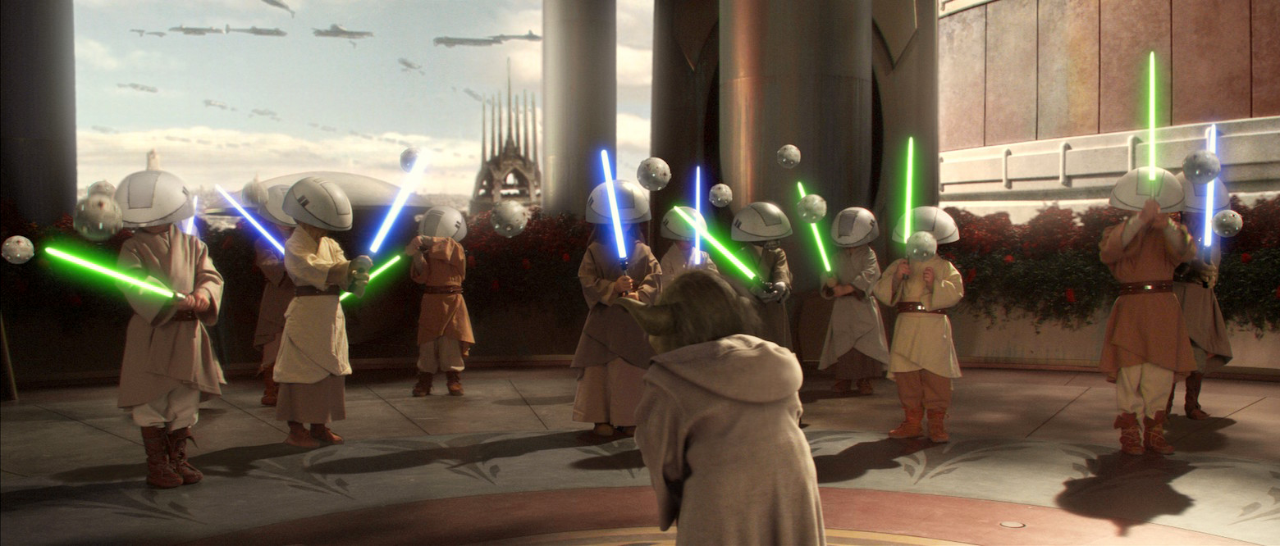
Jedi younglings at practiceWhen we meet young Anakin Skywalker at nine years of age in Episode I, he is already considered too old for the normal Jedi training program.  This is borne out by the scenes we see of five- or six-year-old “younglings” practicing their Jedi arts.  Evidently in the Republic, Force-gifted children were taken away from their families as young as five or six and brought to Coruscant for full-time training.  (No wonder Yoda also complained about Luke’s age in Episode V.)

If Anakin’s own experience is any guide, the younglings don’t return to their families, even, say, for summer vacations.  They are expected to grow up without normal family interactions, living a sort of monastic existence.  This approach might produce an intense concentration on one’s studies, and a sense of fierce fellowship among the Jedi members.  But it’s not clear that the resulting Jedi Knights would be especially well-adjusted for dealings with other, normal citizens.

We saw how badly this worked out for Anakin himself.  When Qui-Gon Jinn and Obi-Wan Kenobi redeem Anakin from slavery in Episode I, they can’t afford to buy out his mother Shmi as well.  But, appallingly, they never go back with more funds to do so; apparently they’re content to leave her enslaved while they concentrate on her Force-enabled son.  (This omission itself says something about the mind-set of the Republic and the Jedi in particular.)  When Anakin returns in Episode II just in time for his mother to die in his arms, this experience plays a key role in his eventual turn to the Dark Side, with the avowed aim of bringing “order to the galaxy” to prevent such tragedies.

No Valentines for Jedi

The exclusion of Jedi Knights from normal family and community life extends forward in their lives as well.  We find out in Episode II that Jedi are not permitted to marry.  (No one seems to have considered that this restriction is a fine way to breed Force-sensitivity right out of the participating species.)

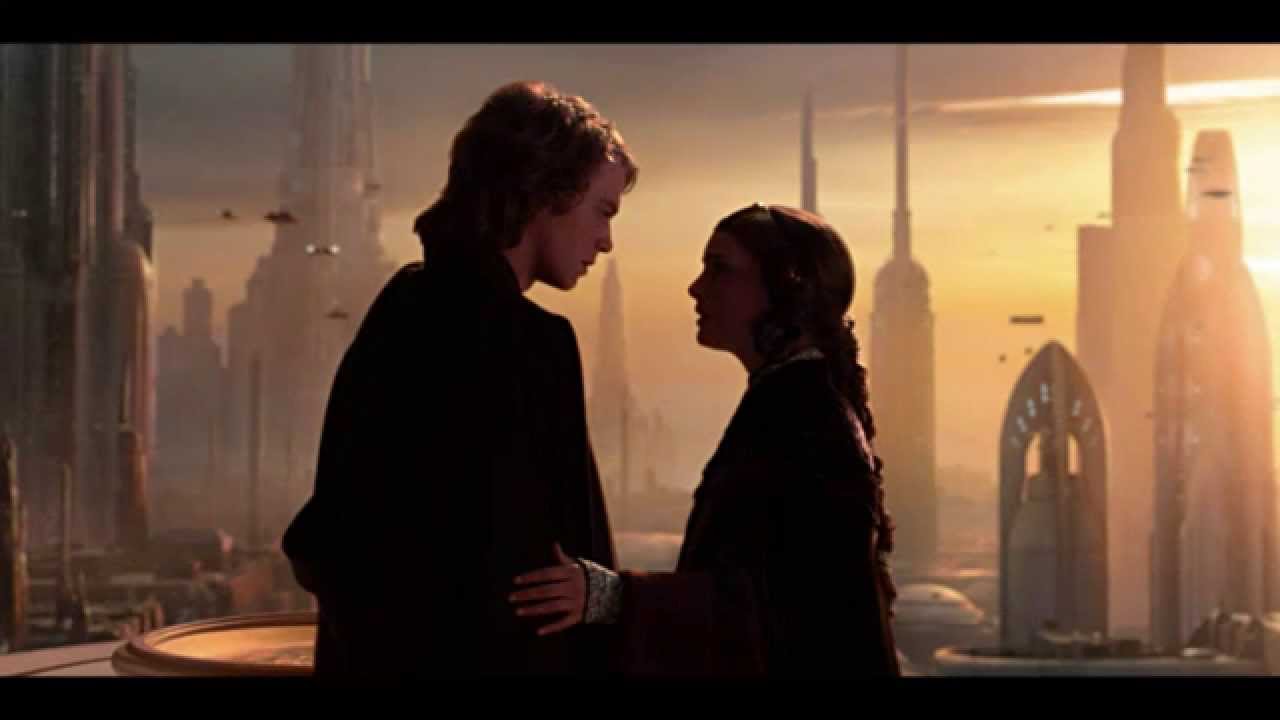
Anakin and Padme silhouetted against cityWhile this barrier may have been set up simply to create a story conflict, it also intensifies the separation of the Jedi from ordinary social interactions.  The trope of a celibate monastic order certainly has some narrative power.  But it may not be an ideal way to establish the primary enforcement and conflict-resolution arm of a galactic society.  In a curious way, the Jedi order resembles the army of familyless clones that the Jedi themselves initially create, and later combat.

A Failing Republic

With this issue in mind, the whole plot of Episodes I-III looks less like a simple tale of scheming intrigue by Senator Palpatine and more like a civilizational tragedy.  A polity falls most easily to a destabilizing force when it is already rotting from within.  Palpatine could not have succeeded so easily, one might argue, if the Republic and the Jedi had not already become decadent or dysfunctional.

In fact, the Jedi leaders in the prequels speak uneasily about some sort of failure or lessening of their communion with the Force, which is never really explained.  Is it possible that the Jedi ways of cultivating young pupils had become hidebound and ossified in a way that decreased their powers and made them vulnerable to a sneak attack or “phantom menace” from the Dark Side?

This is all speculation, of course.  I don’t know whether any such thing was in Lucas’s mind when Episodes I-VI were made, much less in the current screenwriters’ minds now.  But these considerations do suggest that it’s not enough just to restore or return the Republic’s Jedi order.  A renascence or renovation of the Light Side organization may be needed as well.

A Post-Jedi Order?

We now know that you don’t have to be a Sith Lord like Vader or Palpatine to serve the Dark Side.  We’ve also got Kylo’s Knights of Ren, and Snoke, whatever he is.  Maybe it’s also possible to serve the Light Side without being a Jedi Knight.

Based on the above thoughts about Jedi training, I’ve always rather hoped that Luke would rethink the historical Jedi practices (which he hardly knows, anyway) and develop a more humane, more balanced cadre.  We now know that he tried to train a new group between Episode VI and VII, but from the movies, at least, we don’t know how he went about it.  (I haven’t yet read any of the new-continuity novels.)

We do know that Luke’s new Jedi academy was a failure:  it produced Kylo Ren and collapsed after his turn to the Dark Side.  Perhaps now, after years of meditating on his mistakes, Luke may be ready to try something different.  It could be that the new knights of the light won’t be Jedi at all, but a new kind of Force for good.  To my mind, that would be a really interesting development.


These idiosyncratic guesses have a pretty low probability of panning out, to be sure.  The subtleties of training programs might not appeal to the Star Wars audience as a key plot device.  But they’re fun to think about.

The real entertainment value of SWAGs like these is to see how far off they were when the movie actually comes out.  We’ll see in December what “The Last Jedi” really means—and probably have a good laugh about this post.


Follow-up Notes

4/14/2017:  Here’s the latest trailer.
4/18/2017:  Zak Wojnar at ScreenRant has a good commentary today making some of the same points.

Offshoots

In the last ten days I’ve seen two new movies spun off from existing fictional universes, but not part of the main story line.  Their success bodes well for the willingness of audiences to welcome independent stories in a common setting—offshoots from the main trunk, you might say.

Fantastic Beasts and Where to Find Them

Fantastic Beasts posterI found “Fantastic Beasts” unexpectedly enjoyable and rather touching—possibly because I came to it with low expectations.  It is, of course, set in the same world as Harry Potter, but focuses on different characters in a different time period (the 1920s).

The Potterverse, to my mind, is not all that compelling in itself.  The HP novels and movies are enjoyable, but that’s mostly because of the events and characters.  There are too many oddities in the worldbuilding of the Harry Potter stories to make that milieu a preferred destination, to my mind.  (Why does the entire wizard culture revolve around a prep school, and do wizards have no purpose other than to protect their own secrecy?).  So “Fantastic Beasts” didn’t exercise a strong appeal just because it was set in the Potterverse.

But I really liked the characters in this one.  For one thing, they were grown-ups, with adult concerns.  There’s nothing wrong with young adult stories, but after a while one yearns for adult companionship.

In particular, the likable Muggle Jacob Kowalski steals the show.  (The HP books are sadly lacking in sympathetic Muggle characters.)  And I was pleased that Queenie, who first appears to be a traditional dizzy blonde, turns out to be loving and sympathetic and competent.  Both the romances in the story were as pleasing as they were unexpected.

Rogue One

Rogue One posterThe newest Star Wars film is not only set in that same galaxy far, far away, but also tied in very closely with the plot of the original Episode IV, “A New Hope.”  Nonetheless, it’s characterized as a “standalone” Star Wars movie.  The characters are almost entirely new (though some familiar faces appear in cameos), and the plot is distinct from that of “A New Hope” right up to the point at which they tie together.

The movie is good, though I’m not quite sure of its long-term pulling power.  I found the character chemistry a bit more uneven than in the iconic original.  One doesn’t become quite as invested in these new characters, for a variety of reasons.  They have dramatic backstories, but for some reason those backstories didn’t seem to emerge on the screen quite as compellingly.  The plot zigs and zags extensively before it straightens out into the crucial track where it needs to connect with Episode IV – at which point it does become pretty gripping.  (Since the movie has only been out for a few days, I’m striving valiantly to avoid spoilers, which is why my observations are intentionally vague.)

The Reception

Both films seem to be doing well at the box office, and with viewers.  “Fantastic Beasts” has had a successful few weeks, and “Rogue One” had a boffo opening this weekend, as reported in the New York Times and Variety.  The Star Wars picture is getting highly favorable audience reviews—currently 84% on Rotten Tomatoes.

TV Tropes refers to this kind of independent offshoot with the term “Metaplot”—multiple independent works coexisting in the created universe other than sequels or prequels, while there is still an overall story arc that affects the plots of those separate stories.  The phenomenon is common in written works, including those science fiction “future histories” with works separated by long distances in time or space.  It’s becoming more common in the movies too.  For example, Erich Schwartzel in the Wall Street Journal (Dec. 15) mentions the parallels in the Marvel Cineverse.

Conclusions

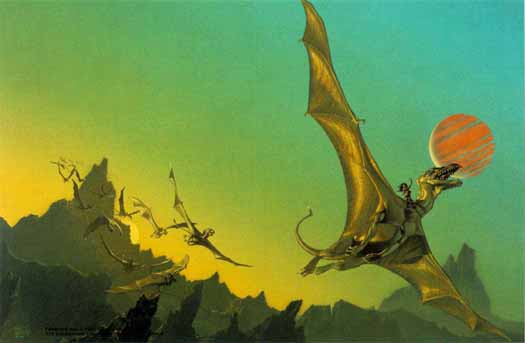
Dragonflight cover artIf we like the “look and feel” of a given universe, we may be glad to revisit that locale, even in the absence of familiar characters and storylines.  For example, Anne McCaffrey’s Dragonriders of Pern has flourished through innumerable sequels, prequels, side stories, and odd departures of all sorts (Dolphins of Pern, Renegades of Pern, The Masterharper of Pern . . .).  People like to spend time on Pern.

Still, this attachment to a location or milieu only takes us so far.  When the original Pern plotline was concluded, and the new batches of characters were not quite as engaging as the first four, I confess that I gradually lost interest.  A well-loved setting can draw a viewer or reader in—but it still takes compelling characters and plots to please the audience in the long run.

That’s the primary lesson I’d take from the success of “Fantastic Beasts” and “Rogue One” so far.  Viewers and readers today seem to be more willing than in the past to invest in expanding universes as well as long story arcs—contrary to what one might call the “ADHD hypothesis” that no one today has an attention span longer than 140 characters.  This is good news for writers who are into worldbuilding.  But building a world people want to visit isn’t enough by itself.  We still need to tell a good story—no matter where it may be set.

The Good King

I began to wonder some years back about the curious preference for monarchy in futuristic settings.  In the world at large, monarchies have been retreating in favor of republics and democracies, at least in theory, since 1776.  Why are SF writers so fond of equipping future societies with kings, emperors, and aristocracies?

Star Kingdoms

We can pass lightly over the old-time, pulp-type stories where royal rule is merely part of the local color:  Burroughs’ A Princess of Mars (1912), Edmond Hamilton’s The Star Kings (1949), E.E. Smith’s The Skylark of Space (1928) with its Osnomian royal families.  Here, like flashing swords and exotic costumes, monarchy is simply part of a deliberately anachronistic setting.  Similarly in high fantasy, where aristocracy comes naturally in the typical pseudo-medieval milieu.

But we see royal or aristocratic governments in more modern stories too.  Asimov’s Foundation stories are centered around a Galactic Empire.  (Since that series was based on Gibbons’ The History of the Decline and Fall of the Roman Empire, an Empire was inevitable.)  Similarly in Star Wars, which draws heavily on Asimov.  Jerry Pournelle’s CoDominium future history has a First and a Second “Empire of Man.”  David Weber’s heroine Honor Harrington serves the “Star Kingdom of Manticore” (later “Star Empire”), modeled closely on England around 1810.  Lois McMaster Bujold’s Vorkosigan Saga contains a number of polities with different forms of government, but many of the stories focus on Barrayar, which has an Emperor.  Anne McCaffrey’s popular Pern series has no monarch, but has two parallel aristocracies (the feudal Holders and the meritocratic dragonriders).  It got to the point where I began to feel a decided preference for avoiding monarchical or imperial governments in SF storytelling.

The Lure of Kingship

Aragorn with crownThere’s something that attracts us in royalty—or we wouldn’t see so much of it.  I encountered this puzzlement directly.  As a kid reading The Lord of the Rings, I was as moved as anyone by the return of the true King.  I asked myself why.  If I don’t even approve of kingship in theory, why am I cheering for Aragorn?

The reasons we’re drawn to monarchy seem to include—

  • Kings are colorful. (So are princesses.)
  • Stability
  • Personal loyalty
  • Individual agency

The first point is obvious, but the others are worth examining.

Stability

It’s been pointed out that even in a constitutional government, a monarch provides a symbolic continuity that may help to hold a nation together.  British prime ministers may come and go, but Queen Elizabeth is always there.  (Literally, at least within my lifetime.)  This gives some plausibility to the idea of a future society’s returning to monarchy.

Something like this stabilizing function is behind commoner Kevin Renner’s half-embarrassed harangue to Captain Rod Blaine, future Marquis of Crucis, in Niven & Pournelle’s The Mote in God’s Eye:  “maybe back home we’re not so thick on Imperialism as you are in the Capital, but part of that’s because we trust you aristocrats to run the show.  We do our part, and we expect you characters with all the privileges to do yours!”  (ch. 40)

Unfortunately, relying on the noblesse oblige of the aristocrats doesn’t always work out well.  It depends on who they are.  For every Imperial Britain, there’s a North Korea.  When the hereditary succession breaks down, you get a War of the Roses or Game of Thrones.

Too much depends on getting the right monarch.  By the law of averages, it doesn’t take long before you get a bad ruler, whether by inheritance or by “right of conquest”—and you’re up the well-known creek.

Personal Loyalty

Personal loyalty appeals to us more strongly than loyalty to an institution.  One can pledge allegiance to a state—but even the American Pledge of Allegiance starts with a symbol:  the flag, and then “the Republic for which it stands.”  Loyalty to an individual moves us more easily.

This kind of loyalty doesn’t have to be to a monarch.  Niven & Pournelle’s Oath of Fealty explores how loyalty among, and to, a trusted group of managers can form a stronger bond than the mere institutional connections of a typical modern bureaucracy.  One can be faithful to family (the root of the hereditary element in kingship), to friends, or even an institution or a people.  But it’s easiest with an individual.  This loyalty is the basis for the stability factor above.

Individual Agency

The vast machinery of modern government sometimes seems to operate entirely in the abstract, without real people involved.  “Washington said today . . .”

In fact it’s always people who are acting.  But it’s easier to visualize this when you have a single person to focus on.  “When Grant advanced toward Richmond . . .”  In the extreme case, we have the ruler who claims to embody the state in his own person:  “L’état, c’est moi” (attributed to Louis XIV, the “Sun King” of France).

In a fascinating 2008 essay, Jo Walton quotes Bujold on political themes in SF:  “In fact, if romances are fantasies of love, and mysteries are fantasies of justice, I would now describe much SF as fantasies of political agency.”  A science fiction character is frequently involved in effecting a revolution, facing down a potential dictator, or establishing a new order—exercising autonomous power.  Walton links this notion of political agency to the fact that SF illustrates change:  “SF is the literature of changing the world.”  The world-changers can be outsiders, or they can be the rulers themselves—as in a number of the examples above.

It’s not surprising that we’re attracted to characters who act outside the normal rules.  We (especially Americans, perhaps) are fond of the idea that good people can act in ways that are untrammeled by the usual conventions.  I’ve already mentioned Robin Hood.  And the whole concept of the superhero—the uniquely powerful vigilante who can be relied on to act for the good—is powered by this attraction.

But this idealization of individual initiative is also dangerous.  Too much depends on getting the right hero—or the right monarch.  It can only work if the independent agent is seriously and reliably good:  virtuous, in the classical sense of virtue as a well-directed “habit” or fixed character trait.  Even then, we may be reluctant to give any hero unlimited power.  Too much is at stake if it goes wrong.

The Rule of Law

Our admiration for the powerful ruler is always in tension with our dedication to the rule of law:  “a government of laws, not of men,” in the well-known phrase attributed to John Adams.  We can see this as far back as Aristotle:  “law should rule rather than any single one of the citizens.  And following this same line of reasoning . . . even if it is better that certain persons rule, these persons should be appointed as guardians of the laws and as their servants.”  (Politics book III, ch. 16, 1287a)

No human being can be trusted with absolute authority.  This is the kernel of truth in the aphorism that “power tends to corrupt and absolute power corrupts absolutely.”  But we can’t get along without entrusting some power to someone.  When we do, it had better be someone who’s as trustworthy as possible.

The Ideal of the Good King

Thus the true king must be a virtuous person—a person of real excellence.  This is the ideal of an Aragorn or a King Arthur, whose return we’re moved to applaud (even against our better judgment).  (It should be obvious that the same principles apply to the good queen—or emperor, empress, princess, prince:  the leader we follow.  But I’ll continue using “king” for simplicity’s sake.)

What virtues do we look for in a good monarch—aside from the obvious ones of justice, wisdom, courage, self-control?

If the ruler or rulers are going to be “servants of the laws,” they require humility.  A king who serves the law can’t claim to be its master.  Arrogance and hubris are fatal flaws in a ruler.  For example, we should always beware of the leader who claims he can do everything himself and is unable to work with others.

The good king is also selfless—seeking the common good of the people, not his own.  Self-aggrandizement is another fatal flaw.

In effect, what we’re looking for is a ruler who doesn’t want to rule:  a king who believes in the sovereignty and the excellence of common people.

Aragorn defers to FrodoIt’s significant that Aragorn, our model of the good king, is introduced in LotR as “Strider,” a scruffy stranger smoking in a corner of a common inn.  Even when he’s crowned in victory, he remembers to exalt the humble.  The movie has him tell the four hobbits, “You kneel to no one.”  Tolkien’s text is more ceremonious:  “And then to Sam’s surprise and utter confusion he bowed his knee before them; and taking them by the hand . . . he led them to the throne, and setting them upon it, he turned . . . and spoke, so that his voice rang over all the host, crying:  ‘Praise them with great praise!’”  (Book VI, ch. 4, p. 232)

We see the same essential humility and selflessness in other admirable leaders, kings or not:  Taran in the Chronicles of Prydain, and the revolutionary princess in Lloyd Alexander’s Westmark trilogy; Niven & Pournelle’s Rod Blaine; Jack Ryan in Tom Clancy’s novels; “Dev” Logan, head of Omnitopia Inc. in Diane Duane’s Omnitopia Dawn—the unpretentious opposite of the “imperial CEO.”  America was fortunate enough to have such an example in the pivotal position of first President, George Washington.

The Alternative

At the other end of the spectrum, the most dangerous person to trust is an unprincipled and unscrupulous autocrat—someone convinced of his personal superiority and infallibility.  Giving power to an individual who has no interest in serving the common good, but only in self-aggrandizement, puts a nation in subjection to a Putin, a Mussolini, a Kim Jong-un.

The antithesis of the good king is the tyrant, who, however innocently he may start out, figures in our stories mainly as the oppressor to be overthrown.  It’s much better, if possible, to intercept such a potentially ruinous ruler before the tyranny comes into effect:  Senator Palpatine before he becomes Emperor, Nehemiah Scudder before he wins his first election.  Allowing the tyrant to gain power may make for good stories, but it generates very bad politics.

If we must have strong leaders, then in real life as well as in stories, character is key—and hubris is deadly.