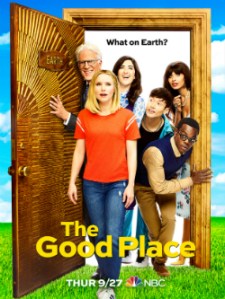
I can’t recall who suggested I start watching The Good Place, which recently released its finale after four seasons. I do remember being warned not to look up the show on Wikipedia or anything first; and that was good advice. The series’ twists and turns are entirely unexpected and it would ruin the effect to know they were coming. So, at the top of this post, I need to point out—

The Slapstick Element
 A TV series about the afterlife is, to the best of my recollection, a novel idea. There’ve been shows that featured regular visitations from the afterlife, such as Topper or My Mother the Car. But these were’t about the afterlife, any more than My Favorite Martian was about life on Mars. They were about events here on earth when visitors from the afterlife intruded. Those who know more than I about the history of TV may be able to provide other examples; but The Good Place’s approach is at least fairly rare.
The second unexpected thing about The Good Place is the transcendent silliness with which Michael Schur and the show’s other writers imbue the series. Almost invariably, if something seems profound or weighty, there’s a pratfall (verbal or otherwise) waiting just around the corner. Even when typical afterlife tropes are invoked, such as torture in hell, they are so exaggerated or understated that one can’t take them seriously. The characters are also drawn very broadly, to the point of caricature—no one could be quite as perfectly airheaded as Jason, as status-conscious as Tahani, as indecisive as Chidi—except for Eleanor, who serves as our Everywoman hero.
 This perpetual wackiness makes the show entertaining, but it also accomplishes some other things. The silliness of the events and characters prevents us from taking the theology seriously. It would be hard to present a serious visualization of heaven or hell in an era when there is no general consensus about such things. But we can all laugh along with the notion that a heaven featuring a really, really great yogurt shop is a bit of a letdown—even if you like yogurt. It’s hard to be offended or galvanized to argument when the theological features are clearly not meant seriously.
In the moments when the show actually does get serious, the surrounding wackiness also keeps it from getting preachy. The levity of the overall atmosphere lends the genuinely moving moments a sort of innocent sincerity. (A fan of G.K. Chesterton, of course, will find that sort of atmosphere immediately congenial.)
The Ending
I’ve seen some lively comments online on how the show ended. Several people have said they hated to see it end. It’s true that one is always reluctant to say goodbye to favorite characters and situations. On the other hand, it’s better for a TV series to close before it’s worn out its original premise and goes into that long slow decline. Exhaustion of the premises is especially likely to occur when the premise is as bizarre as that of The Good Place. So I was kind of pleased to see the writers were bringing the show to an end after four good seasons.
Is it a good ending? Dramatically, yes. I’m content. That’s the essential criterion for the show’s creator: “there’s really only one goal ever for a show finale, in my mind, and that’s to make people who have been watching the show and invested time and energy and emotion in the show feel like it’s a good ending.”
However, the completed work does leave some questions hanging. Appropriately enough, the leftover puzzles are big issues about the fundamental things. I don’t mean that the show should have tried to deal with them: it can best to leave some mystery. However, it’s entertaining to look at what some of these holes were. I present them, of course, from my point of view; those who approach the fundamental questions differently may see the gaps in somewhat different ways.
(Since I flew the spoiler alert above, I’m going to assume that anyone who makes it this far has a pretty good acquaintance with the series.)
First Cause
The more we find out about The Good Place’s underlying machinery of the afterlife, the more we may wonder: Who put this madhouse in place to begin with?

Judge Gen
Nobody seems to be in charge of the whole shebang. The demons who run the Bad Place don’t have complete power, or they’d have simply gone on happily torturing humans indefinitely. The Good Place, apparently, is run by a committee of nonentities, who show up only once or twice, make some entirely ineffectual remarks, and flee at the first opportunity to abdicate their responsibilities. Disputes between the two are resolved by Judge Gen, an irritable, easily distracted entity who seems annoyed by the whole business.
We never do find out who dreamed up the point system that’s used to evaluate human actions. As Sam Adams’ article on Slate puts it, “Introducing a painless exit from the afterlife allowed The Good Place to punt on some of its biggest questions, like who created the universe (the highest-ranking figure we ever meet, the nearly omnipotent Judge Gen, still feels like she’s enforcing someone else’s rules) . . .”
As the setup comes to seem more and more arbitrary, an inquiring viewer is likely to become more and more perplexed about why this particular cockamamie system should exist, rather than any other. (Much less “why there is anything at all,” the fundamental question of metaphysics.)
These are the kinds of questions addressed by the traditional “First Cause” arguments for the existence of God. Why is there this universe rather than some other? Why is there this universe rather than nothing? Ordinarily we sail along day to day without bothering much about the matter. But because The Good Place is showing us (in its own wacky way) the entities that ought to have the answers, the questions become hard to avoid. Once the main characters get backstage, you might say, the God-shaped hole in the overall system becomes more and more evident.
A related issue appears when at one point the judge proposes to wipe the slate clean and start over—annihilate all humans who have ever lived and start the new system from scratch. I found myself wondering, what is the judge trying to accomplish? What are her motives? If the idea is to find a better way to deal with the ongoing human population, that’s fairly clear. But if she’s going to eliminate the humans and start something different, why go to the trouble? Is there some sort of cosmological imperative that there be a human race, or a life-and-afterlife system? We don’t have any idea what her motives might be, because we have no earthly (or unearthly) idea why the existing framework is there in the first place.
Unintended Consequences
 One of the most interesting moral speculations in the show turns up when the main characters are trying to figure out why no humans for centuries have succeeded in qualifying for the Good Place. The reason, it’s suggested, is that the modern world is so complex that an ordinary human can’t know all the consequences of an action. If I buy a Coke, I have to consider not only the effect on my budget and my waistline, but also the bottle’s carbon footprint, whether it was produced using child labor or unfair business practices, and so forth. Every choice is laden with unknowable results—and apparently these are mostly bad, bringing people’s point scores down.
It’s an interesting idea, with at least superficial plausibility. The modern world is more complex than our pre-technological world, and maybe it’s just grown beyond our ability to manage. Today we are constantly being told that it’s our obligation to take into account all sorts of remote consequences, becoming so scrupulous that the slightest decision is weighted with ponderous political and moral consequences.
This argument itself is based on some significant moral assumptions. For instance, it takes for granted that actions are to be evaluated on their results—“consequentialism,” of which the most popular form is utilitarianism. That’s not the only possibility. Chidi, for instance, apparently embraces a “deontological” or rule-based ethics. And then there’s the Aristotelian virtue-based ethics. What actually drives the main characters’ decisions in the end seems to be the worth or importance of persons, which has something in common with Kant’s deontological ethics (every person must be treated as an end in itself) or, more directly, personalism.
One might also wonder whether the problem of unforeseen consequences is really unique to modernity. Life has always been complex, and actions have always had ramifications stretching out far beyond what we can anticipate. It does seem plausible, though, that in a highly interconnected world (“the world is getting smaller”), the effects of a given cause propagate faster and further.
 There’s an additional complexity in the The Good Place’s point system insofar as it uses these remote results to judge the person who is acting. There’s a difference between judging the results and judging the agent. Traditional axiological (good-based) or consequentialist theories of ethics would not normally hold us responsible for consequences we can’t reasonably foresee. If someone does something terrible (or, for that matter, something heroic) we take into account the pressures that person was under, which may include their history and experiences; the limits of their knowledge; the effects of outside conditions like drugs or alcohol; and many other factors that might diminish (or enhance) responsibility.
None of this seems to be considered in the point system with which The Good Place begins. And no wonder: the point system is presented from the beginning as a caricature of real moral judgment, an oversimplified and somewhat unfair scheme. But the “new system” we’re given at the end doesn’t really solve that problem either. Giving the poor humans many lifetimes to become better people is kind, perhaps, but how does it take degrees of responsibility into account (much less resolve the issue of unpredictable consequences)?
Eternity and the Good Life
The driving force of the series’ last episodes is the notion that an eternity of pleasure is itself intolerable. We get bored, and, we’re told, the tedium gradually degrades our faculties, so that the esteemed philosopher Hypatia of Alexandria shows up as a shallow airhead (“Patty”), to the main characters’ dismay. The series’ answer is that the system must provide the opportunity to end this eternal lassitude at a chosen time—“die the real death,” as Zelazny might have put it. The option of ending it all somehow removes the tedium of eternal pleasure and allows us to enjoy the Good Place until we walk through the final door.
The idea of eternity as a bore presents a valid question. It isn’t a question restricted to the afterlife, either; it points back to the classic philosophical issue of what is a good life for human beings. The good life, in the classical ancient or medieval sense, isn’t just the absence of wrongdoing or the ability to score arbitrary points; it embodies the idea of a life that is worth living.
For this reason, it’s worth taking a closer look at what The Good Place has to say about the good life. From the perspective of that question, the show’s final solution looks a bit superficial. Sam Adams, again, says: “The idea that going through the door would simply allow a person’s energy to rejoin the universe—as Eleanor took the fateful step, she dissolved into otherworldly fireflies that wafted down to Earth—felt more like New Age goop than moral philosophy, or maybe just a midway point between Immanuel Kant and Dan Brown.”
It’s true that “[t]he way to love anything is to realise that it might be lost,” as Chesterton says (Tremendous Trifles (1909), ch. 7). But the idea of loving something is curiously muted in The Good Place. The Good Place as we see it in the show does look boring, but that may be because the writers built it that way. The focus on simple pleasures like milkshakes lends itself to this—an eternity of sitting placidly and drinking even the best milkshake would be a bore. With admirable consistency, the screenwriters do apply the same argument to other goods like learning and reading. But it’s not quite as clear that something like learning is as inherently limited as ordinary (and genuinely good) gustatory pleasures.
 Even with respect to the simpler pleasures, The Good Place doesn’t take into account the possibility that becoming bored is a a human weakness—a physiological or psychological failure to continue appreciating something that remains worthwhile in itself. That weakness isn’t necessarily incurable. Chesterton remarks:
The thing I mean can be seen, for instance, in children, when they find some game or joke that they specially enjoy. A child kicks his legs rhythmically through excess, not absence, of life. Because children have abounding vitality, because they are in spirit fierce and free, therefore they want things repeated and unchanged. They always say, “Do it again”; and the grown-up person does it again until he is nearly dead. For grown-up people are not strong enough to exult in monotony. But perhaps God is strong enough to exult in monotony. . . . It may be that He has the eternal appetite of infancy; for we have sinned and grown old, and our Father is younger than we. (G.K. Chesterton, Orthodoxy (Image 1959), ch. IV, p. 60)
The one factor in the depiction of the Good Place that seems to be understated, oddly enough, is love and friendship—relationships. The show does make something of personal interactions, mainly in the two romantic relationships, Eleanor and Chidi and Jason and Janet. But none of the four main characters becomes involved with any other interesting people—despite the plethora of historical figures that might be called on. (As we noted above, the interesting Hypatia has been deliberately dumbed down for the episode to make a point.)
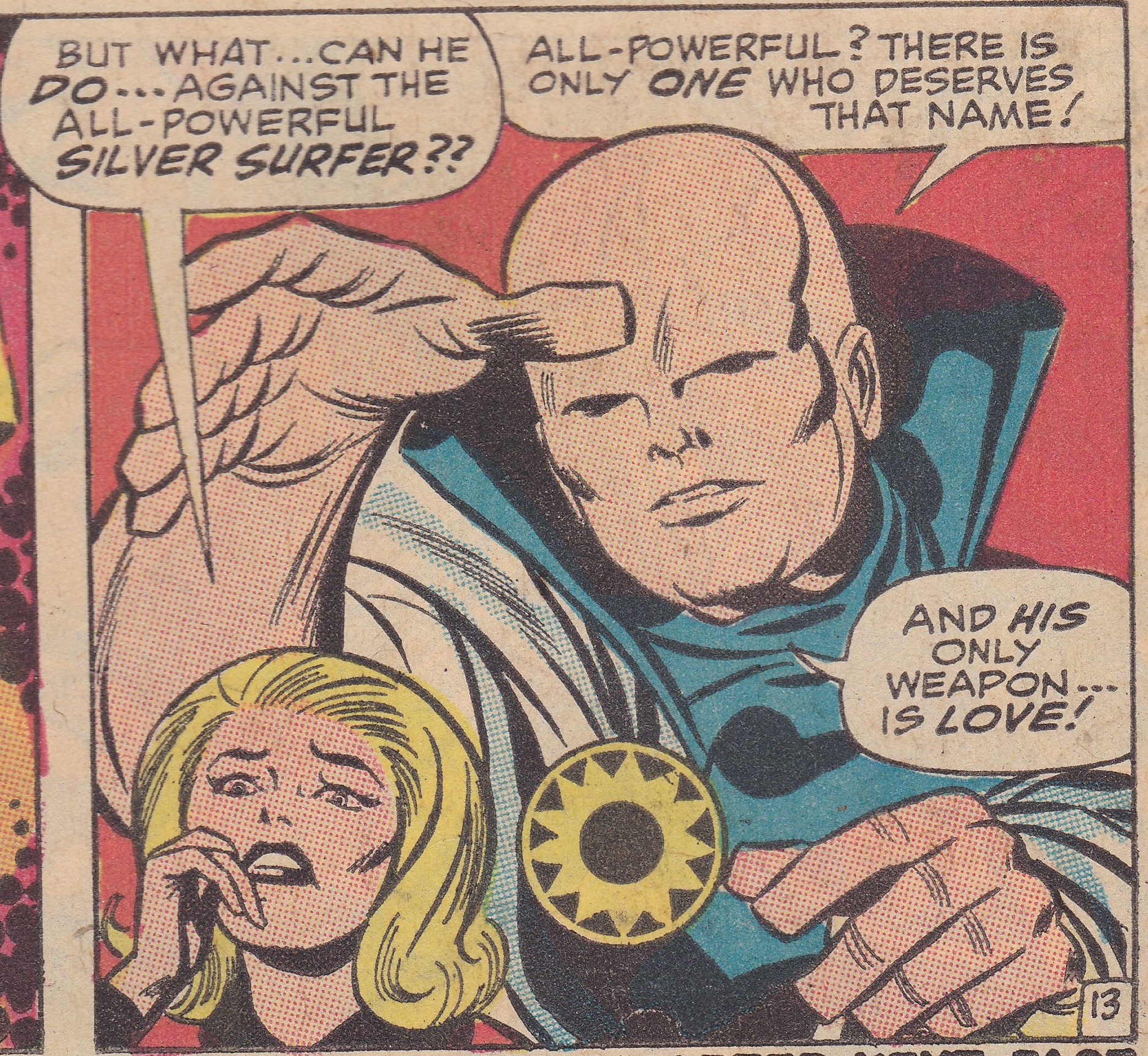
 Outside the central four, together with Michael and Janet, there’s no sense of camaraderie or community. We do not see the potentially unlimited constellations of True Companions—just the one cluster of main characters. And of course the one big relationship is missing: that God-shaped hole. In traditional Christian thinking, at least, God is infinite, and our relationship with God is one time can never exhaust. Because The Good Place adroitly sidesteps the whole question of divinity, that line of solution to the problem of eternity can’t be explored.
Moreover, the show cheats a little when it suggests that a final dissolution is the real end. At least one character uses the conventional phrase “moving on”—which undermines that notion of finality. And what one commentator refers to as “a complete and unknowable end” isn’t quite what we actually get.
For a while, it seems as if Michael Schur is no more prepared to answer existence’s ultimate question than anybody else. But when it’s Eleanor’s turn, the camera doesn’t cut away. Instead, it pans up to the sky above her, a group of ethereal lights floating up into the frame, suggesting that this is what the person that was Eleanor Shellstrop has become. . . . . What that gorgeous final scene suggests is that the best possible reward would be the ability to continue to touch the lives of those we left behind . . . (Rolling Stone)
Even the series’ best attempt at agnosticism about the good life seems to recede before a sense of good action as in some sense eternal.
 Conclusion
The Good Place has been a great show, and I’ve enjoyed it throughout. Simply giving us an opportunity to think about such matters as these is way beyond what most TV series achieve. And to do it in a way that’s consistently entertaining is the cherry on the top of the frozen yogurt.




 Rick Ellrod's Observatory