Meta-reading

The Sign of the Sequel

Ever find yourself approaching the end of a new book—and you realize there’s no way the author can tie up the plot in what remains of the novel?  It’s that moment when you realize:  we’re in for a sequel.

That realization may be awful, or it may be exciting, depending on how much you enjoy the story so far.  But it changes the way you look at the book you’re reading, to know it isn’t complete in itself, but only part of a larger tapestry.  Your sense of the pacing and the shape of the story has to adjust.

Book, fanned openBut the story alone hasn’t told us there will be a sequel.  Rather, we’re drawing on something outside the text itself—our knowledge of how much of the book remains—to tell us something about the story.

Years ago, when I first read Isaac Asimov’s Second Foundation, I almost missed the last chapter altogether.  The conclusion of the novel consists of a series of successive surprises, each overturning the last.  The second-to-last chapter seemed to end so conclusively that I only turned the page because I was in the habit of reflectively turning over the blank endpapers of a book.  —And there was the final chapter!  I could only make that mistake, however, because the last chapter was so short—six pages in my hardcover edition.

It’s harder to make that kind of observation in an e-book, where there are no physical pages to observe.  You can usually find a percentage or “location” indicator, but it’s not quite as obvious as the physical thickness of the pages.

Let’s call this process of drawing on outside information “meta-reading.”

Sources of Meta-Information

There are a number of sources from which we glean this meta-information, consciously or not.

Starting from the broadest case, we get some information from the genre to which the book belongs.  If you find a book in the science fiction section of the bookstore, then no matter how mundane the opening scenes may be, you can be pretty sure that something out of the ordinary is going to turn up at some point.  If you’re reading a genre romance, you can rely on the ironclad rule that a genre romance must have a happy ending:  either “happily ever after,” or at least “happily for now”—HEA or HFN, in the jargon of the trade.  Even if the characters’ relationship seems doomed as you approach the ending, you can be pretty sure it’ll turn out well—which may not be the case in a “mainstream” novel.

Getting to know an author’s habits and preferences is another way to guess what’s going to happen in the end.  If we’ve read a fair sampling of an author’s work, we can gauge fairly well the chances of a happy ending, the likelihood of violence or sex scenes, the kinds of characters you’re likely to meet up with.  It’s a little more tense approaching the end of a book by a new author, because we’re not yet familiar with what kinds of tricks the writer may (or may not) be willing to pull at the denouement.

Then there’s the back-cover blurb, or the flyleaf—often the reason we pick up the book in the first place.  The half-dozen paragraphs or so of teaser text on the flyleaf are designed to tell us just enough to get us interested.  They shouldn’t give away the whole plot, but they do create expectations—which the book as a whole may or may not meet.  Something that comes as a complete surprise to the characters may be something the reader is already primed for, because it’s part of the plot setup that the blurb describes.

Reviews take this principle further.  A review may include spoilers, but even without actual spoilers, it tells is something even before we open page one.

Once we get into the book, there are still more clues.  Chapter titles are out of fashion these days, but if there are such titles, they inevitably tell us something about what’s going to happen.  In my current novel-in-progress, I use temporary chapter titles that remind me what happens in the chapter, but remain obscure enough not to telegraph the outcome to test readers.  Still, when you reach the chapter titled “The Battle of Tremont,” you’re inevitably going to have an idea what to expect.

Finally, in the example I started with, the length of the book tells us something.  As we move through the story, we can measure our sense of pacing with the literal progress through the pages.  There have been a number of cases where it’s looked as if the plot was being wrapped up nicely, and I’ve looked at the mass of material still to come and thought, Something’s bound to come unglued here . . . or we wouldn’t have a hundred pages to go.

Setting Expectations

This kind of insight relies on an awareness of narrative practices.  There are internal necessities to good storytelling.  Guessing the imminence of the climax from the number of remaining pages, for example, depends on our assumptions about how much time after the climax will be devoted to wrapping things up—which, in a long story like The Lord of the Rings, can take quite a while.

Likewise, gauging the amount of space needed to resolve the plot assumes that the plot will be resolved:  good authors, at least, don’t leave things totally dangling.  Our use of meta-reading plays off our assumptions about how stories are told—and can go awry if the author’s views are radically different from the reader’s.

For that very reason, the writer of a story has to take into account the context in which the reader encounters the story, and the expectations raised in that context.  The reader doesn’t come to the story as a blank slate.

If there will be major surprises in the tale, the writer (and publisher) need to make sure they aren’t given away in the blurbs.  If the author wishes to undermine the expectations created by genre classification or advertising, it’s important to be aware of the consequences.  Subverting reader expectations can be illuminating and satisfying to the reader, but it can also be annoying and frustrating. The implicit contract between writer and reader—‘I’m going to tell you a story you will enjoy’—places boundaries on just how subversive one can be without leaving the reader feeling cheated.

The writer’s conversation with the reader, then, extends well beyond the contents of the text itself.  It’s something that’s useful to remember for the writer—and the reader as well.

Arabella of Mars

Arabella of Mars book coverArabella of Mars, by David D. Levine (New York:  Tor, 2016), may be described as a Regency steampunk planetary romance.  Better yet may be the flyleaf testimonial from Madeleine Robins:  “If Edgar Rice Burroughs, Jules Verne, and Patrick O’Brian had sat down together to compose a tale to amuse Jane Austen, the result might be Arabella of Mars.”

Genres are getting complicated these days.  But sometimes that cross-fertilization produces some entertaining mixes.

Our young heroine’s British family maintains a plantation on Mars, as if it were the Caribbean islands or India at the dawn of the nineteenth century.  The native Martians, filling the role of the local population, are considered primitive by the British colonists.  In this respect the setup is faintly reminiscent of the Martian sequence in Heinlein’s The Number of the Beast.

Physically, however, Levine’s Martians are more reminiscent of the green Martians of Burroughs’ Barsoom:  large, nonhuman, living in a desert world.  In keeping with modern sensibilities, the “natives” actually possess a respectable culture and can be formidable opponents.  This accounts for the “planetary romance” aspect—“an extension of late 19th and early 20th century adventure novels and pulp romances to a planetary setting,” as Wikipedia describes the genre.

When tomboyish Arabella is removed with her mother and sister to Earth, the Austen angle takes over.  Arabella finds the Regency-era dinner parties and promenades boring; she’d rather be tinkering with mechanical piano-players and other automata.  The swiftly thickening plot, which involves period devices like entailed estates, forces our heroine to disguise herself as a boy and take a menial position on an East India, er, Mars Company vessel bound for Mars again.

At this point the Burroughs and O’Brian factors collide in an extraordinarily droll description of the Age of Space as an Age of Sail.  Captain Jack Aubrey would have been perfectly at home on the quarterdeck of this interplanetary ship crewed by rough sailors and featuring three masts, not in a row, but protruding from the top and sides of the boat at 120-degree angles.  The Diana is lifted by hot-air balloons (coal-fired, of course) into the extremely high-speed interplanetary air currents, which make travel to Mars a matter of a few months.  These vessels are reminiscent of Burroughs’ Barsoomian airships, bringing us back to the planetary romance theme.

Levine gives us with a straight face his depiction of a Solar System filled with breathable air, without deigning to worry about trivialities such as how the planets could maintain their orbits in such a resisting medium.  The absurdity of the premise simply makes the description more delightful.  As we deal with pirates on the (very) high seas, stop at a convenient asteroid to cut down trees for repairs, and make charcoal to fuel the balloons for the perilous descent to Mars, one can only ride along enjoying Levine’s inventive adaptation of one set of tropes into an entirely different world.

But it’s not just silliness.  The book isn’t a farce.  There’s a good sound story with believable characters strung through this cockeyed worldbuilding.  There’s even a real romance, in the love-story sense, though this plays a somewhat muted role.  Overall, the tale has more of the sea story than of the Regency romance about it.  But it might serve an aficionado of either genre as a cordial introduction to the other.

The novel is billed as “Book One” of “The Adventures of Arabella Ashby.”  One can only imagine what sort of eccentric scenarios might come next.  (For example, I don’t believe anything has yet been mentioned about Venus—which is bound to be a jungle world, perhaps with dinosaurs, if it’s based on the Burroughs-Heinlein model.)  I look forward to seeing where this whimsical tale may lead.

The Backyard Spaceship

When I was little, my father told me he had a spaceship of his own, hidden back in the woods.  As an ardent space fan, I was wildly enthusiastic.  It was when he told me it was propelled by a hamster running in a wheel that I began to suspect he was putting me on.

But I wanted to believe it.

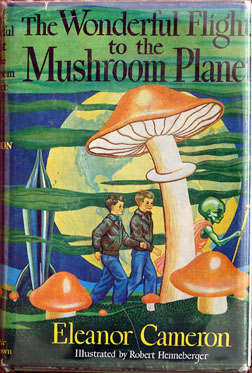
There’s a certain SF tradition of spacecraft built, more or less, in one’s backyard.  Of course, “backyard” may not be literal.  I’m thinking of spaceships constructed on an amateur basis, privately, and usually—though not always—by young people.Cover, The Wonderful Flight to the Mushroom Planet

This was the appeal of a childhood favorite of mine, Eleanor Cameron’s The Wonderful Flight to the Mushroom Planet (1954).  Two boys (“between the ages of eight and eleven”) are recruited by a newspaper ad to put together a small rocket ship for the mysterious Mr. Tyco Bass, a small wispy man who turns out to be a “spore person.”  They fly the ship to a previously unknown miniature moon, “Basidium,” inhabited by other spore-based mushroom people.

Cameron is pretty good with her scientific facts—which means she lampshades the impossibilities carefully.  A rocket built by two kids isn’t going to get off the ground without plentiful helpings of what TV Tropes calls “Applied Phlebotinum,” the unexplained stuff or device(s) necessary to make the plot work.  A classic example is the faster-than-light space drive needed by a Star Trek or Star Wars story.  If the authors could explain how it worked, they wouldn’t be writing a story; they’d be off to the patent office and rake in billions.  Instead, the author and reader tacitly agree to postulate the necessary gizmo or substance for purposes of the tale.  It might as well be magic, in the sense of Clarke’s Third Law—“Any sufficiently advanced technology is indistinguishable from magic.”

Here, Mr. Bass supplies several crucial “inventions” needed to make the boys’ ship spaceworthy.  He provides the rocket motor, the special fuel, the clear sealant that makes the hull airtight, and the “oxygen urn” that provides breathable air—not to mention the “Stroboscopic Polaroid Filter” that allows a telescope to detect the otherwise-invisible Mushroom Planet.  These “phlebotinum” features make the boys’ vessel a little more plausible than my dad’s Hamster Drive.Cover, Rocket Ship Galileo

A more believable example (once you’re out of the middle grades) is Robert A. Heinlein’s Rocket Ship Galileo (1947).  The project here is a private enterprise, with the spacecraft modified from an existing transcontinental “freighter-rocket” by four teenage boys.  They are, however, accompanied by one adult, Dr. Donald Cargraves, an uncle of one of the boys.  Cargraves provides the engineering expertise and the atomic drive he’s just invented, which (to paraphrase Doc Brown) “makes space travel possible.”

Starting with an existing well-equipped vessel, and kids who are already experienced amateur rocket-builders, makes the setup immediately more plausible.  Realistically, it takes months of elbow grease to do the conversion.  The Galileo isn’t actually built in a backyard, but out in the desert.  Still, the idea that kids like you or me could help build the first rocket to the moon is front and center in this story, which formed part of the basis for the early SF movie “Destination Moon.”

The notion of private-sector spaceflight was a favorite of Heinlein’s.  That theme reappears in his novella The Man Who Sold the Moon (1951), which also contributed elements to “Destination Moon.”  In that tale, however, the participants were all adults, and the project was a large and highly-publicized corporate endeavor more like the work of today’s SpaceX or Blue Origin.

A fully grown-up version of the backyard spaceship can be found in the widely influential first novel by E.E. “Doc” Smith, The Skylark of Space (1928, originally written about a decade earlier).  When scientist Dick Seaton stumbles upon an unknown substance that can be used to produce immense energy, his wealthy friend Martin Crane underwrites the construction of a spherical spacecraft to harness that power.  The work is started on Crane’s extensive property—not exactly a backyard, but close—and continues secretly in an independent steel plant after skulduggery enters the picture.  No kids are involved, but the private, secret, and essentially amateur operation makes Skylark an ancestor of this space opera trope.cover, Red Thunder

We might consider this theme an artifact of the naïve early days of SF, but for its reappearance in John Varley’s 2003 novel Red Thunder.  The passage of time has made some differences.  The protagonists are young adults, though they compose a motley group that still reads like “kids” to me (or perhaps it’s just that I’m that much older myself).  Their goal is Mars, rather than the Moon.  The requisite adult supervision, or phlebotinum contribution, is supplied by Travis Broussard, a cashiered former astronaut, and his quasi-autistic genius brother Jubal, who has invented a “squeezer” force field that turns out to be a fabulous rocket drive (among other uses).  Varley’s methodical development of the funding, engineering, and planning for the homegrown spacecraft (built out of a railroad tank car) makes the amateur project believable even for a contemporary audience.  Wikipedia describes the resulting adventure as an homage to Heinlein’s juveniles—since it’s essentially a Rocket Ship Galileo for the 21st century.


Why are we so fond of the backyard spaceship?

This kind of plot enshrines the long American tradition of inspired tinkering, from the Wright brothers and Edison, to Tom Swift, to 1950s kids with hot rods, to space kids with hotter rods (Luke Skywalker asking to go into town for parts to soup up his landspeeder).  The clever gadgeteer is a permanent part of our mythology, right down to Bill Gates and Paul Allen in their garage.

More than that, the idea that ingenious amateurs could conquer space has a democratic, underdog quality that appeals to our mythmaking imaginations.  We love the idea that spaceflight could be easy and accessible to the ordinary person.  It’s a natural evolution of the way we root for the underdog in politics or war (the Ewoks in “Return of the Jedi”).  We cheer for the underdog just as much in personal life—for Cinderella, whose story exhibits, as Chesterton says, the lesson exaltavit humiles—“he shall lift up the humble.”

The backyard spaceship promises to lift the humble right off the earth, in the ancient dream of flight.  It makes for great inspiration, if dubious engineering.  And after all, the most sophisticated aeronautical engineer starts out as a wondering child and an aspiring teenager.  Our dreams rest among the stars; but the journey begins in our own backyard.

How to Stage an Alien Invasion

We love our alien invasions.  Since The War of the Worlds (1897), poor Earth has suffered a steady stream of hostile arrivals—frequently from Mars, but recently from farther afield, as the possibility of other intelligent life in our solar system wanes.

We have one coming up this month, with the June 24 movie premiere of Independence Day:  Resurgence, a sequel to one of the more successful invasions of the last twenty years.  It seems like a good time to look closely at our opponents.

Footfall, a 1985 novel by Larry Niven & Jerry Pournelle (still available in print), is not only a great yarn, but a textbook model of how to write a modern invasion story.  We can look at it as a test case, like an existence proof in mathematics:  What kinds of conditions have to be fulfilled for a believable alien invasion, given what we now know about other planets?


Let’s define the target.  We’re talking about the good old classic invasion story, where the bad guys show up in person, make a direct assault, and we beat them.  That isn’t the only possibility.  There are other variants, such as infiltration, or scenarios where the Earthlings lose and end up a subject species.  But let’s look at what premises make a triumphant Independence Day-style plot viable.


It was easy for Wells.  His relatively nearby Martians could fire off a series of cannon shells, more or less, to land on Earth, break out their tripods, and mount their campaign.  Wells’ tour de force ending, of course, has the Martians beaten not by human opposition, but by humble bacteria.  (Arguably the best moment in the original Independence Day is when Jeff Goldblum realizes we can best the enemy by using a contemporary analogue of the Wellsian microbes—a computer virus.)

But modern invaders have to come from a greater distance.  Regrettably, none of the plausible abodes of life in the solar system have panned out.  Gone are old-time SF’s sweltering jungles of Venus, the canal-crossed deserts of John Carter’s Mars.  Until we’re ready for an attack by potential microbes from Europa, or hypothetical floating denizens of Jupiter’s atmosphere—neither of which, if they exist, have shown any signs of capability for interplanetary excursions—we have to look to interstellar sparring partners for a really good invasion.

This intensifies a long-standing problem with invasion stories.  If they got here, and across the interstellar gulfs at that, their technology must be literally light-years ahead of ours.  How can we expect to beat critters with such vastly advanced technology?  The balance of power is inherently skewed against us.

Paired with this is the question of motivation.  Why are they here?  What do the invaders want that would drive them to come all the way to Earth for it?

This is the easiest place for invasion stories that aren’t built on sound science to go astray.  We need only mention the 1983 TV mini-series “V,” which, though it had many admirable aspects, fell sadly short on the science side.  V gives not one, but two, implausible motives for the seemingly-benevolent Visitors.  They’re here to steal Earth’s water—as if there weren’t vast amounts of ice scattered around our solar system, and probably most other systems, for the taking.  And they’re here to eat us; apparently not only are humans compatible with a completely alien biology, but we’re a tastier treat than more edible and obtainable animals.  Sensible extraterrestrials need a better reason to traipse across the light-years than a local hamburger shortage.


Niven & Pournelle’s epic adventure handles both these questions so beautifully that it might have been plotted specifically to answer them.

Our not-quite-friendly visitors, the fithp (the singular is fi’), arrive in a large interstellar vessel, which launches smaller ships to conduct the attack.  Why are they here?  They’re looking for Lebensraum — living space.  The fithp have been exiled from their homeworld as the result of a conflict among factions—like the Protectors in Niven’s novel Protector.  They need a new place to live.  Among other things, this means “defeat is not an option”:  they can’t go back.  That ups the stakes.

But this exile premise also solves some of the balance-of-power problems.  The fithp’s resources are strictly limited.  There won’t be any reinforcements.  They can’t bring anything more from their homeworld.  All we have to do is defeat this batch of opponents, and we win.

Niven & Pournelle strengthen this limitation on the aliens, and incidentally increase scientific plausibility, by making their mother ship Message Bearer a slower-than-light vessel — a Bussard ramjet.  Their journey takes decades.  This distances the fithp even further from any potential homeworld support.  The authors also use it to introduce another twist:  there’s dissension between the space-born fithp, on one hand, and those who lived on their homeworld and are now awakened from suspended animation, on the other.  This division becomes important as the plot develops.

Without having to account for faster-than-light travel, Niven & Pournelle can give the fithp technology that isn’t too far ahead of our own.  Human numbers—and political, psychological, social characteristics—can make up for the technological imbalance.

In addition, the fithp don’t fully understand their own technology.  They’ve learned a lot of it from records left by their Predecessors, rather than developing the science themselves. This makes them less able to innovate.  By contrast, the humans’ response is a masterpiece of improvisation.  We make the best of what we have.  This, too, helps even the scales.  (Lesson for humans:  Continue fostering that STEM education.)


In the course of this worldbuilding, Niven & Pournelle give us fully fleshed-out aliens, with a coherent culture and society, understandable but different from our own — not an easy task.  Among other things, the fithp are sympathetic characters.  They are people, not just faceless attackers.  We see events from their viewpoints as well as our own.  This makes the story not only more believable, but more interesting.


The original Independence Day scores modestly on these two plausibility counts.  Motivation:  The aliens travel the stars like locusts, stripping planets of their resources.  No details are given, but the basic idea is not unreasonable, particularly in light of contemporary environmental concerns.  Balance of power:  We’re hopelessly behind in technology—but the aliens’ laziness (using our own satellites for signaling), Goldblum’s bright idea, and a captured alien ship get us (barely) over the hump of the willing suspension of disbelief.

We’ll see shortly how these premises play out in the Independence Day sequel—applying the Niven & Pournelle standard.