War of the Rohirrim

I finally got around to watching the 2024 film The Lord of the Rings: The War of the Rohirrim.  Missed it in the theatres, but I caught it on streaming video while my wife (who is not quite so headlong a Tolkien fan as I am) was off on a storytelling adventure.

The movie is very good.  Grim, but good.  Of course, this came out recently enough that I should issue a

Spoiler Alert!

Canon and Its Discontents

I refrained from reading about the plot until I had seen the film, so as not to spoil anything for myself.  When I went back to the source material—the tale of Helm Hammerhand, King of Rohan, about 200 years before the War of the Ring—I was surprised to see how closely the screenwriters had actually followed what Tolkien provided in Appendix A to The Lord of the Rings (section II, The House of Eorl).  This isn’t essential—but it’s helpful.

At this point LotR has become a mythological wellspring of its own.  I think it’s legitimate to treat the Tolkien materials as a basic canon that may still allow for some improvisation and variation, just as the stories around King Arthur are open to a variety of individual interpretations, and, generally, a powerful myth can be “malleable” in the right hands.

In other words, I’m not going to be scandalized just because a Middle-Earth tale isn’t entirely consistent with the canon.  Firing salvos back and forth about canonicity isn’t very productive.  What matters is what we do with the canon (or without it).

At the same time, if a work is worth adapting in the first place—book into movie, for example—then the adapters would do well to understand what made the source appealing.  We can use a source simply as a convenient hook on which to hang a different story, but we’d be wasting what’s worthwhile in the original.  Merely arbitrary or casual departures from the canon often degrade the result, rather than enhancing it.  We have to look at the changes case by case.  (The Peter Jackson Lord of the Rings movies themselves are full of examples both good and bad—but that’s a subject for a much longer dissection, one of these days.)

Thus—to take an SF example—when Gregory Benford wrote one of the sequels to Isaac Asimov’s Foundation series, Foundation’s Fear, Benford threw in a new means of interstellar travel—via wormholes—in addition to the “hyperspatial jump” that was standard in Asimov’s works.  This addition made the story seem a little more up-to-date, since wormholes had come into fashion in SF after Asimov wrote the original stories.  But inserting these wormholes into the background  created unnecessary tensions in the worldbuilding, since events in the original series might have played out quite differently if these wormholes had been around as Benford assumes.  And it added nothing much to the actual interest of the novel.  It wasn’t a big deal, but it was an annoyance.

Thus, we can evaluate War of the Rohirrim fairly by looking at how well it used the original Tolkien material, and how effectively it went beyond.

Adding and Expanding

Poster for The War of the Rohirrim

I thought the screenwriters here did a good job.  The Riders of Rohan as pictured in the movie are recognizably the same civilization we saw in the book and the LotR movies.  Helm Hammerhand is not at all the same character as Theoden, but he comes from the same culture.  Rohan’s relationship with Gondor is consistent with what we see in the books, allowing for two hundred years’ difference.

When the movie brings in LotR’s “oliphaunts,” or mûmakil (appropriately, only the latter name is used, since the former is more of a hobbitish coinage), that may seem an anticipation of the LotR storyline, but it’s plausible enough, drawing on Tolkien’s worldbuilding to add a danger and a challenge to the bare-bones tale of Helm in the books’ appendix.  The Wikipedia article on the movie makes some good observations here, and I’m inclined to agree.

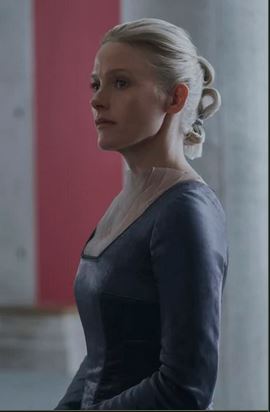
The writers’ key decision, I think, was to use Helm’s daughter as the primary viewpoint character for this story.  She’s mentioned in the book, but her name is never given.  The screenwriters’ choice of “Héra” rather unfortunately invites confusion with the Greek goddess of the same name (less an accent), but it does fit her appropriately into a family containing Helm, Haleth, and Hama.

Telling the story as Héra’s tale allows the movie to create a sense of continuity that would be hard to achieve otherwise, since Helm and his two sons all die in the course of this war, one by one.  None of them survive to carry the viewer through to the end.  It is plausible, though, for Héra to come out alive.  And that also enables the screenwriters to give us something more like a happy ending than would have been possible if the focus had been on, for example, Helm himself.  Helm’s nephew Fréaláf takes the throne, and that’s fine.  Héra, however, can continue forward unconstrained and free.  The writers have wisely left her tale open-ended, rather than resolving it with a romance or other specific commitment.  That open prospect—“the Road goes ever on”—seems an appropriate conclusion for a story that is wound almost too tightly around one set of royal family conflicts and geographic environments.

I’ve found Amazon’s The Rings of Power somewhat disappointing; I’m cheered by this modest, but enjoyable, alternative venture into Middle-Earth.  Who knows:  someday (if the intellectual property rights align) we might even see the stories of the First Age, the Silmarillion, come to the big screen—and wouldn’t that be a sight to see!

Dialing Destiny

Indiana Jones Rides Again

Indiana Jones and the Dial of Destiny, movie poster

My wife and I went to see Indiana Jones and the Dial of Destiny (2023) Friday night.  Good movie—I’m unsure whether to call it “great.”  My reaction was somewhat complicated by the fact that I’d inadvertently gotten us tickets to a theatre with the full range of tactile or “haptic” special effects—seats that bounce you around violently, drafts and puffs of air, sprinkles of water, little gizmos that tickle your neck or ankles.  We both found all this paraphernalia rather distracting at first, though it’s undeniably immersive—rather like seeing a movie and riding a thrill ride at the same time.

I’m going to try and avoid spoilers on this occasion, since it’s likely a lot of us haven’t seen this episode yet.  (It’s fun to get in on opening night sometimes—and I have to keep up my geek cred somehow.)  This closing episode—Harrison Ford and the Spielberg/Lucas team have all said this is to be Indy’s last outing, though I wouldn’t be surprised to see further spinoffs, like the The Young Indiana Jones Chronicles—provides a useful opportunity to reflect on the series as a whole, which we can do without major spoilers.

What Makes Indy Go

Part of what makes the Indiana Jones films so much fun is their unabashed appeal to action-packed derring-do—the meat and drink of the old-time movie serials that both Lucas and Spielberg have pointed to as inspiration.  In that respect, it’s close kin to Star Wars—no surprise, since Lucas was behind that series as well.

Another key element is the character of Indy himself.  He performs incredible (perhaps impossible) physical feats, but he always seems to be doing it in desperate improvisation—no Superman he.  And while he’s an honorable cuss with a warm heart, there’s also a vein of pragmatism that makes him earthier than a traditional noble hero.  (Remember the scene in Raiders where, finding Marion tied up in Belloq’s tent, he has second thoughts while untying her and, to her outrage, ties her back up again?)

The plot driver in each film is a lost and significant object:  the Ark, a jewel, the Grail, the Crystal Skull, the Antikythera mechanism.  The child in us can’t help responding to the appeal of “buried treasure.”  From the children’s adventures of Nancy Drew or of Enid Blyton’s numerous literary offspring, to the (slightly) more grown-up exploits of National Treasure or Pirates of the Caribbean, we’re fascinated by the idea of suddenly discovering some hidden thing of inestimable value.  Even a contemporary middle-grade book like Morgan Matson’s The Firefly Summer can invoke the same perennial attraction.  Of course, “old” is relative—it might be as recent as one’s parents’ generation, or as far back as prehistory.  The antiquities in at least three of these movies are thousands of years old, which is plenty far enough to evoke awe and wonder. 

In the best of the IJ movies, this sense of wonder is intensified and elevated by the fascination of the numinous:  a religious or near-religious awe.  By the “best” movies I mean, of course, Raiders of the Lost Ark and Indiana Jones and the Last Crusade, which I believe are generally regarded as the best of the bunch.  I don’t think Dial of Destiny will rise to that level, though it’s certainly far better than the weakest link, Temple of Doom.  (Of course, your mileage may vary . . .)  The old-time movie-serial ambiance seems better suited to the power of myth than to the science-fiction veneer of the final two episodes.

The Tomb Raider Syndrome

I gather Indy has inspired a number of young people to become actual archaeologists.  That’s a good thing, although as soon as we invoke actual archaeology, we have to acknowledge how far Indy wanders from scientific best practices.  I must admit I cringe a little every time Jones and a companion shove a stone cover violently off a tomb, presumably to crack and shatter on the floor out of camera range—not to mention the absence of any attempt even by 1930s standards to photograph or otherwise record these unique historic sites.  Last Crusade even highlights the difference between real archaeology and mere treasure-hunting:  Indy tells his class “. . . and X never, ever marks the spot”—which caution is then promptly spoofed when he discovers that a giant X (the Roman numeral ten) actually does indicate where a catacomb is buried in Venice.

Of course, Indy has bigger fish to fry, so we blink amiably at these scientific solecisms and get on with the nonstop excitement.  The cavalier treatment of relics is a long-standing tradition, shared (I think) by Indy’s distaff counterpart Lara Croft, among others.  In our more pedantic moments, we may raise our eyebrows at these dubious tactics, but this is a case where TV Tropes’ “MST3K Mantra” applies:  “It’s just a show; I should really just relax.”  Indy himself does aim to do the right thing by history:  he’s constantly contrasted with more mercenary grave-robbers when he insists, “This should be in a museum.”

The Human Element

More important, though, in Indy’s appeal to an eager audience is the human connections.  They’re less prominent than the thrills and special effects, but they’re at the heart of the stories.  Indy’s romance with Marion and his friendship with Sallah, and even his rivalry with the elegant Belloq, give us an enjoyment that outlasts the fight or chase scenes.

Lucas and Spielberg doubled down on this in Last Crusade, where Indy’s relationship with his father made for most of the more memorable moments of that film.  On the other hand, serious human relationships are largely absent from Temple of Doom, whose single saving grace (aside from the mine-cart ride) is his friendship with Short Round.  As an unregenerate romantic, I give Kingdom of the Crystal Skull extra points for reviving Indy’s romance with Marion (after his ephemeral affairs in the second and third installments).

In this respect, I think Dial may fall a bit short.  While Indy’s relationship with his Action Girl goddaughter is a central theme in this movie, I didn’t find the new character quite as likable or interesting as I wanted to.  There are some heartwarming moments here, to be sure, but they tend to bunch up toward the end of the story.

All in all, Dial gives us a distinctly quieter and more elegiac ending than the previous episode’s celebratory denouement.  The lasting appeal of this film may have a lot to do with how audiences respond to the character arcs. After forty-two years, we can fondly say farewell to Indiana Jones in this concluding episode—though after all the thrills and chills, we may feel, with Indy, that “it’s not the years, it’s the mileage.”

Foundation and Dune

As the Apple Foundation series has gradually diverged from the books, sinking from ‘adapted from Asimov’s series’ to ‘loosely inspired by Asimov’s series’ levels, we’ve seen a dramatically opposite example of a classic SF novel adaptation:  the latest movie version of Frank Herbert’s Dune.  The two make an instructive comparison.

Spoiler Alert!

Apple Strikes Out

I haven’t quite finished viewing this season of the Foundation TV series yet, but the trend is pretty clear.  Apple’s version has departed from the storyline of the written works so extensively that I can’t picture how they could possibly get back to it.  Unfortunately, what Goyer & co. have replaced it with is just routine space opera, mildly interesting but no more. 

The original series, as I said in my last post, is cerebral.  It’s more like a political drama than like Star Wars.  And it seems to me that, pace the commentators who consider it unfilmable, the original story could have been filmed in the manner of a political drama, with a modicum of action involved (Hober Mallow’s face-off with the Korellians in “The Merchant Princes,” the escape of the Darells and Ebling Mis from the Mule’s minions, et cetera).  But that’s not how moviegoing audiences have been taught to think of science fiction, and the Apple writers have struck out in a different direction—back to the safe and familiar, rather than what’s distinctive in the Foundation series.

The warship Invictus

The judgment of Rob Bricken in Gizmodo (10/22/21)—“Foundation Just Became Star Wars, and It Sucks”—may be a little simplified.  But it’s basically sound.  The example that triggered Bricken’s article is a useful one.  Several of the episodes (6-8) focus on how warriors from Anacreon kidnap several Foundation folks to try and gain control of a massive Imperial warship, the Invictus.  The ship is presented as a kind of Death Star, a crucial weapon.  The Anacreonians want to use it for revenge, to destroy Trantor, the capital of the Empire—which is presented as a major blow to civilization, something Our Heroes must stop.

But this is all backwards.  In “The Mayors,” third part of the first Foundation book, Anacreon does get the Foundation to help them refurbish an old Imperial warship that they found derelict in space.  The Anacreonians think of this as a major victory, though their concern is expanding their rule in the Periphery, not attacking Trantor.  But the whole point of the incident is that possession of this Big Damn Weapon makes no difference in the course of history.  The canny Salvor Hardin neutralizes the significance of this warship through entirely nonviolent means—a matter of social and psychological leverage rather than military force.  (I’m avoiding the details so as not to spoil the story for those who may want to go back fruitfully to the written works.)

Nor, for that matter, is the fate of the Imperial capital especially important in the long run.  The Seldon Plan predicts its fall in the early years of the Plan, and the collapse of the Empire is necessary to create the environment in which the rise of the Foundation can occur.

Meanwhile, in the TV series, the uploaded simulacrum of Hari Seldon appears to be trying to establish the Second Foundation on his homeworld of Helicon, a planet of no significance in the original series.  Aficionados of the books will recognize that this change (unless it’s all an elaborate deception) would undo most of the action and tension of the latter half of the series.  Again, I’m being deliberately vague (read the books!).

Emperor Day

And Apple continues to follow the Emperors through a peculiar religious ordeal that may or may not have any long-term significance.  There is a religion-politics connection in the original series; it’s possible that Apple intends to bend this arc back to meet the original plotline in some way.  But, again, it’s so far off track already that the result is likely to have little resemblance to Asimov’s story.

Apple’s version of Salvor Hardin (who at this point shares nothing but the name with Asimov’s character) continues to be presented as a Chosen One.  So is Gaal Dornick, on whom the writers have bestowed an ability to predict the future by some sort of mathematical or mystical intuition (a notion that almost seems to have been borrowed from Dune, oddly enough).  In Episode 6, “Death and the Maiden,” at 34:30, Hari Seldon goes to far as to talk about “an entire galaxy pivoting around the actions of an individual.”  But that’s exactly what the premise of the Seldon Plan denies, as Asimov tells us over and over again.  Emphasizing the crucial importance of individuals may be a good narrative practice in itself (and is arguably true in fact).  It is, however, simply inconsistent with Asimov’s premise—at least until the appearance of the Mule, the ‘exception that proves the rule.’

So far, at least, Apple’s Foundation TV series exemplifies one way an adaptation can go wrong.  By ignoring what’s interesting and engaging in the original books, and substituting entirely different content that simply happens to be what’s in fashion at present, the adaptation can lose what’s valuable in the original without the benefit of anything new and equally interesting.

Villeneuve Scores a Victory

Frank Herbert’s iconic SF novel Dune (1965) has been transmuted to video twice before.  A 1984 film by David Lynch has received mixed reviews; it has its quirks, but the major problem is that, since a 507-page book is compressed into 2:17 of film, it’s unlikely anyone not already familiar with the book could follow the complex plot.  In 2000, the Syfy Channel released a TV mini-series version; I’ve never seen it, but, again, reports have been mixed.

Denis Villeneuve’s version hit American theatres on October 21, 2021.  The new film is impressive.  Note that this show is only the first half of the story; Dune:  Part Two, is currently (12/2021) scheduled for release October 20, 2023.  That makes sense.  No two-hour movie could possibly do justice to the book.  (I’m only speaking here about the first book; describing the innumerable sequels, prequels, and associated volumes that have come out since would take an entire post by itself—but IMHO, the later add-ons decline in quality exponentially, so we can safely ignore them here.)

Zendaya as Chani

What’s striking about the new movie is the care it takes in translating Herbert’s work to the screen.  The novel’s remarkable worldbuilding is reflected in stunning visuals that fit together smoothly to support the plot.  Watching it, I had the same kind of reaction I did watching The Fellowship of the Ring twenty years ago:  wow, there it is, just as I imagined it:  ornithopters, stillsuits, Duke Leto, Chani.  The casting is excellent; almost all the actors embody the characters vividly.  (One of the reasons I’ve never gone back to watch the TV mini-series, which I taped at the time, is that I just can’t envision William Hurt as the Duke.)

Moreover, the plot holds together.  Villeneuve follows the storyline of the book very closely.  He does it intelligently, though, rather than slavishly.  For example, there was a banquet scene in the book that doesn’t appear in the movie.  But the banquet isn’t really essential to the plot, and it would have been particularly hard to render it on film in any case—almost all the interest of the scene consists in the characters’ internal thoughts about what’s happening.  So, although I’d been looking forward to seeing that scene, I must agree that it made sense to skip it to save time and finesse a difficult cinematic challenge.

On the whole, though, the storyline of the movie closely reflects that of the book.  This means we get to enjoy the things that made the book engrossing in the first place:  the conflicting allegiances that the hero, Paul Atreides, must navigate; the quasi-mystical disciplines and secret long-term planning of the Bene Gesserit; the devious alliance of the Emperor and the villainous House Harkonnen; the way Paul and his mother Jessica begin to become familiar with the culture of the desert-dwelling Fremen, first officially, and then later when they’re on the run from the Harkonnen.  These pieces have to fit together perfectly to make the plot understandable; and from what I hear, the average moviegoer who has not read the novel is enabled to follow that intricate plot.  This is a noteworthy achievement for the director, screenwriters, and cast.

Aerial battle in 2011 The Three Musketeers

When we hear that a favorite book is being translated to film, this is what we’re primarily looking for:  a new perspective on what was so good in the book.  A movie can get away with substantially altering the story:  see, for instance, my earlier discussion of Man of La Mancha, or the 2011 steampunk version of The Three Musketeers.  But if that’s the path they choose to follow, it’s up to the screenwriters to make the revised story work, and give us a new structure that’s just as satisfying as the original (though perhaps in different ways).  The third possibility is that instead of doing either of those two things, the writers just mess up the original story without giving us a new “take” that can stand on its own feet.  And unfortunately, that third category is the one into which Apple’s Foundation seems to be falling.

Hope for the Future

Perhaps the Foundation crew will still find a way to pull something great out of the plot snarl they’ve created so far.  Perhaps not.  But I’m pleased that the box-office success of the latest Dune can stand as an example to the industry that a genuinely faithful version of a SF story can be both a critical and a money-making success.  With luck, we might see a trend in this direction—drawing on the widely varied types of stories available in the F&SF genres rather than simply looking for the next Game of Thrones or Star Wars.

Third Foundation

I finally caved and subscribed to yet another streaming service, Apple TV+.  I couldn’t resist the need to see what the new TV series would make of Isaac Asimov’s classic SF Foundation stories.

Although the book series is on the order of eighty years old, the TV series is just getting started, so I need to issue a

Spoiler Alert!

Asimov’s Appeal

I grew up reading the Foundation series; it was always a favorite of mine.  Asimov took his premise from Gibbon’s History of the Rise and Fall of the Roman Empire (1776-1789), with a science-fictional twist.

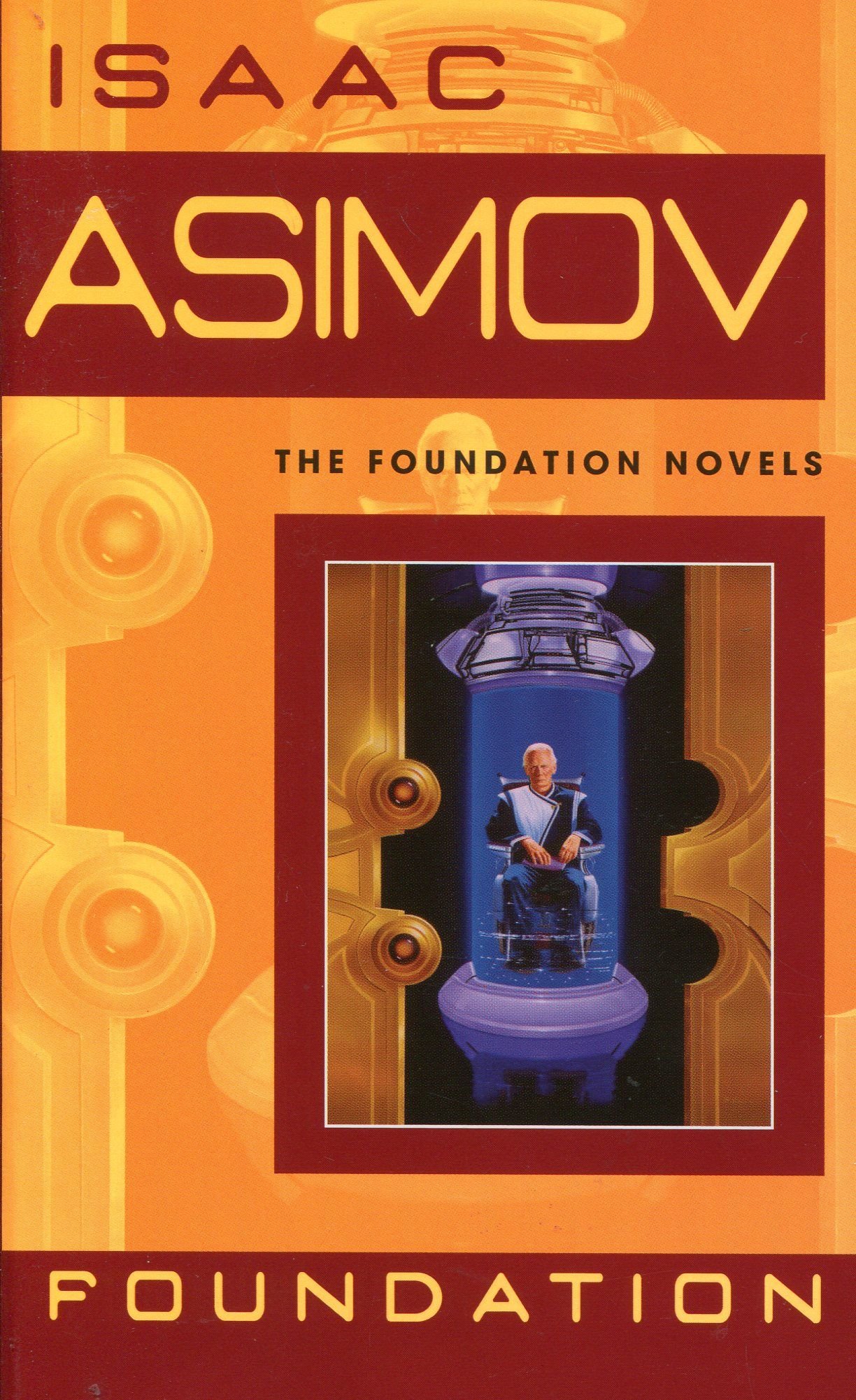
Isaac Asimov, Foundation, cover

A twelve thousand-year-old empire rules the galaxy; but Hari Seldon, inventor of a new science of “psychohistory” that statistically predicts the aggregate actions of human masses (as distinct from the acts of individual persons), realizes that the Empire is headed for an inevitable collapse.  Thirty thousand years of chaos and barbarism will follow.  But, while Seldon concludes the fall cannot be stopped, he does see a way to shorten the period of darkness.  He establishes two “Foundations” from which civilization may be restored more quickly—in a mere thousand years.  Seldon’s mathematics allows him to arrange things in such a way that the Seldon Plan will inevitably prevail—at least to a very high order of probability.

A few years ago I discussed the Seldon Plan in a post on “Prophecy and the Plan” (2018).  For a more detailed description, and one reader’s take on the novels, see Ben Gierhart’s 10/6/2021 article on Tor.

The original three books consist of a series of short stories taking place over about four hundred years.  There are some overlapping characters, but no character persists through the whole time period.  Part of the attraction of the series is the sweep of history over many lifetimes, giving a sense of scope and gravity to the combined stories.  Some of it comes from the age-old appeal of the fated outcome:  we know the Plan will prevail, but how?  And from the midpoint of the series on, a different question takes over:  if through a low-probability turn of events the Plan is in danger of failing, can it be preserved?

We do want it to be preserved, even though the (First) Foundation is composed of fallible and all-too-human people; because the great overarching goal of the Plan is the preservation of civilization in the face of barbarism.  I’ve noted before that this is a compelling theme.

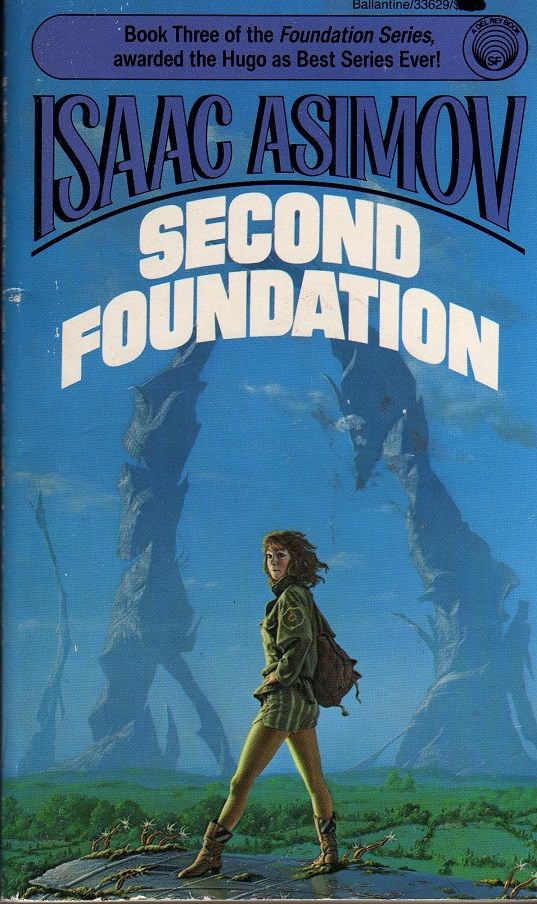
Second Foundation cover

Most of the original stories were first published individually in the SF magazines, and later collected into the aforementioned three volumes—Foundation, Foundation and Empire, and Second Foundation (1951-1953).  Then things got complicated.  In 1981, Asimov “was persuaded by his publishers” (according to Wikipedia) to add a fourth book, Foundation’s Edge.  Several more followed, in the course of which Asimov tied in the Foundation series with his other great series, the positronic robot stories.  The new additions in some ways sought to resolve issues in the original trilogy, and in others tended to undermine the originals.  After Asimov’s death, three other celebrated authors—Gregory Benford, Greg Bear, and David Brin—were recruited to write three more Foundation books.  In the last volume of this new trilogy, Brin manages to pull off a brilliant resolution of the whole series.  But even that conclusion didn’t stop the flow of further related tales.

And now, as if things weren’t already confusing enough . . .

Apple’s Augmentation

A screen adaptation of the series was announced in 2017, and Apple picked it up in 2018.  Asimov’s daughter, Robyn Asimov, serves as one of the executive producers.  The principal writer, David S. Goyer, foresees eighty episodes—none too many for such a vast saga.

The trailers (such as this one) made it clear that the look and feel of the TV series would be rather different from those of Asimov’s cerebral books.  That’s not necessarily a bad thing.  The original tales have become dated in both content and style.  The question is, can Apple preserve what’s appealing in the original stories, while bringing them to life for a modern audience?

We’ve now seen three episodes (the fourth premieres tomorrow).  That’s not enough to allow for a full evaluation of the series, of course.  But it’s fun to try and guess where it’s going and report on how it’s doing, even at this early stage.  If nothing else, there’s the entertainment value, later on, of seeing how wildly inaccurate my take on the story may turn out to be.  So let’s see how the adaptation stands as of the third Foundation episode.

Emperors Demand Attention

Gaal Dornick, reimagined for Apple, with the Prime Radiant

As of Episode 2, I was favorably impressed.  Scores of details had been changed from the books, but often in interesting ways.  For example, Asimov’s cast of characters tended to be almost all-male—although the latter half of the series did include two distinctive female characters with strong agency, Bayta Darell and her descendant Arkady Darell.  The TV series diversifies the cast considerably.  Seldon’s protegé Gaal Dornick is now a black woman.  So is Salvor Hardin, the first Mayor of Terminus and leader of the Foundation.  The technology and culture of the Empire looks pretty convincing on-screen, though it doesn’t exactly track Asimov’s descriptions.  Goyer & co. introduce some up-to-date speculative ideas, such as the notion that the succession of Galactic Emperors at this time is a series of clones—though there’s no obvious reason for that last, other than to modernize the hypothetical science a bit.

The third episode, though, seems to veer away from Asimov’s basic underlying concepts.  However interesting Goyer’s repeating Emperors might be, I expected us to shift away from them as the Foundation itself took center stage.  But Episode 3 continued to focus a great deal of attention on the Emperors.  This seems to run counter to the underlying theme that the Empire fades away as other players become ascendant on the galactic scene.  I don’t know why we’re still spending so much time on the Emperors, unless they’re going to play a larger continuing role than the books would suggest—which makes me wonder what else is happening to the plotline.

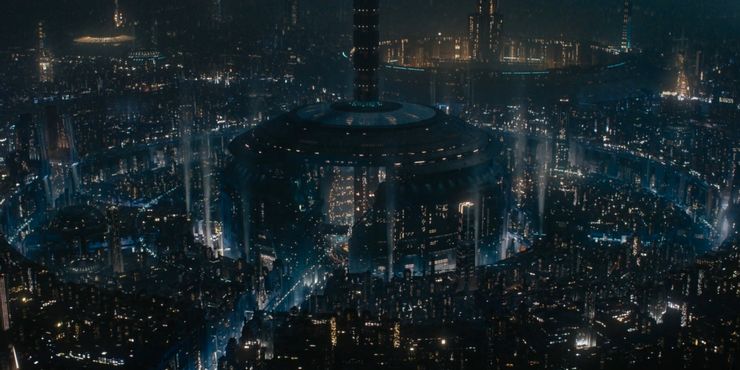
The world-city of Trantor

Science and Mysticism

Asimov’s story, while engrossing, was essentially rationalistic.  Historical events had logical explanations (generally laid out explicitly by the characters after the crisis had passed).  Science, whether technological or psychological, was a dominant theme.  And the key to the whole Seldon Plan concept was that the course of history is determined by economic, cultural, and sociological forces, rather than by any individual’s actions.  One might agree or disagree with that premise, but it was the (I can’t believe I’m saying this) foundation of the whole original series—even though Asimov himself found a way around what might have become a stultifying predictability with the unforeseen character of the Mule.

The video adaptation points up a number of elements with a more mystical quality.  The Time Vault, which in the books is merely a recording of speeches about historical crisis points by the long-dead Seldon, in the TV series is an ominous pointed object hovering unsupported over the landscape of Terminus; we haven’t yet seen what it does.  The “Prime Radiant,” a sort of holographic projector containing the details of the Plan, is presented as a unique and numinous object—though that is, to be sure, a genuine Asimov detail, albeit in a different context.

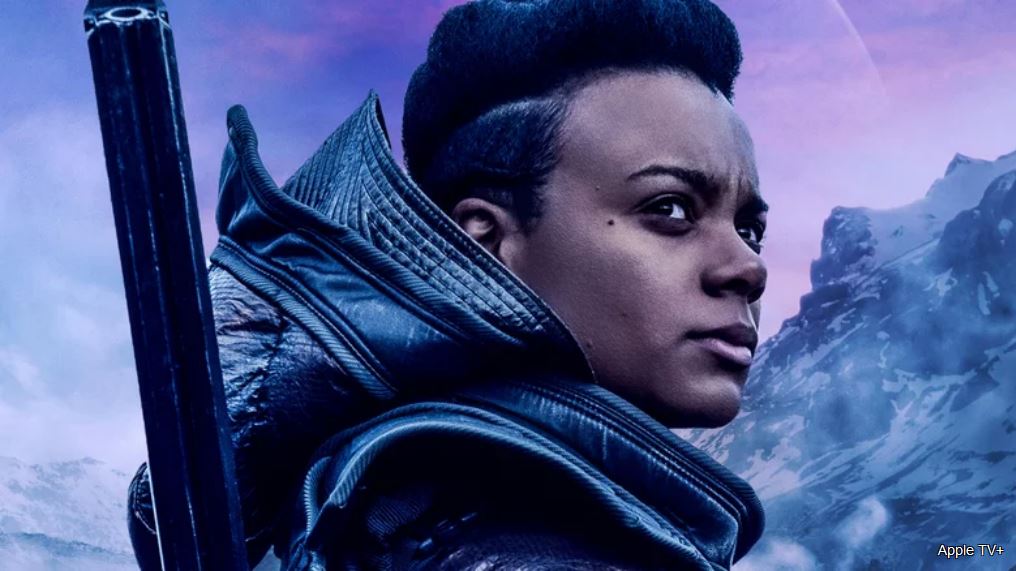
Salvor Hardin, a la Apple

More significantly, Salvor Hardin, a likeable if devious political schemer in the original stories, here appears to be the “Warden” of the Vault, a sort of Obi-Wan Kenobi figure who lurks in the desert.  In Episode 3 we see her set apart even as a child; as an adult, she’s the only person who can pass through the protective field around the Vault that repels all others.  One character even suggests that she may have been somehow included in the Plan.

Now, this invocation of the “Chosen One” trope is directly antithetical to the notion that history is shaped by statistical aggregates and social forces.  Seldon’s Plan, by its nature, cannot depend on the unique actions of individuals.  Even when Asimov introduces the Mule as a mutant with mental powers that can change the large-scale behavior of human populations, that’s presented as disrupting the Plan, ruining Seldon’s statistical predictions.  To have personal qualities written into the Plan itself would undercut the whole idea.  Thus, at the end of Episode 3, I’m wondering whether the TV series is going to carry through the basic Asimovian premise at all.

The Expanded Universe

The sequels to the original trilogy, first by Asimov himself and then by others, took the book series off in somewhat different directions.  I’d been wondering whether the TV series would incorporate the whole “Robots and Empire” connection, or stick to the earlier structure.  To that question, at least, we seem to have an answer.

Eto Demerzel (Daneel Olivaw)

A recurring character in the first three episodes is a woman, an advisor to the Emperors, who turns out in one scene to be a robot.  I hadn’t caught her name at first, and had to look it up in the cast list.  She turns out to be Eto Demerzel (male in the books), who is really the very long-lived robot R. Daneel Olivaw, operating under an alias.  Daneel is one of my favorite characters in the early robot novels The Caves of Steel and The Naked Sun.  In Asimov’s later stories he assumes a much greater importance in shaping the whole course of galactic history.

So it appears that Goyer’s version of the Empire’s history does incorporate Asimov’s later expansion of the Foundation universe, at least to that extent.  It will be fascinating to see how far the writers take that connection—in particular, whether the “second trilogy” contributions of the “Killer Bs” (Benford, Bear, Brin) also figure into the plot.  We’re not likely to see those ultimate developments for years (in real time), though, if the eighty-episode prediction is accurate.

Not A Conclusion

We’re still very early in the development of the Foundation video series.  Tomorrow’s episode might overturn half my speculations here and send us off in an entirely different direction.  But in the meantime, it’s fun to go over what we’ve seen so far and where it seems to be going—even if the secret plans of the screenwriters are as mysterious to us as the Seldon Plan is to the Foundation itself.

Next Stop—Anywhere

Last time we talked about the sequels to the movie Tangled.  But I didn’t say anything about the music.  One song in particular deserves a comment of its own.

Music in the Movies

Rapunzel and Eugene in boat, in Tangled

“I See the Light”

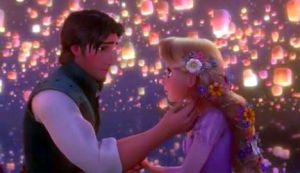
Disney generally gets good composers to do the music for its major movies.  Tangled was especially productive; I already had on my playlists the charming love song “I See the Light” (video here), and the end-credits song (is there a name for that niche?), “Something That I Want” by Grace Potter.

The theme song for the TV series actually premiered in the short film Tangled:  Before Ever After.  “Wind in My Hair” deftly expresses Rapunzel’s excitement as she anticipates continuing to discover the wide world outside her tower—the “endless horizon.”  And there’s a bit of humor in the title:  who, after all, is more suited to having the “wind in her hair” than Rapunzel?

Put On Your Sunday Clothes (movie) dance number

“Put On Your Sunday Clothes”

“Wind in My Hair” falls into a category that TV Tropes calls “Setting Off Songs,” like “We’re Off to See the Wizard,” or “Put On Your Sunday Clothes” from Hello, Dolly!.  There’s always a certain excitement when people are getting started on a journey, be it an epic trip to the Emerald City or just a Sunday jaunt to New York City.  In keeping with Rapunzel’s character, “Wind” is upbeat and optimistic, adding to its charm.

But Rapunzel has much farther to go than we see in the short movie, or the first season of the series.  Most of those stories remain inside the Kingdom of Corona.  It’s at the beginning of the second season that Rapunzel and company set out into the real terra incognita outside the kingdom.  And at that point we get yet another expeditionary song, one that simply knocked me over.  Hence the inevitable reflection:  why do I love this song?

“Next Stop, Anywhere”

“Next Stop, Anywhere,” by Alan Menken and Glenn Slater, is a Setting Off Song squared and cubed.  It appears initially in Season 2, Episode 1, at about 3:23.

Next Stop, Anywhere:  video

Next Stop, Anywhere:  lyrics

Rapunzel has a mission:  to backtrack the ominous black rocks that began to appear in the short film.  The prologue to S2E1 gives us some rather grim history hinting at what she’s going to find.  But when we flick back to Rapunzel and her True Companions in the present day, she’s mostly excited about venturing into the outside world (“It’s our first big city outside of Corona!”).

Rapunzel leaps from the caravanThe song starts with a fast, steady beat, and a series of flute trills, which suggest movement and vigor along with the sunny lightness characteristic of our heroine.  The visuals of a hummingbird and a field of flowers reinforce the musical cue.  Rapunzel leaps out of their ambling caravan and races around in a montage, observing the heavens, using her hair to climb a giant tree, dashing off her signature paintings, turning cartwheels.  The refrain comes in with a bouncy drumbeat that bears out the lyric:  where might we be going next?  Anywhere!

The steady beat continues throughout the following mix of dialogue and singing.  Rapunzel’s enthusiasm is indomitable.  Her romantic interest Eugene is not quite as keen on following “a bunch of creepy rocks” into the unknown; but at Rapunzel’s wry loving look, he has to admit that of course he’s excited:  “I’m with you!  What else could I be?”  He alternates lines with her in the next verse, and they both participate in the next series of acrobatic misadventures.  The theme of first love is an additional source of excitement.

Cassandra and the wild horsesThe pointy black rocks turn up from time to time as they cross the landscape, but Rapunzel and Eugene ignore them; at this point their grim purpose seems trivial.  That theme of leaping over the difficulties to focus on the adventure is refreshed when the caravan, driven by the wary Cassandra, catches up with them (2:05).  Cass admonishes Rapunzel for running off and warns her that “the real world isn’t all fun and games.”  Doesn’t matter.  The song resumes, and even Cassandra can’t resist singing a line or two.  Rapunzel is going to seek out her destiny, but that will cause her to grow:  “find the best in me.”

The Reprise

As the canny viewer may have expected, Vardaros, the “first big city” they encounter, falls disastrously short of expectations.  One character narrowly dodges death, and another, marriage.  The mystery warrior Adira turns up with more ominous warnings about where they’re going.  They’re not ready to move forward again until the end of the second episode (listed on the Web pages as Part II of Episode 1).  (Actually, they spend another couple of segments in Vardaros anyway, but the reprise of “Next Stop” occurs in the second episode at about 20:50.)

Next Stop, Anywhere (reprise):  video

Next Stop, Anywhere (reprise):  lyrics

Rapunzel and Eugene, hands joinedThe music starts with a tensely suspended organ tone.  Then, over a somber bass note, Eugene begins singing more slowly—but his words are expressing determination to continue.  Rapunzel joins in, and they clasp hands.  As the music speeds up and brightens, they invoke their faith in each other.  By the time we reach the refrain, we’re back to full speed and full strength.  The “with you close to me” line expands visually to include Cassandra and the others:  they can overcome the coming obstacles with not only the power of love, but the power of friendship.  Even the serious aspects of the journey give way to the boundless exuberance with which the original song started.  The music, as well as the lyrics, firmly rejects somberness in favor of joy—like the opening passages of the fourth movement of Beethoven’s Ninth Symphony:  not by ignoring the dangers and difficulties, but by acknowledging and surpassing them.

“Out There”

The theme of exploration and discovery is a favorite of mine, and the Setting Off Songs tend to live and move in that theme.  “Out there . . .” is exactly how “Put On Your Sunday Clothes” begins.  We don’t yet know what’s out there, but we’re eager to find out.

The theme isn’t confined to songs, of course.  The iconic opening of the original Star Trek series and its Next Generation sequel hit exactly that note, invoking the “sense of wonder” SF is famous for:  “The final frontier . . . To seek out new life and new civilizations.”  To my mind, the intro to the “Star Trek:  Enterprise” series is even better, with its sequence of daring steps in exploration (real and fictional) over inspiring music.  Similarly, the best scene in the unfortunate first Star Trek movie occurs at the very end, at about 1:30 in this clip.

Kirk gazes forward, ending of Star Trek IKirk:  Ahead warp one.
Sulu:  Warp one, sir.
Helm:  Heading, sir?
Kirk:  (pauses)  Out there. . . . (motions vaguely)  Thattaway.

‘Let’s see what’s out there.’  That attitude, it seems to me, is highly to be prized:  with the sense of incipient wonder, the expectation of finding amazing things, and some degree of confidence in our ability to deal with them.  (Chesterton said, “Man must have just enough faith in himself to have adventures, and just enough doubt of himself to enjoy them”—Orthodoxy, ch. 7.)

It’s important that we be able to see the trials and perils of life as an adventure, not merely an imposition.  That attitude is one of the essential factors in a mature human personality, and it merits perennial refreshing and reinforcement.  That’s why “Next Stop, Anywhere” is so pleasing:  it hits just the right note.

And besides, it’s a cool song.