Christmas Comfort Viewing

Christmas ornaments, candles, bow

    Image courtesy Pixabay

A couple of years ago, we talked about “comfort reading” at Christmastime.  “Comfort viewing” is, of course, just as vitally frivolous a concern.  What kinds of shows are good to watch at the holiday season?

Tone and Timeliness

I’m going to use the term “movies,” because most of the ones I have in mind are theatrical-length.  But the category includes TV programs as well, from “novella”-type brief movies to the half-hour (minus commercials) Christmas specials.  Most of them are available on demand or on DVD in this day and age, so the old distinction between scheduled programs and view-on-demand is less important than it used to be.

Not all Christmas movies are comfort movies.  We’ve got plenty of more or less gloomy shows about dysfunctional families or Christmas catastrophes, too—TV Tropes collects some under the heading “Twisted Christmas.”

They don’t have to be literally disastrous.  I recall seeing Home for the Holidays (1995) some years ago and being surprised how generally unpleasant the story was.  Bill Murray’s variant on A Christmas Carol, the 1988 Scrooged, is a good deal darker and more horror-like than most such Dickens adaptations.  We’ve got action movies, which by definition are not soft and fuzzy:  Die Hard (1988) leaps to mind.  (Maybe there was something in the air in 1988.)  Searching “Christmas horror movies” kicks up quite an array of bloody holiday tales, with which I am (deliberately) unfamiliar.

That’s not what I want to talk about here.  The majority of Christmas flicks tend to be comforting on the whole, even though there’s conflict; they draw on the warmth, generous feelings, and general connectedness of this holiday.  As a colleague recently put it, they’re the kind of stories that “serve as an antidote to the evening news.”

If you want an action movie set at Christmas, by all means pull up Die Hard, or its sequel Die Hard 2 (1990); I like those.  But for purposes of today’s discussion, I’m going to assume we are aiming at heartwarming.

Connie Willis, A Lot Like Christmas, coverThe following are my own recommendations, of course, not a comprehensive survey.  You can find on Wikipedia a commentary on “Christmas by medium”; a list of Christmas films; and a list of TV specials.  For a more focused and informative survey, there’s a set of excellent lists at the end of Connie Willis’ collection A Lot Like Christmas (2017).

A Quick Taxonomy

There are several ways a movie can be appropriate to the season, depending on what sort of Christmasy you’re looking for.  I tend to divide them up this way:

  • Movies about Christmas
    • Religious
    • Santa-related
  • Movies that involve Christmas but whose focus is elsewhere; for example, Christmas romances
  • Movies that happen to be set at that time of year, but in which the holiday itself plays a relatively minor part; or that have particular scenes set at Christmas

All of these can be good, healthy holiday fare.  We may want one atmosphere for Christmas Eve, for example—and a rather different mood for New Year’s Eve.

The Nativity
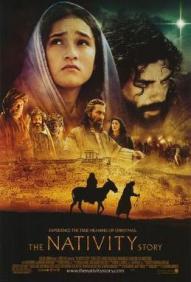
The Nativity Story, posterThere are probably a lot of video productions that depict the Christmas story itself—the birth of Jesus—but I’ve tended to rely on just a few.  2006’s The Nativity Story takes a straightforward approach, with empathetic characters, steering a middle path between excluding and emphasizing the miraculous—a good mix for contemporary sensibilities, to my mind.  Further back, Franco Zeffirelli’s 1977 TV miniseries Jesus of Nazareth contains in its early sections an appealing rendition of the Nativity chronicle.

Scene from Amahl and the Night VisitorsSlightly offstage from Bethlehem, so to speak, is an old favorite of mine, Amahl and the Night Visitors.  This brief opera was composed for television in 1951 by Gian Carlo Menotti; I have a DVD copy of the 1955 telecast in black and white.  Amahl is a young crippled boy whose wild imagination and enthusiasm soar despite the poverty in which he and his widowed mother live.  They are astonished one night to receive a visitation from three kings, following a star to find a different child.  The music is haunting and lovely; the story blends humor with deep feeling.

In the Spirit of Christmas

There’s a wider field of movies that have their roots in the original Christmas story, but capture the spirit of the feast in different ways.

Dickens’ A Christmas Carol is of course the most well-known example.  There are all sorts of film versions of the book, including those with Scrooges played by Reginald Owen (1938), Alastair Sim (1951), George C. Scott (1984), Captain Picard Patrick Stewart (1999), and Kelsey Grammer (2004, a musical).

Mr Magoo's Christmas Carol posterA favorite Christmas game is to re-do the story by casting favorite character ensembles, such as Mickey Mouse and friends or the Muppets, to play Dickens’ parts.  Or one can transpose the story into the modern day—I mentioned Scrooged above.  I must admit that, for me, the Carol that will always be the canonical screen version of the tale—chalk it up to ‘imprinting’ as a child—is the one featuring 1960s cartoon character Mr. Magoo.  Mister Magoo’s Christmas Carol (1962) has the distinction of being the first animated TV Christmas special.  It’s a surprisingly faithful rendition of the original story, using a lot of Dickens’ original language and managing to convey considerable seriousness, as well as comedy, with extremely minimal artwork.  The songs, by noted Broadway composer Jule Styne, are also remarkably effective.  Or so it seems to me—there’s bound to be a sizable nostalgia factor in my evaluation.
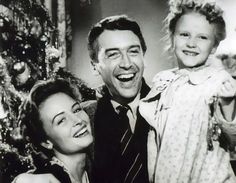
George Bailey, Mary, and Zuzu with tree, It's A Wonderful LifeAnother cluster of films springs from It’s A Wonderful Life (1946), which takes place at Christmastime and may constitute the very definition of “heartwarming” in America.  This story, too, has been adapted into innumerable variations in TV movies and series.  I like Wonderful Life, though I prefer to keep it to once every two or three years for fear it’ll become cloying.  And for some reason I think of it as a good show for New Year’s Day (still within the “octave” of Christmas).  Among the spinoffs, one of our family favorites (for grown-ups) is The Family Man (2000) with Nicolas Cage and Téa Leoni, a kind of reverse-Wonderful Life in which the main character is given a glimpse of how his life would have been better if he had made a different decision years ago—as a spur to making a new decision now.

Sometimes a spirit-of-Christmas movie may involve some kind of Christmas miracle—for example, Miracle on 34th Street (1947, remade in color in 1994).  Sometimes it simply involves a Christmas celebration:  A Muppet Family Christmas (1987) gains some of its abundant cheer from wacky Muppet-ish comedy, but more from being a kind of family reunion, including not only the familiar Muppet Show cast but also characters from Sesame Street, Fraggle Rock, and Muppet Babies.  I’d put the venerable Charlie Brown Christmas (1965) and the original TV special How the Grinch Stole Christmas! (1966) in the same class.

An honorable mention in this category goes to the infamous Star Wars Holiday Special (1978), which is so brilliantly awful that Lucasfilms (so I hear) has never allowed it to be commercially released as a recording; it’s only available in bootleg versions.  I’m not telling who gave me my copy.  It’s fun to see the familiar characters hamming it up in the context of a Wookiee celebration of “Life Day,” but beyond that, I wouldn’t advocate it for either sentiment or space opera.

Jewel in The Ghosts of Christmas Eve (Trans-Siberian Orchestra)I’m particularly attached to The Ghosts of Christmas Eve (1999), a 46-minute frame story for a series of songs by the Trans-Siberian Orchestra featuring Jewel.  The story, about a runaway girl who takes refuge in an abandoned theatre on Christmas Eve, is sufficiently sentimental to qualify; and if you are at all fond of TSO, you’ll love the music.  In particular, this is the show that includes “Promises to Keep,” which I tapped a couple of years ago for the Quote of the Week page.

The Santa Mythology

Many Christmas-specific shows, on the other hand, focus instead on our good friend Santa Claus.

This isn’t a bad thing per se.  There is, after all, still a connection:  St. Nick was, in fact, a saint.  But the system of amiable legends that’s gathered around Father Christmas provides ample fodder for drama (and comedy) without explicitly going back to those roots.

Rudolph the Red-Nosed Reindeer posterThere’s a class of TV specials that have, for us older kids, the pleasure of nostalgia, and also (as far as I can tell) still appeal to more recent generations.  The archetype may be Rudolph the Red-Nosed Reindeer (1964), the first of the Rankin-Bass animated holiday productions.  The Abominable Snow-Monster, the Island of Misfit Toys, and Hermey the elven-dentist have become familiar icons of of pop culture.  I also have some fondness for Frosty the Snowman (1969).  Santa Claus is Comin’ to Town (1970), a favorite in other branches of our family, gives us a novel sort of origin for Mr. Claus.  Full-scale live-action movies have also drawn on the Santa mythology.  I found Will Farrell surprisingly tolerable (playing off Zooey Deschanel’s sardonic romantic interest) in Elf (2003).  As I recall, Arthur Christmas (2011) wasn’t too bad either—though now that I look back at it, that one was CGI, not really live-action.

From there, we slide down a formulaic curve into routine holiday episodes of all sorts of TV series.  I’ll take Inspector Gadget Saves Christmas (1992) as a sample (my kids used to watch the rather amusing Inspector Gadget).  As a useful litmus test, any show that invokes “saving Christmas” is generally at the bottom of the barrel:  “saving Christmas” may be glossed as “ensuring that toys get delivered,” and signals that the primary concern has moved from anything important to mere presents under the tree.  Such episodes may be mildly entertaining, but won’t be comforting.  It’s hard to be heartwarming when the crucial issue in a story is just to make sure that nothing interferes with the distribution of toys.  Note that The Grinch was specifically designed to make the contrary point:  Christmas comes for the Whos of Whoville without any presents at all.

Rise of the Guardians posterOn the other hand, the Santa mythology can develop into something of real depth, depending how the author takes off with it (so to speak).  Our counter-example is Rise of the Guardians (2012, based on a series of books by William Joyce).  This tale actually manages to meld epic fantasy with a pop-culture undercarriage, as various eccentric holiday icons including the Easter Bunny and the Tooth Fairy, along with “Nicholas St. North,” collectively the “Guardians of Childhood,” battle the ‘Dark Lord’ Pitch.  The story has a genuine point, too:  the glad surprise of good gifts coming out of nowhere is presented as crucial to the innocent acceptance of childhood.  What’s at stake is the disillusionment of children, not just their asset inventory.

Guardians also features a genuinely Badass Santa (“Action Santa” division)—a Santa who’s not just jolly but rather formidable, like the Father Christmas who appears in The Lion, the Witch and the Wardrobe.  To combine high merriment with forceful purpose can make for an intriguing contrast.  (While researching this point, I was charmed to discover that in DC Comics mythology, Santa visits Apokolips to give Darkseid a lump of coal each year.  Here’s the actual graphic-novel scene.  Now that’s badass.)

Tangentially Christmas-Related

In the next ‘ring’ away from the center, we have movies that involve Christmas tangentially, but not as the main theme.  The holiday season casts a fireside glow, as it were, that invites other genial stories to blossom in its presence.  Romances, in particular, bloom here:  there’s nothing quite so sweet as a Christmastime romance.

White Christmas movie posterThis category may overlap with some of the spinoff movies above.  An iconic example is White Christmas (1954), which is good fun with an actual good deed (helping out one’s former commanding officer in the postwar era), as well as two romances, at its heart.  (If you want a sort of earlier prototype, with less plot but more holidays, you can alternate it with Holiday Inn (1942), where the song “White Christmas” actually originated.)

There are lots of more modern examples, which vary in the degree of the story’s connectedness with the holiday.  My favorites include While You Were Sleeping (1995), which I find endearing although for some reason it was never a great favorite with the rest of my family; Love Actually (2003)—any movie that plays “God Only Knows” over the final scene gets extra points in my book; The Holiday (2006), a kindly romantic comedy about two women who switch homes for the season and find love; Serendipity (2001), a far-fetched but enjoyable rom-com with John Cusack and Kate Beckinsale; The Sure Thing (1985), starring a much younger Cusack for the college-age set.  Christmas in Connecticut (1945) exemplifies the same sort of approach in a previous generation.

Further afield, we have a range of movies one can arguably justify as Christmas material for one reason or another.  Steven Spielberg’s 1991 Hook, an intriguing sequel to the Peter Pan story, is set at Christmastime.  About a Boy (2002), which seems intended to demonstrate that Hugh Grant cannot play an unlikable character, no matter how dubious that character may be, involves a Christmas setting.  The Shop Around the Corner (1940), a tale with which I feel a certain kinship for other reasons, has its climax on Christmas Eve.  Father Christmas makes a cameo appearance in the movie version of The Lion, the Witch and the Wardrobe (2005), as noted for the novel above.  Even Little Women, in its various film iterations, features Christmas scenes.

Hallmark Christmas Romances

The Hallmark Channel has created an entire cottage industry of Christmas romances in its annual “Countdown to Christmas” seasonal blitz.  It appears that Netflix, as with romantic comedies generally, has now decided to join the action, with a very similar look-and-feel (The Holiday Calendar, 2018); and the Lifetime channel has also entered the competition (Christmas Around the Corner, 2018).

If you don’t watch out, you can spend the entire season swimming in an ocean of these holiday love stories; if I’m counting this correctly, Hallmark alone produced 22 new shows this year, not counting those returning from previous years.  It’s hard to choose which ones to check out; they all sound much the same in the blurbs.  They don’t tend to be terrifically great or abysmally bad; to my mind, they tend to fall either just above or just below my usual cutoff criterion (namely, would I seek it out to watch again?).

Obviously, there’s a lot of repetition, but as usual, “Tropes Are Tools”:  it’s not whether you’re drawing on a well-established pattern, it’s how well you use it.  The standouts (those that land above the line) tend to have a little something more going for them:  perhaps especially engaging actors/characters, a little more plot complexity or depth, wittier dialogue, or the like.

Angels and Ornaments posterA couple of examples will serve to illustrate.  Angels and Ornaments (2014) features a particularly winsome heroine, and, in defiance of the traditional meet-cute, she and her opposite number have known each other all their lives.  They have to come to the realization that they’re meant for each other, a subtler and more interesting process than love at first sight.  To facilitate this process, we have a matchmaker angel, who, in the tradition of It’s A Wonderful Life, is not an angel strictly speaking but a dead human being—who has his own story and character arc.  His encouragement of the main characters’ romance is sometimes silly but reasonably believable; he gives them some sound advice.  The story also involves writing a song—not a tremendous song, but likable enough (as it recalls the movie) that I downloaded it for my audio playlists.  (You’ll note that I give extra points for music; you may or may not have the same reaction.)

A Christmas Detour (2015) gives us an engaging pair, apparently mismatched from the start.  They end up on a road trip together, along with a married second couple, when a snowstorm closes down an airport.  The main characters, Paige and Dylan, develop a relationship along the classic friction-then-affection lines (what TV Tropes dubs “Belligerent Sexual Tension”), and that development works pretty well.  Closure comes when the heroine finally arrives to meet her boring, snobbish fiancé’s equally off-putting parents, and finds (of course) that Dylan is who she really wants.  Meanwhile, the secondary romance—a long-married middle-aged couple that start out constantly sniping at each other (‘Like An Old Married Couple’), but become reconciled with each other via the Christmas spirit and the inspiration of watching the main characters fall in love—adds interest.

Sturgeon’s Law applies, as always—but some of the Hallmark ventures do make good, meat-and-potatoes holiday fare.

Conclusion

There are those who object to the “secularized” versions of Christmas that inspire many of the movies above.  But I see it the other way around:  Christmas is so powerful an idea that it casts a sort of penumbra on everything that comes close to it.  The stories that are not explicitly religious aren’t a distraction from the “true meaning of Christmas.”  Rather, they reflect the feast’s tendency, like a benign infection, to seep into and ennoble everything related to it.  (I wrote a song, about twenty-five years ago, to make just this point.)  The luster of Christmas gives an extra warmth, a heightened sweetness, to romance and toy-giving and every other good thing.  And who couldn’t use a little added warmth at this chilly time of year?

A merry Christmas to all, and to all a good night.

An Incredible Sequel

The Incredibles 2 movie posterSome quick, spoiler-free comments on The Incredibles 2, which I had a chance to see this weekend.

The First Incredibles

The original Pixar film The Incredibles (2004) is a great favorite of mine.  My fondness for superhero stories goes way back, and The Incredibles does an irresistible job of both exemplifying and spoofing the genre.  Moreover, it’s a character-driven story, little as one might expect that from a superhero flick.  It’s got a gallery of memorable characters—not just the family, but distinctive supporting cast members like Frozone and Edna.  And they change over the course of the tale in ways that are plausible, illuminating, and heartwarming.

The Incredibles is genre-savvy enough to be both worldly-wise and innocent.  It starts with a premise that borders on the cynical:  these costumed brawlers cause so much damage that a public outcry forces them to go underground and live normal lives, in a sort of witness protection program.  There’s a note of realism there that contrasts with the usual comic-book conventions.  We see it again when the business of creating the colorful costumes itself turns out to require expertise worthy of James Bond’s Q—giving us Edna Mode as an independent contractor (and style maven).

This issue of collateral damage seems to have preoccupied superhero movies a lot in recent years.  It’s a primary plot driver in both Captain America:  Civil War (2016) and Batman v. Superman (2016).  But The Incredibles was there first, twelve years earlier.  What that says about contemporary attitudes is something at which we may want to take a closer look, another time.

The New Incredibles

Incredibles 2, family in force fieldThe first question that arose when a sequel was announced was, where do they go from here?  Of course, superheroes are almost by definition open to continuing adventures.  And The Incredibles ended with an obvious starting point for another story:  the appearance of a new villain, the Underminer.  But at the end of the first movie, the character arcs, the development of the main characters, had all been neatly completed.  Could the director and screenwriters come up with something equally good from that starting point?

The answer was always:  if anyone could pull that off, it’d be Pixar.

I enjoyed The Incredibles 2 immensely.  I’ll have to let it settle for a while to evaluate how it stands with respect to its classic predecessor.  But the movie is a lot of fun, and it manages to carry forward a story that’s consistent with the first movie, yet departs from it enough to avoid simply repeating the original.  As we’ve seen, this a tricky business.

Despite the fourteen-year gap in realtime between the first and the second movie, the latter picks up exactly where the former leaves off, with the appearance of the Underminer.  This tunnel-drilling villain is an obvious shout-out to Marvel’s Mole Man, who was introduced in the very first issue of The Fantastic Four.

Since the Incredibles have always been a kind of retake of the F.F., the Mole Man connection has a pleasing nostalgia aspect for the long-time comic-book fan.  There’s a similar homage to the F.F. in Kurt Busiek’s Astro City comics—a superhero group called the “First Family.”  (Their last name is actually “Furst,” making them another instance of the proverb that the last shall be Furst, and the Furst shall be last.)  Busiek, incidentally, may have been the first graphic novelist to highlight the collateral damage question; the matter of “everyday life in a superhero universe” is treated not only in Astro City (which started in 1995), but also in his revisiting of the Marvel universe, the limited series Marvels (1994).

Time and Tide

The time lapse (realtime) between Incredibles 1 and 2 is less disruptive than one might imagine, because both movies are set in an alternate past, not in our present.  One article concludes that the main action of The Incredibles takes place in 1962, based on a newspaper date.  This fits with the fact that Brad Bird’s inspiration for the film came from the comic books of the 1960s.  The time period is visible in the charmingly retro designs of the homes and cars in the original movie, not to mention the big rocket used by the villain.

So we’re not disturbed by the fact that the characters in The Incredibles (1 or 2) don’t carry around cell phones or use personal computers.  There are, of course, computers and other high-tech devices in both movies.  But this is consistent with the standard comic-book depiction of advanced technology in the hands of certain individuals or groups, as opposed to the society as a whole.  (This convention also applied in other adventure stories, like the Saturday morning cartoon Jonny Quest, one of my childhood favorites, which makes a brief appearance onscreen in The Incredibles 2.)  We might see high-powered computers and such in the Batcave, or a villain’s lair—or even in some hidden country, like Marvel’s Wakanda (which first appeared in 1966).  But these were always “islands” of high technology, having no effect on the technological level of the overall culture.

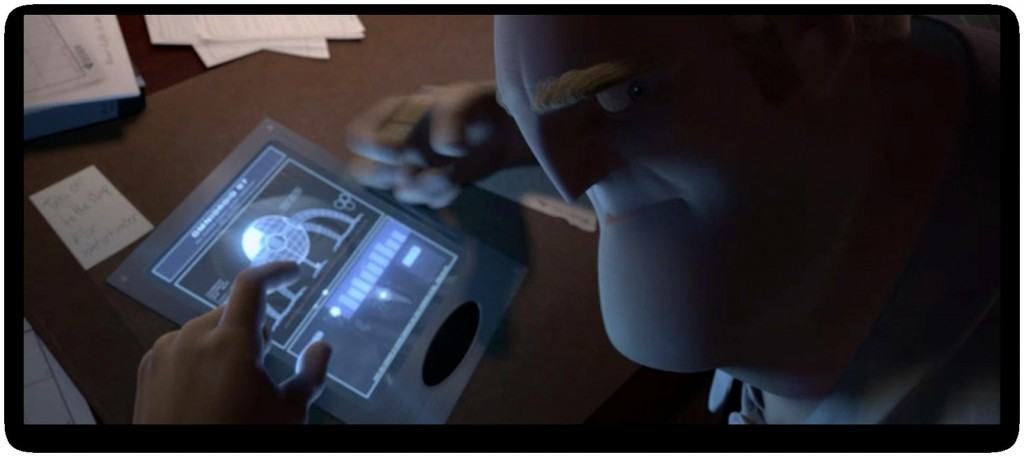
Mr Incredible with Mirage's tablet messageThere is a subtle difference between the 1960s depictions of advanced technology and what we see in the Incredibles movies, which may throw us off a bit.  A 1960s-era imaginary supercomputer looked like an extrapolated version of 1960s-era mainframe computers.  One thinks of old James Bond movies showing computers ornamented with slowly rotating tape drives, which now look ludicrously anachronistic.  But this nostalgic re-creation of 1960s-era high-tech has the advantage of knowing how the future actually turned out.  Thus, in an early scene from the first movie, Mr. Incredible is tracking a car chase in his Incredimobile—and the electronic tracker looks not unlike a GPS, albeit one with primitive graphics.  When Mirage sends a “This message will self-destruct” recording to Bob, it’s on a tablet strangely reminiscent of a modern iPad.  In effect, the movie designers are reimagining the imagined future of the 1960s, by reference to the actual future (our present).  The mind boggles a bit.

All in all, The Incredibles 2 does a very good job of resuming the story fourteen years later with a minimum of retcon.  Compare Back to the Future II, which required a distinct revision of the closing scene from the first movie, only four years after episode 1 was released.

Managing the Handoff

There were a couple of things I didn’t quite expect in the transition from the end of episode 1 to the beginning of episode 2.  But they weren’t really retcons—more like things I’d assumed at the end of The Incredibles that turned out not to be quite so simple.  These aren’t really spoilers, since they become apparent almost at once in the new movie.

Incredibles 2, family chargingThe Parr family and Frozone are publicly acclaimed for defeating Syndrome in episode 1, but that doesn’t mean they’re out of the woods yet.  The anti-supers law still hasn’t been reversed.  When the story was wrapped up in a single movie, we would reasonably assume that such things would automatically be resolved after the movie ended, just as we assume that the main characters’ romance will proceed swimmingly when a movie fades out on a kiss.  But there’s still work to be done on society’s acceptance of supers in The Incredibles 2.

Then there’s baby Jack.  We saw Jack exhibit a variety of assorted superpowers in the first movie and the associated short subject (“Jack-Jack Attack”).  But his family didn’t quite see that; they don’t yet know he has superpowers.  Of course, as the trailers make clear, they find out pretty soon . . .

Conclusion

I heartily recommend the sequel; most fans of The Incredibles should enjoy this follow-up.

And one bit of practical advice for the moviegoer:  the closing credit graphics are entertaining, but there’s no need to wait around for the very end.  Our 1960s-ish superhero family has not yet adopted the modern practice of putting a “stinger” scene at the conclusion of the credits.

Worldwasting: Ragnarok and The Last Jedi

Recently, as the DVD releases became available, I re-watched Thor:  Ragnarok (Thor 3) and Star Wars:  The Last Jedi (Star Wars VIII, “TLJ”).  I enjoyed both movies very much.  But each takes a direction that leads to some reflections on the fine art of worldbuilding.

Making the World

World in geometric pattern (worldbuilding)F&SF writers talk a lot about “worldbuilding”:  constructing a whole background for your story, an imaginary world.  Other kinds of fiction also do some of this. A romance or a Western or a mainstream novel may take place in a fictional town, let the characters eat at an imaginary restaurant, have a marketing maven write slogans for a nonexistent product.  But fantasy and science fiction require the author to invent much more and take less for granted.

Worldbuilding is a fascinating exercise that can become an engrossing end in itself.  We can spend hours on developing languages or family trees or maps.  Tolkien (of course!) famously referred to this process as “sub-creation,” analogous to the creative power of God.  (On Wikipedia, “sub-creation” redirects right back to the main page on worldbuilding.)  There’s even a Worldbuilding Magazine and a Reddit subsite for “sharing your worlds and discussing the many aspects of creating new universes.”

But the primary purpose of worldbuilding in fiction is to provide a background for the story—one with enough depth and verisimilitude to aid the reader’s “willing suspension of disbelief.”  The fictional world is most of all a resource for the story.

. . . And Unmaking It

But a resource can also become a constraint.  Every decision you make for a world limits what you can do later.  If I’ve placed a mountain range here, I can’t put a flat desert in the same place.  If my main character’s father is a heroic pilot, he can’t also be the threatening villain.  (Er, or maybe he can—with enough feverish “retconning” to patch the gap.)

The more the world accretes additional detail over a series of books or movies, the more it may become a confining “Procrustean bed” to which later stories must be fitted.  The problem reaches its height in comic book series, where the same characters’ adventures may run for decades, at the hands of many different writers and artists.  The characters’ backstories and the background details eventually are almost bound to become a “continuity snarl,” with so many contradictory elements that no one can figure out what’s going on any more.  The authors or producers can be driven to “reboot” their world—start over from scratch—as a desperate way to clear up the mess.Colorful spiral

Even if things doesn’t reach this pass, however, a writer may want to get rid of some pre-existing elements.  Maybe they’ve just gotten boring:  who wants to see the same character angst and relationship issues recur over four hundred episodes?  Maybe an old bit of worldbuilding or character history would get in the way of an appealing new development.  Maybe the writer just wants to emphasize how big and menacing a new threat is by having it destroy something that seemed like a fixture of the universe—or simply shock the reader by defying those status quo expectations.

Alongside the draw of building out an ever more fine-grained world, then, there’s a corresponding temptation to tear things up and make radical changes.  In search of greater drama, let’s go all the way!

Such dramatic reversals can be productive.  Sometimes the status quo has become boring and needs to be upended.  But it’s a dangerous enterprise.  The built world is our resource.  The reader’s or viewer’s attachment to characters, enjoyment of well-established locales, and appreciation for long-running history provides a good deal of the continuing interest for the audience.  We risk throwing that away, piece by piece, if we throw away large chunks of the world-background unwisely.

Bags of seed cornThere’s a problem known as spending your capital, or “eating your seed corn.”  If you have to use up the resources necessary for the next step or the next generation – consuming the seed you need to plant for next year’s harvest – the needs of the moment may imperil the chances for longer-range development.  The worldbuilding “resource” represents the capital the writer has on hand to engage readers and develop the story.  It has to be invested wisely.

We’re finally ready to look at the two movies I mentioned—and, unavoidably, to warn—

Here Be Spoilers!

Thor:  Ragnarok

Thor: Ragnarok movie posterFirst, a qualification.  Both of these movies are middle pieces:  we don’t know how the stories end.  (Ragnarok’s “sequel” is Avengers:  Infinity War—and we’ll find out how that develops later this week.  For TLJ, we’ll have to wait for December 2019.)  So we can’t yet fully evaluate what the authors are doing.  But both spend their worldbuilding capital rather freely.

Ragnarok’s villain is Hela, queen of the underworld.  She’s powerful.  How powerful is she?  The first thing she does upon entering Asgard is to kill Fandral and Volstagg, two of the beloved “Warriors Three” that comic-book readers have been following since 1965 and movie viewers since the original Thor.  (The third warrior, Hogun, meets his end a few scenes later.)

Hela wipes them out without breathing hard.  Does that prove her sufficiently badass?  Sure.  Is it a fitting end for such long-standing heroes?  It seems rather abrupt—not even time for memorable last words.

More important, the summary termination deprives the series of those three characters for later stories.  That’s a loss.  If any young ladies were swooning over the dashing Fandral, they will swoon no more.  We won’t see Thor’s three battle buddies at the climactic engagement of the Infinity War.  Of course, given the enormous number of major characters Marvel already has to accommodate somehow in Infinity War, maybe reducing the count by three is seen as an advantage.  But the Marvel Cinematic Universe has lost some potential energy.

Hela crushes Thor's hammerThor’s iconic hammer Mjolnir is featured prominently in the opening scenes of Ragnarok—so it can be caught and shattered by Hela when Thor first meets her.  While Thor (as Odin dryly points out) is not defined by his hammer, it’s his characteristic weapon, and we’ve been shown many times that no one else can even lift it.  Again, Hela’s casual treatment of Mjolnir is startling enough to establish her threat level.  But it’s hard to picture Thor going through the remaining battles of the Cineverse arc without his trusty hammer.

By the end of the movie, Asgard itself is destroyed, and the surviving Asgardians are setting out to find a new home.  While the moment is certainly moving, the universe is a little poorer for the absence of the classic afterworld so brilliantly realized in Thor’s scene design.

Most strikingly, Ragnarok essentially drops the romantic element that’s played a significant part in the story so far.  It appears Thor has simply broken up with Jane Foster (or vice versa)—an ignoble offstage end to what we were to regard as a serious love affair.

Sif (comics)Now, those of us who remember the original comics might be content enough to have Jane replaced by Sif, who, after all, was Thor’s wife in the mythology—and whose interest in Thor was specifically established in the Agents of S.H.I.E.L.D. TV series.  But Sif is also absent, and we don’t even hear an explanation.  It’s possible these two characters were cleared away to make room for a potential romance with the new character Valkyrie (Brunnhilde).  But we don’t really see any sparks fly or bonds form for Thor and Brunnhilde in Ragnarok.

The MCU has backstory to burn, and it’s still quite possible that these will turn out to be resources well spent to build dramatic potential for the overall Avengers plot arc.  One hopes so; a world is a terrible thing to waste.

The Last Jedi

Star Wars: The Last Jedi movie posterThe Force Awakens knocked out one of the pillars of the Star Wars universe by “expending” Han Solo.  That was surprising, but not alarming.  These original-trilogy characters have lived full lives (if not entirely satisfactory ones).  We expect them to give way to the new generation of main characters.  It wasn’t startling to see another New Hope stalwart bite the dust in Episode VIII.  But TLJ goes considerably further than that.

It seems pretty clear that Luke has shuffled off this mortal coil at the end of TLJ:  he’s preformed the Jedi-master trick of evaporating out of his clothing, like Obi-wan and Yoda before him.  We can expect to see him again as a Force ghost, but not to do anything except offer sage advice.  (On the other hand, the ghostly Yoda seems to have called down lightning to burn up the old tree—a more direct intervention than we’ve seen a departed Jedi accomplish before.)

In addition, we won’t see Leia in Episode IX; the character is still alive at the end of TLJ, but is sadly now subject to what TV Tropes has called “Actor Existence Failure.”  That eliminates all three central characters from the first Star Wars picture.

We have the new characters to carry us forward.  But in several ways TLJ weakens their potential plot energy as well.  The most important issue, of course, is Rey and her parentage.

Rey cries out to departing spaceshipRey’s origin probably excited more speculation than any other topic between Episodes VII and VIII.  The solution presented in TLJ is brilliant, in its way:  Rey’s parents are nobodies, uncaring drifters who sold her to a junk dealer for drinking money.  Director Rian Johnson’s solution succeeded in surprising us, since it avoided all the plausible speculations fans had offered over the preceding two years.  More important, this revelation strikes at the heart of Rey’s stubborn, anchoring belief that her parents would return for her someday.  It would be a major character issue to see how she deals with the blow—if we get a chance to see it; she was in the middle of a major battle at the time and there was very limited opportunity to see how she was taking the news.

We should pause to consider whether Kylo Ren was telling Rey the truth, or presenting a lie designed to play on what he’d just called her weakness.  She says she recognizes the truth of his statement at some level herself (reminiscent of Luke’s reaction to Vader in Episode V).  But in her state of confusion, that may not be decisive.

On the other hand, there are a few things that don’t fit well with Kylo’s claim.  In the Force Awakens (“TFA”) flashback scene, we saw young Rey crying out to a departing spaceship.  Would these poor, anonymous drifters have been likely to own a spaceship?  And it’s always been a bit mysterious how the young Rey, if she was essentially a slave to Unkar Plutt without any family connections, was somehow allowed to buy herself free (presumably) and attain even the subsistence life of a scavenger in which we first see her.  It could turn out that the real truth is yet to be revealed.

But I consider that a long shot at best.  Like “I am your father,” the “nobodies” option is simply too good a narrative move to throw away.  It subverts the “Chosen One” theme that’s been running in Star Wars since the beginning, bringing us closer to a more Lord of the Rings-like “democratic” trope.  That shift in attitude is consistent with several moves in TLJ, including the introduction of Rose, the change in presentation of the Force, and especially the wonderful scene at the very end.

If we do accept Kylo’s description of Rey’s parents, it dissipates a lot of potential interest.  There are no hidden connections to be discovered; the mystery is no mystery, but an anticlimax.  There are no further plot developments to follow on Rey’s parentage.  That highly-charged element of TFA simply seems to have been abandoned—dare I say wasted?

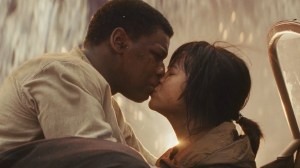
Rose kisses FinnAs with Ragnarok, romance also seems to be relegated to a minor role.  TFA gave us a fascinating relationship between Rey and Finn that seemed to be developing toward a romance.  But they’re separated for most of TLJ, and meanwhile another well-wrought character, Rose Tico, is lined up with Finn.  After Rose tells Finn she loves him, we get a final scene in which Rey rather ruefully turns away from seeing Finn tenderly tucking in the near-death Rose (although Finn himself hasn’t made any declaration yet).

If Rey doesn’t fall in love with Finn, who else is there?  There’s no sign of any mutual interest with Poe, and if she were going to converge with Kylo (as I’ve occasionally feared), the place for that would have been during their mutual battle on Snoke’s flagship—and no romantic move was made.  Like Luke, Rey may be meant for a single life.  There’s nothing wrong with that per se—but declining the potential for romance is, again, letting a degree of character interest fade away.

Finally, there’s the Force itself.  That’s always been a tricky concept, right back to A New Hope—something worthy of more specific discussion one of these days.  But whatever tricks TFA added to the repertoire, TLJ seems to take away.

Does the Force have purposes?  Does it act on its own?  There are things in the original trilogy (IV-VI) that suggest it might.  And in Episode I, we were told that that Force apparently engendered little Anakin Skywalker without even requiring a father.

The title of the series’ revival in Episode VII, The Force Awakens, suggested that Something Big was happening, with its source in the Force itself.  But two movies later, I still have no idea what “an awakening in the Force” is supposed to mean.

J.J. Abrams built up the potential for some kind of revelation in TFA.  But in TLJ, Johnson seems to dissipate that anticipation entirely.  Yoda’s new instruction appears to be that the Force doesn’t act on its own, we simply use it as we will.  Frankly, in a way I like that approach better:  the notion of the Force moving us around like puppets for its own purposes was a bit creepy.  However, our expectation of some revelation about an “awakening” seems to have been scuttled.  Again, it’s not that the new plot development is bad; it’s that the worldbuilding set up by previous episodes seems to be ignored or undone by the most recent film.

Conclusion

Good worldbuilding and plot development are like winding up a spring:  you’re infusing energy into the system that can later be released to power the narrative.  These two recent stories seem to have the opposite effect:  they’re blowing off steam, releasing pressure, without fully utilizing that energy to enhance our interest.

Since we have yet to see how either story line comes out, it’s also possible that my comments could be entirely mistaken:  the apparent untwisting of plot potential may be twisting up new possibilities that aren’t visible yet.  We’ll have to wait and see; that’s the fun of it.

High School Musical: Or, Artful Trope-Wrangling

High School Musical posterIn this season of festive frivolity (and guilty pleasures), what could be more frivolous than the Disney Channel TV movie “High School Musical”?

Yet there may be a few interesting words to say about it.

The Phenomenon

If by some chance you’re not familiar with HSM, the Wikipedia article has a detailed description of the production, plot, and characters.  You can brush up there; I’ll wait.

Since the early 1980s, the Disney Channel has produced a formidable list of original made-for-TV movies, generally aimed at a tween-to-teen audience.  Few of them make much impact on the general moviegoing public, though a number of actors and musicians have gotten their start in the “DCOM” venue.  But every now and then one finds something more substantial among the fluff.

Such surprise successes are not unknown among more adult movies.  No one expected Casablanca to become a film classic when it came out in 1942.  It’s A Wonderful Life, with disappointing results in its original 1946 release, became a beloved holiday heartwarmer in the 1970s.

Disney didn’t expect anything extraordinary from HSM, either.  But the movie was a whirlwind success in its target age group.  Disney, always ready to strike when the iron turns out to be hot, followed up the original HSM not only with the conventional TV sequel but also with a third episode that was released in theatres—“the first and only DCOM to have a theatrical sequel,” according to Wikipedia.

When HSM premiered in 2006, I had a daughter at the right age to be interested; that’s how I came to see the show.  But I was favorably impressed.  As lighthearted romantic fluff goes, this venture was pretty enjoyable.

Clearly, the HSM team did something right.

The Chemistry

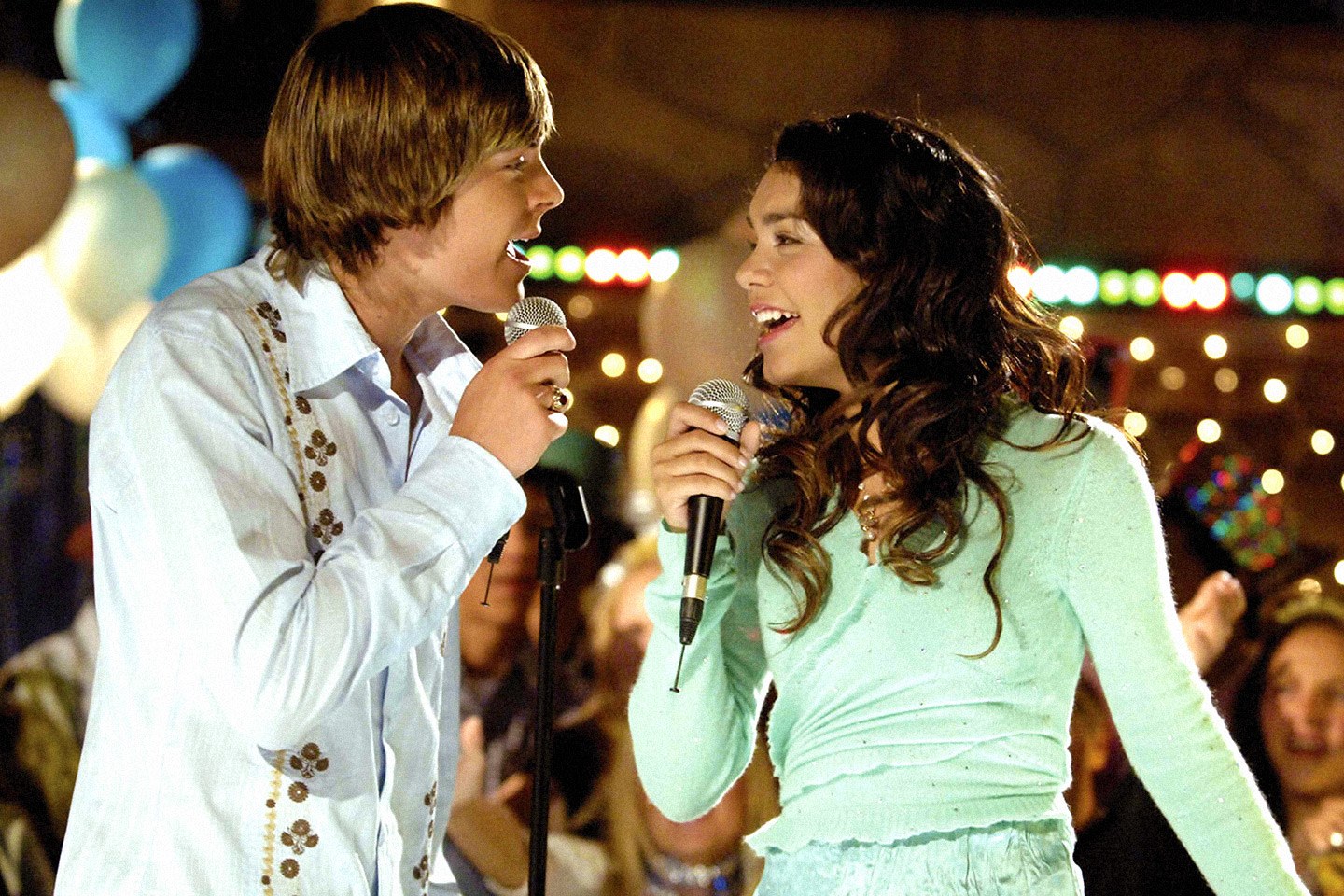
High School Musical, karaoke scene, Troy and GabriellaA romantic comedy can’t work unless the couple appeals to us.  In this respect, HSM hits the right note from the initial meet-cute.  Teenage strangers Troy Bolton (basketball star) and Gabriella Montez (science-oriented A student) are propelled onstage at random by a boisterous karaoke crowd at a resort’s New Year’s Eve party.  By the usual musical-theatre convention, they sing the required duet perfectly, without any prompting, though they act as if they’re amateurs trying this for the first time.  We watch them gradually loosen up, exchange shy glances, and get into the song with enthusiasm.  It’s entirely adorable.  The song itself, with the refrain “This could be the start of something new,” fits neatly with the beginning of a relationship.

Romantic chemistry is to some extent in the eye of the beholder.  But I felt the actors and filmmakers did a good job of making the romantic interest both credible and enjoyable.  (To mention only one example of a film that fails in this respect:  Star Wars fans will wince in unison when reminded of the fact that the prequel trilogy requires us to treat Anakin and Padmé as heroes of an epic romance, but the actors have no chemistry whatsoever.)

The Tropes

HSM is a gallery of familiar tropes—but it does some interesting things with them.

The idea of star-crossed lovers whose groups are at odds goes back to Romeo and Juliet—or Pyramus and Thisbe.  Using the traditional high-school dichotomy of jocks and nerds to create this opposition makes the situation ripe for comedy.  But what makes HSM interesting is that there’s a third force involved:  the drama club.

While the sports championship and the scholastic decathlon preoccupy the basketball team and the brainy types, Troy and Gabriella are really trying to succeed at a third thing—trying out for the spring musical.  Their real opposition is the reigning drama queen, Sharpay, with her acquiescent brother and dance partner Ryan.  Having three factions in play complicates the standard “Two houses, both alike in dignity” plotline.  It also allows for a satisfying alliance of the sports and science factions at the climax, when they conspire to create simultaneous disruptions so that Troy and Gabriella can appear at the all-important (I’m trying to say that with a straight face) callback auditions.

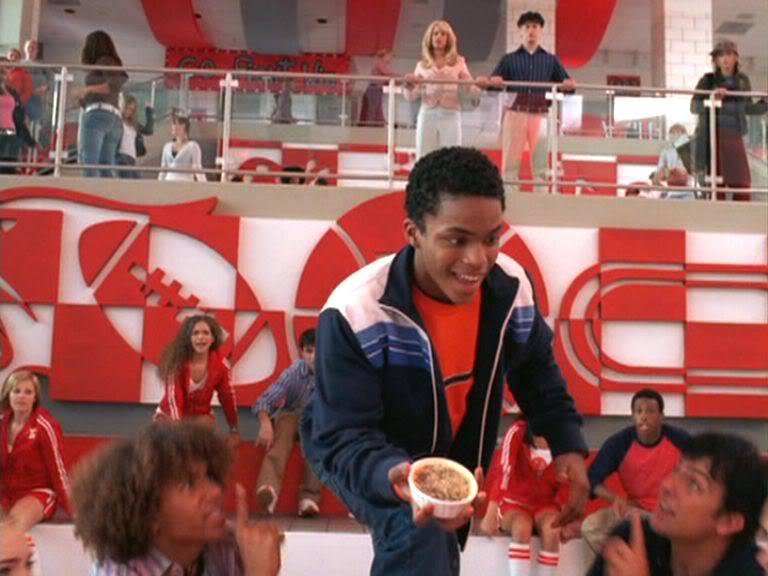
High School Musical, creme bruleeSimilarly, the basic theme of the show is a classic (especially for teenagers) “do your own thing” or “be yourself” message.  But the three-party problem points this up in a slightly unexpected way.  Troy and Gabriella don’t need to recognize each other’s existing strengths; they’re each trying to do something that’s new to both of them.  The same theme works its way down through the minor characters.  In a song about sticking to the status quo, various people confess their unorthodox ambitions.  To me there seems to be something whimsically specific about a basketball player’s dream of cooking the perfect crème brulée, which becomes a running joke.

The HSM characters are typical high-school stereotypes, but with a little more to them.  They are, at least, multi-talented; and they’re capable (in the end) of appreciating each other’s disparate abilities.  It’s just enough of a spin to lift HSM out of the run of teenage comedies.

The Music

The musical numbers are pretty good pop-rock songs, IMHO.  The comic pieces are well done, and they’re carried off with great joie de vivre by the enthusiastic cast.  The love songs—“Start of Something New,” “What I’ve Been Looking For,” “Breaking Free”—are enjoyable enough that they’re worth listening to even aside from the video.  The big finale, “We’re All In This Together,” is just the kind of rousing, energetic closer one wants for an entertainment of this sort.

Conclusion

High School Musical, finaleThere are, of course, flaws.  Characters don’t always act consistently; for instance, the drama club moderator Miss Darbus is sometimes flagrantly biased in favor of her pet prodigies Sharpay and Ryan, while at other times she goes out of her way to give the newbies a fair chance.  The final wrap-up, in which everyone from all factions become friends (temporarily, until the next episode), is endearing but just too neat.

But to my mind, HSM succeeds at being good light entertainment—and that’s not something to sneeze at.  It can be harder to bring off a light comedy than to craft a drama or an action-adventure flick, just as it can be easier to broil a steak than to make a good soufflé.  (Or crème brulée, perhaps.)

Kelsi Nielsen, HSM's "composer"

Olesya Rulin as Kelsi Nielsen

I also have a particular fondness for HSM’s acknowledgement of the composer of the musical as an unsung hero.  The drama club’s musical is being written by a younger student, Kelsi Nielsen.  The senior drama people act superior with Kelsi, but Troy points out to her that in basketball terms she’s the “playmaker”—the one who makes everybody else look good.  That’s an especially satisfying observation to those of us whose activities lie more in the writing and composition areas than in onstage performance.  It’s another welcome subtlety I wouldn’t necessarily have expected in a casual Disney Channel production.

No one will mistake HSM for high drama.  But it’s undeniably fun, and it reminds us that even the most well-worn tropes can be fresh if you throw in a few new twists.

Of Amazons and New Gods

Spoiler Alert!

Wonder Woman is now out on DVD.  Still a great movie.  It’s pleasing to see that the DC Extended Universe (“DCEU”), or “Justice League Universe,” can produce a film on a par with the best of the Marvel movies.  I’m cautiously looking forward to Justice League, which opens just over a month from now (Nov. 17).  Among other things, I’m eager to see whether the group movie will be dominated by its immediate Wonder Woman predecessor, or by its less promising Batman–Superman heritage.

On re-watching, I found myself thinking more about the theology of Wonder Woman, which enmeshes us in some complicated assumptions about the shared world of the DCEU and may give us some clues about JL.

Here Be Spoilers!Fallen Pantheon

Wonder Woman holds lightningAccording to the Amazons of Themyscira, the Greek war god Ares took umbrage when Zeus created human beings.  When Ares turned humans against each other, the other Olympian gods tried to stop him.  Ares killed the other gods, last of all Zeus, whose dying blow put Ares out of action for ages.  Diana kills Ares in the conclusion of WW.  That appears to eliminate all the Olympian gods.

As moviegoers, we readily accept this Greek-myth theology for purposes of the story.  It’s familiar territory, as mythology goes.  While we’re watching the movie, we don’t worry about reconciling Zeus’s creation of humanity with, say, Christian or Hindu or Muslim accounts, or even with the scientific account of human evolutionary origins.

One thing that makes the Greek gods (I keep typing “Geek gods,” which is peculiarly appropriate) easier to swallow is the fact that in WW the pantheon seems to have liquidated itself, unless you count the demigoddess Diana.  By the end of the movie, they’re gone.  We don’t need to worry about whether Athena or Poseidon will turn up in some other superhero story as a deus ex machina, or why DC universe inhabitants can’t call on Zeus to aid the victims of floods or hurricanes.

On the other hand, Justice League takes place in the same universe, which means the premises of WW are built in.  How literally are we to take them?  Do we have to assume that the Greek gods are (or were) the divinities of the DCEU?

Divinity and Technology

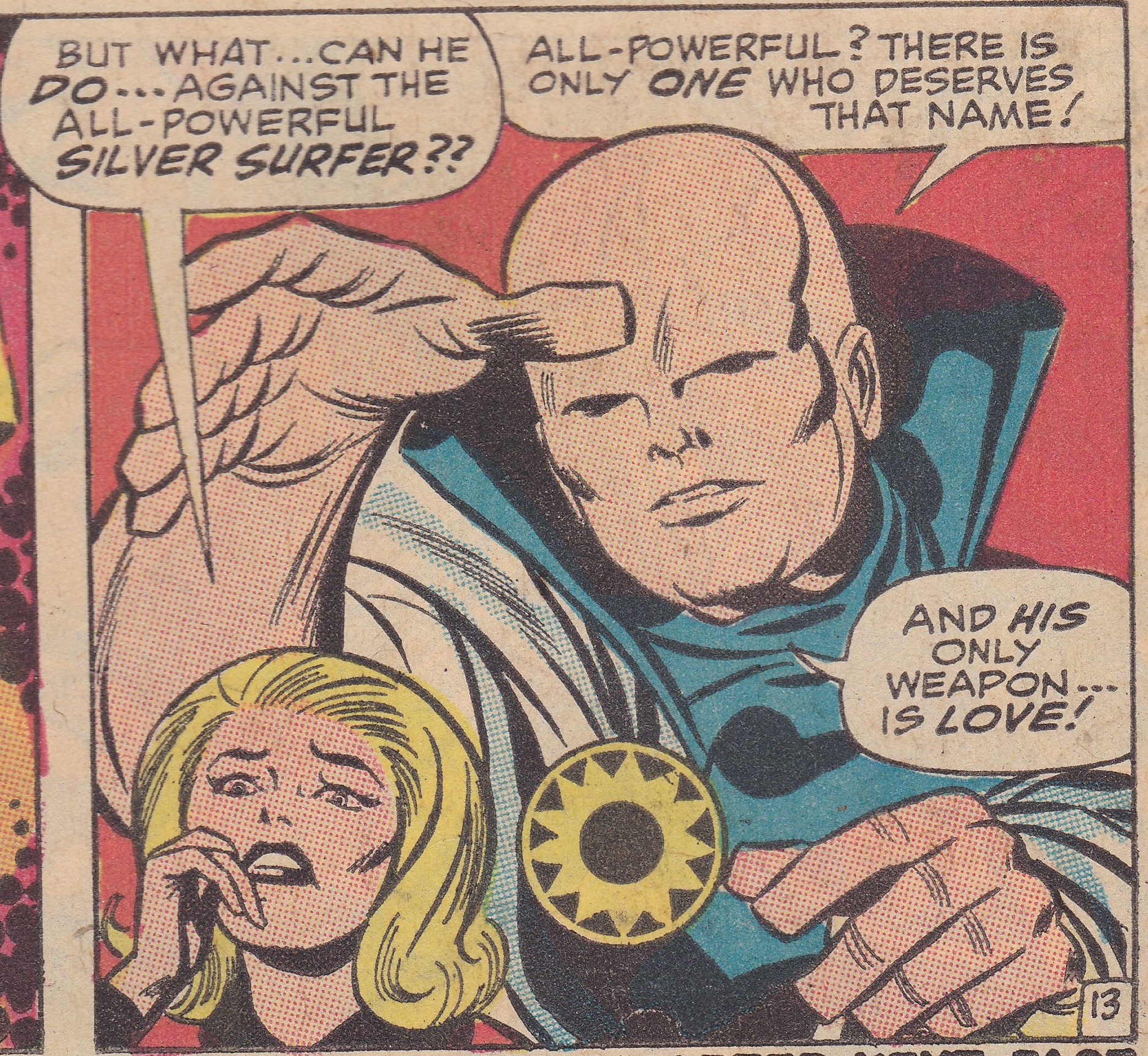
Sue Storm and the Watcher, comic panelComics have drawn from all sorts of Western mythologies, but they generally skirt the issue of whether any of these gods are God.  None of the deities of Greek/Roman or Norse myths have the classic characteristics attributed to God in the Western tradition:  omnipotence, omniscience, omnibenevolence.  The issue is directly addressed so rarely that the occasional occurrence is rather startling.  In Fantastic Four #72 (March 1967, p. 13), for example, Sue Storm refers to “the all-powerful Silver Surfer,” and the Watcher responds:  “All-powerful?  There is only one who deserves that name!  And his only weapon . . . is love!”

Marvel dodged the theological question neatly when it brought Thor into the Marvel Cinematic Universe (MCU).  He brings with him the Norse gods of Asgard, just as in the comics.  But Thor expressly tells us in his first movie that the magic or “divine” powers of the Norse gods are indistinguishable from advanced science (Clarke’s Third Law rides again).  This allows us to regard the Asgardians as just highly advanced creatures, using knowledge so far beyond us that it seems like magic, and bypass theological conundrums.

It’s certainly open to DC to take the same approach, if we don’t take the “Zeus created humanity” claim seriously.  Since the Olympians are (as far as we know) now absent, we can probably skate around that issue without trouble.

In fact, the absence of the Olympians may actually lead into the Justice League scenario, in an unexpected way.  The clue is that the full cast list for JL on IMDB shows “Steppenwolf” as the villain.  Surely the heroes are not clashing with the 1960s heavy-metal band by that name.  Who’s this mystery supervillain?

The Fourth World

Jack Kirby, famous for inventing many classic Marvel characters during his long partnership with Stan Lee, left Marvel for rival DC in 1970.  There he created, wrote and drew a new epic series, sweeping across at least five different lines of comic magazines, known as the “Fourth World.”  In this saga, loosely connected to the rest of DC’s continuity, Earth becomes a battleground for two groups of supernal beings:  the benevolent “New Gods” of “New Genesis,” and the corrupt denizens of its dark sister world “Apokolips.”  New Genesis and Apokolips exist in a parallel universe or “other dimension” reached via temporary portals called “Boom Tubes,” not unlike the Rainbow Bridge in the Thor movies.

Like Marvel’s Asgardians or DC’s version of Greek mythology, these beings are “gods” only in a limited sense.  They have powers beyond those of mere humans, but are far short of all-powerful.

What’s interesting for our purposes here is that Kirby conceived of the dualistic Apokolips-New Genesis regimes as arising after a kind of Ragnarok—the cataclysmic end of the world in Norse myth.  In fact, as Wikipedia’s discussion points out, Kirby’s New Gods grew out of an idea that he originated for Thor comics.  For purposes of this new DC-sponsored saga, it was disconnected from the mythology of Thor.  But the same basic trope remained:  a final battle in which both good and evil forces are destroyed, succeeded by some kind of post-apocalypse revival.  Here’s how Kirby presented it in Orion and the New Gods #2 (April-May 1971, p. 1):  “the holocaust which destroyed the old gods split their ancient world asunder — and created in its place two separate and distinct homes for the new forces . . .”

New Genesis and Apokolips

Apokolips and New Genesis

Steppenwolf and dog cavalry

Steppenwolf

The master-villain of the Fourth World saga is Darkseid, one of the best bad guys of all time.  Marvel’s character Thanos, who happens to be the master-villain of the MCU (appearing briefly in Guardians of the Galaxy and the Avengers movies), was based on Darkseid.  Darkseid’s uncle, and lieutenant, is one Steppenwolf, who in the Fourth World comics rekindles the conflict between Apokolips and the New Gods by killing the New Genesis leader’s wife (Orion and the New Gods #7, March 1972).  The opponents seen in this Justice League trailer are Apokolips parademons.

DC still owns the New Gods characters and plotlines.  It seems likely that Steppenwolf will be the main antagonist in JL with the still greater menace of Darkseid looming behind him, available to up the ante for sequels (as with Darth Vader and the Emperor in The Empire Strikes Back, or Ronan and Thanos in Guardians of the Galaxy).

The New Twilight of the Gods

At this point, the fall of the Olympian gods in Wonder Woman begins to line up rather neatly with the Kirbyesque background that Justice League will draw upon.  Kirby thought of the Fourth World as following on a Norse-style Ragnarok.  But, as noted above, the Wonder Woman cosmogony provides the DCEU with a Ragnarok of its own.  Perhaps in the movie version of the mythology, the New Gods (and their opponents) arise from the twilight of the Olympian gods, not the Norse.

Darkseid, holding Earth

Darkseid

It’ll be intriguing to see how this background influences  the JL movie—if at all.  DC may decide to duck the whole matter and introduce Steppenwolf as a menace with an entirely different origin.  But my money is on a significant Fourth World influence on the upcoming film.  If the DCEU makes good use of Darkseid and the Kirby mythos, that ups the chance that we may see some seriously epic developments, after a rocky start, in the DC shared universe.

We’ll see shortly!