The Hidden Right Stuff

Astronomy Ascendant

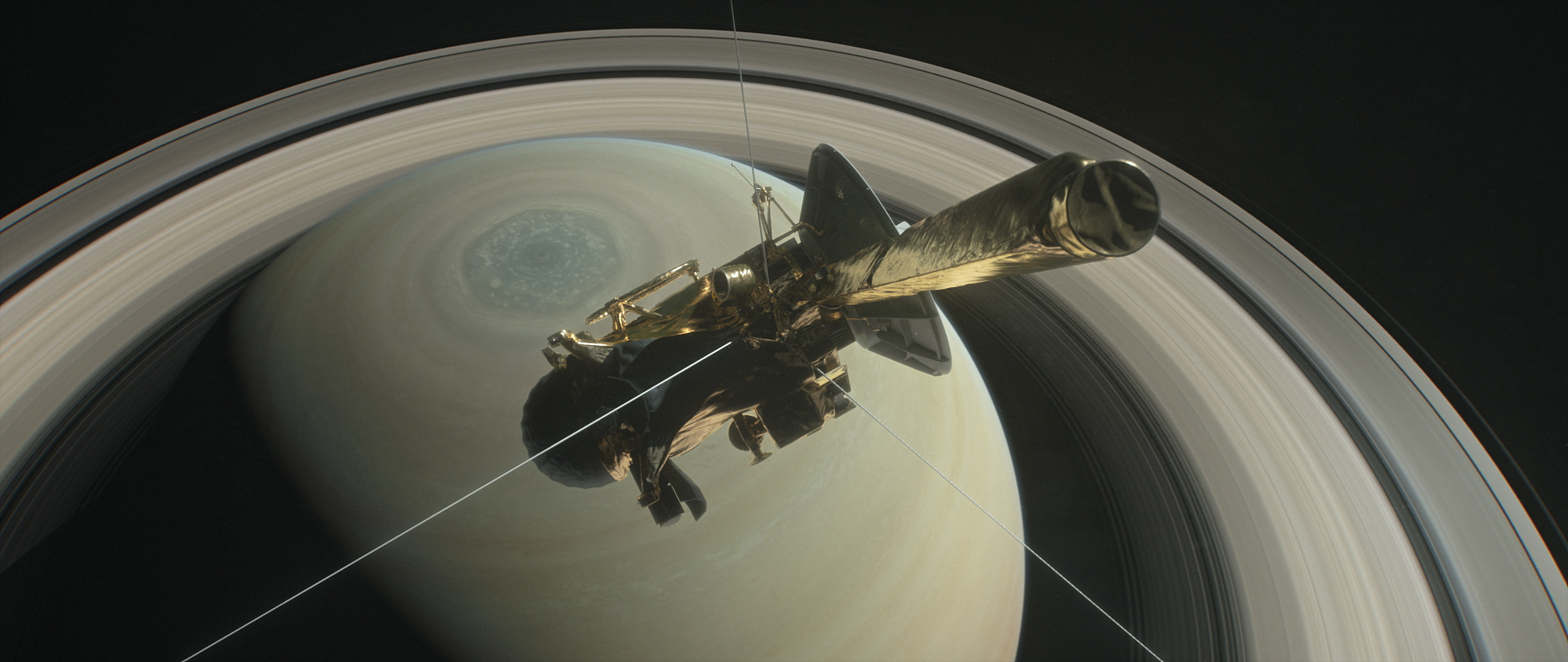
Cassini over Saturn's southern hemisphereIt isn’t surprising that I got a lump in my throat at space probe Cassini’s Grand Finale plunge into Saturn.  What’s striking is that so many other people seem to have felt the same way, as described in the aforelinked article and a Sept. 16 Washington Post editorial titled “The Cassini mission embodies the best of humanity.”  No immediately profitable results, no earthly use—and yet quite a range of people seem to have been moved by the end of this long-running mission.
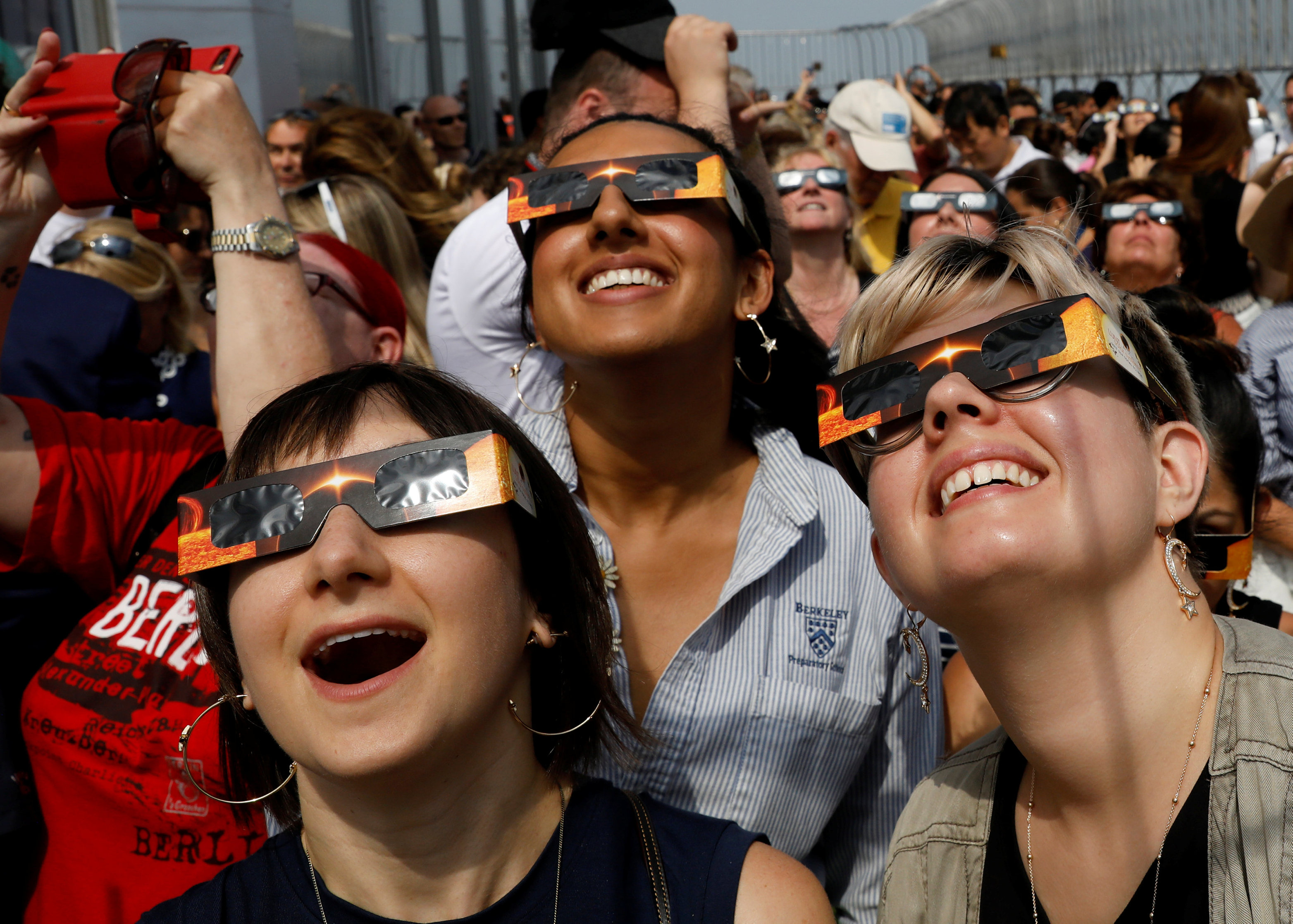
People watch the solar eclipse from the observation deck of The Empire State Building in New YorkThe Cassini Grand Finale followed immediately upon another widely popular sky event, the eclipse of August 21, 2017.  A total solar eclipse visible in the continental United States is rare enough that dedicated eclipse watchers were naturally excited.  But the level of interest in the general public was quite remarkable.  Libraries, giving away eclipse-watching glasses to the public, ran out of them well before the big day.

Why this sudden upsurge in astronomical interest?  My guess is that at a time when other news is so depressing, and human inhumanity to humans is so prevalent, we long to hear about something that’s both bigger than ourselves, and wonderful rather than terrible.

Hidden Figures
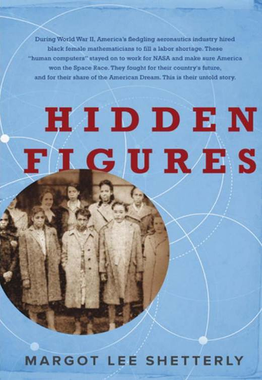
Hidden Figures book coverI recently read Hidden Figures (2016), by Margot Lee Shetterly.  This historical-biographical work tells the story of the African-American women who worked with NASA during the “space race,” at a time when neither women, nor African-Americans, were typically considered candidates for science positions.  Their mathematical expertise was crucial in making possible the Mercury, Gemini, and Apollo missions.
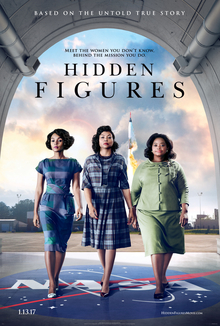
Hidden Figures movie posterAn excellent movie based on the book—I’ve seen it twice so far—came out in December 2016, which must set some kind of record for speedy translation of a book to the big screen.  The film, as is usual with historical movies, alters the facts somewhat to dramatize the changes taking place.  But it effectively conveys how the intrepid characters overcame prejudices and organizational impediments to make great contributions.

Part of the lump-in-the-throat uplift I felt in this story comes from the chance, for once, to see people doing the right thing in terms of justice and respect for everyone.  But another part comes from the fact that the achievements of the women depicted in the book and movie weren’t just any successes.  They were specifically in the area of spaceflight, appealing to the science- and science-fiction enthusiast in me as well as the admirer of virtue.  In that respect, I was reminded of an older favorite film, The Right Stuff.

The Right Stuff

A generation ago, Tom Wolfe’s idiosyncratic history of Project Mercury and the test-pilot culture out of which it grew, The Right Stuff (1979), became a 1983 movie by Philip Kaufman.  From the slapstick humor of the medical testing, to the cheerfully cynical depiction of the public-relations machine that went to work on the Mercury astronauts, The Right Stuff took a decidedly down-to-earth look at the space program.  But as the story develops, those mundane aspects merely serve to underline the genuine courage and daring of the Mercury pioneers.
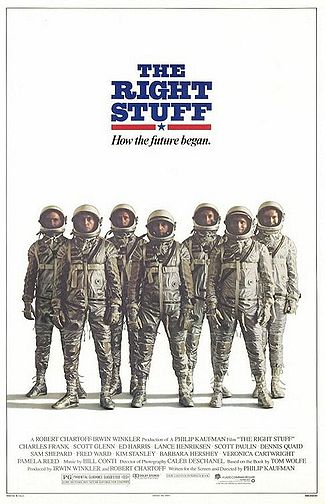
The Right Stuff movie posterThe movie has long been a favorite in my household.  Aided by a soaring score from Bill Conti, The Right Stuff awakens the same sense of wonder we feel from Hidden Figures—with the earthier aspects to remind us that, inspiring as the story may be, this isn’t a fairy tale or even solid SF; it really happened.

Common Ground

These two space race movies obviously have a lot in common.  They share a historical setting, though they approach it from quite different angles, and they cover some of the same events.  Each features an ensemble cast, rather than a single main character.  Some of the characters even overlap; John Glenn plays an important role in both.

Each is a fictionalized movie made from a nonfiction book.  To present their stories, screenwriters and directors have to invent actual dialogue and scenes that aren’t part of the historical record.  Conversely, the books cover more ground than the movies can possibly handle.  The book Hidden Figures, for example, starts its narrative in World War II, while the movie opens around 1960.

More important, I think, is the mood evoked by the two films.  The distinctiveness of that emotion arises from the fact that the U.S. space program is one of the few enterprises in recent history that joins heroic dedication to an aspirational goal, with a visually impressive record that can be readily appreciated by all of us.  (One might point to medical successes, for example, as equally noble—say, the development of the polio vaccine.  But rockets are easier to see and appreciate than bacteria.)

So many of the great heroic efforts we can point to are wars.  The perennial appeal of stories about World War II, the American Civil War, Star Wars, the War of the Ring, show how these exemplars of courage and perseverance continue to move us.  But even when such wars are justified, they are essentially negative efforts.  The participants strive to prevent something—to avert or amend some great evil—and the means for doing so unavoidably involve harm and destruction.

New Horizons launches to PlutoThese stories about the space program, on the other hand, remind us that equally great and heroic efforts can be made for affirmative purposes.  They arouse that heart-lifting sense of people striving mightily together for goals that are not destructive, but wholly aspirational.  To the wonder of discovery and exploration are added the glory of humans exercising their best qualities—intelligence, diligence, boldness, cooperation.  These true stories give us a sense of unity in a good cause, like the “band of brothers” forged in wartime, but without the corresponding division and opposition of a human enemy.

This isn’t Pollyanna territory.  The Right Stuff pays plenty of attention to human foibles and pettiness; but they become trivial in the great achievements of the movie’s second half.  Hidden Figures specifically addresses human vices—and sweeps them aside in the name of something greater.  As with Cassini and the eclipse, we have a chance to focus, for a while, on something that extends beyond ourselves and calls out the best in us.  We don’t ignore human weakness, but we are given examples of how, from time to time, we can transcend it.

These are stories worth telling.
Star Trek vs. Star Wars

Hatfields and McCoys, Marvel and DC, Star Trek and Star Wars.  One never knows how seriously to take these deadly rivalries.  Personally, I like both of the science-fiction series, so I see the Trek-Wars wars more as a difference in tastes.  Sometimes you feel like a hamburger, sometimes a pizza.

The particular difference I see in SW and ST has to do with their atmospheres or sensibilities.

Good Order

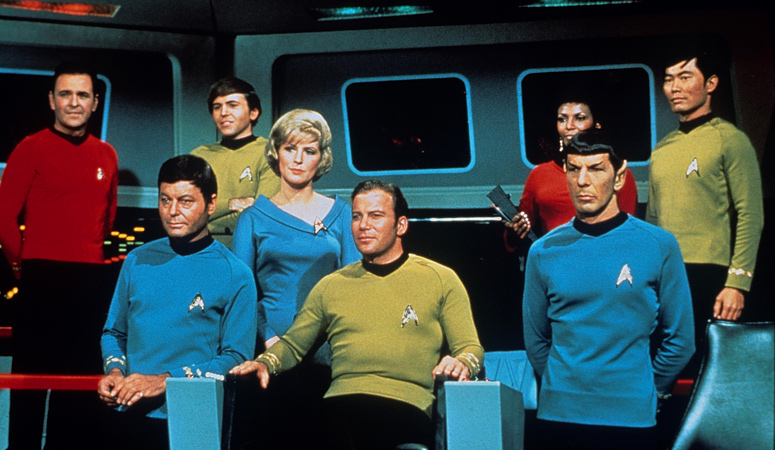
Star Trek TOS bridge crewThe Star Trek universe—I’m focusing especially on the original series (“TOS”) and movies here—is civilized.  There are plenty of things that go wrong, and going where no one has gone before frequently brings us into situations of conflict.  But the Federation itself is organized and mostly decent.  There’s an actual chain of command.  Authority figures are typically respected.

That’s the first approximation.  To be sure, Captain Kirk and his successors don’t mind defying Starfleet orders now and then.  But when Our Heroes turn out to be right, they’re back on amicable terms with their superiors in short order.  At the end of Star Trek IV:  The Voyage Home, Admiral Kirk, after stealing and destroying the Enterprise (among other things), is demoted to Captain again as his “punishment.”  But everyone understands this as simply restoring him to the role he prefers and serves so well.

There’s enough divergence among Starfleet personnel to make the stories interesting, but actual villains in the corps are relatively rare.  Starfleet and the Federation are the orderly defenders of liberty and individual (in our parochial world we say “human”) rights.  That Gene Roddenberry optimism is embedded in the show’s DNA.

Fruitful Disorder

In Star Wars, it’s the villainous Vader who wants to “bring order to the galaxy” (as he says around 1:38 in this clip), and it’s the motley, disorganized rebels who fight for freedom.  Our Heroes are rebels who defy the authorities.  Their chain of command is informal, and pretty much anyone, even the carefree Han Solo, can become a general.

Though the swashbuckling, colorful Star Wars universe may seem lighthearted, it’s actually a rather distressing place.  The nearest outpost of civilization to Luke’s uncle and aunt’s farm is Mos Eisley, a “wretched hive of scum and villainy.”  Slavery has flourished on Tatooine from a generation ago (little Anakin) to Luke’s era (Jabba’s servitors)—and apparently neither the Empire nor the old Republic did anything to stop it.  Intelligent droids are second-class citizens.  In the latter days of the Republic, trade combines were permitted to conduct outright warfare against whole planets (Phantom Menace), with no more than tardy, ineffective intervention by the Jedi Knights.  It seems a much less comfortable universe to live in than Star Trek’s Federation.  Both have their flaws, but the Star Wars ’verse seems much more unstable—if colorfully so.

Star Trek composite posterThere’s nothing wrong with this as a story setting.  A varied world full of dangers makes for more exciting stories than a placid utopia.  But the Star Wars setting calls out to a different kind of fan than that of the Trekkies.

Vader’s desire for order actually has good character-based reasons—one of the things the prequel trilogy got right.  In a world where you’ve been held as a slave, your mother has been tortured to death by barbarians, and your beloved is menaced by assassins at every turn, a desire for law and order is extremely understandable.  But it’s the lively Rebels with whom the viewer’s sympathies lie.  In this democratic milieu, quirky individuals and inspired improvisation flourish.

Both the SW and ST approaches represent ’60s sensibilities, but one is slightly later than the other.  Roddenberry’s Star Trek expresses the firm American optimism of the Kennedy era (1960-1963); it isn’t accidental that in the follow-up movies, Roddenberry kept wanting to tell a story about time-traveling to meet JFK.  Star Wars, on the other hand, evokes the counterculture of the late ’60s, which distrusted authority and prized rebellion—not to mention colorful chaos.

The Abrams Factor

It’s instructive to see how J.J. Abrams handled the two, since he has had the opportunity to reboot both Star Trek and Star Wars franchises.  My sense is that he’s handled SW much better than ST.  Abrams’ Star Trek movies show us a distinctly grittier, more chaotic world than Roddenberry’s.  It is, in fact, more like the Star Wars universe.  And I don’t think I’m alone in feeling that, entertaining as Abrams’ ST movies may be, he doesn’t quite “get” what Star Trek is about.  His Star Wars continuation, The Force Awakens, however, is to my mind an excellent (if not flawless) extension of the SW universe.

In other words, making Star Wars more like Star Wars is a good thing, right up to the point where it begins to get slightly repetitious.  Making Star Trek more like Star Wars runs the risk of losing the very things that makes Roddenberry’s creation distinctive.  Both are good things; but they’re not good in quite the same way.

Alignment

One of the interesting things about the Dungeons & Dragons (D&D) game system is the notion of alignment.  D&D is built on ideas from a whole range of fantasy stories.  Many of those stories involve a conflict between good and evil.  Some, however, make the central conflict one of law vs. chaos.  D&D’s creators took the surprising step of adopting both oppositions, but keeping them distinct.  The result is a three-by-three, nine-cell matrix.  A character’s personality and ethical stance can be lawful good or chaotic good, or straddle the two as neutral good.  The being can also be lawful or chaotic evil—the evil of 1984 or of Beowulf, let’s say—or an intermediate neutral evil.  Finally, someone can be lawful neutral (think an OCD personality), chaotic neutral (low impulse control), or “true neutral” double-neutral (an unprincipled pragmatist, perhaps).  The range of combinations allows for shorthand expression of quite an array of character types.Nine alignments example, F&SF

I wouldn’t necessarily buy into this particular classification of famous fictional characters . . . but it gives us an idea how the alignment scheme works in practice.

The alignment chart also yields a neat way to encapsulate the ST/SW difference we’re examining.  Star Trek honors the lawful good:  the interstellar police force, the scientific explorer, the careful defender.  Star Wars admires the chaotic good:  the lovable rogue, the solitary guru, the loosely organized band of allies.

Political theory

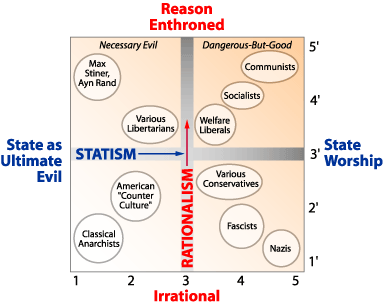
Pournelle political axes chartHere’s yet another way to put it.  Science fiction writer Jerry Pournelle, whose doctorate is in political science, laid out in 1963 a map of political “alignments” with two axes, producing a far more useful classification of positions than the usual left-right continuum.  (Pournelle’s 1986 essay provides a detailed explanation.)  The two dimensions in Pournelle’s scheme are “attitude toward the state” (from state as evil to state worship), and “attitude toward planned social progress” (from rationalism to irrationalism).

If we think of these axes as applying to the character of a culture, not necessarily to politics per se, we can express the ST/SW divide in Pournellean terms.  I’d put TOS-era Star Trek somewhere around 3/4’ or 3.5/4’ on the chart, believing pretty strongly in reason and ambivalent about state power.  Star Wars, by contrast, seems to live in the 2/2’ region, not far from the “American ‘Counter Culture’” to which I compared its ambiance above.  Each milieu will tend to attract viewers who are sympathetic to the points of view expressed in its neighborhood on the grid.

Civilization

What it comes down to, I think, is whether we see the best conditions for free and fruitful lives primarily in order or in disorder.  Both are arguably necessary.  But is what’s best for people a basically orderly society with a healthy modicum of chaos; or a wild-and-crazy culture with just enough organization to hang together?

The Star Trek/Star Wars contrast thus leads us up to the question of what makes for a good society, a true civilization.  There’s a good deal more to be said about this, and I’ll take another crack at it next time.

Let it Go

Buying gifts for small granddaughters reminds me that the popularity of Disney’s Frozen (2013) is undiminished.  This is a fine thing.  It’s a great movie and includes some good role models for little girls.  However, there is something faintly disconcerting about seeing children’s clothing emblazoned with the slogan “Let It Go” (title of the lead song from the movie).

“Let It Go”

At these links, you can find the lyrics to the song (by Kristen Anderson-Lopez and Robert Lopez); a video clip of the song as it appears in the movie, sung by Idina Menzel, with the lyrics helpfully added; and a pop version, with a driving rock beat, by Demi Lovato (with slightly different lyrics).

Let It Go poster with ElsaYou’ll recall that Elsa, the newly-crowned queen of Arendelle, has her uncontrollable ice powers suddenly revealed in public, and flees the city.  Alone on the mountainside, she abandons the careful restraint and concealment that her dead parents imposed, and gives her abilities free rein.  As she creates a magnificent ice castle, she renounces the land and people she’s left behind.  She proclaims that she will break through the limits and use her powers as she will:  “No right, no wrong, no rules for me:  I’m free!”

It’s a great song.  I have both versions on my playlists.  The music is powerful, and the lyrics take some clever turns.  (It’s the first time I’ve heard the term “fractal” used in a song.)  Moreover, the movie visuals that accompany the song are amazing.

Elsa as Role Model

As an anthem for young girls, “Let It Go” is a very appealing choice.  It praises the kinds of qualities we all want to see in young people growing up:  asserting your own identity, using your abilities, being unafraid to admit what you are.  (“What you are” could represent anything from personal tastes and talents to sexuality—the latter of which is suggested by Elsa’s costume change).  The song evokes the “breaking free” trope that’s so appealing to the young—not to mention, now and then, the rest of us—and speaks for self-reliance and independence.

So far, so good.  We can always benefit from another strong female role model.  The trouble is that fixing on “Let It Go” as a rallying cry assumes these attitudes are what we admire in Elsa.  But that’s not actually the role the song plays in the story.

Renunciation

I assume that by now pretty much everybody has seen this movie, so I won’t issue the customary caution about spoilers—since we now have to discuss specific plot points.

Elsa wants to cast aside all association with humanity (“kingdom of isolation”).  She has a praiseworthy motive—she feels she has to be alone, so others won’t be harmed—but she also revels in the freedom of isolation.  She declares independence, not only from arbitrary constraints, but from moral rules (“No right, no wrong”).

Once we’ve seen Elsa’s moment of solitary glory—and it is glorious—the story starts to subvert that declaration.  Her isolation leaves her unaware that she’s transformed summer to winter, not just where she is, but also back in Arendelle.  Not until her sister Anna and the skeptical Kristoff struggle up the mountain to find her does she find out how far-reaching the consequences are.

To her credit, Elsa is taken aback at these unintended consequences (which are not a consequence of her self-assertion per se, but an incidental side effect).  She hasn’t really abandoned all concern for other people.  On the other hand, she still doesn’t know how to release this Fimbulwinter.  She can’t turn it off.  Her only resort is to further distance herself—which endangers Anna and doesn’t solve the problem.

Redemption

Elsa and Anna embraceIn the end, renunciation of human contact and human limitations is not the right answer for Elsa.  Her salvation comes in re-establishing contact with her sister and, eventually, with the rest of the world.  Anna’s loving sacrifice reminds Elsa that love is the right answer.  As soon as she realizes this, she is able to use her powers under full control, for good purposes.  (The abruptness of this solution is a little implausible, but this is a fairy tale, and we’ll let it pass.  Maybe she’ll return to Dagobah to “complete her training” some other time.)

Love does enable and empower; but through connection, not disconnection.  In the end Elsa renounces the very withdrawal she was expressing in “Let It Go.”  The disjunction may have been a necessary stage, but eventually it’s replaced by a deeper bond.  Which is, after all, just the kind of development that normally faces a child making her way through adolescence to adulthood.

To Be Continued?

So I have some misgivings about “Let It Go” as an ideal motto for kids.  The message of the whole story is broader and deeper than that of the song alone.  It’s still a great song, though.  What I’d really like is to have it paired with a song that’s as powerful an affirmation as ”Let It Go” is a renunciation.

There’s actually a sequel to the movie scheduled for release in 2019.  I have no idea what it’ll be about, and such sequels don’t have a good track record for coming out well.  But maybe the story will develop in such a way as to give an opportunity for just such an affirmation song.  We can always hope so.

The Last Jedi . . . Maybe

Boldly Going Where the Story Hasn’t Gone Yet

Debating what may happen in future Star Wars movies has been a favorite spectator sport since 1980, when we all saw The Empire Strikes Back and spent the next three years madly surmising  what would happen in the third episode.  Was Vader really Luke’s father?  (It’s hard to believe in this era, when “I am your father” is a classic meme, but in 1980 it was a viable theory that he was lying.)  Who was the “other” of Yoda’s enigmatic remark, “There is another”?

That last question illustrates the danger of too much speculation.  By the time Return of the Jedi came out, we’d debated every possibility, from a complete unknown to Han Solo—including the winning choice, Princess Leia (requiescat in pace).  The revelation in Episode VI couldn’t help but be an anticlimax.  So I’ve been trying not to spend too much time spinning my wheels over the unanswered questions in The Force Awakens.  We’ll find out soon enough.

The title of Episode VIII, though, does bring up an interesting point.

Last Now, or Last Forever?

Star Wars - The Last Jedi title screenDisney announced the title The Last Jedi for Episode VIII on January 23, 2017.  The fan community immediately went to work to ferret out the implications. It was pointed out, for example, that “Jedi” can be either singular or plural.  There might be one last Jedi, or two last Jedi, or an entire academy-full of last Jedi.  Still, some sort of finality seems to be indicated.

Comments around the Web as of February 12, 2017, suggest there are at least two major possibilities:

Luke and Rey(1)  The film is about the last Jedi who happens to be left alive at the moment.  That’s obviously Luke Skywalker, and Rey could reasonably say, on meeting him, that she’s found the last Jedi.  It doesn’t necessarily mean there won’t be any more to follow.  The Last Jedi might show Luke taking on Rey as an apprentice and making her a new Jedi.  If so, the story could well be captioned, from Rey’s point of view, How I Met the Last Jedi and Became the First Recruit in a New Jedi Order.  This would simply put us back in the realm of “That boy is our only hope / No, there is another.”

(2)  The more interesting, more drastic possibility is that Luke is the last Jedi there will ever be; that Episodes VIII-IX will involve some sort of epoch-making shakeup that will end the Jedi order permanently.  That might seem an anticlimax, after taking all that trouble to restore the order in Return of the Jedi.  But if it did, what would the future look like?

This possibility raises a question that has long intrigued me:  Is the Jedi order as we see it in the prequel series really a good thing?

How Not to Train Your Jedi

We had to wait for the prequels (Episodes I-III) to see how the Jedi order actually worked in its heyday.  What emerged was rather surprising.  The training program is of particular interest, because how you form the next generation of Jedi shapes what kinds of people they become and how they carry out their somewhat hazy galactic peace-keeping responsibilities.

(I should note that I’m referring only to the movies here and not the vast expanded universe of novels and spinoffs, much of which is no longer canon anyway.)

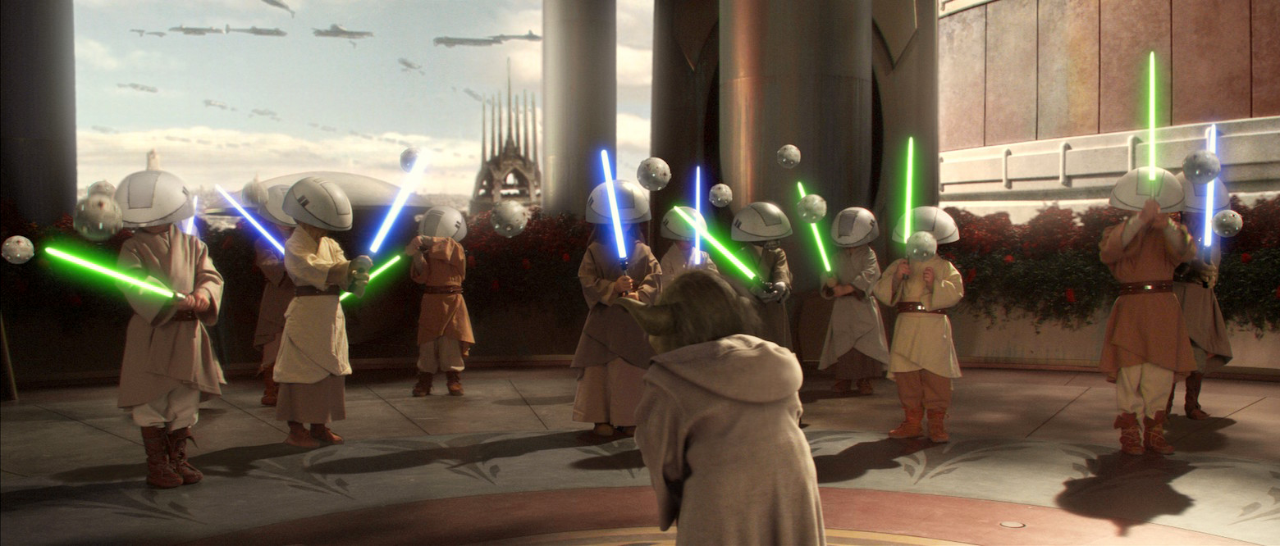
Jedi younglings at practiceWhen we meet young Anakin Skywalker at nine years of age in Episode I, he is already considered too old for the normal Jedi training program.  This is borne out by the scenes we see of five- or six-year-old “younglings” practicing their Jedi arts.  Evidently in the Republic, Force-gifted children were taken away from their families as young as five or six and brought to Coruscant for full-time training.  (No wonder Yoda also complained about Luke’s age in Episode V.)

If Anakin’s own experience is any guide, the younglings don’t return to their families, even, say, for summer vacations.  They are expected to grow up without normal family interactions, living a sort of monastic existence.  This approach might produce an intense concentration on one’s studies, and a sense of fierce fellowship among the Jedi members.  But it’s not clear that the resulting Jedi Knights would be especially well-adjusted for dealings with other, normal citizens.

We saw how badly this worked out for Anakin himself.  When Qui-Gon Jinn and Obi-Wan Kenobi redeem Anakin from slavery in Episode I, they can’t afford to buy out his mother Shmi as well.  But, appallingly, they never go back with more funds to do so; apparently they’re content to leave her enslaved while they concentrate on her Force-enabled son.  (This omission itself says something about the mind-set of the Republic and the Jedi in particular.)  When Anakin returns in Episode II just in time for his mother to die in his arms, this experience plays a key role in his eventual turn to the Dark Side, with the avowed aim of bringing “order to the galaxy” to prevent such tragedies.

No Valentines for Jedi

The exclusion of Jedi Knights from normal family and community life extends forward in their lives as well.  We find out in Episode II that Jedi are not permitted to marry.  (No one seems to have considered that this restriction is a fine way to breed Force-sensitivity right out of the participating species.)

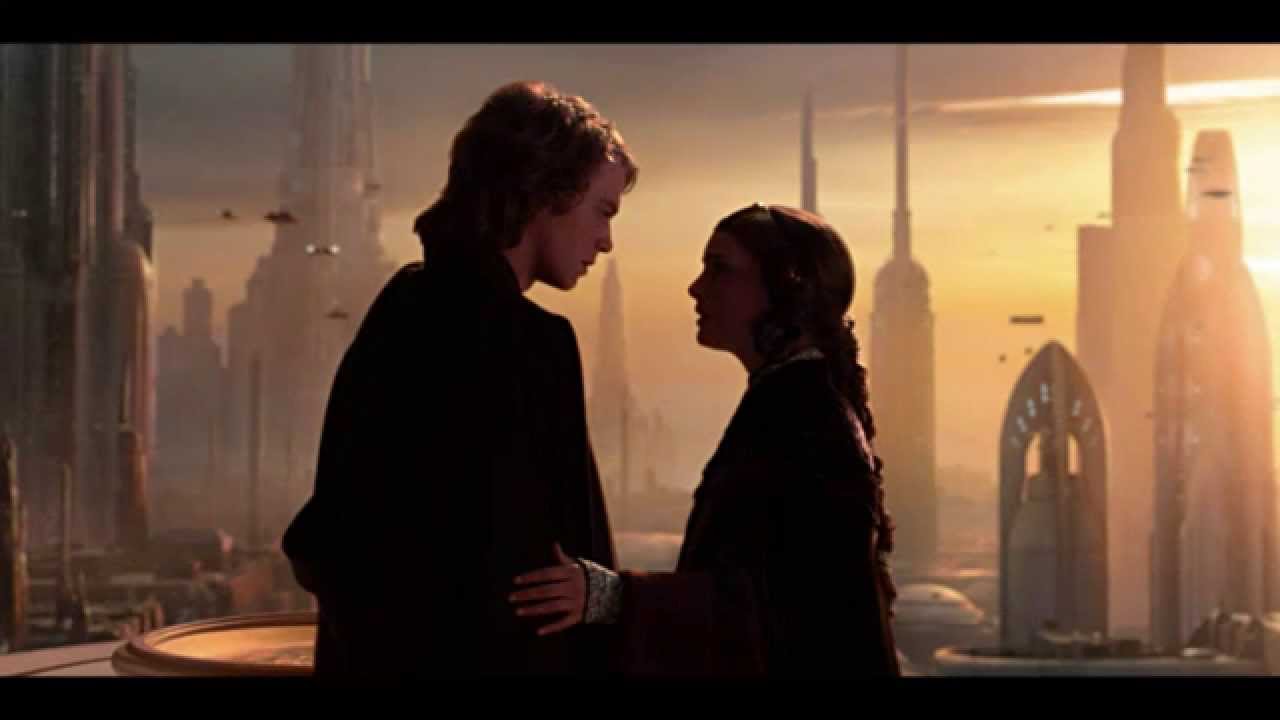
Anakin and Padme silhouetted against cityWhile this barrier may have been set up simply to create a story conflict, it also intensifies the separation of the Jedi from ordinary social interactions.  The trope of a celibate monastic order certainly has some narrative power.  But it may not be an ideal way to establish the primary enforcement and conflict-resolution arm of a galactic society.  In a curious way, the Jedi order resembles the army of familyless clones that the Jedi themselves initially create, and later combat.

A Failing Republic

With this issue in mind, the whole plot of Episodes I-III looks less like a simple tale of scheming intrigue by Senator Palpatine and more like a civilizational tragedy.  A polity falls most easily to a destabilizing force when it is already rotting from within.  Palpatine could not have succeeded so easily, one might argue, if the Republic and the Jedi had not already become decadent or dysfunctional.

In fact, the Jedi leaders in the prequels speak uneasily about some sort of failure or lessening of their communion with the Force, which is never really explained.  Is it possible that the Jedi ways of cultivating young pupils had become hidebound and ossified in a way that decreased their powers and made them vulnerable to a sneak attack or “phantom menace” from the Dark Side?

This is all speculation, of course.  I don’t know whether any such thing was in Lucas’s mind when Episodes I-VI were made, much less in the current screenwriters’ minds now.  But these considerations do suggest that it’s not enough just to restore or return the Republic’s Jedi order.  A renascence or renovation of the Light Side organization may be needed as well.

A Post-Jedi Order?

We now know that you don’t have to be a Sith Lord like Vader or Palpatine to serve the Dark Side.  We’ve also got Kylo’s Knights of Ren, and Snoke, whatever he is.  Maybe it’s also possible to serve the Light Side without being a Jedi Knight.

Based on the above thoughts about Jedi training, I’ve always rather hoped that Luke would rethink the historical Jedi practices (which he hardly knows, anyway) and develop a more humane, more balanced cadre.  We now know that he tried to train a new group between Episode VI and VII, but from the movies, at least, we don’t know how he went about it.  (I haven’t yet read any of the new-continuity novels.)

We do know that Luke’s new Jedi academy was a failure:  it produced Kylo Ren and collapsed after his turn to the Dark Side.  Perhaps now, after years of meditating on his mistakes, Luke may be ready to try something different.  It could be that the new knights of the light won’t be Jedi at all, but a new kind of Force for good.  To my mind, that would be a really interesting development.


These idiosyncratic guesses have a pretty low probability of panning out, to be sure.  The subtleties of training programs might not appeal to the Star Wars audience as a key plot device.  But they’re fun to think about.

The real entertainment value of SWAGs like these is to see how far off they were when the movie actually comes out.  We’ll see in December what “The Last Jedi” really means—and probably have a good laugh about this post.


Follow-up Notes

4/14/2017:  Here’s the latest trailer.
4/18/2017:  Zak Wojnar at ScreenRant has a good commentary today making some of the same points.

Don Quixote of Tomorrowland

2015’s “Tomorrowland” was not a great success with moviegoing audiences or critics.  But it hits on some themes that are vitally important.

We can’t discuss those themes without issuing some spoilers, so be warned.

Spoilers Follow

The World of Tomorrow

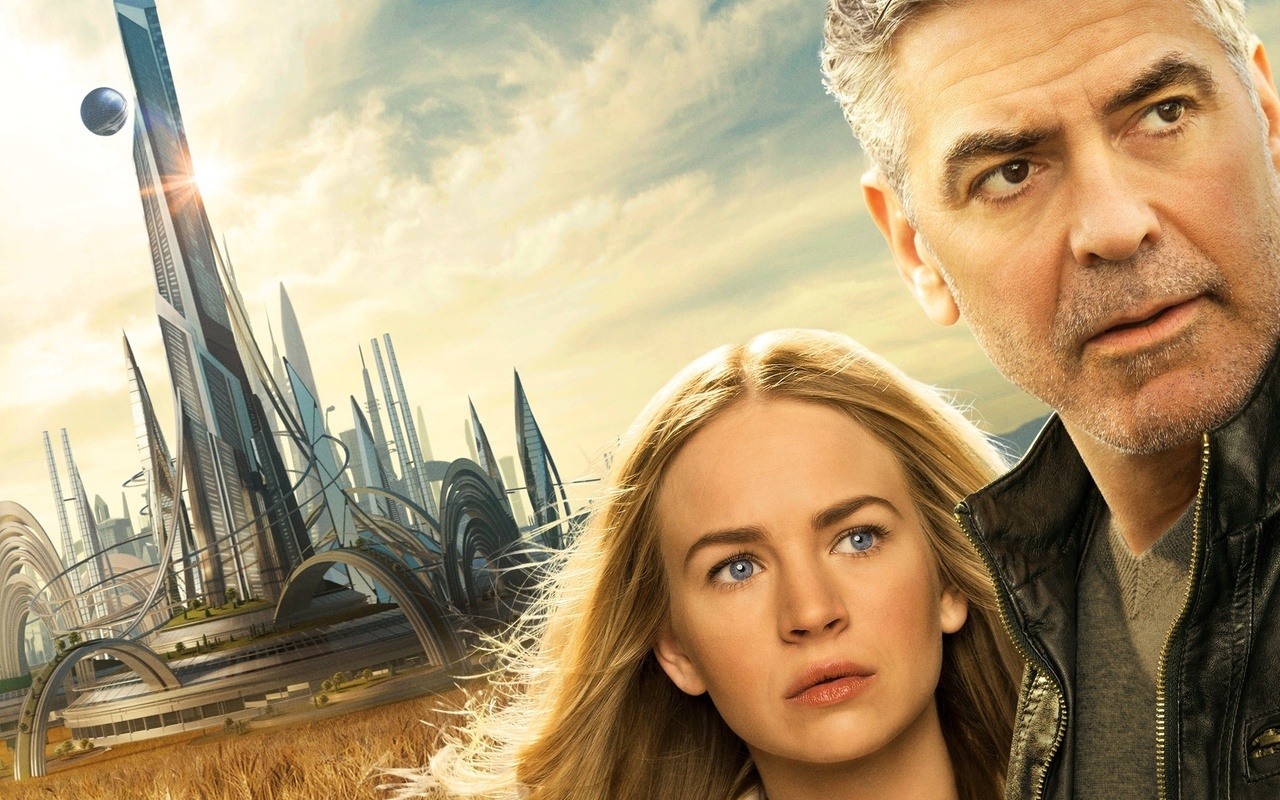
Tomorrowland - Casey and FrankThe story of “Tomorrowland,” co-written and directed by Brad Bird of Pixar fame, involves Frank Walker, a boy inventor whose earliest appearance is in 1964—played in the present day by a disillusioned George Clooney—and Casey Newton, a teenage girl with a particular genius for making things work.

Casey’s dad, a NASA engineer, will shortly lose his job as the agency decommissions a historic launch site.  Casey sneaks onto the site at night to sabotage the demolition efforts, which shows where her loyalties lie.

We see her in school with a series of morose teachers, each explaining how the world is going to hell in a handbasket:  nuclear armageddon, environmental disaster, literary dystopia.  Casey frantically waves her hand and is finally allowed to ask the question none of them are addressing:  “Can we fix it?” And the bell rings.

With this scene, the movie “had me at hello.”  For fifty years we’ve listened to doomsayers telling us how things will inevitably grow worse—from every part of the political map.  Solutions, however, are harder to come by.

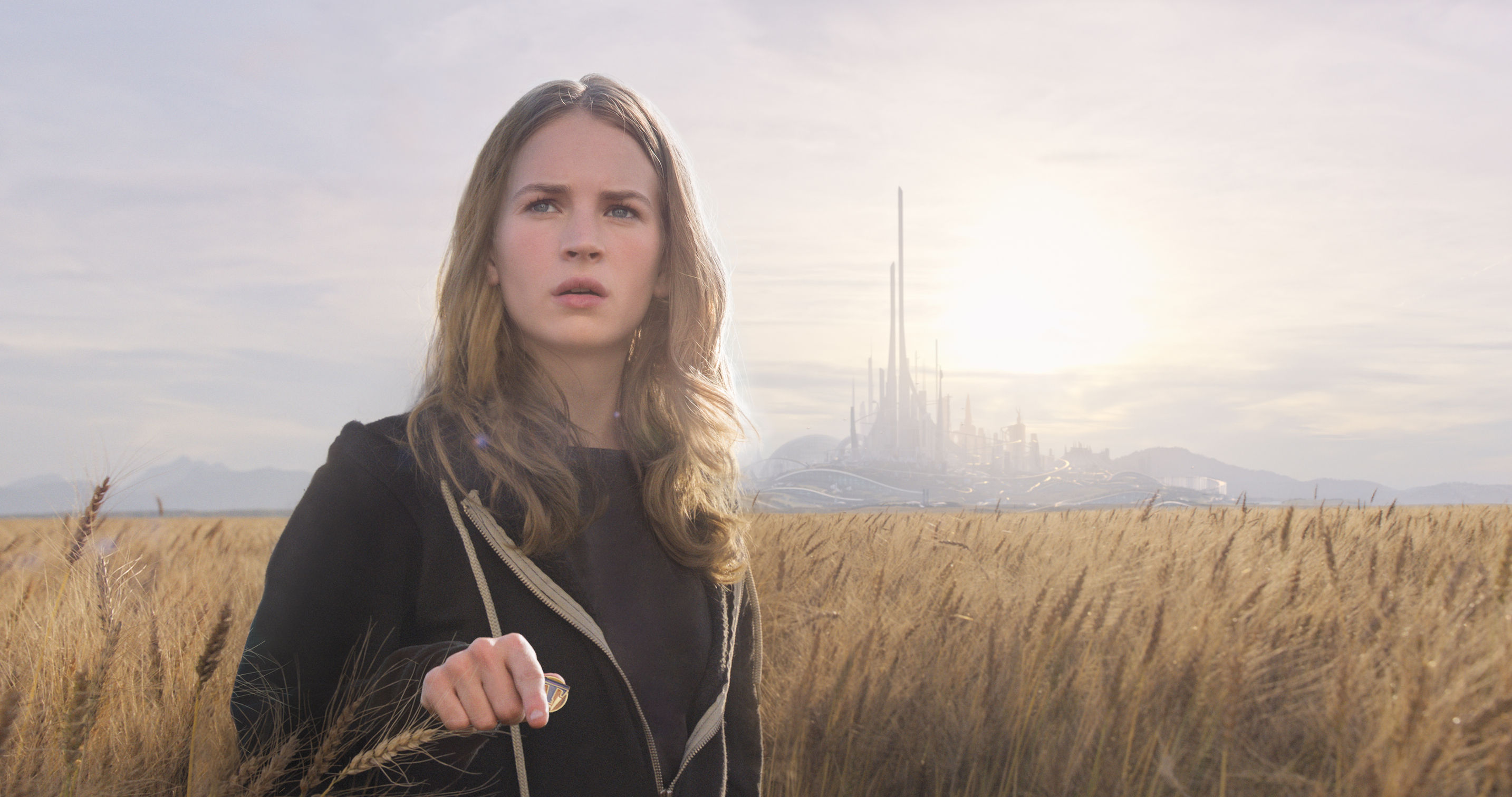
Casey in the golden fieldIn the movie, the same situation turns out to be mirrored in the hidden Tomorrowland.  This haven was founded half a century ago with the goal of recruiting bright people to improve the world.  In the intervening years, it has focused instead on trying to make people face the approaching disasters.  Its futuristic technology beams subliminal messages into our world in an attempt to “raise consciousness” before it’s too late.  But like the schools, this secret cabal is no longer proposing ways to “fix it,” only foretelling doom.

Of course, alerting people to potential disasters is not a bad thing.  Motivating by fear is certainly one way to arouse people to action.  But what Tomorrowland, like the schoolteachers in the opening scenes, has forgotten is that dread, without hope for solutions, doesn’t lead to fruitful changes.  It leads to stagnant despair.

In the end, Casey and Frank halt the doomsaying broadcast, and begin again to recruit “dreamers.”  “Dreamers” here doesn’t mean believing things are just fine.  That would be blind optimism.  Rather, it means believing better things are possible.  If you’re a “fixer”—a builder, a maker—this leads to asking how things can be made better; which leads to plans for change, not just empty wishes.

In other words:  the conviction that catastrophe is inevitable is a self-fulfilling prophecy.  Expect the worst (admitting no other possibilities), and you’ll get it.

The World of La Mancha

A complementary idea forms the backbone of another favorite of mine—the play “Man of La Mancha,” a musical adaptation of the story of Don Quixote by Dale Wasserman, Joe Darion, and Mitch Leigh, written—oddly enough—in 1964.  (There’s a movie version, but this is one case where the stage play is definitely better.)

Man of La Mancha posterThe play slims down the sprawling novel and focuses it on a particular set of ideas—as does the operatic version of Les Misérables.  What makes this Quixote a worthy adjunct to Tomorrowland is the course of his eccentric romance with his lady “Dulcinea.”

The woman the deluded Don identifies as the virtuous Dulcinea is a barmaid and part-time prostitute named Aldonza.  She is at first baffled and then enraged by Quixote’s attempts to place her on a lofty pedestal, his refusal to see her as (she says) she really is.  (Audio / Movie video)

As soon as Aldonza begins to believe she can be better than that, she is brutally disillusioned.  Yet Quixote stands by his conviction that she’s really a noble lady, in the face of all contrary evidence.   At the end of the play (7:42 in the clip), she finally accepts that role:  “My name . . . is Dulcinea.”  She takes on the quest of becoming more than she is.

In other words:  expecting the best calls it forth.


This encouraging principle doesn’t always work out nicely, as the play makes devastatingly clear.  If we seek out the best in people, we’d better be prepared for a letdown sometimes.  But the principle does shape our thinking in the right direction—a productive direction, rather than a dead end.

The two matched stories remind us that some degree of faith in the future, for a person or for a society, is needed if we want to foster energetic action.  It’s therefore incumbent on us not to crush such fertile hopes.  We should never blind ourselves to the facts, but that doesn’t mean we should be satisfied with them.