Comfort Reading

Reading for Reassurance

Chicken soupYou’ve heard of “comfort food,” right?

In Robert A. Heinlein’s The Number of the Beast (1980), one character asks the others:  “Write down the twenty stories you have enjoyed most. . . . Make them stories you reread for pleasure when you are too tired to tackle a new book.”  (ch. 33, p. 349)

I’d never actually thought about it before I read that passage, but there is such a category.  There are times, especially toward the end of the day, when we want to immerse ourselves in a story, but not an arduous story.  Even if we’re currently reading something new that we like, we may not feel we can fully appreciate it when we’re tired out.  We’d rather relax into something less demanding.

The same can be true when we’re feeling emotionally drained.  Sometimes we pine for what we might call “comfort reading” on the analogy of “comfort food.”

We might be tempted to regard this urge for the familiar and reassuring as craven or self-indulgent.  But there’s nothing wrong with giving way to that impulse—some of the time.  We can welcome a new book as a challenge; but we don’t always have to be challenged.  Sometimes we simply need to recoup our energies for a while.

This is true in general, I think, but especially at Christmastime—so today seemed like a good time to bring up the subject.

Good Comfort Reading

What kind of stories one likes for “cocooning” will vary, culturally and individually—as the Wikipedia article cited above makes clear for comfort food.  In TV Tropes terms, “your mileage may vary.”  By way of example, here’s some of what I find myself looking for.

When I relax, I want something relatively light, not a matter of life and death.  A fan of adventure fiction spends a lot of time embroiled in saving the world, or the galaxy—or at least the imperiled main characters.  And a lot of science fiction deals with world-changing issues and problems.  That’s pretty strenuous.  It’s nice to be able follow a narrative where the stakes are not quite so high.

At the same time, there has to be enough substance to engage our interest.  A story in which nothing is at stake won’t hold our attention.  So pure farce or silliness doesn’t always fill the bill.

And for me, at least, it helps if the story is fairly “warm-hearted.”  Happy endings, sympathetic characters, a certain degree of kindness and encouragement in the air.  A cynic might have a quite different preference here:  a happy ending may not be congenial to his world-view.  But we sentimentalists want some of the milk of human kindness in our chicken soup.  (Well, maybe not literally.)

For this reason, romances make good hunting grounds for comfort reading.  Not necessarily genre romances; I’m put in mind of Chesterton’s Tales of the Long Bow, which is almost uncategorizable (social comedy? political commentary? science fiction?) but incorporates no fewer than seven separate romances in a scant 217 pages, possibly a world’s record.

In a good love story, something that matters very much is at issue—but generally only for the main characters.  This is why P.G. Wodehouse’s comedies are almost always romantic comedies.  His amiable main characters are never in very great danger, but rooting for their love affairs keeps us focused through the plot’s succession of hilarious absurdities.
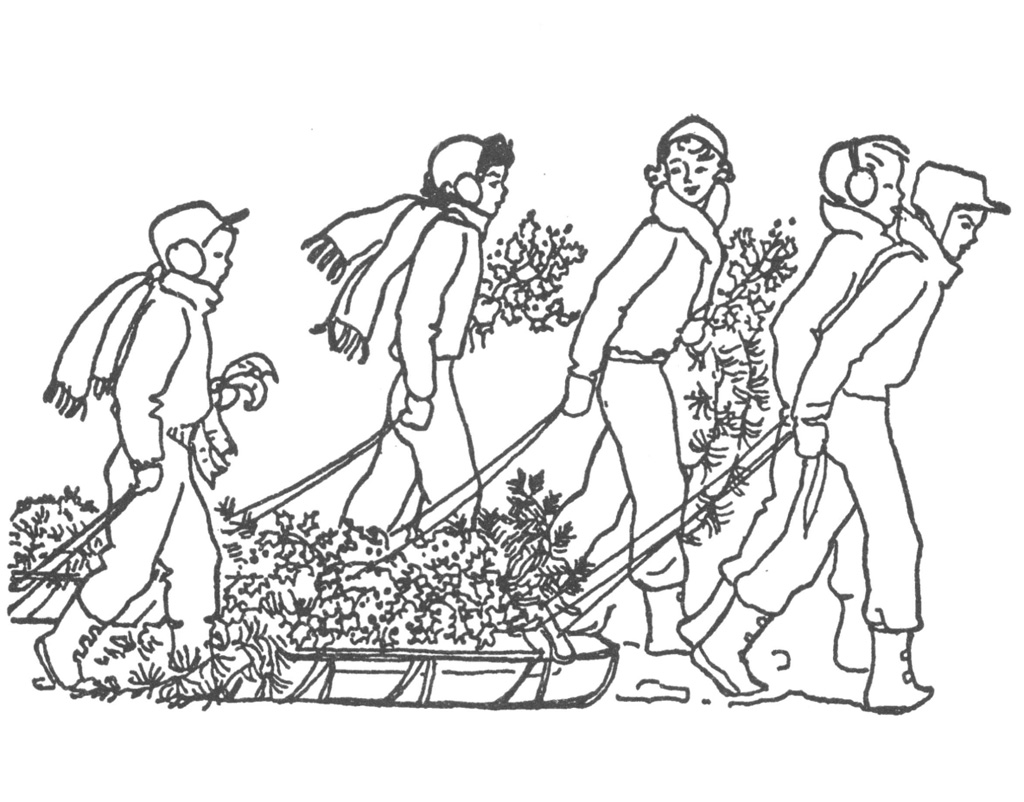
Melendy children with Christmas greensPersonally, I also like children’s stories to relax with.  There’s a category of what I call “family adventures,” where preadolescent children get into a series of scrapes or difficulties that are interesting but never too serious.  Elizabeth Enright’s Melendy Quartet (starting with The Saturdays, 1941) is my paradigm example.  Some of E. Nesbit’s books, such as Five Children and It, have a similar air, but with a fantasy component.  (I’d cite Eleanor Estes and Edward Eager as well, but that would raise the mysterious question of why so many writers in this category have the initials E.E.  Same reason Superman’s girlfriends all have the initials L.L., I suppose.)

Christmastide Reading

Of all the times of the year, the Christmas season may be when one most wants to be reading something engaging but pleasant.  There are probably people who want to stage a “Game of Thrones” marathon on Christmas Day, but I’m not one of them.

There are of course the traditional comforting stories that are specifically about Christmas.  A Christmas Carol is one obvious choice (though the actual book is a bit spookier and more tough-minded than some of the adaptations)

Interim Errantry coverLess obvious favorites of mine include “A good-humoured Christmas chapter” from Dickens’ The Pickwick Papers (ch. 28); “How Lovely Are Thy Branches” from Diane Duane’s Interim Errantry; chapter 5 of The Wind in the Willows (“Dulce Domum”); Madeleine L’Engle’s Dance in the Desert and The Twenty-Four Days Before Christmas; Elizabeth Scarborough’s Carol for Another Christmas; chapters 12-13 of Kate Seredy’s The Good Master; and Manly Wade Wellman’s “On the Hills and Everywhere,” in the collection John the Balladeer.  The only trouble is that some of these are quite short; they’ll barely last you through lunch.
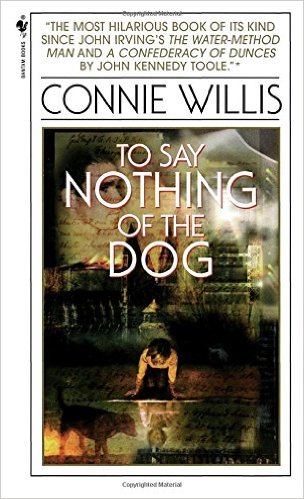
To Say Nothing of the Dog coverBut even at Yuletide, we may not want to marinate in Christmas quite to that extent.  So I also cultivate a selection of books that strike (or encourage) the right mood, but don’t have anything specific to do with Christmas.  I’ve mentioned Wodehouse; Georgette Heyer’s Regency romances have a similar combination of light-heartedness and warm-heartedness (I’ve often thought of her as Wodehouse crossed with Jane Austen).  Other kindly and entertaining tales not specifically about the season include Lois McMaster Bujold’s A Civil Campaign—one of my all-time favorites for all seasons—Connie Willis’s To Say Nothing of the Dog, and Diane Duane’s Omnitopia Dawn.

Have any favorites of your own for Christmastime, or comfort reading generally?

Changing History: “Timeless”

The initial episode of NBC’s new time travel series, Timeless (premiered Oct. 3, 2016), does a neat job of handling the classic trope of changing the past.  There’s more to that kind of plot than generally meets the eye.

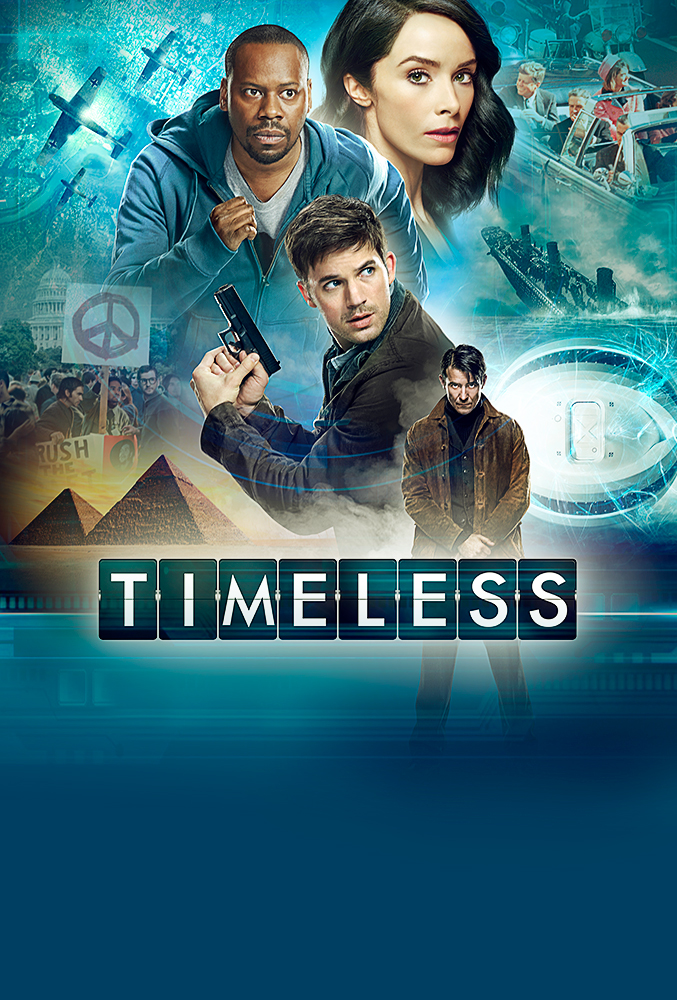
Spoiler Alert!The following necessarily contains spoilers for the first Timeless episode, so if you haven’t seen it and want to, be careful when scrolling down.  I’ll drop another alert message at the point where the spoilers begin.Poster for Timeless

The Lure of the Past

Oddly enough, travel to the past fascinates us more than travel to the future.  One might expect it to be the other way around.  After all, we’ve been to the past.  The first classic time travel tale, H.G. Wells’ The Time Machine, concerned itself exclusively with the future.  But it’s backwards time travel that lets us imagine changing the present by altering its causes—and produces the causal tangles that are unique to time travel stories.

Larry Niven’s essay “The Theory and Practice of Time Travel” (found in All the Myriad Ways) points this out:  “When a child prays, ‘Please, God, make it didn’t happen,’ he is inventing time travel in its essence. . . . The prime purpose of time travel is to change the past; and the prime danger is that the Traveler might change the past.”

The Past Doesn’t Change

Some stories assume that the past can’t be changed.  The time stream protects, or heals, itself automatically once the moving present has passed.  There was an old-time SF story (anyone remember the title?) in which successive attempts to change history misfire because of progressively more unlikely accidents.  The gun misfires.  The bullet misses.  A bystander intercepts the bullet.  A meteor knocks the gun out of the assassin’s hand.  The hypothesis has an air of fate about it, as in the Greek myths.

But unchangeability needn’t be a matter of fate.  It may simply reflect the fact that the past event has already happened, incorporating any interventions from the future that may have taken place.  There is a single past event, which is the product of all its causes, whether they come from the event’s past or its future.  As TV Tropes puts it, “You Already Changed the Past.”  Robert A. Heinlein wrote some of the most famous time travel stories using this approach to generate “constructive” or “ontological” paradoxes—By His Bootstraps and “—All You Zombies—”.

A technology that only allows viewing the past, rather than interacting with it, falls into a similar category.  There’s no chance of changing things; we’re mere observers.  Isaac Asimov’s The Dead Past leaps to mind.

These kinds of stories are fun, but they don’t have quite the emotional appeal of “Make it didn’t happen.”

How A Change Propagates

Suppose, then, that we can change the past.  How exactly is that supposed to work?

A writer sometimes introduces a sense of urgency into the plot by imagining that a change in history propagates through reality in a process that itself takes time (of some sort).  This is what creates the tension in Back to the Future.  We can see Marty’s family gradually disappearing as his disruption of history works its way forward.  Presumably Marty disappears last because he was conceived last.  If he doesn’t reestablish history before he disappears, it’s all over.

This makes a weird sort of sense, because natural processes do normally propagate gradually.  Even gravity has its waves.  But it does result in the curious phenomenon of a reality that isn’t entirely self-consistent.  Marty’s parents never got married, but Marty himself is still inexplicably there.  (For the moment.)

It makes more sense, maybe, to picture the change as taking effect instantaneously.  Take away the causal “supports” for something, and it’s no longer there at all.  This assumption would have made Back to the Future a much shorter movie—and highlighted the “Grandfather Paradox” at the core of its plot.  The time lag gives Marty a chance to cure the paradox before it fully takes effect.

What Happens to the Traveler?

But we’re assuming that the causal ripple from history’s change follows the time traveler even when the traveler’s world line has looped around into the past.  What if that isn’t how it works?  (We’re inventing a theory of time travel; we can make what assumptions we wish.)  If the traveler is absent from the future when the change “gets there,” will the traveler be affected at all?

If the traveler is affected by the same change that affects everything else, we get a time stream that’s more consistent, but harder to tell a story about—because no one in the story will remember the change.  The traveler’s memory alters along with everything else.  (There’s an old SF story about this, too—and it only works because the reader is outside the story’s time stream.  At the end the bizarre monster that was human on page one proclaims, ‘the time experiment is over, and nothing has changed.’  The story only works from an omniscient point of view.)

So a time travel story almost always assumes that the traveler, who was out of the affected time region when the change occurred, remembers the old when she encounters the new.

Here Be Spoilers!

You Can’t Go Home Again

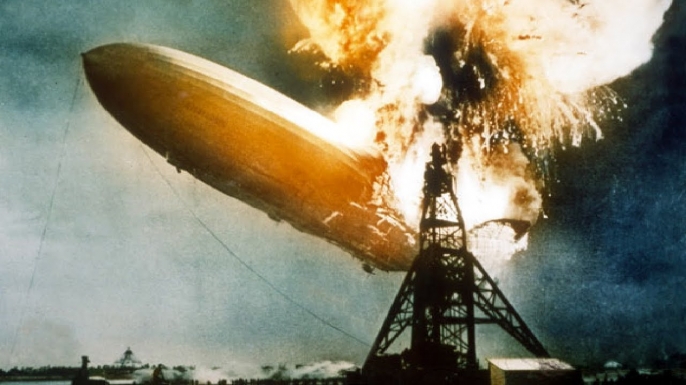
Here’s where Timeless comes in.  Villains of some sort—or are they?—steal the secretly developed time machine and set off to change history.  Our three heroes take the older prototype vehicle (a little less streamlined than a DeLorean) and follow.  They don’t quite succeed in preventing their adversaries from altering the past.  The Hindenburg explodes on its return trip, rather than on its arrival in America.Hindenburg disaster

When our heroes come back to the present, their colleagues believe the zeppelin had always exploded on its return trip—because the change in history has affected them.  The three travelers have to explain to them what’s changed.  In a sense, they no longer belong in the world from which they set out.  It’s an unusual and interesting situation for a TV series.

The Butterfly Effect

So far, we haven’t seen what larger alterations or political ramifications may have resulted, in this new world, from the deaths of several prominent figures on what was now the Hindenburg’s ill-fated second flight.  But the personal implications turn out to be devastating.

Butterfly effect graphicThe screenwriters also have a good handle on another time travel staple, the “butterfly effect,” named for the metaphor that in a massive chaotic system, a butterfly flapping its wings on one continent might result in a tornado in another (or, possibly, named for a classic Ray Bradbury short story).  When main character Lucy Preston comes home from her adventure in the past, she is overjoyed to find that her mother, comatose when Lucy left, is now perfectly healthy.  But Lucy is appalled to find that her beloved sister never existed.  How could the Hindenburg’s altered history have anything to do with this, she cries—and now she has new, and very mixed, motivations as to setting time back on its original course.

The show thus picks up on a theme that’s frequently neglected in a tale about changing the past.  Each change has unpredictable ramifications.  Marty McFly comes home to find his parents much improved, his siblings successful, and the despised Biff reduced to a cipher.  But what of all the people in town who will have interacted with the changed McFlys and Tannens over the past thirty years?  If even minor events can have large long-range effects, it may not be so easy to confine a temporal change to the intended consequences.

This means that our Timeless heroes may have no way to put things back the way they were.  The change may be essentially irreversible—a sort of temporal entropy.  Anything they do to counteract the bad effects of the original change will lead to still more alterations.  They really can’t go home again.

If the writers carry through this fascinating, if rather chilling, line of thought in subsequent episodes, we may get some really interesting story lines—as time goes on.

Star Trek: Raiders of the Lost Arcs

I’m a Star Trek fan from way back.  I enjoyed “Star Trek:  Beyond.”  Why am I not more enthusiastic?

Star Trek Beyond posterStar Trek:  The Original Series (“TOS”) was almost purely episodic.  Each week, another new world or new civilization, a unique problem, a nonrepeating set of guest stars.  Each episode stood pretty much alone.  You could miss one and not be at a loss when you saw the next one, because nothing had changed.  The original “setup” was restored at the end of every show.

This wasn’t unique to Trek; it was the norm on television back in the 1960s.  “Situation comedies” were defined by a permanent “situation” that formed the basis of each week’s program.  Dramatic shows like “Bonanza” or “The Man From U.N.C.L.E.” used the same method.  No matter what happened in the course of one episode, things were back to normal by the opening of the next.  The reductio ad absurdum is “Gilligan’s Island.”  There was a melancholy certainty that no matter how hopeful things seemed, they were never getting off that island.

Of course this was never entirely true.  One of the Cartwright sons on “Bonanza” was Cartwritten out of the script and disappeared.  Chekhov joined the Enterprise crew in the second season of Star Trek and stayed on thereafter.  But mostly, the “initial conditions” for each episode remained the same.

What we did not see was long-running plot arcs or character development.  Each plot had to wrap up neatly in a single episode.  Characters and relationships were static.

It’s instructive to look back and realize how much this has changed.  TV series these days are expected to have long-term plot arcs, often spanning a season or more.  A series like “Chuck” might change the plot premise significantly from one season to the next.  And viewers today are addicted to mini-series (maxi-series?) with extremely long and complex plots, as in “Game of Thrones.”


As the Star Trek movies came out, it presently began to seem that we were essentially seeing series episodes, but stretched out to two hours rather than one.  It left a vague feeling of being cheated.

In a typical two-hour movie, there’s time for more leisurely plot development, and one expects things to happen.  Sure, there are long-running series like the James Bond movies that cycle back to the same scenario just as the old TV series did.  But that isn’t true of most movies.  Even sequels frequently find themselves starting at a new point in narrative or character development—which was a challenge for moviemakers who merely wanted to reprise the success of the original film.

If we pass in merciful silence over Star Trek I (“The Motion Picture”), the striking thing is that the next three movies did have a continuing plot arc.  I’ve heard that they were plotted as a coherent trilogy by Harve Bennett, and that does seem to be borne out by the movies themselves.

While Star Trek II, III, and IV represented remarkably different types of films, there was a continuous thread of action.  The Enterprise crew created the Genesis planet in II, returned to that planet and saw its collapse in III, and made their own return to Earth in IV.  With side trips, of course.

And there were character changes.  One of the things that makes Star Trek II the best of the Trek films is the impact of Spock’s death, around which the entire story is carefully constructed.  Of course fans were pretty sure even then that his death wouldn’t be permanent.  But the characters didn’t know that, and we got to see how this loss affected them.  And Kirk’s son David Marcus did die for good in III—though this new character’s death didn’t have the impact of Spock’s.

Star Trek V and VI, however, were unconnected stories riffing on the same traditional characters, and momentous as the writers tried to make them, there was a distinct sense of “back to the old grind.”  VII was somewhat unique, as the intersection of the TOS crowd with “The Next Generation” (TNG) characters.  But the following movies, VIII through X, were very like individual episodes of the TNG series.

The three films beginning with the 2009 reboot also strike me as standalone episodes.  The occasional attempt to tie them back to other storylines, as with the appearance of Khan and Carol Marcus in “Into Darkness,” is offset by the disconnection from all earlier stories stemming from the timeline change in the 2009 movie.

So this year’s Star Trek entry strikes me as okay, but it lacks the cumulative force of a long-term plotline—unless perhaps you take a strong interest in the desultory Spock-Uhura romance, which so far hasn’t gripped me.

By contrast, series that do have long-term plotlines and character developments, as in Star Wars and Harry Potter, can build up quite a head of steam—and corresponding viewer loyalty—through the accumulating drama of an extended story.


The fact that we now expect long-form plot arcs makes for an interesting countercurrent to some of the standard assumptions about today’s audience.

It sometimes seems that we have all been seized by a collective attention deficit disorder.  Writers are warned to “hook” their readers, not in the first page or even paragraph, but in the first sentence.  Communication packets have been reduced to 140 characters.  It’s easy to bemoan how rushed we all are, and how short our attention spans.

But at the same time, modern viewers take in stride a series of six or seven movies.  Harry Potter brought a generation of viewers through eight lengthy parts without blunting their appetite for more Potteriana.  TV series routinely carry on long-drawn-out developments.  Novel readers happily consume endless serials like the Honor Harrington tales, or the fourteen massive volumes of Robert Jordan’s Wheel of Time.  By today’s standards, the 1800-page Lord of the Rings, touted as a huge work in the 1960s, seems positively concise.

To my mind, this says something favorable about today’s readers and viewers.  We’re fond of the sound bite and tweet, yes—but we also seem willing to tackle much longer stories than in the olden days.  There may be hope for coherence and continuity yet.

Star Wars VII: The Old and the New

By now it should be possible to discuss The Force Awakens without issuing a spoiler alert, since everyone in this galaxy has probably seen it.


I was tempted to use “Everything old is new again” for the way SW7 harks back to the original movie, but it turns out several commentators have already done that.  Then I thought using the phrase “Back to the Future” might express the sense of familiarity the new movie evokes for old-time fans—but it turns out a number of reviews have already done that too (for example, here, here, and here).  Somebody’s even done a Star Wars-Back to the Future mashup.

The great thing about the Internet is that it’s easy to find out what everyone else is saying.  The depressing thing about the Internet is that, when you set out to say something, someone else has probably said it already.


Is the familiarity of Episode VII’s tropes a strength or a weakness?  Is director J.J. Abrams just rehashing old material, or is he providing us with a charming return to our roots?

In this case, I think imitation is the sincerest form of homage.

The familiar moves came off well, by and large.  Heroes with downtrodden humble beginnings – that’s classic storytelling.  Desert planet—Actually, I could have done with a new setting.  But the landscape does express the aridity of Rey’s prior life, and it allows for some nice contrasts.  (“I didn’t know there was this much green in the whole galaxy.”)  And we aren’t there for very long, after all.

Invoking family dysfunctions and mysteries also harks back to the original trilogy, of course.  The angle that struck me particularly (since I’m old enough to appreciate it) is that “Rey Who?” sparks as feverish a storm of fan speculation as Darth Vader’s Empire Strikes Back bombshell.

It’s hard to remember now, when “I am your father” has become a ubiquitous meme, that at the end of ESB we didn’t really know whether Vader was telling the truth.  He probably was; it was too good a narrative twist to pass up.  But those us who were still attached to the image of Luke’s heroic dad spent three years trying out alternative scenarios.

Even more, we debated “There is another.”  We canvassed every conceivable answer to that mystery, and some that were inconceivable.  Same with Rey’s parentage:  I’ve already heard suggestions that are all across the map.

At least, on Disney’s more aggressive release schedule, we’ll only have a year and a half to run this issue into the ground, as opposed to three years back in the 1980s.  Which is a good thing:  by the time Return of the Jedi was released in 1983, we had overthought the matter so much that the actual revelations were almost anticlimactic.

(Of course, the real answer, obviously, is that Rey is Chewbacca’s daughter.  They hit it off so well, and he accompanies her to find Luke at the end.  This explains why Han, Chewie’s old friend, is so protective of her.  She doesn’t look like Chewie, you say?  We can just assume that Wookiees develop all that hair and the growly voice later, post-adolescence.)

By and large, I enjoyed the frequent callouts to Star Wars IV-VI.  The new movie combined the nostalgic recognition of familiar themes with the freshness of new characters and relationships.  Rey and Finn and Poe play off each other well, but not in the same way as Luke and Leia and Han.  Abrams has restarted the story without having to reboot.


On the other hand, there were a couple of repetitions that could be dispensed with.

The biggest (in every sense) is the Death Star.  Er, Starkiller Base.  The whole end sequence in SW7 was fun, to be sure.  But we’ve seen this scenario twice already in the original trilogy.  Three desperate attempts to blow up an Ultimate Weapon is enough.  Can we agree, no more Death Stars, no matter how big they are or what fancy names we give them?

We need something different for the third trilogy.  It’s not as if there aren’t other mythic motifs available.  I’ve always felt the third trilogy would work well as a Quest.  Let there be something Our Heroes need to find to set a New Republic or new Jedi Order on the right track.

With the classic quest theme in mind, the fact that Luke set out looking for “the first Jedi temple” is suggestive.  He’s not just on this island as a hideout; he seems to have been looking for something.  What might one be looking for in the Jedi temple that would make a good MacGuffin for Episodes VIII and IX?  The “Holocron,” a Jedi teaching device invented for the Star Wars Expanded Universe, might be a good candidate.  (In a year or so, we can look back and see how far off-track I was—which is the fun of making rash predictions.)

We can analyze all these questions to death while we’re waiting for Episode VIII to come out.  But if we’ve learned from the 1980s experience, we may prefer just to enjoy the anticipation.