Arthurian Variations (Part II)

We’ve seen that the Arthuriad has generated a wide variety of retellings over the years.  What makes these legends so adaptable, and so congenial to storytellers of all kinds?

To begin with . . .

A few reasons leap out at us.

As we’ve seen before, it helps if there’s no one canonical version of a story.  Without a single clear source, later authors are free from the need to conform to the “classic” tale.  The Wikipedia article says outright, “there is no one canonical version” (¶ 3).

It’s true that Malory’s Le Morte d’Arthur is the central reference point, at least in English.  But his version is so far from current norms that it would be hard to try and reproduce it faithfully—as Steinbeck perhaps found.  Malory serves more as a library or resource for story elements that can be adapted and recombined at will.

The sheer breadth of that source material is a second factor.  All those knights, all those adventures, even the numerous events of the main storyline:  the Arthuriad is its own ‘Pot of Story,’ a stew full of nutritious narrative elements.  “It held a treasure for every seeker.”  (The Mabinogion, tr. Gwyn Jones and Thomas Jones, Everyman’s Library, 1949, 1974, Introduction, p. xxx.)

The story also occupies a colorful historical setting, whether in the plate-mail-and-castles “high road” approach, or in the more historically plausible “low road” approach.  Many readers have a fondness for this quasi-medieval environment—which is why versions of that milieu are used in so many fantasy stories and games.

A Plethora of Characters

In particular, the Arthuriad is filled with strong and interesting characters.  An author can focus on, say, the character of Percival, or Morgan le Fay, or Gawain, and take off from there.  Or she can ring the changes on the main story by redefining the characters and their relationships, as we saw in the examples from Part I.

Arthur himself can be played in many ways.  Generally he tends to have a certain innocence, a certain earnestness and candor about him.  But this can be realized in the psychologically wounded but charismatic leader of Wolf’s tale, in the essential simplicity of the idealist in White’s Once and Future King, or in the clever but dedicated warleader of “King Arthur.”  (It can also be seen in the weak and waffling character of Lerner & Loewe’s “Camelot”—if we include what I consider a failed implementation.)

Other characters are equally mutable.  Mordred is subtle and evil in White; he’s an innocent and rather likable kid in Wolf.  Lancelot contains enough contradictions in himself—loyal friend, betrayer of a marriage, devoted lover, peerless warrior—that an intense character study of this champion is almost unavoidable if we let him into the story at all.

Guinevere is a particularly tricky case.  It’s hard to play her as truly admirable—since so much of her traditional role lies in being untrue, at least after a fashion.  (She’s untrue to Arthur, but true to Lancelot, and the story seems largely willing to forgive the first in light of the second.)  If she isn’t handled carefully, she’s likely to default into being silly, or weak, or fickle.  The challenge of giving her a better role may appeal to an author.  Both books and films have taken up that challenge, though I’m not familiar with those treatments.

Compelling Drama

The story of Arthur contains many events that lend themselves to high drama.  For example—

His origin.  It seems essential for Arthur’s ascent to the throne to exemplify the theme of the lowly raised high, the rise from humble beginnings to glory.  His childhood is modest, in one way or another.  In the traditional formulation, Arthur doesn’t know who he is until he is almost grown, and it may take a magic token (the sword in the stone) to demonstrate his true nature.  As a result, Arthur generally has the humility that I’ve argued characterizes our archetype of the Good King.

This Cinderella-type story appeals to our fondness for the underdog, and the reversal of fortunes is inherently dramatic.  There are a lot of possibilities for how that revelation occurs, and how Arthur and those around him react.

Lancelot, Guinevere, Arthur (King Arthur)The love stories.  An eternal triangle necessarily involves passion, betrayal, and drama.  But there are a lot of possible ways to construe the relations among Arthur, Guinevere, and Lancelot (along with Morgan and other possible players, as we saw last time).

In the central love story, Arthur tends to lose out.  As White puts it (Book Three, beginning of ch. 45):  “Merlyn had not intended him for private happiness.  He had been made for royal joys, for the fortunes of a nation.”

Since Arthur is on the scene first, Lancelot must share some strong bond with Guinevere in order to draw her away from Arthur—unless the Arthur-Guinevere bond isn’t that strong to begin with, as in Wolf.  If we idealize Lancelot and Guinevere’s romance, we have to push Arthur away.

There’s a strong impulse to rescue the love story somehow.  We have three characters, each of whom we love and admire, trapped in this untenable situation.  We don’t want any of them to lose out, but someone has to.

So we get retellings that pare down the triangle.  In The Road to Avalon, Arthur and Morgan are the real romance; it doesn’t matter if Guinevere seeks solace elsewhere (except for political reasons).  In “First Knight,” Arthur is too old for Guinevere; after his inevitable death, Lancelot and Guinevere seem to be left free to marry.  “King Arthur” ends early, in terms of the overall myth, and skips the entire triangular problem.  Arthur and Guinevere marry at the end in a traditional romantic consummation, and Lancelot remains a minor character.

Moreover, if we choose as our main character someone other than the Big Three—one of the numerous other knights or ladies of the Arthurian court—the possibilities for love stories are endless.

The Holy Grail (Indiana Jones)The Holy Grail.  It’s hard to know what to make of the Holy Grail as a storytelling hub.  The Grail’s religious origins (although they are subject to dispute by some literary historians) may cause this part of the story to be bypassed entirely by those writers who prefer to dodge the Christian aspects of the Arthuriad.  White introduces the Grail quest rather ignobly as a distraction to keep the knights busy when there are no wars for them to fight.

Nonetheless, the mythic resonances of this ultimate quest MacGuffin have let it play a role in a surprising number of modern treatments—from “Monty Python and the Holy Grail” to “Indiana Jones and the Last Crusade”—even where, as in the last example, the Arthurian tales are not otherwise involved.  For those who want an air of mystery and the numinous, rather than just clashing swords, the Grail is a natural choice.

Key Themes

Finally, the Arthuriad carries a number of themes of lasting interest.  These themes can also draw storytellers to the court of Camelot.

Knights of the Round Table (Excalibur)True companions.  For Western culture, Arthur’s Round Table knights may be the archetypal example of the tight-knit group of comrades fighting together for the right.  The basic story also includes some inversions of this band-of-brothers relationship—betrayals of several kinds—but that only serves to make the ideal seem more dramatic and memorable.  The Round Table is explicitly portrayed in “First Knight” and (without the table) in “King Arthur.”  It’s satirized, yet mourned, in White.  It does not play a major role in Wolf’s version.  But if an author wants to invoke the ideal of comradeship to the death, Arthur’s court is as likely a touchstone as the Three Musketeers or Robin Hood’s woodland band.

Chivalry.  The Arthurian knights represent the archetype of the ideal of chivalry.  Now, our era has a love-hate relationship with this notion.  We frequently prefer to satirize or criticize the ideals that were held up as models for the Arthurian knights.  Yet there remains a certain appeal to what TV Tropes calls Old-School Chivalry, a less literal version that can turn up in cases as varied as Captain America and “Kate and Leopold.”  These later varieties look back to the hazy memory of a medieval ideal that we associate with Arthur’s court.

Civilization is at stake.  Almost all versions of the tale depict Arthur as standing in some sense for the defense of imperiled civilization against the chaotic forces that threaten it.  The opposition may be literal, as in The Road to Avalon, where Arthur leads armies against the invading Saxons.  Or it may be more subtle, as when The Once and Future King shows Arthur striving to achieve the rule of law as a principle to contain the depredations of warlords.  Not Might makes Right, but Right makes Might, protecting the weak from the strong, ordinary people from the powerful:  this is the chivalric ideal Arthur pursues under the tutelage of Merlyn.

You could call it civilization.  What I meant by civilization when I invented it, was simply that people ought not to take advantage of weakness—not violate maidens, and rob widows, and kill a man when he was down.  People ought to be civil.  (Book Two, chapter 9)

The most poignant aspect of the Arthurian tale is that he achieves this ideal, for a fleeting moment—an island of light in an age of darkness—yet it fails.  The Round Table is broken, Camelot goes down in war and betrayal, Arthur does not found a virtuous dynasty.  This chiaroscuro of success and failure has a dramatic appeal that is hard for a storyteller to resist.
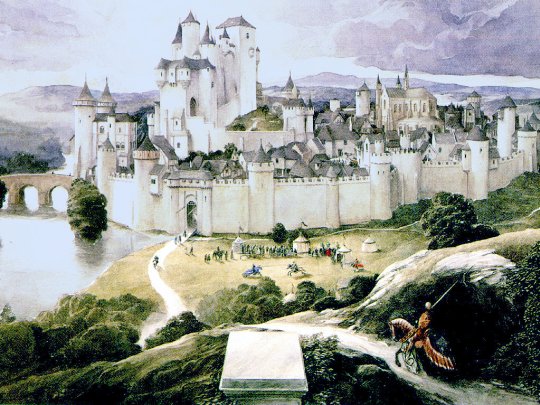
CamelotCamelot falls.  And yet, the story does not quite end in despair.  Arthur may die—but he is not entirely lost; he will somehow return.  In White’s touching ending, Arthur hands on the story itself, the memory of Camelot, to a young page named Tom—Tom Malory.  The ideal remains an ideal, and we are reassured that someday Arthur and the ideals he champions will reawaken.

It is no wonder that this kind of ambiguous, yet hopeful, ending attracts storytellers.  It attracts readers too.  All but the most hardened cynics would like to look forward to such a return.  Arthur’s story, like Arthur himself, never quite dies.

Arthurian Variations (Part I)

A Multitude of Arthurs

Sword in stone, in forestA few months ago I mentioned that the tales of King Arthur and his court—the Arthuriad—make up one of the most adaptable mythologies of all.  We can take a look at some of these variations (Part I), and follow up by considering what makes these legends so endlessly fascinating and malleable (Part II).

Wikipedia hosts two separate pages that enumerate versions of the Arthuriad:  List of works based on Arthurian legends and List of media based on Arthurian legend.  Tendrils of the Arthurian tree reach into such distant nooks as “Indiana Jones and the Last Crusade,” which relies centrally on the Grail legend.

And new branches keep sprouting:  a new film version is coming out from Warner Bros. in 2017.  Even Tolkien worked on one, which I blush to admit I haven’t read:  The Fall of Arthur (composed in the 1930s, published 2013).  The introduction to my copy of The Mabinogion sums it up:  Arthur “is at the centre of British story.”  (Tr. Gwyn Jones and Thomas Jones, Everyman’s Library, 1949, 1974, p. xxv.)

History of the Myth

The Arthuriad grew from many sources.  A number of originally unconnected legends were gradually brought together under one roof—one reason there’s such a plenitude of material in the legendry.  A few brief mentions of Arthur in medieval histories gave rise to tales and poems in England, in France, and in Wales.  Writers like Geoffrey of Monmouth and Thomas Malory assembled these various tales into more or less connected narratives.

The resulting mythology is the central part of the “Matter of Britain”—one of the three subjects that the medievals considered of paramount importance for literary development, along with the “Matter of France” (tales of Charlemagne and his court) and the “Matter of Rome” (the ancient myths that focused on the Trojan War and its ramifications).

It would take a scholarly treatise to deal with this history, not a blog post, even if I were qualified to write such an account.  Here I just want to note a few of the more interesting variations I’ve come across.

The High Road and the Low Road

I like to divide treatments of the Arthuriad into “high road” and “low road” versions.  On the high road we find the kind of setting that we usually think of in connection with the mythical Round Table:  knights in plate mail, ladies in silks and satins, magic from Merlin to the Green Knight round every corner.  This is Malory’s version, which reflected the customs and cultural level of Malory’s own time, rather than the historical setting in which Arthur was supposed to be placed.

The low road takes us to adaptations that hew more closely to actual history.  Here the writer seeks to make an Arthurian chronicle compatible with what we know of the real fifth or sixth century.  Magic and mysticism are minimized, and naturalistic explanations may be given for paranatural features of the original legends, such as the Sword in the Stone.  Contemporary retellings generally prefer the low road, grittier and less idealized than the plate-mail versions.

On the High Road

The high-fantasy Arthur is exemplified by Malory’s Le Morte d’Arthur (The Death of Arthur), which holds a central place:  to quote Charles Williams in The Figure of Arthur (p. 246), “it is Malory’s book which is for English readers the record book of Arthur and of the Grail.”  Traditional versions, particularly in the movies, tend to track Malory—at least in part, because no single novel or movie can possibly touch on the vast trove of material in Le Morte d’Arthur.

The trouble is that Malory is hard to read.  The language is archaic, and the mode of storytelling is far removed from contemporary styles.  Malory spends inordinate amounts of time on things like catalogues of knights at a tournament, and less than we would expect on characters’ thoughts and motivations.  We are thus inclined to search for a version more accessible to the modern reader.

The Once and Future King book coverA leading candidate is T.H. White’s The Once and Future King.  I grew up with White and still think of his as the canonical version.  It generated two popular movies—Lerner & Loewe’s musical “Camelot,” and Disney’s “The Sword in the Stone.”

Personally, I’m not pleased with either of those dramatic offspring.  The treatment of the main characters in “Camelot”is terrible (at least in the movie version), and “The Sword in the Stone” is Disneyfied in the bad sense, written down and trivialized.

There’s a different problem with the book itself:  The Once and Future King is very nearly a spoof of the Arthuriad.  White does a very good job with the main characters, but he fills the book with deliberate anachronisms and doesn’t take the actual quests and missions of the knights very seriously.  He keeps poking fun at Malory’s text.  The spoofery is often justified, and generally good fun.  But it does make White’s fanciful “high road” version a secondary rendering—parasitic, in a sense, on the original—and not really a good candidate for a ‘centric’ version.  (Not to mention the oddity of Part V, the “Book of Merlyn,” which was not published until after White’s death and conflicts in tone and substance, to my mind, with the main novel.)

John Steinbeck began a treatment that can be found under the title The Acts of King Arthur and His Noble Knights.  This might have been a candidate for a canonical modern version, if Steinbeck had ever completed it.  The book starts as a quasi-translation of Malory, but starts to develop more independently as it goes along.  It didn’t get very far, however, before Steinbeck abandoned it—perhaps because he hadn’t decided whether to keep diverging from his source material.

First Knight movie posterOn the screen, the 1995 film “First Knight,” with Sean Connery and Richard Gere, may be the best modern example of the high-road approach.  The main plot of the story is the tragic love story of Arthur, Guinevere, and Lancelot, though in this iteration Lancelot and Guinevere are left alive and apparently free to marry at Arthur’s death—an example of how those who favor romantic happy endings try to sort out the central romantic triangle.  Along with some gritty realism, the film does give us an idealized Camelot, shown more straightforwardly than in most modern adaptations.

On the Low Road

1981’s “Excalibur” may have started the trend toward more realistic versions in the movies.  Based purely on Malory, according to Wikipedia, the movie includes more explicit violence and more primitive settings than in “First Knight” or “Camelot.”  Nonetheless, “Excalibur” does incorporate the Grail theme and the mystical notion of the Fisher-King.

King Arthur movie posterA more recent example of the low-road movie is “King Arthur.”  Here Arthur is a Roman warleader, upholding the last of the fading Roman civilization in Britain, and Guinevere is a Celtic warrior maiden.  In this version, Lancelot dies (without real romantic entanglement) and the movie ends with Arthur and Guinevere’s marriage, stopping short of all the difficult tragic material later in the legend.

On the book side, the low road may be represented by Mary Stewart’s quintet that begins with The Crystal Cave.  In one classic example of a non-magical explanation for a traditional scene, Merlin leaves the sword Caliburn for many years in a cave where dripping water gradually deposits a limestone crust over the blade, from which Arthur breaks it free when he recovers the sword—a neat nod to Malory’s magical sword in the stone.

More Exotic Variants

It really gets interesting when authors start tugging and pulling at the legend to develop stories that depart more strikingly from the Malory-based legends.

Road to Avalon coverOne of my favorites is The Road to Avalon (1988), by Joan Wolf.  This novel takes a low-road approach, with almost nothing in the way of magic or the paranormal.  Here again Arthur is primarily a warleader, Comes Brittaniarum.  But he is also fiercely dedicated to preserving against barbarism the civilized culture represented by Rome—an aspect we shall have occasion to revisit.

Arthur’s task is to unite the British people against the Saxons.  (These Saxons are the invading enemy at this time, but they’ve become the defenders against barbarism by the time of King Alfred, and the underdogs by Robin Hood’s period.  British history is complicated.)

Wolf’s character treatment is what’s most interesting.  Here Morgan (usually “Morgan le Fay,” portrayed as a dangerous fairy or sorceress) is the female lead and Arthur’s real true love.  Gwenhwyfar is sympathetic, if a little shallow, but she never did have much more than a dynastic connection with Arthur, which makes her unfaithfulness with Bedwyr (this version’s Lancelot) more palatable.  In other words, the traditional romantic triangle is skewed—to the good, in this case.

In Wolf,  Mordred, usually the arch-enemy, is a likable boy; Agravaine is the real villain.  There’s a Round Table, for the right reason (to make those who sit at it equals, with no “head of the table” precedence).  But there are no knights in the plate-mail sense.  Religion hardly plays a role, much less the Grail.  But the story is very satisfying, and is followed by two sequels, one set in the generation after Arthur and the other taking up the life of Alfred.

There are lots more.  Marion Zimmer Bradley’s The Mists of Avalon is a feminist version, again with Morgaine as the heroine.  Stephen Lawhead’s five-book Pendragon Cycle starts out in Atlantis—from which we can see how eccentric the plotline has become.  The Last Legion (both book and movie) again stress the Roman connection, with the last emperor of Rome traveling to Britain to found the dynasty that will produce Arthur.  And of course, in the slapstick comedy category, we have Monty Python and the Holy Grail.

The Future King

I’ve seen surprisingly few stories that build on the tradition of Arthur as the “once and future king”—rex quondam rexque futurus.  Arthur is supposed to return; but the tales generally leave him ambiguously ensconced in Avalon.  In C.S. Lewis’s That Hideous Strength, we do see a revived Merlin in the present day, and we’re told in Perelandra that Arthur waits on Venus to come back to Earth for a final battle—but we don’t see that in the stories.

Tim Powers’ oddball The Drawing of the Dark has an eccentric return for Arthur—focusing mostly on beer.  Guy Gavriel Kay’s Fionavar Tapestry promotes a resolution of the Arthurian tragedy that takes place in another world, but draws in characters from our contemporary world.  I remember fondly, for some reason, a 1970 children’s book by Tom McGowen, Sir MacHinery, in which an experimental robot is perceived by a group of present-day Scottish Brownies as an armored knight—the crate is stenciled MACHINERY—where the inventor happens to bear the name Simon Arthur Smith.

But I haven’t run across as many stories about the return of Arthur as one might expect.  Some interesting potential there . . .

The Next Step

This spate of examples illustrates the wide range of variations to which the Arthurian legends are susceptible.  What makes them so adaptable, and so attractive to storytellers of all kinds?  We’ll take those questions up in the next episode.

The Good King

I began to wonder some years back about the curious preference for monarchy in futuristic settings.  In the world at large, monarchies have been retreating in favor of republics and democracies, at least in theory, since 1776.  Why are SF writers so fond of equipping future societies with kings, emperors, and aristocracies?

Star Kingdoms

We can pass lightly over the old-time, pulp-type stories where royal rule is merely part of the local color:  Burroughs’ A Princess of Mars (1912), Edmond Hamilton’s The Star Kings (1949), E.E. Smith’s The Skylark of Space (1928) with its Osnomian royal families.  Here, like flashing swords and exotic costumes, monarchy is simply part of a deliberately anachronistic setting.  Similarly in high fantasy, where aristocracy comes naturally in the typical pseudo-medieval milieu.

But we see royal or aristocratic governments in more modern stories too.  Asimov’s Foundation stories are centered around a Galactic Empire.  (Since that series was based on Gibbons’ The History of the Decline and Fall of the Roman Empire, an Empire was inevitable.)  Similarly in Star Wars, which draws heavily on Asimov.  Jerry Pournelle’s CoDominium future history has a First and a Second “Empire of Man.”  David Weber’s heroine Honor Harrington serves the “Star Kingdom of Manticore” (later “Star Empire”), modeled closely on England around 1810.  Lois McMaster Bujold’s Vorkosigan Saga contains a number of polities with different forms of government, but many of the stories focus on Barrayar, which has an Emperor.  Anne McCaffrey’s popular Pern series has no monarch, but has two parallel aristocracies (the feudal Holders and the meritocratic dragonriders).  It got to the point where I began to feel a decided preference for avoiding monarchical or imperial governments in SF storytelling.

The Lure of Kingship

Aragorn with crownThere’s something that attracts us in royalty—or we wouldn’t see so much of it.  I encountered this puzzlement directly.  As a kid reading The Lord of the Rings, I was as moved as anyone by the return of the true King.  I asked myself why.  If I don’t even approve of kingship in theory, why am I cheering for Aragorn?

The reasons we’re drawn to monarchy seem to include—

  • Kings are colorful. (So are princesses.)
  • Stability
  • Personal loyalty
  • Individual agency

The first point is obvious, but the others are worth examining.

Stability

It’s been pointed out that even in a constitutional government, a monarch provides a symbolic continuity that may help to hold a nation together.  British prime ministers may come and go, but Queen Elizabeth is always there.  (Literally, at least within my lifetime.)  This gives some plausibility to the idea of a future society’s returning to monarchy.

Something like this stabilizing function is behind commoner Kevin Renner’s half-embarrassed harangue to Captain Rod Blaine, future Marquis of Crucis, in Niven & Pournelle’s The Mote in God’s Eye:  “maybe back home we’re not so thick on Imperialism as you are in the Capital, but part of that’s because we trust you aristocrats to run the show.  We do our part, and we expect you characters with all the privileges to do yours!”  (ch. 40)

Unfortunately, relying on the noblesse oblige of the aristocrats doesn’t always work out well.  It depends on who they are.  For every Imperial Britain, there’s a North Korea.  When the hereditary succession breaks down, you get a War of the Roses or Game of Thrones.

Too much depends on getting the right monarch.  By the law of averages, it doesn’t take long before you get a bad ruler, whether by inheritance or by “right of conquest”—and you’re up the well-known creek.

Personal Loyalty

Personal loyalty appeals to us more strongly than loyalty to an institution.  One can pledge allegiance to a state—but even the American Pledge of Allegiance starts with a symbol:  the flag, and then “the Republic for which it stands.”  Loyalty to an individual moves us more easily.

This kind of loyalty doesn’t have to be to a monarch.  Niven & Pournelle’s Oath of Fealty explores how loyalty among, and to, a trusted group of managers can form a stronger bond than the mere institutional connections of a typical modern bureaucracy.  One can be faithful to family (the root of the hereditary element in kingship), to friends, or even an institution or a people.  But it’s easiest with an individual.  This loyalty is the basis for the stability factor above.

Individual Agency

The vast machinery of modern government sometimes seems to operate entirely in the abstract, without real people involved.  “Washington said today . . .”

In fact it’s always people who are acting.  But it’s easier to visualize this when you have a single person to focus on.  “When Grant advanced toward Richmond . . .”  In the extreme case, we have the ruler who claims to embody the state in his own person:  “L’état, c’est moi” (attributed to Louis XIV, the “Sun King” of France).

In a fascinating 2008 essay, Jo Walton quotes Bujold on political themes in SF:  “In fact, if romances are fantasies of love, and mysteries are fantasies of justice, I would now describe much SF as fantasies of political agency.”  A science fiction character is frequently involved in effecting a revolution, facing down a potential dictator, or establishing a new order—exercising autonomous power.  Walton links this notion of political agency to the fact that SF illustrates change:  “SF is the literature of changing the world.”  The world-changers can be outsiders, or they can be the rulers themselves—as in a number of the examples above.

It’s not surprising that we’re attracted to characters who act outside the normal rules.  We (especially Americans, perhaps) are fond of the idea that good people can act in ways that are untrammeled by the usual conventions.  I’ve already mentioned Robin Hood.  And the whole concept of the superhero—the uniquely powerful vigilante who can be relied on to act for the good—is powered by this attraction.

But this idealization of individual initiative is also dangerous.  Too much depends on getting the right hero—or the right monarch.  It can only work if the independent agent is seriously and reliably good:  virtuous, in the classical sense of virtue as a well-directed “habit” or fixed character trait.  Even then, we may be reluctant to give any hero unlimited power.  Too much is at stake if it goes wrong.

The Rule of Law

Our admiration for the powerful ruler is always in tension with our dedication to the rule of law:  “a government of laws, not of men,” in the well-known phrase attributed to John Adams.  We can see this as far back as Aristotle:  “law should rule rather than any single one of the citizens.  And following this same line of reasoning . . . even if it is better that certain persons rule, these persons should be appointed as guardians of the laws and as their servants.”  (Politics book III, ch. 16, 1287a)

No human being can be trusted with absolute authority.  This is the kernel of truth in the aphorism that “power tends to corrupt and absolute power corrupts absolutely.”  But we can’t get along without entrusting some power to someone.  When we do, it had better be someone who’s as trustworthy as possible.

The Ideal of the Good King

Thus the true king must be a virtuous person—a person of real excellence.  This is the ideal of an Aragorn or a King Arthur, whose return we’re moved to applaud (even against our better judgment).  (It should be obvious that the same principles apply to the good queen—or emperor, empress, princess, prince:  the leader we follow.  But I’ll continue using “king” for simplicity’s sake.)

What virtues do we look for in a good monarch—aside from the obvious ones of justice, wisdom, courage, self-control?

If the ruler or rulers are going to be “servants of the laws,” they require humility.  A king who serves the law can’t claim to be its master.  Arrogance and hubris are fatal flaws in a ruler.  For example, we should always beware of the leader who claims he can do everything himself and is unable to work with others.

The good king is also selfless—seeking the common good of the people, not his own.  Self-aggrandizement is another fatal flaw.

In effect, what we’re looking for is a ruler who doesn’t want to rule:  a king who believes in the sovereignty and the excellence of common people.

Aragorn defers to FrodoIt’s significant that Aragorn, our model of the good king, is introduced in LotR as “Strider,” a scruffy stranger smoking in a corner of a common inn.  Even when he’s crowned in victory, he remembers to exalt the humble.  The movie has him tell the four hobbits, “You kneel to no one.”  Tolkien’s text is more ceremonious:  “And then to Sam’s surprise and utter confusion he bowed his knee before them; and taking them by the hand . . . he led them to the throne, and setting them upon it, he turned . . . and spoke, so that his voice rang over all the host, crying:  ‘Praise them with great praise!’”  (Book VI, ch. 4, p. 232)

We see the same essential humility and selflessness in other admirable leaders, kings or not:  Taran in the Chronicles of Prydain, and the revolutionary princess in Lloyd Alexander’s Westmark trilogy; Niven & Pournelle’s Rod Blaine; Jack Ryan in Tom Clancy’s novels; “Dev” Logan, head of Omnitopia Inc. in Diane Duane’s Omnitopia Dawn—the unpretentious opposite of the “imperial CEO.”  America was fortunate enough to have such an example in the pivotal position of first President, George Washington.

The Alternative

At the other end of the spectrum, the most dangerous person to trust is an unprincipled and unscrupulous autocrat—someone convinced of his personal superiority and infallibility.  Giving power to an individual who has no interest in serving the common good, but only in self-aggrandizement, puts a nation in subjection to a Putin, a Mussolini, a Kim Jong-un.

The antithesis of the good king is the tyrant, who, however innocently he may start out, figures in our stories mainly as the oppressor to be overthrown.  It’s much better, if possible, to intercept such a potentially ruinous ruler before the tyranny comes into effect:  Senator Palpatine before he becomes Emperor, Nehemiah Scudder before he wins his first election.  Allowing the tyrant to gain power may make for good stories, but it generates very bad politics.

If we must have strong leaders, then in real life as well as in stories, character is key—and hubris is deadly.

The Malleability of Myth

Our stories are always built on other stories.  We draw not only on real life, but on all the other tales, tropes, and archetypes that we’ve encountered.

Some of those stories are especially powerful.  They express patterns that seem particularly meaningful to us.  Tolkien and Lewis called these “myth”—not in the sense of something false,  a “lie breathed through silver,” but in the sense of something fundamental.

Some mythologies are works of imagination:  the Greek or Norse gods, Superman, Star Wars.  Some may be built on elements of truth:  the fall of Troy, King Arthur.  Some may be literally true, though we can select parts of the overall story and express them in imaginative terms—for example, the tales of the American Revolution (Hamilton or 1776,) or what Lewis called the Christian myth (The Prince of Egypt, The Nativity Story).

Whatever their sources, all these tales make up a reservoir of plots, characters, themes, and locales on which authors draw—our cultural inheritance.  In his famous essay On Fairy-Stories, J.R.R. Tolkien described it this way:  “Speaking of the history of stories and especially of fairy-stories we may say that the Pot of Soup, the Cauldron of Story, has always been boiling, and to it have continually been added new bits . . .”  (Pp. 26-27 as reprinted in The Tolkien Reader (Ballantine, 1966); p. 10 in this online reproduction of the full text.)

A good storyteller does not simply repeat a story verbatim.  We give it our own spin or flavor.  In doing so, we draw from the Cauldron elements from all sorts of other tales.  As they say, “When you take stuff from one writer it’s plagiarism, but when you take from many writers it’s called research.”

This is true even when we purport to be retelling an existing story.  The great tales tend to be open to reshaping.  But how far can we go with this sort of adaptation, and still claim to be retelling the original tale?  How much stretching and twisting can a given story take before it becomes something else altogether?


The best example may be the Arthuriad, the mythology of the Arthurian tales.  But that’s so large a subject that it deserves a discussion of its own.  A more manageable example is the story of Robin Hood.

One thing that helps us feel free to adapt is the lack of a single, “canonical” original version of the story.  Any presentation of The Lord of the Rings—the movie, for example—will be judged against Tolkien’s book.  But there is no unique original source for Robin Hood.  The earliest sources are a variety of medieval ballads, according to Wikipedia’s extensive discussion.

Cover, Roger Lancelyn Green, Adventures of Robin HoodWhen I went in search of a standard version of the Robin Hood tale for my children’s library, there was no single obvious choice.  There is an influential Howard Pyle version, The Merry Adventures of Robin Hood—I haven’t read it, but apparently it’s written in an invented antique English idiom that might not be ideally accessible to young people.  I ended up with Roger Lancelyn Green’s 1956 The Adventures of Robin Hood, which struck me as a good, middle-of-the-road retelling on which to start a young person.


There are enough different elements in the Robin Hood story to allow for a range of  interpretations.  On the surface, there’s the sheer romance of a band of rough but virtuous rogues living cheerfully in the forest:  the “Merry Men” theme. There is the legendary adept or quasi-superhero element:  Best Bowman Ever.  (At least, “best” until you get to Katniss Everdeen, Hawkeye, (Green) Arrow, and other successors — all of whom owe something to the Robin Hood archetype.)

There are also political themes.  The conflict between underdog Saxons and Norman aristocrats got tossed into the Cauldron in the nineteenth century, according to Wikipedia.  More specifically, Robin is often seen as defending the absent Richard the Lionhearted against Prince John’s machinations.  And of course one can focus on the economic aspect, robbing from the rich to give to the poor, and make Robin a hero of the 99% against the 1%.  The tale generally includes a strong romantic element as well.

We can see how these elements can be differently mixed in some of the movie versions, all of which are fairly successful.


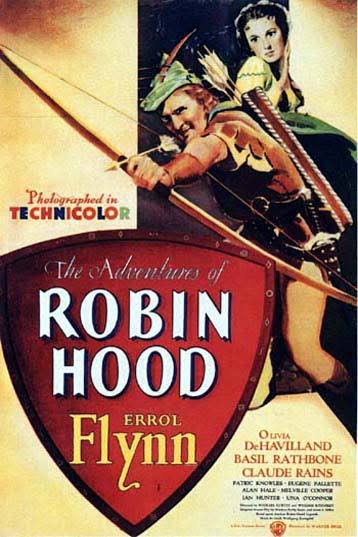
Poster, Errol Flynn, Adventures of Robin HoodIn the Errol Flynn classic The Adventures of Robin Hood (1938), Robin is good-humored and high-spirited.  Merriment abounds; the dashing Robin treats much of the action almost frivolously—“Where’s your love of fights, risk, adventure?”  He fights with a smile, like John Carter.  Marian says:  “he’s brave and he’s reckless, and yet he’s gentle and kind.”  In keeping with this light touch, much of the soundtrack music has an antic air.  Robin is an expert bowman, of course; we see this especially in the tournament/trap sequence (which seems to have been too frivolous to be used in the later movies, below).

The plot gives us Saxons versus Normans, with Robin a Saxon nobleman (though he had traditionally been portrayed as a yeoman).  In this version, the Sheriff of Nottingham is a fat fool; the villains are Prince John and Guy of Gisborne.  Richard is a noble and honorable king, though he has to be reminded of his homeland duties by Robin.  His return is protracted, and the politics is internal.  Robin (and Marian) speak for one England, not Normans against Saxons, under the one true king.  The climactic battle scene is essentially a civil war—John’s supporters against Richard’s.

Maid Marian is a pampered Londoner, a royal ward, though she comes over to Robin’s side promptly when he shows her the sufferings of the poor.  As usual, there is a competitor for her hand—in this case, Guy.  This Marian is not an action heroine.  She arranges the plan to save Robin from hanging after his capture, but it’s his men who execute the rescue.  The love story is a central thread, and the film ends with Robin and Marian rushing off from the celebration together.


Poster, Kevin Costner, Robin Hood - Prince of ThievesRobin Hood:  Prince of Thieves, starring Kevin Costner (1991), presents a more serious treatment.  Wikipedia describes it, accurately, as a “romantic action adventure.”  The Merry Men angle appears only vestigially, befitting Costner’s somewhat dour screen presence.  The Expert Archer trope certainly makes its appearance, as Robin makes progressively more unlikely bowshots to save the day.

Costner’s Robin is again an aristocrat, allying himself with the downtrodden when he returns from the Crusades.  (The notion that Robin had been on crusade with Richard is unusual:  he is usually seen as being driven to outlawry while Richard is away.)  We have the traditional Saxon-Norman conflict, complicated by throwing in a batch of wild-card Celts as well.  But the ethnic or class difference is not prominent; it is expressed primarily as a revolt against the weirdly evil and almost demented Sheriff of Nottingham.  Curiously, Prince John is not mentioned at all.  But King Richard does make an appearance at the very end, to bless the romance.  (In an entertaining nod to film history, Richard is played by Sean Connery, who had himself played Robin Hood in 1976’s Robin and Marian.)

Prince of Thieves leans heavily on the romance.  Marian, a local aristocrat, was acquainted with Robin when they were children—she despised him.  She takes a shine to him, however, after Robin returns to find the Sheriff has murdered Robin’s father.  Here it is the Sheriff who has designs on Marian’s virtue.  The romantic drama rides on Michael Kamen’s epic score for the music—with a main theme so good that Disney has come to use it as the generic musical cue for Disney’s logo.


Poster, Russell Crowe, Robin HoodThe most recent movie version is called simply Robin Hood, directed in 2010 by Ridley Scott, starring Russell Crowe.

Crowe’s Robin is serious-to-grim; no frivolous japes here.  Like Costner’s version, Crowe’s is returning from the Crusades with Richard.  But this Robin is a common archer, not a nobleman.  He does some fancy shooting, but he spends more time swordfighting.  In the climactic battle, he leads a more traditional cavalry charge—and on a beach, not in a forest.  (He does, however, deliver the final coup de grace to Godfrey the villain with a bowshot.)

This film’s whole atmosphere is more cynical than in either of the two versions described above.  For example, where Errol Flynn’s Robin gives King Richard some home truths and is honored for it, Crowe’s Robin gets put in the stocks for giving Richard an honest evaluation, even though Richard specifically asked for honesty.  The movie makes a few more nods to actual history, in the relationships of John, Richard, and Walter Marshal—though with a few minor tweaks, such as an imaginary French invasion.  (The Wikipedia page lists several criticisms on the history.)  Richard is killed near the beginning, in France, rather than returning triumphantly to England.  The focus is more on international politics than in the two preceding versions:  the big final battle here is against the French.

For most of the story, this Robin doesn’t live in the forest.  Nor is he precisely an outlaw, though he and his friends do stop one shipment of grain as “men of the hood.”  Rather, his central role is as a somewhat anachronistic voice for democracy.  Robin’s father Thomas Longstride was a “visionary” who believed in raising up all people; the repeated slogan is “Rise, and rise again, until lambs become lions.”  Thomas wrote a charter of rights, signed even by barons.   In one of the few nods to the Merry Men, these rights include the right for each man “to be as merry as he can”—a livelier form of “the pursuit of happiness.”  There’s a reference to “liberty by law,” as opposed to the despotism of a “strongman” tyrant.  Marion too, though she’s a lady, is shown doing mundane chores alongside the farmers (Robin originally mistakes her for a farm girl).

In this version, the Sheriff is practically a nonentity.  John and the character representing Guy, who has mutated into “Godfrey,” are the villains.  Here John is a much more ambiguous character, rising to an almost heroic role at the climax.  But he then throws that role away by refusing to sign the Magna Carta—a historically dubious twist—and condemning Robin.

The romance element is also strong here, though to some extent it takes a back seat to politics (Wikipedia describes the movie as an “epic historical war film”).  Robin finds himself pretending to be the deceased Sir Robert of “Loxley” on his return to England.  At the real Robert’s father’s insistence, he steps into Robert’s shoes—including becoming (for public relations purposes) “husband” to Robert’s wife Marion.  This puts us somewhere in the region of the “Marriage Before Romance” trope, and allows for some endearing scenes as the two begin to fall for each other.

Marion herself is stronger and more assertive here than either of her film predecessors above (harking back to Green’s description of Marian as an “expert fighter,” p. 222).  She’s competent with sword and bow work; she frees her villagers; she even joins the final battle, in an Eowyn-style armor disguise.  At the same time, she still needs to be rescued occasionally, and is again pursued by unwanted romantic attention from the Sheriff.

In place of the usual happy ending, Robin is finally declared an outlaw at the very end—riding off into the sunset, as it were, as a perennial spirit of rebellion.  “And so the legend begins,” a title tells us.


As noted above, my view is that all of these movie treatments work, despite their varied treatments of Robin’s character, his martial prowess, the political angles, the villains, and the romance.  They all seem to be acceptable ways of telling the Robin Hood story.  One can appreciate the same tale rendered in a number of different ways, mutually inconsistent in their details, but able to coexist in the viewer’s mind.

On the other hand, there are limits to this variability.

The Robin Hood subgenre also offers an example of distorting the underlying myth too far — stretching the rubber band till it breaks.  Robin McKinley’s novel The Outlaws of Sherwood tries so hard to avoid the usual tropes that, in my estimation, it fails as a Robin Hood story.


Cover, Robin McKinley, Outlaws of SherwoodMcKinley’s Robin is anything but merry—he’s a gloomy, plodding yeoman forest ranger.  The Norman-Saxon conflict is active, but Robin has no political awareness at all; he has to be chivvied into revolt by Marian and Much the miller’s son, who handle most of the overall strategy.  Adding insult to injury, he can’t hit the broad side of the barn with an arrow.  All the fancy shooting is done by others, including Marian.  This is a pleasant nod to female action-hero equality, but leaves our image of Robin himself sadly lacking.

About the only thing McKinley’s Robin is good at is provisioning a comfortable forest home for his followers and their families.  You might say he makes a fine quartermaster, but he’s hardly a leader.

The political themes are muted.  Guy and the Sheriff are the villains, and larger national or international issues are not prominent.  Richard the Lionheart does appear, to receive the main characters’ fealty and thus end their outlawry, though he then takes them to the Crusades as a sort of penance.

The Robin-and-Marian romance is integral to the story, but it proceeds in slower and more complex ways than in the movies.  Robin is hesitant and tongue-tied, the opposite of the dashing Errol Flynn.  Only when Marian is injured, after taking Robin’s place in the famous tournament, does he admit to loving her.

McKinley is aware of the way in which authors construct tales in different shapes as they draw their preferred elements from the Cauldron of Story.  She notes in an afterword that “[m]any people have strong ideas about who Robin was and what he was like; and a lot of our ideas are as incompatible with each other as they are with history” (p. 277).  Her version has its points; but to my mind, it stretches the main themes and tropes too far to be a satisfactory iteration of the Robin Hood legend.


We can adapt a myth in any number of ways, but not infinitely many.  There are boundaries that must be observed if the story is to remain recognizable at all.  A story seems to have an “essence,” and violating that essence makes it into something different.  The something different may be valuable in itself; it isn’t necessarily a bad thing to adapt familiar bits from the Cauldron of Story into a new tale.  But that—of course—is another story.

Building a Conversation

Telling a story requires us to juggle numerous things at once.  The best example may be writing conversations between two or more characters. Image of word balloons

Dialogue scenes make up a good bit of most books (and almost the entirety of most stage plays).  A dialogue scene has to perform some function in the story, or it shouldn’t be there at all.  But it also has to be realistic—it has to sound like the way people talk.  Not exactly the way people talk, of course.  In fiction we strip out the hemming and hawing, the repetitions, the false starts, that one sees in a sociologist’s literal narrative of actual conversation.  But it has to flow the way real conversations do.

How can we achieve both things together—story function and plausibility?

The purpose of a discussion scene in the story may include things like advancing the plot, displaying and developing the characters, and providing necessary background information.  If the scene belongs there at all, we probably have an idea what at least some of those purposes are by the time we’re ready to write the scene.

I find it useful to note down in advance what points I want to cover in a conversation.  Let’s say this scene has to get A to persuade B to do something.  How will that happen?  What are some of the things A can say to get B moving—logical reasons, spurious reasons, deceptions, appeals to emotion?  What are some of the things B might say in response?

We can brainstorm such possibilities and note them down in bullet points.  If there are side issues that can be addressed in the course of the discussion—showing what A thinks of B, or what B is afraid of—put those down too.  The characters may also be doing something at the same time—not just sitting around a conference table, but eating a meal, hacking their way through a forest, building a Lego model of the Empire State Building.  If any of that is relevant, or useful, or entertaining, note it down.  We’re compiling points to cover for plot purposes, as well as good bits that we may want to get purely for entertainment.

(Of course the bullet-point method is just one way, not the only way, of starting to plan a conversation—but I find it a useful technique for getting all the raw material together in one place.)


So we’ve got a list of points that we want to get into the dialogue somehow.  But how does the conversation flow?  How do we segue from one topic to another?

Up to now, we’ve been planning out the scene in much the same way we would outline an article or presentation in discursive writing—nonfiction.  But here’s where the approach needs to be different, because making the scene believable means tracking the way a conversation actually meanders along.

An article or advocacy piece proceeds logically, building up in organized fashion to a conclusion.  But people don’t generally talk that way even when they’re debating.  Conversation proceeds not by the logic of argument, but through something more like free association.  Something A says makes B think of an independent gripe, and the smooth progression of A’s argument collapses.  Emotional connections drive the developing dialogue as much as logical connections do.

When we sort the bullet points into order, then, in preparation for expanding them into actual narrative, we want to do it based on the way conversations develop in our own experience, as adapted for the specific characters and situation in the story.  Where might these characters start?  What would come up next?  How can we put the conversational moves in order so they all get covered—like drawing a curve through a certain set of points?

In shaping this process, it’s great to be the author, controlling what everyone says.  In real life, no one participant controls the whole exchange (much as some of us might like to).  The author, on the other hand, can exercise backward causality or teleology.  We can have the earlier lines shape the conversation so it arrives at a particularly good line or key point—as long as each transition is a plausible reaction by the characters to what has been said before.

Once we start writing the conversation, converting the bullet points into actual narrative, things may—and will—change.  When we get into the flow of the dialogue, we often find that a transition that initially seemed natural sounds forced, and we have to go about it another way.  Or we discover that the way an exchange turns out, there’s a quicker way to get where we want to go.  We see an opportunity for a really great line—can we work that in, or will it redirect the discussion too much?  As in most things, we need to remain free to improvise as the scene develops.


I mentioned the chance to get in a “really great line.”  This reminds us that we also need to be thinking about whether the dialogue itself is entertaining—enjoyable to read.

This may be partly a personal bias:  I love witty dialogue.  But the point has broader importance.  I’ve plowed through a lot of writing where a conversation advances the plot, but it’s tedious, dull, uninteresting to read.  If we as reader are just suffering through the dialogue so it will lead us functionally to the next scene, something is missing.  After all, the reader’s primary purpose is not just to get to the end of the book, but to enjoy the ride.

To my mind, then, we must always keep a triple view in mind when writing a conversation:  (a) What would move the story along, serve its purposes?  (b) What would come naturally to the characters in this situation—what would they be likely to say next?  (c) What would entertain the reader?  Good dialogue must satisfy all three criteria.

To put it another way, we should ask ourselves what a conversation is doing in the story both from the author’s point of view (the story purpose), and also from the characters’ point of view (why are they saying these things at these moments, what is the natural drift of the dialogue).


Of course the above represents the observations of a relative novice.  For some really cogent discussion of dialogue from a professional writer, I recommend a series of Patricia Wrede’s blog posts, starting here (12/2/2016) and continuing across the five following entries, ending here (1/6/2016).


(For an amusing image of how not to build a conversation, I refer you to a classic Marvel spoof back in 1967 . . .)