Civilization and Chaos

Last time, we talked about Star Trek and Star Wars—but especially Star Trek—as expressing the ideal of a certain type of civilization.  Now we can broaden the range of examples.  Science fiction and fantasy make an excellent laboratory for thought-experiments here, as in so many things.

Staving Off the Fall

The threat that civilization will fail and collapse is a classic way to create a dramatic situation for a SF story.  The most common historical analogue, of course, is the fall of the Roman Empire in the West.
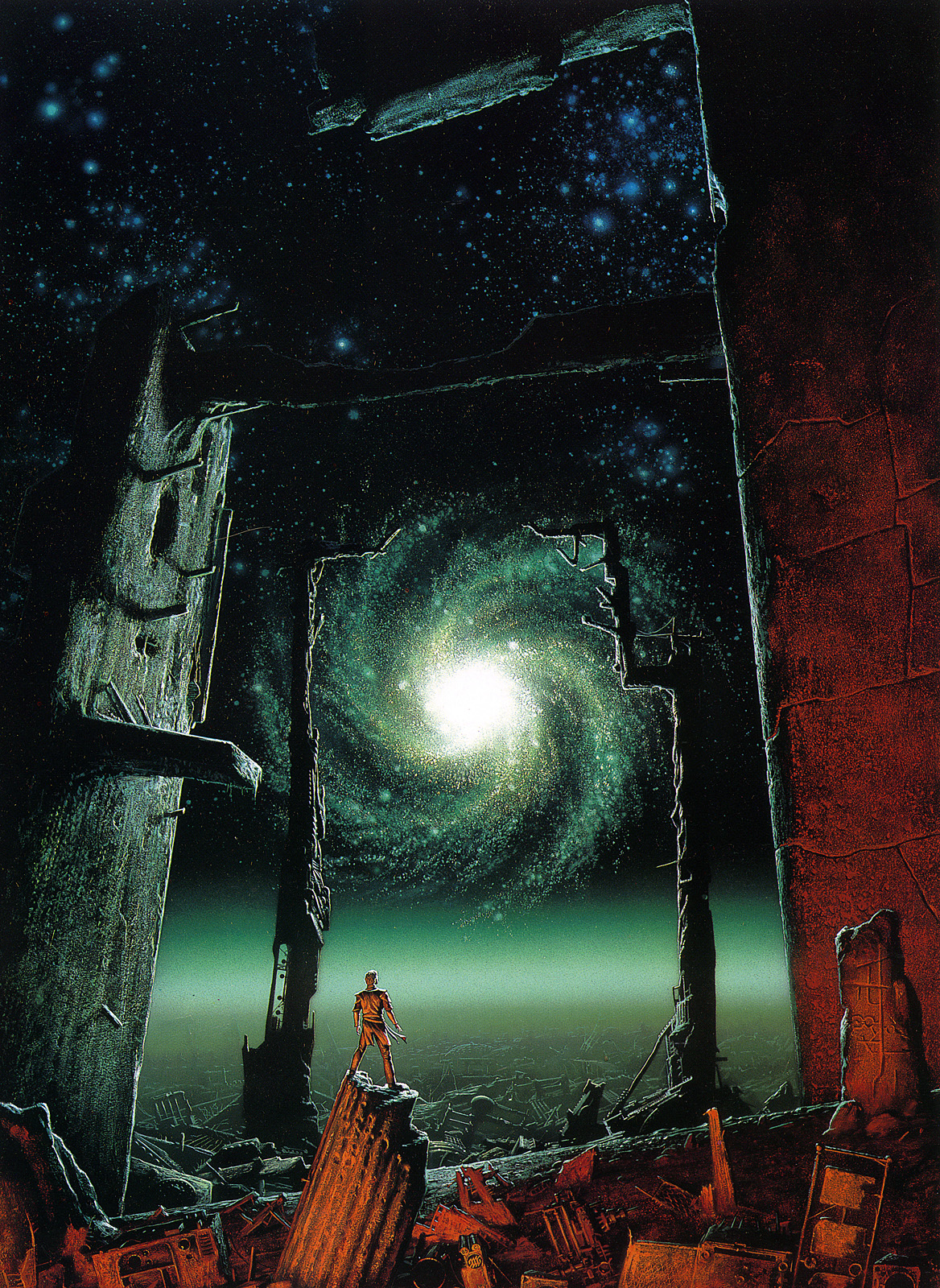
Foundation's Edge cover artIsaac Asimov’s classic Foundation series (1942-1953) deliberately drew on that model; Asimov had been reading Gibbons’ History of the Decline and Fall of the Roman Empire.  In the Foundation universe, Hari Seldon has developed a science of “psychohistory” that predicts the Galactic Empire’s inevitable decline.  There’s no chance of preventing the fall.  But Seldon’s psychohistory offers a way to cut short the ensuing dark age from thirty thousand years to a single thousand.  The emotional charge of the original Foundation stories centers on the Seldon Plan’s bid to minimize the period of barbarism, with its chaos, violence, tyranny and suffering.  (Later developments of the series, too involved to discuss here, go off in somewhat different directions.)

I’ve mentioned H. Beam Piper’s Terro-Human Future History, which includes at least one such decline-and-fall.  The novel Space Viking (1963) gives us a whole culture of space-traveling barbarians, raiding the decadent worlds of the old Federation.  The events of the story suggest the hope of a return to lawfulness in the formation of a “League of Civilized Worlds.”  But given Piper’s cyclical theory of history, this initiative will yield no permanent resolution; the story has a happy ending, but the history does not.

Poul Anderson wrote a series of stories about Sir Dominic Flandry, a dashing secret agent of the Terran Empire reminiscent of a far-future James Bond (though Flandry first appeared in 1951, Bond in 1953).  When he can spare a moment from chasing women and loose living, Flandry devotes his efforts to shoring up the decaying Empire, though he realizes that in the end the “Long Night” is inevitable.

There’s a certain kind of romance, a mood of grandeur and doom, about these falling empires.  Naturally, they tend toward the somber and the tragic.

Defending Civilization

A more upbeat tone characterizes stories in which the fight to preserve civilization has a chance of succeeding.

Lensman imageIn the Lensman series, E.E. Smith actually refers to the heroes’ multispecies galactic community simply as “Civilization.”  That polity reflects the cooperative, yet freedom-loving, nature of the beneficent Arisians, who have nurtured it in secret over millions of years.  The Lensmen’s opponent is “Boskone,” which originally appears to be a mere conspiracy of space pirates or drug dealers.  When Boskone eventually turns out to be a whole independent culture of its own, based in another galaxy, the conflict becomes one of diametrically opposed cultures, rather than simply of order vs. disorder.

But the Boskonian culture is one of thoroughgoing tyranny, from top to bottom.  At every level, those in power scheme against each other.  Lacking any honor or ethical code, they engage in assassination and undermine each other’s plans.  Those at the bottom are essentially slaves.  The Civilization led by humans, on the contrary, respects human dignity and freedom—although the fact that these cultures have been essentially on a war footing throughout their entire history renders that freedom a little less far-ranging than we might imagine.

The Lensman example reminds us that the defenders of civilization are not always fighting against barbarians.  Autocracy and regimentation bring their own kind of chaos, as lawless warlords battle among themselves, not caring what common folk are trampled in the process.  It’s a particular kind of civilization that’s worth preserving.

This is true whether we’re in the future or the past.  We’ve seen that the power of the Arthurian legend stems partly from the theme of defending order and decency against the chaos that lies in wait.  (We may also mention Arthur’s more historically-based successor, King Alfred, who defended England against the real (not Space) Vikings.)

The embattled Arthurian Camelot is frequently connected with Rome itself, the ur-example.  The Last Legion (book and movie) provides a good example.  The waning Roman presence in Britain, as the Dark Ages set in, is a natural setting for the ideal of the lonely, valiant defender.  One example is brought up indirectly by a character’s name.  As Wikipedia puts it,  “Legio XX Valeria Victrix lends its name to the character Valeria Matuchek in Poul Anderson‘s Operation Chaos and its sequel Operation Luna; her mother is said to describe this legion as the last to leave Britain—‘the last that stood against Chaos.’”

To Valeria’s mother Virginia, “the last that stood against Chaos” is a phrase to conjure with.  That’s true for me, too.

The Right Kind of Order

If civilization represents a certain kind of order—that of the Lensmen, not Boskone—what kind are we talking about?  It’s not always easy to explain.

Thus, if one asked an ordinary intelligent man, on the spur of the moment, “Why do you prefer civilization to savagery?” he would look wildly around at object after object, and would only be able to answer vaguely, “Why, there is that bookcase . . . and the coals in the coal-scuttle . . . and pianos . . . and policemen.”  The whole case for civilization is that the case for it is complex.  It has done so many things.  But that very multiplicity of proof which ought to make reply overwhelming makes reply impossible.  (G.K. Chesterton, Orthodoxy (Garden City, NY:  Image Books, 1959), ch. 6, p. 83)

Chesterton’s random examples do cast some light on the question.  A community that has bookcases has books—implying a continuity of knowledge and literature, as well as the leisure to read them.  Coals to keep one warm in winter suggest both the satisfaction of basic human needs, and the whole machinery of society and technology that brings the fuel from the mine to the fireside.  Pianos reflect art and a developed culture.  And policemen indicate a society in which there is at least some attempt to defend the ordinary citizen against the depredations of the powerful and unscrupulous—the rule of law, of which more anon.

In the particular culture to which I belong, when we hold up a certain sort of civilization as an ideal worth defending, what we have in mind is a good order in which spontaneity and creativity can flourish, and people can live their lives without constant fear or privation.  There’s an order that protects the weak against the strong, but there is also enough looseness for individual variation, experiment, and adaptation.  In the “alignment” terms we discussed last time, you might say the position I’m taking is neutral good, tending to lawful.
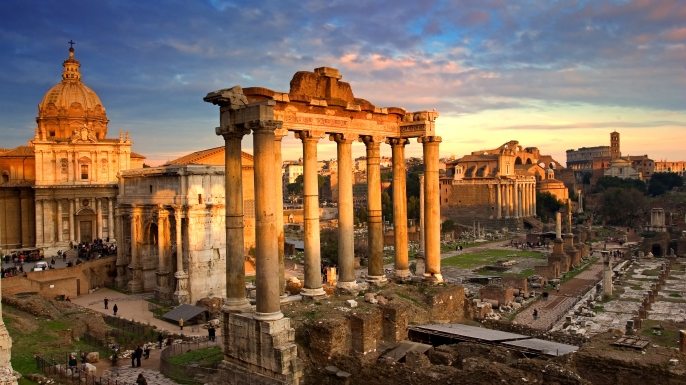
Greco-Roman sceneThe classical roots of this ideal are found in the Greek notion of the polis and the Roman notion of civitas.  But it’s been shaped by the whole history of Western thought into what’s sometimes called the “liberal” ideal of a free society—“liberal” not in the political sense, but the root sense of “free.”

There’s one particular aspect of this ideal, though, that science fiction is peculiarly suited to address.  We’ll talk next time about civilization and science.

The Large Spaceship Competition

Enormity

We space opera fans like big things:  sweeping plots and intrigues, larger-than-life characters, huge explosions.  And big spaceships.  The bigger, the better.

You remember the opening of the original Star Wars.  At the top of the frame, the Imperial Star Destroyer looms into view.  And keeps coming, for what seems like forever.  With this visual cue, Lucas communicates immediately the sheer scale of his story.

In a long story, this can lead to a Lensman Arms Race in terms of spaceship size—each new construct eclipsing the last.  One might wonder:  How far can we go with this?  Who holds the record for Largest Spaceship of All?

Traditional spacecraft

Saturn V-Apollo on transporterOrdinary, garden-variety depictions of spaceships are long since out of the running—not just real vehicles like the Saturn V-Apollo, but fictional ones that are meant to be big.  Kate Wilhelm’s title “The Mile-Long Spaceship” (1957) doesn’t sound even slightly impressive any more.  According to Wikipedia, those Star Destroyers range up to 2,915 meters, almost two miles.  The famous size comparison chart by Dirk Loechel displays these, along with the Independence Day mothership, the Dune Spacing Guild Heighliner, the Borg cube, and many more—but Loechel set his cutoff for the image, arbitrarily, at 24,000 meters:  “I had to draw the line somewhere.”

That’s just getting started.

“That’s no moon”

The alien probe in Clarke’s Rendezvous with Rama, which I’ve mentioned a couple of times before, is 50 kilometers long and 16 wide (31 by 10 miles).  That’s bigger than a lot of Earthly cities.

Death StarStar Wars’ Death Star, famously misidentified as a moon, has been estimated at between 100 and 160 kilometers in diameter (62 to 100 miles), at least three times larger.  The second Death Star, from Return of the Jedi, spanned somewhere between 200 and 400 kilometers (up to 250 miles), according to the same Wikipedia article.

Skylark of Valeron coverFor a long time I idolized E.E. Smith’s Skylark of Valeron as the epitome of spaceship scale.  The ship (not the novel of the same name), “almost of planetary dimensions,” is a sphere one thousand kilometers in diameter—about 621 miles (ch. 20).  That’s over twice the size of the large economy-size Death Star.  (A blogger going under the title Omnivorenz has done a detailed analysis of the various Skylark series spaceships.)

However, we’re still in the moon category, not yet up to planet-sized.  (Of course, if astronomers keep changing the rules on what counts as a planet, the two size ranges can overlap.)

Planets in motion

At this stage, we need to think about what counts as a “spaceship.”  Surely one requirement is that it be able to move in a directed fashion—otherwise the International Space Station would count.  But does it have to be a construct, a made thing?  Or can you take an existing mass and equip it with motive power?

Quite a few science fiction writers have depicted mobile planets (not simply in the sense of moving in an orbit, but of guided, directed motion).  In Blish’s Cities in Flight series, the characters twice use spindizzy drives to send whole worlds careening through the heavens.  E.E. Smith’s Lensmen, after a point, deploy “dirigible” planets almost routinely—not to mention antimatter objects (“negaspheres”) of comparable mass.  In The Wanderer, Fritz Leiber has not one, but two, traveling planets approach the Earth.  (The original source of the word “planet” is a Greek word meaning “wanderer.”)

There’s a series of stories by Robert Reed about something called “the Greatship,” but I haven’t managed to read them yet.  The blurbs describe the Greatship as “larger than worlds” and “apparently built from a re-engineered gas giant” – which would put us into a distinctly different size class from even an Earth-type planet.

And beyond

Here’s a question:  Does a “spaceship” have to be a single contiguous object?  Or can it be an array of objects that travel together, but are not physically connected?

In Larry Niven’s Known Space universe, the species known as Puppeteers flees a coming galactic disaster, not by leaving their homeworld, but by taking their planet with them—along with four others, arranged in a “Klemperer rosette” around their common center of gravity.  That’s traveling in style!  This “Fleet of Worlds” moves slower than light, but not much—and it’s five times larger, altogether, than a Blish or Smith flying planet.

The Cometeers coverBut Niven was writing hard science fiction, with some attempt at scientific plausibility.  The great space operas of earlier eras weren’t constrained by such trivial considerations.  For a long time, my list of giant spacecraft was topped by the so-called “comet” piloted by the adversaries in Jack Williamson’s 1936 classic The Cometeers.  It’s not a comet at all, but a green force-field shell enclosing an entire system of worlds:  the heroes count 143 planets, plus an artificial sun (ch. 13).  The eponymous alien Cometeers sail this congeries of worlds about the universe like space pirates on a grand scale.  It’s the biggest guided space-traveling object I’m run across that’s described with any precision.

The real prize, however, belongs to Arthur C. Clarke.  In the unthinkably far future of The City and the Stars (1956), a reconstruction of history shows the leading intelligences of a galactic civilization leaving the Milky Way on a voyage of exploration in what is apparently an entire star cluster, set into motion by energies on a galactic scale:

They had assembled a fleet before which imagination quailed.  Its flagships were suns, its smallest vessels, planets.  An entire globular cluster, with all its solar systems and all their teeming worlds, was about to be launched across infinity.

The long line of fire smashed through the heart of the Universe [i.e., the Galaxy], leaping from star to star.  In a moment of time a thousand suns had died, feeding their energies to the monstrous shape that had torn along the axis of the Galaxy, and was now receding into the abyss. . . .  (ch. 24)

That’s about as far as my imagination will go, to be sure.

The pursuit of wonder

TV Tropes collects a number of these references, and more, under the heading Planet Spaceship.

As we contemplate these logarithmic jumps in scale, we may note that after a point, the whole exercise can become meaningless.  If your “ship” includes whole planets and solar systems, why go anywhere?  It’s rather mysterious why Williamson’s Cometeers would need to roam the universe preying on other star systems (other than to provide a challenge for our dauntless heroes).  What are they getting that they haven’t already got ‘on board’?

The one likely answer may be, to see what’s out there (assuming you need this large a vessel to take you).  This is the primary reason Clarke’s far-future intelligences set out on their journey:

All we know is that the Empire made contact with—something—very strange and very great, far away around the curve of the Cosmos, at the other extremity of space itself.  What it was we can only guess, but its call must have been of immense urgency, and immense promise.  (ch. 24)

In a way, the exploration motive—“new life and new civilizations”—brings us back to where we started this exercise in scope.  Simply contemplating larger and larger objects brings us some degree of awe—a touch of that “sense of wonder” for which science fiction and fantasy are famous.  But a much greater wonder springs from the idea of meeting wholly new experiences—“very strange and very great.”

The grandest justification for leaving our world may be sheer discovery—even if we end up, like the Puppeteers, taking our world with us when we go.

Action and Passion

Our story approaches its climax:  Our Hero prepares for the cataclysmic action on which all depends.  She tenses her muscles, tightens her fists, screws up her face into a tense grimace.

Or does she?  There are actually two ways to imagine how one achieves some brilliant feat.  We have conflicting ideas about what makes action most effective.

Passion Conquers All

The most common view is that passion brings a sort of high-tension focus that intensifies action.  (I’m using “passion” here to mean any violent emotion or supreme effort, not specifically romantic passion.)  The more you feel, the more vigorously you act.  This connection obviously correlates with our common experience.  F&SF, as always, takes the idea to new levels.

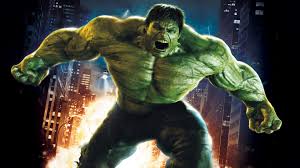
The HulkWe picture this most obviously in fighting.  Today’s most iconic image is probably that of the Hulk, from Marvel Comics, who changes from mild-mannered Bruce Banner to a massive powerhouse when Banner gets angry.  The idea isn’t new to comics, of course; it goes back at least to the Norse berserker, who fights in what Wikipedia calls “a trance-like fury.”  In a more mundane case, we see the milquetoast George McFly motivated by anger at a threat to the girl of his dreams when he finally decks Biff in “Back to the Future.”

But we also see passion as the path to other kinds of achievement.  Great stress, suffering, or effort leads to a breakthrough in ability.  Jean Grey of the X-Men becomes the cosmic-powered Phoenix when her power and endurance are tested to the limit piloting a space shuttle through a solar flare.

Gully Foyle achieves a previously-impossible interplanetary teleportation (“jaunte”) when he’s at the end of his rope in the SF classic The Stars, My Destination.  Roger Zelazny’s hero Corwin recovers his memory and his full powers when he effortfully “walks the Pattern” in Nine Princes in Amber:

          It was agony to move.  Everything tried to beat me aside.  The waters were cold, then boiling.  It seemed that they constantly pushed against me.  I struggled, putting one foot before the other.

In Julian May’s Saga of Pliocene Exile, the tormented Felice Landry achieves new levels of power under extreme stress (The Golden Torc, part III, ch. 3).  On a more positive note, the coda of E.E. Smith’s Lensman series shows Clarissa MacDougall, intensely suffering the loss of her beloved, finding the power necessary to retrieve him from unimaginable reaches (that chapter is a trope namer for TV Tropes’ “The Power of Love”).  Just last night, I saw the movie version of Wonder Woman (excellent, by the way) use the same trope:  a climactic accession of power under immense emotional strain.

Some of the modern roots of the passionate effort concept can be found in the Romantic movement.

Dispassion Also Has Its Points

But there’s a more paradoxical view that we can achieve more when we stop concentrating and enter a state of calmness or centeredness.

This approach also has many roots.  We’re frequently advised, when struggling with a difficult task, that we’re “trying too hard.”  Zen and other Asiatic traditions mobilize a strategy of detaching one’s mind from too great a concentration.  The currently popular practice of “mindfulness” seems to partake of the same idea:  a focus on the present moment without worry or intense concern.  Wikipedia even refers to “choiceless awareness,”  “the state of unpremeditated, complete awareness of the present without preference, effort, or compulsion.”

A nonpassionate sense of focus also appears in F&SF as a way to great achievement, though it’s much more rare.  In Robert Jordan’s massive fantasy epic The Wheel of Time, for example, Rand al’Thor is receiving sword training from a mentor who recommends “[n]ot the wild leaping about and slashing that Rand had in mind . . . but smooth motions, one flowing into another, almost a dance.”

“ . . . Blank your mind, sheepherder.  Empty it of hate or fear, of everything.  Burn them away. . . .”

Rand stared at him.  “The flame and the void,” he said wonderingly.  “That’s what you mean, isn’t it?  My father taught me about that.”  (The Eye of the World, ch. 13, paperback p. 177)

It’s through “the Void” that Rand can be most effective with the sword—and, later, with other things.

Honor Harrington faces the duelDavid Weber’s military SF heroine Honor Harrington, after surviving a shuttle explosion and emotional trauma, faced with a ritual duel to the death, dramatically decapitates her opponent with a single stroke.  But she doesn’t do it in a burst of rage, well-justified as that would be.

Honor waited, poised and still, centered physically and mentally, her eyes watching every part of [her opponent’s] body without focusing on any.  She felt his frustration, but it was as distant and unimportant as the ache of her broken ribs.  She simply waited—and then, suddenly, she moved.  (Flag in Exile, ch. 29, paperback p. 376)

We might also compare Frozen, from a previous post.  Elsa gains full control over her powers not when she lashes out passionately, nor when she painfully restrains herself, but when her power flows freely and gladly.

It’s hard to specify exactly what this dis-passionate state is.  It’s not pure rationality, à la Mr. Spock.  We might consider it a sort of pure will; but it’s not a blind will creating its own goal à la Nietzsche.  What you’re seeking still matters greatly; this Void state is how you approach it.

Nor is it lack of restraint, as we saw with Frozen.  Rather, the mindful actor seems to have perfect direction, perfect control, by means of this very Void state.  The arrow goes straight to the target—but it strikes with unparalleled force.

We don’t see as many examples of such centered intensity in the movies.  Film tends to prefer the display of passion:  it’s showier.  A character whose action arises from an inner balance is likely to look entirely inert, from the outside—until she moves.

Convergence

What these two approaches have in common, maybe, is wholeheartedness.  This seems to be the point of Yoda’s famous advice:  “Do, or do not; there is no try.”  Mr. Miyagi says something very similar to Daniel in The Karate Kid (at about 0:54).

The best modern description of a condition in which complete involvement in an action combines calm with wholehearted dedication may be “flow state.”  Most of us have probably experienced this ourselves.  There’s a certain detachment; yet there’s also deep involvement.  Emotion doesn’t get in the way, but the activity itself involves a sort of ecstasy (which, etymologically, means ‘standing outside oneself’).  Note that the berserker was described above as possessing (or possessed by) a “trance-like fury.”

In other words, the two paths may converge in the end, where maximum emotion is wholly embodied in or transmuted into the act.  None of that energy is wasted on subsidiary symptoms or mechanisms like straining, sweating, grimacing, screaming.


The way we approach these two paths affects how we tell a story.  Depending on our hero, and the hero’s personality or way of life, we may depict the climax as the moment of greatest strain or passion, or as a great achievement in a moment of crucial calm—“the still point of the turning world.”

If we’re simply living life—dancing, singing, coding, negotiating, loving—this may be good advice as well.  The way to do our best may not be to strain every sinew, but to relax and center.  Or possibly both.

Strangeness

One of the specialties of science fiction—and to some extent fantasy—is to evoke a sense of strangeness.  In dealing with the alien, the cosmic, that which is far away in space or time, SF can make us feel we are encountering something that passes the limits of our knowledge or understanding.

This isn’t as easy as it looks.

The Used and the Unusual

Since at least the original Star Wars (1977), it’s been good practice to portray a “Used Future.”  Star Wars gave us a world full of beaten-up, grimy equipment that looked as if it had been duct-taped together.  This is generally a good technique.  It adds realism.  We feel at home in a world where everything is not perfectly cleaned and aligned; it’s like where we actually live.  There’s a sense of familiarity.

One opposite to the “used future,” of course, is the kind of earlier SF movie that was full of shiny, spotless spaceships and immaculate gizmos.  But the sense of familiarity also has its own opposite:  the thrill of unfamiliarity.

One way the challenge arises is with extraterrestrials.  Suppose a story has us meeting intelligent aliens.  If they seem just like us—“rubber-forehead aliens”—they won’t be convincing.  We expect something from another world to be different.  The writer or director has to show creatures, technologies, behaviors that are unlike anything we’ve seen on Earth.

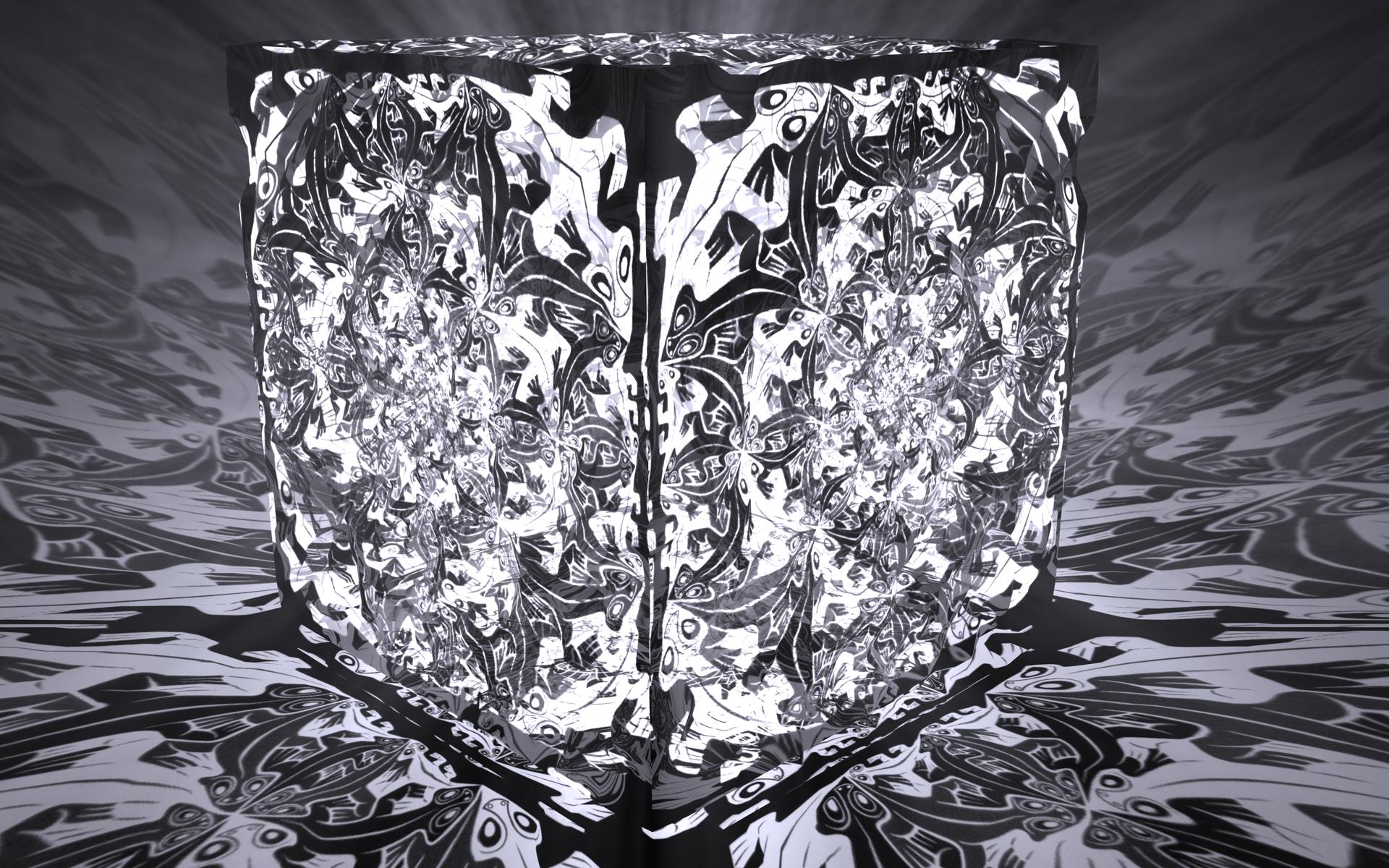
Escher: Wallpaper CaveYet these things must also be believable.  Something that simply looks random or arbitrary, like an abstract swirl of colors, won’t convince us we’re seeing a real thing at all.  How do we thread the needle between the too-familiar and the unintelligible?

Just Alien Enough

Natural laws do enforce certain constraints on physical objects.  But other characteristics are a matter of custom, design choices, or aesthetics.  To show something convincingly alien, we need to know the difference.

Alien ship from movie ArrivalSometimes a single feature can be odd enough to alert us that we’re “not in Kansas any more.”  The alien ship that appears in the movie Arrival looks strange at once, because it’s smaller at the bottom than at the top.  It looks as if it’s upside-down or sideways. Not the way we’d build, yes.  But is it physically impossible?  Nope.  The ship isn’t on the ground, balanced implausibly on a narrow end.  It’s floating in the air.  This not only frees the ship from the usual need for wheels or other supports; it also introduces a second, subtler strangeness.  When we humans land somewhere, we expect to land, to set ourselves down securely on a surface.  These folks seem quite comfortable floating just above the ground.

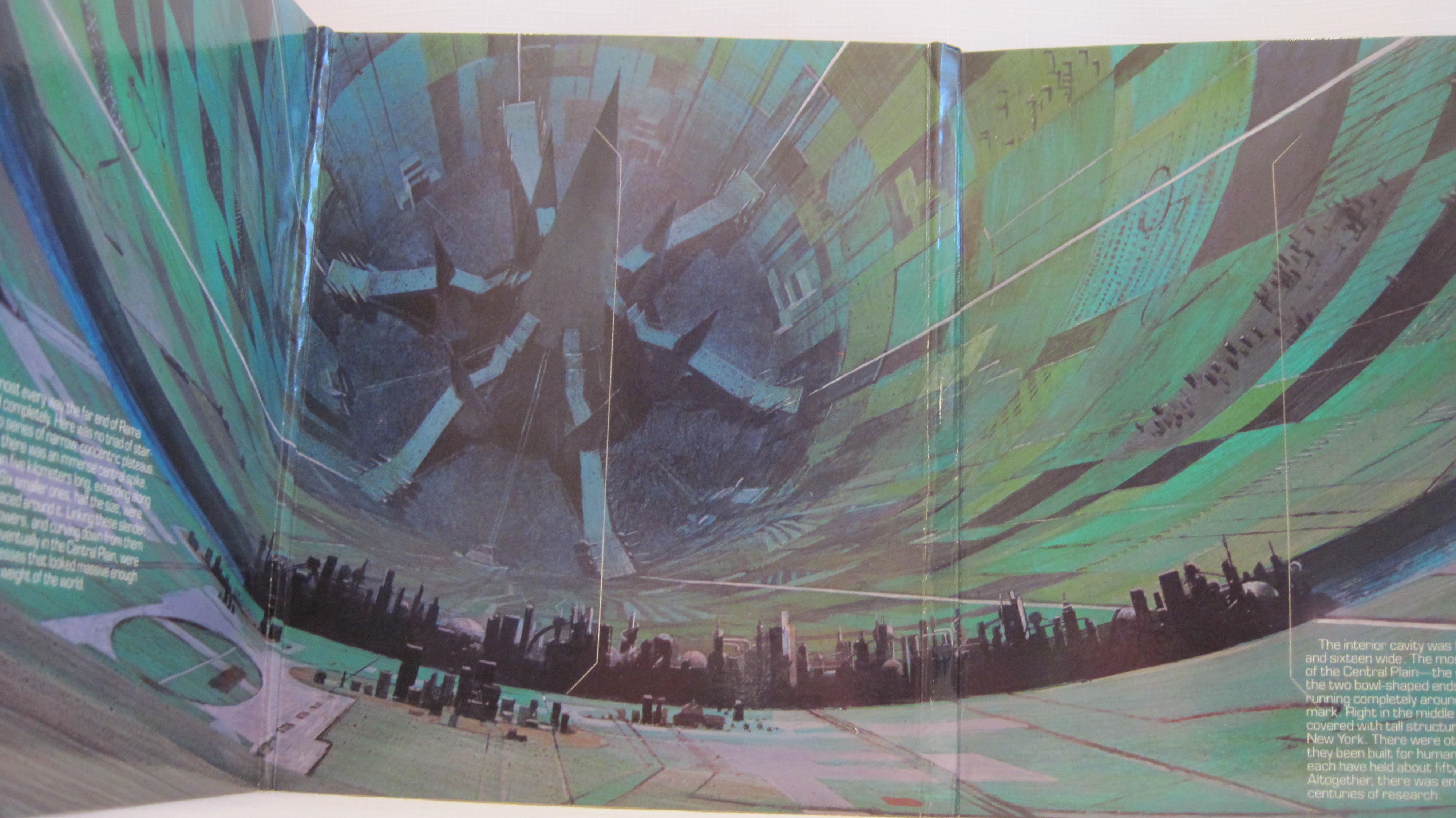
A classic example is Arthur C. Clarke’s Rendezvous with Rama.  A massive spacecraft—a spinning O’Neill cylinder—enters the solar system, apparently inert.  A human crew matches course to explore it before its hyperbolic orbit takes it out into interstellar space again.  The ship begins to “come alive” around them—but there’s no sign of intelligent life aboard.  The explorers find one strange and amazing feature after another.  The purpose of some becomes clear:  the long, shallow rectangular valleys turn out to be immense lights that illuminate the interior.  But they never find out the reasons for many other objects.  In the end they have to cut loose from the vessel, letting it go on its mysterious way.

Rendezvous with Rama interior illustrationClarke’s mastery of clear detail—how the airlock doors open, for instance—gives us the necessary sense of realism.  But leaving many things mysterious evokes the sense of mystery and wonder that is among the most distinctive experiences in science fiction.  The unfamiliar is clearly and concretely depicted, but the purpose remains obscure.

(Parenthetically, I advise paying no attention at all to the dreadful sequels Gentry Lee wrote to Rama under Clarke’s direction.  They make the classic mistake of erasing the mystery without replacing it with anything at all interesting.  As with certain other sequels, the only thing for a conscientious reader to do is declare them non-canonical and pretend they never happened.)

For another Clarke treatment, remember 2001:  A Space Odyssey.  The mundane and even humdrum character of the long space voyage makes the psychedelic sequence at the end feel even weirder than it is in itself.

Sufficiently Advanced Technology

Extraterrestrials need not be involved.  Distance in time or space, and the concurrent advances in technology, can also provide a good foundation for the sense of strangeness.  (It was, after all, Clarke’s Third Law that “any sufficiently advanced technology is indistinguishable from magic.”)

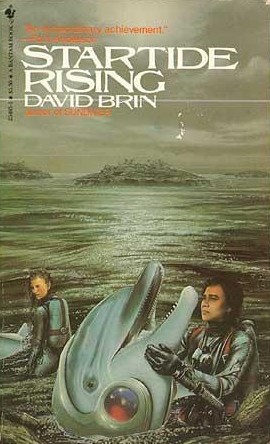
Among the numerous virtues of David Brin’s Hugo-winning novel Startide Rising is that sense of entering a new and unaccountable world.  His Earthly spaceship crew of “uplifted” dolphins, with their small group of human companions, use advanced techniques that are still recognizable to us.  But they’re dealing with galactic cultures that draw on hundreds of millions of years of accumulated science.  The results can be mind-boggling.  One species, for example, travels by using a captive creature that creates portals “by the adamant power of its ego—by its refusal to concede anything at all to Reality.”  This isn’t your grandmother’s hyperdrive.

Toy stack of ringsThe body of another species, the Jophur, consists of a stack of distinct rings, like a child’s toy.  The Brothers of the Ebony Shadows employ a probability weapon that sends out “waves of uncertainty.”  The fact that these species are nonhuman is incidental to the fact that their immense background of far-advanced science lets them use techniques that seem to surpass our understanding.

For a purely human example, let’s look at Arthur C. Clarke’s The City and the Stars.  (Clarke really had the knack for this sort of thing.)  The main character, who bears the pedestrian name of Alvin, lives in Diaspar, the last city on Earth, billions of years in our future.  The city’s structure does not erode or decay; it’s maintained by “eternity circuits” according to the model held in its master computers.  The people do not die in a conventional sense.  After living for a thousand years, each individual walks back into the Hall of Creation and is dissolved—but is also retained in the memory circuits, to be rematerialized eons later.  Thus the population of the city is always changing, but the individuals continue.  And that’s only the beginning . . .

The City and the Stars, illustration

Exotic Ways of Life

Technology is one thing; behavior is another.  The City and the Stars does a terrific job of imagining how the society of Diaspar is shaped by the extraordinary conditions under which its people live.

When I read Yoon Ha Lee’s Ninefox Gambit, it was billed as ‘military science fiction’—but it’s nothing like the general run of military SF.  The six factions in the story make use of technologies that create real-world effects based on “formations” of people and their consensus beliefs.  Much of the plot revolves around a revolt based on “calendrical heresy”—which is just what it sounds like:  deviation from the standard calendars.  In Lee’s world, calendrical uniformity isn’t just a matter of convenience, but of crucial importance.  The resulting society is correspondingly peculiar.  Reading the story makes you feel as if you’re constantly being knocked sideways.

Greg Bear’s City at the End of Time combines present-day characters with those living in a city one hundred trillion years in the future.  The far-future people consist of “noötic” or virtual mass, are defended by “reality generators,” and are trying to fight a cosmic entity that’s trying to destroy the universe by disintegrating its history, acting backward through time.  The present-day people in mundane Seattle keep us grounded, but trying to understand the end-of-time characters and what they are doing requires a constant stretching of the imagination.

Strangeness and Wonder

The sense of strangeness or mystery is one form of the “sense of wonder” often used to characterize science fiction.  It takes us out of the mundane, makes us strain to conceive the inconceivable.  We’re often told that world travel expands our horizons by exposing us to different places and cultures.  Science fiction goes further:  it exposes us to ideas and places and people that don’t exist in the world at all.  At its limits, SF seeks to show us more than we can even comprehend.  The lack of reality is compensated by the greater impetus to go beyond our mental limitations.

To achieve that experience, we seem to need the right combination of the familiar and the exotic.  The weird stuff at the end of 2001 isn’t entirely successful, in my view:  it’s too strange.  Not only do we not understand what’s happening; we don’t quite feel there is anything to understand.  You have to read the book to figure out what’s going on.

But when we have enough groundedness to effect the “willing suspension of disbelief,” yet enough mystery to defeat (in part) our attempt to understand, the combination is uniquely fascinating.  As I noted at the beginning, this isn’t an easy balance to strike.  But the payoff makes it worth attempting.

How Large Is Your World?

Perceived distance

A story may tell you it covers vast distances—but the reader’s or viewer’s experience doesn’t always bear that out.

Star Wars, for example, opens with the announcement that we’re in “a galaxy far, far away,” leading us to expect events on an immense galactic scale.  And of course the story does involve travel among numerous star systems.

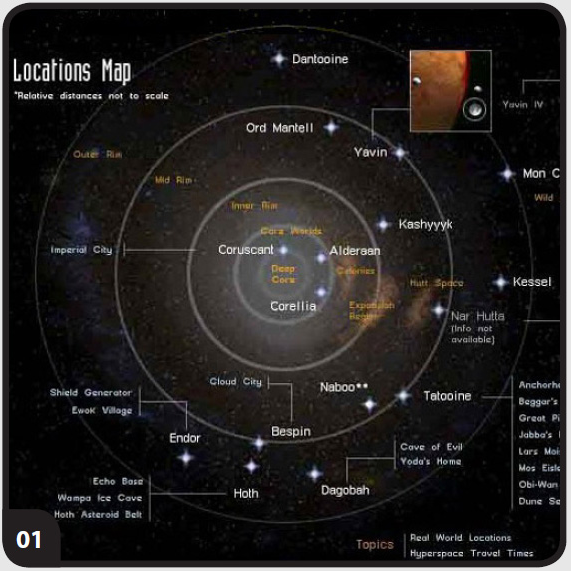
Yet to me, at least, the Star Wars galaxy feels so small as to be almost cozy.  It never seems to take more than a day or two to get from one planet to another.  (Often the trips are made in X-wing fighters or other ships that don’t even seem to be large enough for a bathroom.)  In The Force Awakens, we even have weapons on one planet targeting other planets, as if they were right next door.  We may be instructed that the beam is traversing vast distances via hyperspace—but there’s no visceral sense of great expanses.

This situation isn’t limited to visual media.  I recently read Yoon Ha Lee’s Ninefox Gambit, which has been billed as a space opera—a category that suggests vast scope.  Yet almost all the story’s action takes place within a couple of spacecraft or space stations, lending an almost claustrophobic feel to the tale.  On the other hand, the movie 2001:  A Space Odyssey devotes a good deal of time to communicating a sense of the vastness of space.

In contrast to these surprisingly pocket-size space adventures, consider a fantasy like The Lord of the Rings.  To my mind, Tolkien’s epic does suggest great distances and broad landscapes.  But the actual distances involved are infinitesimal on a Star Wars scale.  Middle-Earth is about the same size as western Europe.  The Millennium Falcon could traverse the whole expanse from the Shire to Mordor in seconds (even without hyperdrive).  But Tolkien’s world feels bigger.  By the time we get to the end of it, we feel as if we’ve been on a journey.

Map of Middle-Earth

The same is true of most high fantasies, which at most work on a continental scale, given their technologies.  Paradoxically, the low-tech locales seem to be better at giving us a sense of epic scope.  Why?

Getting there is half the challenge

The most important factor, I think, is travel time.  We experience distances not in terms of their metric size, but in terms of how long it takes for us to cross them.  This is the sense in which technology has “made the world smaller.”

Tolkien’s world seems large because we cross it, with the characters, on foot.  All that walking!  (It’s not for nothing that the Fellowship is sometimes referred to as the “Nine Walkers.”)  This means that it takes weeks to get anywhere.  Frodo and Sam leave the Shire on September 23 and arrive at Mount Doom on March 24, a six-month journey—albeit with some stops along the way.

Strictly speaking, this factor may be time-relative-to-lifespan, rather than days or years directly.  A six-month trip would be brief for the star-traveling characters in Blish’s Cities in Flight stories; they live for centuries.  It bulks much larger in our own lives.

A related factor is difficulty.  A journey may take a long time, not just because our transportation is slow, but also because we have to grapple with trouble on the way.  Even an uneventful sea voyage from, say, England to America in the 1700s might take seven weeks on average.  But the dangers of storms, limited food and water, and being becalmed made the trip more daunting.  One didn’t do it casually.

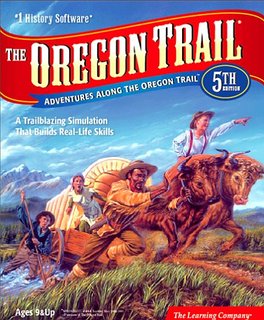
Oregon Trail game, coverSimilarly, the wagon trains of the American West took the settlers through unknown countries full of dangers and delays.  (Recall that Star Trek was originally sold to studios as a “wagon train to the stars.”)  Even aside from the sheer travel time, these perils made the journey a more formidable challenge.  Anyone remember playing “The Oregon Trail”?  It wasn’t easy to survive the strenuous 2,170-mile trip.

The spice of travel

The wagon-train trek illustrates a third factor.  Variety in the places we pass through also makes a trip more consequential.  An Atlantic crossing might be relatively boring, aside from the weather, if you’re not on the Titanic.  But the different kinds of places we experience on the way—terrains, climates, habitations, cultures—also helps give us a sense of distance, of having come a long way.

To some extent this depends on the unfamiliarity of far places.  If another locale has the same chain stores, the same advertisements, the same customs and fashions, we’ll hardly feel as if we’ve gone anywhere.  Passing through a series of identical places will not give us the sense of transition that we gain from different environments.  But as Tolkien’s heroes traverse the Old Forest, the Barrow-downs, Bree, the Wilderlands, Rivendell, Moria, the Anduin . . .  we feel they’ve really traveled.

This unfamiliarity is itself a function of travel time and difficulty.  If it’s hard to get somewhere, not many people in my area will have been there, or know much about it.  Technology also plays a subtler role here.  If we don’t have the technology for recordings—photos, audio, video—then we are dependent on travelers’ tales, less vivid and less exact.  On the other hand, if we’ve immersed ourselves in the imagery and culture of, say, Japan before we visit, the culture shock will be less.  This is another way advanced technology makes the world smaller.

Star Wars universe mapIn a similar way, the different environments we meet on Star Wars planets do provide some sense of genuine travel—though the fact that each planet seems to have a single climate and terrain makes this variety less effective than it might be.

Taken together, the difficulty and variety factors suggest that the number of incidents on an expedition contribute a lot to our sense of size.  A very long trip may seem trivial if nothing happens.  But a quite brief excursion can seem extensive if it’s packed with important occurrences.

Generation ships, inside and out

The generation ship, of which we’ve spoken before, provides an interesting example of both types of journey.  Externally, such a vessel covers vast distances—and taking generations to make a voyage is certainly one way to make the reader feel the distance involved.  But the voyage typically proceeds with very little external change:  the ship bores on through space, for years on end.  If events within the ship are not described, the reader or viewer may not gain much sense of distance.  If the people on board are in suspended animation, there won’t be much sense of time or distance at all.  In the 2016 movie Passengers, for example, it’s only once something goes wrong that the story begins.  (Once it does, the passage of time for the characters who are awake is a major plot element.)

Rendezvous with Rama interior illustration

Interior of starship from Arthur C. Clarke’s Rendezvous with Rama (staticflickr.com)

On the other hand, internally, the world-ship itself may seem a vast environment to the inhabitants.  This is especially true if events have deprived the inhabitants of any high-tech means of travel from place to place within the ship.  A long journey or quest inside the traveling world may thus be a major plot element, as we saw in The Star Seekers or Non-Stop.  Here, again, it’s essential that the characters encounter different cultures or locales within the ship if the reader is to have a sense of scale.

Epic scope

To create a story with epic scope, as in space opera or high fantasy, it’s useful to keep this size issue in mind.  If you want to write an epic, make sure you give it room to breathe.  If that sense of scale is lacking, our grand, sweeping conflict may come across looking like a mere tempest in a teapot.