Arthur’s Eternal Triangle

Assessing the Problem

The “Eternal Triangle” gets its name from its reliable omnipresence as a romantic trope.  Two men love the same woman, or two women love the same man; and the two may themselves be friends.

Triangle illustration (Pixabay)There’s endless fuel for drama here.  As Wikipedia observes, “The term ‘love triangle’ generally connotes an arrangement unsuitable to one or more of the people involved.”  As a result, some kind of resolution seems to be needed.  (In the Western tradition, at least, simply setting up a menage à trois isn’t generally regarded as an option.)

Typically, a storyteller resolves the situation by having one “leg” of the triangle win out.  It’s easier to do this if the third party, the one left out, is painted as undesirable or disreputable—they deserve to lose.  But, on the other hand, the dramatic effect is heightened when the competing persons are each worthy of respect.  Thus Aragorn says of Éowyn in The Lord of the Rings:  “Few other griefs among the ill chances of this world have more bitterness and shame for a man’s heart than to behold the love of a lady so fair and brave that cannot be returned.”  (Return of the King, V.8, “The Houses of Healing)

We’ve touched lightly before on the central role of the Eternal Triangle in the Arthurian tales.  One of the reasons we continue to be fascinated with the Arthuriad is the unresolvable romance at its center.  Typically we like and admire all three characters—Arthur, Guinevere, Lancelot.  But there seems to be no way to bring about a happy ending for everybody.  This part of the tragedy tends to preoccupy modern audiences more than the political or social tragedy of the fall of Camelot; it’s more personal.

The ways in which various authors have tried to manage the matter thus provides a useful survey of ways to address a romantic triangle generally.

Tragedy

Camelot movie posterOne perfectly viable option is to give up the idea of a happy ending and treat the story as an unresolvable tragedy.  This is how the basic Arthurian story works in Malory.  T.H. White’s The Once and Future King (1958) follows the same path.  White’s sympathy for all three characters is evident.  But he doesn’t allow them an easy out.  The story concludes as a tragedy—and a very good one.  I believe the musical Camelot (1960), based on White, follows a similar course:  no romance survives the ending.

The thoroughly weird movie Excalibur (1981) also follows Malory in this respect and accepts the tragic ending.  Lancelot dies.  Arthur, of course, dies too—or at least sails off to Avalon; as usual, whether Arthur will actually return in some fashion remains a mystery.  (In C.S. Lewis’s Perelandra (1943), Arthur is mentioned as residing with other luminaries on the paradisiacal planet Venus, awaiting his return at the Second Coming.)  Guinevere joins a nunnery, as per the basic legend.  The characters are disposed of, but no romance remains.

There is, however, a curious scene toward the end of Excalibur, at about 1:59, in which Arthur visits Guinevere in her nunnery, just before the final battle.  She says she loved him as a king, sometimes as a husband.  He says that someday, when he has finished his kingly duty of making a myth that will inspire later generations, he likes to think that he could come back to her, to meet her merely as a man.  She nods.  The scene hints that the romance might somehow be resolved after their deaths.  We’ll consider that idea further below.
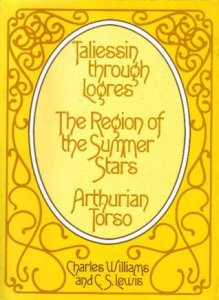
Taliessin Through Logres coverBut the distinction between Arthur’s roles as king and as husband also illustrates a different approach:  one can write the story in such a way that Arthur transcends romance.  This seems to have been Charles Williams’ view in his uncompleted essay The Figure of Arthur (published in 1974 in the combined volume Taliessin through Logres; The Region of the Summer Stars; Arthurian Torso).  In Williams’ view of the myth, Arthur “was not to love, in that kind, at all” (p. 230).  Arthur may be destined purely to serve as a model of the Good King, not to fall in love.

Yet the romancers continue to treat Arthur’s and Guinevere’s marriage as a love story.  The triangle is not so easily disposed of.

Saving a Romance

First Knight (movie) - Arthur, Guinevere, LancelotIf we do want a genuine romance, one way is to give Lancelot and Guinevere a happy ending, and essentially write off Arthur.  We see this in First Knight (1995).  Arthur, played by the redoubtable Sean Connery, seems genuinely fond of Guinevere (Julia Ormond).  But he’s much older than she is (Connery was 65 at the time, Ormond 30).  Lancelot (Richard Gere), much nearer her age, plays his usual role in rescuing Guinevere from various distresses.  When Arthur dies, he commends Guinevere to Lancelot’s care.  At the conclusion, contrary to the usual storyline, those two seem free to pair off, giving the audience the qualified satisfaction of a fulfilled romance.  (Exactly what would have happened to the polity of Camelot in this alternate Arthurian history isn’t discussed.)

Another way is to dodge the issue entirely by simply leaving Lancelot out of the triangle.  King Arthur (2004) depicts Arthur and Guinevere as true lovers, what TV Tropes calls a “Battle Couple.”  After adventures, heroic last stands, and the arrival of The Cavalry, the movie ends with the wedding of Arthur and Guinevere.  Lancelot is in the band of knights, but he doesn’t yet have a crush on Guinevere, or vice versa; so we have the rare case where the Arthur-Guinevere relationship is preserved.  It’s a conventional happy ending, but it requires a considerable departure from the basic Arthurian story.

Arthur’s Alternative

A different way to resolve the triangle is to add a fourth party, who can take over the member of the triangle who’s left behind.  I’ve seen a couple of cases where the author gives Arthur an alternative love, letting Lancelot and Guinevere fall where they may.  Ideally, the alternative is really Arthur’s first love, predating the whole Guinevere-Lancelot thing.  Joan Wolf’s The Road to Avalon (1988) has Arthur growing up with a strong and admirable girl named Morgan—a complete rewrite of Morgan le Fay, who usually serves as a villain.  Arthur falls in love with this Morgan, and she with him.  Things look bright until, just after pledging their troth, they discover that Morgan is actually his half-aunt, too closely related for marriage.  Oops.

Arthur’s marriage to Guinevere is a political necessity; it’s not a betrayal, because he cannot marry Morgan.  In this version, Guinevere (Gwenhwyfar) is a not-especially-likable nonentity, who finds her love with Bedwyr (or Bedivere), a historically earlier version of Lancelot.  While the story cleaves close enough to the myth to prohibit a really happy ending, Arthur does at least find his true love, of sorts, with Morgan.

Mary Jo Putney takes a more romantic tack with her short story Avalon (1998).  This time “Morgana” is identified with the Lady of the Lake, the mysterious personage frequently depicted as giving Arthur Excalibur.  She dwells in Avalon, a faerie realm set apart from the mundane world.  In this story, Arthur sleeps with Morgana at the beginning, long before his political marriage to Guinevere, and returns to her at the end, at his “death.”  But he can be healed in Avalon, as some of the older tales suggest, and thus survives to a genuine “happy ever after” with Morgana.

The Fionavar Tapestry

I’ve saved for last this powerful and daunting trilogy (1984-86) by Guy Gavriel Kay, who helped Christopher Tolkien prepare The Silmarillion for publication.  Kay’s approach is unique:  he takes up the tragedy head-on, but offers a strange kind of hope at the end.

Fionavar Trilogy covers (Tor)

Five college students from our world are transported to another universe, Fionavar, which is said to be the first or most fundamental of all worlds—a little like Roger Zelazny’s Amber.  To win the battle against evil in Fionavar, they must summon “The Warrior.  Who always dies, and is not allowed to rest” (Summer Tree, p. 123).  He fights in many worlds, because of “a great wrong done at the very beginning of his days,” but can only be called at darkest need, by magic, by his secret name.  This Warrior is Arthur, and his secret name (rather unexpectedly) is “Childslayer”—based on an episode from Malory (Chapter I.XXVII) that is usually omitted from an Arthurian tale, in which the young Arthur, panicked at discovering that Mordred has been born, orders a whole set of newborns sent off in a ship to their deaths, rather like Herod.

It’s revealed in the second volume, The Wandering Fire, that one of the five students, Jennifer Lowell, is actually a reincarnation of Guinevere.  Moreover, it becomes necessary to summon Lancelot, as well, awakened from an enchanted sleep.  These three have met and fought the Dark heroically in many worlds, but always suffering in their doomed triangular relationship, as a punishment for their several sins (Arthur here is guilty of an even worse crime than his betrayal by the other two).  All three love each other; “making all the angles equal, shaped most perfectly for grief” (Wandering Fire, p. 122).  Indeed, theirs is the “[s]addest story of all the long tales told” (Wandering Fire, p. 187).

Kay doesn’t blink the tragedy.  It would be an understatement to say that there’s enormous suffering and sorrow in this story.  But there is astonishing moral and physical courage and heroism as well—as in The Lord of the Rings and The Silmarillion.  And Kay stresses (in his idiosyncratic way) the factor of free will in the “weaving” of the universe.  Even the fate of Arthur and his companions is not forever foredoomed.

Once the threat to Fionavar has been vanquished, a new way opens.  All three of them can leave the worlds forever, together, and fight no more.  In the most Tolkien-like moment of the story, the three sail off into eternity, rising along what Tolkien called the Straight Road into the West (The Darkest Road, p. 332).

The scene is so moving that one hardly notices Kay has not actually resolved the romantic triangle at all.  Arthur, Guinevere, and Lancelot are surely worthy of Paradise—but we have no clue as to who ends up with whom.  Is the only way to resolve this triangle to transcend it to some conclusion beyond mortal comprehension?

Lancelot’s Alternative?

I want to mention one possibility that I haven’t seen tried in a modern story (although, in the innumerable variations on the Arthuriad, it’s quite possible that there’s an instance out there).  Instead of coming up with an alternative for Arthur, one might try presenting an alternative for Lancelot, allowing Arthur and Guinevere to come back together as true lovers—perhaps sadder and wiser after what, in such a plot, would be a temporary breach of faith among the three of them.

The concept can in fact be found in a very old source:  Williams mentions a French lay called Lanval (ca. 1170-1215), in which a Lancelot-equivalent, desired by the queen, ends up himself riding off to Avalon with a fairy mistress.  But this is a quite different version of the Arthurian story.  Is there an opening for a Lancelot-mate in the more canonical range of variations?

Lancelot and ElaineThere’s Elaine.  In Malory, Elaine falls in love with Lancelot and tricks him into sleeping with her thinking she’s Guinevere.  Their son is Galahad, and in Malory they actually live together for some time as man and wife.  Could something be made of this?

White’s Once and Future King treats Elaine as a weak and helpless character, hardly worthy of Lancelot.  But she could easily be amped up to modern standards as a stronger individual.  If Guinevere can be a Celtic warrior maid or a Canadian college student, Elaine could certainly be revised to an inventive author’s taste.  Her relationship with Lancelot need not be the failed, one-sided romance depicted by White; she could become Lancelot’s real love.

Actually, there’s an interesting hint in The Fionavar Tapestry.  A seemingly pointless side story concerns a kind of Luthien-figure, the supernally beautiful elf Leyse of the Swan Mark.  She meets Lancelot briefly in the woods and falls in love with him—but of course he’s otherwise occupied.  Leyse then herself sails off into the West (The Darkest Road, p. 233).  It occurred to me that the name “Leyse” faintly resembles “Elaine”; and in preparing this post, I noticed her description on Wikipedia specifically refers to Elaine—although not necessarily the same Elaine (there are several characters by that name in the Arthuriad).  If she too ends up in the West, the Isles of the Blest, or whatever unearthly paradise Kay’s world accommodates—is it conceivable that she provides a quadrilateral solution to the Eternal Triangle?

There always seem to be more possibilities to be explored—which is what makes this myth so fruitful.

The Boot Camp Planet

Training Worlds

Science fiction postulates lots of types of planets—although, for the convenience of humanoid characters, most of the ones shown end up being pretty Earthlike.  (It sometimes seemed that original-series Star Trek planets could be divided into “piles of rocks” and “places exactly like Earth.”  Much easier on the special-effects budget.)  Here I’d like to look at one particular variety—the worlds that serve as training locales for tough guys.

If you want to develop an inhumanly formidable army, you can do it by administering a “super soldier serum,” as in the Marvel comics.  You can do it by postulating a lifetime of intense training, as with Batman.  Or you can do it by throwing your candidates into an environment so fierce that those who survive have to become impossibly “badass” just to live through it.

Dune

Dune, coverWhat TV Tropes calls the “Death World” plays a key role in the plot of Frank Herbert’s Dune (1965).  One of the things that allows the galactic Emperor in Dune to stay on top in the civilization’s complex politics is his legion of crack troops.  The “Sardaukar” are so formidable that even the highly-trained private armies of the feudal Houses are reluctant to face them.

It turns out that the Sardaukar are recruited from the Emperor’s prison planet, Salusa Secundus—a planet so hostile that only the strongest can live.  “A man who survives Salusa Secundus starts out being tougher than most others.  When you add the very best of military training—”  (Thufir Hawat, p. 370).

But Arrakis, the planet called Dune, is harsher still.  The “Fremen,” the Dune population, appear to be simple barbarian nomads.  But the exigencies of survival in the Dune environment are so demanding that, as one character realizes, the Fremen are actually “an entire culture trained to military order” (283)—an invaluable resource for the main character, Paul Atreides, who needs such a cadre to recapture the holdings and status that the Emperor and Paul’s Harkonnen enemies have illegally taken away.  The Fremen are so tough that even their civilians, “women and children and old men,” can beat full-fledged Sardaukar (454).

It’s suggested at one point that the Fremen come from the same stock as the original inhabitants of Salusa Secundus—transported there at a time when they had “grown soft with an easy planet” elsewhere (352).  That stock may have been hardy to begin with, but it’s clear that the harsh environment is what made the difference.  Part of Paul’s eventual plan to take over the Imperium himself is to neutralize the Emperor’s forces by making Salusa Secundus “a garden world, full of gentle things” (481)—a much pleasanter place for the former Emperor to retire in peace, but no longer a source of formidable warriors.

Arrakis, like Salusa Secundus, tests its people rigorously, winnowing out the weak, toughening up the strong.

Prison Planets and More

We wouldn’t choose to live in so taxing an environment—which is why the population is generally conceived as being there not entirely by their own choice.

Jerry Pournelle’s “CoDominium” future history postulates a future in which a number of worlds are settled by political prisoners and other riffraff who are sent there by the combined U.S.-Russian world government.  Some of the toughest fighters come from Tanith, a demanding jungle planet that is, as Wikipedia puts it, an “infamous dumping ground for transportees.”

Tom Godwin, The Survivors, coverAs a kid, I was fascinated by a Tom Godwin SF novel called The Survivors (1958; also known by the cheesier title Space Prison; reprinted in the 2003 collection The Cold Equations & Other Stories).  A Terran colony ship is waylaid by the Nazi-like Gerns; the useful emigrants are taken as slaves, while the remainder (“Rejects”) are marooned on what the Gerns mockingly describe as an “Earth-type” planet—Ragnarok, with extreme climates, 1.5 times Earth’s gravity, and fantastically dangerous wildlife.  Driven by the goal of avenging themselves and their people, the abandoned colony of “rejects” survives across the generations despite its hardships.  When they finally encounter their nemeses again, the colonists’ descendants have become so formidable that they succeed in overrunning and capturing a Gern battleship.

In a smaller way, the colony planet of Grayson in David Weber’s Honor Harrington series reflects a similar situation.  Grayson started out as a group of settlers seeking a far-off home for religious reasons.  But their ideal planet turned out to have so high a concentration of heavy metals in the environment that indigenous life was poisonous and it was impossible even to live in the open air.  The realities of interstellar travel in that period made it impractical for the settlers to simply abandon the colony; in effect they were stranded by their own incautious choice.  While the Grayson people start out in the second Honor book as a cliché of religious intolerance, Weber’s perspective gradually shifts until they are regarded as tough, honest allies.

James H. Schmitz’s Federation of the Hub future history hints at the notion of an entire approach to human civilization based on a similar principle—especially in the 1968 novel The Demon Breed.  But that’s a more involved topic for another day.

Herbert’s and Pournelle’s notion of “transportation” to inhospitable climes as a punishment, archaic as it may seem, harks back to actual British practices in the 17th through 19th centuries.  The British colony of Australia, the destination of many a transportee, still retains (at least in American mythology) the air of a land where hardship breeds self-reliance & sturdy independence (“Where women glow and men plunder”), as both expressed and satirized in Crocodile Dundee.  TV Tropes’ Death World page actually has a separate section for “Real Life:  Australia.”

Real-Life Analogues

In the real world, we intentionally create harsh environments to toughen up specific groups.

Military “boot camp” is the most obvious example.  I’ve never gone through armed forces training myself, so I can’t speak from personal experience.  But it seems clear that basic training is made intentionally demanding so that the recruit becomes accustomed to hardship and hostility, able to function despite adverse conditions.  We may not have a separate planet to host those conditions, but we can create a closed, artificial environment for the purpose.

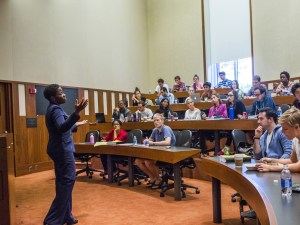
Harvard Law School classroomLaw school provides a much less intense case.  The first-year “acclimatization” to law school involves legendary stresses and challenges.  Of course first-year law students are far better off than military recruits, and even the famous pressures of old-time curricula (as described in the 1971 novel and 1973 film The Paper Chase, or Scott Turow’s 1977 One L) had probably diminished by the mid-1980s, when I attended.  But classroom interrogation by the “Socratic method” certainly seems to be designed, in some respects, to intimidate and unsettle the student.

There’s a reason for this.  Most lawyers will find themselves in practices where they face strenuous and unfriendly opposition, whether in court or at the negotiating table.  If you’re not used to that kind of situation, you’ll have a hard time holding your own.  A lawyer has to learn to perform in the give and take of argument, without losing his cool.  The classroom experience is simply the first step in learning how to do this:  beginning to build up the calluses, so to speak, so we don’t crumple at the first sign of opposition.

I have a notion (again, without personal experience) that a doctor’s residency period may serve a somewhat similar purpose.  Doctors in this stage of practice work traditionally long and stressful hours.  It’s possible that this experience is itself a form of training for the emergency situations in which a physician may find herself, taking life-or-death steps under pressure.

Conclusion

In a much broader theological context, it’s sometimes been suggested—in what might be called a “forge of souls” theodicy—that evil in the world has the function of building character in a way that could not be otherwise achieved.  In some sense, the universe as a whole may be a training camp of sorts.

While the “boot camp world” idea isn’t likely to deal with the problem of evil all by itself, it does provide science fiction writers with a way to push human beings to their maximum potential—creating the larger-than-life characters and institutions that make our fantastic stories so striking, even more than gee-whiz technology and exotic settings.

Romance and the Big Lie

Often a story is built around an elaborate deception.  It may be a caper or heist story, like the Ocean’s Eleven series.  It may be a spy story or thriller.  But there’s more at stake when the Big Lie is central to the main characters’ relationship.  Million-dollar prizes or secret papers are small potatoes; love is serious business.

Let’s look at cases where a romance is founded on a Big Lie.  Resolving that discontinuity—bringing the relationship safely onto a firmer footing—tends to become the main issue of the storyline.  And because at least some of the characters are mistaken about what’s going on, incongruities abound, and the natural home of such stories is romantic comedy.

Dramatic Deceptions

A Big Lie imperils a romance in the most challenging way is if the lie is about the relationship itself.  We can be confused about a potential lover’s name, or status, or identity:  consider all those songs that say ‘I don’t care who you are, only that you love me.’  But if the love itself is false—based on ulterior motives—we’ve got trouble.

10 Things I Hate About You (movie poster)The high-school rom-com 10 Things I Hate About You (1999), loosely based on Shakespeare’s The Taming of the Shrew, is a simple example.  Sophomore Bianca’s overcautious dad won’t let her date unless her older sister, the prickly and unsociable Kat, does too.  Bianca and an admirer arrange for “bad boy” Patrick Verona to be paid to date Kat.  Naturally, Patrick has a hard time convincing Kat he’s really interested in her; but by the time we reach the climactic prom, he actually is.  Naturally, that’s when the secret about the bribe is revealed, leading Kat to reject Pat and storm out.  When she realizes she’s fallen for him, and that he really does care, we arrive at the happy ending.

If A starts out pursuing B for base motives in a comedy, we’re almost bound to be riding the trope where an attachment that starts out fake becomes real.  It may be a cliché, but the pattern has everything going for it:  at least one of the lovers experiences a reluctant or unexpected change, providing a character development arc; the secret creates tension; the inevitable reveal produces emotional drama; and the shift from cynical motives to genuine affection pleases those of us who aren’t already too cynical to be convinced.  TV Tropes locates this plotline at the intersection of the tropes “Was It All A Lie“ and “Becoming the Mask.”

27 Dresses (movie poster)For a grown-up example, try 27 Dresses (2008), with Katherine Heigl and James Marsden.  The unholy motivation here isn’t money, but ambition.  Newspaperman Kevin Doyle (Marsden) wants to shift from writing fluffy wedding reviews to serious investigative journalism.  When he realizes that always-a-bridesmaid Jane Nichols has been in no fewer than 27 of her friends’ weddings, he figures that writing an exposé article about her is his ticket to making the transition to Real Journalist.  But as he gets to know her, he finds she’s not as shallow as he thought.  His attraction becomes genuine just at the point where the unexpected publication of his exposé reveals that he’s been using her for professional advancement.  Because there are other character issues in play, a good deal of further action is needed before Jane recognizes that Kevin’s the one for her.

The Big Lie’s Challenges

A plot built around the Big Lie carries with it some difficulties, which any such story will have to face (or dodge).

One is plausibility.  The bigger the fake, the more unlikely it may seem that someone could pull it off.  On the other hand, the more entertainingly appalling the secret is, the more likely we are to let it ride, just for the fun of it.  This critical leniency is what TV Tropes calls the Rule of Funny (“The limit of the Willing Suspension of Disbelief for a given element is directly proportional to its funniness”).  We can be similarly willing to bend plausibility on such grounds as the Rule of Romantic, Rule of Sexy, Rule of Cute, and of course the Rule of Cool.

More important, we may lose sympathy for the character who conducts such a deception.  A lot depends on the original motivation:  is it understandable, forgivable?  A journalist, for example, can legitimately pursue a story.  The strain occurs when the relationship becomes personal enough that the reporter’s aloof interest in a source begins to seem discordant, or when it becomes evident that the article will be taking advantage of the source’s vulnerabilities or weaknesses.  If the deceiver’s uneasiness grows in proportion to those considerations, we can continue to sympathize.

What makes this kind of plot development understandable is that it reflects a natural progression.  Our love for someone grows (sometimes, at least) as we get to know them better.  So the idea that characters initially brought together for baser motives can eventually fall in love has a built-in plausibility.  It also makes the deceiver’s change of heart more excusable.

Variations

How To Lose A Guy In 10 Days (movie poster)There are enough different ways to run this plotline to keep the Cauldron of Story boiling.

In How to Lose a Guy in 10 Days (2003), both characters are initially acting from unromantic motives.  Andie Anderson, like Kevin Doyle, is a journalist who wants to get more serious assignments.  She decides to start dating a man and drive him away using classic mistakes women make.  Ben Barry, for business-related reasons, makes a bet that he can get any woman to fall for him.  The fact that each of them is in an equally compromised position helps take the sting out of the deceptions.

You’ve Got Mail (1998) develops into the Big Lie after Joe Fox (Tom Hanks) finds out that his intimate online friend is really Kathleen Kelly (Meg Ryan), the same woman he’s skirmishing with about business matters—and he doesn’t tell her.  From that point on, his actions are informed by something she doesn’t know.  But the characters already have a nascent affection—he’s simply grappling with what to do about it without giving her an equal opportunity, which is not as bad.

The Lie is averted in Runaway Bride (1999).  Ike Graham (Richard Gere) is trying to get to know Maggie Carpenter (Julia Roberts) better in order to write a detailed exposé and redeem his journalistic reputation.  But in this case, she’s perfectly well aware that he’s stalking her for discreditable motives, and is willing to use that for her own purposes (and to mess with his mind).  The plot develops in a different direction.  (There seems to be something about this trope that attracts reporter characters.)

These stories, on the whole, are comedies.  But the romantic deception makes up the serious part of the plot engine.  It really is a genuine issue between the characters.  The serious/comic combination isn’t really a paradox:  a comedy of this sort needs a “heart.”  Even a light comedy has to have some gravity, something we care about, at the core; pure fluff doesn’t hold our attention for long.  Even a fluffy soufflé has to be made out of real eggs.  (And that’s no yolking matter.)

Comedies of Errors

We do, however, also have a class of romantic comedies in which the deception is the comic element and not fundamental to the relationship.  Typically this involves something minor that snowballs to absurd proportions, for comic effect.  The deception isn’t about the romantic interest per se, but about something else.  As a result, the people involved come across as kinder, and the issue of character and trust isn’t quite as grave.

While You Were Sleeping (movie poster)A character might, for example, fall into a Big Lie by accident, and then (more or less plausibly) be unable to retrieve it.  While You Were Sleeping (1995) is a favorite example of mine.  Lonely Lucy Moderatz (Sandra Bullock) admires Peter Callaghan, a handsome commuter on the subway line where she’s a token collector, but she has never actually spoken to him.  When he’s mugged and falls onto the rail tracks, she saves him, though he falls into a coma.  A chance utterance from her convinces first the hospital staff, and then the unconscious man’s family, that she is actually his fiancée.

The writers go to considerable trouble to maintain that error while keeping Lucy’s motives innocent.  By the time she has a chance to correct the mistaken impression, she’s concerned that revealing the truth might be a shock to Peter’s grandmother, who has a weak heart.  When Peter’s godfather learns the truth, he encourages Lucy’s deception—because he likes Lucy and feels that she’s as good for the family as the lively, boisterous family is for her.  In the meantime, Lucy develops a true and reciprocal affection not for the unconscious Peter, but for Peter’s brother Jack (Bill Pullman).

False Colours book coverA relatively innocent deception might also be carried out for good motives.  Georgette Heyer’s False Colours involves the Fancot twins, a responsible diplomat (Kit) and his rackety brother (Evelyn, which is in this case a male name).  Kit arrives home to find Evelyn has disappeared just when he’s supposed to meet the family of Cressy Stavely, the young lady to whom Evelyn has proposed a marriage of convenience.  Their flighty mother talks Kit into impersonating Evelyn, just for this one occasion, to save the pending marriage.  Of course circumstances conspire to require Kit to keep up the imposture a good deal longer—much to careful Kit’s dismay.

Heyer is a master at making plausible what at first seems entirely unlikely.  We hear that Kit and Evelyn used to pretend to be each other frequently when they were young.  Kit’s real affection for his brother is the foundation on which his mother cajoles him into the charade.  Moreover, no emotional damage is done, so Kit’s character is not impugned.  When Kit falls in love with Cressy himself (she’s a much better match for him than for Evelyn), it’s not too long before he finds that Cressy has actually figured out the imposture some time since—and is much fonder of him than of Evelyn.  Moreover, when Evelyn finally shows up (with a good excuse), it turns out he’s fallen in love with a different girl.  So no harm comes of the innocent deception, and we can simply enjoy the ingenious maneuvers by which Kit manages to extricate everyone from the results of sailing under “false colours.”

Conclusion

The Big Lie is an inherently tricky device, and requires some care for an author to pull off without irretrievably damaging the character of the deceiving lover.  Deception undermines trust—and the lover must be seen to be trustworthy if the romance is to succeed at all.  Lois McMaster Bujold captured the point in a recent response to a reader:

The question a romance plot must pose, and answer (showing one’s work!) is not “Do these two people get together?” but rather “Can I trust you?”  Which is most certainly not a trivial problem, in art or in life.

But if the writer is adroit enough, the Big Lie does afford opportunities for high (and low) comedy, and it can be managed to a satisfying conclusion.

Good intentions may pave the road to Hell; but on the other hand, dubious motives can be redeemed—if both parties are ultimately willing to deal with the truth.  Since we belong to a species whose motives are seldom wholly pure, there’s a certain reassurance in that.

Unlikable Lovers

It’s hard to root for a romance if you don’t care about the characters.  We generally sympathize with the main character (“MC”).  But that’s not always so for the MC’s romantic interest (the “RI,” let’s say).  What happens when we don’t like the person the MC’s supposed to be interested in?

There’s a variety of types of problematic lovers, and sometimes a particular type is called for by the nature of the plot.  Let’s look at a few.

The Friendly Enemy

Much Ado About Nothing book coverThere’s an entire category of plotline in which the eventually happy couple start out at odds with each other.  TV Tropes captions this “Belligerent Sexual Tension,” and has a splendid list of examples.  They range from Shakespeare’s Much Ado About Nothing with the feuding Beatrice and Benedick (here’s the Tropes page) through F&SF examples like Leia and Han in The Empire Strikes Back, Kim Kinnison and Clarissa MacDougall in the Lensman series, Taran and Eilonwy in the Chronicles of Prydain, Aravis and Shasta in C.S. Lewis’s The Horse and His Boy.

A subcategory of these turnabout stories involves characters who fight in one context while falling for each other in another.  1998’s You’ve Got Mail, and its predecessors such as The Shop Around the Corner (1940), fall into this group, as does my forthcoming novella The World Around the Corner.

Frank and Kathleen across table in You've Got MailSometimes the turbulence between the main characters is based on some conflict in their characters (scoundrel and diplomat in Empire) or their interests (rival businesses in You’ve Got Mail).  Sometimes it’s almost a matter of their own combativeness or aggressive attitudes, as in the romantic comedy Laws of Attraction (2004).  But the writer has to walk a fine line here.  If the relationship is so strained as to become hostile or nasty, we may begin to wonder whether the RI is that great a catch after all.  Would Leia be better off with a “nice man”?  (Other than Luke, of course.)  In You’ve Got Mail, is Joe Fox disqualified by his willingness to take unfair advantage of the fact that he knows who Kathleen is and not vice versa?

In a fight-then-flirt scenario, the romantic interest has to be sufficiently flawed that his tension with the MC doesn’t seem contrived—yet not so flawed that the attraction seems implausible.  The tension must be difficult enough to pose a challenge, and to keep the romance from concluding too quickly.  But the RI has to be admirable enough to be worth winning.

Winning Over the Bad Boy

There’s another class of plots that depend on making the romantic interest disreputable, troubled, or outright wicked.  Not too wicked, of course; they’ve got to be capable of reform—by the right lover.  We see this predominantly with female MCs and male RIs, but not exclusively so.

Clark Gable as Rhett ButlerTake Rhett Butler in Gone With the Wind.  His appeal seems to lie especially in the fact that he’s a smuggler who defies the gentleman’s code of the antebellum South and pokes fun at their romanticized ideals.  Scarlett O’Hara doesn’t set out to reform him, but she does find him fascinating.  And she does reform him, as we can see but she can’t.  Interestingly, in this case Scarlett herself is pretty problematic too:  she’s a difficult, self-centered, domineering woman, with whom it can be hard to sympathize—though we do sympathize, mainly because we can see her inner thinking and where those traits come from.  (Personally, I always liked Melanie better.)

Edward Rochester of Jane Eyre barely escapes crossing the line into unacceptability, to my mind.  He’s brusque, domineering, and frighteningly deceptive.  We’re willing to approve him mostly because Jane is in love with him, and we love Jane.  And his comedown at the end both chastens him and engages our pity.

In my view, Wuthering Heights’ Healthcliff does cross the line.  I’m unmoved by his harsh and erratic behavior, and I don’t respect Catherine for her mad attachment to him.  He lacks redeeming qualities.  On the other hand, his very flamboyant unlikability is the basis for a hilarious imaginary counseling session held for the novel’s characters in Jasper Fforde’s The Well of Lost Plots (2003, chapter 12)—so I guess there’s some justification for his existence, at that.

The Proud, the Crude, and the Gothic

Few of these undesirable, yet desirable, RIs are as comprehensively intolerable as Heathcliff.  Generally one or two off-putting traits are enough to create the necessary tension or conflict.

Elizabeth and Darcy look askanceThe archetype of the proud or arrogant RI, of course, is the much-loved Mr. Darcy of Pride and Prejudice.  Darcy has some unpleasant attitudes and makes some dreadful missteps, but Austen succeeds in convincing us that he’s admirable for all that, partly through his delayed but ultimately sincere devotion to Elizabeth.  Darcy retains such a hold on romantics that he’s even been successful as an artificial intelligence (AI) in Ashlinn Craven’s contemporary story.

Our era’s fondness for the earthy and outrageous gives us a procession of crude romantic interests, whose vulgarity or rudeness may represent a  barrier to be overcome by the Right Woman or merely a species of candor and bluntness—especially in romantic comedies.  Mike Chadway in The Ugly Truth (2009) has made a profession out of cynicism and outrageousness, but comes around in the end, after we’ve seen that his attitude stems from a past rejection.  The main character of Andy Weir’s 2017 novel Artemis sails perilously close to this edge.  But in this era we’re tolerant enough of crudity that the merely indecorous RI doesn’t usually pose a problem.

The brooding, Gothic or Byronic hero can also win readers’ hearts—witness Edward Cullen in the Twilight series.  But his kind of moodiness can so easily slip into annoying self-indulgence that it’s highly vulnerable to parody.  We may be more inclined to snicker than to sympathize, as we see in much of the critical response to Twilight.

The Misguided Romantic Interest

One of the easiest ways to generate conflict without wholly compromising the RI is to make them simply mistaken or wrongheaded.  This aligns neatly with a plot in which the MC shows the romantic interest the error of his (or her) ways.

Pretty Woman dinner scenePretty Woman (1990) is a fine example.  Edward Lewis (the third Edward on our list so far—coincidence?) is a repressed workaholic who uncaringly buys up business operations and sells them off in pieces.  Lively Vivian Ward not only loosens him up personally, but goads him into “using his powers for good” and working to save a company rather than break it up.  Edward’s change of heart in business parallels the more obvious romantic softening and emphasizes the completeness of his transformation.

A character—particularly a female character—working for the bad guys is especially subject to this kind of change.  For example, the atypical Disney heroine Megara in Hercules (1997) aids the scheming Hades, albeit for initially noble reasons.  There’s an entire category of such repentant subvillainesses, documented by the ever-vigilant TV Tropes.

Because the merely misguided RI is only superficially unworthy, this trope is a favorite of Hallmark Christmas romances, where either the MC or the love interest is often a big-city character who wants to turn some idyllic country spot into a soulless commercial enterprise.  This kind of relationship works equally well for either gender.

Overdominance

Genre romance with a female MC has a certain fondness for the strong, dominant male RI.  (If you belong to Critique Circle, here’s a lengthy forum discussion on the “alpha male” from mid-2017.)  But this can easily go awry.  What sounds romantic at first blush may be creepy or distasteful once we think of it in real life.  Many of the male leads discussed above can be classified as dominant types, but there’s a fine line between dominant and domineering.  When this is taken to extremes, we can drift into the dubious territory of the Fifty Shades books.

But we don’t have to go that far to encounter difficulties.  Heinlein’s juvenile SF novel The Star Beast features a somewhat passive hero, John Thomas Stuart XI, and his bratty high-school girlfriend, Betty Sorenson.  Betty is laudably active and independent, but she’s so brash and overbearing that she rather gets on my nerves.  We like to see both strong women and strong men—but we don’t like to see them demonstrate their strength in ways that are tyrannical or overbearing.

Beauty and the Beast soundtrack coverThe various iterations of Beauty and the Beast illustrate the difficulty.  The Beast has to be fearsomely harsh and threatening; that’s the point.  But this quality can’t be so exaggerated as to undermine his potential for transformation into a caring lover.

Excuses

A romantic interest’s bad behavior can be offset when the author provides information that makes the actions understandable, or even sympathetic.  An io9 article by Charlie Jane Anders makes the general argument that there are “10 Ways to Make Everyone Root for Your Amoral Protagonist.”

Anders is a good source on the subject:  her Hugo-nominated 2016 novel All the Birds in the Sky features male and female protagonists who are each highly stressed and at times hard to love.  But the ending, to my mind, is very satisfying.  Part of the reason is that we see so much of the characters’ prior experiences and difficulties.  We comprehend how they got to where they are.

One technique that can help us excuse a character’s faults is to let us hear them speaking in first person at least part of the time.  The romance technique of telling the story by alternating the two principal characters’ viewpoints does the same thing.  It’s rare that characters seem evil to themselves, and letting us in on their thoughts gives us a useful perspective.

Female Variations

We’ve noted that the “bad boy” characters are generally, though not exclusively, male RIs for female MCs.  There are other potentially troublesome character types that tend to skew female.  One is the Manic Pixie Dream Girl:  as TV Tropes puts it, “She’s stunningly attractive, [e]nergetic, high on life, full of wacky quirks and idiosyncrasies (generally including childlike playfulness) . . . She’s inexplicably obsessed with our stuffed-shirt hero, on whom she will focus her kuh-razy antics until he learns to live freely and love madly.”  An example that seems to go too far is Sandra Bullock’s character in Forces of Nature (1999).  Possibly this is why, unusually, the hero ends up marrying someone else, although he benefits from the Dream Girl’s free-spirited attitudes.

the-black-flame-2Another primarily female archetype is what we might call the Siren, the mysteriously fascinating and unattainable character with whom the male MC is irresistibly obsessed—frequently capricious and even cruel.  My favorite example is the title character in Stanley Weinbaum’s SF classic The Black Flame.  Here, as with the equally melodramatic Byronic hero, the character type has been so overused that it’s easy for it to become either unbelievable or unlikable.
When It’s the Main Character

Less common, but not unheard-of, is where the main character is the one whose romantic suitability is in question.  We’ve noted Artemis as one such case.

I recently got around to watching About a Boy (2002), starring Hugh Grant, which came highly recommended by Connie Willis.  While it’s been observed that Hugh Grant is inherently irresistible, I found that in this case his character was so aimless and shallow that I felt the women in the story would indeed be well advised to steer clear of him, until almost the very end, when he finally shapes up a bit.

The 1999 romantic comedy 10 Things I Hate About You (a modernization of The Taming of the Shrew) also successfully makes the main character just sympathetic enough to sustain our interest.  It’s essential to the Shakespearean plot that Kat be so prickly and abrasive as to be a questionable romantic prospect.  But the excuses we hear, and the perfect fit of the actress’s persona to the dual requirements of abrasion and attraction, give us just enough to go on.

Conclusion

In gauging the acceptability of a character as a romantic partner, even more than in most such judgment calls, “your mileage may vary.”  But we can all recognize that just as there’s peril in making the romantic interest too perfect, there’s a corresponding set of pitfalls if the object of our MC’s affections pushes imperfection to the point of no return.

Mind Powers

Mental powers are a staple of both science fiction and fantasy—and even quasi-SF genres like paranormal romance.  The idea’s like the traditional iceberg:  easy to put into a story, but with some major assumptions lurking under the surface.

The Physical and the Non-Physical

In SF, it became fashionable to use the invented term “psionics” to refer to powers of the mind.  The term seems to have originated by analogy to “electronics,” giving it a scientific (or pseudo-scientific) cast, and using the Greek letter psi, the first character of psyche, “soul” or “mind.”  Sometimes simply “psi” is used, as in “psi powers.”  It’s a useful coinage.

There are two broad approaches to psionics.  One treats mental power as acting purely on other minds—what we can loosely call nonphysical:  for example, telepathy.  The other approach allows mental powers to act directly on matter:  the most familiar example is telekinesis, moving things by mind power.

Note that distinguishing “physical” from “nonphysical” already involves some pretty big assumptions—but we’ll get to that.

Mind-to-Mind

Professor Xavier using telepathyQuite a few science fiction stories postulate mental powers that have only mental effects, such as talking mind-to-mind.

The “Lens” worn by the “Lensmen” of E.E. Smith’s classic series is essentially a psionic amplifier.  It gives the wearer telepathic abilities.  This is extremely useful in making contact with unfamiliar species—especially in interstellar law enforcement, with instant communication an essential for “lawmen” that might be pursuing criminals into unknown regions of space.  The Lens also serves as a means of identification that cannot be faked, since an individual’s custom-made Lens will kill anyone who touches it if it’s not in contact with the designated wearer.

But Lensmen can’t make things physically happen by mind power alone; they have to use the conventional space-opera gear of ray guns and such.  The Lensmen can communicate mentally; they can influence or even take over the mind of another person; they can erase or implant memories.  But a Lensman can’t lift objects and throw them around without flexing his muscles in classic action-hero fashion.

There are some odd borderline cases.  The main character, Kimball Kinnison, gains a “sense of perception,” allowing him to perceive nearby objects without using the standard five senses.  He can “see” through solid objects, for example.  That does involve interaction with inanimate matter, of course; but the interaction is all one way—he can’t affect the things he perceives.

Now, a contemporary scientist physicist would find this paradoxical, since it’s fundamental to quantum physics that you can’t perceive an object without interacting with it—bouncing photons off it to see with, for example.  But the Lensman stories were planned out in the 1940s, when we were not so acutely aware of quantum-type theories of perception.  The anomaly does illustrate the difference between these two theories of knowledge:  one in which the knower is the passive recipient of information, and the other in which knowledge is always the product of interaction.

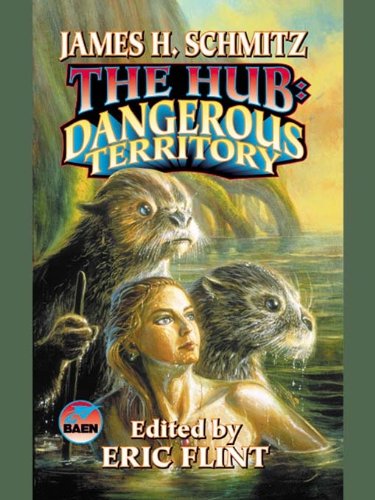
James Schmitz, The Hub - Dangerous Territory, coverJames H. Schmitz’s numerous stories set against the background of the interstellar “Federation of the Hub” use a similar theory of psionics.  Telzey Amberdon, one of the main characters, can communicate telepathically with nonhuman creatures such as her massive “pet,” the crest cat TT (who turns to be a formidably intelligent being in his own right).  Hub psis like Telzey can influence other minds and can be extremely dangerous—whether in a good cause or a bad.  But physical objects aren’t affected.

A similar sort of psionics is assumed in A.E. van Vogt’s classic mutation novel Slan, and in one of my childhood favorites, Star Rangers (The Last Planet), by Andre Norton.  For a more well-known example, the movie Independence Day showed the inimical aliens using mind control to speak through a captive human to communicate with other humans.  But to properly destroy humanity, they used conventional physical weapons.  (Well, “conventional” as science fiction goes; the alien weapons were dismayingly novel for the embattled Earthlings.)

Fantasy, too, can feature purely mental abilities.  There are references in The Lord of the Rings to the ability of elves and wizards to speak mind-to-mind.  (This was shown more explicitly, as I recall, in the movie versions of The Hobbit.)  An analogue might even be found in ghost stories.  Ghosts are often portrayed as acting only through influence on human minds, whether through terror or telepathy—as in A Christmas Carol:  the various spirits do not act except on Scrooge’s own consciousness.

Sometimes telepathy is imagined as “hearing” only what people verbalize—what’s put into words; for example, in Al Macy’s novels about mind-reading detective Eric Beckman.  In other cases, telepathy allows direct access to other people’s feelings and inchoate thoughts, somehow getting behind the speech-forming function.  The notion that one can think without words would itself be anathema to many a twentieth-century linguistic philosopher—consider the linguistic relativism or “Sapir-Whorf hypothesis” so adroitly used in the movie Arrival.  The difference raises basic questions about the relation between speech and thought, and how thinking works.

The divide between mental and physical powers gets further eroded when the story includes telepathic machines.  The Psychology Service in Schmitz’s Hub routinely uses mechanical detectors to monitor psis.  In Slan, “Porgrave broadcasters” can send “recordings” telepathically.  Even aside from the Lens itself, which is a quasi-living physical device, the Lensman series eventually gives us machine-generated mental screens, analogous to the physical force-fields of space-opera lore.  If psionics were confined to minds alone, how can machines handle it?

I’ve spoken loosely about this sort of mind-on-mind power as “nonphysical”; but that involves a very significant assumption—that the mind is not a physical thing.  If the mind were wholly reducible to the brain, there would be no reason in principle why mind powers would only affect matter in the form of other brains.  By analogy, microwaves can be used for communications, but also for cooking dinner.  On this assumption, mind powers would constitute just another kind of physical force, the analogy often being a different “wavelength” of energy.  Second Stage Lensman refers to the “frequency-range of thought” (ch.14), and Smith’s Skylark series presents thought as a “sixth-order wave”—whatever that may be.

Mind Over Matter

We’ve gotten so used to things like telekinesis nowadays that the mind-only abilities discussed above may seem oddly constrained to us.

Vader uses the Force to fling objects at Luke (Empire)The original Star Wars film, A New Hope, showed us that the Force could mediate mental communication, even with the dead (“Use the Force, Luke”), and some degree of mind-control or mental influence (“These aren’t the droids you’re looking for”).  But it was only in the sequel that we saw that it could also enable telekinesis.  I still recall the moment when Luke, ice-cemented to the ceiling in the wampaa’s cave, strains fruitlessly to reach his light-saber—then relaxes and closes his eyes; and I thought with some excitement, so, we’re going to get telekinesis too!  By the end of the episode, we’re watching Darth Vader use mental power to throw objects to distract Luke and keep him off-balance.  You can even use this matter-moving power to move yourself, or in effect to fly without wings—as we saw in one memorable scene in The Last Jedi.

Yoda lifts the X-wing (Empire Strikes Back)By now this sort of mind-over-matter is familiar territory.  But there are still aspects that aren’t obvious on the surface.  For one thing, telekinesis is apparently reactionless.  It’s unclear whether it obeys Newton’s laws of motion, under which action requires an equal and opposite reaction.  It would have been a great comic scene in Empire when Yoda impressively lifts Luke’s X-wing fighter into the air—and Luke had looked over to see Yoda rapidly sinking into the muck, with the entire weight of the X-wing bearing down on his diminutive form.

The simplest fantasy version of telekinesis is the poltergeist, an immaterial spirit which (rather bafflingly) is capable of throwing around physical objects.  Levitation, whether of oneself or of something else, is a commonplace for magicians.  In fantasy, however, mental powers tend to bleed over into magical powers, which we don’t think of in quite the same way—although one way of conceiving magic is as a kind of mind over matter.

There are other kinds of (fictional) mental interactions with matter, over and above mere movement.  A common trope is the ability to start fires, or “pyrokinesis,” as in Stephen King’s Firestarter.  This might be interpreted as a subtle form of telekinesis—since heat consists of motion at the molecular level, maybe a telekinetic could create heat by causing an object’s molecules to move faster.  Such an explanation leaves open the question of where the added energy is coming from; but that’s an issue common to any form of telekinesis.  There may be a certain nerdy satisfaction in supposing that a physically puny specimen like, er, yours truly could throw things around by sheer power of mind, even though one’s muscles aren’t up to it.  But whether things are moving by mind or by muscle, there has to be energy coming from somewhere.

The Golden Torc, second volume of Julian May's Saga of Pliocene Exile, coverThere are other things you can do with matter besides just moving it around.  Julian May’s Saga of Pliocene Exile, and related stories, postulate “metapsychic powers” that include “creativity,” allowing metapsychics to change the form of matter and thus materialize or convert physical objects.  Other stories imagine psionic abilities to “read” the history of an object or a place.

Teleportation—instantaneous movement from one place to another—represents a kind of in-between.  Physical objects are obviously affected, but the physical object in question is typically the practitioner’s own body, and perhaps other objects physically connected (such as clothing—but clothing doesn’t always come along, depending on the story, which can be inconvenient).  Does it count if your mind affects only your own body—the one locus where even theories that sharply separate mind and matter have to assume some crossover between the two?

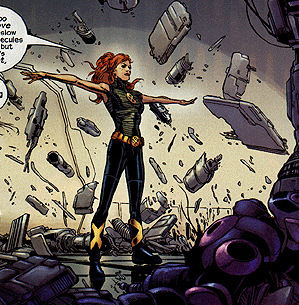
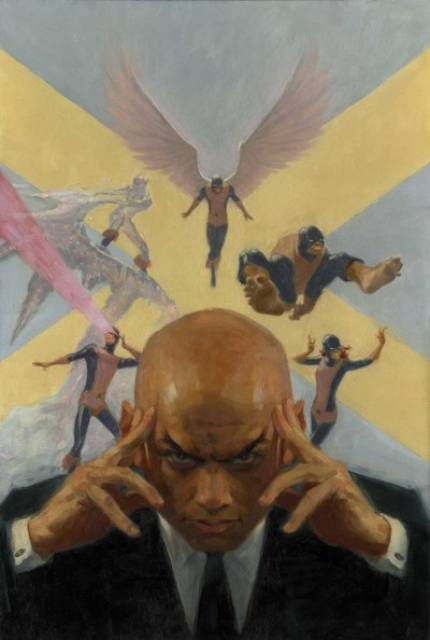
Jean Grey (Marvel Girl) using telekinesisThere’s a long tradition of mental powers in comic books too.  But given the visual nature of the medium, physically effective mental powers tend to predominate over the purely mental.  We do see some of the latter—pure telepathy in Marvel’s Professor Xavier or DC’s Saturn Girl.  But much more popular is Marvel Girl (Jean Grey), whose telekinetic powers make for much more striking imagery.

Minds and Bodies

Considering these two approaches to mind powers raises the philosophical question of whether minds affect matter only in and through a person’s body, or can do so independently.

If we exclude direct physical effects from the scope of (fictional) mental powers, this suggests parallel realms, with thought proceeding on one level while physical actions occur on another, linked only through the minds of humans or other intelligent beings.  It’s almost a Cartesian approach (that is, a theory similar to that of René Descartes) of mind-body dualism, and sinks roots into the long-standing debates over the “mind-body problem.”

The “sense of perception” concept, similarly, functions as if there were two independent metaphysical levels, mental and physical, and this mental sense could allow a person to go “around” the physical senses and inspect an object directly.  The philosophical notion of intentionality (not to be confused with the usual sense of “intentional” or deliberate) is adaptable to such non-sensory knowledge.  But the trend in both philosophy and physics over the last couple hundred years has been to focus on the physical connection between the knower and the known.

It’s become a standard assumption that we can’t know or do anything without a physical connection.  Anything else seems “unscientific.”  What’s interesting is that we seem to be willing to accept the now-unpopular postulate of non-physical knowledge and events when we’re dealing with fiction.

Of course, it’s also possible to meld the two back together by taking the position that mental powers really only reflect physical events taking place at a level we can’t yet detect—as with Smith’s “frequency range.”  But that isn’t the only way to conceive of the relationship.  There is still a certain imaginative appeal, at least, to the notion that mind can act independent of the constraints of the physical body.

I think such stories are helpful.  We’re apt to rush to conclude “science has proven” that the mind equals the brain and the brain is just a particularly subtle form of matter.  Science has not, in fact, proven any such thing.  The physical sciences assume, understandably, that only physics is involved.  But they have by no means demonstrated that all observable phenomena can be wholly explained by physics.  The arguments on this subject are still live.  We should still apply sound standards of evidence, and not leap to conclusions—but that applies in both directions, whether to materialism or to its alternatives.

In other words, there may still be more things in heaven and earth than are dreamt of in our physics, and one of the uses of speculative stories is to help us keep an open mind on these subjects.