Third-Party Love Songs

The Third Party

Girl at door, from "(Kissed You) Good Night"

“(Kissed You) Good Night”

Typically a love song is sung by one lover to another, just as you’d expect.  The lyrics are some combination of first and second person:  “I love you.”  (Oddly enough, there’s only one song on my playlists entitled “I Love You”; you’d think it would be a more common title.)  Or the lovers may sing to each other in a duet—from “People Will Say We’re In Love” to “(Kissed You) Good Night.”

But every now and then we get a case where the singer is a third person.  The song is still about love, but the singer isn’t one of the lovers.  Rather, they’re talking to someone else’s lover, or potential lover.  What kind of story is implied by moving the focus to a third party?

Wonderful Counselor

The most appealing case is where the singer is giving good advice to the lover.  The attitude may be paternal or maternal, fraternal or sisterly (sororal?).  Or the informal counselor may just be a friend putting in a good word at the right moment.

Chronologically, Melissa Manchester’s “You Should Hear How She Talks About You” stands at the very beginning of a love affair.  Melissa’s telling a guy that the nameless “she” is sweet on him:  “she’s half out of her head.”  Hence her encouragement is right there in the opening line:  “you should break the ice.”  Take the first step, fella, she’s waiting for you.

A similar encouragement, a little later in the relationship, is offered by Billy Joel in “Tell Her About It.”  The guy he’s addressing has already found his mate (“let a good thing slip away”).  But a punk kid from New York is likely to be inarticulate, or too macho to let emotions show, or both—like Danny in Grease.  If he doesn’t want to lose her, he’s going to have to learn to talk to her about how he feels.  The contrast between the singer (“a man who’s made mistakes”) and the addressee yields a nice contrast of worldly-weariness and blundering innocence.

Mending the Rift

Another good time for a wise advisor to drop in is during a lover’s quarrel—a “rift in the lute,” as Wodehouse’s Bertie Wooster likes to say.  In the Beatles’ early classic “She Loves You,” the singer is actually carrying messages for a couple who aren’t speaking to each other:  “She says you hurt her so . . . But now she says . . .”  He’s also forthright enough to express his own opinion:  “I think it’s only fair . . . Apologize to her.”

Roxette performing Listen to Your Heart

“Listen to Your Heart”

The complementary female-to-female version is exemplified by Roxette’s Listen To Your Heart:  “Sometimes you wonder if this fight is worthwhile” . . . but the person sung to should consider carefully “before you tell him goodbye.”  While Billy Joel or the Beatles advise actual conversation, Roxette suggests the first step is simply to consult your own deeper feelings or gut reaction.

Amy Grant’s slightly offbeat but arresting “Love Can Do” is a bit more pointed about sticking around rather than giving up.  “Sometimes love means we have to stand and fight . . . Everybody runs, everybody hides.”  In particular, she puts her finger on a ubiquitous misunderstanding:  the idea that love simply evaporates of itself.  “It’s not like that.”  What we do has a crucial role to play.  If you want those feelings back, “no running.”

Carly Simon sings "The Stuff That Dreams Are Made Of" at Martha's Vineyard

Carly Simon sings “The Stuff That Dreams Are Made Of” at Martha’s Vineyard

The perceptive Carly Simon targets a still later point—that midterm period when a couple has been together long enough to get bored with each other.  In “The Stuff That Dreams Are Made Of,” Simon advises a Chestertonian re-imagining or re-envisioning of the relationship:  “What if the prince on the horse in your fairytale / Is right here in disguise, / And what if the stars you’ve been reaching so high for / Are shining in his eyes?”

Rather than providing advice for a particular relationship, another family of third-party songs makes a more general recommendation of an individual.  Alabama’s “She Ain’t Your Ordinary Girl” tells us at length how extraordinary “she” is—“No empty promises; proof is what it takes to win her heart.”  Yet “when you see her smile, nothing seems to matter any more.”  It isn’t quite clear whether the singer is speaking to a particular friend, or to the world at large.

We see this generality more often when we come to the negative examples.

The Prudent Warning

The third-party intervention isn’t always to encourage.  Sometimes it’s negative:  a sort of warning to the general public against an unreliable lover—generally based on the singer’s unhappy experience.

She's So Mean, girl smashes guitar

“She’s So Mean”

There are quite a few of these too.  From the early rock-and-roll era we have Dion’s “Runaround Sue,” which cautions us that “Sue goes . . . out with other guys.”  Hall & Oates want us to watch out for the “Man-Eater.”  Over on the country side, Eric Church tells an aspiring suitor that the object of his affections is “heaven on the eyes,” but “Hell on the Heart.”  Matchbox Twenty explains in vivid detail how “She’s So Mean.”

There ought to be a comparable category of songs by a woman warning about a hard-hearted man, but for some reason the only example that comes to mind is the old Three Dog Night tune “Eli’s Coming,” which issues a general alert about an irresistible guy who appears to be a sort of force of nature.  You can probably think of better examples.

Nostalgic Advice

Sometimes the kindly advisor is a parent or relative.  In that case, the advice is often freighted with nostalgia, looking back on the days when the person spoken about was in the singer’s care.  The country band Heartland has a ballad called “I Loved Her First” that sounds at first like a rejected lover commending “my girl” to a new romantic interest, but turns out to be her father giving her away at her wedding.

Rod Stewart’s “Forever Young” (not to be confused with the earlier Bob Dylan song of the same name) speaks to the young person’s romantic future (“And may you never love in vain . . .”), but in general terms, a kind of open-ended hope.  (Incidentally, that was the song we picked for the father-daughter dance at my daughter’s wedding.)

In these examples, the third-party love song shades into a more open-ended field of advice songs.  Somewhere in that vicinity is a category of reflective “sadder but wiser” songs about love generally, addressed to a particular listener or listeners.  “Some Enchanted Evening” from South Pacific falls roughly into this category.  Even though Émile is singing it directly to his beloved, Nellie, he words it as if he’s talking to someone else:  “Once you have found her, never let her go.”
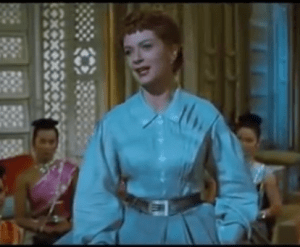
Anna sings Hello, Young Lovers in The King and I

“Hello, Young Lovers”

This kind of reflection seems to have been a favorite of Rodgers & Hammerstein.  In The King and I, Anna sings “Hello, Young Lovers” (which has perhaps the most beautiful introduction of any song from a musical) to an array of Siamese princesses.  “Cling very close to each other tonight /  I’ve been in love like you.”

Conclusion

I find the third-party advice and encouragement songs especially enjoyable.  They gain points for a kind of genial altruism.  An I-love-you song generally expresses care for the other person—we want our beloved to be happy.  But there’s inevitably a certain self-interest involved, too:  a healthy exchange of love will also make me happy.  (“And I wish you all the love in the world / But most of all, I wish it from myself”—Fleetwood Mac’s “Songbird.”)

The third-party advisor is in that sense disinterested.  Like the Master Contriver in a romance, he or she has the generosity of the matchmaker.  The smiling friend’s endorsement reflects and redoubles, as it were, the appeal of the underlying romance.

Prophecy and the Plan

The ancient prophecy is a staple of fantasy.  This child will kill his father and marry his mother.  Not by the hand of man will this being fall.  The source of the information is often vague, but once we’ve heard the prophecy, we know it’s going to come true—somehow.

There’s a comparable science fiction trope:  the long-term Plan.  But the Plan functions rather differently.  Let’s take a look at the two together.

Foretold and Foredoomed

An entire story may be built around the unavoidable destiny that lands on an unlikely or reluctant hero.  Or the mysterious message from the past may relate merely to one aspect of the story—perhaps the only way to accomplish some task (“the penitent man will pass”).  Either way, in the words of TV Tropes, Prophecies Are Always Right.

As the examples on the Tropes page indicate, this is not strictly true:  writers can subvert or otherwise play with the fulfillment of a prediction.  But there wouldn’t be much purpose in introducing the prophecy if it didn’t have some relevance to the plot.  Most commonly, this is because it’s valid.

Statute of sibylThe device goes back to some of the earliest stories we have.  The Greek tale of Oedipus, for example, involves a prediction that a child will bring disaster on his city by killing his father and marrying his mother.  The very actions by which his father tries to avert this outcome turn out to produce it.

Shakespeare’s Macbeth provides a slightly less antique example.  The title character is emboldened to stage a revolt by the “prophetic greeting” of three witches (Act I, Scene 3).  Macbeth is further heartened by hearing that “none of woman born” will harm him, and that he won’t be beaten until “Great Birnam wood to high Dunsinane Hill/Shall come against him,” (Act IV, Scene 1).  Both statements turn out to be true, but not as Macbeth interpreted them:  his opponents approach his stronghold holding “leavy screens” of branches (Act V, Scene 6), and he is slain by Macduff, who was birthed by Caesarean section (Act V, Scene 8).  In both these cases the message appears to be that you can’t fight fate:  the prophecy will come true despite all attempts to prevent it.

The motif carries through to modern fantasy as well.  Harry Potter’s Divination teacher, Professor Trelawney, is generally played for laughs, but her serious predictions come true.  In The Lion, the Witch, and the Wardrobe, the White Witch is right to fear the “old rhyme” that her reign will end when two Sons of Adam and two Daughters of Eve are enthroned in Cair Paravel (ch. 8).

Fated but Free

Eowyn slays the NazgulThe Lord of the Rings provides some interesting examples.  TV Tropes lists a number of vague premonitions by various characters.  But a more specific case occurs when the Witch-King of Angmar, secure in Glorfindel’s prediction that “not by the hand of man will he fall” (Appendix A, I.iv), boasts that “No living man may hinder me!”, and is met by Éowyn’s defiant “But no living man am I!”  (Return of the King, book V, ch. 6, p. 116).

The main issue of the story, however, is subject to no such foreknowledge.  No prophecy gives a hint as to whether the Ring will be destroyed and Sauron defeated.  As TV Tropes points out, free will as well as fate exists in Tolkien’s world.  There is no certainty of outcome in this world’s battles.  As Chesterton puts it:  “I tell you naught for your comfort, yea, naught for your desire / Save that the sky grows darker yet and the sea rises higher.”

The foretellings we do see in fantasy seem to be guaranteed by some trans-human source:  paranormal, supernatural, even divine.  This is why they can generally be relied upon to come true.  But what of science fiction, which tends to invoke science rather than the supernatural?

Foundation

What often takes the place of prophecy in SF is a vast, far-reaching plan of some sort, whose fulfillment is guaranteed not by the supernatural but on some scientific basis.  This is, in effect, the science-fictional version of prophecy or fate.  Such plans typically are made by human beings (or similar creatures).  They are reducible to human intent—and conditioned by human fallibility.

Seldon sits in front of city (Foundation)The classic case is Isaac Asimov’s original Foundation trilogy.  Hari Seldon, inventor of a new science of “psychohistory” that statistically predicts the aggregate actions of human masses (as distinct from the acts of individual persons), realizes that the millennia-spanning Galactic Empire is headed for an inevitable collapse.  To cut short the subsequent thirty thousand years of chaos and barbarism, Seldon launches a plan to establish two “Foundations” from which civilization may be restored more quickly—in a mere thousand years.  Seldon’s mathematics allows him to arrange things in such a way that the Seldon Plan will inevitably prevail—at least to a very high order of probability (given that we’re dealing with statistical conclusions here, rather than superhuman insights).

The stories Asimov tells about the early years of the Foundation thus carry an atmosphere that’s similar in some ways to that of a prophecy in fantasy.  The leaders and people of the Foundation on the planet Terminus have confidence that they will prevail; but they are not privy to the details of the Plan and have no idea how that will occur—just as the Witch-King did not anticipate he would be slain by a woman, or the Pevensie children know just how they can succeed to the king-and-queenship of Narnia.

On the other hand, Seldon’s Plan is not quite as infallible as the typical prophecy.  This becomes evident when an individual known as the Mule upsets the psychohistorical scheme by changing its underlying assumptions about human behavior:  the Mule has mutant mental powers that could not have been predicted by Seldon.

Galactic Networks and Race Minds

The Snow Queen coverJoan Vinge’s 1980 novel The Snow Queen (very loosely based on the plot of Andersen’s fairy tale) also involves a Plan, though the characters are not aware of this initially.  They come to realize that the “sibyl network,” a vast interstellar information system run by technology beyond their understanding, has its own purposes and is seeking (like Seldon) to shape events to promote reconstruction after a collapse of civilization.  But they’re not fully aware of what the sibyl network is trying to do, and they don’t know whether its Plan will be successful.

Unlike the Plan that underlies the Foundation stories, Vinge’s Plan is not made by human agents—though the computer “mind” behind it is a human product.  But like the Seldon Plan, this long-range plan is not guaranteed to succeed.  The sibyl network is not as infallible as the mysterious sources behind the standard fantasy prophecy.

The long-term plan, or purpose, may also belong to a race or species consciousness—a mind (of sorts) that arises from humanity as a whole.  The “terrible purpose” that Paul Atreides struggles with in Dune is that of a subliminal racial consciousness that is driving relentlessly toward an interstellar jihad as a way of mixing up the gene pool to refresh the species.  This quasi-mind does not seem to have a specific plan in mind, but the overall drive, like the statistically-based Seldon Plan, is irresistible.

Something similar seems to be at work in A.E. van Vogt’s mutation-after-humanity novel Slan (1940).  In this future setting, the human species is mutating not at random, but in such a way as to consistently produce a “higher” type of being—smarter, stronger, kinder, with telepathic powers.  One character remarks:  “We have always assumed far too readily that no cohesion exists between individuals, that the race of men is not a unit with an immensely tenuous equivalent of a blood-and-nerve stream flowing from man to man” (ch. 18).  Apparently there is some vague but irresistible analogue of systematic purpose at work in humanity as a whole.  (Greg Bear’s 1999 novel Darwin’s Radio, by contrast, suggests a distributed genetic mechanism for such a wave of mutation, without requiring a single overall mind to account for it.)

Ongoing Guidance

A master Plan that spans generations may be designed to operate without intervening human guidance.  This is true of certain lost world-ship stories, in which the loss of knowledge on a generation ship is deliberately arranged in advance.  In Clifford Simak’s Target Generation (1953), for instance, a book of instructions has been secretly passed down from generation to generation, to be opened only when the starship finally reaches its destination.

Of course, the transmission of such a plan won’t be reliable if it’s subject to human error or accident.  I’ve often felt that the long-dead planners who relied on a secret book in Target Generation ought to have been thrown out on their ears, when the flight was being arranged, for resting the survival of an entire shipload of people on such a fragile and undependable strategy—like the wacky souls behind the Rube Goldberg setup in City of Ember, entertaining as both those stories are.

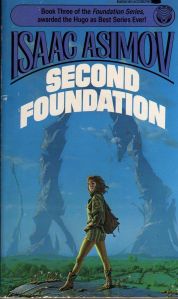
Second Foundation coverSeldon’s Plan at first appears to function in this pilotless way.  But it turns out there is a hidden agency responsible for monitoring the Plan and correcting any deviations:  the Second Foundation, as skilled in psychohistory as the original Foundation is in technology.  The canny Seldon built in a safety net to take care of just such a random variable as the Mule—because a human-based plan lacks the mysterious paranormal guarantee of a prophecy.


Exceptions

Sitting squarely between the F&SF camps in this respect is Star Wars, the exception that proves the rule.  Lucas’s brain child is sometimes referred to as “science fantasy” rather than science fiction, not just because it does not delve into scientific plausibility, but because it simultaneously mobilizes both fantasy and science-fiction tropes; that’s part of the reason the movies are so widely accessible and successful.  The prophecy that Anakin Skywalker will “bring balance to the Force” (whatever exactly that means) is cited throughout the series.  But there’s no real explanation in the movies, at least, as to how this prophecy works or what makes it reliable information.  It’s a fantasy trope, not a science fiction motif.

There is, however, a genuine SF exception of sorts:  time travel stories, when they rely on knowledge gained from being in the future.  For example, in Anne McCaffrey’s Dragonflight (1968), time-traveling dragonrider Lessa assures her compatriots in the past that they will accompany her back to her own time in their future, because that explains their mysterious disappearance, which Lessa already knows about as part of her own history.  Here the source of future knowledge is neither human nor superhuman, but sheer facticity—or, from the standpoint of the characters, experience.  They tell about future events that they’ve already seen happening.

For the Reader

Both types of projections into the future, prophecies and plans, set up a certain kind of tension in a story.  There’s a sort of security—we know how things will turn out, at least in a general way.  (Or if the outcome is tragic, as with Oedipus, the effect may be dread rather than security.)  At the same time, there’s a tension in that we don’t know how the story will arrive at that end.  The power of this combination is proved by the long tradition of such stories throughout human civilization.

The long-term plan or prediction evokes awe at the deeps of time—how something said long ago may still have effects today.  And it generates a certain wonder at the way in which things surprisingly work out.  In either form, they’re a useful part of a storyteller’s arsenal of effects.

Arthur’s Eternal Triangle

Assessing the Problem

The “Eternal Triangle” gets its name from its reliable omnipresence as a romantic trope.  Two men love the same woman, or two women love the same man; and the two may themselves be friends.

Triangle illustration (Pixabay)There’s endless fuel for drama here.  As Wikipedia observes, “The term ‘love triangle’ generally connotes an arrangement unsuitable to one or more of the people involved.”  As a result, some kind of resolution seems to be needed.  (In the Western tradition, at least, simply setting up a menage à trois isn’t generally regarded as an option.)

Typically, a storyteller resolves the situation by having one “leg” of the triangle win out.  It’s easier to do this if the third party, the one left out, is painted as undesirable or disreputable—they deserve to lose.  But, on the other hand, the dramatic effect is heightened when the competing persons are each worthy of respect.  Thus Aragorn says of Éowyn in The Lord of the Rings:  “Few other griefs among the ill chances of this world have more bitterness and shame for a man’s heart than to behold the love of a lady so fair and brave that cannot be returned.”  (Return of the King, V.8, “The Houses of Healing)

We’ve touched lightly before on the central role of the Eternal Triangle in the Arthurian tales.  One of the reasons we continue to be fascinated with the Arthuriad is the unresolvable romance at its center.  Typically we like and admire all three characters—Arthur, Guinevere, Lancelot.  But there seems to be no way to bring about a happy ending for everybody.  This part of the tragedy tends to preoccupy modern audiences more than the political or social tragedy of the fall of Camelot; it’s more personal.

The ways in which various authors have tried to manage the matter thus provides a useful survey of ways to address a romantic triangle generally.

Tragedy

Camelot movie posterOne perfectly viable option is to give up the idea of a happy ending and treat the story as an unresolvable tragedy.  This is how the basic Arthurian story works in Malory.  T.H. White’s The Once and Future King (1958) follows the same path.  White’s sympathy for all three characters is evident.  But he doesn’t allow them an easy out.  The story concludes as a tragedy—and a very good one.  I believe the musical Camelot (1960), based on White, follows a similar course:  no romance survives the ending.

The thoroughly weird movie Excalibur (1981) also follows Malory in this respect and accepts the tragic ending.  Lancelot dies.  Arthur, of course, dies too—or at least sails off to Avalon; as usual, whether Arthur will actually return in some fashion remains a mystery.  (In C.S. Lewis’s Perelandra (1943), Arthur is mentioned as residing with other luminaries on the paradisiacal planet Venus, awaiting his return at the Second Coming.)  Guinevere joins a nunnery, as per the basic legend.  The characters are disposed of, but no romance remains.

There is, however, a curious scene toward the end of Excalibur, at about 1:59, in which Arthur visits Guinevere in her nunnery, just before the final battle.  She says she loved him as a king, sometimes as a husband.  He says that someday, when he has finished his kingly duty of making a myth that will inspire later generations, he likes to think that he could come back to her, to meet her merely as a man.  She nods.  The scene hints that the romance might somehow be resolved after their deaths.  We’ll consider that idea further below.

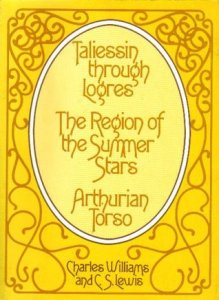
Taliessin Through Logres coverBut the distinction between Arthur’s roles as king and as husband also illustrates a different approach:  one can write the story in such a way that Arthur transcends romance.  This seems to have been Charles Williams’ view in his uncompleted essay The Figure of Arthur (published in 1974 in the combined volume Taliessin through Logres; The Region of the Summer Stars; Arthurian Torso).  In Williams’ view of the myth, Arthur “was not to love, in that kind, at all” (p. 230).  Arthur may be destined purely to serve as a model of the Good King, not to fall in love.

Yet the romancers continue to treat Arthur’s and Guinevere’s marriage as a love story.  The triangle is not so easily disposed of.

Saving a Romance

First Knight (movie) - Arthur, Guinevere, LancelotIf we do want a genuine romance, one way is to give Lancelot and Guinevere a happy ending, and essentially write off Arthur.  We see this in First Knight (1995).  Arthur, played by the redoubtable Sean Connery, seems genuinely fond of Guinevere (Julia Ormond).  But he’s much older than she is (Connery was 65 at the time, Ormond 30).  Lancelot (Richard Gere), much nearer her age, plays his usual role in rescuing Guinevere from various distresses.  When Arthur dies, he commends Guinevere to Lancelot’s care.  At the conclusion, contrary to the usual storyline, those two seem free to pair off, giving the audience the qualified satisfaction of a fulfilled romance.  (Exactly what would have happened to the polity of Camelot in this alternate Arthurian history isn’t discussed.)

Another way is to dodge the issue entirely by simply leaving Lancelot out of the triangle.  King Arthur (2004) depicts Arthur and Guinevere as true lovers, what TV Tropes calls a “Battle Couple.”  After adventures, heroic last stands, and the arrival of The Cavalry, the movie ends with the wedding of Arthur and Guinevere.  Lancelot is in the band of knights, but he doesn’t yet have a crush on Guinevere, or vice versa; so we have the rare case where the Arthur-Guinevere relationship is preserved.  It’s a conventional happy ending, but it requires a considerable departure from the basic Arthurian story.

Arthur’s Alternative

A different way to resolve the triangle is to add a fourth party, who can take over the member of the triangle who’s left behind.  I’ve seen a couple of cases where the author gives Arthur an alternative love, letting Lancelot and Guinevere fall where they may.  Ideally, the alternative is really Arthur’s first love, predating the whole Guinevere-Lancelot thing.  Joan Wolf’s The Road to Avalon (1988) has Arthur growing up with a strong and admirable girl named Morgan—a complete rewrite of Morgan le Fay, who usually serves as a villain.  Arthur falls in love with this Morgan, and she with him.  Things look bright until, just after pledging their troth, they discover that Morgan is actually his half-aunt, too closely related for marriage.  Oops.

Arthur’s marriage to Guinevere is a political necessity; it’s not a betrayal, because he cannot marry Morgan.  In this version, Guinevere (Gwenhwyfar) is a not-especially-likable nonentity, who finds her love with Bedwyr (or Bedivere), a historically earlier version of Lancelot.  While the story cleaves close enough to the myth to prohibit a really happy ending, Arthur does at least find his true love, of sorts, with Morgan.

Mary Jo Putney takes a more romantic tack with her short story Avalon (1998).  This time “Morgana” is identified with the Lady of the Lake, the mysterious personage frequently depicted as giving Arthur Excalibur.  She dwells in Avalon, a faerie realm set apart from the mundane world.  In this story, Arthur sleeps with Morgana at the beginning, long before his political marriage to Guinevere, and returns to her at the end, at his “death.”  But he can be healed in Avalon, as some of the older tales suggest, and thus survives to a genuine “happy ever after” with Morgana.

The Fionavar Tapestry

I’ve saved for last this powerful and daunting trilogy (1984-86) by Guy Gavriel Kay, who helped Christopher Tolkien prepare The Silmarillion for publication.  Kay’s approach is unique:  he takes up the tragedy head-on, but offers a strange kind of hope at the end.

Fionavar Trilogy covers (Tor)

Five college students from our world are transported to another universe, Fionavar, which is said to be the first or most fundamental of all worlds—a little like Roger Zelazny’s Amber.  To win the battle against evil in Fionavar, they must summon “The Warrior.  Who always dies, and is not allowed to rest” (Summer Tree, p. 123).  He fights in many worlds, because of “a great wrong done at the very beginning of his days,” but can only be called at darkest need, by magic, by his secret name.  This Warrior is Arthur, and his secret name (rather unexpectedly) is “Childslayer”—based on an episode from Malory (Chapter I.XXVII) that is usually omitted from an Arthurian tale, in which the young Arthur, panicked at discovering that Mordred has been born, orders a whole set of newborns sent off in a ship to their deaths, rather like Herod.

It’s revealed in the second volume, The Wandering Fire, that one of the five students, Jennifer Lowell, is actually a reincarnation of Guinevere.  Moreover, it becomes necessary to summon Lancelot, as well, awakened from an enchanted sleep.  These three have met and fought the Dark heroically in many worlds, but always suffering in their doomed triangular relationship, as a punishment for their several sins (Arthur here is guilty of an even worse crime than his betrayal by the other two).  All three love each other; “making all the angles equal, shaped most perfectly for grief” (Wandering Fire, p. 122).  Indeed, theirs is the “[s]addest story of all the long tales told” (Wandering Fire, p. 187).

Kay doesn’t blink the tragedy.  It would be an understatement to say that there’s enormous suffering and sorrow in this story.  But there is astonishing moral and physical courage and heroism as well—as in The Lord of the Rings and The Silmarillion.  And Kay stresses (in his idiosyncratic way) the factor of free will in the “weaving” of the universe.  Even the fate of Arthur and his companions is not forever foredoomed.

Once the threat to Fionavar has been vanquished, a new way opens.  All three of them can leave the worlds forever, together, and fight no more.  In the most Tolkien-like moment of the story, the three sail off into eternity, rising along what Tolkien called the Straight Road into the West (The Darkest Road, p. 332).

The scene is so moving that one hardly notices Kay has not actually resolved the romantic triangle at all.  Arthur, Guinevere, and Lancelot are surely worthy of Paradise—but we have no clue as to who ends up with whom.  Is the only way to resolve this triangle to transcend it to some conclusion beyond mortal comprehension?

Lancelot’s Alternative?

I want to mention one possibility that I haven’t seen tried in a modern story (although, in the innumerable variations on the Arthuriad, it’s quite possible that there’s an instance out there).  Instead of coming up with an alternative for Arthur, one might try presenting an alternative for Lancelot, allowing Arthur and Guinevere to come back together as true lovers—perhaps sadder and wiser after what, in such a plot, would be a temporary breach of faith among the three of them.

The concept can in fact be found in a very old source:  Williams mentions a French lay called Lanval (ca. 1170-1215), in which a Lancelot-equivalent, desired by the queen, ends up himself riding off to Avalon with a fairy mistress.  But this is a quite different version of the Arthurian story.  Is there an opening for a Lancelot-mate in the more canonical range of variations?

Lancelot and ElaineThere’s Elaine.  In Malory, Elaine falls in love with Lancelot and tricks him into sleeping with her thinking she’s Guinevere.  Their son is Galahad, and in Malory they actually live together for some time as man and wife.  Could something be made of this?

White’s Once and Future King treats Elaine as a weak and helpless character, hardly worthy of Lancelot.  But she could easily be amped up to modern standards as a stronger individual.  If Guinevere can be a Celtic warrior maid or a Canadian college student, Elaine could certainly be revised to an inventive author’s taste.  Her relationship with Lancelot need not be the failed, one-sided romance depicted by White; she could become Lancelot’s real love.

Actually, there’s an interesting hint in The Fionavar Tapestry.  A seemingly pointless side story concerns a kind of Luthien-figure, the supernally beautiful elf Leyse of the Swan Mark.  She meets Lancelot briefly in the woods and falls in love with him—but of course he’s otherwise occupied.  Leyse then herself sails off into the West (The Darkest Road, p. 233).  It occurred to me that the name “Leyse” faintly resembles “Elaine”; and in preparing this post, I noticed her description on Wikipedia specifically refers to Elaine—although not necessarily the same Elaine (there are several characters by that name in the Arthuriad).  If she too ends up in the West, the Isles of the Blest, or whatever unearthly paradise Kay’s world accommodates—is it conceivable that she provides a quadrilateral solution to the Eternal Triangle?

There always seem to be more possibilities to be explored—which is what makes this myth so fruitful.

An Incredible Sequel

The Incredibles 2 movie posterSome quick, spoiler-free comments on The Incredibles 2, which I had a chance to see this weekend.

The First Incredibles

The original Pixar film The Incredibles (2004) is a great favorite of mine.  My fondness for superhero stories goes way back, and The Incredibles does an irresistible job of both exemplifying and spoofing the genre.  Moreover, it’s a character-driven story, little as one might expect that from a superhero flick.  It’s got a gallery of memorable characters—not just the family, but distinctive supporting cast members like Frozone and Edna.  And they change over the course of the tale in ways that are plausible, illuminating, and heartwarming.

The Incredibles is genre-savvy enough to be both worldly-wise and innocent.  It starts with a premise that borders on the cynical:  these costumed brawlers cause so much damage that a public outcry forces them to go underground and live normal lives, in a sort of witness protection program.  There’s a note of realism there that contrasts with the usual comic-book conventions.  We see it again when the business of creating the colorful costumes itself turns out to require expertise worthy of James Bond’s Q—giving us Edna Mode as an independent contractor (and style maven).

This issue of collateral damage seems to have preoccupied superhero movies a lot in recent years.  It’s a primary plot driver in both Captain America:  Civil War (2016) and Batman v. Superman (2016).  But The Incredibles was there first, twelve years earlier.  What that says about contemporary attitudes is something at which we may want to take a closer look, another time.

The New Incredibles

Incredibles 2, family in force fieldThe first question that arose when a sequel was announced was, where do they go from here?  Of course, superheroes are almost by definition open to continuing adventures.  And The Incredibles ended with an obvious starting point for another story:  the appearance of a new villain, the Underminer.  But at the end of the first movie, the character arcs, the development of the main characters, had all been neatly completed.  Could the director and screenwriters come up with something equally good from that starting point?

The answer was always:  if anyone could pull that off, it’d be Pixar.

I enjoyed The Incredibles 2 immensely.  I’ll have to let it settle for a while to evaluate how it stands with respect to its classic predecessor.  But the movie is a lot of fun, and it manages to carry forward a story that’s consistent with the first movie, yet departs from it enough to avoid simply repeating the original.  As we’ve seen, this a tricky business.

Despite the fourteen-year gap in realtime between the first and the second movie, the latter picks up exactly where the former leaves off, with the appearance of the Underminer.  This tunnel-drilling villain is an obvious shout-out to Marvel’s Mole Man, who was introduced in the very first issue of The Fantastic Four.

Since the Incredibles have always been a kind of retake of the F.F., the Mole Man connection has a pleasing nostalgia aspect for the long-time comic-book fan.  There’s a similar homage to the F.F. in Kurt Busiek’s Astro City comics—a superhero group called the “First Family.”  (Their last name is actually “Furst,” making them another instance of the proverb that the last shall be Furst, and the Furst shall be last.)  Busiek, incidentally, may have been the first graphic novelist to highlight the collateral damage question; the matter of “everyday life in a superhero universe” is treated not only in Astro City (which started in 1995), but also in his revisiting of the Marvel universe, the limited series Marvels (1994).

Time and Tide

The time lapse (realtime) between Incredibles 1 and 2 is less disruptive than one might imagine, because both movies are set in an alternate past, not in our present.  One article concludes that the main action of The Incredibles takes place in 1962, based on a newspaper date.  This fits with the fact that Brad Bird’s inspiration for the film came from the comic books of the 1960s.  The time period is visible in the charmingly retro designs of the homes and cars in the original movie, not to mention the big rocket used by the villain.

So we’re not disturbed by the fact that the characters in The Incredibles (1 or 2) don’t carry around cell phones or use personal computers.  There are, of course, computers and other high-tech devices in both movies.  But this is consistent with the standard comic-book depiction of advanced technology in the hands of certain individuals or groups, as opposed to the society as a whole.  (This convention also applied in other adventure stories, like the Saturday morning cartoon Jonny Quest, one of my childhood favorites, which makes a brief appearance onscreen in The Incredibles 2.)  We might see high-powered computers and such in the Batcave, or a villain’s lair—or even in some hidden country, like Marvel’s Wakanda (which first appeared in 1966).  But these were always “islands” of high technology, having no effect on the technological level of the overall culture.

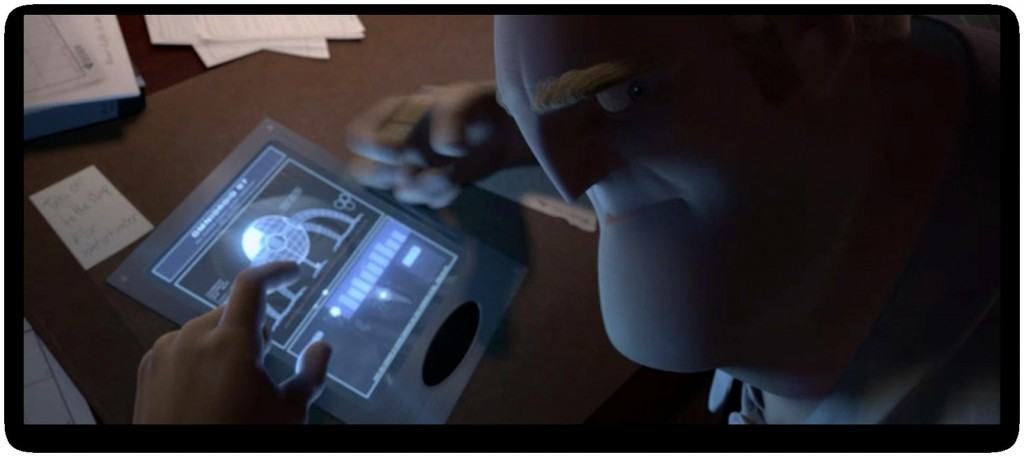
Mr Incredible with Mirage's tablet messageThere is a subtle difference between the 1960s depictions of advanced technology and what we see in the Incredibles movies, which may throw us off a bit.  A 1960s-era imaginary supercomputer looked like an extrapolated version of 1960s-era mainframe computers.  One thinks of old James Bond movies showing computers ornamented with slowly rotating tape drives, which now look ludicrously anachronistic.  But this nostalgic re-creation of 1960s-era high-tech has the advantage of knowing how the future actually turned out.  Thus, in an early scene from the first movie, Mr. Incredible is tracking a car chase in his Incredimobile—and the electronic tracker looks not unlike a GPS, albeit one with primitive graphics.  When Mirage sends a “This message will self-destruct” recording to Bob, it’s on a tablet strangely reminiscent of a modern iPad.  In effect, the movie designers are reimagining the imagined future of the 1960s, by reference to the actual future (our present).  The mind boggles a bit.

All in all, The Incredibles 2 does a very good job of resuming the story fourteen years later with a minimum of retcon.  Compare Back to the Future II, which required a distinct revision of the closing scene from the first movie, only four years after episode 1 was released.

Managing the Handoff

There were a couple of things I didn’t quite expect in the transition from the end of episode 1 to the beginning of episode 2.  But they weren’t really retcons—more like things I’d assumed at the end of The Incredibles that turned out not to be quite so simple.  These aren’t really spoilers, since they become apparent almost at once in the new movie.

Incredibles 2, family chargingThe Parr family and Frozone are publicly acclaimed for defeating Syndrome in episode 1, but that doesn’t mean they’re out of the woods yet.  The anti-supers law still hasn’t been reversed.  When the story was wrapped up in a single movie, we would reasonably assume that such things would automatically be resolved after the movie ended, just as we assume that the main characters’ romance will proceed swimmingly when a movie fades out on a kiss.  But there’s still work to be done on society’s acceptance of supers in The Incredibles 2.

Then there’s baby Jack.  We saw Jack exhibit a variety of assorted superpowers in the first movie and the associated short subject (“Jack-Jack Attack”).  But his family didn’t quite see that; they don’t yet know he has superpowers.  Of course, as the trailers make clear, they find out pretty soon . . .

Conclusion

I heartily recommend the sequel; most fans of The Incredibles should enjoy this follow-up.

And one bit of practical advice for the moviegoer:  the closing credit graphics are entertaining, but there’s no need to wait around for the very end.  Our 1960s-ish superhero family has not yet adopted the modern practice of putting a “stinger” scene at the conclusion of the credits.

The Boot Camp Planet

Training Worlds

Science fiction postulates lots of types of planets—although, for the convenience of humanoid characters, most of the ones shown end up being pretty Earthlike.  (It sometimes seemed that original-series Star Trek planets could be divided into “piles of rocks” and “places exactly like Earth.”  Much easier on the special-effects budget.)  Here I’d like to look at one particular variety—the worlds that serve as training locales for tough guys.

If you want to develop an inhumanly formidable army, you can do it by administering a “super soldier serum,” as in the Marvel comics.  You can do it by postulating a lifetime of intense training, as with Batman.  Or you can do it by throwing your candidates into an environment so fierce that those who survive have to become impossibly “badass” just to live through it.

Dune

Dune, coverWhat TV Tropes calls the “Death World” plays a key role in the plot of Frank Herbert’s Dune (1965).  One of the things that allows the galactic Emperor in Dune to stay on top in the civilization’s complex politics is his legion of crack troops.  The “Sardaukar” are so formidable that even the highly-trained private armies of the feudal Houses are reluctant to face them.

It turns out that the Sardaukar are recruited from the Emperor’s prison planet, Salusa Secundus—a planet so hostile that only the strongest can live.  “A man who survives Salusa Secundus starts out being tougher than most others.  When you add the very best of military training—”  (Thufir Hawat, p. 370).

But Arrakis, the planet called Dune, is harsher still.  The “Fremen,” the Dune population, appear to be simple barbarian nomads.  But the exigencies of survival in the Dune environment are so demanding that, as one character realizes, the Fremen are actually “an entire culture trained to military order” (283)—an invaluable resource for the main character, Paul Atreides, who needs such a cadre to recapture the holdings and status that the Emperor and Paul’s Harkonnen enemies have illegally taken away.  The Fremen are so tough that even their civilians, “women and children and old men,” can beat full-fledged Sardaukar (454).

It’s suggested at one point that the Fremen come from the same stock as the original inhabitants of Salusa Secundus—transported there at a time when they had “grown soft with an easy planet” elsewhere (352).  That stock may have been hardy to begin with, but it’s clear that the harsh environment is what made the difference.  Part of Paul’s eventual plan to take over the Imperium himself is to neutralize the Emperor’s forces by making Salusa Secundus “a garden world, full of gentle things” (481)—a much pleasanter place for the former Emperor to retire in peace, but no longer a source of formidable warriors.

Arrakis, like Salusa Secundus, tests its people rigorously, winnowing out the weak, toughening up the strong.

Prison Planets and More

We wouldn’t choose to live in so taxing an environment—which is why the population is generally conceived as being there not entirely by their own choice.

Jerry Pournelle’s “CoDominium” future history postulates a future in which a number of worlds are settled by political prisoners and other riffraff who are sent there by the combined U.S.-Russian world government.  Some of the toughest fighters come from Tanith, a demanding jungle planet that is, as Wikipedia puts it, an “infamous dumping ground for transportees.”

Tom Godwin, The Survivors, coverAs a kid, I was fascinated by a Tom Godwin SF novel called The Survivors (1958; also known by the cheesier title Space Prison; reprinted in the 2003 collection The Cold Equations & Other Stories).  A Terran colony ship is waylaid by the Nazi-like Gerns; the useful emigrants are taken as slaves, while the remainder (“Rejects”) are marooned on what the Gerns mockingly describe as an “Earth-type” planet—Ragnarok, with extreme climates, 1.5 times Earth’s gravity, and fantastically dangerous wildlife.  Driven by the goal of avenging themselves and their people, the abandoned colony of “rejects” survives across the generations despite its hardships.  When they finally encounter their nemeses again, the colonists’ descendants have become so formidable that they succeed in overrunning and capturing a Gern battleship.

In a smaller way, the colony planet of Grayson in David Weber’s Honor Harrington series reflects a similar situation.  Grayson started out as a group of settlers seeking a far-off home for religious reasons.  But their ideal planet turned out to have so high a concentration of heavy metals in the environment that indigenous life was poisonous and it was impossible even to live in the open air.  The realities of interstellar travel in that period made it impractical for the settlers to simply abandon the colony; in effect they were stranded by their own incautious choice.  While the Grayson people start out in the second Honor book as a cliché of religious intolerance, Weber’s perspective gradually shifts until they are regarded as tough, honest allies.

James H. Schmitz’s Federation of the Hub future history hints at the notion of an entire approach to human civilization based on a similar principle—especially in the 1968 novel The Demon Breed.  But that’s a more involved topic for another day.

Herbert’s and Pournelle’s notion of “transportation” to inhospitable climes as a punishment, archaic as it may seem, harks back to actual British practices in the 17th through 19th centuries.  The British colony of Australia, the destination of many a transportee, still retains (at least in American mythology) the air of a land where hardship breeds self-reliance & sturdy independence (“Where women glow and men plunder”), as both expressed and satirized in Crocodile Dundee.  TV Tropes’ Death World page actually has a separate section for “Real Life:  Australia.”

Real-Life Analogues

In the real world, we intentionally create harsh environments to toughen up specific groups.

Military “boot camp” is the most obvious example.  I’ve never gone through armed forces training myself, so I can’t speak from personal experience.  But it seems clear that basic training is made intentionally demanding so that the recruit becomes accustomed to hardship and hostility, able to function despite adverse conditions.  We may not have a separate planet to host those conditions, but we can create a closed, artificial environment for the purpose.

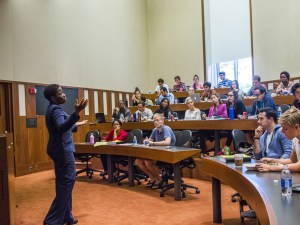
Harvard Law School classroomLaw school provides a much less intense case.  The first-year “acclimatization” to law school involves legendary stresses and challenges.  Of course first-year law students are far better off than military recruits, and even the famous pressures of old-time curricula (as described in the 1971 novel and 1973 film The Paper Chase, or Scott Turow’s 1977 One L) had probably diminished by the mid-1980s, when I attended.  But classroom interrogation by the “Socratic method” certainly seems to be designed, in some respects, to intimidate and unsettle the student.

There’s a reason for this.  Most lawyers will find themselves in practices where they face strenuous and unfriendly opposition, whether in court or at the negotiating table.  If you’re not used to that kind of situation, you’ll have a hard time holding your own.  A lawyer has to learn to perform in the give and take of argument, without losing his cool.  The classroom experience is simply the first step in learning how to do this:  beginning to build up the calluses, so to speak, so we don’t crumple at the first sign of opposition.

I have a notion (again, without personal experience) that a doctor’s residency period may serve a somewhat similar purpose.  Doctors in this stage of practice work traditionally long and stressful hours.  It’s possible that this experience is itself a form of training for the emergency situations in which a physician may find herself, taking life-or-death steps under pressure.

Conclusion

In a much broader theological context, it’s sometimes been suggested—in what might be called a “forge of souls” theodicy—that evil in the world has the function of building character in a way that could not be otherwise achieved.  In some sense, the universe as a whole may be a training camp of sorts.

While the “boot camp world” idea isn’t likely to deal with the problem of evil all by itself, it does provide science fiction writers with a way to push human beings to their maximum potential—creating the larger-than-life characters and institutions that make our fantastic stories so striking, even more than gee-whiz technology and exotic settings.