Future History and Happy Endings

Stories and Endings

We talked last time about SF writers’ fictional histories of the future.  There’s another feature of such backgrounds that must be taken into account.  One of the downsides about a future history is that it blunts the effect of a happy ending.

Those of us who enjoy traditionally constructed stories like to see a happy ending.  It won’t be unreservedly happy, of course.  A story is better if, as TV Tropes puts it, the main characters earn their happy ending—which means they will have gone through a lot of trials and tribulations first.  And there are likely to be losses along the way:  people who die, possibilities that are lost.  But it’s more satisfying if some good is achieved, or at least preserved, in the course of a story.

Even those who scorn the happy ending as naïve generally aim for some sort of closure or conclusion.  It’s pretty generally unsatisfying to read a tale in which nothing at all is accomplished or resolved, even in part.  Such stories exist, but I suspect they appeal mainly to readers so convinced of the meaningless of life that they perceive a pointless story as an affirmation.  For purposes of this discussion, I’m going to assume that one of the elements we look for in a good story is at least some degree of favorable outcome.

Of course, defining the ending of a story is always somewhat arbitrary.  We decide to stop narrating at a certain point, even though life goes on.  (Even in James Blish’s The Triumph of Time, which concludes with the destruction of the universe, new universes are going to be spawned from the death of this one.)

Lakeshore, sunset, coupleThis is particularly true of love stories.  Alasdair MacIntyre once remarked that in Jane Austen’s novels, marriage occupies the place that death occupies in real life.  It brings events to a conclusion.  So it is with many or most love stories, which focus on the formation of a relationship and how it reaches some watershed moment—frequently the commitment of marriage.  Stories about how a healthy marriage proceeds, though exceedingly interesting and valuable, are much more rare—and much harder to write.

And this reflection begins to illuminate our problem.  If we go on telling the story after the high point of the marriage, we run the risk that subsequent events won’t live up to that peak of expectation.  For example, I’ve seen several sequels to Pride and Prejudice that pick up after Elizabeth and Darcy’s marriage; but they don’t tend to be nearly as interesting as the original.

This is true not only of love stories, but of all stories.  At the end of Star Wars IV:  A New Hope, victory is declared, the Empire’s plot is foiled, we exit on cheers and applause.  But at the beginning of the next episode, the rebels are on the run—again—and by the following installment, even the Death Star is being rebuilt.

Early Mr. IncredibleThis sort of thing can rather take the bloom off the original victory.  Aaron Leitko’s December 2015 article on Star Wars VII makes this point about “franchises” that don’t end:  “the galaxy can never truly be saved. It is always in peril. With each victory, a new and greater threat amasses over the horizon. Our childhood heroes are destined to struggle onward until they get old, run out of luck, or are conveniently written out of the script following an unsuccessful contract renegotiation.”  One is reminded of Mr. Incredible’s fretful remark at the opening of The Incredibles:  “Sometimes I just want [the world] to stay saved.”  Don’t we all?

Endings and History

A future history, in effect, equips every story in the sequence (except for the last one) with long-range sequels. This means the problem of stabilizing the happy ending applies not only to the individual characters, but to the story’s large-scale outcome as well, like the struggle against the Empire in Star Wars.

Empire (Piper) coverI mentioned last time that H. Beam Piper’s cyclical future history would ultimately have been thrown out of whack by the happy-ending-inducing Fuzzies.  In its original conception, a certain sort of gloom spread over Piper’s future history.  As John F. Carr observes in his introduction to the Piper collection Empire (Ace paperback, 1981), each book seems to offer the prospect of a brighter future, but the books that follow never show that result.  Rather, the promise of each earlier ending is vitiated by later developments.  “At the end of each of these stories it appears as though the self-reliant man has won; however in future stories we learn that while the battle may have been won, the war was lost.”  (p. 9)

Not every imagined history has to embrace a deterministic or cyclical theory like Piper’s.  But any realistic history has to recognize that things don’t always get continuously better in this life.  There are setbacks, reversals, and recrudescences of attitudes and problems we thought we’d disposed of.  We can legitimately hope that our favorite characters’ victories will make things better at least for a while—but the betterment will not last forever.
Song of Roland coverThis isn’t a modern discovery.  The eleventh-century Song of Roland, one of the legends that surround the mythical court of Charlemagne (France’s answer to the Arthurian Matter of Britain), ends with a victory, avenging the heroic death of Roland, Charlemagne’s nephew.  But even this somber triumph is not final.  In the very last stanza, Charlemagne is told that he must rally his forces yet again to face a new challenge.  “Small heart had [Charlemagne] to journey and to fight; / ‘God!’ says the King, ‘how weary is my life!’”

Happiness in the Moment

We need to be willing to accept a happy ending that is not unqualified.  Something can be good without being forever.  Subsequent failures do not invalidate genuine achievements.

To enjoy a future history, we have to recognize that the uncertainties of the future do not extinguish the glory of success.  Our newly-wedded lovers, for example, will have their ups and downs, but that doesn’t keep their lives from being happy on the whole.

The same is true of civilizations—the large-scale achievements whose fate is frequently at stake in adventure stories.  The establishment of a better world can make a lot of people’s lives better for a long time, even if that achievement is eventually superseded by later events.

A Midsummer Tempest coverValeria Victrix Matuchek, from Poul Anderson’s A Midsummer Tempest (epilogue), put it this way:  “Nothing ever was forever, anyway.  Peace never came natural.  The point is, it can sometimes be won for some years, and they can be lived in.”
Fuzzy Future History

Histories of the Future

A science fiction writer can link diverse stories by setting them in a common “history of the future”—an imagined future that might run anywhere from a dozen years to geological eras.  A new tale may not be a direct sequel or prequel, but it can appeal to us in somewhat the same way when it shares a background with a story we’ve enjoyed already.

Using a common future history has great advantages for the writer, as well.  It’s easier to continue developing an established background than to invent something entirely new.   But this approach also has pitfalls.  We may find that later stories evolve to conflict with the background we’ve already set up.  We saw off the branch we were sitting on.

SF author H. Beam Piper‘s “Fuzzy” series gives us a particularly interesting example of the perils of success.

Little Fuzzy

Piper’s intense interest in history led him to outline a vast scheme of human progress and space exploration, now referred to as his “Terro-Human Future History,” in that it deals mostly with human beings of Terran descent.

Piper believed in a cyclical theory of history, in which similar patterns of events recur in different ways.  His Terro-Human Future History is thus full of analogues to actual events:  the Sepoy Mutiny (Uller Uprising), the barbarian invasions of the European Middle Ages (Space Viking).  Piper’s historical scheme covered 6,000 years’ worth of rises and falls, empires and interregnums.

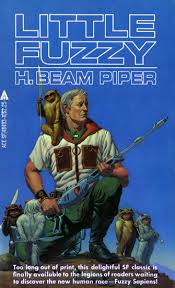
Little Fuzzy book coverLate in his career, Piper won a permanent place in the hearts of SF readers with the novel Little Fuzzy (1962).  Crusty old prospector Jack Holloway on the colony planet Zarathustra discovers a species of small, golden-furred beings, the first of whom he dubs “Little Fuzzy.”  The Fuzzies are primitive hunter-gatherers, perfectly capable of tracking down and killing their food.  But they are also smart, fun-loving, lovable, and an endangered species.

The Chartered Zarathustra Corporation, which runs most of the planet (an analogue of the historical East India Company), takes an intense interest in these little creatures—because its charter depends on the assumption that Zarathustra was an uninhabited world.  When a CZC employee kills one of the Fuzzies, and a company gunman is in turn killed by Jack, it becomes crucial in the subsequent murder trials to decide whether the Fuzzies are truly intelligent persons, or just animals.  The resolution of that issue forms the climax of the story.

Equal parts adventure story, courtroom drama, speculation on the nature of intelligence, and heartwarmer, Little Fuzzy was a hit with readers.  (And it seems likely, I’ve always figured, that the Fuzzies are one of the literary ancestors of the Ewoks.)

Fuzzies Everywhere

Golden Dream book coverThe subsequent literary history of the Fuzzies is exceedingly complex.  Piper published a sequel, Fuzzy Sapiens (or The Other Human Race), two years later.  A third Fuzzy novel had been sent to a publisher when, in November 1964, Piper committed suicide.  The manuscript of the third book was lost.  But reader interest in the Fuzzies led publishers to commission a new Fuzzy sequel by William Tuning, issued in 1981 as Fuzzy Bones.  An overlapping prequel taking off from Tuning’s development of the story, Golden Dream, was written by Ardath Mayhar and appeared the following year.

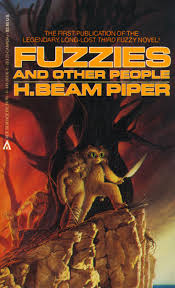
Ironically, no sooner had these continuations come out than the lost manuscript of the third Piper book was found after all.  Piper’s Fuzzies and Other People (“F&OP”) appeared in 1984.  Unsurprisingly, Piper’s continuation was not consistent with Tuning’s and Mayhar’s, leaving us with two inconsistent, but equally interesting, versions of the Fuzzy mythology.

It’s even worse than that.  At least two different reboots or reimaginings of the Fuzzy mythology have been subsequently published.  A detailed explanation of the whole mess can be found in a 2007 article by Fred Patten, with further information in a Goodreads review of Fuzzy Bones.

Irresistible Cuteness

The great charm of the Fuzzy stories lies in their mixture of tough-mindedness and tender-heartedness.  “Pappy Jack” and a whole series of other tough, no-nonsense characters develop unexpected softer sides as they succumb to the irresistible cuteness of the Fuzzies.  In Tuning’s words, “Like many men who were extremely tough, he turned to goo at the sight of those wide, appealing eyes.”

But the Fuzzies aren’t just cute.  Arguably, they are better people than humans.  Fuzzies share without hesitation.  They help each other.  They tell the truth (though this particular trait gets complicated in F&OP).  They’re not competitive, but they do aspire to excellence.  This inherent virtue has its tough side too:  Fuzzies applaud the deserved punishment of evildoers.

More important, for purposes of their long-term effect on human affairs, they aren’t simply an enclave of niceness:  they influence people.  Almost every human who comes in contact with them becomes a better person as a result.  Villains in one story are converted to good guys in the next, once they acquire Fuzzy companions.

Fuzzies and Other People book coverOne character observes in chapter 12 of F&OP:  “we’re hooked.  Hooked on Fuzzies.”  The Fuzzies are making a permanent difference in the quality of human behavior on Zarathustra—not by force, not by persuasion, but simply by being lovable.  It’s not at all the kind of development one would expect from a hardheaded rationalist of Piper’s type.

It’s not what one would have expected of his future history, either.  And that’s the twist I want to point out here.

Can Piper’s Future History Survive the Fuzzies?

When the Fuzzies entered Piper’s future history, it was already well under way.  Four novels and a number of short stories were already in print, and Piper had plans for more.  Many of these stories were set later in time than the events of Little Fuzzy.  And the events of this hypothetical future, as noted above, were built on Piper’s view of cyclical history.  A fundamental change in human behavior would have thrown the whole sequence into disarray.

But the advent of the Fuzzies represented just such a change.  At the end of F&OP, there are plans to take Fuzzies off Zarathustra.  “[E]verybody on Terra will be crazy about them.”  Indeed.  One visualizes Fuzzies spreading throughout the Terran Federation, disseminating goodness and improving human beings wherever they go.

A good thing for those fortunate humans?  Undoubtedly.  But Piper hadn’t set out to write a Utopia.  His later stories depended on the assumption that humans would continue to be the same difficult, ornery creatures they always have been. The innocent-seeming Fuzzies had endangered the whole basis of the Terro-Human Future History.

Piper’s suicide has always been attributed to a certain moodiness combined with financial and personal difficulties.  But I’ve sometimes wondered whether the Fuzzy conundrum might have had something to do with it.  Piper had built a carefully planned future history.  But the more he worked out the implications of the Fuzzy stories, the harder it must have seemed to keep their influence contained in such a way as not to disrupt that careful plan.  With all those stories in print, there was no easy way to resolve the internal contradictions.

We’ll never know about Piper’s personal views.  But we can take the peculiar saga of the Fuzzies as a reminder of how tricky it can be when different types of stories—even good and well-beloved stories—inhabit the same imagined history.

The Last Jedi . . . Maybe

Boldly Going Where the Story Hasn’t Gone Yet

Debating what may happen in future Star Wars movies has been a favorite spectator sport since 1980, when we all saw The Empire Strikes Back and spent the next three years madly surmising  what would happen in the third episode.  Was Vader really Luke’s father?  (It’s hard to believe in this era, when “I am your father” is a classic meme, but in 1980 it was a viable theory that he was lying.)  Who was the “other” of Yoda’s enigmatic remark, “There is another”?

That last question illustrates the danger of too much speculation.  By the time Return of the Jedi came out, we’d debated every possibility, from a complete unknown to Han Solo—including the winning choice, Princess Leia (requiescat in pace).  The revelation in Episode VI couldn’t help but be an anticlimax.  So I’ve been trying not to spend too much time spinning my wheels over the unanswered questions in The Force Awakens.  We’ll find out soon enough.

The title of Episode VIII, though, does bring up an interesting point.

Last Now, or Last Forever?

Star Wars - The Last Jedi title screenDisney announced the title The Last Jedi for Episode VIII on January 23, 2017.  The fan community immediately went to work to ferret out the implications. It was pointed out, for example, that “Jedi” can be either singular or plural.  There might be one last Jedi, or two last Jedi, or an entire academy-full of last Jedi.  Still, some sort of finality seems to be indicated.

Comments around the Web as of February 12, 2017, suggest there are at least two major possibilities:

Luke and Rey(1)  The film is about the last Jedi who happens to be left alive at the moment.  That’s obviously Luke Skywalker, and Rey could reasonably say, on meeting him, that she’s found the last Jedi.  It doesn’t necessarily mean there won’t be any more to follow.  The Last Jedi might show Luke taking on Rey as an apprentice and making her a new Jedi.  If so, the story could well be captioned, from Rey’s point of view, How I Met the Last Jedi and Became the First Recruit in a New Jedi Order.  This would simply put us back in the realm of “That boy is our only hope / No, there is another.”

(2)  The more interesting, more drastic possibility is that Luke is the last Jedi there will ever be; that Episodes VIII-IX will involve some sort of epoch-making shakeup that will end the Jedi order permanently.  That might seem an anticlimax, after taking all that trouble to restore the order in Return of the Jedi.  But if it did, what would the future look like?

This possibility raises a question that has long intrigued me:  Is the Jedi order as we see it in the prequel series really a good thing?

How Not to Train Your Jedi

We had to wait for the prequels (Episodes I-III) to see how the Jedi order actually worked in its heyday.  What emerged was rather surprising.  The training program is of particular interest, because how you form the next generation of Jedi shapes what kinds of people they become and how they carry out their somewhat hazy galactic peace-keeping responsibilities.

(I should note that I’m referring only to the movies here and not the vast expanded universe of novels and spinoffs, much of which is no longer canon anyway.)

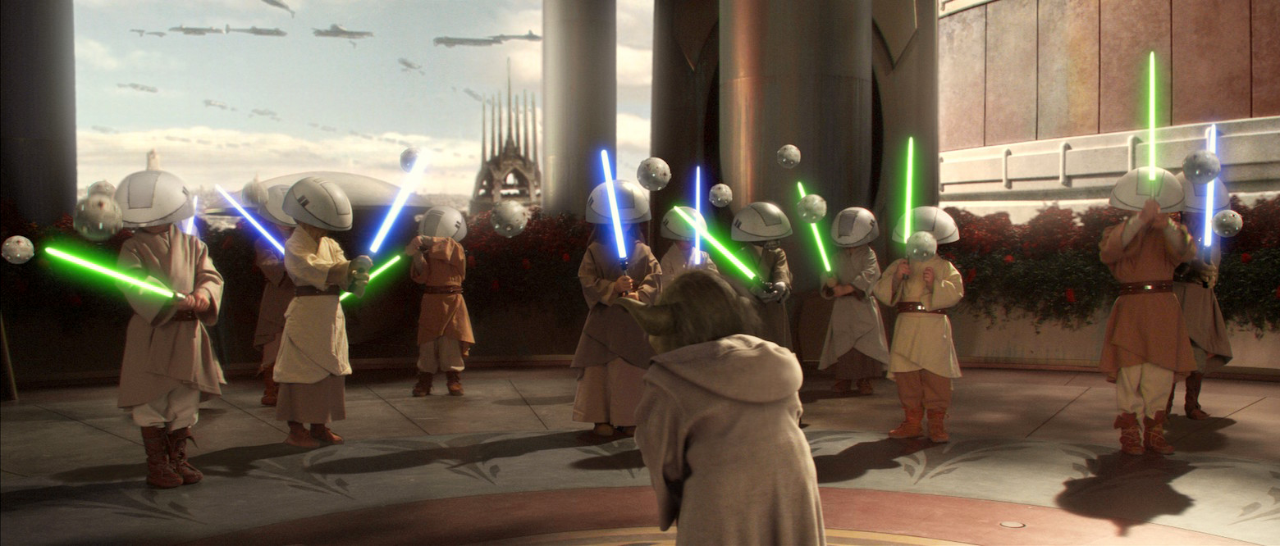
Jedi younglings at practiceWhen we meet young Anakin Skywalker at nine years of age in Episode I, he is already considered too old for the normal Jedi training program.  This is borne out by the scenes we see of five- or six-year-old “younglings” practicing their Jedi arts.  Evidently in the Republic, Force-gifted children were taken away from their families as young as five or six and brought to Coruscant for full-time training.  (No wonder Yoda also complained about Luke’s age in Episode V.)

If Anakin’s own experience is any guide, the younglings don’t return to their families, even, say, for summer vacations.  They are expected to grow up without normal family interactions, living a sort of monastic existence.  This approach might produce an intense concentration on one’s studies, and a sense of fierce fellowship among the Jedi members.  But it’s not clear that the resulting Jedi Knights would be especially well-adjusted for dealings with other, normal citizens.

We saw how badly this worked out for Anakin himself.  When Qui-Gon Jinn and Obi-Wan Kenobi redeem Anakin from slavery in Episode I, they can’t afford to buy out his mother Shmi as well.  But, appallingly, they never go back with more funds to do so; apparently they’re content to leave her enslaved while they concentrate on her Force-enabled son.  (This omission itself says something about the mind-set of the Republic and the Jedi in particular.)  When Anakin returns in Episode II just in time for his mother to die in his arms, this experience plays a key role in his eventual turn to the Dark Side, with the avowed aim of bringing “order to the galaxy” to prevent such tragedies.

No Valentines for Jedi

The exclusion of Jedi Knights from normal family and community life extends forward in their lives as well.  We find out in Episode II that Jedi are not permitted to marry.  (No one seems to have considered that this restriction is a fine way to breed Force-sensitivity right out of the participating species.)

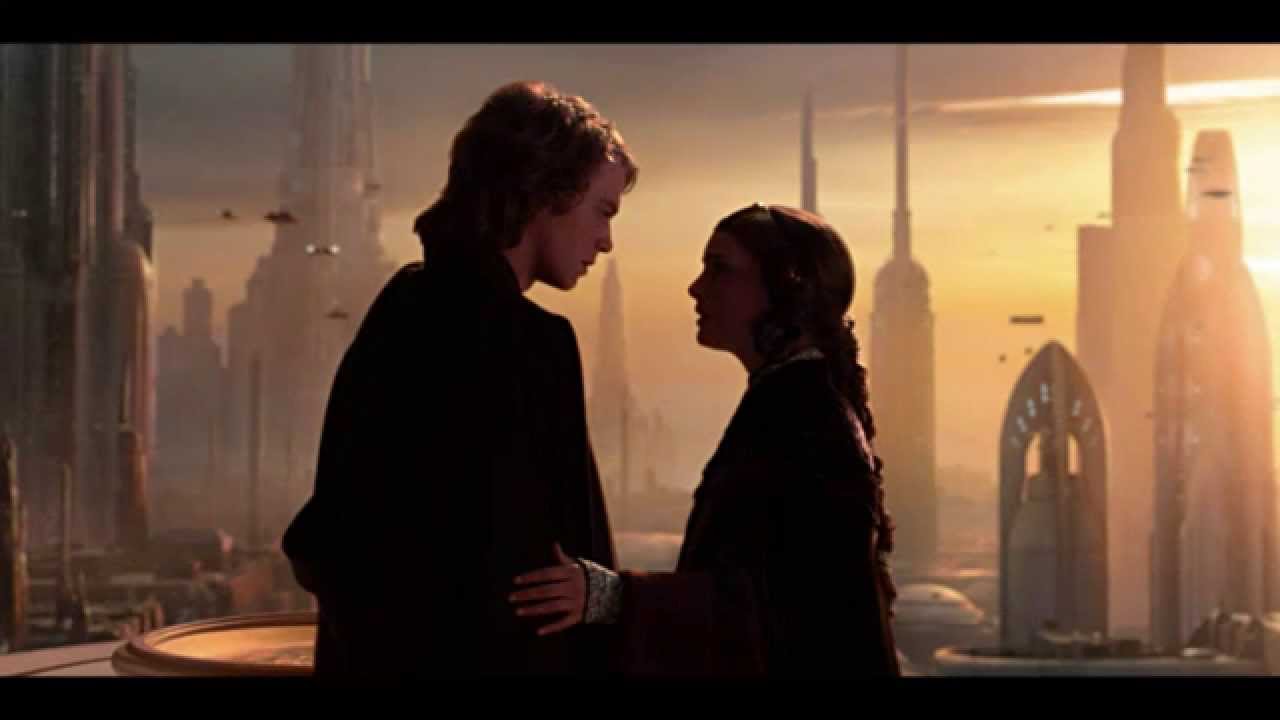
Anakin and Padme silhouetted against cityWhile this barrier may have been set up simply to create a story conflict, it also intensifies the separation of the Jedi from ordinary social interactions.  The trope of a celibate monastic order certainly has some narrative power.  But it may not be an ideal way to establish the primary enforcement and conflict-resolution arm of a galactic society.  In a curious way, the Jedi order resembles the army of familyless clones that the Jedi themselves initially create, and later combat.

A Failing Republic

With this issue in mind, the whole plot of Episodes I-III looks less like a simple tale of scheming intrigue by Senator Palpatine and more like a civilizational tragedy.  A polity falls most easily to a destabilizing force when it is already rotting from within.  Palpatine could not have succeeded so easily, one might argue, if the Republic and the Jedi had not already become decadent or dysfunctional.

In fact, the Jedi leaders in the prequels speak uneasily about some sort of failure or lessening of their communion with the Force, which is never really explained.  Is it possible that the Jedi ways of cultivating young pupils had become hidebound and ossified in a way that decreased their powers and made them vulnerable to a sneak attack or “phantom menace” from the Dark Side?

This is all speculation, of course.  I don’t know whether any such thing was in Lucas’s mind when Episodes I-VI were made, much less in the current screenwriters’ minds now.  But these considerations do suggest that it’s not enough just to restore or return the Republic’s Jedi order.  A renascence or renovation of the Light Side organization may be needed as well.

A Post-Jedi Order?

We now know that you don’t have to be a Sith Lord like Vader or Palpatine to serve the Dark Side.  We’ve also got Kylo’s Knights of Ren, and Snoke, whatever he is.  Maybe it’s also possible to serve the Light Side without being a Jedi Knight.

Based on the above thoughts about Jedi training, I’ve always rather hoped that Luke would rethink the historical Jedi practices (which he hardly knows, anyway) and develop a more humane, more balanced cadre.  We now know that he tried to train a new group between Episode VI and VII, but from the movies, at least, we don’t know how he went about it.  (I haven’t yet read any of the new-continuity novels.)

We do know that Luke’s new Jedi academy was a failure:  it produced Kylo Ren and collapsed after his turn to the Dark Side.  Perhaps now, after years of meditating on his mistakes, Luke may be ready to try something different.  It could be that the new knights of the light won’t be Jedi at all, but a new kind of Force for good.  To my mind, that would be a really interesting development.


These idiosyncratic guesses have a pretty low probability of panning out, to be sure.  The subtleties of training programs might not appeal to the Star Wars audience as a key plot device.  But they’re fun to think about.

The real entertainment value of SWAGs like these is to see how far off they were when the movie actually comes out.  We’ll see in December what “The Last Jedi” really means—and probably have a good laugh about this post.


Follow-up Notes

4/14/2017:  Here’s the latest trailer.
4/18/2017:  Zak Wojnar at ScreenRant has a good commentary today making some of the same points.

Don Quixote of Tomorrowland

2015’s “Tomorrowland” was not a great success with moviegoing audiences or critics.  But it hits on some themes that are vitally important.

We can’t discuss those themes without issuing some spoilers, so be warned.

Spoilers Follow

The World of Tomorrow

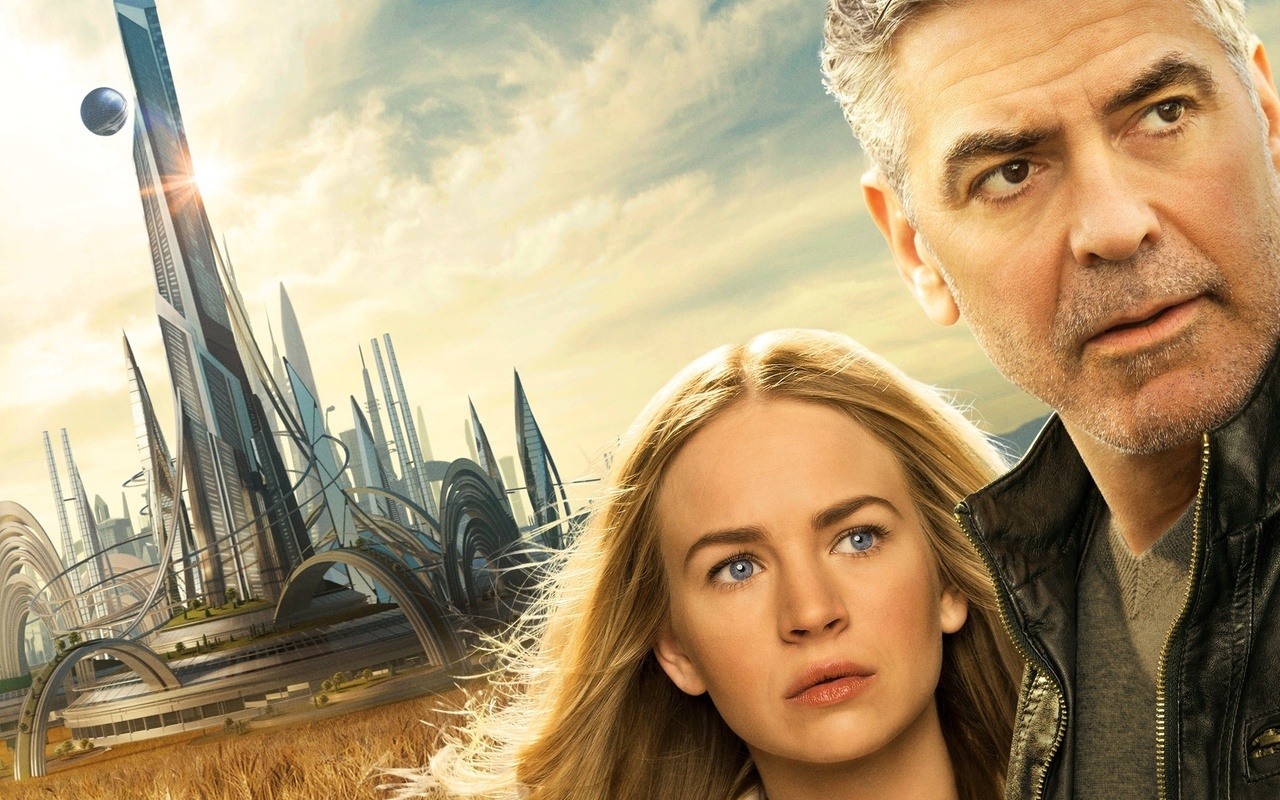
Tomorrowland - Casey and FrankThe story of “Tomorrowland,” co-written and directed by Brad Bird of Pixar fame, involves Frank Walker, a boy inventor whose earliest appearance is in 1964—played in the present day by a disillusioned George Clooney—and Casey Newton, a teenage girl with a particular genius for making things work.

Casey’s dad, a NASA engineer, will shortly lose his job as the agency decommissions a historic launch site.  Casey sneaks onto the site at night to sabotage the demolition efforts, which shows where her loyalties lie.

We see her in school with a series of morose teachers, each explaining how the world is going to hell in a handbasket:  nuclear armageddon, environmental disaster, literary dystopia.  Casey frantically waves her hand and is finally allowed to ask the question none of them are addressing:  “Can we fix it?” And the bell rings.

With this scene, the movie “had me at hello.”  For fifty years we’ve listened to doomsayers telling us how things will inevitably grow worse—from every part of the political map.  Solutions, however, are harder to come by.

Casey in the golden fieldIn the movie, the same situation turns out to be mirrored in the hidden Tomorrowland.  This haven was founded half a century ago with the goal of recruiting bright people to improve the world.  In the intervening years, it has focused instead on trying to make people face the approaching disasters.  Its futuristic technology beams subliminal messages into our world in an attempt to “raise consciousness” before it’s too late.  But like the schools, this secret cabal is no longer proposing ways to “fix it,” only foretelling doom.

Of course, alerting people to potential disasters is not a bad thing.  Motivating by fear is certainly one way to arouse people to action.  But what Tomorrowland, like the schoolteachers in the opening scenes, has forgotten is that dread, without hope for solutions, doesn’t lead to fruitful changes.  It leads to stagnant despair.

In the end, Casey and Frank halt the doomsaying broadcast, and begin again to recruit “dreamers.”  “Dreamers” here doesn’t mean believing things are just fine.  That would be blind optimism.  Rather, it means believing better things are possible.  If you’re a “fixer”—a builder, a maker—this leads to asking how things can be made better; which leads to plans for change, not just empty wishes.

In other words:  the conviction that catastrophe is inevitable is a self-fulfilling prophecy.  Expect the worst (admitting no other possibilities), and you’ll get it.

The World of La Mancha

A complementary idea forms the backbone of another favorite of mine—the play “Man of La Mancha,” a musical adaptation of the story of Don Quixote by Dale Wasserman, Joe Darion, and Mitch Leigh, written—oddly enough—in 1964.  (There’s a movie version, but this is one case where the stage play is definitely better.)

Man of La Mancha posterThe play slims down the sprawling novel and focuses it on a particular set of ideas—as does the operatic version of Les Misérables.  What makes this Quixote a worthy adjunct to Tomorrowland is the course of his eccentric romance with his lady “Dulcinea.”

The woman the deluded Don identifies as the virtuous Dulcinea is a barmaid and part-time prostitute named Aldonza.  She is at first baffled and then enraged by Quixote’s attempts to place her on a lofty pedestal, his refusal to see her as (she says) she really is.  (Audio / Movie video)

As soon as Aldonza begins to believe she can be better than that, she is brutally disillusioned.  Yet Quixote stands by his conviction that she’s really a noble lady, in the face of all contrary evidence.   At the end of the play (7:42 in the clip), she finally accepts that role:  “My name . . . is Dulcinea.”  She takes on the quest of becoming more than she is.

In other words:  expecting the best calls it forth.


This encouraging principle doesn’t always work out nicely, as the play makes devastatingly clear.  If we seek out the best in people, we’d better be prepared for a letdown sometimes.  But the principle does shape our thinking in the right direction—a productive direction, rather than a dead end.

The two matched stories remind us that some degree of faith in the future, for a person or for a society, is needed if we want to foster energetic action.  It’s therefore incumbent on us not to crush such fertile hopes.  We should never blind ourselves to the facts, but that doesn’t mean we should be satisfied with them.

Arthurian Variations (Part II)

We’ve seen that the Arthuriad has generated a wide variety of retellings over the years.  What makes these legends so adaptable, and so congenial to storytellers of all kinds?

To begin with . . .

A few reasons leap out at us.

As we’ve seen before, it helps if there’s no one canonical version of a story.  Without a single clear source, later authors are free from the need to conform to the “classic” tale.  The Wikipedia article says outright, “there is no one canonical version” (¶ 3).

It’s true that Malory’s Le Morte d’Arthur is the central reference point, at least in English.  But his version is so far from current norms that it would be hard to try and reproduce it faithfully—as Steinbeck perhaps found.  Malory serves more as a library or resource for story elements that can be adapted and recombined at will.

The sheer breadth of that source material is a second factor.  All those knights, all those adventures, even the numerous events of the main storyline:  the Arthuriad is its own ‘Pot of Story,’ a stew full of nutritious narrative elements.  “It held a treasure for every seeker.”  (The Mabinogion, tr. Gwyn Jones and Thomas Jones, Everyman’s Library, 1949, 1974, Introduction, p. xxx.)

The story also occupies a colorful historical setting, whether in the plate-mail-and-castles “high road” approach, or in the more historically plausible “low road” approach.  Many readers have a fondness for this quasi-medieval environment—which is why versions of that milieu are used in so many fantasy stories and games.

A Plethora of Characters

In particular, the Arthuriad is filled with strong and interesting characters.  An author can focus on, say, the character of Percival, or Morgan le Fay, or Gawain, and take off from there.  Or she can ring the changes on the main story by redefining the characters and their relationships, as we saw in the examples from Part I.

Arthur himself can be played in many ways.  Generally he tends to have a certain innocence, a certain earnestness and candor about him.  But this can be realized in the psychologically wounded but charismatic leader of Wolf’s tale, in the essential simplicity of the idealist in White’s Once and Future King, or in the clever but dedicated warleader of “King Arthur.”  (It can also be seen in the weak and waffling character of Lerner & Loewe’s “Camelot”—if we include what I consider a failed implementation.)

Other characters are equally mutable.  Mordred is subtle and evil in White; he’s an innocent and rather likable kid in Wolf.  Lancelot contains enough contradictions in himself—loyal friend, betrayer of a marriage, devoted lover, peerless warrior—that an intense character study of this champion is almost unavoidable if we let him into the story at all.

Guinevere is a particularly tricky case.  It’s hard to play her as truly admirable—since so much of her traditional role lies in being untrue, at least after a fashion.  (She’s untrue to Arthur, but true to Lancelot, and the story seems largely willing to forgive the first in light of the second.)  If she isn’t handled carefully, she’s likely to default into being silly, or weak, or fickle.  The challenge of giving her a better role may appeal to an author.  Both books and films have taken up that challenge, though I’m not familiar with those treatments.

Compelling Drama

The story of Arthur contains many events that lend themselves to high drama.  For example—

His origin.  It seems essential for Arthur’s ascent to the throne to exemplify the theme of the lowly raised high, the rise from humble beginnings to glory.  His childhood is modest, in one way or another.  In the traditional formulation, Arthur doesn’t know who he is until he is almost grown, and it may take a magic token (the sword in the stone) to demonstrate his true nature.  As a result, Arthur generally has the humility that I’ve argued characterizes our archetype of the Good King.

This Cinderella-type story appeals to our fondness for the underdog, and the reversal of fortunes is inherently dramatic.  There are a lot of possibilities for how that revelation occurs, and how Arthur and those around him react.

Lancelot, Guinevere, Arthur (King Arthur)The love stories.  An eternal triangle necessarily involves passion, betrayal, and drama.  But there are a lot of possible ways to construe the relations among Arthur, Guinevere, and Lancelot (along with Morgan and other possible players, as we saw last time).

In the central love story, Arthur tends to lose out.  As White puts it (Book Three, beginning of ch. 45):  “Merlyn had not intended him for private happiness.  He had been made for royal joys, for the fortunes of a nation.”

Since Arthur is on the scene first, Lancelot must share some strong bond with Guinevere in order to draw her away from Arthur—unless the Arthur-Guinevere bond isn’t that strong to begin with, as in Wolf.  If we idealize Lancelot and Guinevere’s romance, we have to push Arthur away.

There’s a strong impulse to rescue the love story somehow.  We have three characters, each of whom we love and admire, trapped in this untenable situation.  We don’t want any of them to lose out, but someone has to.

So we get retellings that pare down the triangle.  In The Road to Avalon, Arthur and Morgan are the real romance; it doesn’t matter if Guinevere seeks solace elsewhere (except for political reasons).  In “First Knight,” Arthur is too old for Guinevere; after his inevitable death, Lancelot and Guinevere seem to be left free to marry.  “King Arthur” ends early, in terms of the overall myth, and skips the entire triangular problem.  Arthur and Guinevere marry at the end in a traditional romantic consummation, and Lancelot remains a minor character.

Moreover, if we choose as our main character someone other than the Big Three—one of the numerous other knights or ladies of the Arthurian court—the possibilities for love stories are endless.

The Holy Grail (Indiana Jones)The Holy Grail.  It’s hard to know what to make of the Holy Grail as a storytelling hub.  The Grail’s religious origins (although they are subject to dispute by some literary historians) may cause this part of the story to be bypassed entirely by those writers who prefer to dodge the Christian aspects of the Arthuriad.  White introduces the Grail quest rather ignobly as a distraction to keep the knights busy when there are no wars for them to fight.

Nonetheless, the mythic resonances of this ultimate quest MacGuffin have let it play a role in a surprising number of modern treatments—from “Monty Python and the Holy Grail” to “Indiana Jones and the Last Crusade”—even where, as in the last example, the Arthurian tales are not otherwise involved.  For those who want an air of mystery and the numinous, rather than just clashing swords, the Grail is a natural choice.

Key Themes

Finally, the Arthuriad carries a number of themes of lasting interest.  These themes can also draw storytellers to the court of Camelot.

Knights of the Round Table (Excalibur)True companions.  For Western culture, Arthur’s Round Table knights may be the archetypal example of the tight-knit group of comrades fighting together for the right.  The basic story also includes some inversions of this band-of-brothers relationship—betrayals of several kinds—but that only serves to make the ideal seem more dramatic and memorable.  The Round Table is explicitly portrayed in “First Knight” and (without the table) in “King Arthur.”  It’s satirized, yet mourned, in White.  It does not play a major role in Wolf’s version.  But if an author wants to invoke the ideal of comradeship to the death, Arthur’s court is as likely a touchstone as the Three Musketeers or Robin Hood’s woodland band.

Chivalry.  The Arthurian knights represent the archetype of the ideal of chivalry.  Now, our era has a love-hate relationship with this notion.  We frequently prefer to satirize or criticize the ideals that were held up as models for the Arthurian knights.  Yet there remains a certain appeal to what TV Tropes calls Old-School Chivalry, a less literal version that can turn up in cases as varied as Captain America and “Kate and Leopold.”  These later varieties look back to the hazy memory of a medieval ideal that we associate with Arthur’s court.

Civilization is at stake.  Almost all versions of the tale depict Arthur as standing in some sense for the defense of imperiled civilization against the chaotic forces that threaten it.  The opposition may be literal, as in The Road to Avalon, where Arthur leads armies against the invading Saxons.  Or it may be more subtle, as when The Once and Future King shows Arthur striving to achieve the rule of law as a principle to contain the depredations of warlords.  Not Might makes Right, but Right makes Might, protecting the weak from the strong, ordinary people from the powerful:  this is the chivalric ideal Arthur pursues under the tutelage of Merlyn.

You could call it civilization.  What I meant by civilization when I invented it, was simply that people ought not to take advantage of weakness—not violate maidens, and rob widows, and kill a man when he was down.  People ought to be civil.  (Book Two, chapter 9)

The most poignant aspect of the Arthurian tale is that he achieves this ideal, for a fleeting moment—an island of light in an age of darkness—yet it fails.  The Round Table is broken, Camelot goes down in war and betrayal, Arthur does not found a virtuous dynasty.  This chiaroscuro of success and failure has a dramatic appeal that is hard for a storyteller to resist.

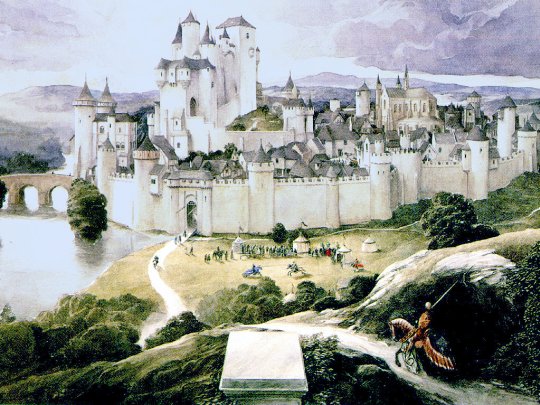
CamelotCamelot falls.  And yet, the story does not quite end in despair.  Arthur may die—but he is not entirely lost; he will somehow return.  In White’s touching ending, Arthur hands on the story itself, the memory of Camelot, to a young page named Tom—Tom Malory.  The ideal remains an ideal, and we are reassured that someday Arthur and the ideals he champions will reawaken.

It is no wonder that this kind of ambiguous, yet hopeful, ending attracts storytellers.  It attracts readers too.  All but the most hardened cynics would like to look forward to such a return.  Arthur’s story, like Arthur himself, never quite dies.