Star Trek: Raiders of the Lost Arcs

I’m a Star Trek fan from way back.  I enjoyed “Star Trek:  Beyond.”  Why am I not more enthusiastic?

Star Trek Beyond posterStar Trek:  The Original Series (“TOS”) was almost purely episodic.  Each week, another new world or new civilization, a unique problem, a nonrepeating set of guest stars.  Each episode stood pretty much alone.  You could miss one and not be at a loss when you saw the next one, because nothing had changed.  The original “setup” was restored at the end of every show.

This wasn’t unique to Trek; it was the norm on television back in the 1960s.  “Situation comedies” were defined by a permanent “situation” that formed the basis of each week’s program.  Dramatic shows like “Bonanza” or “The Man From U.N.C.L.E.” used the same method.  No matter what happened in the course of one episode, things were back to normal by the opening of the next.  The reductio ad absurdum is “Gilligan’s Island.”  There was a melancholy certainty that no matter how hopeful things seemed, they were never getting off that island.

Of course this was never entirely true.  One of the Cartwright sons on “Bonanza” was Cartwritten out of the script and disappeared.  Chekhov joined the Enterprise crew in the second season of Star Trek and stayed on thereafter.  But mostly, the “initial conditions” for each episode remained the same.

What we did not see was long-running plot arcs or character development.  Each plot had to wrap up neatly in a single episode.  Characters and relationships were static.

It’s instructive to look back and realize how much this has changed.  TV series these days are expected to have long-term plot arcs, often spanning a season or more.  A series like “Chuck” might change the plot premise significantly from one season to the next.  And viewers today are addicted to mini-series (maxi-series?) with extremely long and complex plots, as in “Game of Thrones.”


As the Star Trek movies came out, it presently began to seem that we were essentially seeing series episodes, but stretched out to two hours rather than one.  It left a vague feeling of being cheated.

In a typical two-hour movie, there’s time for more leisurely plot development, and one expects things to happen.  Sure, there are long-running series like the James Bond movies that cycle back to the same scenario just as the old TV series did.  But that isn’t true of most movies.  Even sequels frequently find themselves starting at a new point in narrative or character development—which was a challenge for moviemakers who merely wanted to reprise the success of the original film.

If we pass in merciful silence over Star Trek I (“The Motion Picture”), the striking thing is that the next three movies did have a continuing plot arc.  I’ve heard that they were plotted as a coherent trilogy by Harve Bennett, and that does seem to be borne out by the movies themselves.

While Star Trek II, III, and IV represented remarkably different types of films, there was a continuous thread of action.  The Enterprise crew created the Genesis planet in II, returned to that planet and saw its collapse in III, and made their own return to Earth in IV.  With side trips, of course.

And there were character changes.  One of the things that makes Star Trek II the best of the Trek films is the impact of Spock’s death, around which the entire story is carefully constructed.  Of course fans were pretty sure even then that his death wouldn’t be permanent.  But the characters didn’t know that, and we got to see how this loss affected them.  And Kirk’s son David Marcus did die for good in III—though this new character’s death didn’t have the impact of Spock’s.

Star Trek V and VI, however, were unconnected stories riffing on the same traditional characters, and momentous as the writers tried to make them, there was a distinct sense of “back to the old grind.”  VII was somewhat unique, as the intersection of the TOS crowd with “The Next Generation” (TNG) characters.  But the following movies, VIII through X, were very like individual episodes of the TNG series.

The three films beginning with the 2009 reboot also strike me as standalone episodes.  The occasional attempt to tie them back to other storylines, as with the appearance of Khan and Carol Marcus in “Into Darkness,” is offset by the disconnection from all earlier stories stemming from the timeline change in the 2009 movie.

So this year’s Star Trek entry strikes me as okay, but it lacks the cumulative force of a long-term plotline—unless perhaps you take a strong interest in the desultory Spock-Uhura romance, which so far hasn’t gripped me.

By contrast, series that do have long-term plotlines and character developments, as in Star Wars and Harry Potter, can build up quite a head of steam—and corresponding viewer loyalty—through the accumulating drama of an extended story.


The fact that we now expect long-form plot arcs makes for an interesting countercurrent to some of the standard assumptions about today’s audience.

It sometimes seems that we have all been seized by a collective attention deficit disorder.  Writers are warned to “hook” their readers, not in the first page or even paragraph, but in the first sentence.  Communication packets have been reduced to 140 characters.  It’s easy to bemoan how rushed we all are, and how short our attention spans.

But at the same time, modern viewers take in stride a series of six or seven movies.  Harry Potter brought a generation of viewers through eight lengthy parts without blunting their appetite for more Potteriana.  TV series routinely carry on long-drawn-out developments.  Novel readers happily consume endless serials like the Honor Harrington tales, or the fourteen massive volumes of Robert Jordan’s Wheel of Time.  By today’s standards, the 1800-page Lord of the Rings, touted as a huge work in the 1960s, seems positively concise.

To my mind, this says something favorable about today’s readers and viewers.  We’re fond of the sound bite and tweet, yes—but we also seem willing to tackle much longer stories than in the olden days.  There may be hope for coherence and continuity yet.
The Backyard Spaceship

When I was little, my father told me he had a spaceship of his own, hidden back in the woods.  As an ardent space fan, I was wildly enthusiastic.  It was when he told me it was propelled by a hamster running in a wheel that I began to suspect he was putting me on.

But I wanted to believe it.

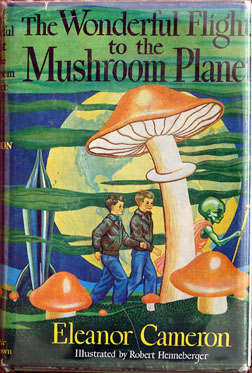
There’s a certain SF tradition of spacecraft built, more or less, in one’s backyard.  Of course, “backyard” may not be literal.  I’m thinking of spaceships constructed on an amateur basis, privately, and usually—though not always—by young people.Cover, The Wonderful Flight to the Mushroom Planet

This was the appeal of a childhood favorite of mine, Eleanor Cameron’s The Wonderful Flight to the Mushroom Planet (1954).  Two boys (“between the ages of eight and eleven”) are recruited by a newspaper ad to put together a small rocket ship for the mysterious Mr. Tyco Bass, a small wispy man who turns out to be a “spore person.”  They fly the ship to a previously unknown miniature moon, “Basidium,” inhabited by other spore-based mushroom people.

Cameron is pretty good with her scientific facts—which means she lampshades the impossibilities carefully.  A rocket built by two kids isn’t going to get off the ground without plentiful helpings of what TV Tropes calls “Applied Phlebotinum,” the unexplained stuff or device(s) necessary to make the plot work.  A classic example is the faster-than-light space drive needed by a Star Trek or Star Wars story.  If the authors could explain how it worked, they wouldn’t be writing a story; they’d be off to the patent office and rake in billions.  Instead, the author and reader tacitly agree to postulate the necessary gizmo or substance for purposes of the tale.  It might as well be magic, in the sense of Clarke’s Third Law—“Any sufficiently advanced technology is indistinguishable from magic.”

Here, Mr. Bass supplies several crucial “inventions” needed to make the boys’ ship spaceworthy.  He provides the rocket motor, the special fuel, the clear sealant that makes the hull airtight, and the “oxygen urn” that provides breathable air—not to mention the “Stroboscopic Polaroid Filter” that allows a telescope to detect the otherwise-invisible Mushroom Planet.  These “phlebotinum” features make the boys’ vessel a little more plausible than my dad’s Hamster Drive.Cover, Rocket Ship Galileo

A more believable example (once you’re out of the middle grades) is Robert A. Heinlein’s Rocket Ship Galileo (1947).  The project here is a private enterprise, with the spacecraft modified from an existing transcontinental “freighter-rocket” by four teenage boys.  They are, however, accompanied by one adult, Dr. Donald Cargraves, an uncle of one of the boys.  Cargraves provides the engineering expertise and the atomic drive he’s just invented, which (to paraphrase Doc Brown) “makes space travel possible.”

Starting with an existing well-equipped vessel, and kids who are already experienced amateur rocket-builders, makes the setup immediately more plausible.  Realistically, it takes months of elbow grease to do the conversion.  The Galileo isn’t actually built in a backyard, but out in the desert.  Still, the idea that kids like you or me could help build the first rocket to the moon is front and center in this story, which formed part of the basis for the early SF movie “Destination Moon.”

The notion of private-sector spaceflight was a favorite of Heinlein’s.  That theme reappears in his novella The Man Who Sold the Moon (1951), which also contributed elements to “Destination Moon.”  In that tale, however, the participants were all adults, and the project was a large and highly-publicized corporate endeavor more like the work of today’s SpaceX or Blue Origin.

A fully grown-up version of the backyard spaceship can be found in the widely influential first novel by E.E. “Doc” Smith, The Skylark of Space (1928, originally written about a decade earlier).  When scientist Dick Seaton stumbles upon an unknown substance that can be used to produce immense energy, his wealthy friend Martin Crane underwrites the construction of a spherical spacecraft to harness that power.  The work is started on Crane’s extensive property—not exactly a backyard, but close—and continues secretly in an independent steel plant after skulduggery enters the picture.  No kids are involved, but the private, secret, and essentially amateur operation makes Skylark an ancestor of this space opera trope.cover, Red Thunder

We might consider this theme an artifact of the naïve early days of SF, but for its reappearance in John Varley’s 2003 novel Red Thunder.  The passage of time has made some differences.  The protagonists are young adults, though they compose a motley group that still reads like “kids” to me (or perhaps it’s just that I’m that much older myself).  Their goal is Mars, rather than the Moon.  The requisite adult supervision, or phlebotinum contribution, is supplied by Travis Broussard, a cashiered former astronaut, and his quasi-autistic genius brother Jubal, who has invented a “squeezer” force field that turns out to be a fabulous rocket drive (among other uses).  Varley’s methodical development of the funding, engineering, and planning for the homegrown spacecraft (built out of a railroad tank car) makes the amateur project believable even for a contemporary audience.  Wikipedia describes the resulting adventure as an homage to Heinlein’s juveniles—since it’s essentially a Rocket Ship Galileo for the 21st century.


Why are we so fond of the backyard spaceship?

This kind of plot enshrines the long American tradition of inspired tinkering, from the Wright brothers and Edison, to Tom Swift, to 1950s kids with hot rods, to space kids with hotter rods (Luke Skywalker asking to go into town for parts to soup up his landspeeder).  The clever gadgeteer is a permanent part of our mythology, right down to Bill Gates and Paul Allen in their garage.

More than that, the idea that ingenious amateurs could conquer space has a democratic, underdog quality that appeals to our mythmaking imaginations.  We love the idea that spaceflight could be easy and accessible to the ordinary person.  It’s a natural evolution of the way we root for the underdog in politics or war (the Ewoks in “Return of the Jedi”).  We cheer for the underdog just as much in personal life—for Cinderella, whose story exhibits, as Chesterton says, the lesson exaltavit humiles—“he shall lift up the humble.”

The backyard spaceship promises to lift the humble right off the earth, in the ancient dream of flight.  It makes for great inspiration, if dubious engineering.  And after all, the most sophisticated aeronautical engineer starts out as a wondering child and an aspiring teenager.  Our dreams rest among the stars; but the journey begins in our own backyard.

Recklessness

The name of the title song from Martina McBride’s album “Reckless” (released April 29, 2016) matches that of another favorite of mine, Alabama’s “Reckless” (1993).  What strikes me most is the difference in what the songs say.

Martina McBride - Reckless (album cover)Here are the links:

Martina McBride’s “Reckless”:  music video; lyrics; Wikipedia entry (album)

Alabama’s “Reckless”:  fan video with lyrics; just lyrics; Wikipedia entry

I’ll refer to the songs by their performers, but since I’m talking about the words, it’s really the lyricists at work (though the music, as in any good song, reinforces the lyric—and vice versa).  For McBride’s song, the writers are Sarah Buxton, Zach Crowell, and Heather Morgan; for Alabama’s, Michael Clark and Jeff Stevens.


Alabama’s song is an ode to spontaneity, with its overtones of rebelliousness and adventure.  The singer and his girlfriend are dissatisfied with life in their Texas small town.  He wants them to take off somewhere else, anywhere else.

The refrain begins with “Let’s roll the windows down…”  Since this song came out, I can’t count the number of country singers I’ve heard rolling their windows down for exactly the same reason.  It works, too.  “[L]et the wind blow through our hair” – what suggests excitement more than air streaming past our faces?  The refrain ends with the inevitably suggestive line, “Let’s get reckless tonight.”

But the overall message is clear in the bridge:  “When you’re crazy in love you gotta take a chance, / Burn the bridge and don’t look back.”  Love, in other words, requires recklessness.  (Despite being burned, however, the bridge remains intact in the song.)

This trope is firmly rooted in classic American tradition.  It lines up with a long tradition of such anthems.  Wilson Phillips’ “Impulsive” comes to mind, where “reckless” is the second adjective the singer applies to herself (to her own surprise) in the refrain.

Love of spontaneity has a much broader reach than love songs alone.  Our fascination with the impulsive, boundary-breaking individual includes, for example, the recurrent trope of the “loose-cannon cop who doesn’t play by the rules” (TV Tropes calls it Cowboy Cop).  The attitude is canonized in the “chaotic good” alignment featured as one of the options in Dungeons & Dragons and other role-playing games (you can find descriptions on Wikipedia, TV Tropes, or elsewhere).


Twenty-three years later, McBride’s take doesn’t quite follow the trope—or does it?  Clearly, we are supposed to be attracted by the singer’s portrait of a wild and impulsive woman.  But the narrator’s actual description of herself isn’t favorable.  The song opens:

For stumbling through a mess of dances
For squandering my second chances
For wrecking every dream
And breaking everything I ever had . . .

The singer seems to be sorry about her ungoverned behavior, or ashamed of it.  She even calls it “criminal” in the refrain.  She feels her beloved cares for her despite this chaotic quality, not because of it.

Originally I wondered whether this new song represented a change in attitudes over time.  We are highly sensitive today to unintended consequences, including “collateral damage”—in everything from environmentalism to superhero movies (the damage caused by epic battles is a major plot driver in this year’s Captain America: Civil War and Batman v. Superman: Dawn of Justice).  One might suspect we’re becoming less enthusiastic about recklessness than we used to be.

On the other hand, we’re still getting just as many images in which operating outside the law is seen as a good thing.  The screenwriters’ sympathies seem to lie more with the “chaotic” side in both those films.  It would be rash to imagine a reversal of so pervasive an attitude based on one song.


But there’s more to it:  McBride’s song has another layer.  Her lover’s willingness to cope with her erratic nature also represents daring or courage.  The last lines of the refrain are:  “For loving me the way you do—I know I’m reckless—but you must be reckless too.”  Loving someone who is so uncontrolled is its own form of recklessness.

This kind of risk-taking appears in the song as a good thing.  She—and we, the listeners—want him to take that chance.  Only when he does so can he prize who she really is, and see her lovableness:  “For looking in my eyes and seeing the soul inside . . .”  It’s the difference between acting unthinkingly or destructively, and taking a desperate risk in a good cause.

McBride’s “Reckless,” in other words, draws our attention to the fact that there is a certain kinship between the kind of recklessness that represents pure spontaneity (and can go drastically wrong), and the kind that dares to take the necessary risks to love someone.  And, yes, can also go drastically wrong.

This truth holds to some extent for everybody.  None of us is ideal and unexceptionable.  We’ve all squandered opportunities and stumbled through life.  Committing ourselves to any of us flawed human beings means taking chances.  Love always requires courage.

What McBride’s song tells us, then, is that there are some risks that must be taken; and love is one of them.  On this, the two songs come back together—Alabama also told us we had to take chances to be “crazy in love.”

It’s one reason we might say, with that well-known sage Rich Burlew, “Love is an Epic-level challenge.”

The Internet Strikes Back

Occasionally, science fiction can’t avoid being shaped by actual facts.  Usually these are scientific facts, but sometimes economic, social, and even legal factors play a role.  It’s illuminating to look at the recent court decision on “network neutrality,” or “Internet open access,” from a science fictioneer’s point of view.

The question of “net neutrality,” or whether Internet service providers (ISPs) such as telecommunications and cable companies can control what people send and receive over the Internet, has been in play since at least 1998.  The Internet first became accessible to the general public by dial-up service over the public switched telephone network in the mid-1990s (who can remember the once-familiar sound of a dial-up modem connecting?).  Since the telephone system was a common carrier like a railroad or the Postal Service, required to carry anyone’s traffic as long as it didn’t harm the network, there was initially no question of the carriers’ controlling anyone’s Internet communications.  But when people began shifting to “broadband” Internet service over cable systems, which had not traditionally been treated as common carriers, new questions arose.

The Federal Communications Commission (FCC) tried three times to establish some kind of rules of the road that would prevent ISPs from blocking or altering people’s Internet communications.  Third time lucky:  on June 14, 2016, the U.S. Circuit Court of Appeals for D.C. upheld the FCC’s 2015 “Open Internet Order.”  The decision was published as United States Telecom Association v. FCC, __ F. 3d ___ (D.C. Cir. June 14, 2016) (USTA).


The ISPs like to frame the dispute in terms of the FCC’s “regulating the Internet.”  Actually, it’s almost the reverse.  All the FCC rules do is prevent the ISPs from regulating the Internet—from controlling what individual users can see on the Web and what they say in messages.  It would be more accurate to say that FCC is setting up rules that foster a free market.  This is why the technology industry, except for carriers and their proxies, is generally in favor of net neutrality.

Like many other tech-driven changes explored in science fiction, our ability to use the Internet has far-reaching consequences.  The court observed:  “Over the past two decades, this content has transformed nearly every aspect of our lives, from profound actions like choosing a leader, building a career, and falling in love to more quotidian ones like hailing a cab and watching a movie.”  (p. 26)

This particular change wasn’t often investigated by SF.  You can find early depictions of something like the Internet.  Characters in James H. Schmitz’s 1960s-1970s Federation of the Hub stories use a network presciently dubbed the “ComWeb,” both to communicate and to access information, as one commentator remarked, “on ‘Internet time.’”  The cyberpunk genre deals with world-wide networks—but I don’t recall a story where the neutrality issue played a role.  (On the other hand, I haven’t read all that much cyberpunk.)  Some stories show the Internet “waking up”—Internet as artificial intelligence:  for instance, Spider Robinson’s “Solace” in Callahan’s Legacy, “Webmind” in Robert J. Sawyer’s Wake.  But that’s another matter entirely.  In most of these stories, the network is just there; control over it by the ISPs isn’t an issue.

But, like a science fiction thought-experiment, the net neutrality controversy shows some of the qualities a modern society needs in a communications system.  For example—

  • Transmission integrity—trustworthiness.  If the system arbitrarily changes the information passing through it, it won’t be very useful either for trade or for speech.  As the USTA court said:  “the Commission explained that ‘[u]sers rely on broadband Internet access service to transmit “information of the user’s choosing,” “between or among points specified by the user,”’ without changing the form or content of that information.  2015 Open Internet Order, 30 FCC Rcd. at 5761 ¶ 361 (quoting 47 U.S.C. § 153(50)).”
  • Universality (which implies affordability).  This was a key feature of the original telephone monopoly—the “social contract” under which the Bell System was allowed a legislative monopoly in return for providing universal service at regulated rates.

Much of the battle over net neutrality revolves around visions of the kind of alternate futures that might result from different legal regimes.  The FCC’s rules, which act to clear a space for free action and competition, are designed to ward off certain kinds of problems that could develop in such alternate futures.

First among those problems is the economic dominance that can be gained through gatekeeper control of communications.  A cabal of ISPs that controlled all communications could prevent entry by competitors; “pick winners and losers,” deciding which new companies and products would succeed; and siphon off the profits from such new and innovative enterprises, right down to the level where a company that relies on communications can barely break even.  Thus, although the ISPs fully recover the network’s costs from end users’ payments (Americans pay more for lower speeds than in many developed countries), they also seek to be paid by the “edge providers” whose Web sites we visit, not only for those companies’ own Internet connections but also for the pure privilege of reaching the ISPs’ subscribers—in other words, to be paid three times for the same network.

In a free market, it’s essential to have a common medium in which trade can take place.  We analogize the Internet to the streets and roads of our transportation system; but if someone owned the only road leading to your home, and could bar certain traffic at will (including mail delivery), they’d have you over a barrel.

We do see examples of this kind of economic dominance by a few organizations in SF stories, though not usually in the communications realm.  In Dune, when the Spacing Guild joins the alliance against the Atreides family, the game is up—the Guild has a monopoly on interstellar travel.  In Heinlein’s Friday, the Shipstone company controls (stored) energy—and in Heinlein’s much more concise short story “Let There Be Light,” we see how entrenched interests can prevent disruptive innovation.  In a similar way, a cartel that controlled communications—without neutrality requirements—in our information-centric society could establish an economic oligarchy.  There are some fascinating stories to be written there . . .

It’s an illusion to think that in the absence of all regulation, we would have free independent individuals trading with each other on an equal basis.  What we’d have is warlords fighting over slices of a steadily shrinking pie.  One of the functions of the rule of law is to create a space in which a free market can exist—to establish the preconditions for free interaction by all economic players.  This is true of enforceable contract law in trade (just as similar principles require enforceable traffic laws on the roads).  A novel example of how legal protections create reliable conditions for trade is the notion of setting up well-policed areas where people who buy and sell online can meet to exchange their goods, without having to fear being robbed—an “Exchange Zone for Online Purchases.”

To gain the advantages of the Internet’s “flat distribution model,” in which even a small business can buy and sell worldwide without having to make major capital investments, one must be able to communicate freely and inexpensively.  The USTA court noted that “[a]ccording to the Commission [FCC], such rules encourage broadband deployment because they ‘preserve and facilitate the “virtuous circle” of innovation that has driven the explosive growth of the Internet.’”  (p. 17, citing Verizon, 740 F.3d at 628)

But we also use the Internet to create pathways for speech—a central First Amendment interest.

Some ISPs—Verizon in an earlier case, Alamo Broadband in the USTA proceeding—have argued that their own First Amendment rights forbid any imposition of net neutrality rules.  Their position is that on the networks they control, they are the “speakers”—and they cannot be compelled (as a common carrier) to transmit any speech they don’t want to carry.  In other words, when you use your Verizon Internet account to read the latest article by your favorite columnist, it isn’t the columnist whose speech is protected by law:  it’s Verizon’s.  And when you e-mail your best friend your opinions on the upcoming election, it isn’t you speaking—it’s Verizon who can exercise “editorial control” over how your message comes out at the other end.  According to this argument, if you wrote “I love Obama” (or Trump, or Sanders, or Hitler), the ISP could substitute “I hate . . .”  It’s their speech.

Fortunately, the USTA court declined to accept this argument.  If the ISPs had prevailed, the results would have been ironic.  It would have been imperative to build a government-owned network at once, one that people could use to communicate without interference—because governments are forbidden by the First Amendment from controlling people’s speech.  And by the same token, the ISPs would have been forced to police every Web site they delivered to subscribers, from pornography to political opinions—since they would be the speakers.

This scenario sounds as absurd as some science-fictional extrapolations.  But in a world where tyrannies around the globe are doing their best to exercise exactly such speech control by acting as Internet gatekeepers, it’s not hard to imagine ISPs doing the same thing.  And it’s hard to say which would be worse.


In sum, the FCC and the court have taken the right path in this case.  The alternatives could make extremely interesting ideas for stories.  But unlike the thought-experiments of SF, this is a real-life experiment, with actual consequences.  It’s important that we get it right.

Sequels in a Changed World

Poster for Independence Day: Resurgence

Independence Day: Resurgence poster

The last post took off from the impending premiere of the movie Independence Day:  Resurgence.  I don’t want to put too much emphasis on this release; I’m no more than cautiously hopeful about whether it’ll be any good.  But there’s more to be said about this kind of sequel.

In a lot of stories, a sequel can start out more or less where the original tale did, because the status quo ante is preserved.  Each James Bond movie starts in our everyday world, because the world-changing plans of the villains were foiled in the previous episode.  It would be a very different world if the villains had succeeded in starting a nuclear war or whatever.  (The only real changes in Bond’s “initial conditions” come from the fact that the films have been produced over the period of half a century, and the real world itself has changed in the meantime:  the Soviet Union falls, a female head of the agency becomes plausible, actors age out and are replaced, and so forth.)

Even in the Star Wars saga, despite the world-shattering events of each movie, the situation tends to cycle back to the starting point.  Episode IV:  the rebels are on the run.  Episode V:  the rebels are on the run.  Episode VI:  the rebels are still on the run.  Episode VII:  we have a new set of rebels with a different empire to fight – but they’re still on the run.

A story that has far-reaching implications can still fail to change the world much.  At the end of E.T., Elliott’s life has certainly been changed.  And there’s a batch of scientists who know something radically new:  there’s other life out there.  But the whole matter has been handled with such mystery and secrecy (for no very good reason) that one can imagine California going right back to its old ways afterwards, after a nine-day wonder about why some government agency swathed Elliott’s house in Saran Wrap for a day or so.  And there’s no reason to think the aliens will be coming back.  (Once they get home, the galactic TripAdvisor probably lists Earth with one star at best:  “Lousy health care, and primitive communications facilities.)  (Of course, there’s only one star in our solar system to begin with.)


But it’s a different matter when the original story changes the world completely.  A sequel to The War of the Worlds would have to be quite different from the original, because Earth could not lapse back into its pre-invasion ignorance of extraterrestrial life—nor ignore all that advanced alien technology lying around for the studying.  Whatever humanity might do in response, it’s unlikely that history would have proceeded as it actually did.  At least one sort-of-sequel to The War of the Worlds recognized this, with Earth’s nations uniting to build a space fleet for a counterattack.

This means that the sequel to a movie like Independence Day needs to be a distinctly different kind of story from the original.  We will not be starting from the same status quo.  Technology will have changed, and with it, ordinary lifestyles.  (“Turn on the force field, would you, dear?  Junior’s going to fall down the steps again.”)  International relations will have changed.  The economics of recovery from mass destruction must be considered.  And most of all, we will not have unsuspecting Earthlings shocked by the extraterrestrial incursion.  We’ve “seen the elephant.”

Science fiction books can get this right.  The first book of David Weber’s Dahak trilogy, Mutineers’ Moon, starts in the near future and reveals an age-old conspiracy with advanced technology.  As a result of the battle against the ancient mutineers, a world government is formed and preparations are put in motion for an attack by an age-old menace.  The second and third books start in a world very different from the present day and logically carry forward the consequences.  (The trilogy is a great read, by the way.)

The marketing difficulty with a film sequel is that the second movie, coming from such a different starting point, may have to be quite different from the first.  This disturbs Hollywood, which typically wants to capture the same audience by giving it more of the same.  There’s a disturbing tendency to pull back from the implications and somehow paste the previous status quo back into place.  For example, Ghostbusters 2 went to considerable trouble to achieve a just-barely-plausible reset in which the universally adored heroes of the original are now forgotten and reduced to underdogs again.

So far, it looks as if the Independence Day sequel may be following Weber’s example.  The tagline for the movie is:  “We had twenty years to prepare.  So did they.”  It sounds as if the Earth that faces another invasion will have changed based on the first story.  How much, we’ll have to see.  Will we start out in a plausible future twenty years on from the end of the first movie?  Time to find out!