Lost World-Ships

Lost Universes

Suppose it turns out that the world in which you and your ancestors have lived isn’t a natural world at all, but a construct.  All you know of reality is the interior of a vast spacecraft.  If the truth ever becomes apparent, you’re going to be in for a shock:  the universe is vaster and stranger than you ever imagined.

Warp Drive exit signThe immense distances between the stars, and the speed-of-light limit, make this kind of situation a staple of modern science fiction.  Barring some as-yet-undiscovered method for faster-than-light travel, like the Star Wars hyperdrive or Star Trek warp drive, an interstellar voyage is likely to take many years.

The “generation ship” is a common SF assumption.  What I call “lost world-ship” stories, in which the inhabitants have forgotten they are even on a spaceship, form a subset of generation ship stories.  The generation ships, in turn, are a subset of the broader category of what might be called “sealed environment” tales:  people live for generations in an restricted artificial environment, but it isn’t a spaceship (as for instance in the movie City of Ember).  The sealed environment stories can in turn be seen as a subset of “exotic environment” SF tales, where an unnatural situation places unique pressures on the people who live there.


. . . And Where To Find Them

I find the lost world-ship plot particularly fascinating, so I’ve accumulated a number of examples over the years.

The Star Seekers coverMy first exposure to the idea as a child was in Milton Lesser’s The Star Seekers (1953), one of the distinctive Winston Science Fiction publications that introduced so many kids in that era to SF.  I recently obtained a Kindle copy and was charmed to encounter the story again, after all these years.  On a 200-year trip to Alpha Centauri, the four levels of the starship have separated into four different cultures, three of which are no longer aware they are on a spacecraft.  The setup is not entirely convincing; there’s no real explanation as to how most of the inhabitants simply “forgot” their origins.  But the book conveyed to me the mystery of discovering something that changed one’s whole world-view.

Orphans of the Sky coverIn pursuing the stories in Heinlein’s Future History, I ran across the real bellwether of the lost world-ship tale, the two novellas “Universe” and “Common Sense” (1941) that form the book Orphans of the Sky.  It may not be the earliest treatment— Don Wilcox was a year ahead with “The Voyage That Lasted 600 Years” (1940).  But in the Wilcox story, as in The Star Seekers, there was still someone on board who remembered the ship’s purpose.  In Heinlein’s starship Vanguard, no one preserved that memory.  A mutiny long ago had killed off the technically skilled, and their descendants preserved the story of the “Trip” to “Centaurus” only as mythology—which they interpreted as pure allegory, not to be taken literally.

Orphans of the Sky focuses on how hard it is for those raised in the artificial environment even to conceive that there could be an outside.  The escape of a few characters to make landfall on a planet, at the end, is a dramedy of errors.
Aldiss Starship coverAnother lost world-ship story that fascinated me in my misspent youth was the Brian Aldiss book Non-Stop (1958), published as Starship in the U.S.  As in Heinlein’s case, Aldiss’s travelers have reverted to barbarism.  The artificial nature of their surroundings is masked by the fact that much of the ship is filled with “ponics” – mutated hydroponic plants that have spread through the corridors.  The real story does not emerge until close to the end, mediated, as in Orphans, by a diary left over from earlier times.  The ship had been ravaged by a disease of sorts, the result of a previously-unknown amino acid picked up on their destination world, from which the ship was now returning.  This plague, and the long unpiloted voyage, has rendered the inhabitants far different from their ancestors, rendering their hopes for escape from the degenerating vessel problematic.

Strangers in the Universe coverI encountered Clifford D. Simak’s Target Generation (1953), originally published as Spacebred Generations, in Simak’s collection Strangers in the Universe.  There’s a well-done summary and analysis of the story by Zachary Kendal on his Web site.  When Simak’s automated starship reaches its destination, it triggers a sequence of events that lead the main character to open a sealed book of instructions that has been waiting for that moment—rather like the instruction page in City of Ember.  He concludes that the builders of the ship had deliberately caused the travelers to forget their origins, except as a vague quasi-religious observance, because that was the only way they could (in Kendal’s words) “survive the journey without terrible psychological trauma.”

All these stories affected me with a sense of vast, brooding spans of time and forgotten lore.  The settings tended to be gloomy, the societies stunted or degraded, the environments worn-down and cramped.  But the tales also raised a sense of hope—that the travelers could somehow break free of their limited universe in the end, and recover the way humans were meant to live.


Other Media and Sources

The lost world-ship trope has turned up in other media too.  The original Star Trek series included a third-season episode (1968) with the cumbersome but evocative title “For the World is Hollow and I Have Touched the Sky,” in which the Enterprise crew discovers that an “asteroid” approaching a Federation planet is actually a generation ship.  There was a mercifully short-lived TV series in 1973 called The Starlost, a decent concept (by Harlan Ellison) with a completely botched execution—an entertaining story in itself.  The Pixar film WALL-E incorporates the idea that the remaining human beings have been living for generations aboard a luxury starship and have almost, if not entirely, forgotten what it’s like to live on a planet.  There was even a 1976 role-playing game called Metamorphosis Alpha set on a generation ship afflicted by an unknown cataclysm.

There’s more.  The Wikipedia and TV Tropes pages on generation ships provide useful lists.  Still more are summarized in a study by Simone Caroti, The Generation Starship in Science Fiction:  A Critical History, 1934-2001 (2011)—though Caroti’s study is a little heavy on the academic Marxist/deconstructionist attitudes for my taste.

For the broader categories I mentioned above, examples of non-spaceborne sealed environments include Hugh Howey’s Wool, James White’s The Watch Below (which pairs an alien fleet of generation ships with a human group trapped in a sunken oceangoing vessel), and Daniel F. Galouye’s Dark Universe.  TV Tropes lists others under the headings City in a Bottle and Small, Secluded World.  Other “exotic environment” stories include Ray Bradbury’s memorable “Frost and Fire” and Christopher Priest’s Inverted World.


Themes

What is it that’s so compelling about the lost world-ship stories as to explain my lifelong love affair with them?

Sense of Wonder.  The strangeness of the environment—the union of familiar human concerns with surpassingly unnatural situations—evokes the “sense of wonder” that is characteristic of F&SF.  But we can point to more specific themes that arise in the lost world-ship setting.

Loss and Forgetfulness.  A sense of loss pervades these stories—a loss not fully appreciated by the characters, but clear to the reader.  The starship inhabitants have lost their history, and with it, their sense of who they really are.  They have lost other kinds of knowledge as well, especially technological knowledge, often existing as barbarians in the ruins of a superscientific construct (again, a wider SF trope).

This sense of loss is like that of another subgenre, the post-apocalyptic story.  The disaster that afflicts the starship is a sort of localized apocalypse; this is what differentiates the lost world-ship from a functioning generation ship.  Pondering the causes—whether mutiny, plague, accident, or even deliberate obliteration of the past—makes us reflect on the fragility of our own histories and societies.

Illusion.  In these stories, the world is never what we think it is.  One need not live on a starship to share that experience; the whole history of modern science can be read as a progressive penetration of appearances.  (Heinlein has a character in Orphans unknowingly echo Galileo as he tries fruitlessly to convince others of how their world really works:  “Nevertheless—Nevertheless—it still moves!”)  The lost world-ship story brings home the way our knowledge is bounded by our experience—or by our assumptions.

The Natural and the Artificial.  This dichotomy can play out in two ways.  Either the inhabitants take their artificial world so matter-of-factly that it seems perfectly natural to them, and they can hardly imagine anything else (Heinlein); or the unnaturalness of their world subtly warps or frustrates them (Aldiss).

The former may seem more plausible to those who prefer “nurture” to “nature” as an explanation.  When you grow up with something, why wouldn’t you take it for granted as normal and natural?  The latter approach may appeal more to those with a strong sense of the natural as fundamental and superior to the artificial.  For example, a character in Non-Stop tries to show his companions that the ponic plants are natural, but corridors are not.  The key question, of course, is how he knows that plants are more natural than walls:  is the difference somehow wired into the human brain?  In Howey’s Dust, part of the Wool series, a knowledgeable character says of their underground sealed environment:  “They don’t know anything beyond their walls, so I guess they don’t have some of the stress about what’s out there that you and I feel.  But I think they have something else that we don’t have, this deep feeling that something is wrong with how they’re living.”

We frequently encounter such nature-nurture arguments in more conventional sociological contexts.  But the lost world-ship story brings us face to face with them in novel ways.

Incongruity.  The lost world-ship is a fertile ground for irony and “cognitive dissonance,” where the reader knows things the characters do not.  In principle this sort of incongruity could be played for light comedy or farce—but I don’t know that I’ve ever seen it done that way, except perhaps toward the middle of The Star Seekers, a young adult novel and thus somewhat lighter in tone.  The starship stories tend to be too grim for farce.

Escape.  The somberness of the classic lost world-ship is alleviated by the possibility of getting out, into a freer and better world.  Once the characters realize there is somewhere else to go, they may be able to escape.

Flammarion cosmos paintingEscape is a major preoccupation in Non-Stop, and contributes much of the story’s emotional force.  It fits in with the fact that we encounter the starships in Target Generation and The Star Seekers just as they arrive at their destinations:  a hoped-for new world, a natural world free of the constraints of the world-ship.

The last generation is in a far better position, in this respect, than their ancestors.  As TV Tropes puts it, commenting on Kim Stanley Robinson’s Aurora:  “A major theme of the book is the fact that while the original generation-ship crew may have consented to their risky mission, their children don’t get a choice.”  The writer of the ancient diary in Non-Stop, facing the beginning of the generations-long return trip, bursts out:  “Only a technological age could condemn unborn generations to exist in [the ship], as if man were mere protoplasm, without emotion or aspiration.”

But the characters we’ve come to know in the story do have the possibility of emerging into something wider and greater.  This hope is not quite the same as what Tolkien means by “Escape” in On Fairy-Stories (a topic for another day), although there is some common ground.

The contrast between the all-too-human characters and the artificial environment has still more resonance, perhaps, with the common human feeling that we don’t really belong in this world.  Some of the twentieth-century existentialists took this reaction as a sign of despair and meaninglessness.  But the notion of escape suggests instead that such emotions may instead point to another place where we do belong, evoking hope rather than despair.  The plight of the lost world-ship traveler may recall Chesterton’s lines in “The House of Christmas”:

For men are homesick in their homes,
And strangers under the sun,
. . . . .
But our homes are under miraculous skies
Where the yule tale was begun.

Meta-reading

The Sign of the Sequel

Ever find yourself approaching the end of a new book—and you realize there’s no way the author can tie up the plot in what remains of the novel?  It’s that moment when you realize:  we’re in for a sequel.

That realization may be awful, or it may be exciting, depending on how much you enjoy the story so far.  But it changes the way you look at the book you’re reading, to know it isn’t complete in itself, but only part of a larger tapestry.  Your sense of the pacing and the shape of the story has to adjust.

Book, fanned openBut the story alone hasn’t told us there will be a sequel.  Rather, we’re drawing on something outside the text itself—our knowledge of how much of the book remains—to tell us something about the story.

Years ago, when I first read Isaac Asimov’s Second Foundation, I almost missed the last chapter altogether.  The conclusion of the novel consists of a series of successive surprises, each overturning the last.  The second-to-last chapter seemed to end so conclusively that I only turned the page because I was in the habit of reflectively turning over the blank endpapers of a book.  —And there was the final chapter!  I could only make that mistake, however, because the last chapter was so short—six pages in my hardcover edition.

It’s harder to make that kind of observation in an e-book, where there are no physical pages to observe.  You can usually find a percentage or “location” indicator, but it’s not quite as obvious as the physical thickness of the pages.

Let’s call this process of drawing on outside information “meta-reading.”

Sources of Meta-Information

There are a number of sources from which we glean this meta-information, consciously or not.

Starting from the broadest case, we get some information from the genre to which the book belongs.  If you find a book in the science fiction section of the bookstore, then no matter how mundane the opening scenes may be, you can be pretty sure that something out of the ordinary is going to turn up at some point.  If you’re reading a genre romance, you can rely on the ironclad rule that a genre romance must have a happy ending:  either “happily ever after,” or at least “happily for now”—HEA or HFN, in the jargon of the trade.  Even if the characters’ relationship seems doomed as you approach the ending, you can be pretty sure it’ll turn out well—which may not be the case in a “mainstream” novel.

Getting to know an author’s habits and preferences is another way to guess what’s going to happen in the end.  If we’ve read a fair sampling of an author’s work, we can gauge fairly well the chances of a happy ending, the likelihood of violence or sex scenes, the kinds of characters you’re likely to meet up with.  It’s a little more tense approaching the end of a book by a new author, because we’re not yet familiar with what kinds of tricks the writer may (or may not) be willing to pull at the denouement.

Then there’s the back-cover blurb, or the flyleaf—often the reason we pick up the book in the first place.  The half-dozen paragraphs or so of teaser text on the flyleaf are designed to tell us just enough to get us interested.  They shouldn’t give away the whole plot, but they do create expectations—which the book as a whole may or may not meet.  Something that comes as a complete surprise to the characters may be something the reader is already primed for, because it’s part of the plot setup that the blurb describes.

Reviews take this principle further.  A review may include spoilers, but even without actual spoilers, it tells is something even before we open page one.

Once we get into the book, there are still more clues.  Chapter titles are out of fashion these days, but if there are such titles, they inevitably tell us something about what’s going to happen.  In my current novel-in-progress, I use temporary chapter titles that remind me what happens in the chapter, but remain obscure enough not to telegraph the outcome to test readers.  Still, when you reach the chapter titled “The Battle of Tremont,” you’re inevitably going to have an idea what to expect.

Finally, in the example I started with, the length of the book tells us something.  As we move through the story, we can measure our sense of pacing with the literal progress through the pages.  There have been a number of cases where it’s looked as if the plot was being wrapped up nicely, and I’ve looked at the mass of material still to come and thought, Something’s bound to come unglued here . . . or we wouldn’t have a hundred pages to go.

Setting Expectations

This kind of insight relies on an awareness of narrative practices.  There are internal necessities to good storytelling.  Guessing the imminence of the climax from the number of remaining pages, for example, depends on our assumptions about how much time after the climax will be devoted to wrapping things up—which, in a long story like The Lord of the Rings, can take quite a while.

Likewise, gauging the amount of space needed to resolve the plot assumes that the plot will be resolved:  good authors, at least, don’t leave things totally dangling.  Our use of meta-reading plays off our assumptions about how stories are told—and can go awry if the author’s views are radically different from the reader’s.

For that very reason, the writer of a story has to take into account the context in which the reader encounters the story, and the expectations raised in that context.  The reader doesn’t come to the story as a blank slate.

If there will be major surprises in the tale, the writer (and publisher) need to make sure they aren’t given away in the blurbs.  If the author wishes to undermine the expectations created by genre classification or advertising, it’s important to be aware of the consequences.  Subverting reader expectations can be illuminating and satisfying to the reader, but it can also be annoying and frustrating. The implicit contract between writer and reader—‘I’m going to tell you a story you will enjoy’—places boundaries on just how subversive one can be without leaving the reader feeling cheated.

The writer’s conversation with the reader, then, extends well beyond the contents of the text itself.  It’s something that’s useful to remember for the writer—and the reader as well.

The Good King

I began to wonder some years back about the curious preference for monarchy in futuristic settings.  In the world at large, monarchies have been retreating in favor of republics and democracies, at least in theory, since 1776.  Why are SF writers so fond of equipping future societies with kings, emperors, and aristocracies?

Star Kingdoms

We can pass lightly over the old-time, pulp-type stories where royal rule is merely part of the local color:  Burroughs’ A Princess of Mars (1912), Edmond Hamilton’s The Star Kings (1949), E.E. Smith’s The Skylark of Space (1928) with its Osnomian royal families.  Here, like flashing swords and exotic costumes, monarchy is simply part of a deliberately anachronistic setting.  Similarly in high fantasy, where aristocracy comes naturally in the typical pseudo-medieval milieu.

But we see royal or aristocratic governments in more modern stories too.  Asimov’s Foundation stories are centered around a Galactic Empire.  (Since that series was based on Gibbons’ The History of the Decline and Fall of the Roman Empire, an Empire was inevitable.)  Similarly in Star Wars, which draws heavily on Asimov.  Jerry Pournelle’s CoDominium future history has a First and a Second “Empire of Man.”  David Weber’s heroine Honor Harrington serves the “Star Kingdom of Manticore” (later “Star Empire”), modeled closely on England around 1810.  Lois McMaster Bujold’s Vorkosigan Saga contains a number of polities with different forms of government, but many of the stories focus on Barrayar, which has an Emperor.  Anne McCaffrey’s popular Pern series has no monarch, but has two parallel aristocracies (the feudal Holders and the meritocratic dragonriders).  It got to the point where I began to feel a decided preference for avoiding monarchical or imperial governments in SF storytelling.

The Lure of Kingship

Aragorn with crownThere’s something that attracts us in royalty—or we wouldn’t see so much of it.  I encountered this puzzlement directly.  As a kid reading The Lord of the Rings, I was as moved as anyone by the return of the true King.  I asked myself why.  If I don’t even approve of kingship in theory, why am I cheering for Aragorn?

The reasons we’re drawn to monarchy seem to include—

  • Kings are colorful. (So are princesses.)
  • Stability
  • Personal loyalty
  • Individual agency

The first point is obvious, but the others are worth examining.

Stability

It’s been pointed out that even in a constitutional government, a monarch provides a symbolic continuity that may help to hold a nation together.  British prime ministers may come and go, but Queen Elizabeth is always there.  (Literally, at least within my lifetime.)  This gives some plausibility to the idea of a future society’s returning to monarchy.

Something like this stabilizing function is behind commoner Kevin Renner’s half-embarrassed harangue to Captain Rod Blaine, future Marquis of Crucis, in Niven & Pournelle’s The Mote in God’s Eye:  “maybe back home we’re not so thick on Imperialism as you are in the Capital, but part of that’s because we trust you aristocrats to run the show.  We do our part, and we expect you characters with all the privileges to do yours!”  (ch. 40)

Unfortunately, relying on the noblesse oblige of the aristocrats doesn’t always work out well.  It depends on who they are.  For every Imperial Britain, there’s a North Korea.  When the hereditary succession breaks down, you get a War of the Roses or Game of Thrones.

Too much depends on getting the right monarch.  By the law of averages, it doesn’t take long before you get a bad ruler, whether by inheritance or by “right of conquest”—and you’re up the well-known creek.

Personal Loyalty

Personal loyalty appeals to us more strongly than loyalty to an institution.  One can pledge allegiance to a state—but even the American Pledge of Allegiance starts with a symbol:  the flag, and then “the Republic for which it stands.”  Loyalty to an individual moves us more easily.

This kind of loyalty doesn’t have to be to a monarch.  Niven & Pournelle’s Oath of Fealty explores how loyalty among, and to, a trusted group of managers can form a stronger bond than the mere institutional connections of a typical modern bureaucracy.  One can be faithful to family (the root of the hereditary element in kingship), to friends, or even an institution or a people.  But it’s easiest with an individual.  This loyalty is the basis for the stability factor above.

Individual Agency

The vast machinery of modern government sometimes seems to operate entirely in the abstract, without real people involved.  “Washington said today . . .”

In fact it’s always people who are acting.  But it’s easier to visualize this when you have a single person to focus on.  “When Grant advanced toward Richmond . . .”  In the extreme case, we have the ruler who claims to embody the state in his own person:  “L’état, c’est moi” (attributed to Louis XIV, the “Sun King” of France).

In a fascinating 2008 essay, Jo Walton quotes Bujold on political themes in SF:  “In fact, if romances are fantasies of love, and mysteries are fantasies of justice, I would now describe much SF as fantasies of political agency.”  A science fiction character is frequently involved in effecting a revolution, facing down a potential dictator, or establishing a new order—exercising autonomous power.  Walton links this notion of political agency to the fact that SF illustrates change:  “SF is the literature of changing the world.”  The world-changers can be outsiders, or they can be the rulers themselves—as in a number of the examples above.

It’s not surprising that we’re attracted to characters who act outside the normal rules.  We (especially Americans, perhaps) are fond of the idea that good people can act in ways that are untrammeled by the usual conventions.  I’ve already mentioned Robin Hood.  And the whole concept of the superhero—the uniquely powerful vigilante who can be relied on to act for the good—is powered by this attraction.

But this idealization of individual initiative is also dangerous.  Too much depends on getting the right hero—or the right monarch.  It can only work if the independent agent is seriously and reliably good:  virtuous, in the classical sense of virtue as a well-directed “habit” or fixed character trait.  Even then, we may be reluctant to give any hero unlimited power.  Too much is at stake if it goes wrong.

The Rule of Law

Our admiration for the powerful ruler is always in tension with our dedication to the rule of law:  “a government of laws, not of men,” in the well-known phrase attributed to John Adams.  We can see this as far back as Aristotle:  “law should rule rather than any single one of the citizens.  And following this same line of reasoning . . . even if it is better that certain persons rule, these persons should be appointed as guardians of the laws and as their servants.”  (Politics book III, ch. 16, 1287a)

No human being can be trusted with absolute authority.  This is the kernel of truth in the aphorism that “power tends to corrupt and absolute power corrupts absolutely.”  But we can’t get along without entrusting some power to someone.  When we do, it had better be someone who’s as trustworthy as possible.

The Ideal of the Good King

Thus the true king must be a virtuous person—a person of real excellence.  This is the ideal of an Aragorn or a King Arthur, whose return we’re moved to applaud (even against our better judgment).  (It should be obvious that the same principles apply to the good queen—or emperor, empress, princess, prince:  the leader we follow.  But I’ll continue using “king” for simplicity’s sake.)

What virtues do we look for in a good monarch—aside from the obvious ones of justice, wisdom, courage, self-control?

If the ruler or rulers are going to be “servants of the laws,” they require humility.  A king who serves the law can’t claim to be its master.  Arrogance and hubris are fatal flaws in a ruler.  For example, we should always beware of the leader who claims he can do everything himself and is unable to work with others.

The good king is also selfless—seeking the common good of the people, not his own.  Self-aggrandizement is another fatal flaw.

In effect, what we’re looking for is a ruler who doesn’t want to rule:  a king who believes in the sovereignty and the excellence of common people.

Aragorn defers to FrodoIt’s significant that Aragorn, our model of the good king, is introduced in LotR as “Strider,” a scruffy stranger smoking in a corner of a common inn.  Even when he’s crowned in victory, he remembers to exalt the humble.  The movie has him tell the four hobbits, “You kneel to no one.”  Tolkien’s text is more ceremonious:  “And then to Sam’s surprise and utter confusion he bowed his knee before them; and taking them by the hand . . . he led them to the throne, and setting them upon it, he turned . . . and spoke, so that his voice rang over all the host, crying:  ‘Praise them with great praise!’”  (Book VI, ch. 4, p. 232)

We see the same essential humility and selflessness in other admirable leaders, kings or not:  Taran in the Chronicles of Prydain, and the revolutionary princess in Lloyd Alexander’s Westmark trilogy; Niven & Pournelle’s Rod Blaine; Jack Ryan in Tom Clancy’s novels; “Dev” Logan, head of Omnitopia Inc. in Diane Duane’s Omnitopia Dawn—the unpretentious opposite of the “imperial CEO.”  America was fortunate enough to have such an example in the pivotal position of first President, George Washington.

The Alternative

At the other end of the spectrum, the most dangerous person to trust is an unprincipled and unscrupulous autocrat—someone convinced of his personal superiority and infallibility.  Giving power to an individual who has no interest in serving the common good, but only in self-aggrandizement, puts a nation in subjection to a Putin, a Mussolini, a Kim Jong-un.

The antithesis of the good king is the tyrant, who, however innocently he may start out, figures in our stories mainly as the oppressor to be overthrown.  It’s much better, if possible, to intercept such a potentially ruinous ruler before the tyranny comes into effect:  Senator Palpatine before he becomes Emperor, Nehemiah Scudder before he wins his first election.  Allowing the tyrant to gain power may make for good stories, but it generates very bad politics.

If we must have strong leaders, then in real life as well as in stories, character is key—and hubris is deadly.

Changing History: “Timeless”

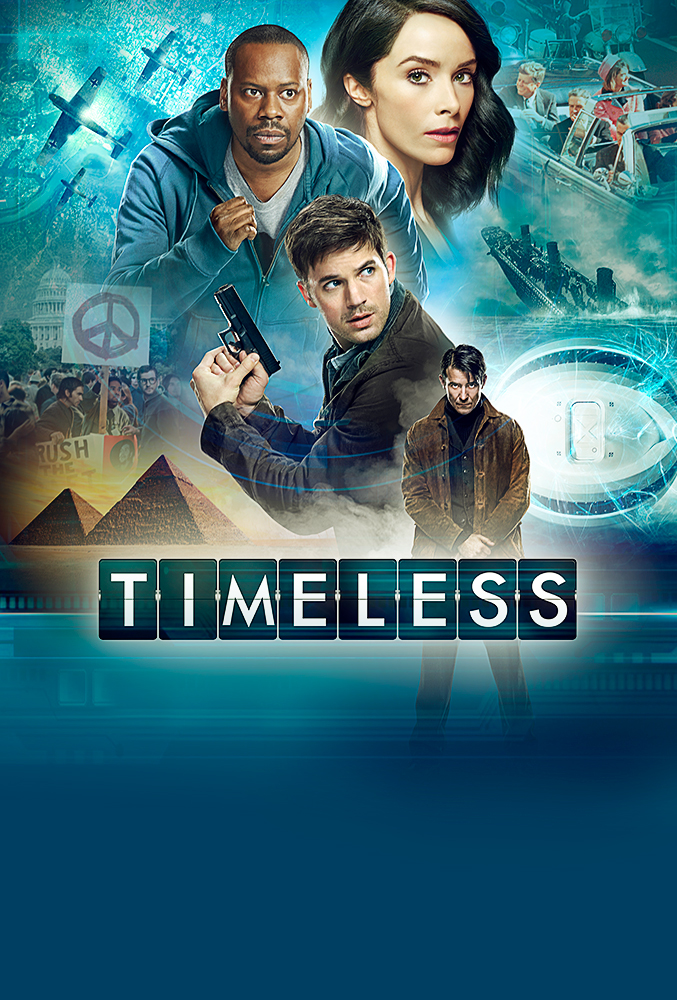
The initial episode of NBC’s new time travel series, Timeless (premiered Oct. 3, 2016), does a neat job of handling the classic trope of changing the past.  There’s more to that kind of plot than generally meets the eye.

Spoiler Alert!The following necessarily contains spoilers for the first Timeless episode, so if you haven’t seen it and want to, be careful when scrolling down.  I’ll drop another alert message at the point where the spoilers begin.Poster for Timeless

The Lure of the Past

Oddly enough, travel to the past fascinates us more than travel to the future.  One might expect it to be the other way around.  After all, we’ve been to the past.  The first classic time travel tale, H.G. Wells’ The Time Machine, concerned itself exclusively with the future.  But it’s backwards time travel that lets us imagine changing the present by altering its causes—and produces the causal tangles that are unique to time travel stories.

Larry Niven’s essay “The Theory and Practice of Time Travel” (found in All the Myriad Ways) points this out:  “When a child prays, ‘Please, God, make it didn’t happen,’ he is inventing time travel in its essence. . . . The prime purpose of time travel is to change the past; and the prime danger is that the Traveler might change the past.”

The Past Doesn’t Change

Some stories assume that the past can’t be changed.  The time stream protects, or heals, itself automatically once the moving present has passed.  There was an old-time SF story (anyone remember the title?) in which successive attempts to change history misfire because of progressively more unlikely accidents.  The gun misfires.  The bullet misses.  A bystander intercepts the bullet.  A meteor knocks the gun out of the assassin’s hand.  The hypothesis has an air of fate about it, as in the Greek myths.

But unchangeability needn’t be a matter of fate.  It may simply reflect the fact that the past event has already happened, incorporating any interventions from the future that may have taken place.  There is a single past event, which is the product of all its causes, whether they come from the event’s past or its future.  As TV Tropes puts it, “You Already Changed the Past.”  Robert A. Heinlein wrote some of the most famous time travel stories using this approach to generate “constructive” or “ontological” paradoxes—By His Bootstraps and “—All You Zombies—”.

A technology that only allows viewing the past, rather than interacting with it, falls into a similar category.  There’s no chance of changing things; we’re mere observers.  Isaac Asimov’s The Dead Past leaps to mind.

These kinds of stories are fun, but they don’t have quite the emotional appeal of “Make it didn’t happen.”

How A Change Propagates

Suppose, then, that we can change the past.  How exactly is that supposed to work?

A writer sometimes introduces a sense of urgency into the plot by imagining that a change in history propagates through reality in a process that itself takes time (of some sort).  This is what creates the tension in Back to the Future.  We can see Marty’s family gradually disappearing as his disruption of history works its way forward.  Presumably Marty disappears last because he was conceived last.  If he doesn’t reestablish history before he disappears, it’s all over.

This makes a weird sort of sense, because natural processes do normally propagate gradually.  Even gravity has its waves.  But it does result in the curious phenomenon of a reality that isn’t entirely self-consistent.  Marty’s parents never got married, but Marty himself is still inexplicably there.  (For the moment.)

It makes more sense, maybe, to picture the change as taking effect instantaneously.  Take away the causal “supports” for something, and it’s no longer there at all.  This assumption would have made Back to the Future a much shorter movie—and highlighted the “Grandfather Paradox” at the core of its plot.  The time lag gives Marty a chance to cure the paradox before it fully takes effect.

What Happens to the Traveler?

But we’re assuming that the causal ripple from history’s change follows the time traveler even when the traveler’s world line has looped around into the past.  What if that isn’t how it works?  (We’re inventing a theory of time travel; we can make what assumptions we wish.)  If the traveler is absent from the future when the change “gets there,” will the traveler be affected at all?

If the traveler is affected by the same change that affects everything else, we get a time stream that’s more consistent, but harder to tell a story about—because no one in the story will remember the change.  The traveler’s memory alters along with everything else.  (There’s an old SF story about this, too—and it only works because the reader is outside the story’s time stream.  At the end the bizarre monster that was human on page one proclaims, ‘the time experiment is over, and nothing has changed.’  The story only works from an omniscient point of view.)

So a time travel story almost always assumes that the traveler, who was out of the affected time region when the change occurred, remembers the old when she encounters the new.

Here Be Spoilers!

You Can’t Go Home Again

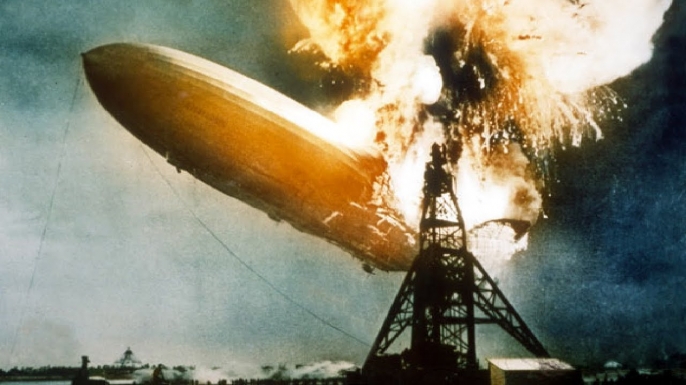
Here’s where Timeless comes in.  Villains of some sort—or are they?—steal the secretly developed time machine and set off to change history.  Our three heroes take the older prototype vehicle (a little less streamlined than a DeLorean) and follow.  They don’t quite succeed in preventing their adversaries from altering the past.  The Hindenburg explodes on its return trip, rather than on its arrival in America.Hindenburg disaster

When our heroes come back to the present, their colleagues believe the zeppelin had always exploded on its return trip—because the change in history has affected them.  The three travelers have to explain to them what’s changed.  In a sense, they no longer belong in the world from which they set out.  It’s an unusual and interesting situation for a TV series.

The Butterfly Effect

So far, we haven’t seen what larger alterations or political ramifications may have resulted, in this new world, from the deaths of several prominent figures on what was now the Hindenburg’s ill-fated second flight.  But the personal implications turn out to be devastating.

Butterfly effect graphicThe screenwriters also have a good handle on another time travel staple, the “butterfly effect,” named for the metaphor that in a massive chaotic system, a butterfly flapping its wings on one continent might result in a tornado in another (or, possibly, named for a classic Ray Bradbury short story).  When main character Lucy Preston comes home from her adventure in the past, she is overjoyed to find that her mother, comatose when Lucy left, is now perfectly healthy.  But Lucy is appalled to find that her beloved sister never existed.  How could the Hindenburg’s altered history have anything to do with this, she cries—and now she has new, and very mixed, motivations as to setting time back on its original course.

The show thus picks up on a theme that’s frequently neglected in a tale about changing the past.  Each change has unpredictable ramifications.  Marty McFly comes home to find his parents much improved, his siblings successful, and the despised Biff reduced to a cipher.  But what of all the people in town who will have interacted with the changed McFlys and Tannens over the past thirty years?  If even minor events can have large long-range effects, it may not be so easy to confine a temporal change to the intended consequences.

This means that our Timeless heroes may have no way to put things back the way they were.  The change may be essentially irreversible—a sort of temporal entropy.  Anything they do to counteract the bad effects of the original change will lead to still more alterations.  They really can’t go home again.

If the writers carry through this fascinating, if rather chilling, line of thought in subsequent episodes, we may get some really interesting story lines—as time goes on.

The Malleability of Myth

Our stories are always built on other stories.  We draw not only on real life, but on all the other tales, tropes, and archetypes that we’ve encountered.

Some of those stories are especially powerful.  They express patterns that seem particularly meaningful to us.  Tolkien and Lewis called these “myth”—not in the sense of something false,  a “lie breathed through silver,” but in the sense of something fundamental.

Some mythologies are works of imagination:  the Greek or Norse gods, Superman, Star Wars.  Some may be built on elements of truth:  the fall of Troy, King Arthur.  Some may be literally true, though we can select parts of the overall story and express them in imaginative terms—for example, the tales of the American Revolution (Hamilton or 1776,) or what Lewis called the Christian myth (The Prince of Egypt, The Nativity Story).

Whatever their sources, all these tales make up a reservoir of plots, characters, themes, and locales on which authors draw—our cultural inheritance.  In his famous essay On Fairy-Stories, J.R.R. Tolkien described it this way:  “Speaking of the history of stories and especially of fairy-stories we may say that the Pot of Soup, the Cauldron of Story, has always been boiling, and to it have continually been added new bits . . .”  (Pp. 26-27 as reprinted in The Tolkien Reader (Ballantine, 1966); p. 10 in this online reproduction of the full text.)

A good storyteller does not simply repeat a story verbatim.  We give it our own spin or flavor.  In doing so, we draw from the Cauldron elements from all sorts of other tales.  As they say, “When you take stuff from one writer it’s plagiarism, but when you take from many writers it’s called research.”

This is true even when we purport to be retelling an existing story.  The great tales tend to be open to reshaping.  But how far can we go with this sort of adaptation, and still claim to be retelling the original tale?  How much stretching and twisting can a given story take before it becomes something else altogether?


The best example may be the Arthuriad, the mythology of the Arthurian tales.  But that’s so large a subject that it deserves a discussion of its own.  A more manageable example is the story of Robin Hood.

One thing that helps us feel free to adapt is the lack of a single, “canonical” original version of the story.  Any presentation of The Lord of the Rings—the movie, for example—will be judged against Tolkien’s book.  But there is no unique original source for Robin Hood.  The earliest sources are a variety of medieval ballads, according to Wikipedia’s extensive discussion.

Cover, Roger Lancelyn Green, Adventures of Robin HoodWhen I went in search of a standard version of the Robin Hood tale for my children’s library, there was no single obvious choice.  There is an influential Howard Pyle version, The Merry Adventures of Robin Hood—I haven’t read it, but apparently it’s written in an invented antique English idiom that might not be ideally accessible to young people.  I ended up with Roger Lancelyn Green’s 1956 The Adventures of Robin Hood, which struck me as a good, middle-of-the-road retelling on which to start a young person.


There are enough different elements in the Robin Hood story to allow for a range of  interpretations.  On the surface, there’s the sheer romance of a band of rough but virtuous rogues living cheerfully in the forest:  the “Merry Men” theme. There is the legendary adept or quasi-superhero element:  Best Bowman Ever.  (At least, “best” until you get to Katniss Everdeen, Hawkeye, (Green) Arrow, and other successors — all of whom owe something to the Robin Hood archetype.)

There are also political themes.  The conflict between underdog Saxons and Norman aristocrats got tossed into the Cauldron in the nineteenth century, according to Wikipedia.  More specifically, Robin is often seen as defending the absent Richard the Lionhearted against Prince John’s machinations.  And of course one can focus on the economic aspect, robbing from the rich to give to the poor, and make Robin a hero of the 99% against the 1%.  The tale generally includes a strong romantic element as well.

We can see how these elements can be differently mixed in some of the movie versions, all of which are fairly successful.


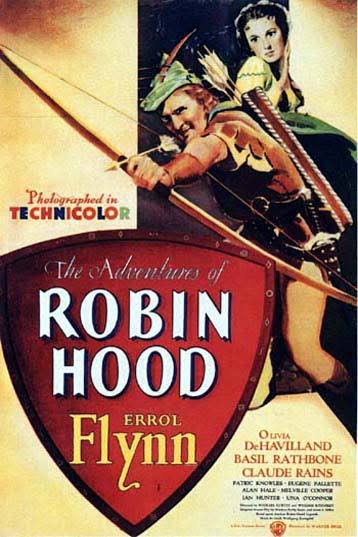
Poster, Errol Flynn, Adventures of Robin HoodIn the Errol Flynn classic The Adventures of Robin Hood (1938), Robin is good-humored and high-spirited.  Merriment abounds; the dashing Robin treats much of the action almost frivolously—“Where’s your love of fights, risk, adventure?”  He fights with a smile, like John Carter.  Marian says:  “he’s brave and he’s reckless, and yet he’s gentle and kind.”  In keeping with this light touch, much of the soundtrack music has an antic air.  Robin is an expert bowman, of course; we see this especially in the tournament/trap sequence (which seems to have been too frivolous to be used in the later movies, below).

The plot gives us Saxons versus Normans, with Robin a Saxon nobleman (though he had traditionally been portrayed as a yeoman).  In this version, the Sheriff of Nottingham is a fat fool; the villains are Prince John and Guy of Gisborne.  Richard is a noble and honorable king, though he has to be reminded of his homeland duties by Robin.  His return is protracted, and the politics is internal.  Robin (and Marian) speak for one England, not Normans against Saxons, under the one true king.  The climactic battle scene is essentially a civil war—John’s supporters against Richard’s.

Maid Marian is a pampered Londoner, a royal ward, though she comes over to Robin’s side promptly when he shows her the sufferings of the poor.  As usual, there is a competitor for her hand—in this case, Guy.  This Marian is not an action heroine.  She arranges the plan to save Robin from hanging after his capture, but it’s his men who execute the rescue.  The love story is a central thread, and the film ends with Robin and Marian rushing off from the celebration together.


Poster, Kevin Costner, Robin Hood - Prince of ThievesRobin Hood:  Prince of Thieves, starring Kevin Costner (1991), presents a more serious treatment.  Wikipedia describes it, accurately, as a “romantic action adventure.”  The Merry Men angle appears only vestigially, befitting Costner’s somewhat dour screen presence.  The Expert Archer trope certainly makes its appearance, as Robin makes progressively more unlikely bowshots to save the day.

Costner’s Robin is again an aristocrat, allying himself with the downtrodden when he returns from the Crusades.  (The notion that Robin had been on crusade with Richard is unusual:  he is usually seen as being driven to outlawry while Richard is away.)  We have the traditional Saxon-Norman conflict, complicated by throwing in a batch of wild-card Celts as well.  But the ethnic or class difference is not prominent; it is expressed primarily as a revolt against the weirdly evil and almost demented Sheriff of Nottingham.  Curiously, Prince John is not mentioned at all.  But King Richard does make an appearance at the very end, to bless the romance.  (In an entertaining nod to film history, Richard is played by Sean Connery, who had himself played Robin Hood in 1976’s Robin and Marian.)

Prince of Thieves leans heavily on the romance.  Marian, a local aristocrat, was acquainted with Robin when they were children—she despised him.  She takes a shine to him, however, after Robin returns to find the Sheriff has murdered Robin’s father.  Here it is the Sheriff who has designs on Marian’s virtue.  The romantic drama rides on Michael Kamen’s epic score for the music—with a main theme so good that Disney has come to use it as the generic musical cue for Disney’s logo.


Poster, Russell Crowe, Robin HoodThe most recent movie version is called simply Robin Hood, directed in 2010 by Ridley Scott, starring Russell Crowe.

Crowe’s Robin is serious-to-grim; no frivolous japes here.  Like Costner’s version, Crowe’s is returning from the Crusades with Richard.  But this Robin is a common archer, not a nobleman.  He does some fancy shooting, but he spends more time swordfighting.  In the climactic battle, he leads a more traditional cavalry charge—and on a beach, not in a forest.  (He does, however, deliver the final coup de grace to Godfrey the villain with a bowshot.)

This film’s whole atmosphere is more cynical than in either of the two versions described above.  For example, where Errol Flynn’s Robin gives King Richard some home truths and is honored for it, Crowe’s Robin gets put in the stocks for giving Richard an honest evaluation, even though Richard specifically asked for honesty.  The movie makes a few more nods to actual history, in the relationships of John, Richard, and Walter Marshal—though with a few minor tweaks, such as an imaginary French invasion.  (The Wikipedia page lists several criticisms on the history.)  Richard is killed near the beginning, in France, rather than returning triumphantly to England.  The focus is more on international politics than in the two preceding versions:  the big final battle here is against the French.

For most of the story, this Robin doesn’t live in the forest.  Nor is he precisely an outlaw, though he and his friends do stop one shipment of grain as “men of the hood.”  Rather, his central role is as a somewhat anachronistic voice for democracy.  Robin’s father Thomas Longstride was a “visionary” who believed in raising up all people; the repeated slogan is “Rise, and rise again, until lambs become lions.”  Thomas wrote a charter of rights, signed even by barons.   In one of the few nods to the Merry Men, these rights include the right for each man “to be as merry as he can”—a livelier form of “the pursuit of happiness.”  There’s a reference to “liberty by law,” as opposed to the despotism of a “strongman” tyrant.  Marion too, though she’s a lady, is shown doing mundane chores alongside the farmers (Robin originally mistakes her for a farm girl).

In this version, the Sheriff is practically a nonentity.  John and the character representing Guy, who has mutated into “Godfrey,” are the villains.  Here John is a much more ambiguous character, rising to an almost heroic role at the climax.  But he then throws that role away by refusing to sign the Magna Carta—a historically dubious twist—and condemning Robin.

The romance element is also strong here, though to some extent it takes a back seat to politics (Wikipedia describes the movie as an “epic historical war film”).  Robin finds himself pretending to be the deceased Sir Robert of “Loxley” on his return to England.  At the real Robert’s father’s insistence, he steps into Robert’s shoes—including becoming (for public relations purposes) “husband” to Robert’s wife Marion.  This puts us somewhere in the region of the “Marriage Before Romance” trope, and allows for some endearing scenes as the two begin to fall for each other.

Marion herself is stronger and more assertive here than either of her film predecessors above (harking back to Green’s description of Marian as an “expert fighter,” p. 222).  She’s competent with sword and bow work; she frees her villagers; she even joins the final battle, in an Eowyn-style armor disguise.  At the same time, she still needs to be rescued occasionally, and is again pursued by unwanted romantic attention from the Sheriff.

In place of the usual happy ending, Robin is finally declared an outlaw at the very end—riding off into the sunset, as it were, as a perennial spirit of rebellion.  “And so the legend begins,” a title tells us.


As noted above, my view is that all of these movie treatments work, despite their varied treatments of Robin’s character, his martial prowess, the political angles, the villains, and the romance.  They all seem to be acceptable ways of telling the Robin Hood story.  One can appreciate the same tale rendered in a number of different ways, mutually inconsistent in their details, but able to coexist in the viewer’s mind.

On the other hand, there are limits to this variability.

The Robin Hood subgenre also offers an example of distorting the underlying myth too far — stretching the rubber band till it breaks.  Robin McKinley’s novel The Outlaws of Sherwood tries so hard to avoid the usual tropes that, in my estimation, it fails as a Robin Hood story.


Cover, Robin McKinley, Outlaws of SherwoodMcKinley’s Robin is anything but merry—he’s a gloomy, plodding yeoman forest ranger.  The Norman-Saxon conflict is active, but Robin has no political awareness at all; he has to be chivvied into revolt by Marian and Much the miller’s son, who handle most of the overall strategy.  Adding insult to injury, he can’t hit the broad side of the barn with an arrow.  All the fancy shooting is done by others, including Marian.  This is a pleasant nod to female action-hero equality, but leaves our image of Robin himself sadly lacking.

About the only thing McKinley’s Robin is good at is provisioning a comfortable forest home for his followers and their families.  You might say he makes a fine quartermaster, but he’s hardly a leader.

The political themes are muted.  Guy and the Sheriff are the villains, and larger national or international issues are not prominent.  Richard the Lionheart does appear, to receive the main characters’ fealty and thus end their outlawry, though he then takes them to the Crusades as a sort of penance.

The Robin-and-Marian romance is integral to the story, but it proceeds in slower and more complex ways than in the movies.  Robin is hesitant and tongue-tied, the opposite of the dashing Errol Flynn.  Only when Marian is injured, after taking Robin’s place in the famous tournament, does he admit to loving her.

McKinley is aware of the way in which authors construct tales in different shapes as they draw their preferred elements from the Cauldron of Story.  She notes in an afterword that “[m]any people have strong ideas about who Robin was and what he was like; and a lot of our ideas are as incompatible with each other as they are with history” (p. 277).  Her version has its points; but to my mind, it stretches the main themes and tropes too far to be a satisfactory iteration of the Robin Hood legend.


We can adapt a myth in any number of ways, but not infinitely many.  There are boundaries that must be observed if the story is to remain recognizable at all.  A story seems to have an “essence,” and violating that essence makes it into something different.  The something different may be valuable in itself; it isn’t necessarily a bad thing to adapt familiar bits from the Cauldron of Story into a new tale.  But that—of course—is another story.