Arabella of Mars

Arabella of Mars book coverArabella of Mars, by David D. Levine (New York:  Tor, 2016), may be described as a Regency steampunk planetary romance.  Better yet may be the flyleaf testimonial from Madeleine Robins:  “If Edgar Rice Burroughs, Jules Verne, and Patrick O’Brian had sat down together to compose a tale to amuse Jane Austen, the result might be Arabella of Mars.”

Genres are getting complicated these days.  But sometimes that cross-fertilization produces some entertaining mixes.

Our young heroine’s British family maintains a plantation on Mars, as if it were the Caribbean islands or India at the dawn of the nineteenth century.  The native Martians, filling the role of the local population, are considered primitive by the British colonists.  In this respect the setup is faintly reminiscent of the Martian sequence in Heinlein’s The Number of the Beast.

Physically, however, Levine’s Martians are more reminiscent of the green Martians of Burroughs’ Barsoom:  large, nonhuman, living in a desert world.  In keeping with modern sensibilities, the “natives” actually possess a respectable culture and can be formidable opponents.  This accounts for the “planetary romance” aspect—“an extension of late 19th and early 20th century adventure novels and pulp romances to a planetary setting,” as Wikipedia describes the genre.

When tomboyish Arabella is removed with her mother and sister to Earth, the Austen angle takes over.  Arabella finds the Regency-era dinner parties and promenades boring; she’d rather be tinkering with mechanical piano-players and other automata.  The swiftly thickening plot, which involves period devices like entailed estates, forces our heroine to disguise herself as a boy and take a menial position on an East India, er, Mars Company vessel bound for Mars again.

At this point the Burroughs and O’Brian factors collide in an extraordinarily droll description of the Age of Space as an Age of Sail.  Captain Jack Aubrey would have been perfectly at home on the quarterdeck of this interplanetary ship crewed by rough sailors and featuring three masts, not in a row, but protruding from the top and sides of the boat at 120-degree angles.  The Diana is lifted by hot-air balloons (coal-fired, of course) into the extremely high-speed interplanetary air currents, which make travel to Mars a matter of a few months.  These vessels are reminiscent of Burroughs’ Barsoomian airships, bringing us back to the planetary romance theme.

Levine gives us with a straight face his depiction of a Solar System filled with breathable air, without deigning to worry about trivialities such as how the planets could maintain their orbits in such a resisting medium.  The absurdity of the premise simply makes the description more delightful.  As we deal with pirates on the (very) high seas, stop at a convenient asteroid to cut down trees for repairs, and make charcoal to fuel the balloons for the perilous descent to Mars, one can only ride along enjoying Levine’s inventive adaptation of one set of tropes into an entirely different world.

But it’s not just silliness.  The book isn’t a farce.  There’s a good sound story with believable characters strung through this cockeyed worldbuilding.  There’s even a real romance, in the love-story sense, though this plays a somewhat muted role.  Overall, the tale has more of the sea story than of the Regency romance about it.  But it might serve an aficionado of either genre as a cordial introduction to the other.

The novel is billed as “Book One” of “The Adventures of Arabella Ashby.”  One can only imagine what sort of eccentric scenarios might come next.  (For example, I don’t believe anything has yet been mentioned about Venus—which is bound to be a jungle world, perhaps with dinosaurs, if it’s based on the Burroughs-Heinlein model.)  I look forward to seeing where this whimsical tale may lead.

Building a Conversation

Telling a story requires us to juggle numerous things at once.  The best example may be writing conversations between two or more characters. Image of word balloons

Dialogue scenes make up a good bit of most books (and almost the entirety of most stage plays).  A dialogue scene has to perform some function in the story, or it shouldn’t be there at all.  But it also has to be realistic—it has to sound like the way people talk.  Not exactly the way people talk, of course.  In fiction we strip out the hemming and hawing, the repetitions, the false starts, that one sees in a sociologist’s literal narrative of actual conversation.  But it has to flow the way real conversations do.

How can we achieve both things together—story function and plausibility?

The purpose of a discussion scene in the story may include things like advancing the plot, displaying and developing the characters, and providing necessary background information.  If the scene belongs there at all, we probably have an idea what at least some of those purposes are by the time we’re ready to write the scene.

I find it useful to note down in advance what points I want to cover in a conversation.  Let’s say this scene has to get A to persuade B to do something.  How will that happen?  What are some of the things A can say to get B moving—logical reasons, spurious reasons, deceptions, appeals to emotion?  What are some of the things B might say in response?

We can brainstorm such possibilities and note them down in bullet points.  If there are side issues that can be addressed in the course of the discussion—showing what A thinks of B, or what B is afraid of—put those down too.  The characters may also be doing something at the same time—not just sitting around a conference table, but eating a meal, hacking their way through a forest, building a Lego model of the Empire State Building.  If any of that is relevant, or useful, or entertaining, note it down.  We’re compiling points to cover for plot purposes, as well as good bits that we may want to get purely for entertainment.

(Of course the bullet-point method is just one way, not the only way, of starting to plan a conversation—but I find it a useful technique for getting all the raw material together in one place.)


So we’ve got a list of points that we want to get into the dialogue somehow.  But how does the conversation flow?  How do we segue from one topic to another?

Up to now, we’ve been planning out the scene in much the same way we would outline an article or presentation in discursive writing—nonfiction.  But here’s where the approach needs to be different, because making the scene believable means tracking the way a conversation actually meanders along.

An article or advocacy piece proceeds logically, building up in organized fashion to a conclusion.  But people don’t generally talk that way even when they’re debating.  Conversation proceeds not by the logic of argument, but through something more like free association.  Something A says makes B think of an independent gripe, and the smooth progression of A’s argument collapses.  Emotional connections drive the developing dialogue as much as logical connections do.

When we sort the bullet points into order, then, in preparation for expanding them into actual narrative, we want to do it based on the way conversations develop in our own experience, as adapted for the specific characters and situation in the story.  Where might these characters start?  What would come up next?  How can we put the conversational moves in order so they all get covered—like drawing a curve through a certain set of points?

In shaping this process, it’s great to be the author, controlling what everyone says.  In real life, no one participant controls the whole exchange (much as some of us might like to).  The author, on the other hand, can exercise backward causality or teleology.  We can have the earlier lines shape the conversation so it arrives at a particularly good line or key point—as long as each transition is a plausible reaction by the characters to what has been said before.

Once we start writing the conversation, converting the bullet points into actual narrative, things may—and will—change.  When we get into the flow of the dialogue, we often find that a transition that initially seemed natural sounds forced, and we have to go about it another way.  Or we discover that the way an exchange turns out, there’s a quicker way to get where we want to go.  We see an opportunity for a really great line—can we work that in, or will it redirect the discussion too much?  As in most things, we need to remain free to improvise as the scene develops.


I mentioned the chance to get in a “really great line.”  This reminds us that we also need to be thinking about whether the dialogue itself is entertaining—enjoyable to read.

This may be partly a personal bias:  I love witty dialogue.  But the point has broader importance.  I’ve plowed through a lot of writing where a conversation advances the plot, but it’s tedious, dull, uninteresting to read.  If we as reader are just suffering through the dialogue so it will lead us functionally to the next scene, something is missing.  After all, the reader’s primary purpose is not just to get to the end of the book, but to enjoy the ride.

To my mind, then, we must always keep a triple view in mind when writing a conversation:  (a) What would move the story along, serve its purposes?  (b) What would come naturally to the characters in this situation—what would they be likely to say next?  (c) What would entertain the reader?  Good dialogue must satisfy all three criteria.

To put it another way, we should ask ourselves what a conversation is doing in the story both from the author’s point of view (the story purpose), and also from the characters’ point of view (why are they saying these things at these moments, what is the natural drift of the dialogue).


Of course the above represents the observations of a relative novice.  For some really cogent discussion of dialogue from a professional writer, I recommend a series of Patricia Wrede’s blog posts, starting here (12/2/2016) and continuing across the five following entries, ending here (1/6/2016).


(For an amusing image of how not to build a conversation, I refer you to a classic Marvel spoof back in 1967 . . .)

Star Trek: Raiders of the Lost Arcs

I’m a Star Trek fan from way back.  I enjoyed “Star Trek:  Beyond.”  Why am I not more enthusiastic?

Star Trek Beyond posterStar Trek:  The Original Series (“TOS”) was almost purely episodic.  Each week, another new world or new civilization, a unique problem, a nonrepeating set of guest stars.  Each episode stood pretty much alone.  You could miss one and not be at a loss when you saw the next one, because nothing had changed.  The original “setup” was restored at the end of every show.

This wasn’t unique to Trek; it was the norm on television back in the 1960s.  “Situation comedies” were defined by a permanent “situation” that formed the basis of each week’s program.  Dramatic shows like “Bonanza” or “The Man From U.N.C.L.E.” used the same method.  No matter what happened in the course of one episode, things were back to normal by the opening of the next.  The reductio ad absurdum is “Gilligan’s Island.”  There was a melancholy certainty that no matter how hopeful things seemed, they were never getting off that island.

Of course this was never entirely true.  One of the Cartwright sons on “Bonanza” was Cartwritten out of the script and disappeared.  Chekhov joined the Enterprise crew in the second season of Star Trek and stayed on thereafter.  But mostly, the “initial conditions” for each episode remained the same.

What we did not see was long-running plot arcs or character development.  Each plot had to wrap up neatly in a single episode.  Characters and relationships were static.

It’s instructive to look back and realize how much this has changed.  TV series these days are expected to have long-term plot arcs, often spanning a season or more.  A series like “Chuck” might change the plot premise significantly from one season to the next.  And viewers today are addicted to mini-series (maxi-series?) with extremely long and complex plots, as in “Game of Thrones.”


As the Star Trek movies came out, it presently began to seem that we were essentially seeing series episodes, but stretched out to two hours rather than one.  It left a vague feeling of being cheated.

In a typical two-hour movie, there’s time for more leisurely plot development, and one expects things to happen.  Sure, there are long-running series like the James Bond movies that cycle back to the same scenario just as the old TV series did.  But that isn’t true of most movies.  Even sequels frequently find themselves starting at a new point in narrative or character development—which was a challenge for moviemakers who merely wanted to reprise the success of the original film.

If we pass in merciful silence over Star Trek I (“The Motion Picture”), the striking thing is that the next three movies did have a continuing plot arc.  I’ve heard that they were plotted as a coherent trilogy by Harve Bennett, and that does seem to be borne out by the movies themselves.

While Star Trek II, III, and IV represented remarkably different types of films, there was a continuous thread of action.  The Enterprise crew created the Genesis planet in II, returned to that planet and saw its collapse in III, and made their own return to Earth in IV.  With side trips, of course.

And there were character changes.  One of the things that makes Star Trek II the best of the Trek films is the impact of Spock’s death, around which the entire story is carefully constructed.  Of course fans were pretty sure even then that his death wouldn’t be permanent.  But the characters didn’t know that, and we got to see how this loss affected them.  And Kirk’s son David Marcus did die for good in III—though this new character’s death didn’t have the impact of Spock’s.

Star Trek V and VI, however, were unconnected stories riffing on the same traditional characters, and momentous as the writers tried to make them, there was a distinct sense of “back to the old grind.”  VII was somewhat unique, as the intersection of the TOS crowd with “The Next Generation” (TNG) characters.  But the following movies, VIII through X, were very like individual episodes of the TNG series.

The three films beginning with the 2009 reboot also strike me as standalone episodes.  The occasional attempt to tie them back to other storylines, as with the appearance of Khan and Carol Marcus in “Into Darkness,” is offset by the disconnection from all earlier stories stemming from the timeline change in the 2009 movie.

So this year’s Star Trek entry strikes me as okay, but it lacks the cumulative force of a long-term plotline—unless perhaps you take a strong interest in the desultory Spock-Uhura romance, which so far hasn’t gripped me.

By contrast, series that do have long-term plotlines and character developments, as in Star Wars and Harry Potter, can build up quite a head of steam—and corresponding viewer loyalty—through the accumulating drama of an extended story.


The fact that we now expect long-form plot arcs makes for an interesting countercurrent to some of the standard assumptions about today’s audience.

It sometimes seems that we have all been seized by a collective attention deficit disorder.  Writers are warned to “hook” their readers, not in the first page or even paragraph, but in the first sentence.  Communication packets have been reduced to 140 characters.  It’s easy to bemoan how rushed we all are, and how short our attention spans.

But at the same time, modern viewers take in stride a series of six or seven movies.  Harry Potter brought a generation of viewers through eight lengthy parts without blunting their appetite for more Potteriana.  TV series routinely carry on long-drawn-out developments.  Novel readers happily consume endless serials like the Honor Harrington tales, or the fourteen massive volumes of Robert Jordan’s Wheel of Time.  By today’s standards, the 1800-page Lord of the Rings, touted as a huge work in the 1960s, seems positively concise.

To my mind, this says something favorable about today’s readers and viewers.  We’re fond of the sound bite and tweet, yes—but we also seem willing to tackle much longer stories than in the olden days.  There may be hope for coherence and continuity yet.

The Backyard Spaceship

When I was little, my father told me he had a spaceship of his own, hidden back in the woods.  As an ardent space fan, I was wildly enthusiastic.  It was when he told me it was propelled by a hamster running in a wheel that I began to suspect he was putting me on.

But I wanted to believe it.

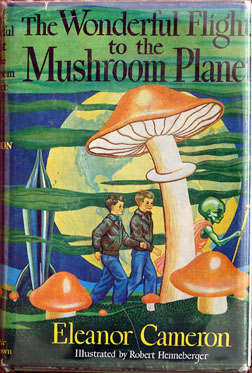
There’s a certain SF tradition of spacecraft built, more or less, in one’s backyard.  Of course, “backyard” may not be literal.  I’m thinking of spaceships constructed on an amateur basis, privately, and usually—though not always—by young people.Cover, The Wonderful Flight to the Mushroom Planet

This was the appeal of a childhood favorite of mine, Eleanor Cameron’s The Wonderful Flight to the Mushroom Planet (1954).  Two boys (“between the ages of eight and eleven”) are recruited by a newspaper ad to put together a small rocket ship for the mysterious Mr. Tyco Bass, a small wispy man who turns out to be a “spore person.”  They fly the ship to a previously unknown miniature moon, “Basidium,” inhabited by other spore-based mushroom people.

Cameron is pretty good with her scientific facts—which means she lampshades the impossibilities carefully.  A rocket built by two kids isn’t going to get off the ground without plentiful helpings of what TV Tropes calls “Applied Phlebotinum,” the unexplained stuff or device(s) necessary to make the plot work.  A classic example is the faster-than-light space drive needed by a Star Trek or Star Wars story.  If the authors could explain how it worked, they wouldn’t be writing a story; they’d be off to the patent office and rake in billions.  Instead, the author and reader tacitly agree to postulate the necessary gizmo or substance for purposes of the tale.  It might as well be magic, in the sense of Clarke’s Third Law—“Any sufficiently advanced technology is indistinguishable from magic.”

Here, Mr. Bass supplies several crucial “inventions” needed to make the boys’ ship spaceworthy.  He provides the rocket motor, the special fuel, the clear sealant that makes the hull airtight, and the “oxygen urn” that provides breathable air—not to mention the “Stroboscopic Polaroid Filter” that allows a telescope to detect the otherwise-invisible Mushroom Planet.  These “phlebotinum” features make the boys’ vessel a little more plausible than my dad’s Hamster Drive.Cover, Rocket Ship Galileo

A more believable example (once you’re out of the middle grades) is Robert A. Heinlein’s Rocket Ship Galileo (1947).  The project here is a private enterprise, with the spacecraft modified from an existing transcontinental “freighter-rocket” by four teenage boys.  They are, however, accompanied by one adult, Dr. Donald Cargraves, an uncle of one of the boys.  Cargraves provides the engineering expertise and the atomic drive he’s just invented, which (to paraphrase Doc Brown) “makes space travel possible.”

Starting with an existing well-equipped vessel, and kids who are already experienced amateur rocket-builders, makes the setup immediately more plausible.  Realistically, it takes months of elbow grease to do the conversion.  The Galileo isn’t actually built in a backyard, but out in the desert.  Still, the idea that kids like you or me could help build the first rocket to the moon is front and center in this story, which formed part of the basis for the early SF movie “Destination Moon.”

The notion of private-sector spaceflight was a favorite of Heinlein’s.  That theme reappears in his novella The Man Who Sold the Moon (1951), which also contributed elements to “Destination Moon.”  In that tale, however, the participants were all adults, and the project was a large and highly-publicized corporate endeavor more like the work of today’s SpaceX or Blue Origin.

A fully grown-up version of the backyard spaceship can be found in the widely influential first novel by E.E. “Doc” Smith, The Skylark of Space (1928, originally written about a decade earlier).  When scientist Dick Seaton stumbles upon an unknown substance that can be used to produce immense energy, his wealthy friend Martin Crane underwrites the construction of a spherical spacecraft to harness that power.  The work is started on Crane’s extensive property—not exactly a backyard, but close—and continues secretly in an independent steel plant after skulduggery enters the picture.  No kids are involved, but the private, secret, and essentially amateur operation makes Skylark an ancestor of this space opera trope.cover, Red Thunder

We might consider this theme an artifact of the naïve early days of SF, but for its reappearance in John Varley’s 2003 novel Red Thunder.  The passage of time has made some differences.  The protagonists are young adults, though they compose a motley group that still reads like “kids” to me (or perhaps it’s just that I’m that much older myself).  Their goal is Mars, rather than the Moon.  The requisite adult supervision, or phlebotinum contribution, is supplied by Travis Broussard, a cashiered former astronaut, and his quasi-autistic genius brother Jubal, who has invented a “squeezer” force field that turns out to be a fabulous rocket drive (among other uses).  Varley’s methodical development of the funding, engineering, and planning for the homegrown spacecraft (built out of a railroad tank car) makes the amateur project believable even for a contemporary audience.  Wikipedia describes the resulting adventure as an homage to Heinlein’s juveniles—since it’s essentially a Rocket Ship Galileo for the 21st century.


Why are we so fond of the backyard spaceship?

This kind of plot enshrines the long American tradition of inspired tinkering, from the Wright brothers and Edison, to Tom Swift, to 1950s kids with hot rods, to space kids with hotter rods (Luke Skywalker asking to go into town for parts to soup up his landspeeder).  The clever gadgeteer is a permanent part of our mythology, right down to Bill Gates and Paul Allen in their garage.

More than that, the idea that ingenious amateurs could conquer space has a democratic, underdog quality that appeals to our mythmaking imaginations.  We love the idea that spaceflight could be easy and accessible to the ordinary person.  It’s a natural evolution of the way we root for the underdog in politics or war (the Ewoks in “Return of the Jedi”).  We cheer for the underdog just as much in personal life—for Cinderella, whose story exhibits, as Chesterton says, the lesson exaltavit humiles—“he shall lift up the humble.”

The backyard spaceship promises to lift the humble right off the earth, in the ancient dream of flight.  It makes for great inspiration, if dubious engineering.  And after all, the most sophisticated aeronautical engineer starts out as a wondering child and an aspiring teenager.  Our dreams rest among the stars; but the journey begins in our own backyard.

Recklessness

The name of the title song from Martina McBride’s album “Reckless” (released April 29, 2016) matches that of another favorite of mine, Alabama’s “Reckless” (1993).  What strikes me most is the difference in what the songs say.

Martina McBride - Reckless (album cover)Here are the links:

Martina McBride’s “Reckless”:  music video; lyrics; Wikipedia entry (album)

Alabama’s “Reckless”:  fan video with lyrics; just lyrics; Wikipedia entry

I’ll refer to the songs by their performers, but since I’m talking about the words, it’s really the lyricists at work (though the music, as in any good song, reinforces the lyric—and vice versa).  For McBride’s song, the writers are Sarah Buxton, Zach Crowell, and Heather Morgan; for Alabama’s, Michael Clark and Jeff Stevens.


Alabama’s song is an ode to spontaneity, with its overtones of rebelliousness and adventure.  The singer and his girlfriend are dissatisfied with life in their Texas small town.  He wants them to take off somewhere else, anywhere else.

The refrain begins with “Let’s roll the windows down…”  Since this song came out, I can’t count the number of country singers I’ve heard rolling their windows down for exactly the same reason.  It works, too.  “[L]et the wind blow through our hair” – what suggests excitement more than air streaming past our faces?  The refrain ends with the inevitably suggestive line, “Let’s get reckless tonight.”

But the overall message is clear in the bridge:  “When you’re crazy in love you gotta take a chance, / Burn the bridge and don’t look back.”  Love, in other words, requires recklessness.  (Despite being burned, however, the bridge remains intact in the song.)

This trope is firmly rooted in classic American tradition.  It lines up with a long tradition of such anthems.  Wilson Phillips’ “Impulsive” comes to mind, where “reckless” is the second adjective the singer applies to herself (to her own surprise) in the refrain.

Love of spontaneity has a much broader reach than love songs alone.  Our fascination with the impulsive, boundary-breaking individual includes, for example, the recurrent trope of the “loose-cannon cop who doesn’t play by the rules” (TV Tropes calls it Cowboy Cop).  The attitude is canonized in the “chaotic good” alignment featured as one of the options in Dungeons & Dragons and other role-playing games (you can find descriptions on Wikipedia, TV Tropes, or elsewhere).


Twenty-three years later, McBride’s take doesn’t quite follow the trope—or does it?  Clearly, we are supposed to be attracted by the singer’s portrait of a wild and impulsive woman.  But the narrator’s actual description of herself isn’t favorable.  The song opens:

For stumbling through a mess of dances
For squandering my second chances
For wrecking every dream
And breaking everything I ever had . . .

The singer seems to be sorry about her ungoverned behavior, or ashamed of it.  She even calls it “criminal” in the refrain.  She feels her beloved cares for her despite this chaotic quality, not because of it.

Originally I wondered whether this new song represented a change in attitudes over time.  We are highly sensitive today to unintended consequences, including “collateral damage”—in everything from environmentalism to superhero movies (the damage caused by epic battles is a major plot driver in this year’s Captain America: Civil War and Batman v. Superman: Dawn of Justice).  One might suspect we’re becoming less enthusiastic about recklessness than we used to be.

On the other hand, we’re still getting just as many images in which operating outside the law is seen as a good thing.  The screenwriters’ sympathies seem to lie more with the “chaotic” side in both those films.  It would be rash to imagine a reversal of so pervasive an attitude based on one song.


But there’s more to it:  McBride’s song has another layer.  Her lover’s willingness to cope with her erratic nature also represents daring or courage.  The last lines of the refrain are:  “For loving me the way you do—I know I’m reckless—but you must be reckless too.”  Loving someone who is so uncontrolled is its own form of recklessness.

This kind of risk-taking appears in the song as a good thing.  She—and we, the listeners—want him to take that chance.  Only when he does so can he prize who she really is, and see her lovableness:  “For looking in my eyes and seeing the soul inside . . .”  It’s the difference between acting unthinkingly or destructively, and taking a desperate risk in a good cause.

McBride’s “Reckless,” in other words, draws our attention to the fact that there is a certain kinship between the kind of recklessness that represents pure spontaneity (and can go drastically wrong), and the kind that dares to take the necessary risks to love someone.  And, yes, can also go drastically wrong.

This truth holds to some extent for everybody.  None of us is ideal and unexceptionable.  We’ve all squandered opportunities and stumbled through life.  Committing ourselves to any of us flawed human beings means taking chances.  Love always requires courage.

What McBride’s song tells us, then, is that there are some risks that must be taken; and love is one of them.  On this, the two songs come back together—Alabama also told us we had to take chances to be “crazy in love.”

It’s one reason we might say, with that well-known sage Rich Burlew, “Love is an Epic-level challenge.”