The Good King (reprise)

Watching The Lord of the Rings movies again recently, to share the experience with my wife, brought to mind this post from eight years ago.  Here it is again, with minor updates.

I began to wonder some years back about the curious preference for monarchy in futuristic settings.  In the world at large, monarchies have been retreating in favor of republics and democracies, at least in theory, since 1776.  Why are SF writers so fond of equipping future societies with kings, emperors, and aristocracies?

Star Kingdoms

We can pass lightly over the old-time, pulp-type stories where royal rule is merely part of the local color:  Burroughs’ A Princess of Mars (1912), Edmond Hamilton’s The Star Kings (1949), E.E. Smith’s The Skylark of Space (1928) with its Osnomian royal families.  Here, like flashing swords and exotic costumes, monarchy is simply part of a deliberately anachronistic setting.  Similarly in high fantasy, where aristocracy comes naturally in the typical pseudo-medieval milieu.

But we see royal or aristocratic governments in more modern stories too.  Asimov’s Foundation stories are centered around a Galactic Empire. (See also the more recent Apple+ series of the same name.)  Since that series was based on Gibbons’ The History of the Decline and Fall of the Roman Empire, an Empire was inevitable.  Similarly in Star Wars, which draws heavily on Asimov.  Jerry Pournelle’s CoDominium future history has a First and a Second “Empire of Man.”  David Weber’s heroine Honor Harrington serves the “Star Kingdom of Manticore” (later “Star Empire”), modeled closely on England around 1810.  Lois McMaster Bujold’s Vorkosigan Saga contains a number of polities with different forms of government, but many of the stories focus on Barrayar, which has an Emperor.  Anne McCaffrey’s popular Pern series has no monarch, but has two parallel aristocracies (the feudal Holders and the meritocratic dragonriders).  It got to the point where I began to feel a decided preference for avoiding monarchical or imperial governments in SF storytelling.

The Lure of Kingship

Aragorn with crown

There’s something that attracts us in royalty—or we wouldn’t see so much of it.  I encountered this puzzlement directly.  As a kid reading The Lord of the Rings, I was as moved as anyone by the return of the true King.  I asked myself why.  If I don’t even approve of kingship in theory, why am I cheering for Aragorn?

The reasons we’re drawn to monarchy seem to include—

  • Kings are colorful. (So are princesses.)
  • Stability
  • Personal loyalty
  • Individual agency

The first point is obvious, but the others are worth examining.

Stability

It’s been pointed out that even in a constitutional government, a monarch provides a symbolic continuity that may help to hold a nation together.  British prime ministers may come and go, but the King, or Queen, is always there.  This gives some plausibility to the idea of a future society’s returning to monarchy.

Something like this stabilizing function is behind commoner Kevin Renner’s half-embarrassed harangue to Captain Rod Blaine, future Marquis of Crucis, in Niven & Pournelle’s The Mote in God’s Eye:  “maybe back home we’re not so thick on Imperialism as you are in the Capital, but part of that’s because we trust you aristocrats to run the show.  We do our part, and we expect you characters with all the privileges to do yours!”  (ch. 40)

Unfortunately, relying on the noblesse oblige of the aristocrats doesn’t always work out well.  It depends on who they are.  For every Imperial Britain, there’s a North Korea.  When the hereditary succession breaks down, you get a War of the Roses or Game of Thrones.

Too much depends on getting the right monarch.  By the law of averages, it doesn’t take long before you get a bad ruler, whether by inheritance or by “right of conquest”—and you’re up the well-known creek.

Personal Loyalty

Personal loyalty appeals to us more strongly than loyalty to an institution.  One can pledge allegiance to a state—but even the American Pledge of Allegiance starts with a symbol:  the flag, and then “the Republic for which it stands.”  Loyalty to an individual moves us more easily.

This kind of loyalty doesn’t have to be to a monarch.  Niven & Pournelle’s Oath of Fealty explores how loyalty among, and to, a trusted group of managers can form a stronger bond than the mere institutional connections of a typical modern bureaucracy.  One can be faithful to family (the root of the hereditary element in kingship), to friends, or even an institution or a people.  But it’s easiest with an individual.  This loyalty is the basis for the stability factor above.

Individual Agency

The vast machinery of modern government sometimes seems to operate entirely in the abstract, without real people involved.  “Moscow said today . . .”

In fact it’s always people who are acting.  But it’s easier to visualize this when you have a single person to focus on.  “When Grant advanced toward Richmond . . .”  In the extreme case, we have the ruler who claims to embody the state in his own person:  “L’état, c’est moi” (attributed to Louis XIV, the “Sun King” of France).

In a fascinating 2008 essay, Jo Walton quotes Bujold on political themes in SF:  “In fact, if romances are fantasies of love, and mysteries are fantasies of justice, I would now describe much SF as fantasies of political agency.”  A science fiction character is frequently involved in effecting a revolution, facing down a potential dictator, or establishing a new order—exercising autonomous power.  Walton links this notion of political agency to the fact that SF illustrates change:  “SF is the literature of changing the world.”  The world-changers can be outsiders, or they can be the rulers themselves—as in a number of the examples above.

It’s not surprising that we’re attracted to characters who act outside the normal rules.  We (especially Americans, perhaps) are fond of the idea that good people can act in ways that are untrammeled by the usual conventions.  I’ve already mentioned Robin Hood.  And the whole concept of the superhero—the uniquely powerful vigilante who can be relied on to act for the good—is powered by this attraction.

But this idealization of individual initiative is also dangerous.  Too much depends on getting the right hero—or the right monarch.  It can only work if the independent agent is seriously and reliably good:  virtuous, in the classical sense of virtue as a well-directed “habit” or fixed character trait.  Even then, we may be reluctant to give any hero unlimited power.  Too much is at stake if it goes wrong.

The Rule of Law

Our admiration for the powerful ruler is always in tension with our dedication to the rule of law:  “a government of laws, not of men,” in the well-known phrase attributed to John Adams.  We can see this as far back as Aristotle:  “law should rule rather than any single one of the citizens.  And following this same line of reasoning . . . even if it is better that certain persons rule, these persons should be appointed as guardians of the laws and as their servants.”  (Politics book III, ch. 16, 1287a)

No human being can be trusted with absolute authority.  This is the kernel of truth in the aphorism that “power tends to corrupt and absolute power corrupts absolutely.”  But we can’t get along without entrusting some power to someone.  When we do, it had better be someone who’s as trustworthy as possible.

The Ideal of the Good King

Thus the true king must be a virtuous person—a person of real excellence.  This is the ideal of an Aragorn or a King Arthur, whose return we’re moved to applaud (even against our better judgment).  It should be obvious that the same principles apply to the good queen—or emperor, empress, princess, prince, president, prime minister:  the leader we follow.  But I’ll continue using “king” for simplicity’s sake.

What virtues do we look for in a good monarch—aside from the obvious ones of justice, wisdom, courage, self-control?

If the ruler or rulers are going to be “servants of the laws,” they require humility.  A king who serves the law can’t claim to be its master.  Arrogance and hubris are fatal flaws in a ruler.  For example, we should always beware of the leader who claims he can do everything himself and is unable to work with others.

The good king is also selfless—seeking the common good of the people, not his own.  Self-aggrandizement is another fatal flaw.

In effect, what we’re looking for is a ruler who doesn’t want to rule:  a king who believes in the sovereignty and the excellence of common people.

Aragorn defers to Frodo

It’s significant that Aragorn, our model of the good king, is introduced in LotR as “Strider,” a scruffy stranger smoking in a corner of a common inn.  Even when he’s crowned in victory, he remembers to exalt the humble.  The movie has him tell the four hobbits, “You kneel to no one.”  Tolkien’s text is more ceremonious:  “And then to Sam’s surprise and utter confusion he bowed his knee before them; and taking them by the hand . . . he led them to the throne, and setting them upon it, he turned . . . and spoke, so that his voice rang over all the host, crying:  ‘Praise them with great praise!’”  (Book VI, ch. 4, p. 232)

We see the same essential humility and selflessness in other admirable leaders, kings or not:  Taran in the Chronicles of Prydain, and the revolutionary princess in Lloyd Alexander’s Westmark trilogy; Niven & Pournelle’s Rod Blaine; Jack Ryan in Tom Clancy’s novels; “Dev” Logan, head of Omnitopia Inc. in Diane Duane’s Omnitopia Dawn—the unpretentious opposite of the “imperial CEO.”  America was fortunate enough to have such an example in the pivotal position of first President, George Washington.

The Alternative

At the other end of the spectrum, the most dangerous person to trust is an unprincipled and unscrupulous autocrat—someone convinced of his personal superiority and infallibility.  Giving power to an individual who has no interest in serving the common good, but only in self-aggrandizement, puts a nation in subjection to a Putin, a Mussolini, a Kim Jong-un.

The antithesis of the good king is the tyrant, who, however innocently he may start out, figures in our stories mainly as the oppressor to be overthrown.  It’s much better, if possible, to intercept such a potentially ruinous ruler before the tyranny comes into effect:  Senator Palpatine before he becomes Emperor, Nehemiah Scudder before he wins his first election.  Allowing the tyrant to gain power may make for good stories, but it generates very bad politics.

If we must have strong leaders, then in real life as well as in stories, character is key—and hubris is deadly.

The Amateur Hero

At the end of the previous post, we noted that, depending on the kind of story authors want to tell, they may choose to deploy either a professional hero—someone whose job it is to face perils and challenges, like a military officer or police officer—or, on the other hand, someone who is dragged unwillingly or unexpectedly into a crisis.  But I didn’t actually say much about how that difference plays out in a story.  This post, then, is a kind of afterthought to the last one.

“You Are Not Prepared”

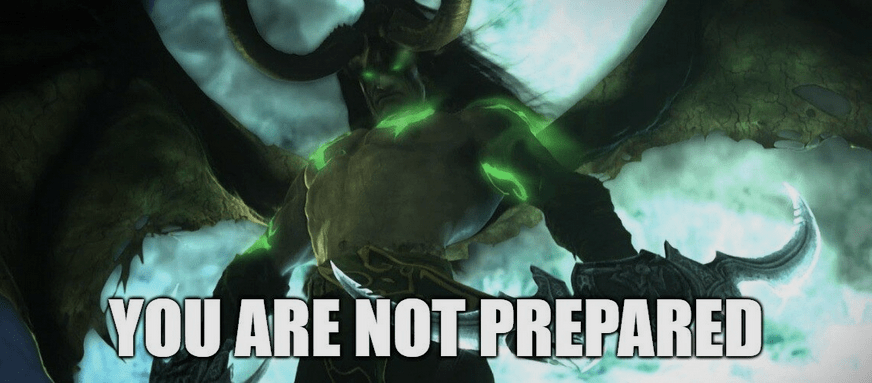
The first expansion for the online game World of Warcraft greeted players with the ominous declaration, “You Are Not Prepared.”  That’s exactly the situation of the individual who didn’t expect to be called upon to be a hero.  The lack of preparation may manifest itself in several ways, any of which can help to shape the story.

Competence.  The main character (MC) may lack the skills or expertise to deal with the kind of crisis that’s occurring.  Maybe there’s fighting involved, and the MC isn’t skilled with fists or swords or rayguns or whatever the weapon of choice happens to be.  It’s a lot easier if they do happen to have the pre-existing skill:  Glory Road’s Oscar, for example, was already experienced at fencing.  If they don’t, then one can expect an extended period of training, since this sort of skill isn’t one that can be picked up in a day.  Luke’s training montage in The Empire Strikes Back is a classic example, taking him from someone with potential and the occasional burst of unexpected powers (“Use the Force, Luke”) to someone who can face off against Darth Vader at the end of Empire and present himself as a full-fledged Jedi Knight at the beginning of the sequel.

Information.  The amateur hero may be drawn into an environment where they aren’t familiar with the geography, the factions, the customs, the people and powers.  In Anne McCaffrey’s Restoree, for example, the heroine is kidnapped by aliens, then rescued by others, all in an unconscious state, and “comes out of it” to find herself in a thoroughly incomprehensible situation.  Glory Road reflects the same struggle by a MC to cope with an unfamiliar environment, though in this case the hero has all the assistance one could desire in learning to deal with the new circumstances.

The same kind of thing occurs in the classic fantasy trope where MCs from a backwater locale are sent into a wider world with which they’re only vaguely acquainted, as in The Lord of the Rings or The Wheel of Time.  One of the advantages of this setup is that the MCs will need to have many things explained to them by more knowledgeable characters; they are the “ignorant interlocutors” whose presence is so convenient for exposition.

Even in more mundane cases, the MC may be placed in conditions where they don’t know their way around.  The eponymous TV series hero Chuck Bartowski is suddenly pitched into the world of intelligence operations and secret agents; he and other characters spend much of the first three seasons learning the ropes.  In a similar way, but much faster (in a two-hour movie rather than a long-running series), the hero of Hitchcock’s North by Northwest must learn the players and the goals of the spy game into which he has been drawn.

Confidence and maturity.  The MC may also be personally unprepared to deal with the crisis posed by the plot.  My favorite example is Romancing the Stone, in which the shy, introverted heroine suddenly has to travel far from home, ally with an unexpected stranger, fight her way through a jungle, and match wits with smugglers and thugs.  Much of the fun of the story is in watching the ironically-named Joan Wilder gain in courage and self-reliance as she overcomes these progressively more dramatic challenges.

Other aspects.  The MC may be unprepared in other respects.  The elemental fact of facing death will be a shock to those of us brought up in more placid situations.  The hero may lack equipment or resources to deal with the new challenges—or, conversely, may happen to have exactly the right resources available; this may actually bring about the adventure, as with the spacesuit in Heinlein’s Have Spacesuit, Will Travel.  Moreover, the homebody hero probably has not yet come to terms with the degree to which the adventure might impact family or personal connections—unlike the hero-by-trade, who has probably reconciled spouse or family with a dangerous career.

The Character Arc

The need to cope with such challenges almost automatically sets up an arc of character development for the MC, reflected in the examples above.  The MC can be expected to grow in confidence and independence.  They may also be tempered by tragedy or suffering; this is the primary course for the young graduate-school characters in Gay Gavriel Kay’s Fionavar Tapestry.

The developing hero may become more street-savvy, more knowledgeable in the ways of the world.  This sort of practical wisdom is a common theme, given the age of the characters, in young adult-targeted stories or the bildungsroman.  For example, Rod Taylor, the MC of Heinlein’s young adult novel Tunnel in the Sky, becomes the informal leader of a band of marooned students by a gradual process.  A group of older students, schooled in political theory and more alert to how groups can be manipulated, ease him out and take over control—with the best of intentions, to be sure.  By the end of the story Rod, once again in command, has become a bit more canny in dealing with the group.  In a similar way, Don Harvey in Between Planets starts out as a fairly naïve high-schooler who learns some hard lessons about political realities as he becomes embroiled in an interplanetary revolution.

Finally, if the MC learns new skills or abilities in the course of the story, they will have grown in that respect too.  The new abilities may qualify the MC for new roles or positions, and perhaps to actually become a professional hero in the end.  We see this in superhero origin stories, where a MC is initially unskilled in managing their superpowers, but gradually takes on the role of a professional do-gooder.  Spider-Man is the classic example, a teenager who didn’t expect to become super-powered and takes a while to become used to his new potential; unlike, say, Iron Man or the Fantastic Four, who start out as grownups and adapt fairly quickly.

As we saw in the last post, an amateur hero almost by definition rises to the occasion.  This is a sufficiently satisfying theme that I suspect adventure stories may tend more to this approach than to that of the professional hero—though I haven’t attempted to take a count.

The City as Character

In some fantasy or science fiction stories, a city actually is a kind of character.  The clearest example—as the title indicates—is N.K. Jemisin’s 2020 novel The City We Became. (Page references are to the hardcover edition, New York:  Orbit, Hatchette Book Group, 2020.)

Since I need to discuss some details of the novel to make the necessary points, I’m flying a

Spoiler Alert!

However, I’ll try to keep actual story spoilers to a minimum.

The City We Became

Jemisin gives the premise, as quoted in a review:  “The city of New York comes to life—literally, as in, the city has developed sentience and an ability to act on its own.”  This quickening takes place through the medium of human avatars.  The city chooses a human being to be “its . . . midwife.  Champion.”  (The City We Became, p. 304.)  In the case of New York, there are actually six avatars:  one for each borough, and one for the city as a whole.  (305)

The City We Became, coverHow does this happen?  A “real city” will “make a weight on the world, a tear in the fabric of reality” (7).  This metaphysical weight comes from the accumulated “strangeness” of the people who come there (8).  A city’s unique load of strangeness—its identity—isn’t a pre-established thing; it develops over time.

[Cities are] organic, dynamic systems.  They are built to incorporate newness.  But some new things become part of a city, helping it grow and strengthen—while some new things can tear it apart.  (46)

This incorporation of newness is especially true of New York.

The city needs newcomers!  He belongs here as much as anyone born and bred to its streets, because anyone who wants to be of New York can be!  (47)

Even the legends and lies about the city contribute to its essence, its distinctive identity—what makes it a “real city.”  (166)

The broader reality in which the weighty essence of a city tears a hole is an alternate-worlds multiverse (165-66).  Not only are there many worlds:  “Imagining a world creates it, if it isn’t already there” (302)—a kind of World as Myth notion.

The tearing isn’t purely benign.  The “hole” that “punches through” actually causes harm:  “The process of our creation, what makes us alive, is the deaths of hundreds or thousands of other closely related universes, and every living thing in them.”  (306)  In that somewhat curious postulate, the story reflects the popular contemporary focus on the destructiveness of progress or expansion.

The newborn New York has an Enemy:  a type of city so alien as to be fundamentally at odds with human cities, which wants to invade our world.  Several characters refer to the anti-city as an “eldritch abomination,” a term characteristic of H.P. Lovecraft and similar early twentieth-century horror writers.  (16-17, 38, 167-68)  But New York also has allies, elder siblings, such as São Paulo in Brazil, and Hong Kong.  Apparently there’s even a community of cities (“the Summit”).  (10, 21-22)

We will hear more about this:  there’s going to be a series, in which this novel is billed as “Great Cities #1.”  The novel itself was developed from Jemisin’s short story “The City Born Great,” a Hugo award winner for 2017, which constitutes the prologue to the novel.  It’s “urban fantasy” in the strongest sense.

The aspect on which I want to focus is that distinctiveness, a civic “personality,” is what makes a city alive.  Thus, in the opposite direction, the Enemy gains a foothold through the interpolation of chain businesses like Starbucks.  “They’re destroying everything that makes New York what it is, replacing it with generic bullshit.”  (357)  The avatars constitute—or express—the “spirit of the place,” the genius loci.

The Personalized City

It’s not unheard of in F&SF to give a city consciousness, though seldom in so full-tilt a manner as Jemisin’s.

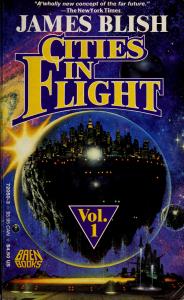
Cities in Flight, coverIn James Blish’s Cities in Flight series, much of the action centers around the star-traveling city of New York.  New York aloft has a perpetual Mayor, John Amalfi, and a City Manager, Mark Hazleton (in the last two books).  But it also has a “server farm” of a hundred-odd computers which collectively make up “the City Fathers.”  That term, generally applied to municipal officials of some venerable sort, indicates authority.  But the balance of power among the Mayor, the City Manager, and the City Fathers is rather complicated.  Amalfi generally gets his way, but sometimes this involves working around the City Fathers—on one occasion, turning them off completely for a period.

While the City Fathers might be considered an intelligence for the city as a whole, they’re not much of an intelligence by modern standards.  Rather, they come across impersonally, a 1950s idea of what a giant computer would be like:  a pure logic.  Their dialogue is rendered in all capitals in the text.  Blish lampshades this typographical indicator in A Life for the Stars (1962), where young Chris DeFord reflects on first acquaintance:  “. . . he would never have mistaken it for a human voice.  Whatever the difference was, he thought of it as though the device were speaking all in capital letters.”

Thus Blish’s City Fathers are almost the polar opposite of Jemisin’s cities:  impersonal and generic rather than distinctive.  In a similar way, while Blish gives some details about the flying city of New York—naming subway stops and the like—he never makes the city “come alive” even in the merely literary sense, to my mind.  The focus is all on the human characters; the city is simply part of the landscape.

An entirely different tack is taken by Anne McCaffrey and S.M. Stirling in  The City Who Fought (1993).  This novel belongs to McCaffrey’s “shellperson” or “Brain & Brawn Ship” series, which originated with the stories collected in The Ship Who Sang (1969).  Here, infants with severe physical disabilities but competent brains may become

an encapsulated ‘brain,’ a guiding mechanism in any one of a number of curious professions.  As such, [they] would suffer no pain, live a comfortable existence in a metal shell for several centuries, performing unusual service to Central Worlds.  (The Ship Who Sang, first page)

Most of the Brain & Brawn stories are about shellpeople who are the animating controllers of spacecraft.  In The City Who Fought, however, we see a case of a “brain” partner who inhabits a space station, rather than a ship.  In that sense, Simeon, the hero of the novel, can be seen as the persona or “soul” of a spaceborne city.  But since the shellpeople are in fact normal human beings, in terms of their minds and personalities, the unique character of the city reduces to the uniqueness of any human being.

Presence

A city can also have a presence, a kind of personality, without actual consciousness.

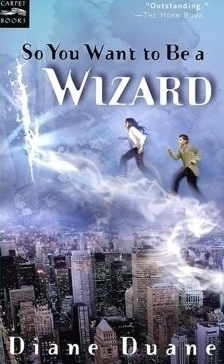
So You Want To Be a Wizard, coverIn Diane Duane’s So You Want To Be a Wizard (1983, rev. ed. 2012), the heroes are translated from their familiar New York City to an alternate, darker New York:  “a shadowed island prisoned between chill rivers and studded with sharp spikes of iron and cold stone” (ch. 2, p. 65).  In this dark-side version, machines like taxicabs are sentient (and vicious); even common objects like fire hydrants are alive.  The character of alternate-NYC is evident from its dramatic contrast against the everyday version in which the rest of the story takes place.  The characters can feel the foreboding threat of the place even before they begin to run into hostile beings.

Charles Williams employs a similarly alternative London in All Hallows Eve (1945).  Here, however, the effect is the reverse of Duane’s.  The main character, a young woman who has recently died, finds herself in an uninhabited alternate London redolent of peace and a mysterious overawing holiness. Meanwhile, ordinary London, including her friend and widowed husband, is threatened by a black magician.

In Williams’ presentation, the city does exert a kind of agency:  the last chapter is titled “The Acts of the City.”  Here, though, the city acts rather as a conduit for the divine than through a consciousness of its own.  Its specific order has numinous importance.

This was a regular theme in Williams.  His friend C.S. Lewis observed:

Williams was a Londoner of the Londoners; Johnson or Chesterton never exulted more than he in their citizenship.  On many of us the prevailing impression made by the London streets is one of chaos; but Williams, looking on the same spectacle, saw chiefly an image—an imperfect, pathetic, heroic, and majestic image—of Order.  (C.S. Lewis, “Williams and the Arthuriad,” in Taliesin Through Logres, The Region of the Summer Stars, Arthurian Torso (1974), p. 289)


The City as Background

In most stories, a city is not so literally personified as in the above examples.  Normally its “personality” merely serves as a colorful background setting, giving a story or series a distinctive flavor based on the milieu.

G.K. Chesterton observes somewhere that in Charles Dickens’ novels, London is practically a character in itself.  It’s not that London is somehow animated or ensouled; it’s that the locale is described with such well-observed detail that it plays as central a role in the story as the actual characters do.  As Lewis noted above, a number of Chesterton’s own stories evoke a similarly distinctive London.  While Chesterton does not provide the wealth of detail Dickens does, the same affectionate appreciation for the city is expressed in a more impressionistic fashion.

Rex Stout’s numerous Nero Wolfe detective stories perform the same service for New York.  Narrator Archie Goodwin is constantly running around the city, intimately familiar with its nooks and crannies, and as we follow him, it begins to seem a familiar place to us too.  Well-known landmarks, both real and fictional, help give the place a sense of concreteness and aid our suspension of disbelief.

To All the Boys: Always and Forever, movie posterMore recently, in the Netflix movie To All the Boys: Always and Forever (2021), high school senior Lara Jean Covey “falls in love” with New York on a school trip.  Her attraction to the place is strong enough to lead her to change her college plans and throw her romance into disarray.

Interestingly, in the book, it was the University of North Carolina at Chapel Hill that attracted Lara Jean’s attention.  UNC-CH also has a nice campus, but the screenwriters seem to have felt that New York would be a more obvious candidate—and we can see why.  Some cities are famous for having more “pull” (or, as Jemisin put it, “weight”) than others.  I recall that, when I was going to law school in Cambridge, two friends were talking about going down to “the city,” and I was puzzled why they’d make such a big deal out of running across the river to Boston.  But that wasn’t the city they meant.  They were New Yorkers; even if you’re next door to another big city, “THE City” is NYC.

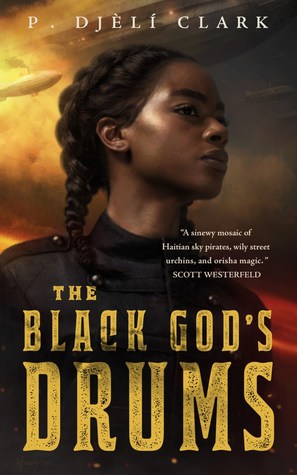
The Black God's Drums, coverOf course, it needn’t always be New York.  Most of Andrew Greeley’s novels are set in Chicago; and by the time you’re read a dozen or so, Greeley’s particular version of Chicago has “come alive” as much as New York.  I have a notion that The Black God’s Drums (2018), by P. Djèlí Clark, was aiming to do something similar for New Orleans, although one can’t go as far in a single novella as one can in a whole series of novels.

The Small Town

If big, brawling cities like New York or Chicago or New Orleans can become characters in their own right, what about small towns?  Certainly a story often invites us to become attached to a small town in the same way that we are to these big cities.  The question, I think, is whether we can find the same sort of distinctiveness in a habitation built on a smaller scale.

In Hallmark romances, we are constantly being introduced to a cozy, adorable small town, usually the site of a struggling local business.  We’re meant to find this municipality lovable and charming.  In most cases, though, the locations seem to be too generic to attract our interest.  The bakeries and bookstores and Christmas tree lightings all seem to blur together after a while.  True, these short films don’t have much time to develop an elaborate background identity.  But that’s not the only factor—because some two-hour films do manage to make a small town real.

Doc Hollywood movie posterMy favorite example is Doc Hollywood (1991), in which Michael J. Fox, a newly-minted doctor on his way to a high-paying plastic surgery job in L.A., gets stranded in Grady, South Carolina.  The whole story is about whether Fox’s character Ben Stone will shake the dust of Grady off his feet as soon as possible and decamp to the big city, or decide he likes it where he is.  For this to work, the town has to be vividly realized.  The actors, director, writers, and composer do a nice job of showing us enough quirky characters and local traditions to convince us that Stone’s inevitable decision makes sense.  Other rom-coms like Murphy’s Romance (1985) and Coffee Shop (2014), in my view, pull off the same trick.

For a more bookish example, we can look at Jan Karon’s long-running Mitford series (1994-present).  The dozen or more stories set in the village of Mitford, North Carolina (the first of which is tellingly titled At Home in Mitford), afford plenty of scope to develop the landscape, landmarks, quirky characters, and history of this hill-country locale to the point where it becomes a familiar retreat one can revisit at will.  As in Jemisin’s New York, it’s primarily the people who make the town what it is.

Conclusion

It appears that both big cities and small towns can become distinctive enough to rise to the level of being a quasi-character (or sometimes an actual character) in a story.  But the end results are different.  The big city tends to be distinctive by being roaring and stimulating; the small town, by being homelike and comforting.  It would be interesting to see if those characteristics could be reversed:  a cozy metropolis, an exciting village.  But those two types of place may be inherently linked to the number of citizens.  We can think of the reversal as a challenge for future writers.

Happily Ever After

Six weeks ago I complained about the lack of happily-ever-after romances in the Star Wars series.  It occurred to me that it would be useful to take a look at what exactly makes for a “happy ever after” ending (“HEA” in genre romance code).  What do we really mean by that, anyway?

The Thrill of the Chase

All the world loves a lover.”  We enjoy seeing stories about people falling in love, whether it’s with someone they’ve just met or by discovering someone who was always “right before my eyes.”  (Unless, of course, we’re too cynical to give any credence to so vulgar and sentimental an idea; in which case it’s the trope we love to hate.)  I’d call it the courtship phase of a relationship, if that term weren’t so archaic.  But “courtship” does express in a useful way the stage I’m referring to, when the lovers-to-be are maneuvering around each other, trying to figure each other out, and (almost invariably, in fiction) overcoming initial obstacles to their mutual attraction.

Couple silhouetted against sunset

“Forever Mine” by welshdragon at DeviantArt

It’s not hard to see why this is.  The courtship phase includes a lot of fun stuff.  We get to see the thrill of discovery, the novelty, the tentative reaching-out and missing connections, the achievement of initially establishing a base of trust and affection.  There’s uncertainty and thus suspense in those first contacts.  The process reminds me of the “handshaking” by which communications systems establish a protocol for exchange of information (anybody remember that windy ‘modem connecting’ sound on a dial-up connection?).

And this process is both tricky and essential.  The relationship can’t move forward until the common foundation is established.  I’ve quoted Lois McMaster Bujold before:

The question a romance plot must pose, and answer (showing one’s work!) is not “Do these two people get together?” but rather “Can I trust you?”  Which is most certainly not a trivial problem, in art or in life.  (Response to a reader question on Goodreads (10/30/2017).)

And the relationship does have to move forward.  Courtship is only a prelude.  It inherently looks forward to something else:  a life together.  (Even to “forever,” but that’s another subject.)  We feel something is missing in a case like that of Romeo and Juliet, where circumstances cheat the lovers of that opportunity.

Falling in love is fun to watch.  But if that’s all a character is interested in, we get the self-centered thrill addict who keeps wanting to have the same experience over and over again—as if they wanted to relive high school graduation repeatedly, Groundhog Day-style.  We can’t fall in love indefinitely; eventually we have to land somewhere.  Whether the story ends with a wedding or just a commitment, there has to be a conclusion.

Yet the conclusion itself is only the kickoff for the real relationship—the HEA.  “Each happy ending’s a brand new beginning.”

What It Isn’t

“Happily ever after” doesn’t mean the initial thrill of falling in love lasts forever.  That simply isn’t possible; human emotions can’t remain at that fever pitch.  At some point, the “dizzy dancing way you feel” is going to ebb.  If we expect to feel the same way always, as I’ve just noted, we’re setting ourselves up for disappointment and unnecessary disillusion.  On the other hand, that thrill can always reappear from time to time.  Wise couples will take steps to encourage and renew that early glamour throughout their marriage.

Couple dancing, from Dancing in the Minefields music videoNor does HEA mean freedom from all troubles.  We can put this aside momentarily to celebrate a wedding, visualizing only a life of unimpeded bliss; but real lives invariably encounter problems and difficulties.  We may even want to remind ourselves of this on the occasion of union itself.  When I ran across Emily Hearn’s wedding video online, I was struck by the fact that the first piece of music set to the video was Andrew Peterson’s “Dancing in the Minefields”:  “And it was harder than we dreamed / But I believe that’s what the promise is for.”

Even the vision of a couple facing adversity staunchly side by side isn’t always going to be valid.  We’re told that even healthy couples have their arguments and disagreements.  Indeed, a couple that never disagrees may be harboring unresolved issues under the surface.

It seems to me that all these flaws or troubles can still be accommodated in the “happily ever after” archetype.  Couples can recover from adversity; it can make them stronger.  Even crises in a lifelong love affair can be healed or overcome.  It’s the overall trend or direction, and the overall tenor of the romance, that leads us to call it “happy.”  Of course, when we wish someone happiness forever, we hope that their troubles will be relatively few and their recoveries maximally joyous.  But a life together need not be perfect to be “happy.”

What It Is

If the ever-after need not be perpetual bliss to count as HEA, what is it made up of?  I am hardly so wise as to prescribe sure-fire ingredients for a happy marriage.  But if we think about what we’d expect to see in a story that depicted a happy couple, we can point to a few things.

Carly Simon singing The Stuff That Dreams Are Made Of at Martha's Vineyard

Carly Simon sings “The Stuff That Dreams Are Made Of”

If it’s going to compete with the initial falling in love, being in love has to gain in depth and resonance what it loses in surface intensity and thrill.  It’s “the slow and steady fire.”

What can a couple that’s been together a while do that lovers who’ve just met can’t?  Consider the cumulative pleasures and joys of two people who know each other well and have learned how to please and help each other.  If they continue faithful to each other and to their union, their mutual trust will grow and deepen.  And the more they trust each other, the more each can express their individual strengths (and admit their individual weaknesses).

Since loving someone doesn’t consist only in having a feeling about them, but in enacting love for them, we can learn to love someone better through experience and attentive learning.  I may start by giving you a gift I would like—but eventually I learn how to give you the gift you would like.  Meanwhile, the sharing of memories and experiences, families, running jokes, can enrich and strengthen the bond.

All these things are compatible with the imperfections and difficulties noted above.  They make up what we’d expect to see, down the road, in a story that goes beyond the courtship—a happy-ever-after.

How We Tell the Story

Because the HEA lacks the surface glitter of the falling-in-love story, we see far fewer stories depicting it.  But for purposes of example and illumination, it’s very useful to see depictions of ongoing marriages.

Such mature romances can crop up in odd places.  For example, in a series that goes on beyond the resolution of initial relationships, or perhaps longer than the author expected, we may see the original lovers ‘age out’ of the focus, but still have the chance to watch them practice the art of love.

Shards of Honor coverExhibit A is Bujold’s Vorkosigan saga.  The first two books in the main sequence, Shards of Honor and Barrayar, deal with Aral Vorkosigan and Cordelia Naismith, whose son, Miles, is the principal character in most of the stories.  So we see Cordelia and Aral fall in love—but then we see them continue through a whole series of other tales as both parents and political prime movers on Miles’ homeworld of Barrayar.  We get to see them working together in common causes, both personal and cosmic.  We see their continuing affection and evident harmony.  Each is so distinctive a personality that we never think of either Aral or Cordelia as merely an extension of the other; rather, they provide an ongoing example of the kind of relationship we wanted to see in their initial stories—and to which Miles aspires for himself, having that example always before him.

Anne McCaffrey’s Dragonriders of Pern give us another example.  In the first book (as published, not chronologically), Dragonflight, we see the rocky road of the strong-willed main characters, Lessa and F’lar, to love.  Both of them are so stubborn and willful that it’s hard to picture them in a peaceful marriage.  And indeed, on Pern, nothing is ever entirely peaceful for long.  But as more couples come and go through the long series of sequels, F’lar and Lessa remain onstage a good bit of the time.  Neither is ever tamed, though they both mellow a bit.  The scrappy young Lessa becomes a little steadier and more mature as she gets older and has a child, but she still retains the original fire.

I frequently refer to the classic Lensman series, but I don’t think I’ve mentioned that the final novel, Children of the Lens, shows us the lovers whose activities dominated the three middle books, Kim Kinnison and Clarissa MacDougall, as middle-aged parents a generation later.  The story is so action-oriented that we don’t get to see much of the family in peace, but what we do see gives us the satisfaction of knowing that Kim and Cris have lived a happy life together (and will continue to do so).  And since the surclimax (if I may invent a word for a secondary climax occurring after the main one) involves Clarissa’s use of the power of their mutual love to retrieve Kim from an otherwise unsolvable trap, it’s clear that the romantic connection consummated at the wedding in the previous volume (twenty years earlier) has not lost its fire.

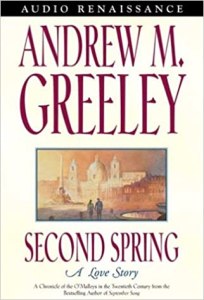
Second Spring coverAndrew Greeley wrote a whole series of novels in which the romance is generally about falling in love.  But in his O’Malley family saga, in which the titles all refer to seasons (of life), he continues the story of one such couple from the post-WWII era right through their “Golden Years.”  The young lovers of A Midwinter’s Tale have to grapple with some pretty serious psychological issues themselves, as well as family drama, over the course of years.  But the “crazy O’Malleys” emerge stronger from their troubles as they go on, giving us a picture of people who are always becoming more themselves as they adjust to changing circumstances.

God is an Englishman coverThere is a subgenre of family sagas—the kinds of long-running, multicharacter stories that always make me think of TV mini-series—and some of these also give us extended looks at maturing romances.  In some such stories, the conflicts arise from the dysfunctionality of the family itself; Mazo de la Roche’s Jalna novels are a case in point.  But in others, we can see a couple holding strong.  I recently reread R.F. Delderfield’s God Is An Englishman, the first book of his “Swann saga.”  His central couple, Adam and Henrietta, grow in significant ways over the course of the story.  Their love waxes and wanes, but after it wanes, it always comes back.  I’d count that as a HEA.

The novella I’m just finishing up, Time Signature, takes place in the Deerbourne Inn common setting created by the Wild Rose Press.  This gave me the chance to show how a secondary couple who were engaged in Amber Daulton’s Lyrical Embrace was getting along, a little later.  While their appearance is brief, I enjoyed the opportunity to represent a growing post-courtship romance, even in its early years.

Real Life

For purposes of inspiration and example, of course it’s even more helpful to be acquainted with real-life successful relationships.  My parents, for instance, lived long and happy lives, and despite religious and political differences, they always remained in harmony.  Though they argued about many subjects, they never, so far as I know, quarreled.  While their lives could not be said to be untroubled (after all, I was one of their children), I’d say they qualified as a happy-ever-after.  I’m privileged to know a number of other couples whose romances have flourished over many years, on whom I’d be glad to bestow the accolade of HEA.

The accumulation of such real and fictional examples gives us the wherewithal to refute those who scoff at the happily-ever-after ending.  None of the characters of our favorite romances will have perfect later lives unmarred by any suffering or any down times in their love affairs.  But if we’re willing to accept that solid happiness can be consistent with life’s inevitable troubles, we can look forward with hope to a satisfactory ending for those couples who approach their lives with both realism and love.

The Select Society of Protectors

Sorry about the delay between posts—I’ve been under the weather lately.


I was recently reading a new “Sharing Knife” story by Lois McMaster Bujold, and it suddenly occurred to me that the relationship of Bujold’s Lakewalkers to Farmers is exactly that of Anne McCaffrey’s Dragonriders to Holders.

But let me back up a bit.

The Sharing Knife

The world of Bujold’s Sharing Knife series is a difficult and dangerous one.  Most people live in a basically agrarian culture, a sort of cross between the traditional medieval fantasy world and the Wild West.  They fear the enigmatic “Lakewalkers,” men and women who wander about the countryside in “patrol” groups and are rumored to have magical powers.  The Lakewalkers claim to be searching for what ordinary people call “blight bogles,” but some consider these to be a mere myth.

They’re not a myth, of course.  In reality the Lakewalkers, who have the ability to use a kind of magic they call “groundwork” (an extremely interesting and well-developed idea in itself), are constantly on the watch to destroy “malices” as they arise.  These malices are truly nasty beings that can mentally enthrall normal humans and mutate animals into humanoid minions.  If the Lakewalkers weren’t killing them off (via the grim “sharing knife” methd of the title), the malices would overrun the whole world.

Many Lakewalkers tend to look down on the people they are defending, whom they refer to generally as “farmers.”  Much of the interest of the story has to do with the prickly relationship between these two interdependent groups, explored through the romance between a farm girl, Fawn, and a Lakewalker patroller, Dag.

The Dragonriders of Pern

As I mentioned in an earlier post, Anne McCaffrey’s Dragonriders of Pern is a science fiction series that reads like fantasy.  The planet Pern is protected by men and women riding flying dragons.  The dragons breathe fire to destroy an alien organic “Thread” that falls from the sky and, if allowed to spread, would multiply to consume the planet.  To qualify as a full-fledged dragonrider, one must have the potential for a certain kind of telepathy that allows rider and dragon to bond at the dragons’ birth.

Dragonflight coverOne of the things that makes the Pern stories sound like fantasy is the quasi-medieval political structure.  A “Lord Holder” resembles a feudal monarch ruling over a sizable population of farmer/serfs, crafters, and minor nobility.  But here the dragonriders form a separate hierarchy.  The riders’ internal pecking order is a combination of aristocracy and meritocracy:  the rider of the senior gold (female) dragon is a kind of queen; the rider whose bronze dragon mates with the gold becomes leader of the entire group that constitutes a Weyr; and those who lack the telepathic talent are servitors (at the lowest level, “drudges”).

While the depiction of Pernese society mellowed a good bit over the course of the series—both holders and riders were pretty high-handed and violent at the beginning, less so later—one consistent theme is the uneasy relationship between the dragonriders and the common folk.  Everyone knows (though they may forget in the generations between periodic Thread attacks) that the riders are essential to preserve the planet:  “Worlds are lost or worlds are saved / From those dangers dragon-braved.”  But the holders often resent the taxes imposed to support the Weyrs and the “searches” in which the dragonriders carry off likely young people to see if they can “impress” a dragon.  Managing this tension consumes a good deal of the main characters’ time in the early books.

The Protectors and the Protected

Now I can make clear the analogy I noticed.  In each case we have a relatively small society of people set apart from ordinary folks, in a good cause:  they are dedicated to protecting the larger population.  The select group of protectors are genuine heroes who possess special talents that fit them for the role.  But the protectors are not stainless; they can abuse their powers.  And the grateful population they defend aren’t always grateful; they may resent the special powers and privileges of the defenders, even aside from the possible abuse of those advantages.

It seems to be a fruitful trope for storytelling.

Rangers and Protectors

Strider with pipe at the Prancing PonyWe can find a similar structure, though not so dominant, back in The Lord of the Rings.  You’ll recall that Strider—Aragorn—is one of a mysterious group of wanderers who travel the countryside, the Dúnedain or Rangers.  They are regarded with suspicion by the ordinary folks in Bree; Barliman Butterbur the innkeeper warns Frodo about the suspicious-looking stranger sitting in the corner.  Yet all the time the Rangers are patrolling the borders of the peaceful lands of Bree and the Shire, fending off possible threats.  Aragorn says at the Council of Elrond:

‘Strider’ I am to one fat man who lives within a day’s march of foes that would freeze his heart, or lay his little town in ruin, if he were not guarded ceaselessly.  Yet we would not have it otherwise.  If simple folk are free from care and fear, simple they will be, and we must be secret to keep them so.  (Fellowship of the Ring, II.2, p. 261)

Aragorn’s fond, if slightly aggrieved, remark brings out a difference.  Pern’s dragonriders are a public society of defenders; everyone knows of their special role.  But Tolkien’s Dúnedain, like the Lakewalkers in Bujold’s more recent fantasy, play a less public role.  They are set apart, but because their heroism is unrecognized, they are objects more of suspicion than of admiration.

Pak protector (by Christopher Bretz)

Pak protector – illustration courtesy of Christopher Bretz (bretz@bretz.ca)

For a more science-fictional take, consider Larry Niven’s Protectors, which figure in the novel Protector (naturally) and in the Ringworld stories.  Niven imagines that humanity is descended from a species called the Pak, which matures through three life stages:  child, breeder, and protector.  The transition from the not-very-bright breeder stage to the highly intelligent and formidable protector stage is triggered by eating a root the characters call “tree-of-life.”  When a Pak colony arrived on Earth ages ago, however, the soil lacked a chemical necessary for the tree-of-life root to function.  The “breeders” could not change into protectors; instead, they evolved on their own into modern-day humans.  Niven’s intriguing conceit is what we see as symptoms of old age actually represent the incomplete transition to the gaunt, tough, hairless protector stage.

Niven depicts the protectors as genetically compelled to protect the members of their own family or clan—the ones who “smell right.”  A functioning Pak colony wouldn’t be as much like a human society as on Pern or Middle-Earth or Bujold’s imaginary world:  it would consist of carefree, barely-sentient breeders watched over by creatures ruthlessly dedicated to their preservation.  Think of it as an extreme case of the separation of defenders from defended.

Counter-Examples

On the other hand, a number of stories depict defenders who are much more thoroughly integrated into their broader societies.

Nita and Kit ascend over New York, from Young Wizards

Young Wizards

In Diane Duane’s Young Wizards series, youngsters with the potential for wizardry are called, not by receiving a letter from Hogwarts, but in more obscure ways—for example, running across a library book called So You Want To Be A Wizard.  There are more wizards around than one might think, because on our planet they don’t advertise their powers:  young wizards still go to school, grown-up wizards might be writers or sell advertising.  (And not all of them are human; there are some very entertaining books about feline wizards.)  But all of them are dedicated to the preservation and fostering of Life, by way of the Wizard’s Oath each must take.  In this setup, there’s no resentment of the society of protectors because no one knows they exist; and abuse of wizardly powers is almost unheard-of, since violating the Oath tends to result in forgetting that wizardry even exists.

Lensman image

Kim Kinnison, Gray Lensman

By contrast, the elite corps of Lensmen in E.E. Smith’s famous series are publicly known and highly respected.  They play the role of galactic policemen and secret agents, with particular attention to the mysterious pirates and drug-runners called “Boskone.”  Like the Young Wizards, the Lensmen are (conveniently) incorruptible, being screened at the outset by the equally mysterious but benevolent Arisians.  (This whole business of incorruptibility is something we need to examine more closely on another occasion.)  But they don’t mind mixing in ordinary society—Gray Lensman includes a scene set at a formal ball—although their grave responsibilities often make them feel set apart in their lonely dedication.

Superheroes, as a class, may occupy the same position.  They live as part of the general public, though their identities are usually secret.  They tend to act as individuals rather than as a whole society, though they do come in small groups (and may occasionally take part in mega-battles that engage the whole range of heroes).  But the modern superhero does show the ambivalence that often characterizes the select defender (Mr. Incredible’s remark that he sometimes wishes the world would just stay saved for a while).  And some graphic novels take up the question of what it’s like for the ordinary person to live in a world full of superheroes—notably Kurt Busiek’s thoughtful Marvels (1994).

Narrative Tensions

The select society of protectors is a fine place for heroes.  But it’s also dangerous.  What if the protectors aren’t incorruptible, and turn bad?  What if they become contemptuous of the people they protect, and come to think of themselves as better than the “rabble”?  In many of the scenarios above, it takes special talents to qualify as one of the defenders.  How likely is it that those who see themselves as specially qualified will end up thinking of themselves as superior?  These questions form fertile ground for various plotlines.

The notion of the select (if not superior) set of defenders may even be seen as applying to a military organization, whose purpose is to protect the general public.  “Citizen soldiers,” or draftees, may see themselves as primarily part of the overall society, temporarily detailed to do their civic duty; but a professional military, which can form its own tightly-knit society with its families and dependents, may be more easily tempted to think of itself as a group apart, with its own loyalties and camaraderie.  In fiction, the entire genre of military SF borders the trope we’re examining here.  In real life, the American military, at least, seems to have avoided that trap; we have not yet seen anything like a military coup.

Everyone Is a Tuvela

It’s interesting to contemplate the opposite trope:  the citizen soldier model taken to its limit.

The Demon Breed, coverIn James Schmitz’s 1968 novel The Demon Breed, a biochemist named Nile Etland on the human colony world Nandy-Cline discovers that independent researcher Ticos Cay has been captured by cruel and formidable aliens called the Parahuans.  Ticos has played on the Parahuans’ own near-superstitious fears to convince them that Nile is a Tuvela, a member of a secret society of superhumans that are the real rulers of human civilization.  All Nile has to do is convince the invaders that she is, in fact, a superior being it would be death to tangle with.  And, with the help of Ticos, two mutant otters, and her own encyclopedic knowledge of the unique biology of Nandy-Cline, she does a marvelous job of pulling the wool over the Parahuans’ eyes and sending them fleeing back to their own worlds.

But there are no Tuvelas.  Nile is a brilliantly resourceful and competent woman, but she’s not superhuman.  Neither is Ticos, nor any of the other inhabitants who are involved at the end in dispersing the Parahuans.  They’re simply ordinary humans.  And there is no secret organization.  Rather, Schmitz’s hypothesis is that a significant fraction of ordinary people (Ticos calls them “antipredators”) can take on that defensive role when extraordinary circumstances require them to do so.  As one character remarks, the Parahuans would have run into “Tuvela” behavior no matter where they sought to attack.

The title The Demon Breed doesn’t refer to the Parahuans.  It refers, from the unfortunate Parahuans’ point of view, to the uncannily resilient humans.  Like the sturdy hobbits of the Shire, human beings are capable of rising to the occasion.  At the end of the story, when the local Nandy-Cline military forces have mobilized to make sure the fleeing Parahuans don’t escape, Nile reflects:  “The human demon was awake and snarling on Nandy-Cline” (ch. 9).

The select society of defenders is a potent storytelling trope; but so is the distributed resourcefulness of the ordinary person.  And both may be useful to keep in mind as we act where we are needed.