The Professional Hero

Glory Road

A couple of comments by Kevin Wade Johnson in connection with my last blog post (now a long way back!) triggered a line of thought about heroes and the hero business.

Glory Road cover

Robert A. Heinlein’s 1963 novel Glory Road looks like a swashbuckling fantasy at first blush, but it turns into something entirely different.  Our hero, E.C. “Oscar” Gordon, kicking around the world after leaving the military, is recruited by an incredibly gorgeous woman to assist her with a quest that involves traveling to other universes and swordfighting.  This is just the kind of adventure he was craving.

As Kevin observes, the first three-quarters of the book are action-adventure, with sizable side dishes of comedy, scandalous liaisons, and cynical social commentary.  At that point the quest is fully resolved—at page 208 out of 288, in my copy.  What, then, occupies the rest of the book?

Gordon returns with “Star,” the beautiful woman he’s now married, to her home universe.  It turns out she’s the empress of a multiuniversal polity that is in some respects a high-tech Utopia.  All Gordon has to do is relax, allow himself to be fêted by the population, and sleep with anyone he finds interesting (the late Heinlein’s polyamory is fully on display here).

He hates it.

What Utopia doesn’t satisfy is Gordon’s lust for adventure.  He doesn’t want to be a dilettante or a “kept man.”  He wants wonder, excitement, the stimulus of danger.  He likes being a hero, with all the occasional discomforts and perils of that role. The placid happy ending of a retired hero holds no attraction for Gordon.

It’s unclear whether Star feels the same way.  She’s willing to consider going in on a kind of adventuring “business” with her slightly tarnished knight.  But first, she says, she’d have to train a replacement for her unique position—and that would take many years.

The solution is for Gordon to head off again on the Glory Road without Star.  He’ll pop back in now and then, but not to take up residence in the Twenty Universes utopia on a permanent basis.  He and Star will remain in love with each other, perhaps, in some sense of the term—but not in a sense that requires fidelity on either’s part.  In Heinlein’s polyamorous world-view, passing romantic involvements are just part of the adventure:  “Knights errant spend their nights erring” (p. 271).  Gordon’s happy ending is the continuing adventure.

The Unsettled Adventurer

This idea comes up from time to time in adventure stories:  the hero (or heroine) who seeks out danger and isn’t content without it.  John Carter of Mars displays a little of this, though in the violent world of Barsoom, he seems to be able to get his fill of trouble while still remaining home-based with the enthralling Dejah Thoris in her city of Helium.  There’s something like this idea in the conclusion of The Good Place—boredom with utopia—as we’ve seen.

The really extreme case can be found in an old-time fantasy by E.R. Eddison, The Worm Ouroboros (1922).  The swashbuckling nobles of Eddison’s imagined world fight the good fight against their sinister enemies, the Witchlanders.  At the end of the novel, those adversaries are conclusively defeated.  Cue the victory feast.  And yet . . . Our Heroes are not quite satisfied.  Things just won’t be as interesting without the Witchlanders constantly scheming and warring against them.  At the very end, the heroes’ fanciful wish is somehow granted:  a herald announces the arrival of an emissary from the bad guys—the same event with which the novel opened.  (Hence the title:  the legendary serpent that swallows its own tail.)

The Series Protagonist

I’ve previously expressed some doubts about whether happy endings really need to be static and boring—so let’s not adopt the Glory Road doctrine too hastily.  (In its extreme form, Eddison’s circular epic, one may feel the opposite dissatisfaction in the sense that all the heroes’ striving and suffering has been for nothing.)  But these examples highlight a difference among types of action heroes.

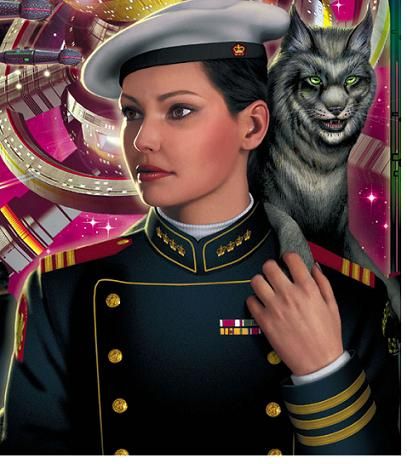
In a long-running action series, unless a hero is improbably falling into one adventure after another against their will, we have to assume that the hero likes what they’re doing.  James Bond seems to be pretty content with his secret-agent life.  Indiana Jones yearns for opportunities to climb out the window of his stuffy professorial office and strike out on some treasure-hunting chase—even at an advanced age, as we’ve recently seen.  Captain Kirk, who’d been promoted to admiral by the beginning of Star Trek II, isn’t suited for a desk job.  At the end of the three-movie cycle he’s demoted to captain again—ostensibly as a punishment for flagrant violations of Starfleet regs, but we’re to see this as a step forward for him, his best destiny.  Yoda accuses Luke of this kind of unrest in The Empire Strikes Back:  “Adventure! Excitement!  A Jedi craves not these things.”

The same is true of almost all superheroes.  Retirement is almost unheard-of.  The occasional counter-example makes for an interesting tale precisely because it runs against type:  Hank Pym in the Marvel Cinematic Universe, Jack-in-the-Box in Astro City.  In a somewhat similar way, continuing campaigns in Dungeons & Dragons or similar games tend to assume the existence of a class of professional adventurers who enter willingly into a life of battle and treasure-hunting, as distinct from an assembled-for-one-purpose group like the Fellowship of the Ring.

This character trait does make things convenient for the writers.  They have a believable rationale for the main character’s continuing adventures.  Otherwise, after a while it would start to seem implausible for one person to keep getting drawn into danger purely by accident.

The Hero By Trade

The Star Trek captains, and other officers, illustrate a type of case where the character really is a professional hero—one who’s taken up a profession or vocation where danger and challenge, and hence the opportunity for heroism, come with the territory.  Anyone pursuing a military or quasi-military career fills that bill.  Honor Harrington, for example, reflects more than once that she’s good at war; it’s her calling, what she was born to do.  Professional police officers, firefighters, or rescue workers—first responders generally—also fall into this category.  (John McClane of Die Hard fame, mentioned above, is in a danger-prone profession, though it’s probably rare for a cop to run into the kinds of major crises he does.)  Unsung heroes like medical personnel may find themselves in the same position.  They may not categorize what they’re doing as heroism (it looks better on them if they don’t); but they are putting themselves “in harm’s way” where acts of heroism are constantly called for.

This is why military SF lends itself so easily to long-running series like Honor Harrington’s.  (The same is true outside the SF genres, as we can see, for example, in Patrick O’Brian’s Aubrey/Maturin sea stories.)  The same is true of private detectives, secret agents, and the like.

The Reluctant Hero

But not all heroes are professional heroes.  An equally perennial favorite is the reluctant or accidental hero—the person who answers the call to adventure, but does wish to return to a peaceful life afterward.

Jim Butcher’s Introduction to Jim Butcher & Kerrie L. Hughes, Heroic Hearts (NY:  Ace Books, 2022), puts it this way:

Real heroes . . . [are] the everyday humans who happen to be standing there when something bad happens, and when there is a sudden need for skill, courage, or intelligence.  They’re the regular people in irregular circumstances who find themselves considering others first and standing up to do whatever needs to be done.”  (p. xi)

Some do manage to go back to their ordinary lives after the crisis has passed.  Cincinnatus, and George Washington, are famous for pulling off the transition:  they took over the reins of the state when they had to, but willingly ceded power afterwards.  On a more modest scale, the “citizen soldier” concept, as in the American National Guard, aims at the same thing.  It’s part of the mystique of the American World War II armies, the so-called “Greatest Generation” model.  You rise up to serve when necessary, but happily return to civilian life when it’s done.  Contemporary discussions are more likely to emphasize post-traumatic stress disorder (PTSD) and the difficulty of the return to civilian life; but it remains an ideal with considerable drawing power.

In fiction, the contrast between heroic acts and ordinary life provides rich soil in which to grow interesting stories and characters.  Tolkien, for example, gives us some characters who do manage the return to everyday existence—Sam Gamgee—and others who find it impossible, such as Frodo.  Of course Frodo does in the end find peace in Valinor, but that requires a literal removal from the circles of the world, a transcendence not available to the average hobbit-in-the-street. 

The situations can become fairly complex.  In the Song of Roland, after the heroic deeds of the story are finished, a weary Charlemagne at the end finds himself called back unwillingly to new conflicts.  In the TV series Chuck, the eponymous Chuck Bartowski is initially appalled to find himself embroiled in spy activities, but the sheer coolness of it all grows on him, and by the fifth season he wants to start his own secret-agent business.  Scott Lang (Ant-Man) at the beginning of Quantumania is resting comfortably on his laurels, and has to be dragged back into action in the name of helping others.

Detectives in mystery stories fall into both camps.  We have professional private eyes like Sherlock Holmes and Nero Wolfe.  But then we also have amateurs like Chesterton’s Father Brown and Agatha Christie’s Miss Marple, who always just seem to be in the right place at the right time.

The Author’s Choice

If we want to write a heroic adventure story, one of the early decisions we have to make is what kind of hero we want to feature.  Sometimes the tale may call for someone who’s automatically in a position to encounter danger, like a military officer.  Sometimes we may prefer to drag the hero into action against their wishes, or by happenstance.  The whole point of Roger Thornhill’s predicament in North by Northwest, for example, is that he has no desire to become involved in skulduggery and is baffled by the strange things that are happening to him.  Like so many other accidental heroes, however, he rises to the occasion.  This is a narrative arc that may be both more interesting and more inspiring than that of the professional hero; because most of us live relatively ordinary lives and can only hope that if called upon, we too could become the kind of hero we admire.

Ends of Eras

Part of the journey is the end.
—Tony Stark

“The Saga Comes To An End”

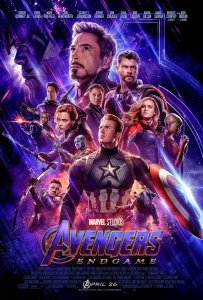
We have a lot of extended stories coming to a close this year.  At this writing, eleven years of Marvel Cineverse movies have concluded with Avengers:  Endgame.  It won’t by any means be the last Marvel movie—we’ll see many of these characters again—but the overall story that began with Iron Man in 2008 has reached its end.  The TV series Game of Thrones released its finale on May 19, 2019.  In December, we anticipate the conclusion of the Star Wars trilogy of trilogies (The Rise of Skywalker).

On the book side, David Weber’s Honor Harrington series (she first appeared in 1992) arrived at a conclusion of sorts with Uncompromising Honor (2018).  There are plotlines still unfinished, and Honor herself may reappear in later stories, but it seems clear her personal narrative arc has closed.

Even a blog post by the FCC’s General Counsel, of all things, has given a nod to this convergence of endings.

I’m going to assume it’s coincidence that these sagas of different lengths are finishing up together.  It does seem like a good moment, however, to reflect on what the resolution of these stories says to us.

(Miraculously, this post seems to have managed to avoid any actual spoilers for Endgame.  But please note that the links, if you follow them, are full of spoilers.)

 “A really long story”

The fact that we have all these long-running series, by itself, brings up some topics that are familiar in this blog.  For instance, it confirms that readers and viewers of our own era are not as lacking in attention span as pundits might claim.  An article by Douglas Wolk, the weekend of Endgame’s release, was titled:  “Americans crave complex ideas.  Just look at the Marvel universe.”

Wolk credits Stan Lee and Jack Kirby, back in the 1960s, with bringing extended stories spanning multiple magazines to comic books.  He notes also that such vast tapestries draw us together by giving us shared topics to talk about:  “to be drawn into conversation to understand them better”—to share reactions, insights, theories about stories that “mean more to us together than alone.”  I can testify to this, as a veteran of many an animated office conversation on what was so good about Captain Marvel or whether people were satisfied with the ending of GoT.

A wide-ranging story also satisfies our appetite for visiting a fully-realized world.  This is the value of what Tolkien called “Escape” in his pivotal essay On Fairy-Stories—the refreshing sense of leaving our ordinary world temporarily behind to immerse oneself in a new and different world.  It was Tolkien who (in the Foreword to The Lord of the Rings) gave his primary motive as “the desire of a tale-teller to try his hand at a really long story”—but who is also one of the great worldbuilders.

The Craving for Epics

But these aspects mostly reflect the sheer size of the saga.  More to the point, perhaps, is that many of us also share an appetite for what we might call the epic:  a mighty struggle in which one side is clearly fighting for something worthwhile, and gains some success, as distinct from a tragedy.

Not everyone has this taste:  some of us prefer more limited stories about individual people’s fates (for example, in the romance genre), or stories that disdain the whole good-versus-evil business as insufficiently gray.  And some massive sagas fit the epic pattern better than others.  Game of Thrones is notorious for its ambivalent characters and refusal to grant unambiguous victories.  Still, from what I hear, the finale did at least bring the Westeros civil war to an end, and (mirabile dictu) many of the more decent characters survived.

Mark Ruffalo (who plays the Hulk), discussing the Avengers movies, said:

You also see the power of storytelling.  One thing I think about these movies that’s really exciting is they’re forward-leaning in the narrative of good versus evil.  We’re able to transcend some of the divisive narratives that are happening now.  (Quoted in Anthony Brezican, “All for One,” Entertainment, April 19/26, 2019, p. 20.)

It’s fascinating to hear a good-versus-evil narrative described as “forward-leaning,” after so many years in which such stories have been derided as passé.  But the remark has further implications.  It matters how things come out in the end—good, bad, or mixed.  And this means there has to be an ending in which some kind of resolution occurs.

Letting a Story End

I can’t really evaluate a story until I’ve seen how it comes out.  I’ve seen stories that were pretty off-putting in the early stages, but managed to redeem themselves at the end.  And I’ve seen some that seemed promising, but ended in a way that ruined everything that had come before.  One is reminded of the ancient adage about a human life:  “Call no man happy before his death, for by how he ends, a man is known” (Sirach 11:28; Aristotle discusses a similar statement by Solon in Nicomachean Ethics I.10).  Since a person’s life is a story, the connection makes sense.

That a story needs an ending might seem a truism if it weren’t that we have lots of stories that don’t end.  For example, comic books and soap operas (“daytime drama”) go on indefinitely, as long as people are willing to read or watch.  The occasional subversion of this pattern is noteworthy for its rarity—for example, the story in Kurt Busiek’s Astro City comic where a costumed hero called Jack-in-the-Box, himself a son who has taken on his father’s hero identity, deliberately trains a successor to take over the role (“Father’s Day,” in Astro City:  Family Album (1999)).

In more conventional literature and movies, we find other timeless, perpetual characters.  The irascible detective Nero Wolfe figured in tales spanning the period from 1934 to 1975, without major changes in his age or situation, despite the major changes in world events and American culture over that time.  The character’s fixity is actually kind of appealing; it seemed odd when a later Wolfe book written by Robert Goldsborough shows Wolfe’s sidekick Archie Goodwin using a computer in place of his trusty typewriter.  Similarly, P.G. Wodehouse’s Bertie Wooster survived innumerable scrapes and confusions from 1923 through 1974, with similarly unsettling chronological consequences (Bertie encounters a protest march in one of the later books).  In the movies, James Bond has eternal life, though actors may come and go.

Dragonflight coverBut barring these iconic perennial characters, a series that goes on indefinitely without an ending—or past its ending—is in danger of becoming humdrum.  When Anne McCaffrey started her Dragonriders of Pern series in 1967, the charcters were fighting the periodically recurring scourge of “Thread,” but aspired to find a way to end it once and for all.  In All the Weyrs of Pern (1991), they actually accomplished that goal.  That wasn’t the end of the stories; almost twenty other Dragonrider books have been published since by McCaffrey and her children.  But I found that I lost a good deal of my interest once the driving force of the original plot ended.  It was always pleasant to visit Pern, but the motivation of an ongoing plot was absent.

This may be a personal predilection; it may account for why I have difficulty staying interested in a TV series for very long.  The exceptions occur where the ongoing character or story arcs are sufficiently compelling to keep me engaged.  The Good Place, for example, achieves this by turning into a quite different kind of story in each of the three seasons so far, but with continuing characters who still seem to be reaching toward an end.  Chuck succeeded in a somewhat similar way, but the original premise was clearly played out by the last half-season; it was a good thing the series ended when it did.  When even a major movie comes across as “just another episode,” that’s a buzz-killer for me.

Closure and Continuation

Theatre critic Ann Hornaday focused on the virtues of conclusion in an excellent article upon the release of Endgame.  One such virtue arises from the very existence of an overall arc, and the associated worldbuilding:  “When contemporary experience seems to be composed of narratively nonsensical shocks to the system, the attraction of coherent, well-constructed alternative realities cannot be underestimated.”  Moreover, a good long story can engender a powerful sense of fulfillment, of achievement, from the closure of an appropriate ending.  It’s worth keeping mind that the word “end” means not just where something stops, but also a goal toward which we strive.  A fitting close is a good thing even if the ending also involves dealing with death—“absence and interior loss,” as Hornaday puts it.

As noted above, the conclusion of an iconic hero’s story is unusual enough that to see such a character retire and reach an end is both somber and refreshing.  We hate to see them go, but if they’ve lived a full life, we feel a kind of elegiac nostalgia.

This works best when the world goes on, but new characters take over—just as in real life.  It won’t surprise anyone that some of the heroes in Endgame do reach their ends; others continue.  Honor Harrington retires, but her successors will carry on while she finally enjoys the fruits of a well-earned victory.  As readers and viewers, we ought to be willing to let a beloved character go.  This reluctant release may be echoed in the story itself.  When one of the characters in Endgame tells another that it’s okay for them to go, it reminded me of what I said to my own mother, at the hospice staff’s suggestion, when she was ready to die.

While we love our heroes, the hero’s journey does have an end (which need not be death; the cited Wikipedia page labels it “The Crossing of the Return Threshold”).  We need that fitting closure to make a good story.

Is it unrealistic to expect neat endings that wind up lives, or at least careers?  Not really.  The wise Sam Gamgee was right to suggest that the great stories never really end (The Two Towers, Book IV, ch. 8); and as Bilbo said, “the Road goes ever on” (The Fellowship of the Ring, Book I, ch. 1).  But the episodes, the substories that make up those grand tales, do have their moments of closure.

We do achieve or complete things, sometimes.  We go through high school or college, and then graduate (mostly).  After a courtship, we marry—which starts a new story.  Elsewhere I’ve quoted Alasdair MacIntyre to the effect that in Jane Austen’s novels, marriage occupies the place of death in real life—an ending we don’t move beyond.  Yet we do move on; and the milestone event is no less an achievement because another phase of the story continues afterward.  “Each happy ending’s a brand new beginning.”  We need both closure and continuation.

This duality is most prominent when one person’s arc winds down and others begin.  It’s not just one story with its phases and milestones, but a vast array of overlapping stories.  Everyone has a story, and they are all woven together.  “In the plan of the Great Dance plans without number interlock, and each movement becomes in its season the breaking into flower of the whole design to which all else had been directed” (Perelandra, ch.17).

So we celebrate the closing of these mighty sagas, and we look forward to the new stories that will follow them.