Star Trek vs. Star Wars

Hatfields and McCoys, Marvel and DC, Star Trek and Star Wars.  One never knows how seriously to take these deadly rivalries.  Personally, I like both of the science-fiction series, so I see the Trek-Wars wars more as a difference in tastes.  Sometimes you feel like a hamburger, sometimes a pizza.

The particular difference I see in SW and ST has to do with their atmospheres or sensibilities.

Good Order
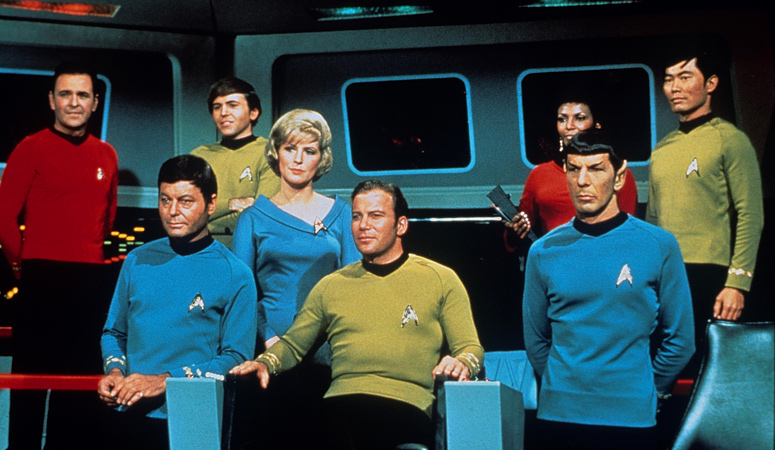
Star Trek TOS bridge crewThe Star Trek universe—I’m focusing especially on the original series (“TOS”) and movies here—is civilized.  There are plenty of things that go wrong, and going where no one has gone before frequently brings us into situations of conflict.  But the Federation itself is organized and mostly decent.  There’s an actual chain of command.  Authority figures are typically respected.

That’s the first approximation.  To be sure, Captain Kirk and his successors don’t mind defying Starfleet orders now and then.  But when Our Heroes turn out to be right, they’re back on amicable terms with their superiors in short order.  At the end of Star Trek IV:  The Voyage Home, Admiral Kirk, after stealing and destroying the Enterprise (among other things), is demoted to Captain again as his “punishment.”  But everyone understands this as simply restoring him to the role he prefers and serves so well.

There’s enough divergence among Starfleet personnel to make the stories interesting, but actual villains in the corps are relatively rare.  Starfleet and the Federation are the orderly defenders of liberty and individual (in our parochial world we say “human”) rights.  That Gene Roddenberry optimism is embedded in the show’s DNA.

Fruitful Disorder

In Star Wars, it’s the villainous Vader who wants to “bring order to the galaxy” (as he says around 1:38 in this clip), and it’s the motley, disorganized rebels who fight for freedom.  Our Heroes are rebels who defy the authorities.  Their chain of command is informal, and pretty much anyone, even the carefree Han Solo, can become a general.

Though the swashbuckling, colorful Star Wars universe may seem lighthearted, it’s actually a rather distressing place.  The nearest outpost of civilization to Luke’s uncle and aunt’s farm is Mos Eisley, a “wretched hive of scum and villainy.”  Slavery has flourished on Tatooine from a generation ago (little Anakin) to Luke’s era (Jabba’s servitors)—and apparently neither the Empire nor the old Republic did anything to stop it.  Intelligent droids are second-class citizens.  In the latter days of the Republic, trade combines were permitted to conduct outright warfare against whole planets (Phantom Menace), with no more than tardy, ineffective intervention by the Jedi Knights.  It seems a much less comfortable universe to live in than Star Trek’s Federation.  Both have their flaws, but the Star Wars ’verse seems much more unstable—if colorfully so.
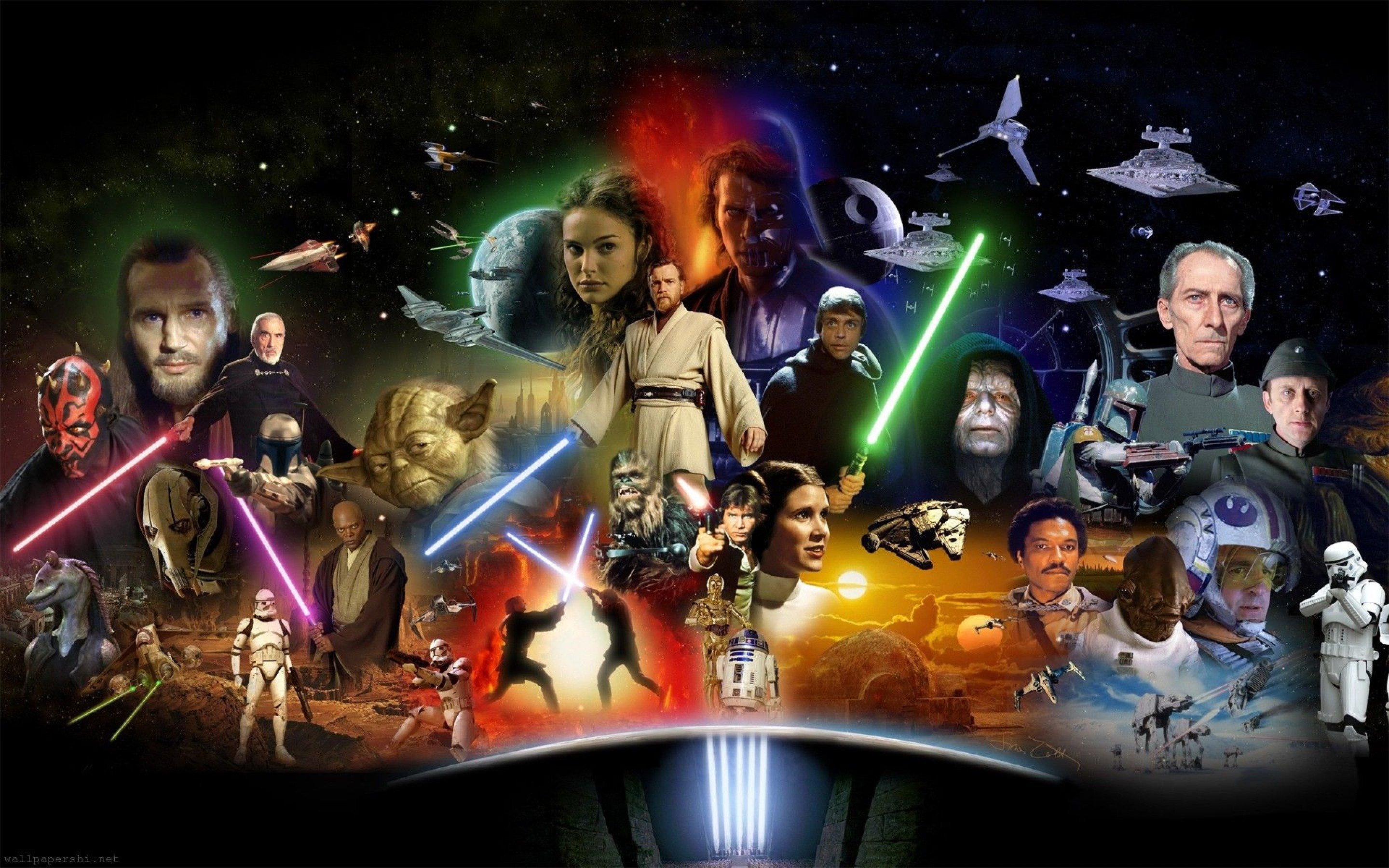
Star Trek composite posterThere’s nothing wrong with this as a story setting.  A varied world full of dangers makes for more exciting stories than a placid utopia.  But the Star Wars setting calls out to a different kind of fan than that of the Trekkies.

Vader’s desire for order actually has good character-based reasons—one of the things the prequel trilogy got right.  In a world where you’ve been held as a slave, your mother has been tortured to death by barbarians, and your beloved is menaced by assassins at every turn, a desire for law and order is extremely understandable.  But it’s the lively Rebels with whom the viewer’s sympathies lie.  In this democratic milieu, quirky individuals and inspired improvisation flourish.

Both the SW and ST approaches represent ’60s sensibilities, but one is slightly later than the other.  Roddenberry’s Star Trek expresses the firm American optimism of the Kennedy era (1960-1963); it isn’t accidental that in the follow-up movies, Roddenberry kept wanting to tell a story about time-traveling to meet JFK.  Star Wars, on the other hand, evokes the counterculture of the late ’60s, which distrusted authority and prized rebellion—not to mention colorful chaos.

The Abrams Factor

It’s instructive to see how J.J. Abrams handled the two, since he has had the opportunity to reboot both Star Trek and Star Wars franchises.  My sense is that he’s handled SW much better than ST.  Abrams’ Star Trek movies show us a distinctly grittier, more chaotic world than Roddenberry’s.  It is, in fact, more like the Star Wars universe.  And I don’t think I’m alone in feeling that, entertaining as Abrams’ ST movies may be, he doesn’t quite “get” what Star Trek is about.  His Star Wars continuation, The Force Awakens, however, is to my mind an excellent (if not flawless) extension of the SW universe.

In other words, making Star Wars more like Star Wars is a good thing, right up to the point where it begins to get slightly repetitious.  Making Star Trek more like Star Wars runs the risk of losing the very things that makes Roddenberry’s creation distinctive.  Both are good things; but they’re not good in quite the same way.

Alignment

One of the interesting things about the Dungeons & Dragons (D&D) game system is the notion of alignment.  D&D is built on ideas from a whole range of fantasy stories.  Many of those stories involve a conflict between good and evil.  Some, however, make the central conflict one of law vs. chaos.  D&D’s creators took the surprising step of adopting both oppositions, but keeping them distinct.  The result is a three-by-three, nine-cell matrix.  A character’s personality and ethical stance can be lawful good or chaotic good, or straddle the two as neutral good.  The being can also be lawful or chaotic evil—the evil of 1984 or of Beowulf, let’s say—or an intermediate neutral evil.  Finally, someone can be lawful neutral (think an OCD personality), chaotic neutral (low impulse control), or “true neutral” double-neutral (an unprincipled pragmatist, perhaps).  The range of combinations allows for shorthand expression of quite an array of character types.Nine alignments example, F&SF

I wouldn’t necessarily buy into this particular classification of famous fictional characters . . . but it gives us an idea how the alignment scheme works in practice.

The alignment chart also yields a neat way to encapsulate the ST/SW difference we’re examining.  Star Trek honors the lawful good:  the interstellar police force, the scientific explorer, the careful defender.  Star Wars admires the chaotic good:  the lovable rogue, the solitary guru, the loosely organized band of allies.

Political theory
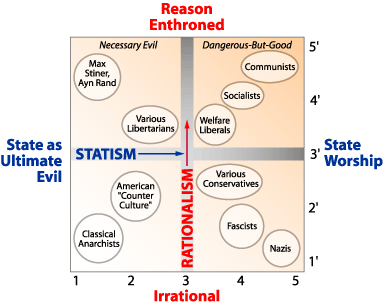
Pournelle political axes chartHere’s yet another way to put it.  Science fiction writer Jerry Pournelle, whose doctorate is in political science, laid out in 1963 a map of political “alignments” with two axes, producing a far more useful classification of positions than the usual left-right continuum.  (Pournelle’s 1986 essay provides a detailed explanation.)  The two dimensions in Pournelle’s scheme are “attitude toward the state” (from state as evil to state worship), and “attitude toward planned social progress” (from rationalism to irrationalism).

If we think of these axes as applying to the character of a culture, not necessarily to politics per se, we can express the ST/SW divide in Pournellean terms.  I’d put TOS-era Star Trek somewhere around 3/4’ or 3.5/4’ on the chart, believing pretty strongly in reason and ambivalent about state power.  Star Wars, by contrast, seems to live in the 2/2’ region, not far from the “American ‘Counter Culture’” to which I compared its ambiance above.  Each milieu will tend to attract viewers who are sympathetic to the points of view expressed in its neighborhood on the grid.

Civilization

What it comes down to, I think, is whether we see the best conditions for free and fruitful lives primarily in order or in disorder.  Both are arguably necessary.  But is what’s best for people a basically orderly society with a healthy modicum of chaos; or a wild-and-crazy culture with just enough organization to hang together?

The Star Trek/Star Wars contrast thus leads us up to the question of what makes for a good society, a true civilization.  There’s a good deal more to be said about this, and I’ll take another crack at it next time.

Arthurian Variations (Part II)

We’ve seen that the Arthuriad has generated a wide variety of retellings over the years.  What makes these legends so adaptable, and so congenial to storytellers of all kinds?

To begin with . . .

A few reasons leap out at us.

As we’ve seen before, it helps if there’s no one canonical version of a story.  Without a single clear source, later authors are free from the need to conform to the “classic” tale.  The Wikipedia article says outright, “there is no one canonical version” (¶ 3).

It’s true that Malory’s Le Morte d’Arthur is the central reference point, at least in English.  But his version is so far from current norms that it would be hard to try and reproduce it faithfully—as Steinbeck perhaps found.  Malory serves more as a library or resource for story elements that can be adapted and recombined at will.

The sheer breadth of that source material is a second factor.  All those knights, all those adventures, even the numerous events of the main storyline:  the Arthuriad is its own ‘Pot of Story,’ a stew full of nutritious narrative elements.  “It held a treasure for every seeker.”  (The Mabinogion, tr. Gwyn Jones and Thomas Jones, Everyman’s Library, 1949, 1974, Introduction, p. xxx.)

The story also occupies a colorful historical setting, whether in the plate-mail-and-castles “high road” approach, or in the more historically plausible “low road” approach.  Many readers have a fondness for this quasi-medieval environment—which is why versions of that milieu are used in so many fantasy stories and games.

A Plethora of Characters

In particular, the Arthuriad is filled with strong and interesting characters.  An author can focus on, say, the character of Percival, or Morgan le Fay, or Gawain, and take off from there.  Or she can ring the changes on the main story by redefining the characters and their relationships, as we saw in the examples from Part I.

Arthur himself can be played in many ways.  Generally he tends to have a certain innocence, a certain earnestness and candor about him.  But this can be realized in the psychologically wounded but charismatic leader of Wolf’s tale, in the essential simplicity of the idealist in White’s Once and Future King, or in the clever but dedicated warleader of “King Arthur.”  (It can also be seen in the weak and waffling character of Lerner & Loewe’s “Camelot”—if we include what I consider a failed implementation.)

Other characters are equally mutable.  Mordred is subtle and evil in White; he’s an innocent and rather likable kid in Wolf.  Lancelot contains enough contradictions in himself—loyal friend, betrayer of a marriage, devoted lover, peerless warrior—that an intense character study of this champion is almost unavoidable if we let him into the story at all.

Guinevere is a particularly tricky case.  It’s hard to play her as truly admirable—since so much of her traditional role lies in being untrue, at least after a fashion.  (She’s untrue to Arthur, but true to Lancelot, and the story seems largely willing to forgive the first in light of the second.)  If she isn’t handled carefully, she’s likely to default into being silly, or weak, or fickle.  The challenge of giving her a better role may appeal to an author.  Both books and films have taken up that challenge, though I’m not familiar with those treatments.

Compelling Drama

The story of Arthur contains many events that lend themselves to high drama.  For example—

His origin.  It seems essential for Arthur’s ascent to the throne to exemplify the theme of the lowly raised high, the rise from humble beginnings to glory.  His childhood is modest, in one way or another.  In the traditional formulation, Arthur doesn’t know who he is until he is almost grown, and it may take a magic token (the sword in the stone) to demonstrate his true nature.  As a result, Arthur generally has the humility that I’ve argued characterizes our archetype of the Good King.

This Cinderella-type story appeals to our fondness for the underdog, and the reversal of fortunes is inherently dramatic.  There are a lot of possibilities for how that revelation occurs, and how Arthur and those around him react.

Lancelot, Guinevere, Arthur (King Arthur)The love stories.  An eternal triangle necessarily involves passion, betrayal, and drama.  But there are a lot of possible ways to construe the relations among Arthur, Guinevere, and Lancelot (along with Morgan and other possible players, as we saw last time).

In the central love story, Arthur tends to lose out.  As White puts it (Book Three, beginning of ch. 45):  “Merlyn had not intended him for private happiness.  He had been made for royal joys, for the fortunes of a nation.”

Since Arthur is on the scene first, Lancelot must share some strong bond with Guinevere in order to draw her away from Arthur—unless the Arthur-Guinevere bond isn’t that strong to begin with, as in Wolf.  If we idealize Lancelot and Guinevere’s romance, we have to push Arthur away.

There’s a strong impulse to rescue the love story somehow.  We have three characters, each of whom we love and admire, trapped in this untenable situation.  We don’t want any of them to lose out, but someone has to.

So we get retellings that pare down the triangle.  In The Road to Avalon, Arthur and Morgan are the real romance; it doesn’t matter if Guinevere seeks solace elsewhere (except for political reasons).  In “First Knight,” Arthur is too old for Guinevere; after his inevitable death, Lancelot and Guinevere seem to be left free to marry.  “King Arthur” ends early, in terms of the overall myth, and skips the entire triangular problem.  Arthur and Guinevere marry at the end in a traditional romantic consummation, and Lancelot remains a minor character.

Moreover, if we choose as our main character someone other than the Big Three—one of the numerous other knights or ladies of the Arthurian court—the possibilities for love stories are endless.

The Holy Grail (Indiana Jones)The Holy Grail.  It’s hard to know what to make of the Holy Grail as a storytelling hub.  The Grail’s religious origins (although they are subject to dispute by some literary historians) may cause this part of the story to be bypassed entirely by those writers who prefer to dodge the Christian aspects of the Arthuriad.  White introduces the Grail quest rather ignobly as a distraction to keep the knights busy when there are no wars for them to fight.

Nonetheless, the mythic resonances of this ultimate quest MacGuffin have let it play a role in a surprising number of modern treatments—from “Monty Python and the Holy Grail” to “Indiana Jones and the Last Crusade”—even where, as in the last example, the Arthurian tales are not otherwise involved.  For those who want an air of mystery and the numinous, rather than just clashing swords, the Grail is a natural choice.

Key Themes

Finally, the Arthuriad carries a number of themes of lasting interest.  These themes can also draw storytellers to the court of Camelot.

Knights of the Round Table (Excalibur)True companions.  For Western culture, Arthur’s Round Table knights may be the archetypal example of the tight-knit group of comrades fighting together for the right.  The basic story also includes some inversions of this band-of-brothers relationship—betrayals of several kinds—but that only serves to make the ideal seem more dramatic and memorable.  The Round Table is explicitly portrayed in “First Knight” and (without the table) in “King Arthur.”  It’s satirized, yet mourned, in White.  It does not play a major role in Wolf’s version.  But if an author wants to invoke the ideal of comradeship to the death, Arthur’s court is as likely a touchstone as the Three Musketeers or Robin Hood’s woodland band.

Chivalry.  The Arthurian knights represent the archetype of the ideal of chivalry.  Now, our era has a love-hate relationship with this notion.  We frequently prefer to satirize or criticize the ideals that were held up as models for the Arthurian knights.  Yet there remains a certain appeal to what TV Tropes calls Old-School Chivalry, a less literal version that can turn up in cases as varied as Captain America and “Kate and Leopold.”  These later varieties look back to the hazy memory of a medieval ideal that we associate with Arthur’s court.

Civilization is at stake.  Almost all versions of the tale depict Arthur as standing in some sense for the defense of imperiled civilization against the chaotic forces that threaten it.  The opposition may be literal, as in The Road to Avalon, where Arthur leads armies against the invading Saxons.  Or it may be more subtle, as when The Once and Future King shows Arthur striving to achieve the rule of law as a principle to contain the depredations of warlords.  Not Might makes Right, but Right makes Might, protecting the weak from the strong, ordinary people from the powerful:  this is the chivalric ideal Arthur pursues under the tutelage of Merlyn.

You could call it civilization.  What I meant by civilization when I invented it, was simply that people ought not to take advantage of weakness—not violate maidens, and rob widows, and kill a man when he was down.  People ought to be civil.  (Book Two, chapter 9)

The most poignant aspect of the Arthurian tale is that he achieves this ideal, for a fleeting moment—an island of light in an age of darkness—yet it fails.  The Round Table is broken, Camelot goes down in war and betrayal, Arthur does not found a virtuous dynasty.  This chiaroscuro of success and failure has a dramatic appeal that is hard for a storyteller to resist.

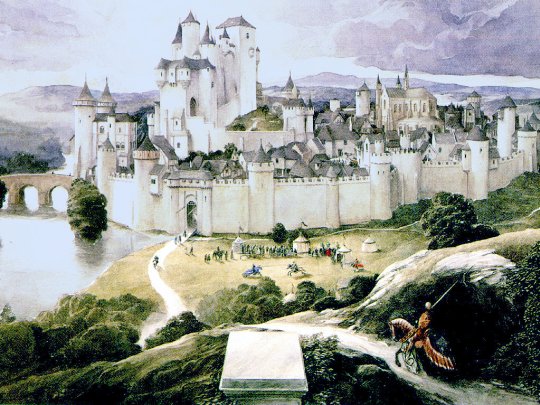
CamelotCamelot falls.  And yet, the story does not quite end in despair.  Arthur may die—but he is not entirely lost; he will somehow return.  In White’s touching ending, Arthur hands on the story itself, the memory of Camelot, to a young page named Tom—Tom Malory.  The ideal remains an ideal, and we are reassured that someday Arthur and the ideals he champions will reawaken.

It is no wonder that this kind of ambiguous, yet hopeful, ending attracts storytellers.  It attracts readers too.  All but the most hardened cynics would like to look forward to such a return.  Arthur’s story, like Arthur himself, never quite dies.