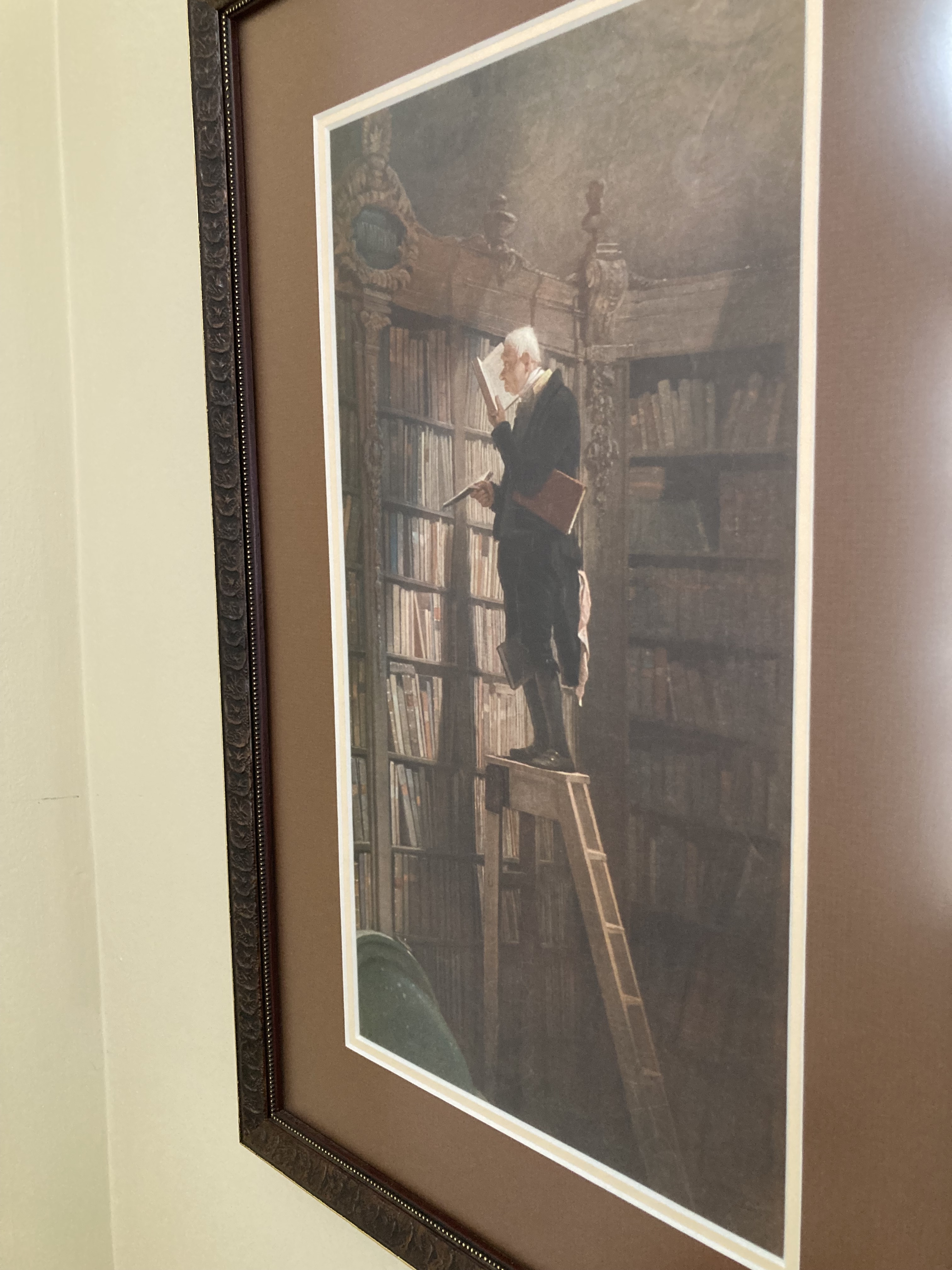
Can one have too many books? I want to say no. (See the illustration, which hangs on our front hall next to the library.) On the other hand, it’s become difficult to fit my accumulated collection comfortably into any reasonable home—and doubly so when you add in my wife’s lifelong collection as well—even without the eight or ten boxes of books I sold off to the fabulous Wonder Books in Frederick in an attempt to thin out the collection. And nonfiction is another story. (Well, the stories are in the fiction section; but you see what I mean.)
This is so even though I’ve tried to exercise restraint by buying only those books I’ll want to read over again. I prefer to try out a new book by getting it from the library, and, after reading, to decide whether this is a “keeper” that I always want to have available. The rare exceptions are new books that I already know I’ll want to own, generally in a series. While Lois McMaster Bujold’s Vorkosigan saga was still coming out, for instance, I’d grab those off the bookstore shelves at once, sight unseen. (Though I admit I do have only an electronic copy of Gentleman Jole and the Red Queen—but that’s another discussion.)
Aside from considerations of space, it occurred to me some years ago that the “read again” rationale necessarily diminishes over time. Given my likely lifespan, how many times am I likely to reread any given volume? That number is constantly decreasing. This makes me a little cautious about buying new books—as opposed to using the library. One of the great perks of my current job is that there’s a county library branch right on the first floor of our building. I can put a book on hold and nip down while at the office to pick it up. Same thing to return it. A wonderful arrangement . . . at least until I retire . . .
The other motivation I’ve had for accumulating books has been a vague notion that they serve as a kind of reference library. In writing posts like these, it’s convenient to be able to grab a favorite book to check on some point or to make a citation precise. For years, I kept around an old paperback copy of Neil Jones’s The Planet of the Double Sun (1931, paperback edition 1967), merely as an example of a really crummy old-time SF yarn. It finally occurred to me that there was no particular purpose in having it—rereading it would be too boring to be worth any use I might make of the mention—and I ditched, er, released my copy to find a new home with some historian of SF. Haven’t missed it since.
The Great Reread
In the process of going over my packed-and-unpacked-and-reshelved books (two moves in the last two and a half years!), I’ve sometimes found it hard to recall what some of the stories were actually like. Or I feel as if I’d like to read a book once more before I consign it to the outermost depths. So I find myself rereading a lot of old material. Some of it holds up pretty well. Others, I wonder what I saw in the tale in the first place. The rereads end up being a combination of final trial—do I want to keep this book?—and fond farewell.
Of course I continue to read new stories too: new good books are coming out all the time. But it’s rather enjoyable to revisit some old friends as part of a balanced bookish diet.
And sometimes the old stuff may be worthy of comment. So I’m going to include the occasional post here from the Great Reread. The inspiration comes from Jo Walton’s brilliant series of essays, “What Makes This Book So Great,” originally hosted, I believe, at Tor and published in a 2014 collection. (There seems to be a list of links here; Walton’s own comments on rereading are here.) I’m not spotlighting what are necessarily the greatest books—but there may be interesting things to say even about the non-great or non-classic tomes I find cluttering my shelves.
Since these books tend to be fairly well aged, I don’t think it’s necessary to issue spoiler alerts in each case. The comments all have spoilers.
Brian Daley’s Peripatetic Heroes
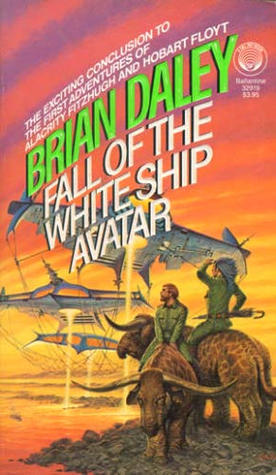
I first ran across Brian Daley (1947-1996) in his 1977 novel The Doomfarers of Coramonde, which has the irresistible premise that a sorcerer in a fantasy land summons magical assistance from another world—and it turns out to be an armored personnel carrier, with crew, from the war in Vietnam. The fish-out-of-water contrast was delightful and the action first-rate. I was primed to look for more good fun a few years later when Daley published Requiem for a Ruler of Worlds (1985), the first in a trilogy of adventures featuring the mismatched buddies Hobart Floyt and Alacrity Fitzhugh.
They’re still good fun. The heroes are both likable and relatable—dashing and mercurial Alacrity, a knockabout itinerant spacer with “friends in low places” across the starlanes, and staid Hobart, a minor bureaucrat from a congested backwater Earth. Alacrity has some personal issues to get over, mostly in the third volume, but Hobart develops most, rising to the occasion as he travels into space to obtain a bequest inexplicably left to him by an interstellar magnate. The worldbuilding is brilliant: planet after exotic planet, oddball character after still odder character. The sheer variety and colorfulness of Daley’s cosmos is pleasing.
The Floyt-Fitzhugh saga falls into the category of the “picaresque” tale. Originally I misunderstood that term to mean the same thing as simply “picturesque,” and the story certainly is that. When I actually looked up the word, many years ago, I realized it had a more specific meaning: “Characteristic of a genre of Spanish satiric novel dealing with the adventures of a roguish hero,” as Wiktionary puts it. That fits our heroes pretty well—Alacrity from the start, Hobart learning fast. They’re lovable rogues, often on the wrong side of the law (or at least local customs), with hearts of about 12-carat gold. Even in the last scene of the series, they’re off again to who knows where, one jump ahead of pursuit.
And thereby hang my possibly idiosyncratic reservations about the story. The plot of the first book is very good; there’s a clear goal and climax. In the second and third books, not quite so much. Alacrity and Hobart achieve some interesting results, but they themselves don’t actually stop to absorb or enjoy them. Our Heroes are always on to the next thing. Daley gives each of them a pretty good romance subplot, but these never quite resolve, since the MCs are always leaving their girlfriends behind—even at the end of the third book, Fall of the White Ship Avatar. I was left wondering, do these two ever get to settle down and enjoy the fruits of their labors?
This is a standard issue with wandering, picaresque heroes, particularly those who star in open-ended series. Daley even lampshades this aspect by including a whimsical journalist in the story who features Floyt and Fitzhugh in a series of utterly melodramatic “penny dreadfuls,” to Our Heroes’ perpetual embarrassment and annoyance. Daley seems to want to place them in the company of series heroes whose adventures never really end. James Bond is never going to stop secret-agenting; he just gets re-cast with increasingly younger actors. At the end of Indiana Jones and the Kingdom of the Crystal Skull, just when we might expect Indy to retire and be replaced by his son, Indy snatches back his rolling fedora at the last moment. The ending of The Incredibles or Spider-Man 2 show the characters resolving their personal character arcs, but nonetheless leaping into the next adventure.
One wonders if these perpetual adventurers ever retire, even as they inevitably age. We’ve pondered this previously in considering the “professional hero.” There has been the occasional hero who explicitly retires and passes on the mantle to a successor. There’s a neat little story in Kurt Busiek’s Astro City showing how superhero Jack-in-the-Box is training his successor. And Captain America eventually retires in the MCU, though the ‘line of succession’ is rather fraught.
Personally, I like to see the main characters settle down at some point, if only to enjoy a well-earned respite from perpetual danger and damage. They can continue to have interesting adventures later on; “happily ever after” need not be a static condition. Consider, for example, the somewhat atypical honeymoon of Miles and Ekaterin Vorkosigan in Diplomatic Immunity. But it’s satisfying to see beloved characters enjoying some degree of stability.
On the other hand, there’s also a certain appeal to the hero who’s eternally “out there,” a legendary figure, always at their peak and unabatedly themselves. In a way I don’t want to see Nero Wolfe or James Bond retire. So I do rather appreciate the perpetual motion of Floyt and Fitzhugh, despite the lack of resolution. To resolve, or not to resolve? That is the question—but either answer may be acceptable. I’ll be keeping the Daley books on my overstuffed shelves.
A couple of comments by Kevin Wade Johnson in connection with my last blog post (now a long way back!) triggered a line of thought about heroes and the hero business.
Robert A. Heinlein’s 1963 novel Glory Road looks like a swashbuckling fantasy at first blush, but it turns into something entirely different. Our hero, E.C. “Oscar” Gordon, kicking around the world after leaving the military, is recruited by an incredibly gorgeous woman to assist her with a quest that involves traveling to other universes and swordfighting. This is just the kind of adventure he was craving.
As Kevin observes, the first three-quarters of the book are action-adventure, with sizable side dishes of comedy, scandalous liaisons, and cynical social commentary. At that point the quest is fully resolved—at page 208 out of 288, in my copy. What, then, occupies the rest of the book?
Gordon returns with “Star,” the beautiful woman he’s now married, to her home universe. It turns out she’s the empress of a multiuniversal polity that is in some respects a high-tech Utopia. All Gordon has to do is relax, allow himself to be fêted by the population, and sleep with anyone he finds interesting (the late Heinlein’s polyamory is fully on display here).
He hates it.
What Utopia doesn’t satisfy is Gordon’s lust for adventure. He doesn’t want to be a dilettante or a “kept man.” He wants wonder, excitement, the stimulus of danger. He likes being a hero, with all the occasional discomforts and perils of that role. The placid happy ending of a retired hero holds no attraction for Gordon.
It’s unclear whether Star feels the same way. She’s willing to consider going in on a kind of adventuring “business” with her slightly tarnished knight. But first, she says, she’d have to train a replacement for her unique position—and that would take many years.
The solution is for Gordon to head off again on the Glory Road without Star. He’ll pop back in now and then, but not to take up residence in the Twenty Universes utopia on a permanent basis. He and Star will remain in love with each other, perhaps, in some sense of the term—but not in a sense that requires fidelity on either’s part. In Heinlein’s polyamorous world-view, passing romantic involvements are just part of the adventure: “Knights errant spend their nights erring” (p. 271). Gordon’s happy ending is the continuing adventure.
The Unsettled Adventurer
This idea comes up from time to time in adventure stories: the hero (or heroine) who seeks out danger and isn’t content without it. John Carter of Mars displays a little of this, though in the violent world of Barsoom, he seems to be able to get his fill of trouble while still remaining home-based with the enthralling Dejah Thoris in her city of Helium. There’s something like this idea in the conclusion of The Good Place—boredom with utopia—as we’ve seen.
The really extreme case can be found in an old-time fantasy by E.R. Eddison, The Worm Ouroboros (1922). The swashbuckling nobles of Eddison’s imagined world fight the good fight against their sinister enemies, the Witchlanders. At the end of the novel, those adversaries are conclusively defeated. Cue the victory feast. And yet . . . Our Heroes are not quite satisfied. Things just won’t be as interesting without the Witchlanders constantly scheming and warring against them. At the very end, the heroes’ fanciful wish is somehow granted: a herald announces the arrival of an emissary from the bad guys—the same event with which the novel opened. (Hence the title: the legendary serpent that swallows its own tail.)
The Series Protagonist
I’ve previously expressed some doubts about whether happy endings really need to be static and boring—so let’s not adopt the Glory Road doctrine too hastily. (In its extreme form, Eddison’s circular epic, one may feel the opposite dissatisfaction in the sense that all the heroes’ striving and suffering has been for nothing.) But these examples highlight a difference among types of action heroes.
In a long-running action series, unless a hero is improbably falling into one adventure after another against their will, we have to assume that the hero likes what they’re doing. James Bond seems to be pretty content with his secret-agent life. Indiana Jones yearns for opportunities to climb out the window of his stuffy professorial office and strike out on some treasure-hunting chase—even at an advanced age, as we’ve recently seen. Captain Kirk, who’d been promoted to admiral by the beginning of Star Trek II, isn’t suited for a desk job. At the end of the three-movie cycle he’s demoted to captain again—ostensibly as a punishment for flagrant violations of Starfleet regs, but we’re to see this as a step forward for him, his best destiny. Yoda accuses Luke of this kind of unrest in The Empire Strikes Back: “Adventure! Excitement! A Jedi craves not these things.”
The same is true of almost all superheroes. Retirement is almost unheard-of. The occasional counter-example makes for an interesting tale precisely because it runs against type: Hank Pym in the Marvel Cinematic Universe, Jack-in-the-Box in Astro City. In a somewhat similar way, continuing campaigns in Dungeons & Dragons or similar games tend to assume the existence of a class of professional adventurers who enter willingly into a life of battle and treasure-hunting, as distinct from an assembled-for-one-purpose group like the Fellowship of the Ring.
This character trait does make things convenient for the writers. They have a believable rationale for the main character’s continuing adventures. Otherwise, after a while it would start to seem implausible for one person to keep getting drawn into danger purely by accident.
The Hero By Trade
The Star Trek captains, and other officers, illustrate a type of case where the character really is a professional hero—one who’s taken up a profession or vocation where danger and challenge, and hence the opportunity for heroism, come with the territory. Anyone pursuing a military or quasi-military career fills that bill. Honor Harrington, for example, reflects more than once that she’s good at war; it’s her calling, what she was born to do. Professional police officers, firefighters, or rescue workers—first responders generally—also fall into this category. (John McClane of Die Hard fame, mentioned above, is in a danger-prone profession, though it’s probably rare for a cop to run into the kinds of major crises he does.) Unsung heroes like medical personnel may find themselves in the same position. They may not categorize what they’re doing as heroism (it looks better on them if they don’t); but they are putting themselves “in harm’s way” where acts of heroism are constantly called for.
This is why military SF lends itself so easily to long-running series like Honor Harrington’s. (The same is true outside the SF genres, as we can see, for example, in Patrick O’Brian’s Aubrey/Maturin sea stories.) The same is true of private detectives, secret agents, and the like.
The Reluctant Hero
But not all heroes are professional heroes. An equally perennial favorite is the reluctant or accidental hero—the person who answers the call to adventure, but does wish to return to a peaceful life afterward.
Jim Butcher’s Introduction to Jim Butcher & Kerrie L. Hughes, Heroic Hearts (NY: Ace Books, 2022), puts it this way:
Real heroes . . . [are] the everyday humans who happen to be standing there when something bad happens, and when there is a sudden need for skill, courage, or intelligence. They’re the regular people in irregular circumstances who find themselves considering others first and standing up to do whatever needs to be done.” (p. xi)
Some do manage to go back to their ordinary lives after the crisis has passed. Cincinnatus, and George Washington, are famous for pulling off the transition: they took over the reins of the state when they had to, but willingly ceded power afterwards. On a more modest scale, the “citizen soldier” concept, as in the American National Guard, aims at the same thing. It’s part of the mystique of the American World War II armies, the so-called “Greatest Generation” model. You rise up to serve when necessary, but happily return to civilian life when it’s done. Contemporary discussions are more likely to emphasize post-traumatic stress disorder (PTSD) and the difficulty of the return to civilian life; but it remains an ideal with considerable drawing power.
In fiction, the contrast between heroic acts and ordinary life provides rich soil in which to grow interesting stories and characters. Tolkien, for example, gives us some characters who do manage the return to everyday existence—Sam Gamgee—and others who find it impossible, such as Frodo. Of course Frodo does in the end find peace in Valinor, but that requires a literal removal from the circles of the world, a transcendence not available to the average hobbit-in-the-street.
The situations can become fairly complex. In the Song of Roland, after the heroic deeds of the story are finished, a weary Charlemagne at the end finds himself called back unwillingly to new conflicts. In the TV series Chuck, the eponymous Chuck Bartowski is initially appalled to find himself embroiled in spy activities, but the sheer coolness of it all grows on him, and by the fifth season he wants to start his own secret-agent business. Scott Lang (Ant-Man) at the beginning of Quantumania is resting comfortably on his laurels, and has to be dragged back into action in the name of helping others.
Detectives in mystery stories fall into both camps. We have professional private eyes like Sherlock Holmes and Nero Wolfe. But then we also have amateurs like Chesterton’s Father Brown and Agatha Christie’s Miss Marple, who always just seem to be in the right place at the right time.
The Author’s Choice
If we want to write a heroic adventure story, one of the early decisions we have to make is what kind of hero we want to feature. Sometimes the tale may call for someone who’s automatically in a position to encounter danger, like a military officer. Sometimes we may prefer to drag the hero into action against their wishes, or by happenstance. The whole point of Roger Thornhill’s predicament in North by Northwest, for example, is that he has no desire to become involved in skulduggery and is baffled by the strange things that are happening to him. Like so many other accidental heroes, however, he rises to the occasion. This is a narrative arc that may be both more interesting and more inspiring than that of the professional hero; because most of us live relatively ordinary lives and can only hope that if called upon, we too could become the kind of hero we admire.
My wife and I went to see Indiana Jones and the Dial of Destiny (2023) Friday night. Good movie—I’m unsure whether to call it “great.” My reaction was somewhat complicated by the fact that I’d inadvertently gotten us tickets to a theatre with the full range of tactile or “haptic” special effects—seats that bounce you around violently, drafts and puffs of air, sprinkles of water, little gizmos that tickle your neck or ankles. We both found all this paraphernalia rather distracting at first, though it’s undeniably immersive—rather like seeing a movie and riding a thrill ride at the same time.
I’m going to try and avoid spoilers on this occasion, since it’s likely a lot of us haven’t seen this episode yet. (It’s fun to get in on opening night sometimes—and I have to keep up my geek cred somehow.) This closing episode—Harrison Ford and the Spielberg/Lucas team have all said this is to be Indy’s last outing, though I wouldn’t be surprised to see further spinoffs, like the The Young Indiana Jones Chronicles—provides a useful opportunity to reflect on the series as a whole, which we can do without major spoilers.
What Makes Indy Go
Part of what makes the Indiana Jones films so much fun is their unabashed appeal to action-packed derring-do—the meat and drink of the old-time movie serials that both Lucas and Spielberg have pointed to as inspiration. In that respect, it’s close kin to Star Wars—no surprise, since Lucas was behind that series as well.
Another key element is the character of Indy himself. He performs incredible (perhaps impossible) physical feats, but he always seems to be doing it in desperate improvisation—no Superman he. And while he’s an honorable cuss with a warm heart, there’s also a vein of pragmatism that makes him earthier than a traditional noble hero. (Remember the scene in Raiders where, finding Marion tied up in Belloq’s tent, he has second thoughts while untying her and, to her outrage, ties her back up again?)
The plot driver in each film is a lost and significant object: the Ark, a jewel, the Grail, the Crystal Skull, the Antikythera mechanism. The child in us can’t help responding to the appeal of “buried treasure.” From the children’s adventures of Nancy Drew or of Enid Blyton’s numerous literary offspring, to the (slightly) more grown-up exploits of National Treasure or Pirates of the Caribbean, we’re fascinated by the idea of suddenly discovering some hidden thing of inestimable value. Even a contemporary middle-grade book like Morgan Matson’s The Firefly Summer can invoke the same perennial attraction. Of course, “old” is relative—it might be as recent as one’s parents’ generation, or as far back as prehistory. The antiquities in at least three of these movies are thousands of years old, which is plenty far enough to evoke awe and wonder.
In the best of the IJ movies, this sense of wonder is intensified and elevated by the fascination of the numinous: a religious or near-religious awe. By the “best” movies I mean, of course, Raiders of the Lost Ark and Indiana Jones and the Last Crusade, which I believe are generally regarded as the best of the bunch. I don’t think Dial of Destiny will rise to that level, though it’s certainly far better than the weakest link, Temple of Doom. (Of course, your mileage may vary . . .) The old-time movie-serial ambiance seems better suited to the power of myth than to the science-fiction veneer of the final two episodes.
The Tomb Raider Syndrome
I gather Indy has inspired a number of young people to become actual archaeologists. That’s a good thing, although as soon as we invoke actual archaeology, we have to acknowledge how far Indy wanders from scientific best practices. I must admit I cringe a little every time Jones and a companion shove a stone cover violently off a tomb, presumably to crack and shatter on the floor out of camera range—not to mention the absence of any attempt even by 1930s standards to photograph or otherwise record these unique historic sites. Last Crusade even highlights the difference between real archaeology and mere treasure-hunting: Indy tells his class “. . . and X never, ever marks the spot”—which caution is then promptly spoofed when he discovers that a giant X (the Roman numeral ten) actually does indicate where a catacomb is buried in Venice.
Of course, Indy has bigger fish to fry, so we blink amiably at these scientific solecisms and get on with the nonstop excitement. The cavalier treatment of relics is a long-standing tradition, shared (I think) by Indy’s distaff counterpart Lara Croft, among others. In our more pedantic moments, we may raise our eyebrows at these dubious tactics, but this is a case where TV Tropes’ “MST3K Mantra” applies: “It’s just a show; I should really just relax.” Indy himself does aim to do the right thing by history: he’s constantly contrasted with more mercenary grave-robbers when he insists, “This should be in a museum.”
The Human Element
More important, though, in Indy’s appeal to an eager audience is the human connections. They’re less prominent than the thrills and special effects, but they’re at the heart of the stories. Indy’s romance with Marion and his friendship with Sallah, and even his rivalry with the elegant Belloq, give us an enjoyment that outlasts the fight or chase scenes.
Lucas and Spielberg doubled down on this in Last Crusade, where Indy’s relationship with his father made for most of the more memorable moments of that film. On the other hand, serious human relationships are largely absent from Temple of Doom, whose single saving grace (aside from the mine-cart ride) is his friendship with Short Round. As an unregenerate romantic, I give Kingdom of the Crystal Skull extra points for reviving Indy’s romance with Marion (after his ephemeral affairs in the second and third installments).
In this respect, I think Dial may fall a bit short. While Indy’s relationship with his Action Girl goddaughter is a central theme in this movie, I didn’t find the new character quite as likable or interesting as I wanted to. There are some heartwarming moments here, to be sure, but they tend to bunch up toward the end of the story.
All in all, Dial gives us a distinctly quieter and more elegiac ending than the previous episode’s celebratory denouement. The lasting appeal of this film may have a lot to do with how audiences respond to the character arcs. After forty-two years, we can fondly say farewell to Indiana Jones in this concluding episode—though after all the thrills and chills, we may feel, with Indy, that “it’s not the years, it’s the mileage.”
So, okay, I gave in and signed up for Disney+. It’s not as if I needed the streaming service to see the Disney fairy tales, or Star Wars, or the Marvel movies; I have those on disc. But there were these other things. First, I wanted to see the Hamilton movie (just as impressive as it’s cracked up to be). Then, since I was already subscribed for a month, I figured I’d check out The Mandalorian, if only to keep up my geek cred—it had taken me a while just to figure out where all the “Baby Yoda” memes were coming from.
By the end of the first month, I’d scanned the offerings and marked down a bunch of other things that I’d sort of wanted to see, or that I hadn’t known about but looked interesting, and now could get without paying more than I already was. And I was off and streaming . . .
One of the unanticipated things I turned up was a set of ancillary videos related to the 2010 fairy-tale adaptation Tangled, Disney’s version of the Rapunzel story. And thereby hangs a blog post.
A Tangle of Sequels
I’ve always been fond of the Tangled movie. But the continuing story also turned out to be remarkably good. As a rule, sequels to Disney princess movies tend to be humdrum affairs dashed off to exploit the movie’s popularity—though I must admit that I say this without having seen very many of them; ventures like The Little Mermaid II or Cinderella II: Dreams Come True never seemed to deserve even a look. (Frozen II is a decided exception.)
But the Tangled folks managed to pull off some impressive work in the follow-up media. To discuss it in detail, of course, I’m going to have to deploy detailed spoilers.
In 2012 Disney released a six-minute cartoon, Tangled Ever After, which is basically a comic bit about the exploits of the animal characters during the wedding of Rapunzel and her romantic interest, Eugene Fitzherbert (who previously used the name of legendary rogue-hero “Flynn Rider”). Nothing of interest there.
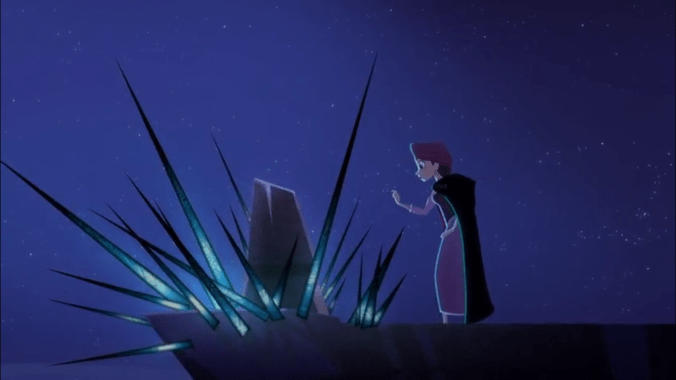
However, in 2017 the Disney Channel debuted a 55-minute short film, Tangled: Before Ever After. As the title indicates, this story takes place before the wedding sequence. The day before Rapunzel’s coronation, her lady-in-waiting, a tough-minded and capable girl named Cassandra, helps her sneak out beyond the kingdom’s walls to get away from the stress and chaos of the preparations. At the site of the magic flower that originally gave Rapunzel’s hair its healing powers, they find a stand of mysterious pointed black rocks. When Rapunzel touches one, more rocks suddenly sprout from the ground, forcing them to flee. But Rapunzel’s hair, which was cut short and returned to its natural brown in the original movie, suddenly turns blonde again and reverts to its 70-foot tower length.
This business with the black rocks is the story’s “One Ring,” the MacGuffin that links the old story to the new and provides the plot driver going forward. It isn’t explained or resolved in Before Ever After, but serves as the hook for the three-season TV series (2016-2020) that followed. The series was initially labeled “Tangled: The Series,” but in its second season was rechristened Rapunzel’s Tangled Adventure. Season 1 follows Rapunzel’s experiences in her parents’ kingdom; Seasons 2 and 3 take her and her companions on the road on a long-running quest. Wikipedia has a handy list of the episodes.
The series is where most of the plot and character development occurs. It concluded in March 2020. At this point it’s pretty clear that no further follow-ons are necessary, though one can’t rule out the possibility (“never say never again”). There’s also a stage musical (a version of the movie) and a video game, which I haven’t seen and assume are not in the continuity. Wikipedia’s convenient overall reference for the Tangled franchise is here.
Opening Out the Ever After
The first challenge in making a sequel to a fairy-tale movie is what to do about the ending. Traditionally, these stories end in a romantic happily-ever-after. If the main characters marry at the end (or immediately afterward), we’ve resolved the romantic tension. In addition, it may be hard to reconcile the vague vision of enduring happiness with the kinds of perilous adventures that would give life to a sequel.
The “before ever after” notion is thus productive. The characters can have further adventures even before their happiness is, as it were, sealed. We can stave off the fairy-tale ending, without subverting it entirely. To ruin the romance would be opprobrious, diminishing the appeal of the original story; but there’s no reason it has to come to fruition (presumably in a wedding) at once.
It’s particularly easy to take advantage of this idea if the couple hasn’t actually become engaged in the original story (even though the audience knows perfectly well that’s going to happen). Some reduced degree of romantic tension remains if the character still has to work up the nerve to propose, though the issue becomes more comical than dramatic. (A similar tactic was used in Frozen II.)
Thus, Eugene proposes to Rapunzel several times in the course of the sequels. She doesn’t accept at once. She wants to marry Eugene, but she isn’t quite ready yet. This brings out the familiar “moral” that a girl’s future is not solely bound up in marriage. It also makes psychological sense—and this is one of the ways in which the Tangled sequels intelligently carry forward the original storyline. As other characters point out, Rapunzel has spent almost all her life locked up in a tower, never meeting another human being but her “mother” captor. It seems hardly appropriate to expect her immediately to enter into a marriage.
Of course, Rapunzel could marry and still have adventures. The story thus plays around with the notion that “happily ever after” means the end of adventures and of our interest in the characters—a notion I’ve criticized elsewhere. It both dodges, and runs into, that trap.
The World and the Plot
Varian
Since the continuing story takes Rapunzel into new territory, both within and later beyond the Kingdom of Corona (which turned out to be a somewhat infelicitous name for this year, however appropriate for a princess), it was also necessary to expand the world. The writers carry out this worldbuilding exercise with enough novelty to earn some credit. For example, one of the new secondary characters is a young alchemist named Varian. Although his alchemy is technically magic, he firmly takes the position that it’s science, not fantasy. He thus adds a sort of steampunk vibe to the whole business.
Adira
The second season of the series introduces a secret society of crack warriors who are in some way protecting or defending the source of the black rocks. An enigmatic woman named Adira provides them with clues, along with ominous nonspecific warnings, and occasionally ends up sparring with the suspicious Cassandra. She and other members of the “Brotherhood of the Dark Kingdom” sometimes end up opposing or challenging the main characters, though they are basically on the same side. This secret society’s stance is reminiscent of the Brotherhood of the Cruciform Sword from Indiana Jones and the Last Crusade.
The most striking element of the plot is the long-running plot arc, which begins with the black-rock episode in Before Ever After and isn’t completed until the final episode of the series. The black rocks are tied in with the “sundrop flower” that originally gave Rapunzel her powers, so they link back neatly into the original movie. Keeping such an über-plot going over sixty episodes is a challenge, and the writers lay in enough complications and reversals to make it work.
This long-term development isn’t perfectly uniform. There are one-off episodes sandwiched in, often with throwaway plots (Max the noble steed is threatened by a competing evil horse! The queen’s annoying sister shows up for a visit!). Nor do the “side quest” episodes always make sense. In one show (Season 2 Episode 6), Rapunzel and Eugene decide to go off on a “date” while the group is encamped on the road in the middle of nowhere. (Butterbur in The Lord of the Rings: “Well, you do want looking after and no mistake: your party might be on a holiday!”) At the same time, these one-offs do sometimes have a point. The “date” introduces some characters who eventually turn out to be crucial to the plot. For another example, in a primarily silly episode (S2 E18) which turns most of the characters into toddlers, we get a fairly interesting lecture on parenting styles, courtesy of Rapunzel and Eugene.
The metaphysics, the “theory of magic,” is somewhat murky. Rapunzel’s “sundrop” and the “Moonstone” source of the black rocks have a sort of yin-yang relationship, but the Moonstone power is sometimes presented as evil, and sometimes as merely complementary. Rapunzel’s long hair, as restored in Before Ever After, has lost its power to heal, but has now arbitrarily become invulnerable—uncuttable—just like the black rocks. The conclusion of the story does make some degree of sense, though, so this particular worldbuilding weakness isn’t fatal.
Captain Quaid’s return
The story is willing to deal with serious issues. For example, the story introduces some genuine moral dilemmas, as when Rapunzel has to break a promise to Varian in S1 E16, which leads to no end of trouble for everyone. Some cogent sociopolitical points are raised, unlikely though that seems in a cartoon, in the second and third episodes of Season 2. Rapunzel and her followers want to reform the city of Vardaros, whose citizens have collapsed into a state of mutual distrust and predation. Rapunzel’s effort to use sheer niceness to show the inhabitants a better way doesn’t work: the locals don’t trust these strangers. Instead, Rapunzel and company have to convince the former “sheriff” everyone trusted to come back out of retirement and lead the reform. The success of this strategy is still a bit cut-and-dried, but for two 24-minute episodes, it’s handled pretty well.
Other character developments can also be surprisingly sophisticated. The scheming girl Eugene was supposed to marry ends up being reformed—but she still steals the party’s money; she doesn’t suddenly become sweetness and light. An entire episode (S1 E2) is devoted to showing that, even though Rapunzel is so adorable that everyone loves her, there’s one old guy in Corona who doesn’t—and he’s a good guy, respected by everyone, kind and helpful; he just doesn’t especially care for Rapunzel. And the moral of this story is that you don’t have to make everyone like you—a good thing for a young viewer (or even an older one) to recognize.
The sequels are thoroughly genre-savvy—a good platform for ringing new changes on the stock fairy-tale conventions. In S2 E 23, the characters are threatened by “…lethal, inescapable traps.” An array of nasty spikes springs up—and immediately crumble into ruin. “They’re old,” one character remarks, pinpointing one of the silly aspects of Indiana Jones-type adventures where centuries-old mechanical devices work perfectly without deterioration. And at the end of the second season, the characters walk into a whole series of classic Star Wars and Lord of the Rings tropes in succession—surely on purpose.
Carrying On the Characters: Rapunzel
The most interesting aspect of the Tangled sequels is the treatment of Rapunzel herself.
Rapunzel’s role in the movie is that of a “fish out of water” character—the naïve newcomer to the world, to whom everything is new and fascinating. That’s one of the things I like about the movie. Another is that she faces this brave new world outside the tower with kindness and wonder, though not without a sensible caution that’s sometimes deployed against the wrong targets, for comic effect. It isn’t by accident that Eugene calls her “Sunshine.”
Although she has to deal with progressively more fearsome and even heartbreaking problems as the series goes on, Rapunzel doesn’t lose that essential innocence. Yet, imperceptibly—and that’s the artistry—through the second and third seasons, she develops into the genuine leader of the group. She becomes capable of making difficult decisions. She isn’t intimidated by threats. When she has to take over governance of the kingdom, she falters at first, but later on becomes perfectly capable of running things without her parents. The changes are highlighted in the “dream trap” episode, S2 E19, where the matured Rapunzel speaks with her earlier self.
She even becomes a capable fighter in her own right. Rapunzel uses her long, indestructible hair like Indiana Jones’ whip, as both a weapon and a tool. Of course, this is cartoon physics. This slender girl hurls around what’s essentially a 70-foot rope without any issues of strength or leverage; it catches onto things and releases them just as she wishes, like Indy’s whip. The hair only gets in her way, or is used against her, when the plot requires it. It never frizzes or becomes unruly (fortunately for everyone nearby). Nonetheless, her trademark feature, which seems a romantic beauty mark at first glance, transforms her into a melee fighter, who can hold her own in a scrap.
While Rapunzel is no longer a magical healer, she does gain the ability to use ‘sundrop power’ over time. This power is erratic and not dependable, but it does rise to cosmic levels at the point where she can blow up an entire landscape at the end of Season 2. TV Tropes rightly cites her under the Films–Animation section of Badass Adorable.
The really remarkable thing about this maturing process is that Rapunzel is not altered out of recognition. She retains that essential sweetness of character that made her so likable in the movie. To depict a character who is both powerful and “nice” is difficult, and rare. When we have a chance to see the character visibly grow into that maturity, with both continuity and change, the writers’ achievement is noteworthy.
Romantic interest Eugene, in the sequels, gets somewhat dumbed down or, in TV Tropes’ term, “Flanderized”: turned into a caricature of himself. His vanity, a nicely balanced flaw in the movie, becomes tiresome when played out in every episode. His capability is uneven: sometimes he’s clever, sometimes clueless; sometimes he’s a formidable fighter, sometimes ineffective—as the plot may require. This is a classic problem in a continuing series, where different writers may produce inconsistent characterization.
Rapunzel’s parents, also, are not too well managed. In the movie, they’re merely props: the welcoming family to which Rapunzel can finally return at the end. In the series, we’re told that her mother, Queen Arianna, was once a sort of adventurer herself—but we see little of that. Her father, King Frederic (what a promising name!), tends to play the overbearing, irrationally restrictive father, generally as an obstacle to Rapunzel’s self-assertion. The two of them tend to fade out almost entirely toward the end of the series to give Rapunzel sole center stage.
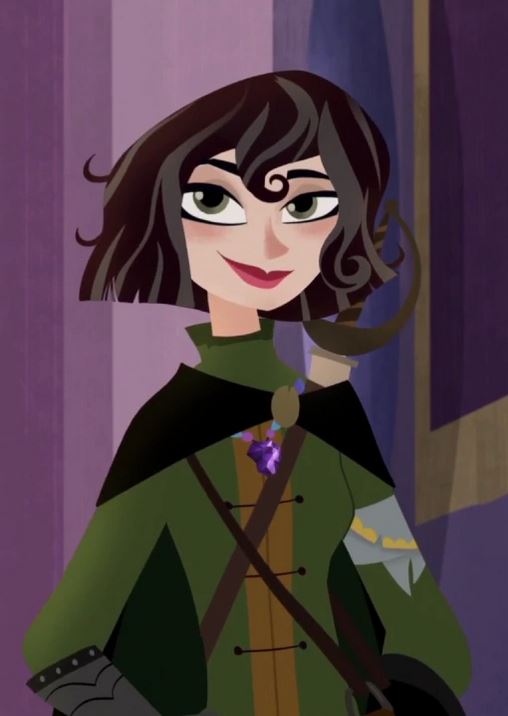
Cassandra
The great prize among the new characters is Cassandra. Her edgy but loyal personality makes her a perfect foil for the sunny Rapunzel. That same sardonic cynicism makes it plausible when she veers from the path of righteousness and aligns herself with the enemies at the end of Season 2, a development that is carefully shaped over much of that season. In particular, she highlights an aspect of hero-stories that doesn’t get much attention. What happens if you’re not the Chosen One? If the whole motion of the plot is toward Rapunzel’s destiny, how does the henchperson feel whose role is simply to support the main character? Doesn’t she have a destiny too?
The series as a whole shows a certain bias toward what we might call the “Arthas Effect,” a plot staple in the World of Warcraft game: an initially good character becomes corrupted and turns into a major villain. The two most prominent secondary characters, Cassandra and Varian, are both subject to this kind of transformation at different times. The basically positive tone of the Tangled story is borne out by the fact that each eventually repents and returns to the side of good. But the “turn to the Dark Side” motif helps keep the tale from becoming too optimistic or Pollyanna-ish.
The Romance
The Tangled sequels honor the original movie’s romance. We see from the very beginning that Rapunzel and Eugene do get married eventually. But that aspect is sidelined in such a way that the impetus of the romantic interest is largely lost.
During the entire first season, Rapunzel and Eugene hang around the castle, waiting for—what? We noted above that Rapunzel puts off the wedding, and there’s nothing wrong with that. But her reasons remain rather vague, and we don’t see much of the longing or attraction I’d expect from a couple of young people who are very much in love. It’s as if the writers every now and then remember that there’s supposed to be a love affair going on, but mostly take that to be understood.
The diverging development of the two characters also creates a somewhat unsatisfying disparity. While Rapunzel develops in power, competence, and maturity, Eugene has no comparable character arc. As a result, by the end we may ask ourselves whether he’s really sufficient for her. The lovers are “unevenly matched,” a problem I’ve noted before.
Conclusion
The key theme of the extended Tangled story, as I see it, is that power and innocence are compatible. You can be a consummately nice, caring, pretty, cheerful sort—and still have the determination, endurance, capability, and courage to fight what needs fighting.
Rapunzel is not the only example of such a seemingly-paradoxical character. But the writers were able to take advantage of the extended development of the TV series to showcase in detail how a person can grow to take on that mantle. It’s something we always need to see more of.







 Rick Ellrod's Observatory