Mind Powers

Mental powers are a staple of both science fiction and fantasy—and even quasi-SF genres like paranormal romance.  The idea’s like the traditional iceberg:  easy to put into a story, but with some major assumptions lurking under the surface.

The Physical and the Non-Physical

In SF, it became fashionable to use the invented term “psionics” to refer to powers of the mind.  The term seems to have originated by analogy to “electronics,” giving it a scientific (or pseudo-scientific) cast, and using the Greek letter psi, the first character of psyche, “soul” or “mind.”  Sometimes simply “psi” is used, as in “psi powers.”  It’s a useful coinage.

There are two broad approaches to psionics.  One treats mental power as acting purely on other minds—what we can loosely call nonphysical:  for example, telepathy.  The other approach allows mental powers to act directly on matter:  the most familiar example is telekinesis, moving things by mind power.

Note that distinguishing “physical” from “nonphysical” already involves some pretty big assumptions—but we’ll get to that.

Mind-to-Mind
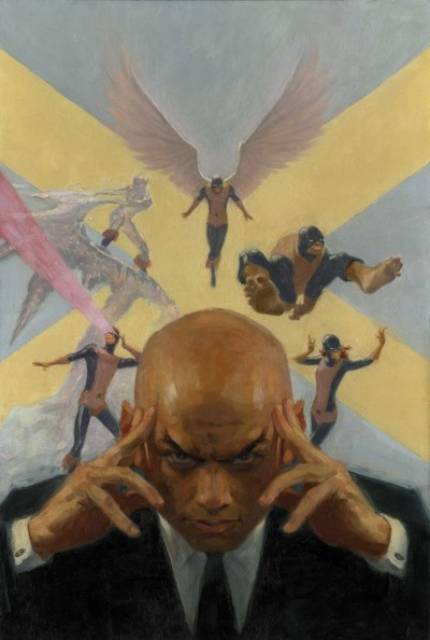
Professor Xavier using telepathyQuite a few science fiction stories postulate mental powers that have only mental effects, such as talking mind-to-mind.

The “Lens” worn by the “Lensmen” of E.E. Smith’s classic series is essentially a psionic amplifier.  It gives the wearer telepathic abilities.  This is extremely useful in making contact with unfamiliar species—especially in interstellar law enforcement, with instant communication an essential for “lawmen” that might be pursuing criminals into unknown regions of space.  The Lens also serves as a means of identification that cannot be faked, since an individual’s custom-made Lens will kill anyone who touches it if it’s not in contact with the designated wearer.

But Lensmen can’t make things physically happen by mind power alone; they have to use the conventional space-opera gear of ray guns and such.  The Lensmen can communicate mentally; they can influence or even take over the mind of another person; they can erase or implant memories.  But a Lensman can’t lift objects and throw them around without flexing his muscles in classic action-hero fashion.

There are some odd borderline cases.  The main character, Kimball Kinnison, gains a “sense of perception,” allowing him to perceive nearby objects without using the standard five senses.  He can “see” through solid objects, for example.  That does involve interaction with inanimate matter, of course; but the interaction is all one way—he can’t affect the things he perceives.

Now, a contemporary scientist physicist would find this paradoxical, since it’s fundamental to quantum physics that you can’t perceive an object without interacting with it—bouncing photons off it to see with, for example.  But the Lensman stories were planned out in the 1940s, when we were not so acutely aware of quantum-type theories of perception.  The anomaly does illustrate the difference between these two theories of knowledge:  one in which the knower is the passive recipient of information, and the other in which knowledge is always the product of interaction.
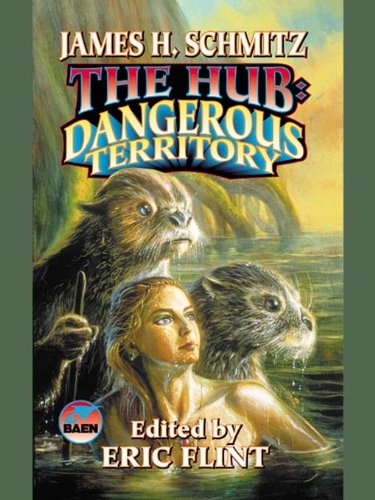
James Schmitz, The Hub - Dangerous Territory, coverJames H. Schmitz’s numerous stories set against the background of the interstellar “Federation of the Hub” use a similar theory of psionics.  Telzey Amberdon, one of the main characters, can communicate telepathically with nonhuman creatures such as her massive “pet,” the crest cat TT (who turns to be a formidably intelligent being in his own right).  Hub psis like Telzey can influence other minds and can be extremely dangerous—whether in a good cause or a bad.  But physical objects aren’t affected.

A similar sort of psionics is assumed in A.E. van Vogt’s classic mutation novel Slan, and in one of my childhood favorites, Star Rangers (The Last Planet), by Andre Norton.  For a more well-known example, the movie Independence Day showed the inimical aliens using mind control to speak through a captive human to communicate with other humans.  But to properly destroy humanity, they used conventional physical weapons.  (Well, “conventional” as science fiction goes; the alien weapons were dismayingly novel for the embattled Earthlings.)

Fantasy, too, can feature purely mental abilities.  There are references in The Lord of the Rings to the ability of elves and wizards to speak mind-to-mind.  (This was shown more explicitly, as I recall, in the movie versions of The Hobbit.)  An analogue might even be found in ghost stories.  Ghosts are often portrayed as acting only through influence on human minds, whether through terror or telepathy—as in A Christmas Carol:  the various spirits do not act except on Scrooge’s own consciousness.

Sometimes telepathy is imagined as “hearing” only what people verbalize—what’s put into words; for example, in Al Macy’s novels about mind-reading detective Eric Beckman.  In other cases, telepathy allows direct access to other people’s feelings and inchoate thoughts, somehow getting behind the speech-forming function.  The notion that one can think without words would itself be anathema to many a twentieth-century linguistic philosopher—consider the linguistic relativism or “Sapir-Whorf hypothesis” so adroitly used in the movie Arrival.  The difference raises basic questions about the relation between speech and thought, and how thinking works.

The divide between mental and physical powers gets further eroded when the story includes telepathic machines.  The Psychology Service in Schmitz’s Hub routinely uses mechanical detectors to monitor psis.  In Slan, “Porgrave broadcasters” can send “recordings” telepathically.  Even aside from the Lens itself, which is a quasi-living physical device, the Lensman series eventually gives us machine-generated mental screens, analogous to the physical force-fields of space-opera lore.  If psionics were confined to minds alone, how can machines handle it?

I’ve spoken loosely about this sort of mind-on-mind power as “nonphysical”; but that involves a very significant assumption—that the mind is not a physical thing.  If the mind were wholly reducible to the brain, there would be no reason in principle why mind powers would only affect matter in the form of other brains.  By analogy, microwaves can be used for communications, but also for cooking dinner.  On this assumption, mind powers would constitute just another kind of physical force, the analogy often being a different “wavelength” of energy.  Second Stage Lensman refers to the “frequency-range of thought” (ch.14), and Smith’s Skylark series presents thought as a “sixth-order wave”—whatever that may be.

Mind Over Matter

We’ve gotten so used to things like telekinesis nowadays that the mind-only abilities discussed above may seem oddly constrained to us.

Vader uses the Force to fling objects at Luke (Empire)The original Star Wars film, A New Hope, showed us that the Force could mediate mental communication, even with the dead (“Use the Force, Luke”), and some degree of mind-control or mental influence (“These aren’t the droids you’re looking for”).  But it was only in the sequel that we saw that it could also enable telekinesis.  I still recall the moment when Luke, ice-cemented to the ceiling in the wampaa’s cave, strains fruitlessly to reach his light-saber—then relaxes and closes his eyes; and I thought with some excitement, so, we’re going to get telekinesis too!  By the end of the episode, we’re watching Darth Vader use mental power to throw objects to distract Luke and keep him off-balance.  You can even use this matter-moving power to move yourself, or in effect to fly without wings—as we saw in one memorable scene in The Last Jedi.

Yoda lifts the X-wing (Empire Strikes Back)By now this sort of mind-over-matter is familiar territory.  But there are still aspects that aren’t obvious on the surface.  For one thing, telekinesis is apparently reactionless.  It’s unclear whether it obeys Newton’s laws of motion, under which action requires an equal and opposite reaction.  It would have been a great comic scene in Empire when Yoda impressively lifts Luke’s X-wing fighter into the air—and Luke had looked over to see Yoda rapidly sinking into the muck, with the entire weight of the X-wing bearing down on his diminutive form.

The simplest fantasy version of telekinesis is the poltergeist, an immaterial spirit which (rather bafflingly) is capable of throwing around physical objects.  Levitation, whether of oneself or of something else, is a commonplace for magicians.  In fantasy, however, mental powers tend to bleed over into magical powers, which we don’t think of in quite the same way—although one way of conceiving magic is as a kind of mind over matter.

There are other kinds of (fictional) mental interactions with matter, over and above mere movement.  A common trope is the ability to start fires, or “pyrokinesis,” as in Stephen King’s Firestarter.  This might be interpreted as a subtle form of telekinesis—since heat consists of motion at the molecular level, maybe a telekinetic could create heat by causing an object’s molecules to move faster.  Such an explanation leaves open the question of where the added energy is coming from; but that’s an issue common to any form of telekinesis.  There may be a certain nerdy satisfaction in supposing that a physically puny specimen like, er, yours truly could throw things around by sheer power of mind, even though one’s muscles aren’t up to it.  But whether things are moving by mind or by muscle, there has to be energy coming from somewhere.

The Golden Torc, second volume of Julian May's Saga of Pliocene Exile, coverThere are other things you can do with matter besides just moving it around.  Julian May’s Saga of Pliocene Exile, and related stories, postulate “metapsychic powers” that include “creativity,” allowing metapsychics to change the form of matter and thus materialize or convert physical objects.  Other stories imagine psionic abilities to “read” the history of an object or a place.

Teleportation—instantaneous movement from one place to another—represents a kind of in-between.  Physical objects are obviously affected, but the physical object in question is typically the practitioner’s own body, and perhaps other objects physically connected (such as clothing—but clothing doesn’t always come along, depending on the story, which can be inconvenient).  Does it count if your mind affects only your own body—the one locus where even theories that sharply separate mind and matter have to assume some crossover between the two?
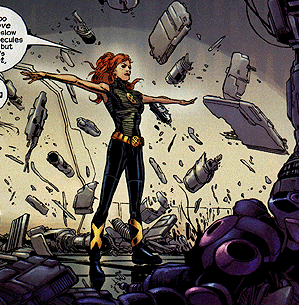
Jean Grey (Marvel Girl) using telekinesisThere’s a long tradition of mental powers in comic books too.  But given the visual nature of the medium, physically effective mental powers tend to predominate over the purely mental.  We do see some of the latter—pure telepathy in Marvel’s Professor Xavier or DC’s Saturn Girl.  But much more popular is Marvel Girl (Jean Grey), whose telekinetic powers make for much more striking imagery.

Minds and Bodies

Considering these two approaches to mind powers raises the philosophical question of whether minds affect matter only in and through a person’s body, or can do so independently.

If we exclude direct physical effects from the scope of (fictional) mental powers, this suggests parallel realms, with thought proceeding on one level while physical actions occur on another, linked only through the minds of humans or other intelligent beings.  It’s almost a Cartesian approach (that is, a theory similar to that of René Descartes) of mind-body dualism, and sinks roots into the long-standing debates over the “mind-body problem.”

The “sense of perception” concept, similarly, functions as if there were two independent metaphysical levels, mental and physical, and this mental sense could allow a person to go “around” the physical senses and inspect an object directly.  The philosophical notion of intentionality (not to be confused with the usual sense of “intentional” or deliberate) is adaptable to such non-sensory knowledge.  But the trend in both philosophy and physics over the last couple hundred years has been to focus on the physical connection between the knower and the known.

It’s become a standard assumption that we can’t know or do anything without a physical connection.  Anything else seems “unscientific.”  What’s interesting is that we seem to be willing to accept the now-unpopular postulate of non-physical knowledge and events when we’re dealing with fiction.

Of course, it’s also possible to meld the two back together by taking the position that mental powers really only reflect physical events taking place at a level we can’t yet detect—as with Smith’s “frequency range.”  But that isn’t the only way to conceive of the relationship.  There is still a certain imaginative appeal, at least, to the notion that mind can act independent of the constraints of the physical body.

I think such stories are helpful.  We’re apt to rush to conclude “science has proven” that the mind equals the brain and the brain is just a particularly subtle form of matter.  Science has not, in fact, proven any such thing.  The physical sciences assume, understandably, that only physics is involved.  But they have by no means demonstrated that all observable phenomena can be wholly explained by physics.  The arguments on this subject are still live.  We should still apply sound standards of evidence, and not leap to conclusions—but that applies in both directions, whether to materialism or to its alternatives.

In other words, there may still be more things in heaven and earth than are dreamt of in our physics, and one of the uses of speculative stories is to help us keep an open mind on these subjects.
Civilization and Chaos

Last time, we talked about Star Trek and Star Wars—but especially Star Trek—as expressing the ideal of a certain type of civilization.  Now we can broaden the range of examples.  Science fiction and fantasy make an excellent laboratory for thought-experiments here, as in so many things.

Staving Off the Fall

The threat that civilization will fail and collapse is a classic way to create a dramatic situation for a SF story.  The most common historical analogue, of course, is the fall of the Roman Empire in the West.

Foundation's Edge cover artIsaac Asimov’s classic Foundation series (1942-1953) deliberately drew on that model; Asimov had been reading Gibbons’ History of the Decline and Fall of the Roman Empire.  In the Foundation universe, Hari Seldon has developed a science of “psychohistory” that predicts the Galactic Empire’s inevitable decline.  There’s no chance of preventing the fall.  But Seldon’s psychohistory offers a way to cut short the ensuing dark age from thirty thousand years to a single thousand.  The emotional charge of the original Foundation stories centers on the Seldon Plan’s bid to minimize the period of barbarism, with its chaos, violence, tyranny and suffering.  (Later developments of the series, too involved to discuss here, go off in somewhat different directions.)

I’ve mentioned H. Beam Piper’s Terro-Human Future History, which includes at least one such decline-and-fall.  The novel Space Viking (1963) gives us a whole culture of space-traveling barbarians, raiding the decadent worlds of the old Federation.  The events of the story suggest the hope of a return to lawfulness in the formation of a “League of Civilized Worlds.”  But given Piper’s cyclical theory of history, this initiative will yield no permanent resolution; the story has a happy ending, but the history does not.

Poul Anderson wrote a series of stories about Sir Dominic Flandry, a dashing secret agent of the Terran Empire reminiscent of a far-future James Bond (though Flandry first appeared in 1951, Bond in 1953).  When he can spare a moment from chasing women and loose living, Flandry devotes his efforts to shoring up the decaying Empire, though he realizes that in the end the “Long Night” is inevitable.

There’s a certain kind of romance, a mood of grandeur and doom, about these falling empires.  Naturally, they tend toward the somber and the tragic.

Defending Civilization

A more upbeat tone characterizes stories in which the fight to preserve civilization has a chance of succeeding.

Lensman imageIn the Lensman series, E.E. Smith actually refers to the heroes’ multispecies galactic community simply as “Civilization.”  That polity reflects the cooperative, yet freedom-loving, nature of the beneficent Arisians, who have nurtured it in secret over millions of years.  The Lensmen’s opponent is “Boskone,” which originally appears to be a mere conspiracy of space pirates or drug dealers.  When Boskone eventually turns out to be a whole independent culture of its own, based in another galaxy, the conflict becomes one of diametrically opposed cultures, rather than simply of order vs. disorder.

But the Boskonian culture is one of thoroughgoing tyranny, from top to bottom.  At every level, those in power scheme against each other.  Lacking any honor or ethical code, they engage in assassination and undermine each other’s plans.  Those at the bottom are essentially slaves.  The Civilization led by humans, on the contrary, respects human dignity and freedom—although the fact that these cultures have been essentially on a war footing throughout their entire history renders that freedom a little less far-ranging than we might imagine.

The Lensman example reminds us that the defenders of civilization are not always fighting against barbarians.  Autocracy and regimentation bring their own kind of chaos, as lawless warlords battle among themselves, not caring what common folk are trampled in the process.  It’s a particular kind of civilization that’s worth preserving.

This is true whether we’re in the future or the past.  We’ve seen that the power of the Arthurian legend stems partly from the theme of defending order and decency against the chaos that lies in wait.  (We may also mention Arthur’s more historically-based successor, King Alfred, who defended England against the real (not Space) Vikings.)

The embattled Arthurian Camelot is frequently connected with Rome itself, the ur-example.  The Last Legion (book and movie) provides a good example.  The waning Roman presence in Britain, as the Dark Ages set in, is a natural setting for the ideal of the lonely, valiant defender.  One example is brought up indirectly by a character’s name.  As Wikipedia puts it,  “Legio XX Valeria Victrix lends its name to the character Valeria Matuchek in Poul Anderson‘s Operation Chaos and its sequel Operation Luna; her mother is said to describe this legion as the last to leave Britain—‘the last that stood against Chaos.’”

To Valeria’s mother Virginia, “the last that stood against Chaos” is a phrase to conjure with.  That’s true for me, too.

The Right Kind of Order

If civilization represents a certain kind of order—that of the Lensmen, not Boskone—what kind are we talking about?  It’s not always easy to explain.

Thus, if one asked an ordinary intelligent man, on the spur of the moment, “Why do you prefer civilization to savagery?” he would look wildly around at object after object, and would only be able to answer vaguely, “Why, there is that bookcase . . . and the coals in the coal-scuttle . . . and pianos . . . and policemen.”  The whole case for civilization is that the case for it is complex.  It has done so many things.  But that very multiplicity of proof which ought to make reply overwhelming makes reply impossible.  (G.K. Chesterton, Orthodoxy (Garden City, NY:  Image Books, 1959), ch. 6, p. 83)

Chesterton’s random examples do cast some light on the question.  A community that has bookcases has books—implying a continuity of knowledge and literature, as well as the leisure to read them.  Coals to keep one warm in winter suggest both the satisfaction of basic human needs, and the whole machinery of society and technology that brings the fuel from the mine to the fireside.  Pianos reflect art and a developed culture.  And policemen indicate a society in which there is at least some attempt to defend the ordinary citizen against the depredations of the powerful and unscrupulous—the rule of law, of which more anon.

In the particular culture to which I belong, when we hold up a certain sort of civilization as an ideal worth defending, what we have in mind is a good order in which spontaneity and creativity can flourish, and people can live their lives without constant fear or privation.  There’s an order that protects the weak against the strong, but there is also enough looseness for individual variation, experiment, and adaptation.  In the “alignment” terms we discussed last time, you might say the position I’m taking is neutral good, tending to lawful.

Greco-Roman sceneThe classical roots of this ideal are found in the Greek notion of the polis and the Roman notion of civitas.  But it’s been shaped by the whole history of Western thought into what’s sometimes called the “liberal” ideal of a free society—“liberal” not in the political sense, but the root sense of “free.”

There’s one particular aspect of this ideal, though, that science fiction is peculiarly suited to address.  We’ll talk next time about civilization and science.

The Large Spaceship Competition

Enormity

We space opera fans like big things:  sweeping plots and intrigues, larger-than-life characters, huge explosions.  And big spaceships.  The bigger, the better.

You remember the opening of the original Star Wars.  At the top of the frame, the Imperial Star Destroyer looms into view.  And keeps coming, for what seems like forever.  With this visual cue, Lucas communicates immediately the sheer scale of his story.

In a long story, this can lead to a Lensman Arms Race in terms of spaceship size—each new construct eclipsing the last.  One might wonder:  How far can we go with this?  Who holds the record for Largest Spaceship of All?

Traditional spacecraft

Saturn V-Apollo on transporterOrdinary, garden-variety depictions of spaceships are long since out of the running—not just real vehicles like the Saturn V-Apollo, but fictional ones that are meant to be big.  Kate Wilhelm’s title “The Mile-Long Spaceship” (1957) doesn’t sound even slightly impressive any more.  According to Wikipedia, those Star Destroyers range up to 2,915 meters, almost two miles.  The famous size comparison chart by Dirk Loechel displays these, along with the Independence Day mothership, the Dune Spacing Guild Heighliner, the Borg cube, and many more—but Loechel set his cutoff for the image, arbitrarily, at 24,000 meters:  “I had to draw the line somewhere.”

That’s just getting started.

“That’s no moon”

The alien probe in Clarke’s Rendezvous with Rama, which I’ve mentioned a couple of times before, is 50 kilometers long and 16 wide (31 by 10 miles).  That’s bigger than a lot of Earthly cities.

Death StarStar Wars’ Death Star, famously misidentified as a moon, has been estimated at between 100 and 160 kilometers in diameter (62 to 100 miles), at least three times larger.  The second Death Star, from Return of the Jedi, spanned somewhere between 200 and 400 kilometers (up to 250 miles), according to the same Wikipedia article.

Skylark of Valeron coverFor a long time I idolized E.E. Smith’s Skylark of Valeron as the epitome of spaceship scale.  The ship (not the novel of the same name), “almost of planetary dimensions,” is a sphere one thousand kilometers in diameter—about 621 miles (ch. 20).  That’s over twice the size of the large economy-size Death Star.  (A blogger going under the title Omnivorenz has done a detailed analysis of the various Skylark series spaceships.)

However, we’re still in the moon category, not yet up to planet-sized.  (Of course, if astronomers keep changing the rules on what counts as a planet, the two size ranges can overlap.)

Planets in motion

At this stage, we need to think about what counts as a “spaceship.”  Surely one requirement is that it be able to move in a directed fashion—otherwise the International Space Station would count.  But does it have to be a construct, a made thing?  Or can you take an existing mass and equip it with motive power?

Quite a few science fiction writers have depicted mobile planets (not simply in the sense of moving in an orbit, but of guided, directed motion).  In Blish’s Cities in Flight series, the characters twice use spindizzy drives to send whole worlds careening through the heavens.  E.E. Smith’s Lensmen, after a point, deploy “dirigible” planets almost routinely—not to mention antimatter objects (“negaspheres”) of comparable mass.  In The Wanderer, Fritz Leiber has not one, but two, traveling planets approach the Earth.  (The original source of the word “planet” is a Greek word meaning “wanderer.”)

There’s a series of stories by Robert Reed about something called “the Greatship,” but I haven’t managed to read them yet.  The blurbs describe the Greatship as “larger than worlds” and “apparently built from a re-engineered gas giant” – which would put us into a distinctly different size class from even an Earth-type planet.

And beyond

Here’s a question:  Does a “spaceship” have to be a single contiguous object?  Or can it be an array of objects that travel together, but are not physically connected?

In Larry Niven’s Known Space universe, the species known as Puppeteers flees a coming galactic disaster, not by leaving their homeworld, but by taking their planet with them—along with four others, arranged in a “Klemperer rosette” around their common center of gravity.  That’s traveling in style!  This “Fleet of Worlds” moves slower than light, but not much—and it’s five times larger, altogether, than a Blish or Smith flying planet.

The Cometeers coverBut Niven was writing hard science fiction, with some attempt at scientific plausibility.  The great space operas of earlier eras weren’t constrained by such trivial considerations.  For a long time, my list of giant spacecraft was topped by the so-called “comet” piloted by the adversaries in Jack Williamson’s 1936 classic The Cometeers.  It’s not a comet at all, but a green force-field shell enclosing an entire system of worlds:  the heroes count 143 planets, plus an artificial sun (ch. 13).  The eponymous alien Cometeers sail this congeries of worlds about the universe like space pirates on a grand scale.  It’s the biggest guided space-traveling object I’m run across that’s described with any precision.

The real prize, however, belongs to Arthur C. Clarke.  In the unthinkably far future of The City and the Stars (1956), a reconstruction of history shows the leading intelligences of a galactic civilization leaving the Milky Way on a voyage of exploration in what is apparently an entire star cluster, set into motion by energies on a galactic scale:

They had assembled a fleet before which imagination quailed.  Its flagships were suns, its smallest vessels, planets.  An entire globular cluster, with all its solar systems and all their teeming worlds, was about to be launched across infinity.

The long line of fire smashed through the heart of the Universe [i.e., the Galaxy], leaping from star to star.  In a moment of time a thousand suns had died, feeding their energies to the monstrous shape that had torn along the axis of the Galaxy, and was now receding into the abyss. . . .  (ch. 24)

That’s about as far as my imagination will go, to be sure.

The pursuit of wonder

TV Tropes collects a number of these references, and more, under the heading Planet Spaceship.

As we contemplate these logarithmic jumps in scale, we may note that after a point, the whole exercise can become meaningless.  If your “ship” includes whole planets and solar systems, why go anywhere?  It’s rather mysterious why Williamson’s Cometeers would need to roam the universe preying on other star systems (other than to provide a challenge for our dauntless heroes).  What are they getting that they haven’t already got ‘on board’?

The one likely answer may be, to see what’s out there (assuming you need this large a vessel to take you).  This is the primary reason Clarke’s far-future intelligences set out on their journey:

All we know is that the Empire made contact with—something—very strange and very great, far away around the curve of the Cosmos, at the other extremity of space itself.  What it was we can only guess, but its call must have been of immense urgency, and immense promise.  (ch. 24)

In a way, the exploration motive—“new life and new civilizations”—brings us back to where we started this exercise in scope.  Simply contemplating larger and larger objects brings us some degree of awe—a touch of that “sense of wonder” for which science fiction and fantasy are famous.  But a much greater wonder springs from the idea of meeting wholly new experiences—“very strange and very great.”

The grandest justification for leaving our world may be sheer discovery—even if we end up, like the Puppeteers, taking our world with us when we go.

The Missing Mentor

[Discussing stories in detail inevitably involves some spoilers.
The ones in this post, however, should be fairly mild.
]

Gandalf, polygon art portrait

Image from desktopimages.org

The wise old mentor is a staple, not only in fantasy, but in all kinds of stories.  From a narrative point of view, though, these mentor figures are rather an inconvenience – which is why they so frequently go missing.

Gandalf the Grey, the very archetype of the mentor in an adventuring party, is kept offstage by other engagements for much of The Hobbit.  In The Lord of the Rings Tolkien goes so far as to have him perish (not permanently, to be sure).

In the Harry Potter stories, Albus Dumbledore tends to be curiously inactive – he’s not around when the crises occur – though this changes over the course of the series, until he’s fully engaged toward the end.

Professor X, of the X-Men, is generally confined to a wheelchair, which keeps him out of the action.  In the first couple of X-Men movies, he’s also hors de combat much of the time.

Gordon Ashe, the main character’s mentor in Andre Norton’s Time Traders­ series, often happens to be sick or injured.

And of course Obi-Wan Kenobi dies about a third of the way through Star Wars:  A New Hope – even if he keeps popping up periodically through the three original episodes as a Force ghost.

Why does a writer introduce these characters, only to shuffle them offstage as soon as possible?  Consider what the mentor contributes:

  1. Power.  The mentor is often a fully-developed version of what the hero is becoming, as in Star Wars.  If not, like Gandalf, he is typically a powerful figure in his own right.
  2. Knowledge.  Gandalf knows how to terminate trolls and how to open the doors of Moria (Frodo helps in the movie, but not the book).  Mr. Miyagi in The Karate Kid (1984) know how to train in karate.  Obi-Wan knows where to find Yoda.
  3. Wisdom.  The mentor often advises the hero about life – not specific information, but how to live in a more global sense.  “Do, or do not; there is no try.”  “All we have to decide is what to do with the time that is given us.”  “Man who catch fly with chopstick accomplish anything.”

Here’s where the problems start to arise.  If the mentor is a powerful figure, why isn’t the mentor out fighting the battle, rather than sending the hapless (hero) apprentice?  The more impressive the mentor’s abilities, the harder it is to avoid having the mentor displace the hero.  With the mentor in action, things would be too easy for the main characters.  (There’s a parallel problem in children’s adventure stories – how to get the children away from parents and other caregivers so they have to act on their own.)

Knowledge poses a lesser problem, but a good storyteller still rations the mentor’s advice closely.  It makes for better drama if the hero doesn’t quite know what to do and isn’t fully trained.  (The tagline for the first World of Warcraft game expansion was:  “YOU ARE NOT PREPARED!”)  Luke Skywalker is more thrilling as a brash but vulnerable neophyte facing Darth Vader than he would have been as a fully seasoned Jedi knight.  The writer may prefer to have the hero not fully informed – if only to enable a shocking surprise at the right moment.

The problems are not as severe with the mentor’s third role, as dispenser of wisdom – though it still falls to the hero to implement the teacher’s wise counsel, when the crisis comes.

Authors thus expend a lot of effort to keep mentors out of the action, leaving the heroes on their own to apply what they have learned – or fail to do so.

Gandalf dies in Moria; he returns, but by that time he’s cut off from Frodo and Sam, who most need his guidance.  (“Its name was Cirith Ungol . . . Aragorn could perhaps have told them that name and its significance; Gandalf would have warned them.”  The Two Towers, ch. IV.3)  Gandalf is present, however, for the big battle scenes, and is ready to take on the Witch-King at Minas Tirith.  In effect, Tolkien has held Gandalf’s might in reserve:  as the enemies get bigger and worse over the course of the story, it makes sense to bring the powerful mentor back in, to even the scales.  We see the same kind of progression in Harry Potter, where Dumbledore takes a more direct hand as the story goes on (though he’s removed to make the final battle more challenging).

In the Silver Age comics, the wheelchair was enough to keep Professor Xavier out of the action most of the time.  In the movies, his range and power is vastly expanded, and he has to be rendered comatose to keep him out of the fray.

George Lucas managed to eat his cake and still have it.  He opts for the drastic solution by killing off Obi-Wan for good.  But Obi-Wan’s continuation as a ghost allows him to keep providing occasional advice – not to mention retconned explanations (“From a certain point of view”).

E.E. Smith’s classic Lensman series gives us an entire species, the Arisians, as mentors.  One character, a “fusion” of four Arisians, is actually known as Mentor.  Smith crafts his story to produce fairly subtle and plot-central reasons for keeping the Arisians out of the main conflicts.  At first they need to conceal their existence from their Eddorian adversaries.  Later, they need to keep their vast powers under wraps so as not to undermine the confidence and self-reliance of the Galactic Patrol.  But the Arisians do emerge in time for the climactic battle – which could not be won without both the Arisians and the Patrol (and the Children of the Lens, but that’s another story).

The mentor isn’t always missing in action.  A writer can engage the mentor figure in the story, if proper caution is employed to dodge the above problems.  For example, the social conditions of The Karate Kid mean that Mr. Miyagi can’t simply obliterate the adversaries.  He has to equip Daniel to fight a duel, in which third parties aren’t allowed to intervene.

Another way of handling it is to have the hero and mentor fighting on separate tracks.  Thus, in The Mask of Zorro (1998), the older Zorro is supposed to be dead and has to stay in disguise for most of the story.  But during the climax he is revealed and takes on his old nemesis, while the new Zorro is saving lives and fighting his own opposite number.

One of the reasons the absent mentor appeals to us, I think, is that it reflects something we experience in real life.  As we grow older, we do leave our mentors behind.  Generally, we outlive them – and sometimes feel inadequate without the advice and assistance of those who seemed towering figures in our youth.  Yet, just as in a story, this is necessary if we are to grow up.  In the end we succeed our mentors, and become the heroes of our own stories — and, in turn, mentors to the next generation.