Civilization and the Rule of Law (reprise)

Another rerun, adapted from a post from seven years ago.

We’ve talked about how the Star Trek-Star Wars divide reflects preferences for a more lawful or more chaotic world; how F&SF stories often show us a defense of civilization against chaos; and how civilization makes science possible and rests in turn on human technology.  But both order and technology can be oppressive.  The missing element is the rule of law.

Universal Laws

It’s a crucial element of right governance that there are rules applying to everyone, as opposed to the arbitrary wishes of a dictator, who can make decisions based on favoritism, political preferences, or personal relationships.  The Wikipedia article describes rule of law as “the legal principle that law should govern a nation, as opposed to being governed by decisions of individual government officials.”
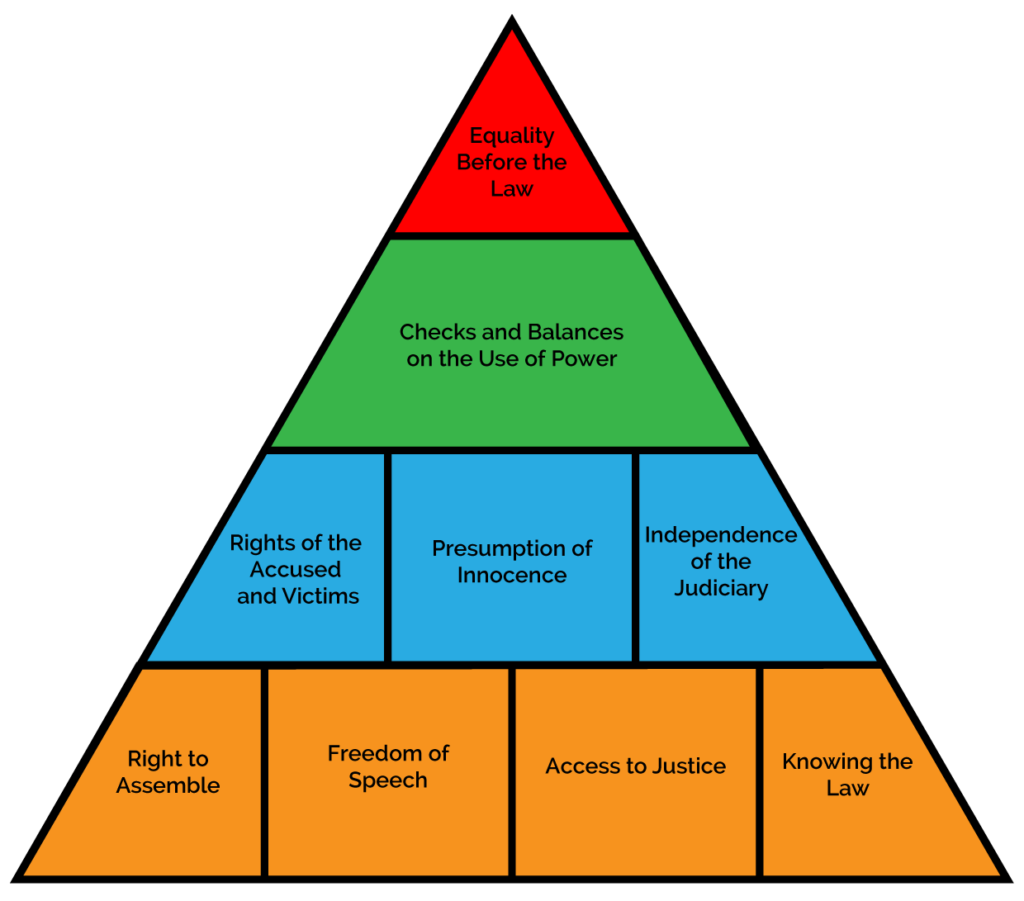
Rule of Law pyramid
(Rule of Law Institute of Australia)

As we saw in the recently updated post The Good King (reprise), the concept of the rule of law goes back at least to Aristotle.  It became a central principle of the American founders via the English tradition of John Locke.  “Rule of law implies that every citizen is subject to the law, including lawmakers themselves” (Wikipedia again).  It is thus in tension with kingship, where rule is almost by definition arbitrary and personal.  But one can have mixed cases—kings who are bound by certain laws, as in the British constitutional monarchy.

Without the rule of law, we depend on the good behavior of those who have power of some sort—physical, military, economic.  We slide toward the “war of each against all,” where might makes right and the vulnerable are the pawns of the strong.  Autocracy soon follows, as people look for any means to find safety from those who are powerful but unscrupulous.  Hence the quotation from John Christian Falkenberg, which I’ve used before:  “The rule of law is the essence of freedom.”  (Jerry Pournelle, Prince of Mercenaries (New York:  Baen 1989), ch. 21, p. 254.)  Strength itself, a good thing, is only safe under laws.

Test Cases

It’s easy to miss the importance of the rule of law.  We’re typically born into a society with better or worse laws, and criticize them from the inside.  It’s less common to find ourselves in straits where lawfulness as such has collapsed.  Regrettably, sizable numbers of people are exposed to such conditions in the world today.  But many of us are fortunate enough not to see them ourselves.  As always, fantasy and science fiction provide useful “virtual laboratories” for examining the possibilities.
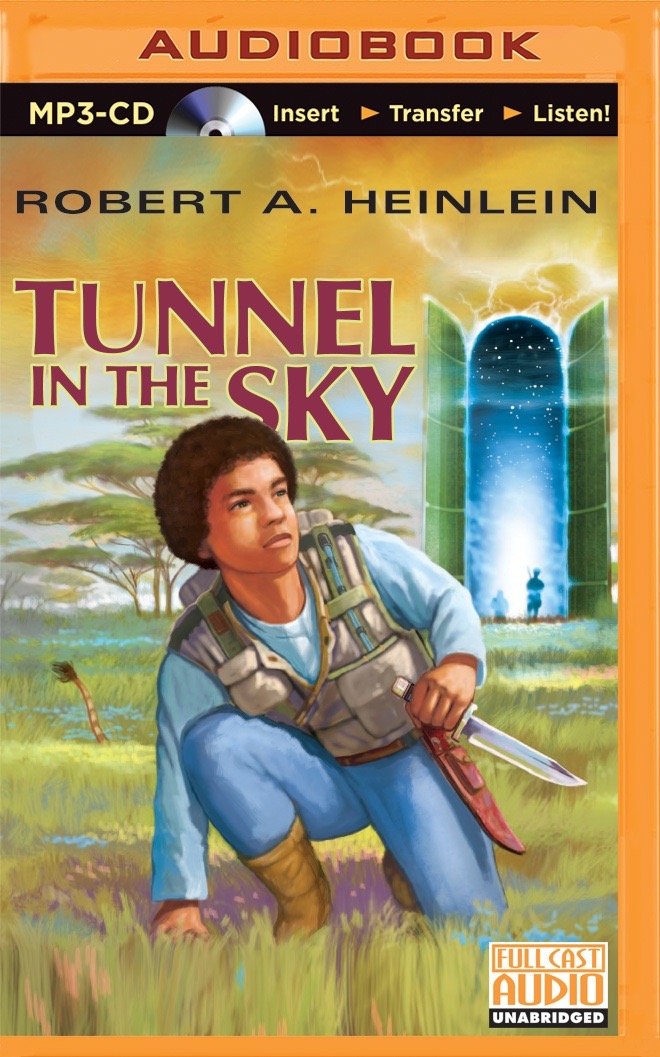
Tunnel in the Sky (audiobook) cover

A classic SF case is where a group thrown into a “state of nature” attempts to set up a lawful society.  For example, in Heinlein’s Tunnel in the Sky (1955), students from a high-school class on survival techniques are given a final exam in which they are dropped onto an unspecified planet to survive for up to ten days.  When an astronomical accident leaves them stranded, they need to organize for the long term.  Rod Walker, the hero, becomes the leader-by-default of a growing group of young people.  The tension between this informal leadership and the question of forming an actual constitution—complete with committees, regulations, and power politics—makes up a central theme of the story.

The Postman movie poster

David Brin’s post-apocalyptic novel The Postman (1985), later made into a 1997 movie with Kevin Costner, illustrates the power of civil order, the unstated practices of a culture, as recalling—and perhaps fostering—the rule of law.  The hero, a wanderer who happens to have appropriated a dead postman’s uniform and mail sack, presents himself as a mail carrier for the “Restored United States of America” to gain shelter in one of the isolated fortress-towns, ruled by petty tyrants, that remain.  His desperate imposture snowballs into a spreading movement in which people begin to believe in this fiction, and this belief puts them on the road toward rebuilding civilization.  The result is a sort of field-test not only of civil order and government, but of what Plato famously imagined as the “noble lie.”

In Niven & Pournelle’s Lucifer’s Hammer (1977), a small community headed by a United States Senator hopes to serve as a nucleus for reconstructing civilization after a comet strike.  We see at the end the strong pull of personal rule or kingship:  as the Senator lies dying, the future of the community will be determined by which of the competing characters gains the personal trust and endorsement of the people—and the hand of the Senator’s daughter, a situation in which she herself recognizes the resurfacing of an atavistic criterion for rule.  Unstated, but perhaps implicit, is the nebulous idea that deciding in favor of scientific progress may also mean an eventual movement back toward an ideal of rule by laws, not by inherited power.

Seeking a Balance

The “laboratory” of F&SF is full of subversions, variations, and elaborations on the rule of law.  In particular, we should note the counter-trend previously discussed as “chaotic good.”  Laws can be stifling as well as liberating.

The Moon is a Harsh Mistress cover

Heinlein’s The Moon Is A Harsh Mistress (1966) imagines how the “rational anarchy” of a lunar prison colony is mobilized to throw off autocratic rule.  The healthy chaos of the libertarian Loonies is hardly utopian, but the story does make it seem appealing.  Interestingly, Heinlein returned to this setting with a kind of critique twenty years later in The Cat Who Walks Through Walls (1985), where the post-revolution lunar anarchy seems much less benign, seen from an outsider’s perspective.

Taran Wanderer book cover

While fantasy seems to concern itself with this issue much less than science fiction, consider the region called the “Free Commots” in Lloyd Alexander’s Chronicles of Prydain.  When protagonist Taran visits this area in the fourth book (Taran Wanderer), he finds a society of independent villages, where the most prominent citizens are master-craftspeople.  They neither have nor need a lord to organize them.  The Commots contrast favorably to the feudal or wilderness regions through which Taran travels.  A kind of anarchic democracy, as an ideal, thus sneaks into what otherwise seems to be a traditional aristocratic high fantasy.

One way of managing the tension between a government of laws and a culture of liberty is the principle of subsidiarity:  the notion that matters should be governed or controlled at the lowest possible organizational level where they can be properly handled.  It’s frequently illustrated in G.K. Chesterton’s ardent defenses of localism.  In The Napoleon of Notting Hill (1904), extreme localism is played for laughs—“half fun and full earnest,” to borrow Andrew Greeley’s phrase.  The more mature Tales of the Long Bow (1924), which might qualify as a sort of proto-steampunk story, treats the idea more seriously, in the form of an oddly high-tech (for 1924) revolt of local liberty against overweening and arbitrary national rule.

It remains true that we need good people as well as sound laws.  “Good men can make poor laws workable; poor men will wreak havoc with good laws” (James M. Landis, 1960; see this article at 432 & n.107).  The quality of a civilization can also be assessed by whether it fosters citizens who act with decency and good judgment even when there isn’t a law to constrain them (as in David Brin’s “Ritual of the Street Corner”).  After all, we neither can nor should try to create laws to govern everything.

But being willing to improvise well in situations where no law applies is different from considering oneself above the law, disdaining the constraints that apply to everybody else.  This is doubly and triply true of rulers, who are constantly tempted to arrogate power and dodge accountability to accomplish their ends.  If a ruler is allowed to get away with law-breaking, we’re headed for trouble.

Brin has noted that the stories that fill and shape our culture—movies, books, television—encourage a broad “suspicion of authority” that tells us all institutions are corrupt or useless, and so are most other people—so that the heroes and heroines of the stories can face and overcome challenges by their heroic actions.  Like most attitudes, suspicion of authority is helpful in moderation, but corrosive when it gets out of hand.  If that attitude leads us to throw over laws and institutions altogether in the hope that individual heroes or autocrats will save us, we need to keep in mind that benevolent dictatorship, unconstrained by law, is just one step away from despotism.

The Fragility of Civilization

When we grow up taking for granted the rule of law, we can fail to see how vulnerable it is—along with the civilization that it reflects and makes possible.

“The Establishment,” as they used to say in the 1960s, seems vast and invulnerable.  When we’re trying to make a change, it seems insuperable, so rigid that nothing can be done about it.  But this is an illusion.  The structure of civilization, good and bad, is fragile.  It’s easier than we think to throw away the rule of law, so painfully constructed (as Rod Walker found), in favor of shortcuts or easy answers to our problems.

One thing F&SF have brought us is a better sense of this vulnerability.  The spate of post-apocalyptic tales in recent years—zombie apocalypses, worldwide disasters, future dystopias like The Hunger Games, going all the way back to the nuclear-war stories of the 1950s—do help us appreciate that our civilization can go away.

But that collapse doesn’t require a disaster.  Civilization, and the rule of law, can erode gradually, insidiously, as in the “Long Night” stories we’ve talked about earlier.

Historically, the Sixties counterculture fostered anarchists who felt “the Establishment” was invulnerable.  Often with the best of intentions, they did more to undermine civil order than they expected.  Those who now see no better aim than breaking up the structures of democratic government and civil life—whether from the side of government, or from the grass roots—also fray the fabric of civilization.  The extrapolations of science fiction and fantasy illustrate why eroding the rule of law should not be taken lightly.

Near the bottom of Brin’s Web home page, he places the following:

I am a member of a civilization

It’s good that we have a rambunctious society, filled with opinionated individualists. Serenity is nice, but serenity alone never brought progress. Hermits don’t solve problems. The adversarial process helps us to improve as individuals and as a culture. Criticism is the only known antidote to error — elites shunned it and spread ruin across history. We do each other a favor (though not always appreciated) by helping find each others’ mistakes.

And yet — we’d all be happier, better off and more resilient if each of us were to now and then say:

“I am a member of a civilization.” (IAAMOAC)

Step back from anger. Study how awful our ancestors had it, yet they struggled to get you here. Repay them by appreciating the civilization you inherited.

It’s incumbent on all of us to cherish and defend the rule of law.  Give up civilization lightly, and we may not have the choice again.
The Amateur Hero

At the end of the previous post, we noted that, depending on the kind of story authors want to tell, they may choose to deploy either a professional hero—someone whose job it is to face perils and challenges, like a military officer or police officer—or, on the other hand, someone who is dragged unwillingly or unexpectedly into a crisis.  But I didn’t actually say much about how that difference plays out in a story.  This post, then, is a kind of afterthought to the last one.

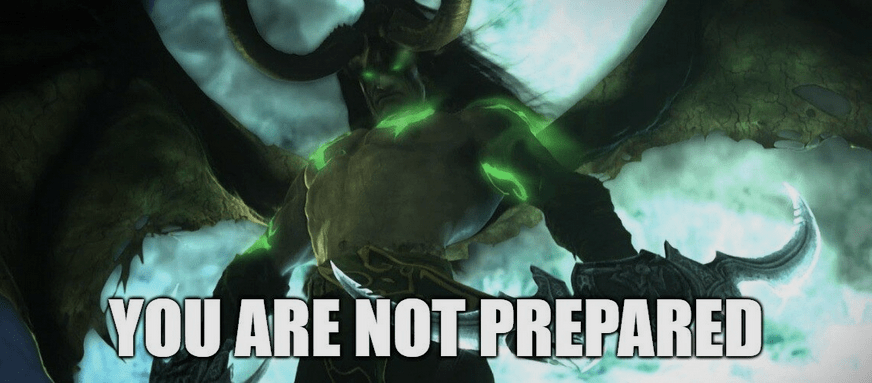
“You Are Not Prepared”

The first expansion for the online game World of Warcraft greeted players with the ominous declaration, “You Are Not Prepared.”  That’s exactly the situation of the individual who didn’t expect to be called upon to be a hero.  The lack of preparation may manifest itself in several ways, any of which can help to shape the story.

Competence.  The main character (MC) may lack the skills or expertise to deal with the kind of crisis that’s occurring.  Maybe there’s fighting involved, and the MC isn’t skilled with fists or swords or rayguns or whatever the weapon of choice happens to be.  It’s a lot easier if they do happen to have the pre-existing skill:  Glory Road’s Oscar, for example, was already experienced at fencing.  If they don’t, then one can expect an extended period of training, since this sort of skill isn’t one that can be picked up in a day.  Luke’s training montage in The Empire Strikes Back is a classic example, taking him from someone with potential and the occasional burst of unexpected powers (“Use the Force, Luke”) to someone who can face off against Darth Vader at the end of Empire and present himself as a full-fledged Jedi Knight at the beginning of the sequel.

Information.  The amateur hero may be drawn into an environment where they aren’t familiar with the geography, the factions, the customs, the people and powers.  In Anne McCaffrey’s Restoree, for example, the heroine is kidnapped by aliens, then rescued by others, all in an unconscious state, and “comes out of it” to find herself in a thoroughly incomprehensible situation.  Glory Road reflects the same struggle by a MC to cope with an unfamiliar environment, though in this case the hero has all the assistance one could desire in learning to deal with the new circumstances.

The same kind of thing occurs in the classic fantasy trope where MCs from a backwater locale are sent into a wider world with which they’re only vaguely acquainted, as in The Lord of the Rings or The Wheel of Time.  One of the advantages of this setup is that the MCs will need to have many things explained to them by more knowledgeable characters; they are the “ignorant interlocutors” whose presence is so convenient for exposition.

Even in more mundane cases, the MC may be placed in conditions where they don’t know their way around.  The eponymous TV series hero Chuck Bartowski is suddenly pitched into the world of intelligence operations and secret agents; he and other characters spend much of the first three seasons learning the ropes.  In a similar way, but much faster (in a two-hour movie rather than a long-running series), the hero of Hitchcock’s North by Northwest must learn the players and the goals of the spy game into which he has been drawn.

Confidence and maturity.  The MC may also be personally unprepared to deal with the crisis posed by the plot.  My favorite example is Romancing the Stone, in which the shy, introverted heroine suddenly has to travel far from home, ally with an unexpected stranger, fight her way through a jungle, and match wits with smugglers and thugs.  Much of the fun of the story is in watching the ironically-named Joan Wilder gain in courage and self-reliance as she overcomes these progressively more dramatic challenges.

Other aspects.  The MC may be unprepared in other respects.  The elemental fact of facing death will be a shock to those of us brought up in more placid situations.  The hero may lack equipment or resources to deal with the new challenges—or, conversely, may happen to have exactly the right resources available; this may actually bring about the adventure, as with the spacesuit in Heinlein’s Have Spacesuit, Will Travel.  Moreover, the homebody hero probably has not yet come to terms with the degree to which the adventure might impact family or personal connections—unlike the hero-by-trade, who has probably reconciled spouse or family with a dangerous career.

The Character Arc

The need to cope with such challenges almost automatically sets up an arc of character development for the MC, reflected in the examples above.  The MC can be expected to grow in confidence and independence.  They may also be tempered by tragedy or suffering; this is the primary course for the young graduate-school characters in Gay Gavriel Kay’s Fionavar Tapestry.

The developing hero may become more street-savvy, more knowledgeable in the ways of the world.  This sort of practical wisdom is a common theme, given the age of the characters, in young adult-targeted stories or the bildungsroman.  For example, Rod Taylor, the MC of Heinlein’s young adult novel Tunnel in the Sky, becomes the informal leader of a band of marooned students by a gradual process.  A group of older students, schooled in political theory and more alert to how groups can be manipulated, ease him out and take over control—with the best of intentions, to be sure.  By the end of the story Rod, once again in command, has become a bit more canny in dealing with the group.  In a similar way, Don Harvey in Between Planets starts out as a fairly naïve high-schooler who learns some hard lessons about political realities as he becomes embroiled in an interplanetary revolution.

Finally, if the MC learns new skills or abilities in the course of the story, they will have grown in that respect too.  The new abilities may qualify the MC for new roles or positions, and perhaps to actually become a professional hero in the end.  We see this in superhero origin stories, where a MC is initially unskilled in managing their superpowers, but gradually takes on the role of a professional do-gooder.  Spider-Man is the classic example, a teenager who didn’t expect to become super-powered and takes a while to become used to his new potential; unlike, say, Iron Man or the Fantastic Four, who start out as grownups and adapt fairly quickly.

As we saw in the last post, an amateur hero almost by definition rises to the occasion.  This is a sufficiently satisfying theme that I suspect adventure stories may tend more to this approach than to that of the professional hero—though I haven’t attempted to take a count.

The Professional Hero

Glory Road

A couple of comments by Kevin Wade Johnson in connection with my last blog post (now a long way back!) triggered a line of thought about heroes and the hero business.

Glory Road cover

Robert A. Heinlein’s 1963 novel Glory Road looks like a swashbuckling fantasy at first blush, but it turns into something entirely different.  Our hero, E.C. “Oscar” Gordon, kicking around the world after leaving the military, is recruited by an incredibly gorgeous woman to assist her with a quest that involves traveling to other universes and swordfighting.  This is just the kind of adventure he was craving.

As Kevin observes, the first three-quarters of the book are action-adventure, with sizable side dishes of comedy, scandalous liaisons, and cynical social commentary.  At that point the quest is fully resolved—at page 208 out of 288, in my copy.  What, then, occupies the rest of the book?

Gordon returns with “Star,” the beautiful woman he’s now married, to her home universe.  It turns out she’s the empress of a multiuniversal polity that is in some respects a high-tech Utopia.  All Gordon has to do is relax, allow himself to be fêted by the population, and sleep with anyone he finds interesting (the late Heinlein’s polyamory is fully on display here).

He hates it.

What Utopia doesn’t satisfy is Gordon’s lust for adventure.  He doesn’t want to be a dilettante or a “kept man.”  He wants wonder, excitement, the stimulus of danger.  He likes being a hero, with all the occasional discomforts and perils of that role. The placid happy ending of a retired hero holds no attraction for Gordon.

It’s unclear whether Star feels the same way.  She’s willing to consider going in on a kind of adventuring “business” with her slightly tarnished knight.  But first, she says, she’d have to train a replacement for her unique position—and that would take many years.

The solution is for Gordon to head off again on the Glory Road without Star.  He’ll pop back in now and then, but not to take up residence in the Twenty Universes utopia on a permanent basis.  He and Star will remain in love with each other, perhaps, in some sense of the term—but not in a sense that requires fidelity on either’s part.  In Heinlein’s polyamorous world-view, passing romantic involvements are just part of the adventure:  “Knights errant spend their nights erring” (p. 271).  Gordon’s happy ending is the continuing adventure.

The Unsettled Adventurer

This idea comes up from time to time in adventure stories:  the hero (or heroine) who seeks out danger and isn’t content without it.  John Carter of Mars displays a little of this, though in the violent world of Barsoom, he seems to be able to get his fill of trouble while still remaining home-based with the enthralling Dejah Thoris in her city of Helium.  There’s something like this idea in the conclusion of The Good Place—boredom with utopia—as we’ve seen.

The really extreme case can be found in an old-time fantasy by E.R. Eddison, The Worm Ouroboros (1922).  The swashbuckling nobles of Eddison’s imagined world fight the good fight against their sinister enemies, the Witchlanders.  At the end of the novel, those adversaries are conclusively defeated.  Cue the victory feast.  And yet . . . Our Heroes are not quite satisfied.  Things just won’t be as interesting without the Witchlanders constantly scheming and warring against them.  At the very end, the heroes’ fanciful wish is somehow granted:  a herald announces the arrival of an emissary from the bad guys—the same event with which the novel opened.  (Hence the title:  the legendary serpent that swallows its own tail.)

The Series Protagonist

I’ve previously expressed some doubts about whether happy endings really need to be static and boring—so let’s not adopt the Glory Road doctrine too hastily.  (In its extreme form, Eddison’s circular epic, one may feel the opposite dissatisfaction in the sense that all the heroes’ striving and suffering has been for nothing.)  But these examples highlight a difference among types of action heroes.

In a long-running action series, unless a hero is improbably falling into one adventure after another against their will, we have to assume that the hero likes what they’re doing.  James Bond seems to be pretty content with his secret-agent life.  Indiana Jones yearns for opportunities to climb out the window of his stuffy professorial office and strike out on some treasure-hunting chase—even at an advanced age, as we’ve recently seen.  Captain Kirk, who’d been promoted to admiral by the beginning of Star Trek II, isn’t suited for a desk job.  At the end of the three-movie cycle he’s demoted to captain again—ostensibly as a punishment for flagrant violations of Starfleet regs, but we’re to see this as a step forward for him, his best destiny.  Yoda accuses Luke of this kind of unrest in The Empire Strikes Back:  “Adventure! Excitement!  A Jedi craves not these things.”

The same is true of almost all superheroes.  Retirement is almost unheard-of.  The occasional counter-example makes for an interesting tale precisely because it runs against type:  Hank Pym in the Marvel Cinematic Universe, Jack-in-the-Box in Astro City.  In a somewhat similar way, continuing campaigns in Dungeons & Dragons or similar games tend to assume the existence of a class of professional adventurers who enter willingly into a life of battle and treasure-hunting, as distinct from an assembled-for-one-purpose group like the Fellowship of the Ring.

This character trait does make things convenient for the writers.  They have a believable rationale for the main character’s continuing adventures.  Otherwise, after a while it would start to seem implausible for one person to keep getting drawn into danger purely by accident.

The Hero By Trade

The Star Trek captains, and other officers, illustrate a type of case where the character really is a professional hero—one who’s taken up a profession or vocation where danger and challenge, and hence the opportunity for heroism, come with the territory.  Anyone pursuing a military or quasi-military career fills that bill.  Honor Harrington, for example, reflects more than once that she’s good at war; it’s her calling, what she was born to do.  Professional police officers, firefighters, or rescue workers—first responders generally—also fall into this category.  (John McClane of Die Hard fame, mentioned above, is in a danger-prone profession, though it’s probably rare for a cop to run into the kinds of major crises he does.)  Unsung heroes like medical personnel may find themselves in the same position.  They may not categorize what they’re doing as heroism (it looks better on them if they don’t); but they are putting themselves “in harm’s way” where acts of heroism are constantly called for.

This is why military SF lends itself so easily to long-running series like Honor Harrington’s.  (The same is true outside the SF genres, as we can see, for example, in Patrick O’Brian’s Aubrey/Maturin sea stories.)  The same is true of private detectives, secret agents, and the like.

The Reluctant Hero

But not all heroes are professional heroes.  An equally perennial favorite is the reluctant or accidental hero—the person who answers the call to adventure, but does wish to return to a peaceful life afterward.

Jim Butcher’s Introduction to Jim Butcher & Kerrie L. Hughes, Heroic Hearts (NY:  Ace Books, 2022), puts it this way:

Real heroes . . . [are] the everyday humans who happen to be standing there when something bad happens, and when there is a sudden need for skill, courage, or intelligence.  They’re the regular people in irregular circumstances who find themselves considering others first and standing up to do whatever needs to be done.”  (p. xi)

Some do manage to go back to their ordinary lives after the crisis has passed.  Cincinnatus, and George Washington, are famous for pulling off the transition:  they took over the reins of the state when they had to, but willingly ceded power afterwards.  On a more modest scale, the “citizen soldier” concept, as in the American National Guard, aims at the same thing.  It’s part of the mystique of the American World War II armies, the so-called “Greatest Generation” model.  You rise up to serve when necessary, but happily return to civilian life when it’s done.  Contemporary discussions are more likely to emphasize post-traumatic stress disorder (PTSD) and the difficulty of the return to civilian life; but it remains an ideal with considerable drawing power.

In fiction, the contrast between heroic acts and ordinary life provides rich soil in which to grow interesting stories and characters.  Tolkien, for example, gives us some characters who do manage the return to everyday existence—Sam Gamgee—and others who find it impossible, such as Frodo.  Of course Frodo does in the end find peace in Valinor, but that requires a literal removal from the circles of the world, a transcendence not available to the average hobbit-in-the-street. 

The situations can become fairly complex.  In the Song of Roland, after the heroic deeds of the story are finished, a weary Charlemagne at the end finds himself called back unwillingly to new conflicts.  In the TV series Chuck, the eponymous Chuck Bartowski is initially appalled to find himself embroiled in spy activities, but the sheer coolness of it all grows on him, and by the fifth season he wants to start his own secret-agent business.  Scott Lang (Ant-Man) at the beginning of Quantumania is resting comfortably on his laurels, and has to be dragged back into action in the name of helping others.

Detectives in mystery stories fall into both camps.  We have professional private eyes like Sherlock Holmes and Nero Wolfe.  But then we also have amateurs like Chesterton’s Father Brown and Agatha Christie’s Miss Marple, who always just seem to be in the right place at the right time.

The Author’s Choice

If we want to write a heroic adventure story, one of the early decisions we have to make is what kind of hero we want to feature.  Sometimes the tale may call for someone who’s automatically in a position to encounter danger, like a military officer.  Sometimes we may prefer to drag the hero into action against their wishes, or by happenstance.  The whole point of Roger Thornhill’s predicament in North by Northwest, for example, is that he has no desire to become involved in skulduggery and is baffled by the strange things that are happening to him.  Like so many other accidental heroes, however, he rises to the occasion.  This is a narrative arc that may be both more interesting and more inspiring than that of the professional hero; because most of us live relatively ordinary lives and can only hope that if called upon, we too could become the kind of hero we admire.

Remembering the Adelines

Adeline and Adaline

One of the functions of imagination is to make odd, sometimes random connections.  In this case, the random connection is between two very different stories about women with almost the same name.  The “Addie” in V.E. Schwab’s The Invisible Life of Addie LaRue (2020) is Adeline, a young girl of the seventeenth century who becomes immortal—at a price.  In the 2015 movie The Age of Adaline, the titular Adaline is also immortal, for entirely different reasons.  Yet both face certain issues that resonate particularly well with us today.

Addie’s Dark Deal

The Invisible Life of Addie LaRue, cover

Addie LaRue doesn’t set out to become immortal.  A village girl in seventeenth-century France, she wants to avoid being shunted into an unwanted marriage that will trap her in this small country backwater, isolated from the larger world she longs to know.  Although she’s cautioned by her eccentric mentor never to deal with the gods that come out after sunset, Addie incautiously promises her soul to a Darkness in return for freedom from these entanglements.

This supernatural entity grants her wish in a way that’s as tricky and cruel as any fairy-tale curse.  Addie will be free of entrapment because everyone she meets will forget her once they’re out of her presence.  She won’t die or change until she willingly gives up her unremembered life; but she can form no lasting relationships.

Addie’s family fails to recognize her when she returns to the village.  A good Samaritan who’s convinced to help her forgets about it as soon as she leaves to bring food, and never returns.  If she pays in advance for a room, the innkeeper has forgotten the payment next time they meet.  Addie is, of course, prevented from explaining her predicament to anyone, even if they would believe her.

Much of the story takes place in the present day, where we meet Addie living by her wits from moment to moment, as she has for three hundred years.  While the wish gone wrong is a classic fairy-tale trope, this is not a fairy tale; it’s more like science fiction.  Schwab does an amazing job of showing us the logical ramifications of the curse and how a highly sympathetic character copes with them.

Then the ground shifts when Addie meets a young man in a bookstore who—somehow—does remember her name.  This leads to a haunting illustration of human life and how we live it that, as a perceptive book review notes, is hard to forget.

The Perpetual Reboot

No one can remember Adeline from one meeting to the next—even a lover waking up in the morning.  In this respect, her situation resembles what we find in other stories that deal with memory issues, or with repeating circumstances that only the main character can recall.  Bill Murray’s character Phil Connors in Groundhog Day (1993) finds himself with a similar problem:  when he finally wants to form a permanent relationship with the woman he’s falling in love with, the permanence is all on his side.  He has to win her affection again every day.

50 First Dates, movie poster

The same result occurs, from an opposite cause, in the movie 50 First Dates (2004).  Lucy Whitmore, the girl Henry Roth becomes interested in, has suffered a traumatic short-term memory defect:  she remembers her life up to the date of the accident, but each night she forgets everything that’s happened after that time.  Her family and friends find ways to cope with this—but she knows them from before.  Henry, who wants to get to know her, has no previous relationship to build on.  Like Phil, he has to ingratiate himself with her—court her—each day anew.

Addie’s case is harder.  No one remembers her from day to day; she is prevented from making any permanent mark on the world.  But the hardest part is similar.  She can form no lasting relationships.  The essential loneliness of the main character is each case is what makes the stories so poignant.

In that respect, there’s a similarity to Diana Wynne Jones’s eerie story The Homeward Bounders (1981).  Jamie, the narrator there, is condemned to wander from one alternate world to another whenever a “move” is made by supernatural players who game with human lives.  Like Addie, he can’t be killed or seriously harmed—but he can never find a home.  “You wouldn’t believe how lonely you get” (chapters 2, 14).

Adaline’s Accidental Immortality

The Age of Adaline movie poster

In contrast to the stories mentioned above, which mostly depend on fantasy tropes of one sort or another to set up the situation, The Age of Adaline is straight science fiction—though it’s not advertised as a “science fiction movie.”  A voice-over narrator explains to us that when Adaline Bowman, born in 1908, falls into a freezing lake in 1937 and then is revived by a lightning strike, the “principle of electron compression in DNA,” which will be discovered in 2035, causes her to stop aging.

This fact only gradually becomes apparent to her.  We see it through a narrative sequence that jumps back and forth in time, just as in Addie LaRue.  As her birth date recedes, but she does not visibly age, people look at her more and more oddly—say, in a traffic stop where the policeman examines the date on her driver’s license.  Eventually the FBI takes an interest.  Adaline escapes and begins changing her identity every so often to conceal her real age.

Methuselah's Children cover

Adaline’s situation resembles that of the long-lived “Howard Family” members in Heinlein’s classic novel Methuselah’s Children (1941, 1958).  She lives a perpetual “masquerade.”  She is not quite so deprived of permanence as Addie; she can live for a while in a given identity, build up a bank account, buy a home.  Ultimately, however, she has to keep moving.  Her problem is in a way the opposite of Addie’s:  Adaline needs to keep from being remembered (by the wrong people).

But this deprives her of long-term relationships just as in Addie’s and Phil’s cases.  We see Adaline’s (latest) dog die, reminding her that she will outlive anyone.  Her first husband died young, before her immortality began; for her, love means growing old together—but she can’t have that.  Becoming involved with an “ephemeral” can only lead to tragedy in the end.

As a result, Adaline shies away from long-term commitments.  It is too emotionally wrenching for her to confront the fate reluctantly embraced at one point by Lazarus Long, one of Heinlein’s Methuselah’s Children characters, who does marry a short-lived ordinary human in “The Tale of the Adopted Daughter.”  But Adaline finds the lack of such relationships more and more a grief as time goes on.  As a character who’s learned her secret tells her (at 1:27):  “All these years you’ve lived, but you never had a life.”

Reaching for Continuity

Phil and piano teacher in Groundhog Day

The long lives of Addie and Adaline have their compensations.  For example, by living for so many years as a youthful adult, one builds up a sizable store of skills.  Addie knows many languages; so does Adaline.  Phil in Groundhog Day becomes a whiz at the piano by taking a one-hour lesson on each of his innumerable repeating days.  Adaline can win a game of Trivial Pursuit; she also seems to a friend to drive like a maniac—but she can do this safely, since she’s had more experience than any professional race-car driver and still has the reflexes of a 29-year-old.

But these pragmatic advantages aren’t worth the isolation they must endure.  Not the inability to connect—but the inability to forge a permanent connection, as we see in the desperate moments at the end of a cycle in several of these stories.  At one point, Addie reflects:

Sure, she dreams of sleepy mornings over coffee, legs draped across a lap, inside jokes and easy laughter, but those comforts come with the knowing.  There can be no slow build, no quiet lust, intimacy fostered over days, weeks, months.  (p. 100)

We are fond of admiring the freshness of love’s beginning:  most romances stick to the courtship stage.  But we may not be as attentive to the charms of continuity.  At p. 171, the one man who can remember Addie calls her his “date”:

Date.  The word thrills through her.  A date is something made, something planned; not a chance of opportunity, but time set aside at one point for another, a moment in the future.

In an article about the fast-moving changes in our culture, a recent article in Wired observes:

. . . what most of us long for, whether we realize it or not, is continuity – the sense that our lives are part of an ongoing narrative that began before we were born and will continue after we die.  (Meghan O’Gieblyn, “Cloud Support:  Am I Obligated to Join TikTok?”, Wired, March 2021, p. 25)

Age of Adaline:  It's not the same when there's no growing old together.

We want to be remembered, to be held dear, to make a mark on the world.  The burden with which Addie grapples is the inability to achieve those things.

We honor freedom, the ability to be unconstrained by the past; and that is both true and good.  But that value too can be taken to an extreme. Addie LaRue serves as a kind of reductio ad absurdum of the absolutism of freedom.  The “god” who cursed her says jeeringly:

You asked for freedom.  There is no greater freedom than that.  You can move through the world unhindered.  Untethered.  Unbound.  (p. 149)

What we want, as ever, is the happy medium—or, to put it differently, to have our cake and also eat it.  We are willing to expend our freedom to make commitments in relationships, even though this necessarily involves giving hostages to fate—we can always lose the ones we love.  We do this because it’s the only way we can achieve other good things:  “inside jokes and easy laughter,” shared memories, the comfort and the pride of a relationship seasoned over many years.

Not remembering can be a problem; being remembered too well can be a problem too (as we are keenly aware in these days when the Internet preserves all our youthful indiscretions forever).  The ways in which these two Ad(e/a)lines respond to memory, and seek after continuity, are well worth a look as we employ the freedoms and build the permanences of our lives.

Little Did I Know

Foreshadowing

Stories vary in how they hint at what’s to come.  “Foreshadowing” provides the reader with more or less vague clues about things that will happen later on.  As the Wikipedia article notes, even the title of a chapter or an entire work can give us such a hint.  (I once changed the title of a novel—House of Stars, currently seeking a publisher—because the original working title gave away too much of the plot.)

One particularly overt way of foreshadowing is to have the narrator tell us straight out about something they didn’t find out until later.  I think of this as the “little did I know” trope, based on the hackneyed formula for introducing such a hint in old-time books.  That method strikes me as rather heavy-handed, and I’m dubious about whether it’s really a good idea.

”I Was Soon To Find That Out”

Stranger in a Strange Land, coverA classic example occurs in Heinlein’s Stranger in a Strange Land (1961).  Mentor-figure Jubal Harshaw (not the titular Martian), as a side business, ghost-writes the kind of ‘confessional’ novels popular in the early twentieth century.  Every now and then in Stranger, he’s motivated to dictate a bit of purple prose for such a tale.  So in ch. 17 (p. 157 in my battered old paperback copy), we hear, as part of the opening for “I Married a Martian”:  “In those carefree childhood days I did not dream to what strange bittersweet fate my tomboy ambition would . . .”

The fragmentary example is classic because it’s supposed to be a sample of hack writing; Harshaw is contemptuous of the potboilers he turns out.  Of course, not every “little did I know” example needs to be so trite.

Summer of the Dragon, coverRomantic suspense novels are given to this trope, since a primary purpose of the foreshadowing is to build anticipation and suspense.  For example, Elizabeth Peters was a master of the witty, light-hearted romantic suspense story.  In Summer of the Dragon (1979), we see a whole series of such hints.

It was like a game.
But it wasn’t a game, and I was soon to find that out.”  (ch. 7, p. 150)

I know now what it was that woke me at the crack of dawn next morning; but at the time I was amazed at myself.  (ch. 9, p. 181)

Every passing moment made me more and more uneasy; it was as if some part of my mind knew something awful was about to happen, something I couldn’t prevent.  (ch. 9, p. 194)

The fact is, my compassion was stupid.  I didn’t know how stupid until it was almost too late  (ch. 10, p. 213)

If I believed in premonitions I would claim that I knew the next day was going to see some sort of climax.  Since I don’t believe in them, I will only claim I was nervous.  (ch. 11, p. 249)

“My second impulse canceled the first; and I still maintain, in spite of what resulted, that it was a rational decision.”  (almost at very end:  ch. 12, p. 285)

After being hit over the head repeatedly with such ominous notes, one feels they’ve begun to lose their effectiveness.  And, although the individual lines are well written, the cumulative effect is to give the story a sort of “pulp” atmosphere.  In fact, that may have been just what the author was going for.  (Her laugh-out-loud description of the cover of a Gothic romance at the beginning of The Camelot Caper shows that she knew exactly what she was poking fun at.)

Some authors are particularly fond of this technique.  Andrew Greeley, for example, regularly warns us that something bad’s going to happen.  In A Christmas Wedding (2000), the hero and heroine agree that her father is a sick man, and the hero adds:  “And, as we would later find out to our dismay, dangerous too.”  (ch. 19, p. 235)  In a later book in the same series, September Song (2001), ch. 5 ends bluntly with:  “The future would be a lot worse than I expected.”  Oddly enough, in many cases the foreshadowing seems to overstate the result:  what ultimately happens is less awful than we’ve been led to expect.

Medusa in the Graveyard, coverThe “little did I know” trope isn’t confined to older works.  Emily Devenport’s fascinating Medusa in the Graveyard (2019) seems to concentrate such hints in the midsection of the story:  “That was about to change, but I didn’t know it” (ch. 14).  “I didn’t know we were about to be confronted by . . .” (ch. 14).  Or, deploying one of my favorite stock phrases:  “Famous last words” (ch. 15).

As the examples indicate, this particular type of open foreshadowing by the narrator tends to occur especially in first-person narratives.  It can also be used in the third person (“Little did she know…”), but in that case the quasi-presence of a narrator other than the main character becomes apparent—almost like “breaking the fourth wall.”

Similar Techniques

There are less obvious methods than “little did I know” to telegraph what’s coming up in a story, sharing some of the same weaknesses and strengths.

When the Fellowship of the Ring reaches Lothlorien, Frodo sees Aragorn lost in memory of meetings with Arwen there in days long past.  He comes out of his reverie and, taking Frodo’s hand, “left the hill of Cerin Amroth and came there never again as living man.”  (end of Book Two, ch. 6, p. 367)  We wonder whether this third-person statement by the narrator means that Aragorn will die on the quest.  But that doesn’t happen.  (I think everyone is familiar with that spoiler.)  Aragorn survives; but there’s no particular reason why he should come back to that particular spot (unless he and Arwen wanted to reminisce on their honeymoon), and it happens that he never does.  When we reread the story, we may wonder why Tolkien makes such a point of telling us that Aragorn doesn’t come there again “as living man,” when nothing comes of it.  (We’re not told that he visits as a ghost, either.)

We see a similar effect when an author doesn’t merely hint at, but shows us, the future:  when a story starts at a later point and ‘doubles back’ to earlier events.  This is a classic technique, as for example in The Aeneid; the fact that the story opens with Aeneas telling Dido about his escape from Troy means that we don’t have any suspense about whether he escapes when we later read those scenes.  But sometimes the later-placed-earlier scene seems to be designed to set up our expectations, more or less explicitly.

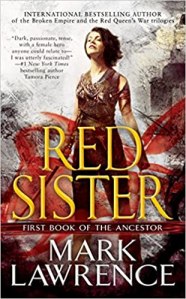
Red Sister, cover

First volume of Book of the Ancestor

For example, in Mark Lawrence’s Book of the Ancestor series, the very first book of the trilogy suggests that certain things are going to happen before the end.  But (minor spoiler here) that scene, which is presented in several places during the story, is always incomplete and carefully limited; and when it finally occurs, the context makes it quite different from what we were led to expect.  I found myself feeling that the author had sort of cheated – although that didn’t diminish my enjoyment of the story; it led me to wonder whether the foreshadowing scenes were really necessary at all.

In the limiting case, any first-person story gives us a pretty good idea that the narrator will survive at least to the end of the story, as noted in TV Tropes’ article on First-Person Perspective.  Although it’s been known to happen that the hero dies at the end; the tale may conclude there, or may drop back to a third-party coda for the conclusion.

Similarly, the spoiler effect is already present in any classic tale where one already knows the conclusion—the Arthuriad, for example.  Most ancient literature was written this way; Homer’s readers already knew that Troy lost the war.  In such cases, our anticipation is not to learn the outcome of the story, but to find out how the author is going to get us there—as is also the case with many genre stories, such as romances and mysteries, and with historical fiction.

The Function of Foreshadowing

As noted above, foreshadowing of any type serves the purpose of shaping our expectations and building suspense.  The mere glimpse attracts more attention than a complete revelation—a principle every fashion designer knows.  The Wikipedia article also suggests that foreshadowing can make later events seem more plausible, since we’re already conditioned to expect them.

Plausibility can also be served by the lampshading function of a character’s anticipatory retrospective reflections.  When Peters’ heroine in Summer of the Dragon comments on her own reaction—“ my compassion was stupid.  I didn’t know how stupid until”—we are a little less inclined to excoriate the character for being an idiot, since the reflection makes clear that they now know they were an idiot.

So, if “little did I know” has legitimate functions, what’s the problem with it?

Looking Through a Character’s Eyes

Woman sits on wall looking out over a city

Viewpoint
(Image by Pexels from Pixabay)

There’s a strong trend these days toward choosing the viewpoint of a story to encourage the reader to identify as closely as possible with the main character(s).  If a story isn’t told in first person, then one is advised to use “close” or “deep” third person, where the reader’s point of view is tightly limited to that of a particular character.  There may be more than one viewpoint character, but while we’re in a given person’s head, we see only what they see, know only the things they know, experience their feelings as we face their challenges with them.

Presumably this is intended to make the reading experience more engaging and immersive.  The frequent use today of present tense (“I open the door”) rather than the usual “narrative past” (“I opened the door”)—for example, in the Hunger Games trilogy—appears to be another means to the same end.

Now, I’m not slavishly devoted to the “close third” option.  Plenty of the stories I read growing up were told in “omniscient” third person, where the author felt free to give the reader information the characters were not privy to.  In the lost world-ship story Orphans of the Sky, for example, Heinlein fills us in on things that the characters, given the boundaries of their experience, cannot understand.  Or consider Victor Hugo’s notorious disquisition on the Paris sewer system in Book the Second of Volume Five in Les Misérables.  I’m comfortable with a more ‘distant’ viewpoint; I can read The Silmarillion as well as The Lord of the Rings.

The Downside of Knowing

Image of eye, shadowed

Image by Helmut Strasil from Pixabay

But to my mind, the heavy-handed “little did I know” sort of foreshadowing does tend to pull one out of the story.  We now know something the viewpoint character doesn’t; we are no longer sharing their feelings in the moment, but rather their retrospective evaluation based on later knowledge.  We are not quite in the internal time of the story, but viewing it sub specie aeternitatis, from a point of view that is not time-bound.  This distances us to some degree from the story.

The specific foreshadowing typical of these hints, as distinct from a general air of ominousness, builds dramatic tension; but it also reduces surprise.  Of course, this kind of surprise is lost the second time you read any book.  We already know what’s going to happen.  Still, the building up of expectations proportionately reduces even the apparent freshness of the experience when the foreshadowed event finally takes place.  We may find ourselves thinking more about the later events that are being implied than being “mindful” about the current action.

That diversion from the ‘narrative present’ may be particularly distracting when we don’t feel that the author makes good on the implied threat of the foreshadowing.  If we’re told that something terrible is in the offing, and then it turns out not to be so bad after all, we may feel disappointed or cheated.  Greeley’s stories are especially subject to this problem; on the second read-through, we may feel we’re being manipulated when the author earnestly warns us to expect something awful, but we know the outcome won’t live up to the warning.  After a while, we may begin to take the author’s insinuations with a grain of salt, since we know their habit of overthreatening and not delivering.

The not-delivering can actually be a relief, rather than a letdown:  ‘Whew, that wasn’t as bad as I thought it was going to be.’  That reaction makes me ambivalent about the faux foreshadowing.  The release of dramatic tension in a positive way may be as satisfying as the fulfillment in a negative way.  Perhaps overthreatening actually is a useful device—particularly if we want the reader to be relieved rather than appalled.

My sense, in the end, is that “little did I know” is a technique to be used with care.  Foreshadow away; but be sure of exactly what you’re trying to achieve and how the language used will accomplish it.