The Good King (reprise)

Watching The Lord of the Rings movies again recently, to share the experience with my wife, brought to mind this post from eight years ago.  Here it is again, with minor updates.

I began to wonder some years back about the curious preference for monarchy in futuristic settings.  In the world at large, monarchies have been retreating in favor of republics and democracies, at least in theory, since 1776.  Why are SF writers so fond of equipping future societies with kings, emperors, and aristocracies?

Star Kingdoms

We can pass lightly over the old-time, pulp-type stories where royal rule is merely part of the local color:  Burroughs’ A Princess of Mars (1912), Edmond Hamilton’s The Star Kings (1949), E.E. Smith’s The Skylark of Space (1928) with its Osnomian royal families.  Here, like flashing swords and exotic costumes, monarchy is simply part of a deliberately anachronistic setting.  Similarly in high fantasy, where aristocracy comes naturally in the typical pseudo-medieval milieu.

But we see royal or aristocratic governments in more modern stories too.  Asimov’s Foundation stories are centered around a Galactic Empire. (See also the more recent Apple+ series of the same name.)  Since that series was based on Gibbons’ The History of the Decline and Fall of the Roman Empire, an Empire was inevitable.  Similarly in Star Wars, which draws heavily on Asimov.  Jerry Pournelle’s CoDominium future history has a First and a Second “Empire of Man.”  David Weber’s heroine Honor Harrington serves the “Star Kingdom of Manticore” (later “Star Empire”), modeled closely on England around 1810.  Lois McMaster Bujold’s Vorkosigan Saga contains a number of polities with different forms of government, but many of the stories focus on Barrayar, which has an Emperor.  Anne McCaffrey’s popular Pern series has no monarch, but has two parallel aristocracies (the feudal Holders and the meritocratic dragonriders).  It got to the point where I began to feel a decided preference for avoiding monarchical or imperial governments in SF storytelling.

The Lure of Kingship

Aragorn with crown

There’s something that attracts us in royalty—or we wouldn’t see so much of it.  I encountered this puzzlement directly.  As a kid reading The Lord of the Rings, I was as moved as anyone by the return of the true King.  I asked myself why.  If I don’t even approve of kingship in theory, why am I cheering for Aragorn?

The reasons we’re drawn to monarchy seem to include—

  • Kings are colorful. (So are princesses.)
  • Stability
  • Personal loyalty
  • Individual agency

The first point is obvious, but the others are worth examining.

Stability

It’s been pointed out that even in a constitutional government, a monarch provides a symbolic continuity that may help to hold a nation together.  British prime ministers may come and go, but the King, or Queen, is always there.  This gives some plausibility to the idea of a future society’s returning to monarchy.

Something like this stabilizing function is behind commoner Kevin Renner’s half-embarrassed harangue to Captain Rod Blaine, future Marquis of Crucis, in Niven & Pournelle’s The Mote in God’s Eye:  “maybe back home we’re not so thick on Imperialism as you are in the Capital, but part of that’s because we trust you aristocrats to run the show.  We do our part, and we expect you characters with all the privileges to do yours!”  (ch. 40)

Unfortunately, relying on the noblesse oblige of the aristocrats doesn’t always work out well.  It depends on who they are.  For every Imperial Britain, there’s a North Korea.  When the hereditary succession breaks down, you get a War of the Roses or Game of Thrones.

Too much depends on getting the right monarch.  By the law of averages, it doesn’t take long before you get a bad ruler, whether by inheritance or by “right of conquest”—and you’re up the well-known creek.

Personal Loyalty

Personal loyalty appeals to us more strongly than loyalty to an institution.  One can pledge allegiance to a state—but even the American Pledge of Allegiance starts with a symbol:  the flag, and then “the Republic for which it stands.”  Loyalty to an individual moves us more easily.

This kind of loyalty doesn’t have to be to a monarch.  Niven & Pournelle’s Oath of Fealty explores how loyalty among, and to, a trusted group of managers can form a stronger bond than the mere institutional connections of a typical modern bureaucracy.  One can be faithful to family (the root of the hereditary element in kingship), to friends, or even an institution or a people.  But it’s easiest with an individual.  This loyalty is the basis for the stability factor above.

Individual Agency

The vast machinery of modern government sometimes seems to operate entirely in the abstract, without real people involved.  “Moscow said today . . .”

In fact it’s always people who are acting.  But it’s easier to visualize this when you have a single person to focus on.  “When Grant advanced toward Richmond . . .”  In the extreme case, we have the ruler who claims to embody the state in his own person:  “L’état, c’est moi” (attributed to Louis XIV, the “Sun King” of France).

In a fascinating 2008 essay, Jo Walton quotes Bujold on political themes in SF:  “In fact, if romances are fantasies of love, and mysteries are fantasies of justice, I would now describe much SF as fantasies of political agency.”  A science fiction character is frequently involved in effecting a revolution, facing down a potential dictator, or establishing a new order—exercising autonomous power.  Walton links this notion of political agency to the fact that SF illustrates change:  “SF is the literature of changing the world.”  The world-changers can be outsiders, or they can be the rulers themselves—as in a number of the examples above.

It’s not surprising that we’re attracted to characters who act outside the normal rules.  We (especially Americans, perhaps) are fond of the idea that good people can act in ways that are untrammeled by the usual conventions.  I’ve already mentioned Robin Hood.  And the whole concept of the superhero—the uniquely powerful vigilante who can be relied on to act for the good—is powered by this attraction.

But this idealization of individual initiative is also dangerous.  Too much depends on getting the right hero—or the right monarch.  It can only work if the independent agent is seriously and reliably good:  virtuous, in the classical sense of virtue as a well-directed “habit” or fixed character trait.  Even then, we may be reluctant to give any hero unlimited power.  Too much is at stake if it goes wrong.

The Rule of Law

Our admiration for the powerful ruler is always in tension with our dedication to the rule of law:  “a government of laws, not of men,” in the well-known phrase attributed to John Adams.  We can see this as far back as Aristotle:  “law should rule rather than any single one of the citizens.  And following this same line of reasoning . . . even if it is better that certain persons rule, these persons should be appointed as guardians of the laws and as their servants.”  (Politics book III, ch. 16, 1287a)

No human being can be trusted with absolute authority.  This is the kernel of truth in the aphorism that “power tends to corrupt and absolute power corrupts absolutely.”  But we can’t get along without entrusting some power to someone.  When we do, it had better be someone who’s as trustworthy as possible.

The Ideal of the Good King

Thus the true king must be a virtuous person—a person of real excellence.  This is the ideal of an Aragorn or a King Arthur, whose return we’re moved to applaud (even against our better judgment).  It should be obvious that the same principles apply to the good queen—or emperor, empress, princess, prince, president, prime minister:  the leader we follow.  But I’ll continue using “king” for simplicity’s sake.

What virtues do we look for in a good monarch—aside from the obvious ones of justice, wisdom, courage, self-control?

If the ruler or rulers are going to be “servants of the laws,” they require humility.  A king who serves the law can’t claim to be its master.  Arrogance and hubris are fatal flaws in a ruler.  For example, we should always beware of the leader who claims he can do everything himself and is unable to work with others.

The good king is also selfless—seeking the common good of the people, not his own.  Self-aggrandizement is another fatal flaw.

In effect, what we’re looking for is a ruler who doesn’t want to rule:  a king who believes in the sovereignty and the excellence of common people.

Aragorn defers to Frodo

It’s significant that Aragorn, our model of the good king, is introduced in LotR as “Strider,” a scruffy stranger smoking in a corner of a common inn.  Even when he’s crowned in victory, he remembers to exalt the humble.  The movie has him tell the four hobbits, “You kneel to no one.”  Tolkien’s text is more ceremonious:  “And then to Sam’s surprise and utter confusion he bowed his knee before them; and taking them by the hand . . . he led them to the throne, and setting them upon it, he turned . . . and spoke, so that his voice rang over all the host, crying:  ‘Praise them with great praise!’”  (Book VI, ch. 4, p. 232)

We see the same essential humility and selflessness in other admirable leaders, kings or not:  Taran in the Chronicles of Prydain, and the revolutionary princess in Lloyd Alexander’s Westmark trilogy; Niven & Pournelle’s Rod Blaine; Jack Ryan in Tom Clancy’s novels; “Dev” Logan, head of Omnitopia Inc. in Diane Duane’s Omnitopia Dawn—the unpretentious opposite of the “imperial CEO.”  America was fortunate enough to have such an example in the pivotal position of first President, George Washington.

The Alternative

At the other end of the spectrum, the most dangerous person to trust is an unprincipled and unscrupulous autocrat—someone convinced of his personal superiority and infallibility.  Giving power to an individual who has no interest in serving the common good, but only in self-aggrandizement, puts a nation in subjection to a Putin, a Mussolini, a Kim Jong-un.

The antithesis of the good king is the tyrant, who, however innocently he may start out, figures in our stories mainly as the oppressor to be overthrown.  It’s much better, if possible, to intercept such a potentially ruinous ruler before the tyranny comes into effect:  Senator Palpatine before he becomes Emperor, Nehemiah Scudder before he wins his first election.  Allowing the tyrant to gain power may make for good stories, but it generates very bad politics.

If we must have strong leaders, then in real life as well as in stories, character is key—and hubris is deadly.
The Amateur Hero

At the end of the previous post, we noted that, depending on the kind of story authors want to tell, they may choose to deploy either a professional hero—someone whose job it is to face perils and challenges, like a military officer or police officer—or, on the other hand, someone who is dragged unwillingly or unexpectedly into a crisis.  But I didn’t actually say much about how that difference plays out in a story.  This post, then, is a kind of afterthought to the last one.

“You Are Not Prepared”

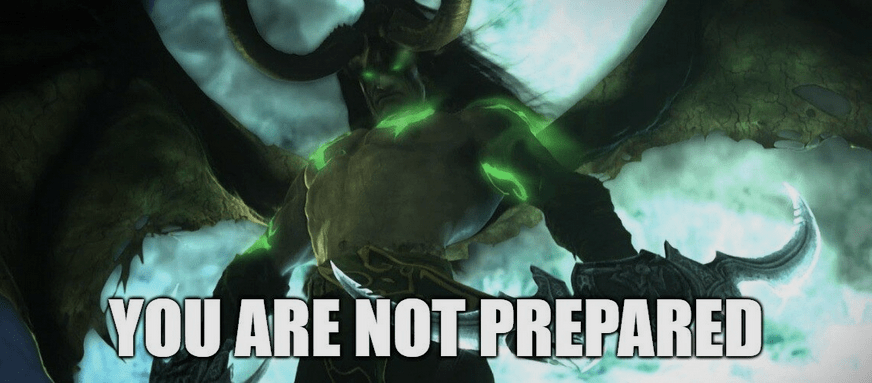
The first expansion for the online game World of Warcraft greeted players with the ominous declaration, “You Are Not Prepared.”  That’s exactly the situation of the individual who didn’t expect to be called upon to be a hero.  The lack of preparation may manifest itself in several ways, any of which can help to shape the story.

Competence.  The main character (MC) may lack the skills or expertise to deal with the kind of crisis that’s occurring.  Maybe there’s fighting involved, and the MC isn’t skilled with fists or swords or rayguns or whatever the weapon of choice happens to be.  It’s a lot easier if they do happen to have the pre-existing skill:  Glory Road’s Oscar, for example, was already experienced at fencing.  If they don’t, then one can expect an extended period of training, since this sort of skill isn’t one that can be picked up in a day.  Luke’s training montage in The Empire Strikes Back is a classic example, taking him from someone with potential and the occasional burst of unexpected powers (“Use the Force, Luke”) to someone who can face off against Darth Vader at the end of Empire and present himself as a full-fledged Jedi Knight at the beginning of the sequel.

Information.  The amateur hero may be drawn into an environment where they aren’t familiar with the geography, the factions, the customs, the people and powers.  In Anne McCaffrey’s Restoree, for example, the heroine is kidnapped by aliens, then rescued by others, all in an unconscious state, and “comes out of it” to find herself in a thoroughly incomprehensible situation.  Glory Road reflects the same struggle by a MC to cope with an unfamiliar environment, though in this case the hero has all the assistance one could desire in learning to deal with the new circumstances.

The same kind of thing occurs in the classic fantasy trope where MCs from a backwater locale are sent into a wider world with which they’re only vaguely acquainted, as in The Lord of the Rings or The Wheel of Time.  One of the advantages of this setup is that the MCs will need to have many things explained to them by more knowledgeable characters; they are the “ignorant interlocutors” whose presence is so convenient for exposition.

Even in more mundane cases, the MC may be placed in conditions where they don’t know their way around.  The eponymous TV series hero Chuck Bartowski is suddenly pitched into the world of intelligence operations and secret agents; he and other characters spend much of the first three seasons learning the ropes.  In a similar way, but much faster (in a two-hour movie rather than a long-running series), the hero of Hitchcock’s North by Northwest must learn the players and the goals of the spy game into which he has been drawn.

Confidence and maturity.  The MC may also be personally unprepared to deal with the crisis posed by the plot.  My favorite example is Romancing the Stone, in which the shy, introverted heroine suddenly has to travel far from home, ally with an unexpected stranger, fight her way through a jungle, and match wits with smugglers and thugs.  Much of the fun of the story is in watching the ironically-named Joan Wilder gain in courage and self-reliance as she overcomes these progressively more dramatic challenges.

Other aspects.  The MC may be unprepared in other respects.  The elemental fact of facing death will be a shock to those of us brought up in more placid situations.  The hero may lack equipment or resources to deal with the new challenges—or, conversely, may happen to have exactly the right resources available; this may actually bring about the adventure, as with the spacesuit in Heinlein’s Have Spacesuit, Will Travel.  Moreover, the homebody hero probably has not yet come to terms with the degree to which the adventure might impact family or personal connections—unlike the hero-by-trade, who has probably reconciled spouse or family with a dangerous career.

The Character Arc

The need to cope with such challenges almost automatically sets up an arc of character development for the MC, reflected in the examples above.  The MC can be expected to grow in confidence and independence.  They may also be tempered by tragedy or suffering; this is the primary course for the young graduate-school characters in Gay Gavriel Kay’s Fionavar Tapestry.

The developing hero may become more street-savvy, more knowledgeable in the ways of the world.  This sort of practical wisdom is a common theme, given the age of the characters, in young adult-targeted stories or the bildungsroman.  For example, Rod Taylor, the MC of Heinlein’s young adult novel Tunnel in the Sky, becomes the informal leader of a band of marooned students by a gradual process.  A group of older students, schooled in political theory and more alert to how groups can be manipulated, ease him out and take over control—with the best of intentions, to be sure.  By the end of the story Rod, once again in command, has become a bit more canny in dealing with the group.  In a similar way, Don Harvey in Between Planets starts out as a fairly naïve high-schooler who learns some hard lessons about political realities as he becomes embroiled in an interplanetary revolution.

Finally, if the MC learns new skills or abilities in the course of the story, they will have grown in that respect too.  The new abilities may qualify the MC for new roles or positions, and perhaps to actually become a professional hero in the end.  We see this in superhero origin stories, where a MC is initially unskilled in managing their superpowers, but gradually takes on the role of a professional do-gooder.  Spider-Man is the classic example, a teenager who didn’t expect to become super-powered and takes a while to become used to his new potential; unlike, say, Iron Man or the Fantastic Four, who start out as grownups and adapt fairly quickly.

As we saw in the last post, an amateur hero almost by definition rises to the occasion.  This is a sufficiently satisfying theme that I suspect adventure stories may tend more to this approach than to that of the professional hero—though I haven’t attempted to take a count.

The Professional Hero

Glory Road

A couple of comments by Kevin Wade Johnson in connection with my last blog post (now a long way back!) triggered a line of thought about heroes and the hero business.

Glory Road cover

Robert A. Heinlein’s 1963 novel Glory Road looks like a swashbuckling fantasy at first blush, but it turns into something entirely different.  Our hero, E.C. “Oscar” Gordon, kicking around the world after leaving the military, is recruited by an incredibly gorgeous woman to assist her with a quest that involves traveling to other universes and swordfighting.  This is just the kind of adventure he was craving.

As Kevin observes, the first three-quarters of the book are action-adventure, with sizable side dishes of comedy, scandalous liaisons, and cynical social commentary.  At that point the quest is fully resolved—at page 208 out of 288, in my copy.  What, then, occupies the rest of the book?

Gordon returns with “Star,” the beautiful woman he’s now married, to her home universe.  It turns out she’s the empress of a multiuniversal polity that is in some respects a high-tech Utopia.  All Gordon has to do is relax, allow himself to be fêted by the population, and sleep with anyone he finds interesting (the late Heinlein’s polyamory is fully on display here).

He hates it.

What Utopia doesn’t satisfy is Gordon’s lust for adventure.  He doesn’t want to be a dilettante or a “kept man.”  He wants wonder, excitement, the stimulus of danger.  He likes being a hero, with all the occasional discomforts and perils of that role. The placid happy ending of a retired hero holds no attraction for Gordon.

It’s unclear whether Star feels the same way.  She’s willing to consider going in on a kind of adventuring “business” with her slightly tarnished knight.  But first, she says, she’d have to train a replacement for her unique position—and that would take many years.

The solution is for Gordon to head off again on the Glory Road without Star.  He’ll pop back in now and then, but not to take up residence in the Twenty Universes utopia on a permanent basis.  He and Star will remain in love with each other, perhaps, in some sense of the term—but not in a sense that requires fidelity on either’s part.  In Heinlein’s polyamorous world-view, passing romantic involvements are just part of the adventure:  “Knights errant spend their nights erring” (p. 271).  Gordon’s happy ending is the continuing adventure.

The Unsettled Adventurer

This idea comes up from time to time in adventure stories:  the hero (or heroine) who seeks out danger and isn’t content without it.  John Carter of Mars displays a little of this, though in the violent world of Barsoom, he seems to be able to get his fill of trouble while still remaining home-based with the enthralling Dejah Thoris in her city of Helium.  There’s something like this idea in the conclusion of The Good Place—boredom with utopia—as we’ve seen.

The really extreme case can be found in an old-time fantasy by E.R. Eddison, The Worm Ouroboros (1922).  The swashbuckling nobles of Eddison’s imagined world fight the good fight against their sinister enemies, the Witchlanders.  At the end of the novel, those adversaries are conclusively defeated.  Cue the victory feast.  And yet . . . Our Heroes are not quite satisfied.  Things just won’t be as interesting without the Witchlanders constantly scheming and warring against them.  At the very end, the heroes’ fanciful wish is somehow granted:  a herald announces the arrival of an emissary from the bad guys—the same event with which the novel opened.  (Hence the title:  the legendary serpent that swallows its own tail.)

The Series Protagonist

I’ve previously expressed some doubts about whether happy endings really need to be static and boring—so let’s not adopt the Glory Road doctrine too hastily.  (In its extreme form, Eddison’s circular epic, one may feel the opposite dissatisfaction in the sense that all the heroes’ striving and suffering has been for nothing.)  But these examples highlight a difference among types of action heroes.

In a long-running action series, unless a hero is improbably falling into one adventure after another against their will, we have to assume that the hero likes what they’re doing.  James Bond seems to be pretty content with his secret-agent life.  Indiana Jones yearns for opportunities to climb out the window of his stuffy professorial office and strike out on some treasure-hunting chase—even at an advanced age, as we’ve recently seen.  Captain Kirk, who’d been promoted to admiral by the beginning of Star Trek II, isn’t suited for a desk job.  At the end of the three-movie cycle he’s demoted to captain again—ostensibly as a punishment for flagrant violations of Starfleet regs, but we’re to see this as a step forward for him, his best destiny.  Yoda accuses Luke of this kind of unrest in The Empire Strikes Back:  “Adventure! Excitement!  A Jedi craves not these things.”

The same is true of almost all superheroes.  Retirement is almost unheard-of.  The occasional counter-example makes for an interesting tale precisely because it runs against type:  Hank Pym in the Marvel Cinematic Universe, Jack-in-the-Box in Astro City.  In a somewhat similar way, continuing campaigns in Dungeons & Dragons or similar games tend to assume the existence of a class of professional adventurers who enter willingly into a life of battle and treasure-hunting, as distinct from an assembled-for-one-purpose group like the Fellowship of the Ring.

This character trait does make things convenient for the writers.  They have a believable rationale for the main character’s continuing adventures.  Otherwise, after a while it would start to seem implausible for one person to keep getting drawn into danger purely by accident.

The Hero By Trade

The Star Trek captains, and other officers, illustrate a type of case where the character really is a professional hero—one who’s taken up a profession or vocation where danger and challenge, and hence the opportunity for heroism, come with the territory.  Anyone pursuing a military or quasi-military career fills that bill.  Honor Harrington, for example, reflects more than once that she’s good at war; it’s her calling, what she was born to do.  Professional police officers, firefighters, or rescue workers—first responders generally—also fall into this category.  (John McClane of Die Hard fame, mentioned above, is in a danger-prone profession, though it’s probably rare for a cop to run into the kinds of major crises he does.)  Unsung heroes like medical personnel may find themselves in the same position.  They may not categorize what they’re doing as heroism (it looks better on them if they don’t); but they are putting themselves “in harm’s way” where acts of heroism are constantly called for.

This is why military SF lends itself so easily to long-running series like Honor Harrington’s.  (The same is true outside the SF genres, as we can see, for example, in Patrick O’Brian’s Aubrey/Maturin sea stories.)  The same is true of private detectives, secret agents, and the like.

The Reluctant Hero

But not all heroes are professional heroes.  An equally perennial favorite is the reluctant or accidental hero—the person who answers the call to adventure, but does wish to return to a peaceful life afterward.

Jim Butcher’s Introduction to Jim Butcher & Kerrie L. Hughes, Heroic Hearts (NY:  Ace Books, 2022), puts it this way:

Real heroes . . . [are] the everyday humans who happen to be standing there when something bad happens, and when there is a sudden need for skill, courage, or intelligence.  They’re the regular people in irregular circumstances who find themselves considering others first and standing up to do whatever needs to be done.”  (p. xi)

Some do manage to go back to their ordinary lives after the crisis has passed.  Cincinnatus, and George Washington, are famous for pulling off the transition:  they took over the reins of the state when they had to, but willingly ceded power afterwards.  On a more modest scale, the “citizen soldier” concept, as in the American National Guard, aims at the same thing.  It’s part of the mystique of the American World War II armies, the so-called “Greatest Generation” model.  You rise up to serve when necessary, but happily return to civilian life when it’s done.  Contemporary discussions are more likely to emphasize post-traumatic stress disorder (PTSD) and the difficulty of the return to civilian life; but it remains an ideal with considerable drawing power.

In fiction, the contrast between heroic acts and ordinary life provides rich soil in which to grow interesting stories and characters.  Tolkien, for example, gives us some characters who do manage the return to everyday existence—Sam Gamgee—and others who find it impossible, such as Frodo.  Of course Frodo does in the end find peace in Valinor, but that requires a literal removal from the circles of the world, a transcendence not available to the average hobbit-in-the-street. 

The situations can become fairly complex.  In the Song of Roland, after the heroic deeds of the story are finished, a weary Charlemagne at the end finds himself called back unwillingly to new conflicts.  In the TV series Chuck, the eponymous Chuck Bartowski is initially appalled to find himself embroiled in spy activities, but the sheer coolness of it all grows on him, and by the fifth season he wants to start his own secret-agent business.  Scott Lang (Ant-Man) at the beginning of Quantumania is resting comfortably on his laurels, and has to be dragged back into action in the name of helping others.

Detectives in mystery stories fall into both camps.  We have professional private eyes like Sherlock Holmes and Nero Wolfe.  But then we also have amateurs like Chesterton’s Father Brown and Agatha Christie’s Miss Marple, who always just seem to be in the right place at the right time.

The Author’s Choice

If we want to write a heroic adventure story, one of the early decisions we have to make is what kind of hero we want to feature.  Sometimes the tale may call for someone who’s automatically in a position to encounter danger, like a military officer.  Sometimes we may prefer to drag the hero into action against their wishes, or by happenstance.  The whole point of Roger Thornhill’s predicament in North by Northwest, for example, is that he has no desire to become involved in skulduggery and is baffled by the strange things that are happening to him.  Like so many other accidental heroes, however, he rises to the occasion.  This is a narrative arc that may be both more interesting and more inspiring than that of the professional hero; because most of us live relatively ordinary lives and can only hope that if called upon, we too could become the kind of hero we admire.

Dialing Destiny

Indiana Jones Rides Again

Indiana Jones and the Dial of Destiny, movie poster

My wife and I went to see Indiana Jones and the Dial of Destiny (2023) Friday night.  Good movie—I’m unsure whether to call it “great.”  My reaction was somewhat complicated by the fact that I’d inadvertently gotten us tickets to a theatre with the full range of tactile or “haptic” special effects—seats that bounce you around violently, drafts and puffs of air, sprinkles of water, little gizmos that tickle your neck or ankles.  We both found all this paraphernalia rather distracting at first, though it’s undeniably immersive—rather like seeing a movie and riding a thrill ride at the same time.

I’m going to try and avoid spoilers on this occasion, since it’s likely a lot of us haven’t seen this episode yet.  (It’s fun to get in on opening night sometimes—and I have to keep up my geek cred somehow.)  This closing episode—Harrison Ford and the Spielberg/Lucas team have all said this is to be Indy’s last outing, though I wouldn’t be surprised to see further spinoffs, like the The Young Indiana Jones Chronicles—provides a useful opportunity to reflect on the series as a whole, which we can do without major spoilers.

What Makes Indy Go

Part of what makes the Indiana Jones films so much fun is their unabashed appeal to action-packed derring-do—the meat and drink of the old-time movie serials that both Lucas and Spielberg have pointed to as inspiration.  In that respect, it’s close kin to Star Wars—no surprise, since Lucas was behind that series as well.

Another key element is the character of Indy himself.  He performs incredible (perhaps impossible) physical feats, but he always seems to be doing it in desperate improvisation—no Superman he.  And while he’s an honorable cuss with a warm heart, there’s also a vein of pragmatism that makes him earthier than a traditional noble hero.  (Remember the scene in Raiders where, finding Marion tied up in Belloq’s tent, he has second thoughts while untying her and, to her outrage, ties her back up again?)

The plot driver in each film is a lost and significant object:  the Ark, a jewel, the Grail, the Crystal Skull, the Antikythera mechanism.  The child in us can’t help responding to the appeal of “buried treasure.”  From the children’s adventures of Nancy Drew or of Enid Blyton’s numerous literary offspring, to the (slightly) more grown-up exploits of National Treasure or Pirates of the Caribbean, we’re fascinated by the idea of suddenly discovering some hidden thing of inestimable value.  Even a contemporary middle-grade book like Morgan Matson’s The Firefly Summer can invoke the same perennial attraction.  Of course, “old” is relative—it might be as recent as one’s parents’ generation, or as far back as prehistory.  The antiquities in at least three of these movies are thousands of years old, which is plenty far enough to evoke awe and wonder. 

In the best of the IJ movies, this sense of wonder is intensified and elevated by the fascination of the numinous:  a religious or near-religious awe.  By the “best” movies I mean, of course, Raiders of the Lost Ark and Indiana Jones and the Last Crusade, which I believe are generally regarded as the best of the bunch.  I don’t think Dial of Destiny will rise to that level, though it’s certainly far better than the weakest link, Temple of Doom.  (Of course, your mileage may vary . . .)  The old-time movie-serial ambiance seems better suited to the power of myth than to the science-fiction veneer of the final two episodes.

The Tomb Raider Syndrome

I gather Indy has inspired a number of young people to become actual archaeologists.  That’s a good thing, although as soon as we invoke actual archaeology, we have to acknowledge how far Indy wanders from scientific best practices.  I must admit I cringe a little every time Jones and a companion shove a stone cover violently off a tomb, presumably to crack and shatter on the floor out of camera range—not to mention the absence of any attempt even by 1930s standards to photograph or otherwise record these unique historic sites.  Last Crusade even highlights the difference between real archaeology and mere treasure-hunting:  Indy tells his class “. . . and X never, ever marks the spot”—which caution is then promptly spoofed when he discovers that a giant X (the Roman numeral ten) actually does indicate where a catacomb is buried in Venice.

Of course, Indy has bigger fish to fry, so we blink amiably at these scientific solecisms and get on with the nonstop excitement.  The cavalier treatment of relics is a long-standing tradition, shared (I think) by Indy’s distaff counterpart Lara Croft, among others.  In our more pedantic moments, we may raise our eyebrows at these dubious tactics, but this is a case where TV Tropes’ “MST3K Mantra” applies:  “It’s just a show; I should really just relax.”  Indy himself does aim to do the right thing by history:  he’s constantly contrasted with more mercenary grave-robbers when he insists, “This should be in a museum.”

The Human Element

More important, though, in Indy’s appeal to an eager audience is the human connections.  They’re less prominent than the thrills and special effects, but they’re at the heart of the stories.  Indy’s romance with Marion and his friendship with Sallah, and even his rivalry with the elegant Belloq, give us an enjoyment that outlasts the fight or chase scenes.

Lucas and Spielberg doubled down on this in Last Crusade, where Indy’s relationship with his father made for most of the more memorable moments of that film.  On the other hand, serious human relationships are largely absent from Temple of Doom, whose single saving grace (aside from the mine-cart ride) is his friendship with Short Round.  As an unregenerate romantic, I give Kingdom of the Crystal Skull extra points for reviving Indy’s romance with Marion (after his ephemeral affairs in the second and third installments).

In this respect, I think Dial may fall a bit short.  While Indy’s relationship with his Action Girl goddaughter is a central theme in this movie, I didn’t find the new character quite as likable or interesting as I wanted to.  There are some heartwarming moments here, to be sure, but they tend to bunch up toward the end of the story.

All in all, Dial gives us a distinctly quieter and more elegiac ending than the previous episode’s celebratory denouement.  The lasting appeal of this film may have a lot to do with how audiences respond to the character arcs. After forty-two years, we can fondly say farewell to Indiana Jones in this concluding episode—though after all the thrills and chills, we may feel, with Indy, that “it’s not the years, it’s the mileage.”

Writing a Series

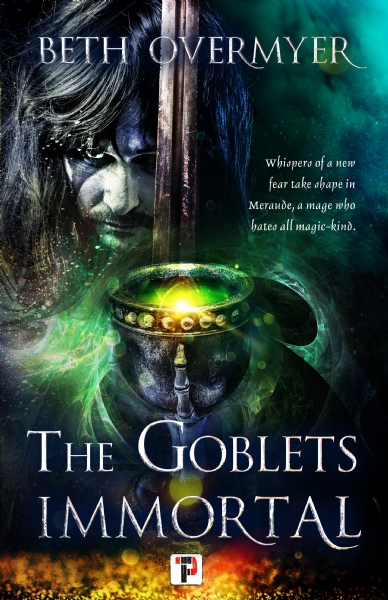
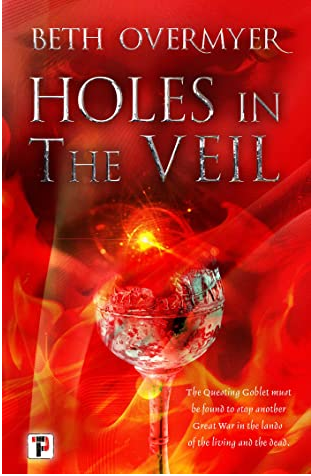
This week we have a guest post from Beth Overmyer, author of The Goblets Immortal, mentioned in our last episode.  The sequel to Goblets hits the stands on February 16.  It’s thus a timely moment to take a look at the special complications of writing a series.

Take it away, Beth!

Writing a Series — Beth Overmyer

There are many things to take into consideration when writing a series. Will it be two books (a duology)?  Or maybe it’s going to be a serial, books that pick up right after one another and could be slapped together as a single volume (The Lord of the Rings, anyone?)  How do I keep track of all my information?  Where do I even get started?

Let’s start at the end . . . of the first two books in a trilogy, that is.

Endings

The Goblets Immortal, coverSome writers advocate that it’s important to know where your book/series is headed.  If you aim at nothing, they reason, that’s what you’ll get.  Knowing the ending of the series before you pen page one of book one can be helpful and gives you something to reach toward.  When I was writing The Goblets Immortal books, however, I had only a distant idea of what I was aiming toward.  Not necessarily a clear target, but an emotional note I wanted to end on.

There are different types of endings, and each book in the series might have a different one.  Book one might be a HEA (happily ever after) or a HFN (happy for now), while book two might be a cliffhanger, and the final book might end in a tragedy.  I don’t necessarily recommend this path, however.  Despite liking surprises, readers also tend to want consistency from the author.

And I don’t recommend making every book a cliffhanger.  A lot of readers don’t like them.  A cliffhanger, of course, leaves the characters in a crisis.  The reader might be frustrated that they have to wait a whole year (or more!) to find out what’s going to happen next.  Also remember your genre’s expectations.  Fantasy endings can vary, but a romance or F&SF romance needs a HEA or a HFN.

Let’s take a look at the endings of one series’ first and second installments.

Star Wars, Episode IV:  A New Hope

The end of the story sees the episode’s main conflict resolved (the Death Star is blown up), but there are enough loose ends (Vader’s alive, the Emperor’s out there, Imperial Troops abound) left to keep things open for future installments.  Yet this movie could very much be a standalone.  Many Book Ones wrap things up to a greater degree than Book Two.

Star Wars, Episode V:  The Empire Strikes Back

The near-end offers up a few surprises, but the very end (Han is spirited away on a bounty hunter’s ship) sets up the opening conflict for the next movie.  This movie is less of a standalone, but it could be watched and understood without watching the first movie.

Series Bible

“But how do I keep track of all my information?” I hear you ask.  A very good question.  One simple way to solve this:  reread the first book/s in your series before you write the next installment.  Not only will this give you a refresher course on the details of the story, it will put you back in that world and remind you of the voice you’re writing in.

Series bible for The Goblets ImmortalAnother way to keep track of information is to make a series bible.

It’s impossible to keep every detail about every character (appearance, personality, catchphrases, etc.), location, event, and timeline in your head . . . especially if you’re a pantser or plantser and haven’t written all the details out.  Once book one’s been written, it might be a good idea to put together what is known as a series bible.  In fact, it might be better to develop one as you go along.

A series bible is a document full of details from the books in a series. When you have a question about a character’s appearance, flip back to their page and look it up. Forget the name of a town? Flip back to the locations section of your bible.

When I started writing book two in The Goblets Immortal series, I already had notes on each Goblet Immortal, what that Goblet did, where it originated, where it was at the end of book one, and other important details.  I also had a few character notes.

Getting Started

We’ve looked at endings and keeping track of details.  But how does a writer even get started with a series?

Let me start by giving you permission:  you are allowed to write out of order.  If you have an idea for a scene later down the road, jot down notes or go right ahead and write.  You can always revise it Holes in the Veil, coverto fit your opening better later on.

As with writing any other book, follow your preferred method.  Are you a plotter?  Write an outline for book one, and jot down notes for the books that will follow.  Are you a pantser?  Roll up your sleeves and dig in.  Plantser (a mix of a plotter and a pantser)—jot down some notes and get started writing.

The best thing to do, besides getting some experience under your belt, is to read and study other series.  What did you like about your favorite trilogy?  What made you stop reading your least favorite one?  Don’t make their mistakes, but emulate their triumphs—without outright copying, that is.

Another word of advice: keep a running list of questions that need to be answered in later books.  If a missing magical knife is mentioned in book one but is not referenced again in book two, remind your audience of it before its grand appearance in book three.  I have a document titled “Loose Ends,” and I highlight things in green once I’ve taken care of them.  Things I’ve mostly taken care of, I highlight in yellow.  Things that I’ve decided to let go of, I cross out.

Conclusion

So, there you have it. There are some good resources out there on series writing, though not as many as you would think. For your reading pleasure, might I suggest trying:  How to Write A Series:  A Guide to Series Types and Structure plus Troubleshooting Tips and Marketing Tactics (Genre Fiction How To Book 2) by Sara Roset, and Writing the Fiction Series:  The Complete Guide for Novels and Novellas by Karen S. Wiesner.

Thanks, Rick, for hosting me!

Keep your nose in a book and your pen on the page,
Beth Overmyer
Beth’s Web Site