Einstein, Heinlein, and Queen

Science-fictional ideas have been gradually percolating through our popular storytelling and entertainment for years, as I noted at the beginning of these observations.  One example is the idea of time dilation—that time passes more slowly at very high velocities—in the theory of relativity.  The classic illustration is the “twin paradox.”  We can trace this image from the science itself, through a classic novel, to—of all things—a rock song.

The Physicist’s Version

Those who are already familiar with relativistic time dilation can skip to the next heading.  Otherwise, here’s a rough layman’s explanation of the phenomenon:

One of the consequences of Einstein’s theory of relativity, noted as early as 1911, is that time passes more slowly as we approach the speed of light.  More precisely, a clock (or other process) that’s moving at a high velocity, relative to the observer, will be seen to operate more slowly than a clock in the observer’s own reference frame.  If I sit in my comfortable lab on Earth and watch what’s happening on a spaceship accelerating away from the Earth, I’ll see the spaceship’s clock running slower and slower, falling further and further behind the clock on my wall.  The closer to the speed of light (usually symbolized as “C”) the spaceship gets, the greater the discrepancy—the “time dilation.”

Time dilation graph and equationThis isn’t an illusion.  When the spaceship eventually returns to Earth, I’ll find that the traveling clock is behind the stay-at-home timepiece.  The same is true for living organisms.  If I planted a pair of trees before the ship left, the tree that made the flight may still be a sapling when it returns, dwarfed by its towering ‘sister’ on Earth.  If you’d like the math, the Wikipedia article on the twin paradox gives an example for a trip to the nearest star, Alpha Centauri.

As with most of the peculiar consequences of relativity, we don’t notice such differences in ordinary life because they’re so small as to be undetectable at the speeds and scales we normally deal with.  But if we look closely enough, the same effects are observable.  Even the humble GPS app on your smartphone has to take into account the slowdown of the clocks on the GPS satellites, which move slowly compared to C but fast enough that the very precise positioning signals are affected.

Early on, physicists came up with a vivid illustration involving a pair of twins.  If one twin takes a trip at near-lightspeed, she will end up younger than the twin who stays home.

At low velocities, the difference will be unnoticeable.  A twin who spends a few months on the International Space Station will come back slightly younger than the stay-at-home twin, but only slightly.  Up the velocity, though, and we up the ante.  It would be quite startling, by normal standards, if the astronaut twin were still college-age while the earthbound twin were ready for retirement.

Sounds like a story, doesn’t it?

The Storyteller’s Version

Robert A. Heinlein’s 1956 young adult novel Time for the Stars does exactly this:  it makes a story out of the twin paradox.
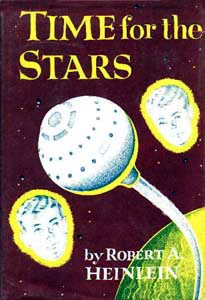
Time for the Stars coverTom and Pat Bartlett are teenagers growing up centuries from now.  Tom is our viewpoint character.  Pat is the “dominant” twin:  he always seems to end up with the bigger piece of pie.

In this future, population pressure is extreme.  The Long Range Foundation commissions twelve near-lightspeed “torchships” to look for colonizable planets among the nearby stars.  The LRF has discovered that certain pairs of twins can communicate with each other instantaneously, by telepathy (which baffles the physicists no end, since that’s theoretically impossible).  This gives the LRF a way for the starships to get their findings promptly back to Earth, and incidentally explains what an average teen is doing aboard an interstellar exploratory ship.  One twin goes abroad; one stays home.

Heinlein’s characteristic mixture of sound scientific detail and relatable characters makes the novel a highly engaging story.  We see the finagling by which it’s decided which twin (Tom) goes to space.  We get a vivid picture of life aboard a starship that will travel independently for years (even according to its own time frame)—which is where I first learned the word “ecology.”  We see strange worlds and watch how the people aboard the Lewis and Clark (known to its passengers as the “Elsie”) interact.

Time dilation is described with realistic detail.  As the Elsie approaches the speed of light (never quite reaching it), Tom has to “speak” to his brother more and more quickly, and Pat on Earth has to communicate more and more slowly, because their time frames are increasingly out of sync:  “he complained that I was drawling, while it seemed to me that he was starting to jabber” (ch. 11, p. 113).

But it’s the age difference that makes things really difficult.  At the end of the first near-lightspeed jump, Pat is eleven years older than Tom and has a seven-year-old daughter, Molly.  It becomes harder for Tom and Pat to connect; they’ve grown apart to the extent that they now have little in common.  Fortunately, it turns out that the twins’ connectedness can sometimes be passed on (stretching the original concept considerably):  Tom can communicate with Molly as well.  As time goes on, Tom’s connection with Earth is increasingly through his brother’s descendants, though Pat is still alive.

The Lewis and Clark’s expedition ends when she’s met by a new ship from Earth.  Based on investigations into the instantaneous telepathy, scientists have developed a new theory that allows for an “irrelevant” space drive—one that can whisk the whole crew home in mere hours.  The twin imagery is vivid when college-age Tom meets his brother Pat, now an old man in a wheelchair.  The time slippage is even more pointedly illustrated when Tom meets his great-grandniece Vicky, whom he’s spoken with telepathically for all of her life—and is now going to marry.  (The appearance of incest is illusory:  Tom and Vicky have only 1/8 of their parentage in common, or five degrees of consanguinity in terms of Wikipedia’s table.)

Jo Walton has a review with a fascinating (and telling) aside on what Heinlein’s book would have been like if it were written today, rather than in the 1950s.  But we’re going to go on to look at a more unlikely treatment of time dilation.

The Musical Version

As far as I know, no one is contemplating making Time for the Stars into a musical.  But years ago I ran across a song on a 1975 album by the rock band Queen.  The song is called “’39.”  The official lyric video gives you both the recording and Brian May’s lyrics.  Note the imagery the band chose for the introductory graphics.

'39, official lyric video openingIf you didn’t have the lead-in we’ve walked through here, the song might seem rather baffling.  The acoustic sound, the rather antique style, and the mention of sailing off to discover new lands makes us think of olden times.  But what’s with “. . . the day I’ll take your hand / In the land that our grandchildren knew”?

One clue is the songwriter’s coyness about the first two digits of the date that forms the title.  If someone says “’39,” we normally assume they mean 1939.  But there was nothing like this happening in 1939.  The song is full of this careful ambiguity.

If you come to the song with a science-fiction background, however, it’s clear what it’s really about.  Clues are scattered all through the lyrics.  We’ve got the population pressure:  “the days when lands were few.”  The brave crew is “inside” the ship, rather than “aboard.”  It sails “across the milky seas”—the Milky Way.  The singer is “many years away” from his beloved.  The Volunteers bring back news of “a world so newly born” to colonize.  Most significant, he’s “older but a year,” yet the earth and his beloved have radically changed.  We haven’t got twins or telepathy in sight, but otherwise, we might well be talking about the mission of the Lewis and Clark.

When the Web was invented and I finally looked up the song in Wikipedia, I was tickled to find my guess was correct.  According to the Songfacts site, the composer May studied astrophysics, and he himself has referred to the piece as a “sci-fi folk song” (commonly referred to as a “filk song”).

The story line isn’t as clear as Heinlein’s, to be sure.  For one thing, the traveler seems astonished at the relativistic time slippage when he returns (“this cannot be”).  No real astronaut would be that unaware of what to expect.  In addition, in the chorus the singer seems to be addressing both a stay-at-home spouse with whom he’s had grandchildren (“my love”), and a descendant (“your mother’s eyes”)—unless perhaps, like Tom Bartlett, he’s fallen in love with a much younger family member.

In any case, with the necessary compression of a story into the poetry of lyrics, we don’t expect as literal a narrative as in a novel—particularly when, as here, May seems to have been deliberately indirect, even tongue-in-cheek, as a sort of joke on the listener.

But, just as in the novel, the song’s emotional resonance involves a romance as the most poignant expression of the results of time dilation.  It also ends with an appeal for sympathy with the personal dislocation of the narrator, who returns to a world far different from the one he left (“For my life still ahead, pity me”)—a theme also touched on at the end of Time for the Stars.

The three-part comparison reminds us that, even as far back as the 1970s, science fiction turns up in the darnedest places; and that scientific developments can bring new aspects to the timeless concerns of our hearts.

Future History and Happy Endings

Stories and Endings

We talked last time about SF writers’ fictional histories of the future.  There’s another feature of such backgrounds that must be taken into account.  One of the downsides about a future history is that it blunts the effect of a happy ending.

Those of us who enjoy traditionally constructed stories like to see a happy ending.  It won’t be unreservedly happy, of course.  A story is better if, as TV Tropes puts it, the main characters earn their happy ending—which means they will have gone through a lot of trials and tribulations first.  And there are likely to be losses along the way:  people who die, possibilities that are lost.  But it’s more satisfying if some good is achieved, or at least preserved, in the course of a story.

Even those who scorn the happy ending as naïve generally aim for some sort of closure or conclusion.  It’s pretty generally unsatisfying to read a tale in which nothing at all is accomplished or resolved, even in part.  Such stories exist, but I suspect they appeal mainly to readers so convinced of the meaningless of life that they perceive a pointless story as an affirmation.  For purposes of this discussion, I’m going to assume that one of the elements we look for in a good story is at least some degree of favorable outcome.

Of course, defining the ending of a story is always somewhat arbitrary.  We decide to stop narrating at a certain point, even though life goes on.  (Even in James Blish’s The Triumph of Time, which concludes with the destruction of the universe, new universes are going to be spawned from the death of this one.)

Lakeshore, sunset, coupleThis is particularly true of love stories.  Alasdair MacIntyre once remarked that in Jane Austen’s novels, marriage occupies the place that death occupies in real life.  It brings events to a conclusion.  So it is with many or most love stories, which focus on the formation of a relationship and how it reaches some watershed moment—frequently the commitment of marriage.  Stories about how a healthy marriage proceeds, though exceedingly interesting and valuable, are much more rare—and much harder to write.

And this reflection begins to illuminate our problem.  If we go on telling the story after the high point of the marriage, we run the risk that subsequent events won’t live up to that peak of expectation.  For example, I’ve seen several sequels to Pride and Prejudice that pick up after Elizabeth and Darcy’s marriage; but they don’t tend to be nearly as interesting as the original.

This is true not only of love stories, but of all stories.  At the end of Star Wars IV:  A New Hope, victory is declared, the Empire’s plot is foiled, we exit on cheers and applause.  But at the beginning of the next episode, the rebels are on the run—again—and by the following installment, even the Death Star is being rebuilt.

Early Mr. IncredibleThis sort of thing can rather take the bloom off the original victory.  Aaron Leitko’s December 2015 article on Star Wars VII makes this point about “franchises” that don’t end:  “the galaxy can never truly be saved. It is always in peril. With each victory, a new and greater threat amasses over the horizon. Our childhood heroes are destined to struggle onward until they get old, run out of luck, or are conveniently written out of the script following an unsuccessful contract renegotiation.”  One is reminded of Mr. Incredible’s fretful remark at the opening of The Incredibles:  “Sometimes I just want [the world] to stay saved.”  Don’t we all?

Endings and History

A future history, in effect, equips every story in the sequence (except for the last one) with long-range sequels. This means the problem of stabilizing the happy ending applies not only to the individual characters, but to the story’s large-scale outcome as well, like the struggle against the Empire in Star Wars.

Empire (Piper) coverI mentioned last time that H. Beam Piper’s cyclical future history would ultimately have been thrown out of whack by the happy-ending-inducing Fuzzies.  In its original conception, a certain sort of gloom spread over Piper’s future history.  As John F. Carr observes in his introduction to the Piper collection Empire (Ace paperback, 1981), each book seems to offer the prospect of a brighter future, but the books that follow never show that result.  Rather, the promise of each earlier ending is vitiated by later developments.  “At the end of each of these stories it appears as though the self-reliant man has won; however in future stories we learn that while the battle may have been won, the war was lost.”  (p. 9)

Not every imagined history has to embrace a deterministic or cyclical theory like Piper’s.  But any realistic history has to recognize that things don’t always get continuously better in this life.  There are setbacks, reversals, and recrudescences of attitudes and problems we thought we’d disposed of.  We can legitimately hope that our favorite characters’ victories will make things better at least for a while—but the betterment will not last forever.

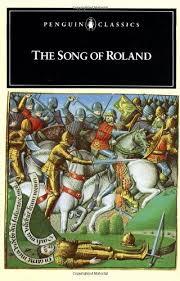
Song of Roland coverThis isn’t a modern discovery.  The eleventh-century Song of Roland, one of the legends that surround the mythical court of Charlemagne (France’s answer to the Arthurian Matter of Britain), ends with a victory, avenging the heroic death of Roland, Charlemagne’s nephew.  But even this somber triumph is not final.  In the very last stanza, Charlemagne is told that he must rally his forces yet again to face a new challenge.  “Small heart had [Charlemagne] to journey and to fight; / ‘God!’ says the King, ‘how weary is my life!’”

Happiness in the Moment

We need to be willing to accept a happy ending that is not unqualified.  Something can be good without being forever.  Subsequent failures do not invalidate genuine achievements.

To enjoy a future history, we have to recognize that the uncertainties of the future do not extinguish the glory of success.  Our newly-wedded lovers, for example, will have their ups and downs, but that doesn’t keep their lives from being happy on the whole.

The same is true of civilizations—the large-scale achievements whose fate is frequently at stake in adventure stories.  The establishment of a better world can make a lot of people’s lives better for a long time, even if that achievement is eventually superseded by later events.

A Midsummer Tempest coverValeria Victrix Matuchek, from Poul Anderson’s A Midsummer Tempest (epilogue), put it this way:  “Nothing ever was forever, anyway.  Peace never came natural.  The point is, it can sometimes be won for some years, and they can be lived in.”

Fuzzy Future History

Histories of the Future

A science fiction writer can link diverse stories by setting them in a common “history of the future”—an imagined future that might run anywhere from a dozen years to geological eras.  A new tale may not be a direct sequel or prequel, but it can appeal to us in somewhat the same way when it shares a background with a story we’ve enjoyed already.

Using a common future history has great advantages for the writer, as well.  It’s easier to continue developing an established background than to invent something entirely new.   But this approach also has pitfalls.  We may find that later stories evolve to conflict with the background we’ve already set up.  We saw off the branch we were sitting on.

SF author H. Beam Piper‘s “Fuzzy” series gives us a particularly interesting example of the perils of success.

Little Fuzzy

Piper’s intense interest in history led him to outline a vast scheme of human progress and space exploration, now referred to as his “Terro-Human Future History,” in that it deals mostly with human beings of Terran descent.

Piper believed in a cyclical theory of history, in which similar patterns of events recur in different ways.  His Terro-Human Future History is thus full of analogues to actual events:  the Sepoy Mutiny (Uller Uprising), the barbarian invasions of the European Middle Ages (Space Viking).  Piper’s historical scheme covered 6,000 years’ worth of rises and falls, empires and interregnums.

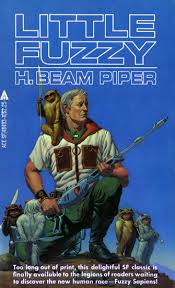
Little Fuzzy book coverLate in his career, Piper won a permanent place in the hearts of SF readers with the novel Little Fuzzy (1962).  Crusty old prospector Jack Holloway on the colony planet Zarathustra discovers a species of small, golden-furred beings, the first of whom he dubs “Little Fuzzy.”  The Fuzzies are primitive hunter-gatherers, perfectly capable of tracking down and killing their food.  But they are also smart, fun-loving, lovable, and an endangered species.

The Chartered Zarathustra Corporation, which runs most of the planet (an analogue of the historical East India Company), takes an intense interest in these little creatures—because its charter depends on the assumption that Zarathustra was an uninhabited world.  When a CZC employee kills one of the Fuzzies, and a company gunman is in turn killed by Jack, it becomes crucial in the subsequent murder trials to decide whether the Fuzzies are truly intelligent persons, or just animals.  The resolution of that issue forms the climax of the story.

Equal parts adventure story, courtroom drama, speculation on the nature of intelligence, and heartwarmer, Little Fuzzy was a hit with readers.  (And it seems likely, I’ve always figured, that the Fuzzies are one of the literary ancestors of the Ewoks.)

Fuzzies Everywhere

Golden Dream book coverThe subsequent literary history of the Fuzzies is exceedingly complex.  Piper published a sequel, Fuzzy Sapiens (or The Other Human Race), two years later.  A third Fuzzy novel had been sent to a publisher when, in November 1964, Piper committed suicide.  The manuscript of the third book was lost.  But reader interest in the Fuzzies led publishers to commission a new Fuzzy sequel by William Tuning, issued in 1981 as Fuzzy Bones.  An overlapping prequel taking off from Tuning’s development of the story, Golden Dream, was written by Ardath Mayhar and appeared the following year.

Ironically, no sooner had these continuations come out than the lost manuscript of the third Piper book was found after all.  Piper’s Fuzzies and Other People (“F&OP”) appeared in 1984.  Unsurprisingly, Piper’s continuation was not consistent with Tuning’s and Mayhar’s, leaving us with two inconsistent, but equally interesting, versions of the Fuzzy mythology.

It’s even worse than that.  At least two different reboots or reimaginings of the Fuzzy mythology have been subsequently published.  A detailed explanation of the whole mess can be found in a 2007 article by Fred Patten, with further information in a Goodreads review of Fuzzy Bones.

Irresistible Cuteness

The great charm of the Fuzzy stories lies in their mixture of tough-mindedness and tender-heartedness.  “Pappy Jack” and a whole series of other tough, no-nonsense characters develop unexpected softer sides as they succumb to the irresistible cuteness of the Fuzzies.  In Tuning’s words, “Like many men who were extremely tough, he turned to goo at the sight of those wide, appealing eyes.”

But the Fuzzies aren’t just cute.  Arguably, they are better people than humans.  Fuzzies share without hesitation.  They help each other.  They tell the truth (though this particular trait gets complicated in F&OP).  They’re not competitive, but they do aspire to excellence.  This inherent virtue has its tough side too:  Fuzzies applaud the deserved punishment of evildoers.

More important, for purposes of their long-term effect on human affairs, they aren’t simply an enclave of niceness:  they influence people.  Almost every human who comes in contact with them becomes a better person as a result.  Villains in one story are converted to good guys in the next, once they acquire Fuzzy companions.

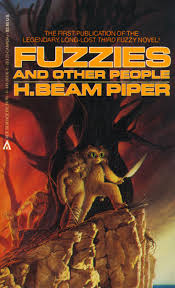
Fuzzies and Other People book coverOne character observes in chapter 12 of F&OP:  “we’re hooked.  Hooked on Fuzzies.”  The Fuzzies are making a permanent difference in the quality of human behavior on Zarathustra—not by force, not by persuasion, but simply by being lovable.  It’s not at all the kind of development one would expect from a hardheaded rationalist of Piper’s type.

It’s not what one would have expected of his future history, either.  And that’s the twist I want to point out here.

Can Piper’s Future History Survive the Fuzzies?

When the Fuzzies entered Piper’s future history, it was already well under way.  Four novels and a number of short stories were already in print, and Piper had plans for more.  Many of these stories were set later in time than the events of Little Fuzzy.  And the events of this hypothetical future, as noted above, were built on Piper’s view of cyclical history.  A fundamental change in human behavior would have thrown the whole sequence into disarray.

But the advent of the Fuzzies represented just such a change.  At the end of F&OP, there are plans to take Fuzzies off Zarathustra.  “[E]verybody on Terra will be crazy about them.”  Indeed.  One visualizes Fuzzies spreading throughout the Terran Federation, disseminating goodness and improving human beings wherever they go.

A good thing for those fortunate humans?  Undoubtedly.  But Piper hadn’t set out to write a Utopia.  His later stories depended on the assumption that humans would continue to be the same difficult, ornery creatures they always have been. The innocent-seeming Fuzzies had endangered the whole basis of the Terro-Human Future History.

Piper’s suicide has always been attributed to a certain moodiness combined with financial and personal difficulties.  But I’ve sometimes wondered whether the Fuzzy conundrum might have had something to do with it.  Piper had built a carefully planned future history.  But the more he worked out the implications of the Fuzzy stories, the harder it must have seemed to keep their influence contained in such a way as not to disrupt that careful plan.  With all those stories in print, there was no easy way to resolve the internal contradictions.

We’ll never know about Piper’s personal views.  But we can take the peculiar saga of the Fuzzies as a reminder of how tricky it can be when different types of stories—even good and well-beloved stories—inhabit the same imagined history.

Comfort Reading

Reading for Reassurance

Chicken soupYou’ve heard of “comfort food,” right?

In Robert A. Heinlein’s The Number of the Beast (1980), one character asks the others:  “Write down the twenty stories you have enjoyed most. . . . Make them stories you reread for pleasure when you are too tired to tackle a new book.”  (ch. 33, p. 349)

I’d never actually thought about it before I read that passage, but there is such a category.  There are times, especially toward the end of the day, when we want to immerse ourselves in a story, but not an arduous story.  Even if we’re currently reading something new that we like, we may not feel we can fully appreciate it when we’re tired out.  We’d rather relax into something less demanding.

The same can be true when we’re feeling emotionally drained.  Sometimes we pine for what we might call “comfort reading” on the analogy of “comfort food.”

We might be tempted to regard this urge for the familiar and reassuring as craven or self-indulgent.  But there’s nothing wrong with giving way to that impulse—some of the time.  We can welcome a new book as a challenge; but we don’t always have to be challenged.  Sometimes we simply need to recoup our energies for a while.

This is true in general, I think, but especially at Christmastime—so today seemed like a good time to bring up the subject.

Good Comfort Reading

What kind of stories one likes for “cocooning” will vary, culturally and individually—as the Wikipedia article cited above makes clear for comfort food.  In TV Tropes terms, “your mileage may vary.”  By way of example, here’s some of what I find myself looking for.

When I relax, I want something relatively light, not a matter of life and death.  A fan of adventure fiction spends a lot of time embroiled in saving the world, or the galaxy—or at least the imperiled main characters.  And a lot of science fiction deals with world-changing issues and problems.  That’s pretty strenuous.  It’s nice to be able follow a narrative where the stakes are not quite so high.

At the same time, there has to be enough substance to engage our interest.  A story in which nothing is at stake won’t hold our attention.  So pure farce or silliness doesn’t always fill the bill.

And for me, at least, it helps if the story is fairly “warm-hearted.”  Happy endings, sympathetic characters, a certain degree of kindness and encouragement in the air.  A cynic might have a quite different preference here:  a happy ending may not be congenial to his world-view.  But we sentimentalists want some of the milk of human kindness in our chicken soup.  (Well, maybe not literally.)

For this reason, romances make good hunting grounds for comfort reading.  Not necessarily genre romances; I’m put in mind of Chesterton’s Tales of the Long Bow, which is almost uncategorizable (social comedy? political commentary? science fiction?) but incorporates no fewer than seven separate romances in a scant 217 pages, possibly a world’s record.

In a good love story, something that matters very much is at issue—but generally only for the main characters.  This is why P.G. Wodehouse’s comedies are almost always romantic comedies.  His amiable main characters are never in very great danger, but rooting for their love affairs keeps us focused through the plot’s succession of hilarious absurdities.

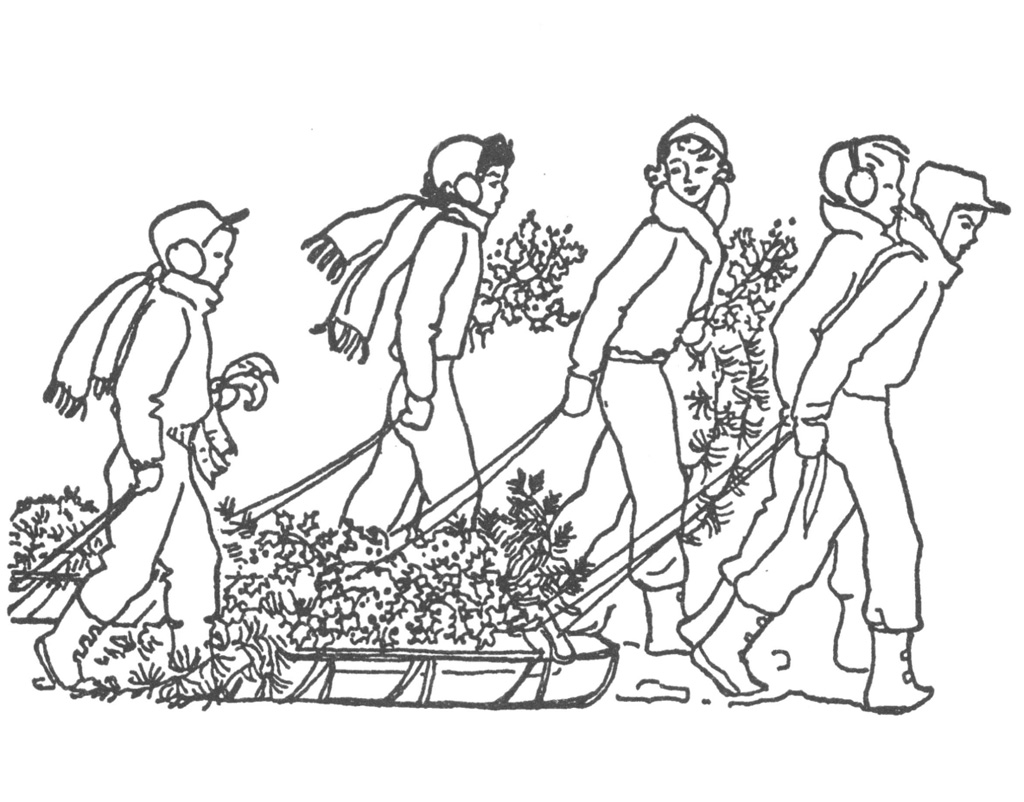
Melendy children with Christmas greensPersonally, I also like children’s stories to relax with.  There’s a category of what I call “family adventures,” where preadolescent children get into a series of scrapes or difficulties that are interesting but never too serious.  Elizabeth Enright’s Melendy Quartet (starting with The Saturdays, 1941) is my paradigm example.  Some of E. Nesbit’s books, such as Five Children and It, have a similar air, but with a fantasy component.  (I’d cite Eleanor Estes and Edward Eager as well, but that would raise the mysterious question of why so many writers in this category have the initials E.E.  Same reason Superman’s girlfriends all have the initials L.L., I suppose.)

Christmastide Reading

Of all the times of the year, the Christmas season may be when one most wants to be reading something engaging but pleasant.  There are probably people who want to stage a “Game of Thrones” marathon on Christmas Day, but I’m not one of them.

There are of course the traditional comforting stories that are specifically about Christmas.  A Christmas Carol is one obvious choice (though the actual book is a bit spookier and more tough-minded than some of the adaptations)

Interim Errantry coverLess obvious favorites of mine include “A good-humoured Christmas chapter” from Dickens’ The Pickwick Papers (ch. 28); “How Lovely Are Thy Branches” from Diane Duane’s Interim Errantry; chapter 5 of The Wind in the Willows (“Dulce Domum”); Madeleine L’Engle’s Dance in the Desert and The Twenty-Four Days Before Christmas; Elizabeth Scarborough’s Carol for Another Christmas; chapters 12-13 of Kate Seredy’s The Good Master; and Manly Wade Wellman’s “On the Hills and Everywhere,” in the collection John the Balladeer.  The only trouble is that some of these are quite short; they’ll barely last you through lunch.

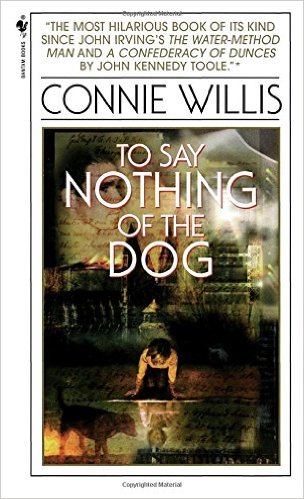
To Say Nothing of the Dog coverBut even at Yuletide, we may not want to marinate in Christmas quite to that extent.  So I also cultivate a selection of books that strike (or encourage) the right mood, but don’t have anything specific to do with Christmas.  I’ve mentioned Wodehouse; Georgette Heyer’s Regency romances have a similar combination of light-heartedness and warm-heartedness (I’ve often thought of her as Wodehouse crossed with Jane Austen).  Other kindly and entertaining tales not specifically about the season include Lois McMaster Bujold’s A Civil Campaign—one of my all-time favorites for all seasons—Connie Willis’s To Say Nothing of the Dog, and Diane Duane’s Omnitopia Dawn.

Have any favorites of your own for Christmastime, or comfort reading generally?

Lost World-Ships

Lost Universes

Suppose it turns out that the world in which you and your ancestors have lived isn’t a natural world at all, but a construct.  All you know of reality is the interior of a vast spacecraft.  If the truth ever becomes apparent, you’re going to be in for a shock:  the universe is vaster and stranger than you ever imagined.

Warp Drive exit signThe immense distances between the stars, and the speed-of-light limit, make this kind of situation a staple of modern science fiction.  Barring some as-yet-undiscovered method for faster-than-light travel, like the Star Wars hyperdrive or Star Trek warp drive, an interstellar voyage is likely to take many years.

The “generation ship” is a common SF assumption.  What I call “lost world-ship” stories, in which the inhabitants have forgotten they are even on a spaceship, form a subset of generation ship stories.  The generation ships, in turn, are a subset of the broader category of what might be called “sealed environment” tales:  people live for generations in an restricted artificial environment, but it isn’t a spaceship (as for instance in the movie City of Ember).  The sealed environment stories can in turn be seen as a subset of “exotic environment” SF tales, where an unnatural situation places unique pressures on the people who live there.


. . . And Where To Find Them

I find the lost world-ship plot particularly fascinating, so I’ve accumulated a number of examples over the years.

The Star Seekers coverMy first exposure to the idea as a child was in Milton Lesser’s The Star Seekers (1953), one of the distinctive Winston Science Fiction publications that introduced so many kids in that era to SF.  I recently obtained a Kindle copy and was charmed to encounter the story again, after all these years.  On a 200-year trip to Alpha Centauri, the four levels of the starship have separated into four different cultures, three of which are no longer aware they are on a spacecraft.  The setup is not entirely convincing; there’s no real explanation as to how most of the inhabitants simply “forgot” their origins.  But the book conveyed to me the mystery of discovering something that changed one’s whole world-view.

Orphans of the Sky coverIn pursuing the stories in Heinlein’s Future History, I ran across the real bellwether of the lost world-ship tale, the two novellas “Universe” and “Common Sense” (1941) that form the book Orphans of the Sky.  It may not be the earliest treatment— Don Wilcox was a year ahead with “The Voyage That Lasted 600 Years” (1940).  But in the Wilcox story, as in The Star Seekers, there was still someone on board who remembered the ship’s purpose.  In Heinlein’s starship Vanguard, no one preserved that memory.  A mutiny long ago had killed off the technically skilled, and their descendants preserved the story of the “Trip” to “Centaurus” only as mythology—which they interpreted as pure allegory, not to be taken literally.

Orphans of the Sky focuses on how hard it is for those raised in the artificial environment even to conceive that there could be an outside.  The escape of a few characters to make landfall on a planet, at the end, is a dramedy of errors.

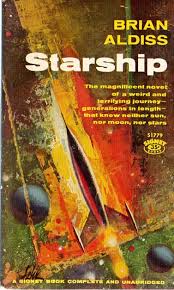
Aldiss Starship coverAnother lost world-ship story that fascinated me in my misspent youth was the Brian Aldiss book Non-Stop (1958), published as Starship in the U.S.  As in Heinlein’s case, Aldiss’s travelers have reverted to barbarism.  The artificial nature of their surroundings is masked by the fact that much of the ship is filled with “ponics” – mutated hydroponic plants that have spread through the corridors.  The real story does not emerge until close to the end, mediated, as in Orphans, by a diary left over from earlier times.  The ship had been ravaged by a disease of sorts, the result of a previously-unknown amino acid picked up on their destination world, from which the ship was now returning.  This plague, and the long unpiloted voyage, has rendered the inhabitants far different from their ancestors, rendering their hopes for escape from the degenerating vessel problematic.

Strangers in the Universe coverI encountered Clifford D. Simak’s Target Generation (1953), originally published as Spacebred Generations, in Simak’s collection Strangers in the Universe.  There’s a well-done summary and analysis of the story by Zachary Kendal on his Web site.  When Simak’s automated starship reaches its destination, it triggers a sequence of events that lead the main character to open a sealed book of instructions that has been waiting for that moment—rather like the instruction page in City of Ember.  He concludes that the builders of the ship had deliberately caused the travelers to forget their origins, except as a vague quasi-religious observance, because that was the only way they could (in Kendal’s words) “survive the journey without terrible psychological trauma.”

All these stories affected me with a sense of vast, brooding spans of time and forgotten lore.  The settings tended to be gloomy, the societies stunted or degraded, the environments worn-down and cramped.  But the tales also raised a sense of hope—that the travelers could somehow break free of their limited universe in the end, and recover the way humans were meant to live.


Other Media and Sources

The lost world-ship trope has turned up in other media too.  The original Star Trek series included a third-season episode (1968) with the cumbersome but evocative title “For the World is Hollow and I Have Touched the Sky,” in which the Enterprise crew discovers that an “asteroid” approaching a Federation planet is actually a generation ship.  There was a mercifully short-lived TV series in 1973 called The Starlost, a decent concept (by Harlan Ellison) with a completely botched execution—an entertaining story in itself.  The Pixar film WALL-E incorporates the idea that the remaining human beings have been living for generations aboard a luxury starship and have almost, if not entirely, forgotten what it’s like to live on a planet.  There was even a 1976 role-playing game called Metamorphosis Alpha set on a generation ship afflicted by an unknown cataclysm.

There’s more.  The Wikipedia and TV Tropes pages on generation ships provide useful lists.  Still more are summarized in a study by Simone Caroti, The Generation Starship in Science Fiction:  A Critical History, 1934-2001 (2011)—though Caroti’s study is a little heavy on the academic Marxist/deconstructionist attitudes for my taste.

For the broader categories I mentioned above, examples of non-spaceborne sealed environments include Hugh Howey’s Wool, James White’s The Watch Below (which pairs an alien fleet of generation ships with a human group trapped in a sunken oceangoing vessel), and Daniel F. Galouye’s Dark Universe.  TV Tropes lists others under the headings City in a Bottle and Small, Secluded World.  Other “exotic environment” stories include Ray Bradbury’s memorable “Frost and Fire” and Christopher Priest’s Inverted World.


Themes

What is it that’s so compelling about the lost world-ship stories as to explain my lifelong love affair with them?

Sense of Wonder.  The strangeness of the environment—the union of familiar human concerns with surpassingly unnatural situations—evokes the “sense of wonder” that is characteristic of F&SF.  But we can point to more specific themes that arise in the lost world-ship setting.

Loss and Forgetfulness.  A sense of loss pervades these stories—a loss not fully appreciated by the characters, but clear to the reader.  The starship inhabitants have lost their history, and with it, their sense of who they really are.  They have lost other kinds of knowledge as well, especially technological knowledge, often existing as barbarians in the ruins of a superscientific construct (again, a wider SF trope).

This sense of loss is like that of another subgenre, the post-apocalyptic story.  The disaster that afflicts the starship is a sort of localized apocalypse; this is what differentiates the lost world-ship from a functioning generation ship.  Pondering the causes—whether mutiny, plague, accident, or even deliberate obliteration of the past—makes us reflect on the fragility of our own histories and societies.

Illusion.  In these stories, the world is never what we think it is.  One need not live on a starship to share that experience; the whole history of modern science can be read as a progressive penetration of appearances.  (Heinlein has a character in Orphans unknowingly echo Galileo as he tries fruitlessly to convince others of how their world really works:  “Nevertheless—Nevertheless—it still moves!”)  The lost world-ship story brings home the way our knowledge is bounded by our experience—or by our assumptions.

The Natural and the Artificial.  This dichotomy can play out in two ways.  Either the inhabitants take their artificial world so matter-of-factly that it seems perfectly natural to them, and they can hardly imagine anything else (Heinlein); or the unnaturalness of their world subtly warps or frustrates them (Aldiss).

The former may seem more plausible to those who prefer “nurture” to “nature” as an explanation.  When you grow up with something, why wouldn’t you take it for granted as normal and natural?  The latter approach may appeal more to those with a strong sense of the natural as fundamental and superior to the artificial.  For example, a character in Non-Stop tries to show his companions that the ponic plants are natural, but corridors are not.  The key question, of course, is how he knows that plants are more natural than walls:  is the difference somehow wired into the human brain?  In Howey’s Dust, part of the Wool series, a knowledgeable character says of their underground sealed environment:  “They don’t know anything beyond their walls, so I guess they don’t have some of the stress about what’s out there that you and I feel.  But I think they have something else that we don’t have, this deep feeling that something is wrong with how they’re living.”

We frequently encounter such nature-nurture arguments in more conventional sociological contexts.  But the lost world-ship story brings us face to face with them in novel ways.

Incongruity.  The lost world-ship is a fertile ground for irony and “cognitive dissonance,” where the reader knows things the characters do not.  In principle this sort of incongruity could be played for light comedy or farce—but I don’t know that I’ve ever seen it done that way, except perhaps toward the middle of The Star Seekers, a young adult novel and thus somewhat lighter in tone.  The starship stories tend to be too grim for farce.

Escape.  The somberness of the classic lost world-ship is alleviated by the possibility of getting out, into a freer and better world.  Once the characters realize there is somewhere else to go, they may be able to escape.

Flammarion cosmos paintingEscape is a major preoccupation in Non-Stop, and contributes much of the story’s emotional force.  It fits in with the fact that we encounter the starships in Target Generation and The Star Seekers just as they arrive at their destinations:  a hoped-for new world, a natural world free of the constraints of the world-ship.

The last generation is in a far better position, in this respect, than their ancestors.  As TV Tropes puts it, commenting on Kim Stanley Robinson’s Aurora:  “A major theme of the book is the fact that while the original generation-ship crew may have consented to their risky mission, their children don’t get a choice.”  The writer of the ancient diary in Non-Stop, facing the beginning of the generations-long return trip, bursts out:  “Only a technological age could condemn unborn generations to exist in [the ship], as if man were mere protoplasm, without emotion or aspiration.”

But the characters we’ve come to know in the story do have the possibility of emerging into something wider and greater.  This hope is not quite the same as what Tolkien means by “Escape” in On Fairy-Stories (a topic for another day), although there is some common ground.

The contrast between the all-too-human characters and the artificial environment has still more resonance, perhaps, with the common human feeling that we don’t really belong in this world.  Some of the twentieth-century existentialists took this reaction as a sign of despair and meaninglessness.  But the notion of escape suggests instead that such emotions may instead point to another place where we do belong, evoking hope rather than despair.  The plight of the lost world-ship traveler may recall Chesterton’s lines in “The House of Christmas”:

For men are homesick in their homes,
And strangers under the sun,
. . . . .
But our homes are under miraculous skies
Where the yule tale was begun.