The Ignorant Interlocutor

The Convenient Newbie

It helps to have someone to explain things to—especially if you’re writing fantasy or science fiction.

How do we introduce our audience to the world where our story takes place?  It’s something we have to think about even in a normal, contemporary setting.  We have to give a sense of where our characters are and what they’re doing there, even if the answers are as mundane as “middle America” and “going to work on a Monday.”  But this task is much more challenging if the setting is in the far future, or the distant past, or some entirely separate reality as in Game of Thrones.  The same problem applies in some degree in a historical novel, or a tale set in a very different culture.  How can we get readers or viewers acquainted with the milieu if much of it is unfamiliar?

Of course we can simply tell them about a setting directly:  “A long time ago, in a galaxy far, far away . . .”  But the audience won’t sit still for indefinite amounts of backstory before the main story gets going.  On the other hand, another time-honored F&SF approach is just to throw the reader into the deep end and let them swim.  But that makes for a steep learning curve, trying to absorb a lot of strange peoples and places and customs all at once.  The throw-them-in approach may discourage readers or viewers not by boring them, but by making them scramble to keep up.  Some will enjoy that challenge; but others may be daunted and close the book (or video).

One way to inform the audience is to make one of the lead characters an inexperienced person who doesn’t know much about their own world.  Other characters will have to explain to this person things that they know perfectly well, but that this character is unfamiliar with.  The “ignorant interlocutor” is a convenient stand-in for the reader, making the necessary exposition seem natural.

Some Convenient Examples
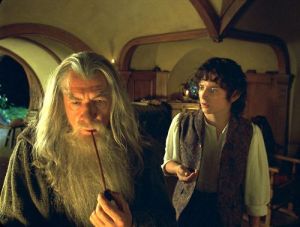
Frodo and Gandalf at Bag EndHobbits might have been designed specifically for this role.  The hobbits of the Shire are back-country unsophisticates, living quietly in a little country without much contact with the rest of the world.  Once they’re taken out of their homely environment into the wider world, Gandalf or Aragorn or someone frequently has to explain things to them, helping the audience get acquainted with Tolkien’s vast world and history—or, at least, with those parts that are important to the story.  (At the same time, we should note that Tolkien also uses other forms of exposition that no new writer could get away with nowadays.  The Lord of the Rings actually opens with a sixteen-page Prologue providing background on such essential matters as pipe-weed—followed shortly in Chapter Two by fifteen pages of explanation in which Gandalf instructs Frodo on the challenge they face.)
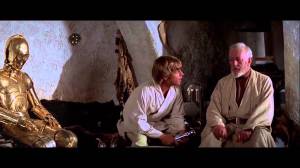
Luke and Obi-WanThe most well-known SF parallel is Luke Skywalker, the unsophisticated farm boy who is catapulted into galactic affairs by the death of his foster parents and the charismatic advice of Obi-Wan Kenobi.  When Obi-Wan tells Luke “You’ve taken your first step into a larger world,” he isn’t merely refering to the Force, but implicitly to Luke’s need to learn many things as he emerges from the backwater planet Tatooine.

We don’t see quite such an inexperienced protagonist in the other trilogies, with Anakin or with Rey.  By the time we see the prequel or the sequel trilogy, we’re already familiar with the Star Wars background, and not as much needs to be explained.  Interestingly, Lucas too adds a more artificial form of exposition, the screen crawl at the opening of each film, perhaps primarily for its nostalgia value.

An Earthly culture of another time period can be just as unfamiliar as an extraterrestrial.  Friday’s Child was the first Regency romance I read, and I found it a particularly good place to start.  The naïve heroine, Hero Wantage, marries the kind-hearted but rakish Viscount of Sheringham and is carried off into the whirl of London society, whose manners and mores are often peculiar to modern eyes.  We are introduced along with Hero to these rather arbitrary rules—if a carriage-race between females is high entertainment at a private country gathering, why is it a terrible social gaffe in public?—where her lack of understanding frequently lands her in a “scrape.”  Similar inexperienced heroines also appear in other Heyer stories, such as Arabella and Cotillion (in descending order of ignorance or naïveté).
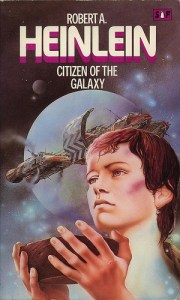
Citizen of the Galaxy coverA science-fiction example of the socially inexperienced character can be found in Heinlein’s Citizen of the Galaxy.  Thorby, the main character, must learn to copy with several unfamiliar environments in succession over the course of the story, but especially with the strict customs followed by the Free Traders, nomadic interstellar merchants.  An anthropologist traveling with the Traders to study their culture is invaluable in explaining these customs to Thorby—and the reader.

The ignorant interlocutor in Heinlein’s Beyond This Horizon, by contrast, is a minor character, “the Man from the Past,” who has been preserved from the present into the story’s centuries-later future by a time stasis field.  He comes into the story only briefly, but long enough for Heinlein to get in some exposition about facets of the future society that are well-known to the other characters, but need to be explained to the archaic survivor.

A more well-known Heinlein story, Stranger in a Strange Land, uses space—and species—rather than time as the cultural differentiator.  Michael Valentine Smith, the “Man from Mars,” is a human being raised from infancy by Martians.  Many of the most interesting parts of the story show Mike trying to grapple with human customs when he arrives back on Earth as a young man—which also allows Heinlein to make satirical commentary on these peculiar creatures, the humans.

Some Storytelling Advantages

Having someone to explain things to is helpful because dialogue is often a better way to present information than authorial lecturing.  A scene in which our puzzled naïf asks questions and gets answers—or makes mistakes and is corrected—is easier to make interesting.  These interactions can accomplish other things at the same time.  The way a conversation goes can reveal character and show relationships developing.  It can be mixed with action—characters talk while they’re hiking, exploring a wrecked spaceship, dancing.

Making one character’s knowledge limited similarly allows us to avoid the dreaded “As you know, Bob” problem, in which characters tell each other things of which they are already well aware, to educate the reader at the expense of in-story plausibility.  (The term comes from the Turkey City Lexicon, a guide to F&SF tropes for use in writing workshops.)  TV Tropes has a particularly good discussion of this whole issue.

Where to Find Them

If we want to include an ignorant interlocutor in a story, what kinds of situations might naturally produce this sort of character?
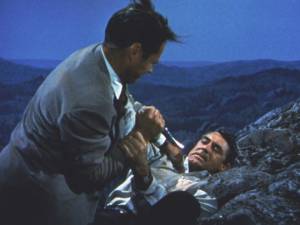
North by Northwest, Mt. Rushmore fightYouth and inexperience tend to go together; and a curious child can serve the purpose (perhaps a precocious child, who is uninformed but capable of grasping the explanation once offered).  TV Tropes’ term is “Little Jimmy.”  But the explainee may also be a competent enough adult who has simply been thrust into a situation or milieu they’re not ready for.  Cary Grant’s character Roger Thornhill in North by Northwest is a good example:  he may be a fine advertising executive, but the world of international espionage is new to him.  Captain Pausert of James Schmitz’s classic SF novel The Witches of Karres is an expert ship-handler and a pretty effective trader, but the young witches need to bring him up to speed quickly when he gets involved in Karres business.

The innocent naïf who needs to be told how the world works is another category, particularly if the story is going to deal with gritty realities.  Several of our examples above count, and we might also mention yet another Heinlein character (he was fond of the trope), Max in Starman Jones, who’s described by Wikipedia as “a farm boy who wants to go to the stars” and learns the ropes from the cynical rogue Sam Anderson.

The uninformed party may also be the student of a new art—the beginner or newbie.  Harry Potter is new to the wizarding world and has to have all kinds of things explained to him, including his own backstory.  In Anne McCaffrey’s YA novel Dragonsong—one of the best of the Dragonriders of Pern books, in my opinion—it’s musicianship that young Menolly is learning as she’s suddenly brought into the Harper Hall’s training program.  Captain Pausert’s induction into Karres witchery reflects some similar elements, in a very different situation—learning on the fly rather than in a structured environment.  The character’s new situation may involve learning the art itself, or the folkways of the school, or both.
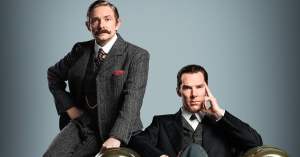
Sherlock Holmes and Doctor WatsonFinally, one of the functions of the sidekick can be as a foil to whom the principal character can explain things.  Robin has played this role for Batman—at least in the wacky 1960s TV series.  A classic case, of course, is Holmes and Watson; TV Tropes even dubs such an character The Watson (“the character whose job it is to ask the same questions the audience must be asking and let other characters explain what’s going on”).  Master detectives, who are supposed to be smarter than the audience, form fertile ground for such relationships:  Archie Goodwin, who is no dummy, regularly receives nuggets of wisdom from his immobile employer Nero Wolfe.

Finally, the person who graciously explains things is often a mentor figure—the wise or knowledgeable one, a Gandalf or an Obi-Wan, the polar opposite of the uninformed interlocutor.  When the mentor’s job is primarily to educate the main character, this may explain why the mentor is around early in the story, but may disappear or become unavailable when the action starts to heat up.

A Pride of Brothers

This week we have a guest post from Peggy Jaeger, a fellow author at the Wild Rose Press.  She’s got a new romance series going, “A Pride of Brothers.”  Since the name of the first book’s hero is Rick, she’s obviously setting off on the right foot.

In today’s post, she talks about moving into writing for a new subgenre.  Over to you, Peggy!

A Pride of Brothers:  Rick

For most of my fiction writing career (all 5 years if it!) I’ve written contemporary romance novels and RomComs, or romantic comedies.  Since these are my favorite romance books to read, it stands to reason they’d be my favorite to write.

A Pride of Brothers: Rick, coverThe publication of my newest book, though, A Pride of Brothers:  Rick, is a bit of a departure for me, writing-structure-wise.  With this book and the two others planned for the series, I’m delving into the romantic suspense lite genre. I’ll explain the “lite” portion in a bit, but first . . .

Writing romance isn’t easy, but there are some tried and true rules you must follow to have a book classified as a romance in any of the subgenres.

  1. You must have a central love interest in the story. It can be between a man and a woman, two men, a woman and a shape-shifting dragon . . . you get the idea.  As long as there is a central love story within the book, you have a qualified romance.
  2. You must have a happily ever after (HEA) ending, or at least a final happy for now (HFN) one. The obvious definition of the first is the classic, And they lived happily ever after, where a marriage and an emotional commitment is solidified at the end of the book.  This used to mean marriage and only marriage.  Nowadays, a romance can have a happy for now ending and still be qualified as a romantic read as long as the people involved in the central love story are committed to one another.  The hope of a lifetime commitment is there, written as a promise, but not explicitly divulged on the page.  Get the difference?
  3. Taboo subjects you must never include as the central theme in a romance are rape, incest, child abuse, sexual abuse—really, abuse of any kind—cruelty, and bestiality.

If you follow these rules you can write a romance.

Pride of Brothers, graphic with quote

The structure of writing a romantic suspense is a bit different.

Yes, you must still have a love interest within the plot, and yes, it still needs to have an HEA or a HFN ending.  Rule number 3 applies to every book, so I don’t need to reiterate it here.

The difference in this subgenre that is apparent, though, is in the name: romantic suspense.

The definition of this subgenre varies a bit, but basically it is any romance novel in which suspense, mystery or thriller elements constitute an integral part of the plot, or one that features a prominent mystery, suspense or thriller story line.

When I was a teenager in the ‘80s this type of book was called a WOMAN IN JEOPARDY story because the plot centered around a woman who had some kind of danger in her life like an abusive ex-beau, or a stalker.  The implication of the tag line was that a woman needed a man to help her out of the bad situation (the “jeopardy”), and in so doing, they’d fall in love.

Nowadays, that sexist and archaic description is gone, replaced with “Romantic Suspense,” and it’s not only the gals who need help with a problem any longer.  There are plenty of bad-ass female bounty hunters, cops, etc., out there who help the hero with an issue.

Welcome to the 21st century, folks.

So, I promised an explanation of the term romantic suspense lite with regards to my writing.

I didn’t set out to write a romantic suspense when I came up with the story line for the first Pride of Brothers book.  I wanted to tell a frenemies-to-lovers story about two strong and opposite personalities who wound up falling in love.  That’s the romance aspect of the tale.  I had to make them foils, and the plot needed to revolve around something where one of them would need to help the other out of a situation.

What I came up with was a story about a lawyer who fights for disenfranchised women and their children, and a man who was the definition of disenfranchised as a child.  When the husband of a client threatens the lawyer and then subsequently tries to murder his wife and kidnap his son, the hero vows to protect the heroine from danger.  She isn’t convinced she is in danger, but a series of events unfolds that proves she is.  That’s the suspense part.  It’s the hero’s job to keep her safe, even though she can do that on her own.

The reason I dub it a lite romantic suspense is that more than 60% of the tale is the evolving romance between the two protagonists, with about 40% steeped in the actual thriller/suspense part of it.  There is a forced proximity aspect to the storyline, which is a classic romsusp factor, along with knife fights, guns, and kidnapping—all elements you don’t find in your everyday regular small town romance novel.

I am hopeful I’ve done the subgenre proud with the release of this book. It was an absolute blast to write and I can only hope it is enjoyable to readers as well.

Look for book two, A PRIDE OF BROTHERS: DYLAN early in 2021.

Until next time ~ Peg

A Pride of Brothers:  Rick at
Amazon ~ Barnes & Noble ~ Apple Books ~Books-A-Million


Unevenly Matched

Unbalanced

We’ve looked at a couple of ways a romantic story can go wrong:  for example, an unsympathetic romantic interest, or too much deception.  Here’s another failure mode:  the two characters don’t seem to be evenly matched.  They’re not on the same level.  We may accept the romance, but we feel a little unsatisfied, because one of the lovers isn’t quite up to the other’s weight, so to speak.  We may feel the one doesn’t quite deserve the other; but it’s not so much a matter of goodness as of stature.

An Array of Mismatches

We can spot the kind of thing I’m thinking of in a wide variety of genres.

The Grand Sophy, coverOne of my favorite Georgette Heyer Regencies is The Grand Sophy (1950).  Our heroine, Sophia Stanton-Lacy, has grown up following her diplomat father around the world.  She’s tall, high-spirited, and outgoing; doesn’t worry about the conventions but is very elegant; always good-humored; and quite capable of taking over a household full of tangled relationships and straightening things out in her own inimitable way—a classic master contriver.  The title is an accurate description:  Sophy is a magnificent and delightful character.

Her cousin Charles Rivenhall, though a relatively young man, had to take charge of his hapless relatives and, as Wikipedia puts it, “has assumed since a young age the role of the adult in the household.”  As a result, he’s autocratic and rather harsh.  Having decided to settle down, Sophy sets her sights on him—and we kind of wonder why.  Charles is a dominant, if not domineering character, to be sure; he can literally stand up to Sophy, although she’s perpetually outmaneuvering him.  But he’s not nearly as engaging and interesting a character as she is.  The weakest part of the book, to my mind, is that Charles seems rather dull compared to the colorful, ebullient Sophy.

Dolly and Horace, from Hello Dolly!Sophy’s carefree campaign to corral Charles reminds me a bit of how Dolly Levi scoops up Horace Vandergelder in Hello, Dolly! (1964)—and there’s another example.  Dolly is also rather magnificent—charming and clever, if devious.  But what does she see in stuffy Horace?  He has his points, of course.  He’s not a bad guy, at heart.  But he seems rather too tame for Dolly—unless perhaps the point is that she needs a stabilizing force at this time of her life.

Wonder Woman and Steve TrevorThe “too tame” problem is a possibility whenever we get an especially strong-willed and noteworthy heroine.  (And it often seems to be the heroes that are an inadequate match for the heroines—perhaps because a match between an overpowering man and a weak woman would tend to collapse into a stereotype and forfeit our interest.)  Take Wonder Woman.  She’s a hard act to follow, and a hard match to make.  Her 2017 movie barely steers clear of the pitfall.  Romantic interest Steve Trevor isn’t her equal in terms of power, but he is a soldier; he has courage, initiative, and independence.  Still, he’s not really in her league, and while their brief love affair has an important softening and motivating role in the story, it’s almost a relief that he dies heroically, removing himself from contention.  I believe the comics sometimes pair Diana up with Superman, which seems almost too pat; we get a match not just of equally powerful persons, but of equally iconic figures.

At the opposite end from the comic books, we have the classics.  Some readers of Little Women, I believe, are disappointed when the lively Jo ends up with undistinguished middle-aged Professor Bhaer, particularly after having been teased with the more dashing Laurie throughout.  He’s a nice guy, and he makes an important difference in Jo’s career, but he’s not exactly a romantic hero—which is in some degree the whole point.  Or take The Merchant of Venice (ca. 1596-99).  Portia is a wonderful character, but by comparison, her husband Bassanio seems a bit ineffectual and drab.

Further Variations

Heyer actually makes the uneven match a plot element in her novel Bath Tangle (1955).  (Incidentally, the title refers to the town of Bath; a more literal reading would suggest a degree of raciness entirely foreign to Heyer.)  The willful and quick-tempered Serena Carlow (the incongruity of “Serena” with her personality is no doubt intentional) has recently jilted the rough and domineering Lord Ivo Rotherham, and instead become engaged to the more moderate and kindly Major Hector Kirkby.  But it becomes apparent that Serena is rather too much for Hector to handle.  He gradually falls for Serena’s younger and sweeter widowed stepmother Fanny, who reciprocates his sentiments but is aghast at the thought of betraying her dear Serena.  The story shows very effectively that the caustic Serena and Ivo are a proper fit for each other, tempestuous though their relationship may be; while the milder Hector and Fanny work much better as a couple.

The Snow Queen coverHave we been giving science fiction short shrift?  Consider Joan Vinge’s Hugo-winning novel The Snow Queen (1980).  In an adult SF version of the Hans Christian Andersen tale, Arienrhod, Queen of the planet Tiamat, has extended her life using local resources and offworld technology throughout the planet’s generations-long winter period; but as Tiamat moves toward high summer, the black hole gateway used for interstellar travel will be disrupted.  As a way of perpetuating her rule in some sense, Arienrhod clones herself, giving up young Moon to be raised among the Summer clans to become the Summer Queen.  Moon grows up kinder and gentler than her clone-mother.  But she is also determined and dedicated, as becomes evident when she is accidentally transported offworld, interrupting her childhood romance with the boy Sparks (they correspond to Gerda and Kay in the Andersen fairy tale).  In Moon’s absence, Sparks becomes Arienrhod’s hardened, debased enforcer “Starbuck.”  When they are reunited, Moon’s sheer goodness causes Sparks to return to his true self and renounce the Winter Queen.  It’s a great story—but Moon is so genuinely heroic and loving that Sparks, with his long, sordid fall into corruption, doesn’t seem to deserve her; his conversion is a little too convenient.

Little Dorrit, from book's frontispiece

Little Dorrit

This “deserving” issue comes up a lot with the more saintly heroines; for instance, in Dickens, who was fond of such characters.  Maybe it’s just that I’m hopelessly in love with the titular heroine of Little Dorrit (1857), but I don’t think her romantic interest Arthur Clennam is good enough for her; he’s a little too weak-willed and hapless.  Similiarly, the character we remember from A Tale of Two Cities (1859) is the lovely grief-stricken Lucie Manette, not the somewhat stiff Charles Darnay.  On the other hand, Dickens plays and then averts the uneven-match trope in David Copperfield (1850):  David’s first wife, the ethereal and rather air-headed Dora, dies tragically and is replaced by the much more steady and substantial Agnes, David’s childhood friend.

I recall hearing that the ending of The Hunger Games (2008-2010) was disappointing, but when I reached the conclusion, I thought it wasn’t actually so bad.  It developed that my informant was on “Team Gale,” favoring the more dashing of Katniss’s romantic interests, rather than “Team Peeta,” who were rooting for the more plodding and retiring guy who actually wins out in the end.  Personally, I was content to have Peeta succeed; but I can see why some readers might find him too dull for the formidable Katniss.

The Seasoning of Pepper

In this connection, it’s interesting to look at the evolution of Virginia “Pepper” Potts, Tony Stark’s perpetual romantic interest from Iron Man.  Originally Pepper was Tony’s secretary—one of a number of cases in 1960s Marvel comics, somewhat disturbing in retrospect, where superheroes had crushes on their employees (see Don Blake and Jane Foster, Matt Murdock and Karen Page).  As a redhead, Pepper was of course supposed to be fiery, but as a standard-issue would-be girlfriend, she was actually a bit bland.

Pepper Potts and Tony StarkIn the Iron Man movies, however, responding to the tastes of a different era, Pepper has a much larger role.  She replaces Tony as CEO of Stark Industries while the latter is gallivanting around the universe (and arguably does a better job at actually running the company).  In Iron Man 3 (2013), she temporarily wields a superpower herself; and in Avengers:  Endgame (2019), she fights in the final battle in a powered armor suit of her own.

As with a lot of the routine girlfriends of 1960s superheroes, Pepper might originally have been considered too minor a character to be on Iron Man’s level.  But her character has grown over the years—not so much in the sense of character development, as in being given larger and more significant roles by later writers—to a point where we’re quite willing to see them as equals in Endgame, where their marriage seems fully balanced.

The Well-Matched

In contrast to the unevenly matched couples noted above, a lot of classic romances show their main characters to be well-matched.  The ever-popular Pride and Prejudice (1813), for instance, is especially satisfying because we do feel that Elizabeth and Darcy are made for each other—if they can only be brought to realize it.  Their families differ in wealth and status, but the couple themselves seem to be on a par in terms of intelligence, determination, and decency, not to mention stiff-necked standoffishness.

Or take an example quite different in tone, Wuthering Heights (1847).  No matter how much we may dislike both characters (I certainly do), you can’t deny they’re well-suited:  one is mad and the other’s crazy.  Across the pond, Gone With the Wind (1936) suffers a similar problem with difficult main characters, but the romances work (even when they tragically fail):  everyone but Scarlett can see that she belongs with the roguish Rhett, not the mild-mannered Ashley, who is a much better fit with the angelic Melanie, who could have walked right out of Dickens.  Even in Anne of Green Gables, which is not exactly a classic romance, we do feel that mischievous but affectionate Gilbert Blythe can hold his ground, as a character, even by the side of the extravagantly lively Anne.

Miles and Ekaterin

I’m particularly fascinated by the way Lois McMaster Bujold handles her signature character, Miles Naismith Vorkosigan, and his eventual mate Ekaterin Vorsoisson.

You have to know Miles to appreciate why he’s such a difficult man to match.  He hails from an aristocratic family on the planet Barrayar, which has recently thrown off conquering invaders and is still organized along military lines.  Miles desperately wants to become a soldier, but he’s not physically fitted for the role, due to a bioweapon attack on his parents while he was in utero that left him undersized, with brittle bones that will break under any serious strain.

As a result, he has to use brains, not brawn.  And what a brain it is!  Miles has a positive genius for getting himself into completely untenable situations, and then having to frantically improvise his way out.  He always finds the unexpected third way out of a dilemma; at least one other SF character makes it a practice, in a tough spot, to ask herself “What would Miles Vorkosigan do?” He’s hyperactive, honorable, very persuasive, and devious.  In his first excursion he ends up leading a mercenary army, without ever quite intending to.  To call him a dominant personality would be a laughable understatement.

Miles in Love coverSo how do you find this extraordinary character a mate?  We might be inclined to develop an equally forceful and flamboyant female to equal him.  And Miles does, over the course of various stories in the series, carry on sincere if temporary affairs with several military officers (Brothers In Arms), warrior women (“Labyrinth”), and at least one brilliant scientist (Mirror Dance).  But none of these proves sufficient.  Miles is quite ready to settle down—if he can find a woman who’s prepared to take on his complex and Barrayaran heritage.

When he meets Ekaterin in the novel Komarr (1998), she’s struggling to make an unhappy marriage work and take care of her young son.  In personality, Ekaterin is practically Miles’ polar opposite:  she’s quiet and reserved, although she shows more brightness as they begin to interact.  She’s made a conventional Barrayaran marriage and is skittish about causing a disturbance.  Yet the action-adventure climax (which conveniently leaves her a widow) shows she can act decisively and even brilliantly, little as she may think of herself that way.  And, being a member of the same Vor class as Miles, she gets his sense of honor and responsibility.

But is she up to his weight?  Against all appearances, she is.  Her depth matches his “forward momentum.”  Her good sense and willingness to act beyond her comfort zone in a crisis is both a foil and a counterpart to Miles’ conventional loyalties and unconventional tactics (I don’t think he has a comfort zone).  Bujold manages to show us a woman whose strength shows in radically different ways, but whose well-concealed firmness of character puts her on Miles’ plane.  We can have the classic pairing of opposites, and still make them equal opposites.  The result is one of the best SF romances I’ve seen.

The example of Miles and Ekaterin points us to the question underlying the examples above:  In what way is it necessary for a couple to be well-matched, to prevent the pairing from seeming unbalanced to the reader?

An Internal Reason:  Force of Character

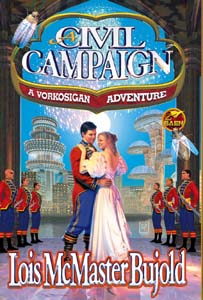
A Civil Campaign, coverIt’s clear the lovers can be unequal in many ways without generating the uneven-match problem—and that’s a good thing, since those differences are a primary source of dramatic tension and romantic interest.  (And humor, where the differences trigger comic incongruity; the sequel to Komarr, A Civil Campaign, which carries on Miles’ and Ekaterin’s courtship, is one of the great SF romantic comedies and an all-time favorite of mine.)

The pair can represent rags and riches, as in the traditional Cinderella story or Disney’s Aladdin; they don’t need to be matched in wealth.  Nor is it social status; on the contrary, differences in social status are frequently emphasized, as a proof of just how strong the characters’ love is.  See, for example, Titanic, or Han and Leia (“You think a princess and a guy like me . . . ?”).  Both Star Wars characters are sufficiently distinctive and forceful personalities that their social standing doesn’t matter.

Clearly, we’re not talking about equality in physical prowess.  That works (the Wonder Woman-Superman example above), but we’re equally content with a pairing of brains and brawn, or brawn and beauty, or the like.

Nor is it a matter (in fiction) of similar moral character.  The girl (or guy) in love with the bad boy (or girl) is a classic trope—often ending with the better character redeeming the worse.  To be sure, in the end the couple has to come out at least on the same moral plane of lasting devotion to each other.

But in terms of what we see as making a well-matched romance work internally, within the story, the key dimension seems to be mostly force of character.  The couple has to be able to stand up to one another; neither is entirely dominant.

Hence the obedient Cinderella is matched with a low-key (sometimes to the point of blandness) prince.  A highly assertive Serena or Scarlett O’Hara gets paired with an equally forceful male.  Ekaterin may be less visible than the flamboyant Miles, but she’s not dominated by him.

Phantom of the Opera, movie posterIt’s not simply a matter of equal aggressiveness:  the less assertive of the two may morally overawe the other, so to speak, as in the traditional archetype of the knight and the lady.  Undefeatable or angelic innocence can itself be a sort of power or force of character.  One thinks of Christine Daae in The Phantom of the Opera (at least in the operatic movie version, the one with which I’m familiar), a “hero of compassion,” willing to sacrifice herself and genuinely love the Phantom in order to save her true beloved.

An External Reason:  Distinctive Character

Force of character is an internal reason for considering a couple evenly matched:  a personality characteristic that would be visible to the people in the story themselves.  But I think there’s also an external reason—the author’s or reader’s reason.

What makes a pairing seem well-balanced from the outside is, I think, at least partly a matter of how distinctive the character is.  We’re dissatisfied when a fully developed, well-rounded character is matched up with a mere cardboard cutout or stereotype.  Steve Trevor, or Professor Bhaer, is not quite as fully realized a character as Diana or Jo, whom we’ve seen grow up from childhood, knowing their thoughts and feelings.

This is a narrative reason, so to speak—what makes a good story, as distinct from what makes a good relationship.  And yet the two are closely linked.  I’m not sure you can make a good romantic story (in the sense of one where the romance satisfies us) out of a bad romantic relationship; although one can always, through incompetent storytelling, make a bad story out of good relationship.  A really successful romantic story requires both.

A romance is essentially a meeting of equal-but-differents.  And if it isn’t, it isn’t a real romance.

Tell Me What You’re Doing

Shakespearean Description

A few years ago my kids gave me a copy of The Jedi Doth Return—or, in full, William Shakespeare’s The Jedi Doth Return:  Star Wars Part the Sixth, by Ian Doescher (2014).  This little book is a retelling of the movie Return of the Jedi in the form of a Shakespeare play, with the entire text in iambic pentameter.

The Jedi Doth Return, cover

It’s great fun to see the swashbuckling space epic transformed into sixteenth-century poetry.  And the reading is surprisingly good as well, with some memorable phrases bringing out nuances not necessarily detectable in the movie; at least one passage was striking enough to make it onto my Quote of the Week page back in 2017.

But one thing in particular caught my attention, perhaps because of the contrast between SF subject matter and Shakespearean technique:  how frequently the characters describe in words what’s happening.  For example, in Act I, Scene 3 (p. 25), Leia sneaks into Jabba’s palace to rescue Han Solo:

In stealth I move throughout the palace dark,
That no one shall bear witness to my acts.
Now cross the court, with footsteps nimbly plac’d.
Ne’er did a matter of such weight depend
Upon a gentle footfall in the night.
Put out the light, and then relume his light—
Aye, now I spy my goal:  the frozen Han.
Thy work is finish’d, feet.  Now ’tis the hands
That shall a more profound task undertake.
Quick to the panel, press the needed code.
O swiftly fly, good hands, and free this man
From his most cold and undeservéd cell.
O true decryptionist, thy codes are quick!
The scheme hath work’d, the carbonite doth melt.

Han & Leia illustration from The Jedi Doth Return

She’s narrating what’s happening, in just the fashion of a true Shakespeare character (“What light through yonder window breaks?”).  Of course, if she were actually saying this aloud, she’d have roused the whole palace; but of course the Shakespearean convention of the inaudible (except to the audience) soliloquy is also in effect.

This self-description seems to be even more necessary in an action sequence.  When Luke peels off from Leia to pursue Imperial scouts in the landspeeder chase through the forest (Act III, Scene 1, p. 77), along with stage directions, we get a similar blow-by-blow account:

LEIA:  ‘Tis well. Be safe, and I shall see thee soon.
LUKE:  [aside]  O sister, all my thanks for tender words.

[Luke falls behind, alongside
Imperial Scouts 5 and 6.

Now shall this bike’s keen blaster find its mark!
I shoot, and one is dead; the other next.

[Luke shoots and kills Imperial Scout 6.

LEIA:  I shall fly high o’er this one’s bike, that he
May think that I have fled.  Then shall I from
Above make my attack.  Ha!  Now beside
His bike, surprise is my sure strategy.

[Imperial Scout 4 shoots at Leia.

Alas!  My bike is hit, and off I fall!

Reading this as a book, the narration helps me figure out what’s going on (and helps me visualize the appropriate scenes from the movie I know so well).  Of course, if I could see the play actually performed, some things would be clearer.  Still, a stage play can’t provide all the visual background we’d get in a movie.  I have no idea how they’d depict the land-speeder chase on stage—though I’d like to see them try!  Maybe it’s the shortage of visual imagery that requires the dialogue.

But it’s not quite that simple.

The Comic-Book Monologue

In an old-style comic book, we also see characters providing a lot of description.  The villain doesn’t just whip out his infernal device and fire it at the good guys; he’s also likely to announce something like, “Now, tremble before the power of my unstoppable Meson Beam, as it suppresses the strong nuclear force and disintegrates your very molecules!” Here’s an example from Fantastic Four #52, the first appearance of the Black Panther (1966):

3-panel action scene from Fantastic Four number 52

Sometimes a quantity of prose is expended on a mere landscape scene, as with this magnificent Kirbyesque high-tech jungle shot.

Fantastic Four enters Black Panther's high-tech jungle

Why all the verbiage?  The trouble is, the special effects alone doesn’t tell us much.  In primarily visual media, we don’t get internals or narrator comments.  A genius like Reed Richards may be able to figure out instantly what an exotic weapon is doing, but we poor readers can’t.  Even in a non-action scene, the implications of the Panther’s “jungle” might not be obvious without having someone to explain.

Of course, as the first panels above illustrate, wedging all this dialogue into an action sequence requires another convention, as arbitrary as the Shakespearean soliloquy:  “talking is a free action.”  We are simply to accept the notion that a character can deliver a lengthy speech while taking split-second actions.  The expository lecture is more plausible when cruising through a landscape, as in the second image.

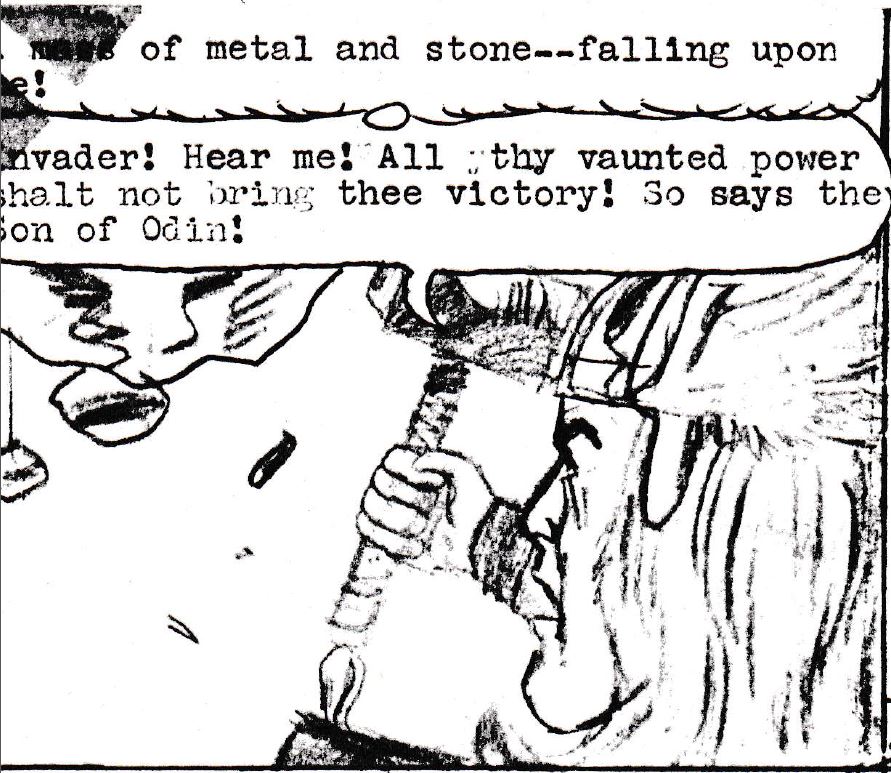
Thor's instantaneous declaration, From Beyond This UniverseWhen my brother Matt and I were working on our great unfinished comic-book epic back in grade school, we faithfully replicated this convention, allowing a hero to get off an appropriately heroic declaration while a roof is falling on his head.  (Apologies for the black-and-white shot; I don’t have the full-color original ready to hand.)


Sailor Moon manga attack sceneNot all graphic novels use this convention.  It may not be as common in manga, for example, where there’s a lot more action without explanation—and where, as a consequence, I sometimes have trouble figuring out what’s going on.  This discrepancy may reflect a cultural difference; I didn’t grow up with Japanese comic culture and may be missing some clues.  Still, I think it’s harder to make out events  without the occasional verbal aside.  In the Sailor Moon manga and anime, for example, if there’s any dialogue at all that relates to a superpower, it’s likely to consist in calling out an attack name like “Moon Princess Halation,” which by itself communicates even less than “magnetic anti-polarity.”  I’ve encountered some similar problems reading contemporary American graphic novels like Monstress.

On-Screen Obscurity

Visual media have some advantages in being able to show directly what people are doing, depending on the medium.  However, the audience for a stage play is likely to be at some distance from the performers, which means that very small actions may be hard to make out.  If a character on stage is, say, picking a lock, there will probably have to be some setup to make clear what they’re going to do (especially if the locked door is invisible and not actually part of the stage set).  In a movie, on the other hand, the director is free to show the character crouching next to the door with her tools, then cut to a close-up shot of her hands working the tools in the lock, then back out to the door opening.  Comic books can do the same thing.

This assumes we already understand what picking a lock is.  The need for explanatory narration is accentuated in science fiction and fantasy stories, where the things that are happening may be extraordinary.  When the action is more mundane, we can get by with less explanation.  If the villain fires a pistol at the good guys, we don’t need to be told how a pistol works.  But if the action uses superhuman powers or advanced technology that we haven’t seen before, an explanation may still be necessary.

Consider Marvel Comics’ Scarlet Witch (Wanda Maximoff).  Her powers originally consisted rather vaguely in casting a “hex,” which caused things to go wrong (in unspecified ways) for the target of the hex.  Later retcons and expansions introduced a number of different power sets.  But in the Marvel Cineverse movie versions, her powers are hardly explained at all.  We may see her blasting Thanos, but we don’t actually understand (even in the lenient comic-book-movie sense of “understand”) what her powers are supposed to be.  For all practical purposes, she might as well be Sailor Moon.  (Now there’s an idea for a crossover . . .)

As always, there are good and bad ways to supply the necessary explanations.  As I’ve mentioned before, the original Star Wars is good at this:  Han can snap out the line “. . . while I make the calculations for the jump to lightspeed,” and that’s all we need to know.  On the other hand, there’s what Shamus Young describes as “Super Exposition” in a 7/6/17 blog post:  “The villains blabbed their plans for no reason. Heroes narrated their own actions to themselves, out loud, during a fight. Characters would stop and explain why something was good or bad right in the middle of it happening, because the writers didn’t set anything up ahead of time.”  Overdone, the practice falls into condescending overexplanation.

On the whole, the different media seem to require different types and levels of exposition.  In a purely verbal medium like a book, when we have only the words to work with, every action must be described.  On stage, at least some forms of presentation describe the action verbally as well.  And even in a movie, where we can see what’s happening in detail, we may still need to have the events analyzed.

Changing the Past – Or Avenging It

Introduction

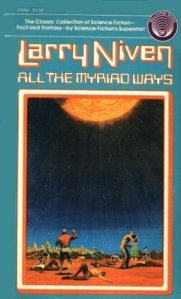
Avengers Endgame posterI set out to do an analytical essay on Three Theories of Time Travel—until I realized that Larry Niven’s astute and entertaining brief article “The Theory and Practice of Time Travel” (1971) had already covered those theories pretty well.  (You can find that article in Niven’s All the Myriad Ways, and a couple other locations.)  So I decided instead to comment on how they’re used in Avengers:  Endgame, which seems to invoke at least two and possibly three different theories.

Maybe I’d have been better off sticking with the original plan; this post has turned out to be considerably longer than I’d planned.

Endgame came out on April 26, 2019, and was released on disc August 13, so it’s still new enough at this writing that I should issue a

Spoiler Alert!

I’m not going to address the mechanics of how one might travel into the past—whether via Tipler machines, or wormholes, or simply thinking oneself into the past à la Jack Finney.  (Endgame manages it via what the movies refer to as the “Quantum Realm,” which is completely incoherent in one way but rather fascinating in another—a side issue I won’t go into here.)  I’m interested in what happens if you let causality turn back on itself.  I can think of three main ways of handling the question of changing the past.  Each has its pros and cons, from a storytelling point of view.

“Make It Didn’t Happen”

First, let’s suppose we can change the past (and, by extension, the present and future).  The idea arises because we often wish we could go back and undo something—either our own actions, or the broader course of history.  Niven observes, “When a child prays, ‘Please, God, make it didn’t happen,’ he is inventing time travel in its essence.”  He goes on to note, “The prime purpose of time travel is to change the past; and the prime danger is that the Traveler might change the past.”  These twin aspects of the idea generate plot tensions and conflicts immediately, on both a personal and a historical scale, so it’s not surprising they’re so popular.

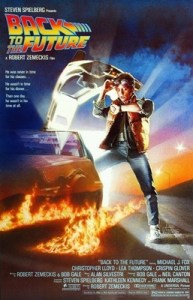
Back to the Future posterThe most familiar example, of course, is Back to the Future (1985-1990).  In the three movies, Zemeckis played several variations on the idea of making history come out differently.  The cultural reference is so well-known that Marvel was able to riff off it for a comic moment in Endgame.  Scott Lang, the young and relatively naïve Ant-Man, says they’ll be okay if they obey the ‘rules of time travel’ (at about 0:35).  Tony Stark, the all-round genius of the Marvel movies, derides Scott for having gotten his “rules” from BTTF, and proceeds to shoot the notion down as hopelessly unscientific.

And Tony’s right, in the sense that building a theory of time travel purely on the assumptions made in fictional stories is silly.  We don’t know what would happen if it were possible to change the past; we haven’t done it.  That would make time travel really dangerous if it could be attempted in real life.  On the other hand, that same lack of knowledge leaves a wide field open for the fiction writer.  We can make whatever assumptions we like, as long as they’re consistent.  We can imagine that you can only go back in time a certain distance, at a certain geographical location, as in Julian May’s Saga of Pliocene Exile (1981-84).  We can imagine that the transition requires vast energies, as in Arthur C. Clarke’s story “Technical Error” (1950).  Or we can invoke the imaginary “Pym particles” of Ant-Man lore and time-travel at will.

This first theory of time travel generates the paradoxes we know and love.  We have the “grandfather paradox,” in which an effect removes its own cause.  (I go back in time and kill my grandfather.)  We have what Wikipedia calls the “ontological paradox,” in which an effect becomes its own cause.  (I go back but my grandfather fails to show up, so I marry my grandmother instead and name my son after my dad…)  I talked about these a bit in a 2016 post on the TV series Timeless.

One thing that’s not always obvious is that the idea of changing the past requires a second time dimension.  There’s the familiar one that’s typically represented by a “timeline,” a one-dimensional line ordering events from past to future.  But if someone changes the past, then the old line has to be replaced by a new one:  imagine a second timeline lying next to the first.  Every time a change is made, another timeline gets added.  The set of lines forms a plane, extending through a second dimension, in which each new timeline happens after (in some Pickwickian sense) the last.  Otherwise, it wouldn’t make any sense to say that we’d changed history.  Marty can’t rejoice in having “fixed” his family unless the new timeline succeeds the first, just as events along the timeline succeed each other.  Hence, a second time dimension, to accommodate the sequence of timelines.  (This may, or may not, be related to what TV Tropes calls “San Dimas Time,” a reference from Bill and Ted’s Excellent Adventure (1989).

As a narrative device, the chance to change the past creates suspense.  But it only works if you don’t look too closely.  The author has to stage-manage things carefully so that changes of all sorts don’t start happening in all directions, and this means that time travel must be rare.  If we imagine a period of hundreds or thousands of years, during which people invent time machines every so often and start changing the past, it would become impossible to make sense of what was happening.  Different changes, each with their rippling “butterfly effects,” would take place, one after another—or even at the same, er, time.  (I tried playing around with that idea in an as-yet-unpublished story called Getting to Gettysburg.)  So I’m skeptical about stories based on letting time travel become routine, as in “Time Patrol” scenarios or Asimov’s The End of Eternity.

Avengers Disassemble

Does Endgame, after all Tony’s disclaimers, involve changing the past?  Maybe not; but it’s hard to see how the story can avoid it.

Thanos with Infinity GauntletThe screenwriters chose to set themselves an interesting dilemma that makes the simple time-travel solution (go back and kill Thanos) unusable.  When the time-travel possibility arises, five years have passed since the Snap, in which Thanos killed off half the people in the universe.  Life has gone on.  Tony and Pepper, for example, have an adorable little girl.  But eliminating the Snap would also eliminate Tony’s little daughter Morgan, along with everything else that’s happened since.  That’s unacceptable (at least to Tony).  So the Avengers are not trying to avert the Snap; instead, they want to bring back, in the present time, all those who disintegrated.

The reason they have to go into the past is to retrieve the six Infinity Stones, which Thanos destroyed after the Snap.  The Avengers will need to use the Stones for a Snap of their own to bring back all the people Thanos destroyed.  But in order to avoid changing the past, they will have to put the Stones back in their earlier times after they’ve been used.  This is a clever idea, but it’s going to be really tricky to execute in practice, as we’ll discuss below.

It’s Already Happened

Meanwhile, the business of a second time dimension may make us start to wonder about the whole idea of changing the past.  Maybe we’ve forgotten to take into account the integrity of the original time dimension.  After all, if something happened in the past, it has already happened.  The effects of past events should be baked into the present that follows from them.  If I go back to 1800 and leave a hidden time capsule, let’s say, I should be able to dig it up in 2019.  You might say that the change I wish to make has already taken place.

Kate and Leopold posterBut it follows that if I can find the evidence in the present, then I know the event occurred in the past.  (That’s what “evidence” means.)  If I find the time capsule, I know that it was buried.  This may allow me to predict or “retrodict” my future changes to the past on the basis of what’s known now. If I find the time capsule, I know I’m going to bury it—or someone else will.  A key scene in Kate and Leopold (2001) relies on just such a discovery about a future event that changes the past.  (Have we mixed up the tenses enough yet?)  Bill and Ted makes even more comically inventive use of this aspect.

But on this theory, the event in the past isn’t really a change.  It was always that way.  The time capsule persisted through all the intervening time.  You can’t change the past, because your change is already included in the past we know and thus embedded in the present.  As Niven puts it, “any attempt on the part of a time traveler to change the past has already been made, and is a part of the past.”

This approach deprives us of the fun of changing history, but I rather like it.  It ensures the timeline remains consistent with itself.  In fact, one version of this postulate is referred to as the “Novikov self-consistency principle,” named for Russian physicist Igor Dmitriyevich Novikov.  We avoid grandfather paradoxes:  we already know I didn’t succeed in traveling into the past and killing my grandfather, because here I am.  If I try, something will go wrong.  On the other hand, ontological paradoxes are still allowed, as in Heinlein’s classic novella By His Bootstraps (1941).  In fact, I tend to think of this as ‘Heinlein’s theory of time travel,’ because he used it extensively—not only in Bootstraps and the even more baffling  “—All You Zombies—” (1959), but also in the delightful The Door Into Summer (1957).  Of course, Heinlein’s by no means the only writer using a Novikov-type theory.

One reason I like this type of time travel story is that everything fits neatly together, like a puzzle.  The fun of the story is in seeing how they’ll fit.  In that sense, the enjoyment of you-already-changed-the-past stories resembles that of the Greek tragedies, in which an oracular pronouncement tells what’s going to happen, and the story shows how it happens.  No matter how Oedipus tries to avoid the awful future foretold, he can’t.  The efforts to avoid the predicted outcome may themselves produce it.

In such a tragedy, where time travel isn’t involved (except to the extent the oracle itself is future information acting on the past), the Greek tragedy tends to suggest that the outcome is determined by some kind of Fate, whether we like it or not.  (Niven puts this view under the heading of “determinism.”)  But the Novikov-type theory can also be seen as compatible with free will.  Even actions freely taken, once they are complete, become part of the fabric of history, not subject to further change afterwards—except to the extent that backward causation via time travel is possible, which alters the whole meaning of “afterwards.”

The Door Into Summer, coverA subclass of these stories assumes that the time continuum somehow defends itself against change.  It may automatically “self-heal” to swallow up minor changes, or all changes:  Edison doesn’t invent the light bulb, but someone else does.  Or the time stream may simply be designed so that with “fail-safes” that prevent catastrophic causality failures.  At the end of The Door Into Summer, the engineer hero seems to be speculating in this direction:  if time travel could be used commercially, he thinks,

it will be because the Builder designed the universe that way.  He gave us eyes, two hands, a brain; anything we do with them can’t be a paradox.  He doesn’t need busybodies to “enforce” His laws; they enforce themselves.  (p. 158)

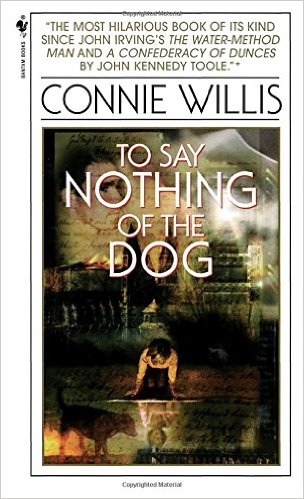
To Say Nothing of the Dog coverIn a modern context, God seems to take over the role of Fate—not by predetermining everything, but by designing the system (i.e., the universe) so nothing can go fatally wrong with causality.  Something similar, I think, lies behind the way the time travel “net” portal functions in Connie Willis’s time travel stories.  If allowing something through the net would create a paradox, the net simply won’t open—which leads to some tortuous reasoning by the characters as to what is keeping the net from openingaat  a particular moment.  Something like Providence seems to be at work.  The only causal loops allowed are what we might call ‘virtuous loops’—those that work out right.

What makes this confusing is that we’re used to analyzing causality by looking at the conditions preceding the effect.  Here, we don’t see the ‘virtuous loop’ conditions being set at any particular point in time.  The conditions have to apply to the continuum as a whole—from outside it, in effect.

You Can’t Avenge the Future

When Tony initially declares Scott’s proposed “time heist” impossible, the remaining Avengers bring in Bruce Banner as a substitute scientific resource.  Banner (who now combines his own brain with the Hulk’s body) does make a nod to the fact that his scientific expertise is primarily in biology, not physics, but the story remains basically true to the comic-book idea that a scientific genius is a genius in every science.  At about 0:59, Banner says something that sounds rather like the Novikov principle we’ve been discussing:  if you kill someone in the past, that doesn’t erase their later selves.  Apparently causality doesn’t propagate down the world lines of already-existing characters to wipe them out when their original causes go away.  On this theory, Marty wouldn’t have had to worry about disappearing even if he couldn’t get his parents back together.

On the other hand, Bruce doesn’t seem to be saying you can’t kill the person in the past; he seems to be saying that if you did kill them, it wouldn’t make any difference.  This may have more to do with what TV Tropes calls “ontological inertia” (see here, but also here).  Bruce’s approach seems to allow for wild inconsistency in the timeline, because I can be alive in 2019 even after being killed in 1971.

The simplest answer may be to conclude that Bruce wasn’t a very good physicist; maybe Tony silently corrected Bruce’s theory when Tony finally did agree to join the party.

Branching Timelines

At some point in SF history, people realized that the whole paradox thing could be avoided by introducing a third theory, the notion of multiple branching timelines.  Niven’s phrase is “multiple time tracks.”  If you change the past, the original future going forward from that point remains unchanged, but a new future comes into existence, branching off to take into account the change.  (The character making the change always seem to end up in the new branch, not the old.)  We can have our cake and eat it too:  one version of me devours the cake, but another, equally real, version of me prudently saves the cake for later.

The multiple-timeline approach gains some headway from the general popularity of alternate-history stories, and some plausibility from the fact that physicists take seriously the suggested “many-worlds” interpretation of quantum mechanics.  It appears to solve the problem of time paradoxes.  However, it runs very close to an assumption that would make it impossible to tell a good story at all.

Stories are about action and choice.  A mere recounting of a series of experiences that happen to someone wouldn’t be much of a story (which is one reason the ending of 2001:  A Space Odyssey is so weak).  James Michener’s introduction to the novel Hawaii (1959), which describes the geological formation of the islands, is only part of a story because it lays the groundwork for what the characters later say and do.

All the Myriad Ways coverIf every possible alternative branched off a new timeline whenever there were options, there would be no point in making a choice, because whichever choice I made, another version of me would make the opposite choice.  Niven captures the problem exactly:

. . . did you ever sweat over a decision?  Think about one that really gave you trouble, because you knew that what you did would affect you for the rest of your life.  Now imagine that for every way you could have jumped, one of you in one universe did jump that way.

Now don’t you feel silly?  Sweating over something so trivial, when you were going to take all the choices anyway.  And if you think that’s silly, consider that one of you still can’t decide . . .  (p. 117)

The title story in All the Myriad Ways explores exactly that issue—what would happen if people really started to believe that all alternatives were equally real.

But suppose we assume that every choice doesn’t spawn alternate universes—just the changes caused by time travel, by backward causality.  That doesn’t destroy all narrative in the way just described.  It just ruins the story you’re trying to tell.  The main characters move heaven and earth to get into the past and make the necessary change.  They succeed!  Whew.  Victory.  —Except that in another universe, the original one, they didn’t succeed.  Somewhere, the sad failures who are Marty McFly’s parents still languish by the TV.  That’s not a really satisfying conclusion.

Alternating Avengers

The multiple-timeline approach certainly comes up in Endgame.  What I can’t make out is whether it prevails in the end, or is averted.

Ancient One and Banner with timeline simulationAt about 1:24 in the movie, Bruce Banner is having a tense conversation with the Ancient One (Dr. Strange’s mentor) about the plan to return the stones to their original places in time.  The idea is that if he takes the Time Stone from the Ancient One at (let’s say) 1:03:12 p.m. on January 31, 2010, and eventually Steve Rogers returns it to her at 1:03:13 p.m. on January 31, 2010, there won’t be a need for a branch to form.  History continues on as it had always been.  (Steve describes his mission concisely at 2:43 in the movie:  “I know.  Clip all the branches.”)  Thus, the timeline of the movie, in which Thanos Snapped half the universe away, and five years later the assembled Avengers brought them back and did away with Thanos, remains the one-and-only timeline.  There’s a helpful description of this procedure in an article from July 2019 (which is also full of spoilers, by the way).

If we leave aside how hard it would have been to put things back exactly as they were, given the butterfly effect—not all the Stone retrievals were as simple as Bruce’s—does this work?  Did the screenwriters (Christopher Markus and Stephen McFeely) come up with a way to manage the dizzying time loops and still save the story?

I’m still not quite sure.  One glaring plot hole, as various people have pointed out, is that we have to account for Thanos himself.  In order to give us a great battle at the end (and what a battle it is!), the movie has Thanos in pre-Snap 2014 discover what’s going to happen and time-travel forward to 2019, where he’s ultimately disintegrated by the Avengers.  He never returns to 2014.  That seems to mean that the disappearance of Thanos did create a branch, since if he vanished from 2014 and never came back, the Snap would never have occurred.

At least that reduces us to two timelines, the one we see in the movie and another where Thanos does not continue to exist after 2014.  And, interestingly enough, the Avengers’ actions saved both of those timelines from the Snap.  The people who lived through the movie timeline experienced the Snap, but the lost people were eventually returned.  Meanwhile, in the new alternate timeline, Thanos never came back, he never got the Infinity Stones, and the Snap never occurred.  That’s not such a bad (dual) ending.

I don’t know.  All these causal loops produce a kind of shell game in which I’m not quite sure how things came out.  Nonetheless, it’s a great movie, if you like the Marvel characters at all.  If you haven’t seen it, you shouldn’t have been reading this (but maybe the circuitous account above will be helpful).  If you have—see it again!  Just don’t try to go back to April to catch the premiere a second time; who knows what that would do to the space-time continuum.