Happily Ever After

Six weeks ago I complained about the lack of happily-ever-after romances in the Star Wars series.  It occurred to me that it would be useful to take a look at what exactly makes for a “happy ever after” ending (“HEA” in genre romance code).  What do we really mean by that, anyway?

The Thrill of the Chase

All the world loves a lover.”  We enjoy seeing stories about people falling in love, whether it’s with someone they’ve just met or by discovering someone who was always “right before my eyes.”  (Unless, of course, we’re too cynical to give any credence to so vulgar and sentimental an idea; in which case it’s the trope we love to hate.)  I’d call it the courtship phase of a relationship, if that term weren’t so archaic.  But “courtship” does express in a useful way the stage I’m referring to, when the lovers-to-be are maneuvering around each other, trying to figure each other out, and (almost invariably, in fiction) overcoming initial obstacles to their mutual attraction.

Couple silhouetted against sunset

“Forever Mine” by welshdragon at DeviantArt

It’s not hard to see why this is.  The courtship phase includes a lot of fun stuff.  We get to see the thrill of discovery, the novelty, the tentative reaching-out and missing connections, the achievement of initially establishing a base of trust and affection.  There’s uncertainty and thus suspense in those first contacts.  The process reminds me of the “handshaking” by which communications systems establish a protocol for exchange of information (anybody remember that windy ‘modem connecting’ sound on a dial-up connection?).

And this process is both tricky and essential.  The relationship can’t move forward until the common foundation is established.  I’ve quoted Lois McMaster Bujold before:

The question a romance plot must pose, and answer (showing one’s work!) is not “Do these two people get together?” but rather “Can I trust you?”  Which is most certainly not a trivial problem, in art or in life.  (Response to a reader question on Goodreads (10/30/2017).)

And the relationship does have to move forward.  Courtship is only a prelude.  It inherently looks forward to something else:  a life together.  (Even to “forever,” but that’s another subject.)  We feel something is missing in a case like that of Romeo and Juliet, where circumstances cheat the lovers of that opportunity.

Falling in love is fun to watch.  But if that’s all a character is interested in, we get the self-centered thrill addict who keeps wanting to have the same experience over and over again—as if they wanted to relive high school graduation repeatedly, Groundhog Day-style.  We can’t fall in love indefinitely; eventually we have to land somewhere.  Whether the story ends with a wedding or just a commitment, there has to be a conclusion.

Yet the conclusion itself is only the kickoff for the real relationship—the HEA.  “Each happy ending’s a brand new beginning.”

What It Isn’t

“Happily ever after” doesn’t mean the initial thrill of falling in love lasts forever.  That simply isn’t possible; human emotions can’t remain at that fever pitch.  At some point, the “dizzy dancing way you feel” is going to ebb.  If we expect to feel the same way always, as I’ve just noted, we’re setting ourselves up for disappointment and unnecessary disillusion.  On the other hand, that thrill can always reappear from time to time.  Wise couples will take steps to encourage and renew that early glamour throughout their marriage.

Couple dancing, from Dancing in the Minefields music videoNor does HEA mean freedom from all troubles.  We can put this aside momentarily to celebrate a wedding, visualizing only a life of unimpeded bliss; but real lives invariably encounter problems and difficulties.  We may even want to remind ourselves of this on the occasion of union itself.  When I ran across Emily Hearn’s wedding video online, I was struck by the fact that the first piece of music set to the video was Andrew Peterson’s “Dancing in the Minefields”:  “And it was harder than we dreamed / But I believe that’s what the promise is for.”

Even the vision of a couple facing adversity staunchly side by side isn’t always going to be valid.  We’re told that even healthy couples have their arguments and disagreements.  Indeed, a couple that never disagrees may be harboring unresolved issues under the surface.

It seems to me that all these flaws or troubles can still be accommodated in the “happily ever after” archetype.  Couples can recover from adversity; it can make them stronger.  Even crises in a lifelong love affair can be healed or overcome.  It’s the overall trend or direction, and the overall tenor of the romance, that leads us to call it “happy.”  Of course, when we wish someone happiness forever, we hope that their troubles will be relatively few and their recoveries maximally joyous.  But a life together need not be perfect to be “happy.”

What It Is

If the ever-after need not be perpetual bliss to count as HEA, what is it made up of?  I am hardly so wise as to prescribe sure-fire ingredients for a happy marriage.  But if we think about what we’d expect to see in a story that depicted a happy couple, we can point to a few things.

Carly Simon singing The Stuff That Dreams Are Made Of at Martha's Vineyard

Carly Simon sings “The Stuff That Dreams Are Made Of”

If it’s going to compete with the initial falling in love, being in love has to gain in depth and resonance what it loses in surface intensity and thrill.  It’s “the slow and steady fire.”

What can a couple that’s been together a while do that lovers who’ve just met can’t?  Consider the cumulative pleasures and joys of two people who know each other well and have learned how to please and help each other.  If they continue faithful to each other and to their union, their mutual trust will grow and deepen.  And the more they trust each other, the more each can express their individual strengths (and admit their individual weaknesses).

Since loving someone doesn’t consist only in having a feeling about them, but in enacting love for them, we can learn to love someone better through experience and attentive learning.  I may start by giving you a gift I would like—but eventually I learn how to give you the gift you would like.  Meanwhile, the sharing of memories and experiences, families, running jokes, can enrich and strengthen the bond.

All these things are compatible with the imperfections and difficulties noted above.  They make up what we’d expect to see, down the road, in a story that goes beyond the courtship—a happy-ever-after.

How We Tell the Story

Because the HEA lacks the surface glitter of the falling-in-love story, we see far fewer stories depicting it.  But for purposes of example and illumination, it’s very useful to see depictions of ongoing marriages.

Such mature romances can crop up in odd places.  For example, in a series that goes on beyond the resolution of initial relationships, or perhaps longer than the author expected, we may see the original lovers ‘age out’ of the focus, but still have the chance to watch them practice the art of love.

Shards of Honor coverExhibit A is Bujold’s Vorkosigan saga.  The first two books in the main sequence, Shards of Honor and Barrayar, deal with Aral Vorkosigan and Cordelia Naismith, whose son, Miles, is the principal character in most of the stories.  So we see Cordelia and Aral fall in love—but then we see them continue through a whole series of other tales as both parents and political prime movers on Miles’ homeworld of Barrayar.  We get to see them working together in common causes, both personal and cosmic.  We see their continuing affection and evident harmony.  Each is so distinctive a personality that we never think of either Aral or Cordelia as merely an extension of the other; rather, they provide an ongoing example of the kind of relationship we wanted to see in their initial stories—and to which Miles aspires for himself, having that example always before him.

Anne McCaffrey’s Dragonriders of Pern give us another example.  In the first book (as published, not chronologically), Dragonflight, we see the rocky road of the strong-willed main characters, Lessa and F’lar, to love.  Both of them are so stubborn and willful that it’s hard to picture them in a peaceful marriage.  And indeed, on Pern, nothing is ever entirely peaceful for long.  But as more couples come and go through the long series of sequels, F’lar and Lessa remain onstage a good bit of the time.  Neither is ever tamed, though they both mellow a bit.  The scrappy young Lessa becomes a little steadier and more mature as she gets older and has a child, but she still retains the original fire.

I frequently refer to the classic Lensman series, but I don’t think I’ve mentioned that the final novel, Children of the Lens, shows us the lovers whose activities dominated the three middle books, Kim Kinnison and Clarissa MacDougall, as middle-aged parents a generation later.  The story is so action-oriented that we don’t get to see much of the family in peace, but what we do see gives us the satisfaction of knowing that Kim and Cris have lived a happy life together (and will continue to do so).  And since the surclimax (if I may invent a word for a secondary climax occurring after the main one) involves Clarissa’s use of the power of their mutual love to retrieve Kim from an otherwise unsolvable trap, it’s clear that the romantic connection consummated at the wedding in the previous volume (twenty years earlier) has not lost its fire.

Second Spring coverAndrew Greeley wrote a whole series of novels in which the romance is generally about falling in love.  But in his O’Malley family saga, in which the titles all refer to seasons (of life), he continues the story of one such couple from the post-WWII era right through their “Golden Years.”  The young lovers of A Midwinter’s Tale have to grapple with some pretty serious psychological issues themselves, as well as family drama, over the course of years.  But the “crazy O’Malleys” emerge stronger from their troubles as they go on, giving us a picture of people who are always becoming more themselves as they adjust to changing circumstances.

God is an Englishman coverThere is a subgenre of family sagas—the kinds of long-running, multicharacter stories that always make me think of TV mini-series—and some of these also give us extended looks at maturing romances.  In some such stories, the conflicts arise from the dysfunctionality of the family itself; Mazo de la Roche’s Jalna novels are a case in point.  But in others, we can see a couple holding strong.  I recently reread R.F. Delderfield’s God Is An Englishman, the first book of his “Swann saga.”  His central couple, Adam and Henrietta, grow in significant ways over the course of the story.  Their love waxes and wanes, but after it wanes, it always comes back.  I’d count that as a HEA.

The novella I’m just finishing up, Time Signature, takes place in the Deerbourne Inn common setting created by the Wild Rose Press.  This gave me the chance to show how a secondary couple who were engaged in Amber Daulton’s Lyrical Embrace was getting along, a little later.  While their appearance is brief, I enjoyed the opportunity to represent a growing post-courtship romance, even in its early years.

Real Life

For purposes of inspiration and example, of course it’s even more helpful to be acquainted with real-life successful relationships.  My parents, for instance, lived long and happy lives, and despite religious and political differences, they always remained in harmony.  Though they argued about many subjects, they never, so far as I know, quarreled.  While their lives could not be said to be untroubled (after all, I was one of their children), I’d say they qualified as a happy-ever-after.  I’m privileged to know a number of other couples whose romances have flourished over many years, on whom I’d be glad to bestow the accolade of HEA.

The accumulation of such real and fictional examples gives us the wherewithal to refute those who scoff at the happily-ever-after ending.  None of the characters of our favorite romances will have perfect later lives unmarred by any suffering or any down times in their love affairs.  But if we’re willing to accept that solid happiness can be consistent with life’s inevitable troubles, we can look forward with hope to a satisfactory ending for those couples who approach their lives with both realism and love.

Preferred Atrocities

One might suppose that people would write stories in which a society followed their preferred points of view.  We would see socialists writing about the peaceful harmony of the commune, libertarians about collections of sturdy self-reliant individuals, feminists about places where women were ascendant, or at least equal.

Handmaid's Tale coverBut The Handmaid’s Tale wasn’t written by a man.

More often than not, authors seem to write about the opposite of what they appear to prefer.  Their heroes and heroines struggle against epic oppression by regimes of exactly the type the author finds most atrocious.

Evidently, we love stories about the things we hate.

Dystopias Made to Order

Just as our views about good and bad character influence the kinds of people we see as heroes, our views about good and bad societies influence the systems we create—in the negative.

Thus, in 1985 Margaret Atwood writes about a near future in which a theocratic revolution in the United States takes the oppression of women to unprecedented levels—the worst cast for a feminist.  A robust agnostic like Robert A. Heinlein depicts a revolt against another type of theocracy in the 1940 novella If This Goes On— (though putting it that way vastly oversimplifies the relationship between Heinlein and his stories).  Anti-collectivist libertarian Ayn Rand gives us a society in which even first-person pronouns have been eliminated with the novella Anthem (1938)—and the America of Atlas Shrugged (1957), while not yet so extreme, is tending in that direction.

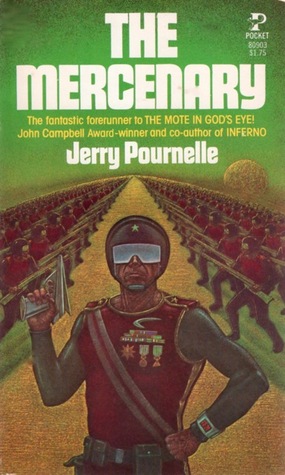
The Mercenary coverIn the second section of Jerry Pournelle’s The Mercenary (1988), John Christian Falkenberg’s mercenary army is hired to help maintain order on the planet Hadley, where Earth’s “Bureau of Relocation” has dumped job lots of involuntary “colonists” with few skills and no will to work.  The result is a classic welfare-state nightmare.  In the climactic sequence, the bad apples have all concentrated themselves in a self-appointed constitutional convention in a stadium, seizing power and essentially enslaving the technicians who keep the colony running.  When this self-serving mob initiates violent resistance against the nominal government, Falkenberg orders his troops to secure the stadium.  The mob attacks after refusing to heed warnings—and the troops systematically slaughter all the armed attackers who will not surrender.

The way Pournelle tells the story, the reader is wholly sympathetic to the “mercenaries” and feels righteous satisfaction when the tables are finally turned on the antagonists.  The cumulative misdeeds of the mob are what give us the sense that the last-resort violent countermeasures are justified.

There may even be examples of preferential atrocities in the young adult dystopias that currently spread across the landscape.  The common element in The Hunger Games, the Divergent series, and perhaps The Maze Runner is that likable teenagers are cruelly oppressed by sinister adults.  Societies in which young adults are subjected to the arbitrary and exacting rule of hostile grown-ups might be considered to constitute the anti-ideal for teenagers—the characteristic dystopia.

The Appeal of the Atrocious

If we ask why so many writers depict worlds entirely at odds with their own (or their audience’s) preferences, one simple answer is that utopias are notoriously boring.  A story requires conflict.  And, once we’ve defined what makes our heroes virtuous, the obvious opponent is their opposite—depicted in as extreme a way as possible.

But I think there are also other factors at work.

We could perhaps write a story about defending a utopia against attack, rather than attacking a dystopia.  But it’s easier to depict something that’s obviously noxious than to show how a really well-working society would go.  Destroying is easy; building is hard.  If the bad guys are sufficiently bad, we may never have to wonder about, say, exactly what kind of reformed society the Rebel Alliance would put into place after defeating Darth Vader’s Empire.  (To its credit, the Hunger Games series does provide some hints at the end about the pitfalls of establishing a better successor regime—although, again, more by showing how the revolution could go wrong than by showing it going right.)

OrcsMore important, it’s easier to engage our emotions by showing how bad the bad guys are.  Personally, I am even more moved by awe at the acts of heroism and virtue; but rousing our outrage against evils may be more visceral.  In a dystopic story, the despicable practices or institutions of the society justify our hatred of the antagonists.

It’s hard to overstate the adrenaline rush of righteous anger.  It’s seductive.  When a storyteller takes the despised behavior of the oppressive society to an extreme, they allow us to imagine, and desire, the equally extreme response.  Shoot ’em all down!  Blow up the Death Star!  No quarter!

From Story to Fact

This is one of the places where the stories we tell extend their reach out into the real world.  If we get too attached to that defiant rush, we may be more susceptible to the possibility of finding it in reality.  The prospect of being forced to ultimate measures is appalling—but there’s also a certain thrill.  What if the apocalypse is finally here?  We can finally abandon restraint and pull out all the stops!

Of course, there genuinely are times “when in the course of human events, it becomes necessary” to take extreme measures.  There are always two ways of going wrong.  We may be too rash and rush to extremes; but we may also be too complacent.  Either way may involve, in part, a failure of imagination.  It’s one kind of failure not to recognize the anti-ideal when it genuinely begins to happen.  But the other kind is to pounce on every sign that our favorite stories—the ones with the atrocities we despise—are coming true.  It’s when we prematurely think we see this in real life that the stories in the back of our heads become dangerous.

Image of old piano with rose petals

Image by SeaReeds from Pixabay

Extreme measures need to be kept to a true last resort, because civilization is more fragile than it seemsWe cannot lightly throw away the rule of law.  If we do, the result is likely to be worse than the original problem.  We need to keep that essential idea firmly in view, even in difficult circumstances—including those where the rule of law itself is being violated and needs to be reasserted and reawakened.

There is no substitute for thinking things through, with care and determination.  The adrenaline rush so familiar from our favorite stories can’t be allowed to keep us from drawing the right lines, at the right times, in the right places.  If we are too complacent, or too belligerent, we may simply be lending ourselves to making someone else’s preferred atrocity come true—and earning their equally extreme resistance.  That isn’t the kind of resolution we need.

Describing the Indescribable

Showing the Unshowable

In our last exciting episode, we noted that fantasy and science fiction stories often seek to transcend the boundaries of human experience—to show us things beyond our ordinary understanding.  Take it further:  the author may wish to present things that are beyond all human understanding.  How do we get across to human readers, or viewers, something that we’ve just postulated as indescribable or incomprehensible?

We’re not asking whether there can be things the human intellect or senses cannot grasp.  Kant or Aquinas, for example, would have rather complex answers to that question.  Rather, we’re focusing here on how to put the ungraspable into a story.

Beyond the Senses

Doctor Strange casts a spellThere are plenty of things that are impossible, but easy to describe; we can detail how they appear to our senses, though explaining how they can actually occur is another matter.  For example, magic spells cast by Doctor Strange frequently manifest as flat discs suspended in space, generally with symbols or letters inscribed.  Both the comics and (using CGI) the movies can show us these with no problem.  That’s not what we’re interested in here.

What’s intriguing is a sensory experience different from any we normally experience (or, perhaps, can experience).  In James Schmitz’s The Witches of Karres, our hero Captain Pausert, who is just beginning to exhibit witch powers, detects an extra-universal entity called a “vatch.”  His young witch companions have referred to “relling” a vatch, but this is the first time Pausert himself has had the experience:

The Witches of Karres, coverIt was something like smelling a grumble, or hearing dark green, or catching a glimpse of a musky scent.  As Goth had suggested, it was not to be described in any terms that made sense.  But it was quite unmistakable.  He knew exactly what he was doing—he was relling a vatch.  (ch. 9, p. 250)

I tried this same technique of combining nonsensical sensory references to suggest something magical about spell-casting music in my short story The Green Song.

While Schmitz chooses to present this supernormal power as “magic,” such special powers can just as well be described in science-fiction terms (often as “psionic” powers), which is how we normally use words like “telepathy” and “telekinesis.”  Though it’s worth noting that fantasy characters like Gandalf and Galadriel can “speak mind to mind” as well—they just don’t call it telepathy.

I’ve just finished The Pursuit of the Pankera, a recently-discovered earlier version of Heinlein’s The Number of the Beast which takes off in a quite different direction.  In chapter 38, one character, Deety Burroughs Carter, meets a Lensman from E.E. Smith’s Lensman series and tries to describe the famously indescribable Lens itself:  “The nearest I can think of is an enormous fire opal with a light behind it—but take that and cube it.  It’s all colors and the colors keep changing and the lights come from the Lens itself and dance like a color organ but brighter and more alive—and I still haven’t described it.”

Heinlein’s method is instructive.  In this brief passage, we start with a known image—fire opal—and are told to extend it in an unspecfied way (“cube it”).  The second sentence is a run-on, piling image on image in a way that suggests an inability to capture the item in any single description.  She finishes by apologizing that the result is still inadequate (“I still haven’t described it”).

An extraordinary experience like Schmitz’s “relling” is neutral—just an unfamiliar new sense.  But once we’ve postulated the non-natural, it’s easy to transition to the “unnatural,” in the pejorative sense of the term.

The Colour Out of Space, magazine illustrationI recently revisited H.P. Lovecraft’s short story The Colour Out of Space (1927)—the only Lovecraft piece I’ve ever actually read.  According to the story, a meteorite arrives on earth in 1882, in the Arkham area (there’s a reason why the lunatic asylum in Gotham City is called the “Arkham Asylum”).  Weird growths emerge from the meteorite and transform plants, animals, rocks, water, and humans in horrible ways.  The creatures so affected are characterized by an unearthly color, first noticed in globules in the meteorite:  “The colour, which resembled some of the bands in the metetor’s strange spectrum, was almost impossbile to describe; and it was only by analogy that they called it colour at all” (p. 150 in the anthology I have).  Skunk cabbages infected by this influence are described unpleasantly:  “. . . they held strange colours that could not be put into any words.  Their shapes were monstrous, and the horse had snorted at an odour which struck Stephen as wholly unprecedented.”

The notion of extra colors that can be seen with ordinary vision is dubious, given what we now know about neurobiology and the electromagnetic spectrum.  But the notion does communicate a sense of the weird and unnatural.  That’s what Lovecraft was driving at, according to Wikipedia—“to create an entity that was truly alien.”

More important, Lovecraft, like other horror writers of the pulp era, was quick to treat the incomprehensible as evil, or at least destructive to humans.  If you’re writing horror, I suppose that comes naturally.  But it isn’t a necessary conclusion.  Something not naturally perceivable could be neutral, as in Karres—or it could also be incompehensibly good.

The Extraordinary and the Supernatural

An extra sense or a psionic talent would be beyond ordinary human capabilities, but not beyond the range of nature itself.  Those powers needn’t be good or evil—just neutral, like most human abilities, able to be used for good or bad purposes.  Bur we’re especially likely to run into the indescribable when we speak of the supernatural.

The supernatural tends to have an evaluative charge, so to speak:  either good or evil in itself.  Lovecraft’s unnatural horrors tend in that direction; he doesn’t describe them as theological, exactly, but they’re definitely horrible (at least to humans).  Something supernally good, however, may be just as difficult to describe.

At the end of C.S. Lewis’s Perelandra, two eldila—planetary angels of a sort—ask Ransom, the main character, in what form in which they should appear to do honor to the new human masters of the planet.  Their first attempts aren’t very successful:

A tornado of sheer monstrosities seemed to be pouring over Ransom.  Darting pillars filled with eyes, lightning pulsations of flame, talons and beaks and billowy masses of what suggested snow, volleyed through cubes and heptagons into an infinite black void.  “Stop it . . . stop it,” he yelled, and the scene cleared.  He gazed round blinking on the field of lilies, and presently gave the eldila to understand that ths kind of appearance was not suited to human sensations.  (ch. 16, p. 197-98)

Lewis handles the incomprehensible by referring to some familiar things, but placing them in unexpected or incoherent contexts (darting pillars, with eyes; bird imagery and pure geometry).  He also uses Ransom’s reaction, as Lovecraft used the horse’s reaction to an “unprecedented” smell, to evoke the strangeness and unbearableness of the experience.

A Wind in the Door, coverMadeleine L’Engle is also talking about angels, more or less, in The Wind in the Door (sequel to A Wrinkle in Time) when she introduces a being called Proginoskes.  The human characters first see—

wings, it seemed like hundreds of wings, spreading, folding, stretching—
and eyes
how many eyes can a drive of dragons have?
and small jets of flame

On a closer look, Meg reacts this way:  “She had the feeling that she never saw all of it at once, and which of all the eyes could she meet? merry eye, wise eyes, ferocious eyes, kitten eyes, dragon eyes, opening and closing . . .”  (ch. 2-3, pp. 53-54)  Again, some familiar things are mentioned, but in unexpected relationships.  The notion that “she never saw all of it at once” acknowledges the inadequacy of her perception, along with the baffled question about which eyes to meet.  (The cover illustration shown on the Wikipedia page attempts to show in pictorial form what Meg is describing.)

These examples occur in a theological context, but they’re not good or evil themselves.  Lewis and L’Engle are showing us that creatures of a different kind may be beyond our perception.  But in some cases there emerges a sense that the very goodness of something may exceed our ordinary knowledge.

Lewis’s The Great Divorce adopts the fanciful notion that souls from Purgatory or Hell (or both) may be allowed a “vacation” in the lower realms of heaven.  Our narrator, one such soul, finds that heaven is not the vaporous or cloudy region we sometimes imagine; on the contrary, it is more solid and more real than lower things.  Blades of grass are so solid that  don’t bend under the feet of the visiting shades (ch. 3, p. 27); the rain so substantial that it penetrates them like bullets; the flowers are hard like diamonds.

The men were as they always had been; as all the men I had known had been perhaps.  It was the light, the grass, the trees that were different; made of some different substance, so much solider than things in our country that men were ghosts by comparison.  (p. 28)

Simply being in this region causes the narrator’s sensory capacity to expand.

. . . something had happened to my senses so that they were now receiving impressions which would normally exceed their capacity.  On earth, such a waterfall could not have been perceived at all as a whole; it was too big.  Its sound would have been a terror in the wood for twenty miles.  Here, after the first shock, my sensibility ‘took’ both, as a well-built ship takes a huge wave.  I exulted.  (ch. 6, p. 49)

Lewis’s evocation of strangeness here is in the service of a theological point:  he wants to demolish our tendency to think of the spiritual as less real than the solid earth and propose that it is more real.

The Ball and the Cross, coverIn a similar way, G.K. Chesterton suggests that ordinary objects can be subtly transformed for us—can appear to a greater degree as what they are—when we are transformed by the dawn of love.

The difference between this experience and common experiences was analogous to that between waking life and a dream.  Yet he did not feel in the least as if he were dreaming; rather the other way; as waking was more actual than dreaming, so this seemed by another degree more actual than waking itself.  But it was another life altogether, like a cosmos with a new dimension.  (The Ball and the Cross, ch. 9, p. 111)

As Lewis’s Heaven reverses our usual reactions to indicate something more substantial than our ordinary world, Chesterton reverses the usual relationship of dream and reality to imagine a vita nuova more awake than waking.

Finally, attempting to show us complete transcendence at the very end of the Narnian books, Lewis can only fall back on very rough metaphors and, again, a confession of inadequacy.

“’The term is over:  the holidays have begun.  The dream is ended:  this is the morning.’ . . . but the things that began to happen after that were so great and beautiful that I cannot write them.  And for us this is the end of all the stories, and we can most truly say that they all lived happily ever after.  But for them it was only the beginning of the real story.”  (The Last Battle, final pages)

Where Lovecraft presents the transcendent as unintelligible, repelling our comprehension, these examples rather seek the superintelligible, something that draws our comprehension deeper.

How It’s Done

From these examples, we can throw together a list of some techniques used to evoke the incomprehensible.

  • Deliberately mix sensory references in a way that’s literally nonsensical, so as to suggest an unknown sensation.
  • Astronaut in bedroom, near end of 2001: A Space OdysseyRefer to ordinary objects, but in a surreal sort of way, as in the ending of the movie 2001: A Space Odyssey.
  • Lead us up to the pinnacle of something that we know, and then point beyond it: the method of “supereminence” that I spoke of last time.
  • Describe people’s reactions to the indescribable thing: horror, exaltation, comfort.  This is particularly appropriate and effective if we’re dealing with supernatural good or evil, as in The Colour Out of Space, or the descent of Venus in That Hideous Strength (ch. 15.1).
  • Acknowledge the insufficiency of our explanation; leave much of the description mysterious and unaccounted-for.

Such methods may be helpful if we want to write about what is beyond description.  They might even be of some use in interpreting our own experience if we should encounter such things ourselves . . . which is never entirely out of the question.

Portraying the Transhuman Character

More Than Human

Kevin Wade Johnson’s comments on my recent post about The Good Place raised a couple of issues worth a closer look.  Here’s one:

Lots of science fiction, and some fantasy, deals with characters who are greater, or more intelligent, or more gifted in some way, than mere humans.  But we the authors and readers are mere humans.  How do we go about showing a character who’s supposed to be more sublime than we can imagine?

It’s one thing to have characters whose capabilities are beyond us.  Superman can leap tall buildings with a single bound; I can’t.  But I can easily comprehend Superman’s doing so.  (I can even see it at the movies.)  On the other hand, if a character is supposed to be so intelligent I can’t grasp their reasoning, or has types of knowledge that are beyond me, that’s harder to represent.  I can simply say so:  “Thorson had an intelligence far beyond that of ordinary men.”  But how can I show it?

Long-Lived Experience

There are a number of ways this can come up.  For example, if a character lived a very long time, would their accumulated experience allow for capabilities, or logical leaps in thinking, beyond what we can learn in our short lives?

I’m thinking of a Larry Niven story—I’m blanking on the name:  maybe one of the “Gil the Arm” stories?—in which a character who appears to be a young woman turns out to be centuries old, and when she drops the deception, she moves with uncanny grace—she doesn’t bump into anything or trip over her own feet, because she’s had that long to train herself in how to move (without the limitations imposed by our bodies’ degeneration from aging).

Of course, a story about long-lived people doesn’t have to take long-lived learning into account.  The depiction of the “Howard Families” in Heinlein’s Methuselah’s Children and Time Enough for Love almost seem dedicated to the opposite proposition, that no matter how long we live, we’re basically the same kinds of personalities; we don’t learn much.

Galadriel, radiantIn a similar way, Tolkien’s immortal elves may seem ineffably glorious to us, but their behavior often seems all too human—especially if you read The Silmarillion, where elves make mistakes, engage in treachery, and allow overweening pride to dictate their actions in ways that may surprise those of us familiar only with LotR.  On the other hand, the books and movies do succeed in convincing us that characters like Galadriel and Gandalf are of a stature that exceeds human possibility.

Logic and Language

There are other ways to have transhuman abilities.  As Kevin observes, Niven’s “Protectors” fit the description.  Niven imagines a further stage of human development—something that comes after childhood, adolescence, and adulthood—that we’ve never seen, because when our remote ancestors arrived on Earth from elsewhere, they lacked the plants hosting the symbiotic virus necessary for transition to that final stage.  The “trans-adult” Protectors are stronger, faster, and more durable than ordinary humans.  They also think faster.  Thus Niven shows them as following out a chain of logic with blinding speed to its conclusion, allowing them to act long before regular humans could figure out what to do.  Because this is a matter of speed, not incomprehensible thinking, Niven can depict a Protector as acting in ways that are faster than normal, but are explainable once we sit down and work out the reasoning.

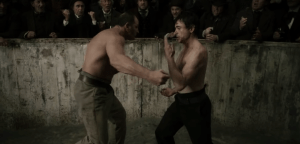
Sherlock Holmes, arena fight sceneA visual analogue is used in the 2009 and 2011 Sherlock Holmes films starring Robert Downey, Jr.  Unlike most other treatments of the character, Guy Ritchie’s version supposes that Holmes’ incredible intelligence can be used not only for logical deduction, but to predict with lightning speed how a hand-to-hand combat may develop.  Holmes thus becomes a ninja-like melee fighter, so effective as to confound all opponents.  The movie shows us this by slowing down the process that to Holmes is instantaneous:  we see a very short montage of positions and moves as they would occur, or could occur, before we see Holmes carry out the final “conclusion” of his martial reasoning.  This allows us to appreciate what the quasi-superhuman character is doing and why, without actually having to execute the same process ourselves.

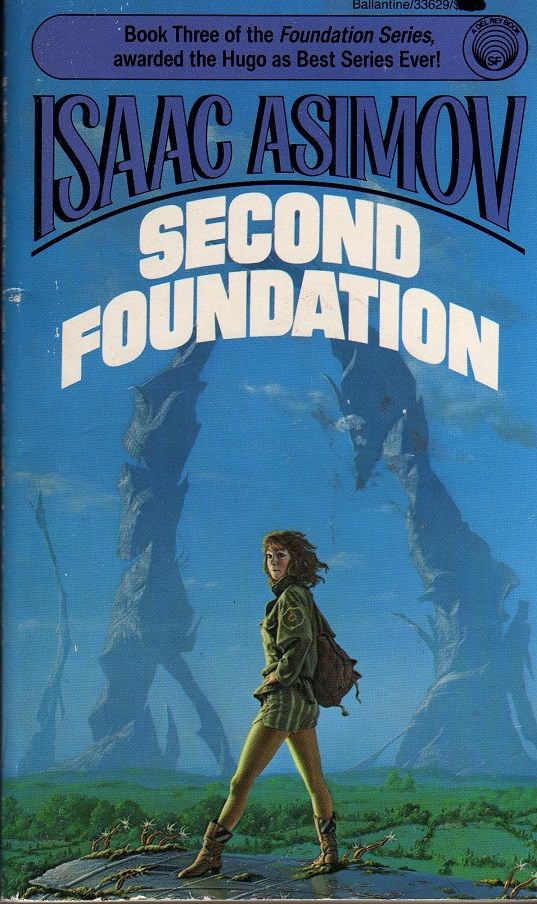
Preternatural intelligence may be more subtle in its effects.  Such a person may, for example, be able to understand things fully from what, to us, would be mere hints and implications.  So, for example, when Isaac Asimov introduces the members of the Second Foundation in his Foundation series, he tells us that their tremendous psychological training allows them to talk among themselves in a manner so concise and compressed that entire paragraphs require only a few words.

Speech as known to us was unnecessary.  A fragment of a sentence amounted almost to long-winded redundancy.  A gesture, a grunt, the curve of a facial line—even a significantly timed pause yielded informational juice.  (Second Foundation, end of chapter 1, “First Interlude,” p. 16)

Second Foundation coverBreaking the fourth wall, Asimov warns us that his account is “about as far as I can go in explaining color to a blind man—with myself as blind as the audience.”  (same page)  He then adroitly avoids showing us any of the actual conversation; instead, he says he’s “freely translating” it into our ordinary language.  This move illustrates one of the classic ways of presenting the incomprehensible in a story:  point out its incomprehensibility and “translate” into something we can understand.  (Note that this is much more easily done in writing than in a visual medium such as TV or the movies.)

A similar technique is used by Poul Anderson in his 1953 novel Brain Wave, which starts with the interesting premise that in certain regions of space, neurons function faster than in others.  When Earth’s natural rotation around the center of the galaxy brings it into a “faster” area, the brains of every creature with a central nervous system speed up, and human beings (as well as other animals) all become proportionately smarter.  Anderson notes that the speech of the transformed humans would be incomprehensible to us and, like Asimov, “translates” it for our convenience.  When a couple of the characters, in a newly invented faster-than-light spaceship, accidentally cross the border back into the “slow zone,” they are unable to understand the controls they themselves designed until the ship’s travel brings them out and lets their intelligence return to its new normal.  (Anderson’s concept may have been the inspiration for the “Zones of Thought” universe later developed in several fascinating stories by Vernor Vinge.)

Showing and Telling

We can glean some general principles from these examples.  If the extraordinary acts don’t actually have to be shown in the medium I’m using, I can simply point to them and tell the reader they’re there.  In a written story, I can say my main character is a world-class violinist without having to demonstrate that level of ability myself.  (Although if I have some experience in that particular art, I’ll be able to provide some realistic details, to help make my claim sound plausible.)  But if the supernormal achievement is something that can be shown in our chosen medium, we have to be able to demonstrate it:  a movie about the great violinist will have to exhibit some pretty masterful violin-playing, or those in the audience who know something about the art will laugh themselves silly.

Flowers For Algernon coverWe should note that there are good and bad ways of telling the audience about a character’s superiority.  In the unforgettable short story “Flowers for Algernon,” which consists entirely of diary entries by Charlie Gordon, the main character, the text vividly shows us the effects of an intelligence-raising treatment on a man of initially lower-than-normal intelligence.  The entries improve so radically in writing competence and understanding that when Charlie describes how his brainpower is beginning to exceed that of ordinary humans, we believe him, because we’re already riding on the curve of rising ability up to our own level that is apparent in the text—a true tour de force of writing.  On the other hand, in the drastically worse movie version, Charly (1968), the screenwriters are reduced to having Charly stand in front of an audience of experts and scornfully dismiss the greatest intellectual achievements from human history—a weak and ineffective technique at best for conveying superiority.

Summary

This quick review of the problem turns up several methods for handling supernormal abilities in a story.


  • If the superior ability is intelligible to us ordinary people in the audience—maybe it’s just doing normal things faster—we can have the wiser or super-enabled person explain it to someone less wise: our last post’s Ignorant Interlocutor.
  • If the advantage is mainly a matter of speed, we can slow it down to a speed at which regular people can follow the action.
  • If we can get away without actually showing the ability in question, we may be able to point toward it, or “translate” it into something we can understand, and convincingly tell the audience about it—if we can achieve the necessary suspension of disbelief.
  • If a character is supposed to be, let us say, preternaturally wise, and there’s simply no way to avoid showing that in the dialogue, the best we can do is to evoke the best we can do—have the character be as wise as possible—and imply ‘like this, only more so.’ This method—like “projecting” a line or a curve—is the method of “supereminence,” which is sometimes employed in theological talk about things that are inherently beyond our full understanding.


Kicking around this question makes us aware that portraying the more-than-human character is only a special case of a more general problem.  When our stories try to incorporate anything that’s indescribable, incomprehensible, how do we handle that?  Our F&SF stories frequently want to reach out beyond the boundaries of human experience, yet in a tale written for ordinary humans.  We’ll talk about the more general question next time.

The Ignorant Interlocutor

The Convenient Newbie

It helps to have someone to explain things to—especially if you’re writing fantasy or science fiction.

How do we introduce our audience to the world where our story takes place?  It’s something we have to think about even in a normal, contemporary setting.  We have to give a sense of where our characters are and what they’re doing there, even if the answers are as mundane as “middle America” and “going to work on a Monday.”  But this task is much more challenging if the setting is in the far future, or the distant past, or some entirely separate reality as in Game of Thrones.  The same problem applies in some degree in a historical novel, or a tale set in a very different culture.  How can we get readers or viewers acquainted with the milieu if much of it is unfamiliar?

Of course we can simply tell them about a setting directly:  “A long time ago, in a galaxy far, far away . . .”  But the audience won’t sit still for indefinite amounts of backstory before the main story gets going.  On the other hand, another time-honored F&SF approach is just to throw the reader into the deep end and let them swim.  But that makes for a steep learning curve, trying to absorb a lot of strange peoples and places and customs all at once.  The throw-them-in approach may discourage readers or viewers not by boring them, but by making them scramble to keep up.  Some will enjoy that challenge; but others may be daunted and close the book (or video).

One way to inform the audience is to make one of the lead characters an inexperienced person who doesn’t know much about their own world.  Other characters will have to explain to this person things that they know perfectly well, but that this character is unfamiliar with.  The “ignorant interlocutor” is a convenient stand-in for the reader, making the necessary exposition seem natural.

Some Convenient Examples

Frodo and Gandalf at Bag EndHobbits might have been designed specifically for this role.  The hobbits of the Shire are back-country unsophisticates, living quietly in a little country without much contact with the rest of the world.  Once they’re taken out of their homely environment into the wider world, Gandalf or Aragorn or someone frequently has to explain things to them, helping the audience get acquainted with Tolkien’s vast world and history—or, at least, with those parts that are important to the story.  (At the same time, we should note that Tolkien also uses other forms of exposition that no new writer could get away with nowadays.  The Lord of the Rings actually opens with a sixteen-page Prologue providing background on such essential matters as pipe-weed—followed shortly in Chapter Two by fifteen pages of explanation in which Gandalf instructs Frodo on the challenge they face.)

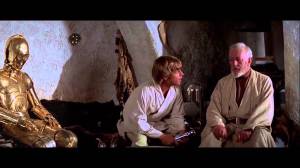
Luke and Obi-WanThe most well-known SF parallel is Luke Skywalker, the unsophisticated farm boy who is catapulted into galactic affairs by the death of his foster parents and the charismatic advice of Obi-Wan Kenobi.  When Obi-Wan tells Luke “You’ve taken your first step into a larger world,” he isn’t merely refering to the Force, but implicitly to Luke’s need to learn many things as he emerges from the backwater planet Tatooine.

We don’t see quite such an inexperienced protagonist in the other trilogies, with Anakin or with Rey.  By the time we see the prequel or the sequel trilogy, we’re already familiar with the Star Wars background, and not as much needs to be explained.  Interestingly, Lucas too adds a more artificial form of exposition, the screen crawl at the opening of each film, perhaps primarily for its nostalgia value.

An Earthly culture of another time period can be just as unfamiliar as an extraterrestrial.  Friday’s Child was the first Regency romance I read, and I found it a particularly good place to start.  The naïve heroine, Hero Wantage, marries the kind-hearted but rakish Viscount of Sheringham and is carried off into the whirl of London society, whose manners and mores are often peculiar to modern eyes.  We are introduced along with Hero to these rather arbitrary rules—if a carriage-race between females is high entertainment at a private country gathering, why is it a terrible social gaffe in public?—where her lack of understanding frequently lands her in a “scrape.”  Similar inexperienced heroines also appear in other Heyer stories, such as Arabella and Cotillion (in descending order of ignorance or naïveté).

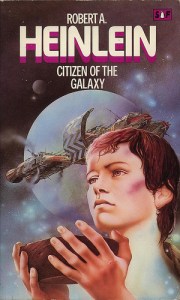
Citizen of the Galaxy coverA science-fiction example of the socially inexperienced character can be found in Heinlein’s Citizen of the Galaxy.  Thorby, the main character, must learn to copy with several unfamiliar environments in succession over the course of the story, but especially with the strict customs followed by the Free Traders, nomadic interstellar merchants.  An anthropologist traveling with the Traders to study their culture is invaluable in explaining these customs to Thorby—and the reader.

The ignorant interlocutor in Heinlein’s Beyond This Horizon, by contrast, is a minor character, “the Man from the Past,” who has been preserved from the present into the story’s centuries-later future by a time stasis field.  He comes into the story only briefly, but long enough for Heinlein to get in some exposition about facets of the future society that are well-known to the other characters, but need to be explained to the archaic survivor.

A more well-known Heinlein story, Stranger in a Strange Land, uses space—and species—rather than time as the cultural differentiator.  Michael Valentine Smith, the “Man from Mars,” is a human being raised from infancy by Martians.  Many of the most interesting parts of the story show Mike trying to grapple with human customs when he arrives back on Earth as a young man—which also allows Heinlein to make satirical commentary on these peculiar creatures, the humans.

Some Storytelling Advantages

Having someone to explain things to is helpful because dialogue is often a better way to present information than authorial lecturing.  A scene in which our puzzled naïf asks questions and gets answers—or makes mistakes and is corrected—is easier to make interesting.  These interactions can accomplish other things at the same time.  The way a conversation goes can reveal character and show relationships developing.  It can be mixed with action—characters talk while they’re hiking, exploring a wrecked spaceship, dancing.

Making one character’s knowledge limited similarly allows us to avoid the dreaded “As you know, Bob” problem, in which characters tell each other things of which they are already well aware, to educate the reader at the expense of in-story plausibility.  (The term comes from the Turkey City Lexicon, a guide to F&SF tropes for use in writing workshops.)  TV Tropes has a particularly good discussion of this whole issue.

Where to Find Them

If we want to include an ignorant interlocutor in a story, what kinds of situations might naturally produce this sort of character?

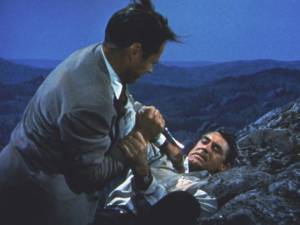
North by Northwest, Mt. Rushmore fightYouth and inexperience tend to go together; and a curious child can serve the purpose (perhaps a precocious child, who is uninformed but capable of grasping the explanation once offered).  TV Tropes’ term is “Little Jimmy.”  But the explainee may also be a competent enough adult who has simply been thrust into a situation or milieu they’re not ready for.  Cary Grant’s character Roger Thornhill in North by Northwest is a good example:  he may be a fine advertising executive, but the world of international espionage is new to him.  Captain Pausert of James Schmitz’s classic SF novel The Witches of Karres is an expert ship-handler and a pretty effective trader, but the young witches need to bring him up to speed quickly when he gets involved in Karres business.

The innocent naïf who needs to be told how the world works is another category, particularly if the story is going to deal with gritty realities.  Several of our examples above count, and we might also mention yet another Heinlein character (he was fond of the trope), Max in Starman Jones, who’s described by Wikipedia as “a farm boy who wants to go to the stars” and learns the ropes from the cynical rogue Sam Anderson.

The uninformed party may also be the student of a new art—the beginner or newbie.  Harry Potter is new to the wizarding world and has to have all kinds of things explained to him, including his own backstory.  In Anne McCaffrey’s YA novel Dragonsong—one of the best of the Dragonriders of Pern books, in my opinion—it’s musicianship that young Menolly is learning as she’s suddenly brought into the Harper Hall’s training program.  Captain Pausert’s induction into Karres witchery reflects some similar elements, in a very different situation—learning on the fly rather than in a structured environment.  The character’s new situation may involve learning the art itself, or the folkways of the school, or both.

Sherlock Holmes and Doctor WatsonFinally, one of the functions of the sidekick can be as a foil to whom the principal character can explain things.  Robin has played this role for Batman—at least in the wacky 1960s TV series.  A classic case, of course, is Holmes and Watson; TV Tropes even dubs such an character The Watson (“the character whose job it is to ask the same questions the audience must be asking and let other characters explain what’s going on”).  Master detectives, who are supposed to be smarter than the audience, form fertile ground for such relationships:  Archie Goodwin, who is no dummy, regularly receives nuggets of wisdom from his immobile employer Nero Wolfe.

Finally, the person who graciously explains things is often a mentor figure—the wise or knowledgeable one, a Gandalf or an Obi-Wan, the polar opposite of the uninformed interlocutor.  When the mentor’s job is primarily to educate the main character, this may explain why the mentor is around early in the story, but may disappear or become unavailable when the action starts to heat up.