Little Did I Know

Foreshadowing

Stories vary in how they hint at what’s to come.  “Foreshadowing” provides the reader with more or less vague clues about things that will happen later on.  As the Wikipedia article notes, even the title of a chapter or an entire work can give us such a hint.  (I once changed the title of a novel—House of Stars, currently seeking a publisher—because the original working title gave away too much of the plot.)

One particularly overt way of foreshadowing is to have the narrator tell us straight out about something they didn’t find out until later.  I think of this as the “little did I know” trope, based on the hackneyed formula for introducing such a hint in old-time books.  That method strikes me as rather heavy-handed, and I’m dubious about whether it’s really a good idea.

”I Was Soon To Find That Out”

Stranger in a Strange Land, coverA classic example occurs in Heinlein’s Stranger in a Strange Land (1961).  Mentor-figure Jubal Harshaw (not the titular Martian), as a side business, ghost-writes the kind of ‘confessional’ novels popular in the early twentieth century.  Every now and then in Stranger, he’s motivated to dictate a bit of purple prose for such a tale.  So in ch. 17 (p. 157 in my battered old paperback copy), we hear, as part of the opening for “I Married a Martian”:  “In those carefree childhood days I did not dream to what strange bittersweet fate my tomboy ambition would . . .”

The fragmentary example is classic because it’s supposed to be a sample of hack writing; Harshaw is contemptuous of the potboilers he turns out.  Of course, not every “little did I know” example needs to be so trite.
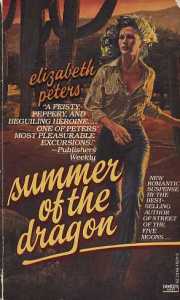
Summer of the Dragon, coverRomantic suspense novels are given to this trope, since a primary purpose of the foreshadowing is to build anticipation and suspense.  For example, Elizabeth Peters was a master of the witty, light-hearted romantic suspense story.  In Summer of the Dragon (1979), we see a whole series of such hints.

It was like a game.
But it wasn’t a game, and I was soon to find that out.”  (ch. 7, p. 150)

I know now what it was that woke me at the crack of dawn next morning; but at the time I was amazed at myself.  (ch. 9, p. 181)

Every passing moment made me more and more uneasy; it was as if some part of my mind knew something awful was about to happen, something I couldn’t prevent.  (ch. 9, p. 194)

The fact is, my compassion was stupid.  I didn’t know how stupid until it was almost too late  (ch. 10, p. 213)

If I believed in premonitions I would claim that I knew the next day was going to see some sort of climax.  Since I don’t believe in them, I will only claim I was nervous.  (ch. 11, p. 249)

“My second impulse canceled the first; and I still maintain, in spite of what resulted, that it was a rational decision.”  (almost at very end:  ch. 12, p. 285)

After being hit over the head repeatedly with such ominous notes, one feels they’ve begun to lose their effectiveness.  And, although the individual lines are well written, the cumulative effect is to give the story a sort of “pulp” atmosphere.  In fact, that may have been just what the author was going for.  (Her laugh-out-loud description of the cover of a Gothic romance at the beginning of The Camelot Caper shows that she knew exactly what she was poking fun at.)

Some authors are particularly fond of this technique.  Andrew Greeley, for example, regularly warns us that something bad’s going to happen.  In A Christmas Wedding (2000), the hero and heroine agree that her father is a sick man, and the hero adds:  “And, as we would later find out to our dismay, dangerous too.”  (ch. 19, p. 235)  In a later book in the same series, September Song (2001), ch. 5 ends bluntly with:  “The future would be a lot worse than I expected.”  Oddly enough, in many cases the foreshadowing seems to overstate the result:  what ultimately happens is less awful than we’ve been led to expect.

Medusa in the Graveyard, coverThe “little did I know” trope isn’t confined to older works.  Emily Devenport’s fascinating Medusa in the Graveyard (2019) seems to concentrate such hints in the midsection of the story:  “That was about to change, but I didn’t know it” (ch. 14).  “I didn’t know we were about to be confronted by . . .” (ch. 14).  Or, deploying one of my favorite stock phrases:  “Famous last words” (ch. 15).

As the examples indicate, this particular type of open foreshadowing by the narrator tends to occur especially in first-person narratives.  It can also be used in the third person (“Little did she know…”), but in that case the quasi-presence of a narrator other than the main character becomes apparent—almost like “breaking the fourth wall.”

Similar Techniques

There are less obvious methods than “little did I know” to telegraph what’s coming up in a story, sharing some of the same weaknesses and strengths.

When the Fellowship of the Ring reaches Lothlorien, Frodo sees Aragorn lost in memory of meetings with Arwen there in days long past.  He comes out of his reverie and, taking Frodo’s hand, “left the hill of Cerin Amroth and came there never again as living man.”  (end of Book Two, ch. 6, p. 367)  We wonder whether this third-person statement by the narrator means that Aragorn will die on the quest.  But that doesn’t happen.  (I think everyone is familiar with that spoiler.)  Aragorn survives; but there’s no particular reason why he should come back to that particular spot (unless he and Arwen wanted to reminisce on their honeymoon), and it happens that he never does.  When we reread the story, we may wonder why Tolkien makes such a point of telling us that Aragorn doesn’t come there again “as living man,” when nothing comes of it.  (We’re not told that he visits as a ghost, either.)

We see a similar effect when an author doesn’t merely hint at, but shows us, the future:  when a story starts at a later point and ‘doubles back’ to earlier events.  This is a classic technique, as for example in The Aeneid; the fact that the story opens with Aeneas telling Dido about his escape from Troy means that we don’t have any suspense about whether he escapes when we later read those scenes.  But sometimes the later-placed-earlier scene seems to be designed to set up our expectations, more or less explicitly.
Red Sister, cover

First volume of Book of the Ancestor

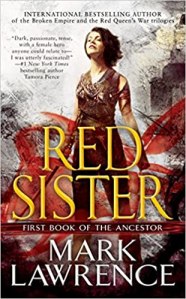
For example, in Mark Lawrence’s Book of the Ancestor series, the very first book of the trilogy suggests that certain things are going to happen before the end.  But (minor spoiler here) that scene, which is presented in several places during the story, is always incomplete and carefully limited; and when it finally occurs, the context makes it quite different from what we were led to expect.  I found myself feeling that the author had sort of cheated – although that didn’t diminish my enjoyment of the story; it led me to wonder whether the foreshadowing scenes were really necessary at all.

In the limiting case, any first-person story gives us a pretty good idea that the narrator will survive at least to the end of the story, as noted in TV Tropes’ article on First-Person Perspective.  Although it’s been known to happen that the hero dies at the end; the tale may conclude there, or may drop back to a third-party coda for the conclusion.

Similarly, the spoiler effect is already present in any classic tale where one already knows the conclusion—the Arthuriad, for example.  Most ancient literature was written this way; Homer’s readers already knew that Troy lost the war.  In such cases, our anticipation is not to learn the outcome of the story, but to find out how the author is going to get us there—as is also the case with many genre stories, such as romances and mysteries, and with historical fiction.

The Function of Foreshadowing

As noted above, foreshadowing of any type serves the purpose of shaping our expectations and building suspense.  The mere glimpse attracts more attention than a complete revelation—a principle every fashion designer knows.  The Wikipedia article also suggests that foreshadowing can make later events seem more plausible, since we’re already conditioned to expect them.

Plausibility can also be served by the lampshading function of a character’s anticipatory retrospective reflections.  When Peters’ heroine in Summer of the Dragon comments on her own reaction—“ my compassion was stupid.  I didn’t know how stupid until”—we are a little less inclined to excoriate the character for being an idiot, since the reflection makes clear that they now know they were an idiot.

So, if “little did I know” has legitimate functions, what’s the problem with it?

Looking Through a Character’s Eyes

Woman sits on wall looking out over a city

Viewpoint
(Image by Pexels from Pixabay)

There’s a strong trend these days toward choosing the viewpoint of a story to encourage the reader to identify as closely as possible with the main character(s).  If a story isn’t told in first person, then one is advised to use “close” or “deep” third person, where the reader’s point of view is tightly limited to that of a particular character.  There may be more than one viewpoint character, but while we’re in a given person’s head, we see only what they see, know only the things they know, experience their feelings as we face their challenges with them.

Presumably this is intended to make the reading experience more engaging and immersive.  The frequent use today of present tense (“I open the door”) rather than the usual “narrative past” (“I opened the door”)—for example, in the Hunger Games trilogy—appears to be another means to the same end.

Now, I’m not slavishly devoted to the “close third” option.  Plenty of the stories I read growing up were told in “omniscient” third person, where the author felt free to give the reader information the characters were not privy to.  In the lost world-ship story Orphans of the Sky, for example, Heinlein fills us in on things that the characters, given the boundaries of their experience, cannot understand.  Or consider Victor Hugo’s notorious disquisition on the Paris sewer system in Book the Second of Volume Five in Les Misérables.  I’m comfortable with a more ‘distant’ viewpoint; I can read The Silmarillion as well as The Lord of the Rings.

The Downside of Knowing
Image of eye, shadowed

Image by Helmut Strasil from Pixabay

But to my mind, the heavy-handed “little did I know” sort of foreshadowing does tend to pull one out of the story.  We now know something the viewpoint character doesn’t; we are no longer sharing their feelings in the moment, but rather their retrospective evaluation based on later knowledge.  We are not quite in the internal time of the story, but viewing it sub specie aeternitatis, from a point of view that is not time-bound.  This distances us to some degree from the story.

The specific foreshadowing typical of these hints, as distinct from a general air of ominousness, builds dramatic tension; but it also reduces surprise.  Of course, this kind of surprise is lost the second time you read any book.  We already know what’s going to happen.  Still, the building up of expectations proportionately reduces even the apparent freshness of the experience when the foreshadowed event finally takes place.  We may find ourselves thinking more about the later events that are being implied than being “mindful” about the current action.

That diversion from the ‘narrative present’ may be particularly distracting when we don’t feel that the author makes good on the implied threat of the foreshadowing.  If we’re told that something terrible is in the offing, and then it turns out not to be so bad after all, we may feel disappointed or cheated.  Greeley’s stories are especially subject to this problem; on the second read-through, we may feel we’re being manipulated when the author earnestly warns us to expect something awful, but we know the outcome won’t live up to the warning.  After a while, we may begin to take the author’s insinuations with a grain of salt, since we know their habit of overthreatening and not delivering.

The not-delivering can actually be a relief, rather than a letdown:  ‘Whew, that wasn’t as bad as I thought it was going to be.’  That reaction makes me ambivalent about the faux foreshadowing.  The release of dramatic tension in a positive way may be as satisfying as the fulfillment in a negative way.  Perhaps overthreatening actually is a useful device—particularly if we want the reader to be relieved rather than appalled.

My sense, in the end, is that “little did I know” is a technique to be used with care.  Foreshadow away; but be sure of exactly what you’re trying to achieve and how the language used will accomplish it.

The City as Character

In some fantasy or science fiction stories, a city actually is a kind of character.  The clearest example—as the title indicates—is N.K. Jemisin’s 2020 novel The City We Became. (Page references are to the hardcover edition, New York:  Orbit, Hatchette Book Group, 2020.)

Since I need to discuss some details of the novel to make the necessary points, I’m flying a

Spoiler Alert!

However, I’ll try to keep actual story spoilers to a minimum.

The City We Became

Jemisin gives the premise, as quoted in a review:  “The city of New York comes to life—literally, as in, the city has developed sentience and an ability to act on its own.”  This quickening takes place through the medium of human avatars.  The city chooses a human being to be “its . . . midwife.  Champion.”  (The City We Became, p. 304.)  In the case of New York, there are actually six avatars:  one for each borough, and one for the city as a whole.  (305)

The City We Became, coverHow does this happen?  A “real city” will “make a weight on the world, a tear in the fabric of reality” (7).  This metaphysical weight comes from the accumulated “strangeness” of the people who come there (8).  A city’s unique load of strangeness—its identity—isn’t a pre-established thing; it develops over time.

[Cities are] organic, dynamic systems.  They are built to incorporate newness.  But some new things become part of a city, helping it grow and strengthen—while some new things can tear it apart.  (46)

This incorporation of newness is especially true of New York.

The city needs newcomers!  He belongs here as much as anyone born and bred to its streets, because anyone who wants to be of New York can be!  (47)

Even the legends and lies about the city contribute to its essence, its distinctive identity—what makes it a “real city.”  (166)

The broader reality in which the weighty essence of a city tears a hole is an alternate-worlds multiverse (165-66).  Not only are there many worlds:  “Imagining a world creates it, if it isn’t already there” (302)—a kind of World as Myth notion.

The tearing isn’t purely benign.  The “hole” that “punches through” actually causes harm:  “The process of our creation, what makes us alive, is the deaths of hundreds or thousands of other closely related universes, and every living thing in them.”  (306)  In that somewhat curious postulate, the story reflects the popular contemporary focus on the destructiveness of progress or expansion.

The newborn New York has an Enemy:  a type of city so alien as to be fundamentally at odds with human cities, which wants to invade our world.  Several characters refer to the anti-city as an “eldritch abomination,” a term characteristic of H.P. Lovecraft and similar early twentieth-century horror writers.  (16-17, 38, 167-68)  But New York also has allies, elder siblings, such as São Paulo in Brazil, and Hong Kong.  Apparently there’s even a community of cities (“the Summit”).  (10, 21-22)

We will hear more about this:  there’s going to be a series, in which this novel is billed as “Great Cities #1.”  The novel itself was developed from Jemisin’s short story “The City Born Great,” a Hugo award winner for 2017, which constitutes the prologue to the novel.  It’s “urban fantasy” in the strongest sense.

The aspect on which I want to focus is that distinctiveness, a civic “personality,” is what makes a city alive.  Thus, in the opposite direction, the Enemy gains a foothold through the interpolation of chain businesses like Starbucks.  “They’re destroying everything that makes New York what it is, replacing it with generic bullshit.”  (357)  The avatars constitute—or express—the “spirit of the place,” the genius loci.

The Personalized City

It’s not unheard of in F&SF to give a city consciousness, though seldom in so full-tilt a manner as Jemisin’s.

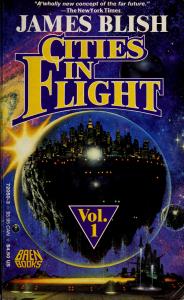
Cities in Flight, coverIn James Blish’s Cities in Flight series, much of the action centers around the star-traveling city of New York.  New York aloft has a perpetual Mayor, John Amalfi, and a City Manager, Mark Hazleton (in the last two books).  But it also has a “server farm” of a hundred-odd computers which collectively make up “the City Fathers.”  That term, generally applied to municipal officials of some venerable sort, indicates authority.  But the balance of power among the Mayor, the City Manager, and the City Fathers is rather complicated.  Amalfi generally gets his way, but sometimes this involves working around the City Fathers—on one occasion, turning them off completely for a period.

While the City Fathers might be considered an intelligence for the city as a whole, they’re not much of an intelligence by modern standards.  Rather, they come across impersonally, a 1950s idea of what a giant computer would be like:  a pure logic.  Their dialogue is rendered in all capitals in the text.  Blish lampshades this typographical indicator in A Life for the Stars (1962), where young Chris DeFord reflects on first acquaintance:  “. . . he would never have mistaken it for a human voice.  Whatever the difference was, he thought of it as though the device were speaking all in capital letters.”

Thus Blish’s City Fathers are almost the polar opposite of Jemisin’s cities:  impersonal and generic rather than distinctive.  In a similar way, while Blish gives some details about the flying city of New York—naming subway stops and the like—he never makes the city “come alive” even in the merely literary sense, to my mind.  The focus is all on the human characters; the city is simply part of the landscape.

An entirely different tack is taken by Anne McCaffrey and S.M. Stirling in  The City Who Fought (1993).  This novel belongs to McCaffrey’s “shellperson” or “Brain & Brawn Ship” series, which originated with the stories collected in The Ship Who Sang (1969).  Here, infants with severe physical disabilities but competent brains may become

an encapsulated ‘brain,’ a guiding mechanism in any one of a number of curious professions.  As such, [they] would suffer no pain, live a comfortable existence in a metal shell for several centuries, performing unusual service to Central Worlds.  (The Ship Who Sang, first page)

Most of the Brain & Brawn stories are about shellpeople who are the animating controllers of spacecraft.  In The City Who Fought, however, we see a case of a “brain” partner who inhabits a space station, rather than a ship.  In that sense, Simeon, the hero of the novel, can be seen as the persona or “soul” of a spaceborne city.  But since the shellpeople are in fact normal human beings, in terms of their minds and personalities, the unique character of the city reduces to the uniqueness of any human being.

Presence

A city can also have a presence, a kind of personality, without actual consciousness.

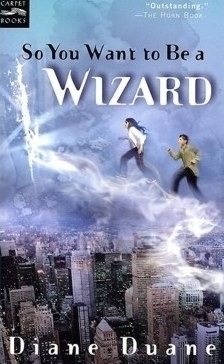
So You Want To Be a Wizard, coverIn Diane Duane’s So You Want To Be a Wizard (1983, rev. ed. 2012), the heroes are translated from their familiar New York City to an alternate, darker New York:  “a shadowed island prisoned between chill rivers and studded with sharp spikes of iron and cold stone” (ch. 2, p. 65).  In this dark-side version, machines like taxicabs are sentient (and vicious); even common objects like fire hydrants are alive.  The character of alternate-NYC is evident from its dramatic contrast against the everyday version in which the rest of the story takes place.  The characters can feel the foreboding threat of the place even before they begin to run into hostile beings.

Charles Williams employs a similarly alternative London in All Hallows Eve (1945).  Here, however, the effect is the reverse of Duane’s.  The main character, a young woman who has recently died, finds herself in an uninhabited alternate London redolent of peace and a mysterious overawing holiness. Meanwhile, ordinary London, including her friend and widowed husband, is threatened by a black magician.

In Williams’ presentation, the city does exert a kind of agency:  the last chapter is titled “The Acts of the City.”  Here, though, the city acts rather as a conduit for the divine than through a consciousness of its own.  Its specific order has numinous importance.

This was a regular theme in Williams.  His friend C.S. Lewis observed:

Williams was a Londoner of the Londoners; Johnson or Chesterton never exulted more than he in their citizenship.  On many of us the prevailing impression made by the London streets is one of chaos; but Williams, looking on the same spectacle, saw chiefly an image—an imperfect, pathetic, heroic, and majestic image—of Order.  (C.S. Lewis, “Williams and the Arthuriad,” in Taliesin Through Logres, The Region of the Summer Stars, Arthurian Torso (1974), p. 289)


The City as Background

In most stories, a city is not so literally personified as in the above examples.  Normally its “personality” merely serves as a colorful background setting, giving a story or series a distinctive flavor based on the milieu.

G.K. Chesterton observes somewhere that in Charles Dickens’ novels, London is practically a character in itself.  It’s not that London is somehow animated or ensouled; it’s that the locale is described with such well-observed detail that it plays as central a role in the story as the actual characters do.  As Lewis noted above, a number of Chesterton’s own stories evoke a similarly distinctive London.  While Chesterton does not provide the wealth of detail Dickens does, the same affectionate appreciation for the city is expressed in a more impressionistic fashion.

Rex Stout’s numerous Nero Wolfe detective stories perform the same service for New York.  Narrator Archie Goodwin is constantly running around the city, intimately familiar with its nooks and crannies, and as we follow him, it begins to seem a familiar place to us too.  Well-known landmarks, both real and fictional, help give the place a sense of concreteness and aid our suspension of disbelief.

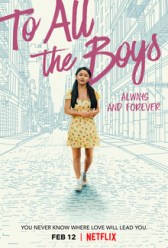
To All the Boys: Always and Forever, movie posterMore recently, in the Netflix movie To All the Boys: Always and Forever (2021), high school senior Lara Jean Covey “falls in love” with New York on a school trip.  Her attraction to the place is strong enough to lead her to change her college plans and throw her romance into disarray.

Interestingly, in the book, it was the University of North Carolina at Chapel Hill that attracted Lara Jean’s attention.  UNC-CH also has a nice campus, but the screenwriters seem to have felt that New York would be a more obvious candidate—and we can see why.  Some cities are famous for having more “pull” (or, as Jemisin put it, “weight”) than others.  I recall that, when I was going to law school in Cambridge, two friends were talking about going down to “the city,” and I was puzzled why they’d make such a big deal out of running across the river to Boston.  But that wasn’t the city they meant.  They were New Yorkers; even if you’re next door to another big city, “THE City” is NYC.

The Black God's Drums, coverOf course, it needn’t always be New York.  Most of Andrew Greeley’s novels are set in Chicago; and by the time you’re read a dozen or so, Greeley’s particular version of Chicago has “come alive” as much as New York.  I have a notion that The Black God’s Drums (2018), by P. Djèlí Clark, was aiming to do something similar for New Orleans, although one can’t go as far in a single novella as one can in a whole series of novels.

The Small Town

If big, brawling cities like New York or Chicago or New Orleans can become characters in their own right, what about small towns?  Certainly a story often invites us to become attached to a small town in the same way that we are to these big cities.  The question, I think, is whether we can find the same sort of distinctiveness in a habitation built on a smaller scale.

In Hallmark romances, we are constantly being introduced to a cozy, adorable small town, usually the site of a struggling local business.  We’re meant to find this municipality lovable and charming.  In most cases, though, the locations seem to be too generic to attract our interest.  The bakeries and bookstores and Christmas tree lightings all seem to blur together after a while.  True, these short films don’t have much time to develop an elaborate background identity.  But that’s not the only factor—because some two-hour films do manage to make a small town real.

Doc Hollywood movie posterMy favorite example is Doc Hollywood (1991), in which Michael J. Fox, a newly-minted doctor on his way to a high-paying plastic surgery job in L.A., gets stranded in Grady, South Carolina.  The whole story is about whether Fox’s character Ben Stone will shake the dust of Grady off his feet as soon as possible and decamp to the big city, or decide he likes it where he is.  For this to work, the town has to be vividly realized.  The actors, director, writers, and composer do a nice job of showing us enough quirky characters and local traditions to convince us that Stone’s inevitable decision makes sense.  Other rom-coms like Murphy’s Romance (1985) and Coffee Shop (2014), in my view, pull off the same trick.

For a more bookish example, we can look at Jan Karon’s long-running Mitford series (1994-present).  The dozen or more stories set in the village of Mitford, North Carolina (the first of which is tellingly titled At Home in Mitford), afford plenty of scope to develop the landscape, landmarks, quirky characters, and history of this hill-country locale to the point where it becomes a familiar retreat one can revisit at will.  As in Jemisin’s New York, it’s primarily the people who make the town what it is.

Conclusion

It appears that both big cities and small towns can become distinctive enough to rise to the level of being a quasi-character (or sometimes an actual character) in a story.  But the end results are different.  The big city tends to be distinctive by being roaring and stimulating; the small town, by being homelike and comforting.  It would be interesting to see if those characteristics could be reversed:  a cozy metropolis, an exciting village.  But those two types of place may be inherently linked to the number of citizens.  We can think of the reversal as a challenge for future writers.

Writing a Series

This week we have a guest post from Beth Overmyer, author of The Goblets Immortal, mentioned in our last episode.  The sequel to Goblets hits the stands on February 16.  It’s thus a timely moment to take a look at the special complications of writing a series.

Take it away, Beth!

Writing a Series — Beth Overmyer

There are many things to take into consideration when writing a series. Will it be two books (a duology)?  Or maybe it’s going to be a serial, books that pick up right after one another and could be slapped together as a single volume (The Lord of the Rings, anyone?)  How do I keep track of all my information?  Where do I even get started?

Let’s start at the end . . . of the first two books in a trilogy, that is.

Endings

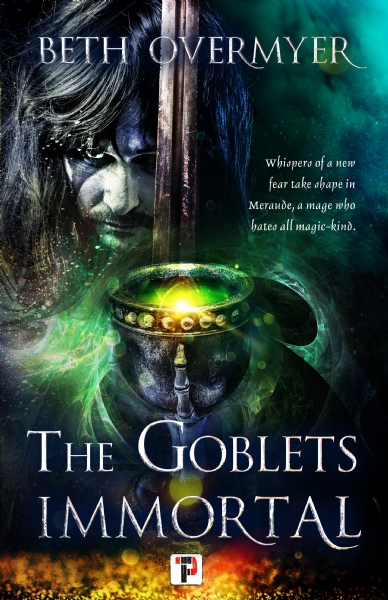
The Goblets Immortal, coverSome writers advocate that it’s important to know where your book/series is headed.  If you aim at nothing, they reason, that’s what you’ll get.  Knowing the ending of the series before you pen page one of book one can be helpful and gives you something to reach toward.  When I was writing The Goblets Immortal books, however, I had only a distant idea of what I was aiming toward.  Not necessarily a clear target, but an emotional note I wanted to end on.

There are different types of endings, and each book in the series might have a different one.  Book one might be a HEA (happily ever after) or a HFN (happy for now), while book two might be a cliffhanger, and the final book might end in a tragedy.  I don’t necessarily recommend this path, however.  Despite liking surprises, readers also tend to want consistency from the author.

And I don’t recommend making every book a cliffhanger.  A lot of readers don’t like them.  A cliffhanger, of course, leaves the characters in a crisis.  The reader might be frustrated that they have to wait a whole year (or more!) to find out what’s going to happen next.  Also remember your genre’s expectations.  Fantasy endings can vary, but a romance or F&SF romance needs a HEA or a HFN.

Let’s take a look at the endings of one series’ first and second installments.

Star Wars, Episode IV:  A New Hope

The end of the story sees the episode’s main conflict resolved (the Death Star is blown up), but there are enough loose ends (Vader’s alive, the Emperor’s out there, Imperial Troops abound) left to keep things open for future installments.  Yet this movie could very much be a standalone.  Many Book Ones wrap things up to a greater degree than Book Two.

Star Wars, Episode V:  The Empire Strikes Back

The near-end offers up a few surprises, but the very end (Han is spirited away on a bounty hunter’s ship) sets up the opening conflict for the next movie.  This movie is less of a standalone, but it could be watched and understood without watching the first movie.

Series Bible

“But how do I keep track of all my information?” I hear you ask.  A very good question.  One simple way to solve this:  reread the first book/s in your series before you write the next installment.  Not only will this give you a refresher course on the details of the story, it will put you back in that world and remind you of the voice you’re writing in.

Series bible for The Goblets ImmortalAnother way to keep track of information is to make a series bible.

It’s impossible to keep every detail about every character (appearance, personality, catchphrases, etc.), location, event, and timeline in your head . . . especially if you’re a pantser or plantser and haven’t written all the details out.  Once book one’s been written, it might be a good idea to put together what is known as a series bible.  In fact, it might be better to develop one as you go along.

A series bible is a document full of details from the books in a series. When you have a question about a character’s appearance, flip back to their page and look it up. Forget the name of a town? Flip back to the locations section of your bible.

When I started writing book two in The Goblets Immortal series, I already had notes on each Goblet Immortal, what that Goblet did, where it originated, where it was at the end of book one, and other important details.  I also had a few character notes.

Getting Started

We’ve looked at endings and keeping track of details.  But how does a writer even get started with a series?

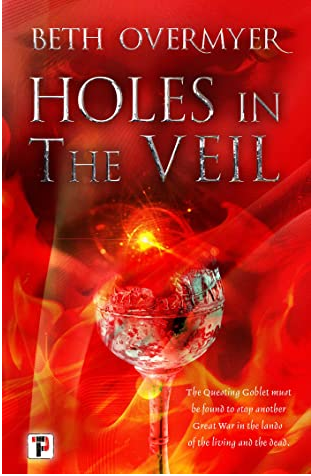
Let me start by giving you permission:  you are allowed to write out of order.  If you have an idea for a scene later down the road, jot down notes or go right ahead and write.  You can always revise it Holes in the Veil, coverto fit your opening better later on.

As with writing any other book, follow your preferred method.  Are you a plotter?  Write an outline for book one, and jot down notes for the books that will follow.  Are you a pantser?  Roll up your sleeves and dig in.  Plantser (a mix of a plotter and a pantser)—jot down some notes and get started writing.

The best thing to do, besides getting some experience under your belt, is to read and study other series.  What did you like about your favorite trilogy?  What made you stop reading your least favorite one?  Don’t make their mistakes, but emulate their triumphs—without outright copying, that is.

Another word of advice: keep a running list of questions that need to be answered in later books.  If a missing magical knife is mentioned in book one but is not referenced again in book two, remind your audience of it before its grand appearance in book three.  I have a document titled “Loose Ends,” and I highlight things in green once I’ve taken care of them.  Things I’ve mostly taken care of, I highlight in yellow.  Things that I’ve decided to let go of, I cross out.

Conclusion

So, there you have it. There are some good resources out there on series writing, though not as many as you would think. For your reading pleasure, might I suggest trying:  How to Write A Series:  A Guide to Series Types and Structure plus Troubleshooting Tips and Marketing Tactics (Genre Fiction How To Book 2) by Sara Roset, and Writing the Fiction Series:  The Complete Guide for Novels and Novellas by Karen S. Wiesner.

Thanks, Rick, for hosting me!

Keep your nose in a book and your pen on the page,
Beth Overmyer
Beth’s Web Site

VOTE!

Representation

In America, we have a presidential and congressional election coming up in November.  I want to take a moment out to incite every American to vote.

Every now and then, it’s helpful to remind ourselves of first principles.  In a democratic polity—a “republic” in the sense used in American law and political theory—the people of the polity govern themselves.  (Please note that these terms are “small d” democracy and “small r” republic.)  The way we do this, in a representative government, is to elect representatives.  Since those representatives make most decisions as to law and government, voting in elections is the primary way in which we govern ourselves.  It’s kind of a big deal.

The Crucial Hero(es)

In America, voter turnouts, even in presidential elections, tend to be relatively low.  Why would people skip their key chance to take charge of their government?  I suspect much of this failure to take part in governing ourselves stems from a combination of things:  inertia (it takes some little trouble to register and vote), plus a pervasive sense that my one vote doesn’t affect the outcome.  Why make the effort if it doesn’t matter?

The logical flaw in this understandable attitude is that things can matter in the aggregate, even if any one item is not the sole decisive element that changes the outcome.

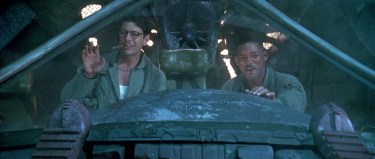
Will Smith and Jeff Goldblum deliver the virus in Independence Day (the movie)The stories that inspire us, and help form our attitudes, tend to undermine this recognition and subliminally support our reluctance to participate.  A story is more dramatic if everything comes down to the actions of one, or a few, people.  If James Bond doesn’t pull off this next stunt, the World Will Come To An End.  Will Smith and Jeff Goldblum, alone, deliver the computer virus that takes down the mother ship in Independence Day, which conveniently disables all the rest; the entire tension of the plot is funneled through that one bottleneck, as it were.  A few superheroes save the universe—well, half of it—in the Avengers movies.  In Netflix’s just-released Enola Holmes movie (mild spoiler), the heroine’s actions save the one person who casts the deciding vote on a British reform act.  We love this trope.

The desire to make everything come down to a few people’s desperate actions can even warp the adaptation of a story.  A number of small, but annoying, changes in the plot of Peter Jackson’s Lord of the Rings movies seem to stem from a tendency to have every crucial point depend on the actions of the nine members of the Fellowship.  For example, in the books, the Ents meet and decide the time has come to attack Isengard.  In the movies, the Ents decide not to act—until Pippin and Merry maneuver Treebeard to where he can see Saruman’s wanton destruction of the forests (on the absurd assumption that the Shepherd of the Trees didn’t know about that already).

Pippin lights the beaconIn the books, Denethor sensibly sends a messenger from Minas Tirith to Rohan to call for help.  But the movies leave it to Gandalf and Pippin to fire up a beacon that transmits the call to Rohan.  (The fact that the lighting of the beacons is one of the most terrific scenes in the whole series doesn’t entirely mitigate the plot diversion.)  When the Corsair ships sailing up the Great River to Minas Tirith turn out to contain relief for the city rather than further invaders, the movie makes this just Aragorn, Legolas, and Gimli, along with the faceless army of the Dead—rather than a whole array of human reinforcements from South Gondor, as in the books.

Aggregates and Bottlenecks

But when we return to the mundane world, we have to put aside this tempting way of telling a story.  We don’t often see this pattern of world-saving heroic acts.  We find instead that crucial changes depend on the combined actions of innumerable people, all doing the right (or wrong) things.

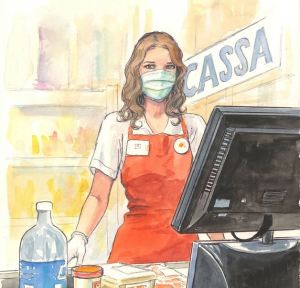
Milo Manara honors heroic women

Milo Manara honors heroic women

The present moment can provide us a heightened appreciation of these unnoticed individual actions.  The early days of the COVID-19 pandemic saw an outpouring of support rightly directed to the unsung heroes—doctors and nurses and medical technicians, grocery store clerks, people who make toilet paper—unsung because they are too many to spotlight individually.  (Although individual acts of appreciation are still a just way to honor those continuing acts of undemonstrative service.)  Indeed, everyone has to act in concert if the pandemic is to be contained.

Peter Jackson’s Gandalf gets the underlying point right in one of the Hobbit movies:

I have found it is the small things, everyday deeds of ordinary folk, that keeps [sic] the darkness at bay.  Simple acts of kindness and love.  (The Hobbit:  An Unexpected Journey (2012), at about 1:42)

We must all be heroes now.

Of course, going in and making some marks on a piece of paper doesn’t feel much like heroism—even less so than wearing a facemask.  Perhaps it feels a little more dramatic when we’re braving the chance of coronavirus infection to cast our ballots.  And if that way of viewing our action as a daring deed spurs us to act, by all means indulge!

But in this kind of case, the only way to achieve anything is by small actions, each of which contributes to a whole.  The entire set makes a difference; but there can’t be an entire set unless there are individual acts.  In voting, as in picking up one’s trash, or in the innumerable actions that make up a free market, we must carry out the individual actions to produce the aggregate effect.

Turning the Tide in Real Life

If we need further encouragement, we can look to the additional fact that even one vote, or a few, can sometimes make the crucial difference.

Virginia Board of Elections draws lots to decide tied electionRight here in Virginia, we had an election in 2017 that resulted in a literal tie:  an equal number of votes for each candidate.  A purely random action had to be used to break the tie.  “Each candidate’s name was placed in a film canister; those were then placed into a bowl and one name was drawn.”  (NPR, 1/4/2018)

Even a few votes, even one, can make the critical difference, as recounted here and here—notably including “the year 2000 U.S. presidential election, decided by a few hundred votes in the state of Florida”  (Jared Diamond, Collapse:  How Societies Choose to Fail or Succeed (2005), “Further Readings” for ch. 16, p. 556)  Over and above my contribution to the whole, I cannot know in advance whether my vote might not be, in fact, the deciding factor in a hotly contested election.

Moreover, even if the outcome of an election might be clear without my vote, adding to the total is not pointless.  In today’s atmosphere of distrust and suspicion, the clearer and more decisive the result, the less opportunity there will be to cast doubt on the results.  Every vote added to the total reduces the number of people who will be convinced that the results are false, and thus directly supports the rule of law.

This concern also bears on the notion of voting for a third-party candidate.  In the upcoming election, many people may be sufficiently dissatisfied with both major parties to be motivated to cast their ballots for a third-party contender.  It might feel virtuous to spurn both parties and “vote one’s conscience” in favor of a candidate who cannot win.  But in practice, that action will only serve to make the results less clear, at a time when clarity is vitally needed.

L’Envoi

Voting is much trickier—even perhaps a heroic act, as noted above—in these pandemic times.  Nevertheless, there are avenues available by which all of us can safely exercise the franchise.

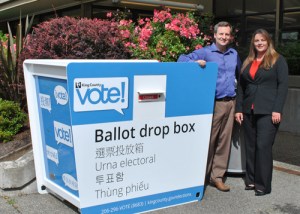
Drop box for ballotsFor my own locality in Virginia, here’s a guide to voting early, voting by mail, and voting on Election Day.  The local paper has a Web site on How to Vote, by state; I haven’t researched that reference in detail, but it may be useful.  Here are three articles on drop boxes for ballots.

I urge every eligible voter to take part in this crucial action of self-government.  Unless you’re actually in the hospital in a coma (or the like), there’s no excuse not to participate.

Human Extraterrestrials

Introduction

Even though science fiction is often focused on the future, its assumptions are tied to the present.

Aldrin descends from Apollo 11In some respects this is obvious.  A story about the near future can become dated by history itself.  Every SF story prior to 1969 that describes the first moon landing in detail (happy 51st anniversary, last week!) is obsolete.  And every story that predicted a smooth reach out into colonizing the solar system directly after that first landing, unfortunately, is also defunct.  Stories can also be rendered unbelievable by scientific advance:  all the delightful tales based on a habitable Venus or Mars are gone with the, er, vacuum.

But there’s also a subtler way.  Even though F&SF specialize in examining our assumptions about the universe, the assumptions that seem plausible shift over time.  Fashions change.  To take a heartening example:  SF stories from the late 1940s and the 1950s tended to take it for granted that there would shortly be a nuclear world war.  (Hence it’s spot-on characterization when the 1955 version of Doc Brown in “Back to the Future” accepts Marty’s recorded appearance in a hazmat suit as logical because of the “fallout from the atomic wars.”)  But for over seventy years, we’ve managed to avoid that particular catastrophe.

One assumption that’s always intrigued me is whether we are likely to meet people like ourselves—and I mean, exactly like ourselves—on another planet.  If we discovered an Earthlike planet of another sun, might we climb down the ladder from our spaceship to shake hands with a biologically human alien?

Not Really Alien

I’m talking about a “convergent evolution” hypothesis—the notion that the human species might have developed independently more than once.  And, incidentally, the standard biological definition of “species” as “interfertile” (a more precise definition can be found on Wikipedia) is what I’m using here; because, obviously, one of the potential uses of the assumption in a story is to make possible a romance between two characters from different worlds, and romance is not unrelated to sex and reproduction.

The Cometeers coverSo we want to set aside, to begin with, a class of stories in which people from different planets are all human because they have a common ancestry.  For example, in Jack Williamson’s classic space opera The Cometeers (1936), Bob Star finds his true love Kay Nymidee among the human subjects of the decidedly nonhuman masters of an immense assemblage of space-traveling planets, the “comet.”  But the reason there are human beings present is that a research ship from Earth was captured by the Cometeers long ago, and these are the descendants of the crew.

It’s not uncommon for the inheritance to work the other way around.  David Weber’s “Mutineers’ Moon” (1991) starts with the eye-opening assumption that our Moon is actually a long-inert giant spaceship—and reveals that the humanity of Earth is descended from the original crew members of that spaceship.  Thus, it’s perfectly plausible when hero Colin MacIntyre falls for a preserved member of the original crew; they’re from the same stock.  Similarly, in at least the original 1978 version of Battlestar Galactica, the human survivors of the “rag-tag fugitive fleet” are human because Earth itself was one of their original colonies, which apparently fell out of touch.

The Era of Planetary Romance

In the early days of modern SF—say, from about 1912 through the 1930s—it was commonly assumed that the answer was yes:  human beings (with minor variations) might be found independently on other planets.  Arguably, this may have been because the early planetary romances—melodramas set on exotic worlds, heavy on adventure and love stories—were less interested in science than in plot devices.  But biology was less advanced in those days; recall that DNA was not identified as the basis of genetic inheritance until 1952.  It’s easy to forget how little we knew about things we take for granted today, even in relatively recent periods.

A classic early case is that of Edgar Rice BurroughsBarsoom.  In A Princess of Mars (1912), Earthman John Carter is transported by obscure means to Mars, called by its inhabitants “Barsoom.”  Those inhabitants include the nonhuman “Green Martians,” but also people identical to humans in several colors, particularly the “Red Martians” among whom Carter finds his lady-love, Dejah Thoris.  As a Red Martian, Dejah is human enough for Carter to mate with, and they have a son, Carthoris, thus meeting the “interfertile” criterion.

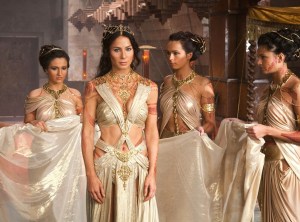
Lynn Collins as Dejah Thoris in John Carter of Mars

Lynn Collins as Dejah Thoris

To be sure, the biology here is a little mysterious.  Dejah looks entirely human, and even, to borrow a Heinlein phrase, “adequately mammalian” (see, for example, Lynn Collins’ portrayal in the loosely adapted movie John Carter (2012)).  But Martians don’t bear their young as Earth-humans do; they lay eggs, which then develop for ten years before hatching.  It’s not easy to imagine the genetics that could produce viable offspring from an individual whose genes direct live birth and one whose genes result in egg-laying.  But that didn’t stop Burroughs.

E.E. Smith, whose initial SF writing goes back just about as far as that of Burroughs, was willing to accept this trope as well.  In The Skylark of Space (published 1928, but written between 1915 and 1921), our intrepid heroes travel to a planet inhabited by two nations of essentially human people—although the double wedding in the story does not involve any interplanetary romances, but is between two pairs of characters from Earth.  Smith’s later Lensman series (1948-1954), which features one of the most diverse arrays of intelligent creatures in SF, also allows for apparently interfertile humans from a variety of planets.  My impression is that this sort of duplication was also true of some of the nonhuman species in the Lensman unverse—there might be, say, Velantian-types native to planets other than Velantia.

This approach wasn’t universal in old-time SF.  The more scientifically-minded John W. Campbell’s extraterrestrial character Torlos in Islands of Space (1930) was generally humanoid in form, but quite different in makeup:  his iron bones, for instance.  It’s been argued that a roughly humanoid form has some advantages for an intelligent species, and hence that we might find vaguely humanoid aliens on different planets—though this is pure speculation.  But “humanoid” is a far cry from biologically human.

Darkover Landfall coverWe see some persistence of this tradition into the second half of the twentieth century.   Marion Zimmer Bradley’s iconic planet Darkover, for instance (first novel published 1958), is populated by the descendants of Terran humans from a colony ship and also by the elf-like indigenous Chieri, who, despite minor differences like six fingers and golden eyes, not to mention the ability to change sex at will, have interbred with the Terran immigrants.

An interesting variation can be seen in Julian May’s Saga of Pliocene Exile (first story published in 1981).  When modern humans are sent on a one-way trip into the distant past, they are enslaved by the Tanu, aliens from another galaxy who have settled on Earth.  The story indicates that the Tanu were specifically searching for a place where the local gene pool was similar to theirs—which might also account for why they came all the way from another galaxy (also a somewhat antique trope) to get here.

It’s slightly odd that, even where basically identical human beings turn up on other planets, other animals never seem to be similarly duplicated.  On Burroughs’ Barsoom, one doesn’t ride horses, but thoats; is menaced not by tigers, but by banths; and keeps a calot, not a dog, as a pet.  In a planetary romance or science fantasy setting, one is less likely to see Terran-equivalent fauna than parallel creatures with exotic names and slight differences—whence the SF-writing gaffe “Call a Rabbit a Smeerp” (see TV Tropes and the Turkey City Lexicon).

At the Movies

The all-too-human trope is carried on into the present day in video media—movies and TV.  Again, this may be partly because the science is often subordinated to the plot; but the cost and difficulty of putting convincing nonhuman characters on-screen is surely another factor.  Filmmakers’ ability to depict exotic creatures, however, has changed immensely in the last forty years, to a point where almost any imaginable creature can be created if the budget is sufficient.  Thus, the original Star Trek series of the 1960s stuck largely to slightly disguised humanoid aliens, perhaps relying on the ‘universal humanoid’ hypothesis mentioned above, while later series were able to branch out a bit.  Similarly, the Star Wars movies could readily give us nonhuman characters like Jabba the Hutt, Chewbacca, and C3PO; they, too, grew in variety as the capabilities of CGI and other techniques expanded.

Jupiter Ascending movie posterStill, it may be harder for us to adjust to interactions among characters where we can see their nonhumanity, rather than just reading about it.  So we still tend to see extraterrestrial humans on-screen.  The Kree in Captain Marvel (2019), for example, are indistinguishable from humans—an actual plot point, since this makes it possible for Yon-Rogg to tell Carol that she’s an enhanced Kree rather than a kidnapped human.  The Kree do have blue blood, in the movie; it’s not clear what kind of biological difference (hemocyanin?) might result in that feature.  We also see a number of alien humans in Jupiter Ascending (2015), though I think of that tale as a deliberate throwback to pulpish science fantasy or planetary romance.

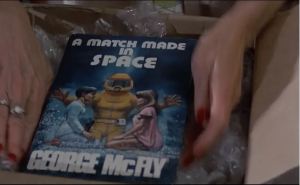
A Match Made in Space, fictional coverI keep wanting to cite the fictional novel written by George McFly as shown in the closing scenes of Back to the Future, “A Match Made in Space,” since the cover seems to suggest an interplanetary romance (and one thinks of George as a nerdy romantic); but it isn’t actually clear whether that’s the case.  All we have to go on is the title and the cover, and that could just as easily depict a match between two humans, fostered by an alien matchmaker (or vice versa).

The Modern Era

We don’t see nearly as many extraterrestrial humans in modern SF, and for good reason.

The more we understand about genetics, the less likely it seems that another human species, so closely similar as to be interfertile, could evolve independently.  What we know about evolution suggests that there are just too many random chances along the way—cases where the prevailing mutations might have turned out differently.  Even if we assume that humanoid form is probable, why not have six fingers, or hemocyanin rather than hemoglobin?  While I’m not well enough educated in biology to venture any actual probabilities, I think our growing sense of the complexity of the human body and its workings, over the last seventy years or so, has simply made it seem vanishingly unlikely that an independently evolved intelligence would come out that close to the human genotype.

For example, the scientifically-minded Arthur C. Clarke depicted a galaxy in which each intelligent species, including humans, was unique:  The City and the Stars (1956, developed from an earlier story published in 1948).  In one of the unused story fragments he wrote while working on 2001:  A Space Odyssey (1968), his hero, well along on his journey into mystery, thinks:

He did not hesitate to call them people, though by the standards of Earth they would have seemed incredibly alien.  But already, his standards were not those of Earth; he had seen too much, and realized by now that only a few times in the whole history of the Universe could the fall of the genetic dice have produced a duplicate of Man.  The suspicion was rapidly growing in his mind—or had something put it there?—that he had been sent to this place because these creatures were as close an approximation as could readily be found to Homo sapiens, both in appearance and in culture.  (Clarke, The Lost Worlds of 2001, ch. 39, p. 220)

Contemporary SF writers who are really adept at building interesting and coherent aliens—David Brin and Becky Chambers, to name two of the best—give us a wide range of wildly exotic creatures from other planets, but not humans.

The Uplift War, coverIf we are still fond of the idea of interplanetary romance, we might find a possible work-around in the shapeshifter.  The Tymbrimi female Athaclena in Brin’s The Uplift War (1987) uses her species’ unusual abilities to adjust her appearance closer to that of a human female—but of course she has an entirely different genetic heritage, as that ability itself demonstrates.  The result wouldn’t meet our criterion of interfertility, no matter how close the similarity in physical structure.  To adjust one’s genes in the same way would be another order of change altogether.

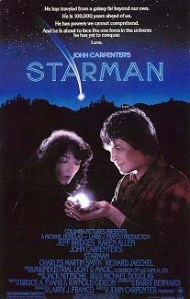
Starman movie posterThe 1984 movie Starman, in a way, plays off this idea.  The alien in this case is apparently an entity made of pure energy, without a physical structure of its own.  Using hair from the female lead’s deceased husband, it creates a new body with a human genetic structure.  The two do, eventually, prove to be interfertile.  If we’re willing to accept the notion of an energy being in the first place, this approach is actually more plausible than, say, mating with the oviparous Dejah Thoris.

If one were writing a SF story today, it would be rash to assume that Earthborn characters could run across independently evolved humans elsewhere.  The idea may not be entirely inconceivable.  But it’s out of fashion for good reasons.  Attractive as the notion of interplanetary romance may be, at this point we’d best confine it to the kind of case noted above, where some common ancestry—no matter how far-fetched—can account for the common humanity.