Ends of Eras

Part of the journey is the end.
—Tony Stark

“The Saga Comes To An End”

We have a lot of extended stories coming to a close this year.  At this writing, eleven years of Marvel Cineverse movies have concluded with Avengers:  Endgame.  It won’t by any means be the last Marvel movie—we’ll see many of these characters again—but the overall story that began with Iron Man in 2008 has reached its end.  The TV series Game of Thrones released its finale on May 19, 2019.  In December, we anticipate the conclusion of the Star Wars trilogy of trilogies (The Rise of Skywalker).

On the book side, David Weber’s Honor Harrington series (she first appeared in 1992) arrived at a conclusion of sorts with Uncompromising Honor (2018).  There are plotlines still unfinished, and Honor herself may reappear in later stories, but it seems clear her personal narrative arc has closed.

Even a blog post by the FCC’s General Counsel, of all things, has given a nod to this convergence of endings.

I’m going to assume it’s coincidence that these sagas of different lengths are finishing up together.  It does seem like a good moment, however, to reflect on what the resolution of these stories says to us.

(Miraculously, this post seems to have managed to avoid any actual spoilers for Endgame.  But please note that the links, if you follow them, are full of spoilers.)

 “A really long story”

The fact that we have all these long-running series, by itself, brings up some topics that are familiar in this blog.  For instance, it confirms that readers and viewers of our own era are not as lacking in attention span as pundits might claim.  An article by Douglas Wolk, the weekend of Endgame’s release, was titled:  “Americans crave complex ideas.  Just look at the Marvel universe.”

Wolk credits Stan Lee and Jack Kirby, back in the 1960s, with bringing extended stories spanning multiple magazines to comic books.  He notes also that such vast tapestries draw us together by giving us shared topics to talk about:  “to be drawn into conversation to understand them better”—to share reactions, insights, theories about stories that “mean more to us together than alone.”  I can testify to this, as a veteran of many an animated office conversation on what was so good about Captain Marvel or whether people were satisfied with the ending of GoT.

A wide-ranging story also satisfies our appetite for visiting a fully-realized world.  This is the value of what Tolkien called “Escape” in his pivotal essay On Fairy-Stories—the refreshing sense of leaving our ordinary world temporarily behind to immerse oneself in a new and different world.  It was Tolkien who (in the Foreword to The Lord of the Rings) gave his primary motive as “the desire of a tale-teller to try his hand at a really long story”—but who is also one of the great worldbuilders.

The Craving for Epics

But these aspects mostly reflect the sheer size of the saga.  More to the point, perhaps, is that many of us also share an appetite for what we might call the epic:  a mighty struggle in which one side is clearly fighting for something worthwhile, and gains some success, as distinct from a tragedy.

Not everyone has this taste:  some of us prefer more limited stories about individual people’s fates (for example, in the romance genre), or stories that disdain the whole good-versus-evil business as insufficiently gray.  And some massive sagas fit the epic pattern better than others.  Game of Thrones is notorious for its ambivalent characters and refusal to grant unambiguous victories.  Still, from what I hear, the finale did at least bring the Westeros civil war to an end, and (mirabile dictu) many of the more decent characters survived.

Mark Ruffalo (who plays the Hulk), discussing the Avengers movies, said:

You also see the power of storytelling.  One thing I think about these movies that’s really exciting is they’re forward-leaning in the narrative of good versus evil.  We’re able to transcend some of the divisive narratives that are happening now.  (Quoted in Anthony Brezican, “All for One,” Entertainment, April 19/26, 2019, p. 20.)

It’s fascinating to hear a good-versus-evil narrative described as “forward-leaning,” after so many years in which such stories have been derided as passé.  But the remark has further implications.  It matters how things come out in the end—good, bad, or mixed.  And this means there has to be an ending in which some kind of resolution occurs.

Letting a Story End

I can’t really evaluate a story until I’ve seen how it comes out.  I’ve seen stories that were pretty off-putting in the early stages, but managed to redeem themselves at the end.  And I’ve seen some that seemed promising, but ended in a way that ruined everything that had come before.  One is reminded of the ancient adage about a human life:  “Call no man happy before his death, for by how he ends, a man is known” (Sirach 11:28; Aristotle discusses a similar statement by Solon in Nicomachean Ethics I.10).  Since a person’s life is a story, the connection makes sense.

That a story needs an ending might seem a truism if it weren’t that we have lots of stories that don’t end.  For example, comic books and soap operas (“daytime drama”) go on indefinitely, as long as people are willing to read or watch.  The occasional subversion of this pattern is noteworthy for its rarity—for example, the story in Kurt Busiek’s Astro City comic where a costumed hero called Jack-in-the-Box, himself a son who has taken on his father’s hero identity, deliberately trains a successor to take over the role (“Father’s Day,” in Astro City:  Family Album (1999)).

In more conventional literature and movies, we find other timeless, perpetual characters.  The irascible detective Nero Wolfe figured in tales spanning the period from 1934 to 1975, without major changes in his age or situation, despite the major changes in world events and American culture over that time.  The character’s fixity is actually kind of appealing; it seemed odd when a later Wolfe book written by Robert Goldsborough shows Wolfe’s sidekick Archie Goodwin using a computer in place of his trusty typewriter.  Similarly, P.G. Wodehouse’s Bertie Wooster survived innumerable scrapes and confusions from 1923 through 1974, with similarly unsettling chronological consequences (Bertie encounters a protest march in one of the later books).  In the movies, James Bond has eternal life, though actors may come and go.

Dragonflight coverBut barring these iconic perennial characters, a series that goes on indefinitely without an ending—or past its ending—is in danger of becoming humdrum.  When Anne McCaffrey started her Dragonriders of Pern series in 1967, the charcters were fighting the periodically recurring scourge of “Thread,” but aspired to find a way to end it once and for all.  In All the Weyrs of Pern (1991), they actually accomplished that goal.  That wasn’t the end of the stories; almost twenty other Dragonrider books have been published since by McCaffrey and her children.  But I found that I lost a good deal of my interest once the driving force of the original plot ended.  It was always pleasant to visit Pern, but the motivation of an ongoing plot was absent.

This may be a personal predilection; it may account for why I have difficulty staying interested in a TV series for very long.  The exceptions occur where the ongoing character or story arcs are sufficiently compelling to keep me engaged.  The Good Place, for example, achieves this by turning into a quite different kind of story in each of the three seasons so far, but with continuing characters who still seem to be reaching toward an end.  Chuck succeeded in a somewhat similar way, but the original premise was clearly played out by the last half-season; it was a good thing the series ended when it did.  When even a major movie comes across as “just another episode,” that’s a buzz-killer for me.

Closure and Continuation

Theatre critic Ann Hornaday focused on the virtues of conclusion in an excellent article upon the release of Endgame.  One such virtue arises from the very existence of an overall arc, and the associated worldbuilding:  “When contemporary experience seems to be composed of narratively nonsensical shocks to the system, the attraction of coherent, well-constructed alternative realities cannot be underestimated.”  Moreover, a good long story can engender a powerful sense of fulfillment, of achievement, from the closure of an appropriate ending.  It’s worth keeping mind that the word “end” means not just where something stops, but also a goal toward which we strive.  A fitting close is a good thing even if the ending also involves dealing with death—“absence and interior loss,” as Hornaday puts it.

As noted above, the conclusion of an iconic hero’s story is unusual enough that to see such a character retire and reach an end is both somber and refreshing.  We hate to see them go, but if they’ve lived a full life, we feel a kind of elegiac nostalgia.
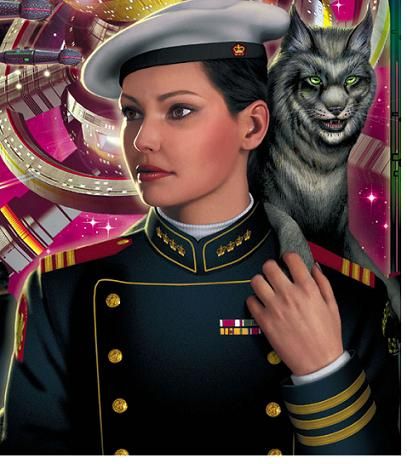
This works best when the world goes on, but new characters take over—just as in real life.  It won’t surprise anyone that some of the heroes in Endgame do reach their ends; others continue.  Honor Harrington retires, but her successors will carry on while she finally enjoys the fruits of a well-earned victory.  As readers and viewers, we ought to be willing to let a beloved character go.  This reluctant release may be echoed in the story itself.  When one of the characters in Endgame tells another that it’s okay for them to go, it reminded me of what I said to my own mother, at the hospice staff’s suggestion, when she was ready to die.

While we love our heroes, the hero’s journey does have an end (which need not be death; the cited Wikipedia page labels it “The Crossing of the Return Threshold”).  We need that fitting closure to make a good story.

Is it unrealistic to expect neat endings that wind up lives, or at least careers?  Not really.  The wise Sam Gamgee was right to suggest that the great stories never really end (The Two Towers, Book IV, ch. 8); and as Bilbo said, “the Road goes ever on” (The Fellowship of the Ring, Book I, ch. 1).  But the episodes, the substories that make up those grand tales, do have their moments of closure.

We do achieve or complete things, sometimes.  We go through high school or college, and then graduate (mostly).  After a courtship, we marry—which starts a new story.  Elsewhere I’ve quoted Alasdair MacIntyre to the effect that in Jane Austen’s novels, marriage occupies the place of death in real life—an ending we don’t move beyond.  Yet we do move on; and the milestone event is no less an achievement because another phase of the story continues afterward.  “Each happy ending’s a brand new beginning.”  We need both closure and continuation.

This duality is most prominent when one person’s arc winds down and others begin.  It’s not just one story with its phases and milestones, but a vast array of overlapping stories.  Everyone has a story, and they are all woven together.  “In the plan of the Great Dance plans without number interlock, and each movement becomes in its season the breaking into flower of the whole design to which all else had been directed” (Perelandra, ch.17).

So we celebrate the closing of these mighty sagas, and we look forward to the new stories that will follow them.
Temporary Death

Back from the Dead

Bringing back the dead is a tricky business, story-wise.  For a major character to die adds gravitas.  It gains our sympathy; it makes us take the story more seriously.

But in adventure stories, characters who die have a pretty good chance of turning up again later.  This has become such a convention that we are often adjured not to assume someone’s dead unless you actually see the body.

There’s a strong temptation for a writer to save a beloved (and sometimes lucrative) character; yet the return undermines the impact of the death.  Are there ways to manage that dilemma?

The White Rider

Gandalf faces Balrog with sword and staffThe theme of one who was dead who turns up alive has a very long history—as we may note particularly in this Easter season.  For the literary trope, however, I think of Gandalf in The Lord of the Rings as the the ur-example.  Gandalf’s loss is appalling for the reader, and his reappearance is a classic example of the sudden turn beyond hope that Tolkien called “eucatastrophe.”

LotR comes early enough in the history of modern high fantasy that it may have been unexpected, at that time, for a character to really die and then come back.  Merely apparent death is much more common—even in LotR.  An article I read once observed how frequently someone is thought to be dead in the course of the story.  For example, Aragorn thinks Frodo has been killed by an orc-spear in the Mines of Moria (Book II, Ch. 5).  Sam assumes Shelob has killed Frodo, when in fact the spider has merely put him into a coma (Book IV, Ch. 10).  Éomer believes Éowyn is dead, but when she’s borne back to the city she is found to be alive (Book V, Ch. 6).  Et cetera.

Gandalf the WhiteGandalf, on the other hand, really does die at the end of his extensive combat with the Balrog.  But this isn’t as fatal as it seems.  Gandalf is a semi-divine spirit, one of the Maiar, and his mission in Middle-Earth is not yet complete.  He says:  “Naked I was sent back—for a brief time, until my task is done” (Book III, ch. 5).  The “naked” is not simply a bodily description.  In passing “through fire and deep water,” he has given up his old self, Gandalf the Grey, and become an elevated version, Gandalf 2.0, the White Rider.

This is perhaps one clue as to what makes a return from death succeed, in a narrative sense.  It isn’t easy, and it isn’t trivial.  Gandalf’s being “sent back” is extraordinary, and it changes him in deep ways.  To my mind, this death-and-reversal add to the depth and power of the story.

The Descent into Routine

Unfortunately, that’s not always the case.  If the return is taken for granted, then we aren’t moved or edified by the dying.  We don’t believe it in the first place.  In fact, reading or watching a death we know is reversible tends to make us cynical.  The writers are playing on our emotions, and we feel manipulated rather than moved.

Batman and Wonder Woman mourn SupermanIn the 2016 movie Batman v Superman:  Dawn of Justice, Superman dies at the end.  Did anyone believe for a minute this death would last?  No one is going to kill off such an iconic character.  If nothing else (here’s the cynical part), the future income stream from Superman stories is an irresistible lure.  Just as with the comic-book “Death of Superman” sequence from which the idea was taken, I suspect my reaction was shared by many:  here’s a cheap trick to get our attention.

To be sure, there are some affecting moments in the transition from BvS to Justice League (2017), in which Superman is revived—partly because reviving him is arduous and difficult, as further discussed below.  But those moments are not easily attained.  The artifice is too transparent.

Westley recovers from death with Inigo and FezzikI have somewhat the same reaction, for a different reason, to The Princess Bride—one of the flaws in that admirable tale.  Goldman’s narrator makes a great deal out of telling his son (in the movie, grandson) that Westley dies (ch. 6).  Really.  He’s not faking.  And naturally, the boy is outraged.  The hero isn’t supposed to die!  Yet he did.  —But no, the author has tricked us.  Westley isn’t really dead.  Miracle Max tells us, “there’s different kinds of dead:  there’s sort of dead, mostly dead, and all dead.  This fella here, he’s only sort of dead . . .” (ch. 7).

That’s cheating.  We may be willing to accept the trick in The Princess Bride because it’s already such a roaring stream of clichés, so enthusiastically devised and appreciated that we never do take the story quite seriously.  But we aren’t really moved.  Our appreciation is of a different order:  we’re laughing fondly at the author’s willingness to indulge with such unreserved gusto in the most absurd fairy-tale stereotypes and gimmicks.

If we’re commenting on Batman v. Superman, we really ought to say something about Avengers:  Infinity War/Endgame.  But it’s too soon—too many spoilers.  Maybe another time.

Variations

Incidentally, the routine return can apply to villains as well as heroes.  A hero’s recurring nemesis may also be an iconic character, and the fact that the nemesis keeps coming back is a convention we rather enjoy.  TV Tropes refers to it as “Joker Immunity.”  Superman’s Lex Luthor, Spider-Man’s Green Goblin, the Fantastic Four’s Doctor Doom:  if any of them appear to be dead in the comic books, we can be pretty sure they’ll be back.  On the other hand, movie series don’t run on forever in the same way that comics series do.  The screen adapters of Spider-Man can thus afford to “expend” the Goblin, or Dr. Octopus, because they’re only going to make three or four films in a given series.  There isn’t time for repeated recurrences of an arch-enemy.

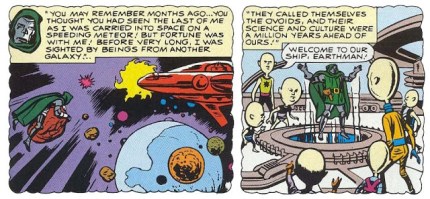
Doctor Doom is rescued by the Ovoids

On the other hand, it’s notorious that we hear Emperor Palpatine’s sinister laughter at the end of the most recent Star Wars IX trailer (4/12/2019). immediately following Luke’s voiceover line, “No one’s ever really gone.”  Some movie series do go on that long . . .

Once revival has become routine, it’s a noteworthy exception when an author is willing to let a main character go permanently (Killed Off For Real; see a list of film examples, and also the trope Deader Than Dead).  J.K. Rowling, for example, killed off Albus Dumbledore for good, well before the end of the Harry Potter saga.  Veronica Roth’s Divergent series allows the heroine herself to die at the end, though this seems to have been omitted from the corresponding movie.

In Star Wars, the regular appearance of “Force ghosts” provides a sort of compromise.  The fallen heroes don’t come back to life, but they do hang around to provide advice, commentary, and snarky explanations.

The Search for Spock

Let’s return to an instance where a temporary death does work to see if we can determine what makes that possible.

Spock's death in Star Trek 2Along with LotR, my other go-to example is Star Trek II:  The Wrath of KhanWrath is generally considered to be among the best of the Trek movies (for example, here, here, and here), and a sizable part of its draw is the death of the beloved Spock.  Like Gandalf, Spock perishes heroically, subjecting himself to a fatal overdose of radiation to make a crucial repair that saves everyone else on the Enterprise.  And his loss is fully realized by his long-time friends, along with the new characters we’ve just gotten to know.  Maybe I’m sentimental, but Kirk’s eulogy at Spock’s funeral has always struck me as a genuinely moving moment.

At the same time, there was no doubt in my mind when I first saw the film that Spock would be back.  The whole atmosphere of the final scenes in Wrath—hopefulness so intense you can almost taste it—lent itself to anticipating eucatastrophe rather than a final end.  The shiny “casket,” nestled in the burgeoning growth of the Genesis planet, seemed to promise some kind of resurrection.  What made us feel Spock’s death so effectively, even though we were morally certain we’d see him again?

Part of it is that these characters had had such a long history together.  We’d seen their relationship grow over three TV seasons, and we’d been recently reminded of that history in the first Star Trek movie, flop though it was.  To the numerous loyal Trek fans, at least, these were truly iconic characters, and we were emotionally invested in them.  The history had built up a kind of emotional potential that the death sequence could draw upon.

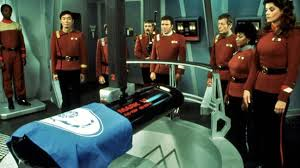
Spock's funeralEven more important, the other characters were visibly affected.  They didn’t know Spock would be back.  We grieved for Spock through his friends.  The screenwriter and director wisely gave us enough time, in the final sequences, to absorb and appreciate that grief with the other characters.  I suspect this, more than anything, is what makes a provisional death effective:  a powerful portrayal of other people’s response to the loss.

Finally, the heroism of Spock’s final acts, and the overwhelming sense of something wonderful that’s been achieved on the Genesis planet at the end, lend depth and further feeling to the event.  We respect his sacrifice, and it means something.  The hope for new life doesn’t necessarily erode the gravity of the death.

Moreover, the sequels navigated the difficulty pretty well.  Star Trek III:  The Search for Spock did unavoidably undercut the resolution of Wrath a bit.  The Genesis planet is unstable; it isn’t quite as wonderful as we thought.  The adversaries in Search are much more mundane than Khan (who had his own history with the Enterprise crew).  And the death isn’t permanent.

Yet the complex, gradual, effortful reconstitution of Spock manages to become something wonderful in itself, rather than just a reversal of the loss.  The notion that Spock’s katra or spirit survives adds an element of the mystical or sublime to the science-fiction texture of the series.  The notion that it survived in McCoy’s head gave the situation humor and irony.  The unconventional expedients the Enterprise crew must use to get McCoy back to Genesis provide both adventure and a maverick sense of, well, enterprise.  Meanwhile, the scenes of Spock’s body re-growing from childhood to adulthood as accelerated by the Genesis effect have their own sense of wonder.

Spock is rebornWhen the Vulcan ceremony of reintegration rejoins Spock’s spirit with his body, the impact of the result is heightened by the fact that Spock is clearly changed by his passage through death.  (The final film of the trilogy, Star Trek IV:  The Voyage Home, continues this theme by showing Spock visibly struggling to get used to life again.)  The return, which takes two whole movies to complete—a quest in itself—is far more than a handwave.  It’s an achievement.

Conclusions

From these examples I think we can pick out some factors that help a story to make good use of a temporary death, as opposed to a routine we-know-they’ll-be-back.

  • The death is heroic; it means something.
  • We care about the lost person—and so do the other people in the story.
  • The other characters experience the death fully, even if the reader or viewer knows that it won’t be permanent.
  • The deceased character is absent long enough to let the loss sink in.
  • The deceased character earns the return. It doesn’t come easy.
  • The returned character is transformed in some way by the experience.

When an author can incorporate these elements, we the audience can extend our “willing suspension of disbelief” to sympathize with the rest of the cast in their loss, even when we are aware in propria persona that the beloved dead aren’t gone for good.

The Animal Sidekick

Introduction

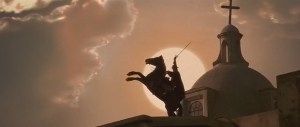
Zorro on Tornado, against the moonThe hero of a story is frequently attended by a loyal beast of some sort.  Pirate captains have their parrots.  Roy Rogers had his sturdy steed Trigger, and Zorro relies on his horse Tornado—a mount he went to some pains to acquire, for example, in The Mask of Zorro (1998).  Ron Stoppable, sidekick to teenage hero Kim Possible, had his own companion in a naked mole-rat, Rufus.  The Stark siblings in Game of Thrones (I finally got around to watching the first episode last week) each have a direwolf.  For those who remember the 1950s TV series, we might also instance Timmy and Lassie (though in that case arguably Lassie was the lead and Timmy the accessory; she did get top billing).

In fantasy and science fiction, however, such accompanying creatures often get a significant upgrade.  A F&SF character’s animal assistant may be enough of an independent character to be a genuine companion, rather than merely a pet—occasionally rising almost to the level of the more familiar human sidekick.

Quasi-Intelligent Companions

Science fiction and fantasy elements allow for semi-sentient or semi-intelligent versions of what would otherwise be considered pets.  They’re not equal to their human masters—at least not as a rule (see below)—but they’re not just brute animals either.

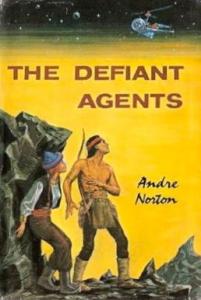
Defiant Agents coverAndre Norton’s SF novel The Defiant Agents (1962) provides a good example.  When a group of Native American colonists is sent to found a habitation on a far-off planet, with them is a pair of enhanced coyotes.  Norton gives the backstory this way:

. . . The coyote had not only adapted to the country of the white sands; he had evolved into something which could not be dismissed as an animal, clever and cunning, but limited to beast range.  Six cubs had been brought back on the first expedition, coyote in body, their developing minds different.  The grandchildren of those cubs were now in the ship’s cages, their mutated senses alert . . . Sent to Topaz as eyes and ears for less keenly endowed humans, they were not completely under the domination of man.  (ch. 2, p. 19)

Anne McCaffrey’s Dragonriders of Pern give us perhaps the classic case.  The planet Pern is protected by men and women riding flying dragons.  The dragons breathe fire to destroy an alien organic “Thread” that falls from the sky and, if allowed to spread, would multiply to consume the planet.  Moreover, the dragons can teleport from place to place by “going between.”  (Despite the fantasy tropes, the Pern stories are actually science fiction.)  Dragons and their human riders bond for life at the dragons’ birth and communicate telepathically; the bond is so complete that if one partner dies, the other is likely to die as well.

Dragonflight coverA crucial fact is that McCaffrey’s dragons talk.  Speech is a key sign of intelligence.  We might imagine getting an answer back when we speak to a beloved horse or dog; we might wish for such a relationship—but in F&SF that wish can be realized.

Nonetheless, even though it’s the dragons who do most of the work against Thread, they are the subordinate members of the pairings.  They are immature compared to their humans—halfway to the unspeaking beast, as it were.  One of the main characters reflects that “[d]ragon instinct was limited to here-and-now, with no ability to control or anticipate.  Mankind existed in partnership with them to supply wisdom and order . . .”  (Dragonflight (1968), part II, p. 133)

Nonetheless, speech isn’t always necessary to show that a creature is more than an animal.  In particular, if we’re dealing with alien creatures whose thought processes are different from ours, it may be hard to tell how their degree of intelligence compares.

In Alan E. Nourse’s Star Surgeon (1959), the main character is Dal Timgar, an alien Garvian who has just graduated from medical school on Earth.  Like all Garvians, Dal has a symbiotic partner, a fuzzy ball of mutable protoplasm referred to simply as “Fuzzy,” normally found sitting on Dal’s shoulder.  The Garvians and their Fuzzies (not to be confused with H. Beam Piper’s Fuzzies) have the same kind of interdependence as McCaffrey’s dragonriders:  they can’t live without each other.  While Dal’s Fuzzy certainly seems to be a person of sorts, he doesn’t talk.  His telepathic bond with Dal does not express itself in words.  But that bond is a central part of the story.

The Tropes

The animal sidekick gives rise to a number of classifications on TV Tropes.  The broadest is perhaps Loyal Animal Companion, which spans the range from mere pets to non-human peers.  In this last group, where the two are essentially equals—the Non-Human Sidekick—the “Film–Animation” subgroup includes a list of the animal helpers found in most of the Disney fairy-tale films, such as the talking mice in Cinderella (1950).  (Note, though, that in the more realistic 2015 live-action version, the mice don’t talk and are more like pets.)

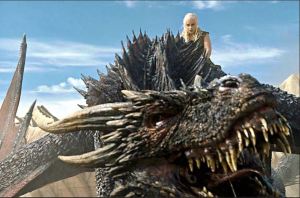
Daenerys Targaryen, mounted on dragonThe symbiotic relationships described above are captured under the title Bond Creatures, with a separate page devoted to dragon-riders generally—including Daenerys Targaryen of Game of Thrones.  Witches’ or wizards’ familiars, like Svartalf in Poul Anderson’s Operation Chaos, appear under The Familiar.

There’s also a page for Mons, of which the famous Pokémon are probably the most widely-known.  A human master may have many Pokémon, but Pikachu, for instance, does seem to be a boon companion and not just a fighting pet—although in the animated series his speech (like Groot’s) is limited to variations on his own name.  Note that the upcoming movie version is quite different:  in this movie Pikachu talks and is a complete person—even, apparently, the lead.

The Sidekick’s Contribution

The Beast Master, coverAnimal sidekicks can aid their principals in many ways.  Some you can ride, like McCaffrey’s dragons or Gandalf’s steed Shadowfax; there’s yet another Tropes page for the Sapient Steed (including the robotic horse Fess in Christopher Stasheff’s Warlock of Gramarye series).  Some act primarily as scouts, as noted for the Norton coyotes above; so also the Falcon’s avian companion Redwing in Marvel comics (sadly reduced to a robotic drone in the movies).  The enhanced or mutated otters in James Schmitz’s The Demon Breed (1968) do some scouting, and can also carry bombs and perform other basic actions; they talk back to main character Nile Etland, though in a simplified way.  Norton’s The Beast Master (1959) features a whole team of animals who assist main character Hosteen Storm, a Native American like The Defiant Agent’s Travis Fox.

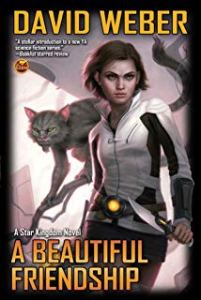
The animal companion may also be able to fight alongside you, in ways a human could not match.  We’ve already looked at the dragons of Pern; we should also mention the treecats of David Weber’s Honor Harrington series, who have averted at least one assassination by being unexpectedly formidable in an emergency.  Owen Grady’s team of raptors in Jurassic World is equally capable.

Ascension of the Sidekick

Frequently, animal sidekicks tend to be a little childlike and essentially innocent.  They’re depicted as simpler than their human sponsors.  The nonhuman creature may be quite bloodthirsty or deadly, but it’s in an innocent way.  We don’t hold animals responsible for being savage; that’s just the way they are.  The more animal sidekicks lack the full intelligence and moral agency of a person, the more they get the benefit of animal innocence.

But sometimes it turns out that the seeming animal is more than it appears.  It may develop that the “sidekick” is really the equal of the human partner—in intelligence, in culture, in overall personhood.  At that point, we pass from subordinate to peer, and the relationship may shift to something more like that of a buddy movie.

Treecat with Stephanie HarringtonThis is true of Weber’s treecats:  as the series progressed, they were revealed to be about as intelligent as humans, though without advanced science.  The Pernese dragons have also shifted gradually in that direction; in particular, Ruth, the eponymous character of The White Dragon (1978), is depicted as a “sport,” human-like in personality and mental capabilities.

Sticking with the dragonrider model, we see a similar progression in the How to Train Your Dragon movies.  These dragons have always been pretty smart; but the third episode, released in the U.S. in February 2019, gives them a culture and even a governmental structure of their own.

Heinlein was fond of this twist.  He used it in Red Planet (1949), where Willis the “Martian roundhead,” originally the main character’s pet, turns out to be an immature form of the regular civilized Martians and a particularly important individual.  Similarly, in The Star Beast (1954), the main character’s monstrous “pet” Lummox turns out to be a very young royal child of the sophisticated and formidable Hroshii species.

James Schmitz’s first story about Telzey Amberdon, “Novice” (1962, appearing in The Universe Against Her and volume one of the Eric Flint Hub compilation), presents Telzey with a telepathic “pet” named Tick-Tock who is revealed to be one of the indigenous “crest cats”—predators so dangerous that, while humans have been hunting them, the crest cats view themselves as hunting the humans on an equal basis.  (Since Telzey is a formidable character herself, even at age fifteen, the team-up really is a union of equals.)

Role in the Story

Telzey Amberdon with Tick-TockThe animal sidekick’s unique abilities or powers, noted above, afford one explanation for its appearance in a story.  Such a companion can allow characters to do things they couldn’t do on their own, whether it’s adding to their fighting strength, reading other characters’ minds, or teleporting to other places and times.  The sidekick is a helper and an ally.

An animal companion provides such assistance in a different way than a human companion would.  In creating a new separate species, a writer can establish limitations in intelligence or otherwise that place the sidekick firmly in a secondary role.  We are rightly uncomfortable putting other humans in such a permanent sidekick position; it creates a fundamental tension with the fact of basic human equality.  (It would take us too far afield here to go into the variations of human ancillary characters—the superhero’s assistant; the military servant or “batman,” as with Honor Harrington or James Christian Falkenberg or Jack Aubrey; Jeeves the “gentleman’s personal gentleman.”)

An animal ancillary character can provide companionship—empathy, psychological support—for the main character without invoking the kinds of interactions that are inevitable when other human beings are involved.  Instead, the relationship between the principal and the sidekick can explore other kinds of interactions, more analogous to those of parent and child, or teacher and student, than those of peers.

In compiling this survey, I’ve noticed that a lot of the stories are older, often dating from the mid-twentieth century.  It may be that this isn’t an accident.  Contemporary thinking leans strongly toward an assumption of equality among all kinds of beings, reaching out to postulate humanlike rights for (e.g.) whales or chimpanzees.  The whole notion of a permanently subordinate or secondary being may be particularly repugnant to many of today’s readers.

On the other hand, coming from the animal side rather than the human-surrogate side, there may be something to the simple wish to communicate on more of a mutual basis with the other creatures that share the world with us.  Wouldn’t we all like to be able to talk to our horse, dog, cat?

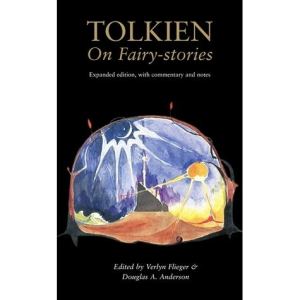
Tolkien, On Fairy-Stories, coverIn his essay On Fairy-Stories (1939), Tolkien points out that fantasy satisfies “the desire to converse with other living things.  On this desire, as ancient as the Fall, is largely founded the talking of beasts and creatures in fairy-tales . . .”  If we can’t talk with our actual dogs and cats, we can imagine similarly situated beings with whom we can.  And if they include flying dragons and wily coyotes, so much the better.

The Stroke of Lightning

Love at First Sight

In French it’s “le coup de foudre,” “the stroke of lightning.”  Love at first sight—if we’re going to be talking about it so much, let’s call it LAFS for short (an especially good term if we’re doing romantic comedy)—is one of the most ancient, familiar, and infamous romance tropes.  But contemporary genre romance has its own spin on the matter.

Scene from It Only Takes A MomentThere are, of course, innumerable songs that memorialize this phenomenon, from the classic “Some Enchanted Evening” (from Rodgers & Hammerstein’s South Pacific)—“you may see a stranger, across a crowded room”—to a more recent Colbie Caillat song, Brighter Than the Sun, which actually uses the phrase “lightning strikes the heart.”  Or simply consider the title of “It Only Takes a Moment,” which originated in Hello Dolly (1964) and was used to poignant effect in WALL-E (2008).

Shakespeare goes so far as to say “Who ever lov’d that lov’d not at first sight?” (As You Like It, III.5.81), an homage to Christopher Marlowe, who’d said it before in his 1598 poem Hero and Leander (according to Wikipedia).  I need not mention Romeo and Juliet.

Aside from romance strictly speaking, LAFS can be useful in an adventure story, by way of what TV Tropes calls The Dulcinea Effect:  “the compulsion many male heroes have to champion, quest for, or die for girls they met five minutes ago.”  This can be contrasted with, or may lead to, a romance “forged in fire”—the notion that a couple may bond through having an adventure together.  I’m fond of this one myself, perhaps applied with one spin or another.

For the moment, let’s note that the instant-love convention is fun, but often seems implausible, not to mention clichéd.  One can see LAFS simply as a dramatic convention, like the Shakespearean soliloquy—but perhaps that’s not all there is to it.

Lust at First Sight

Shanna, book cover

The contemporary romance, more preoccupied with eros.

In modern genre romances, a great deal more emphasis is placed on physical desire than was the case in earlier tales.  As a result, LAFS takes a slightly different form.

In a “Some Enchanted Evening” or Romeo and Juliet scenario, the lovers’ beguilement may be almost spiritual, a sort of epiphany.  They are attracted to each other’s beauty, but there may be an element of reverence mixed in.  In the contemporary romance, on the other hand, the first impression is decidedly physical.  Once the main characters meet, they can hardly keep their hands off each other.

This sort of LAFS is both more plausible and less substantial than the more general sort.  It’s plausible because physical desirability can be evident at first sight.  It can be intensified by further acquaintance—getting to know the voice, actions, words, varied aspects of the beloved.  But the sexual attraction, at least, can be immediate.  This is traditionally true for males, but contemporary romance makes it abundantly clear that in at least some cases women react the same way.  Examples are so omnipresent as to make it unnecessary to cite them.

To do these stories justice, they recognize that insta-lust isn’t enough.  The main characters typically take an entire novel’s worth of events to really fall in love.  Lust (or, less tendentiously, sexual desire) is just the initial driver.  There’s a lot of “getting to know you” to be done before the story is over.  And a good deal of that usually happens through meeting obstacles or countervailing forces that need to be overcome.

Tension and Obstacle

If the romantic leads fall in love immediately, there have to be obstacles that prevent them from getting together at once.  Otherwise, the story will be very short.  I believe it’s from an entertaining opus entitled Writing a Romance Novel for Dummies that I recall the sage advice:  “If your story is ‘they came, they saw, they dated,’ then you don’t have a story yet.”  With intense attraction pulling the lovers together, they’ll collapse into each other at once unless there’s also something to push them apart.

Strictly speaking, this isn’t precisely true.  One could simply depict a couple gradually growing more interested in each other.  At first the romantic interest is just somebody they know or meet.  Then a greater interest awakens, attraction strengthens, and they reach that obsessive fascination that marks the “falling in love” stage.  This type of relationship might be the most common and realistic of all.  But it’s the hardest to manage for an author:  it requires depicting a whole series of attitudes developing at just the right pace.

I would love to see such a story.  But it would be much subtler and more gradual than the tempestuous narratives audiences tend to prefer.  Your average handbook on fiction writing will dwell at length on the importance of conflict in holding a reader’s interest—and for good reason.

Count to a Trillion coverThe obstacles that keep the lovers apart, then, may be external or internal.  The simplest external problem is physical separation.  In John C. Wright’s “Count to the Eschaton” series (it begins with Count to a Trillion, 2011), the star-crossed lovers connect in volume one.  However, the female lead, Rania, must embark on a slower-than-light interstellar voyage that will last twelve thousand years.  She will survive due to time dilation.  But it’s a good thing her earthbound partner, Menelaus Illation Montrose (there’s a name for you!), has ways of prolonging his life over the intervening millennia.  In the meantime, their relationship is on hold.

A more conventional separation can be seen in tales from the Age of Sail, when sea travel around the world might take years—shorter than millennia, but long enough in a human life.  Captain Jack Aubrey, for example, the perennial hero of Patrick O’Brian’s Aubrey-Maturin series, frequently spends months at a time apart from his beloved Sophie.

External obstacles may also include dangers that keep the characters otherwise occupied—from immediate peril in an action-adventure story to blackmail or other threats—as well as social or cultural barriers like those faced by Romeo and Juliet.

In a less action-oriented tale, the obstacles are more character-based or internal.  The love affair may be interrupted by disputes (You’ve Got Mail), misunderstandings, antipathy for one reason or another (Pride and Prejudice), or by one or the other person’s inner character issues, such as previous bad experiences or trust issues (where the Big Lie often plays a role).  External and internal problems can be combined in romantic thrillers like Don’t Look Down (Jennifer Crusie and Bob Mayer, 2007).

In each case, the characters’ initial attraction, the LAFS moment, keeps pulling them together in spite of the difficulties, ad astra per aspera.  They just can’t resist each other, no matter what plausible reasons might be given for trying.  The combination of opposing drives creates the fruitful tension that keeps the reader’s interest.

White Smoke coverIt’s worth noting that Andrew Greeley counterposes desire in a similar way to the more mundane obstacles of daily life.  In White Smoke (1996), Blackie Ryan, a frequent Greeley spokesperson character, observes:  “human sexuality is distinct from the sex of other primates in that it is for bonding as well as for procreation.  The bond between husband and wife stretches like a rubber band. . . . Then, when it is at the breaking point, the force of passionate love draws them together again.”  This is a constant theme in Greeley’s novels.  In other words, lust or desire isn’t just for beginnings, for LAFS.  It continues to play a vital role throughout a love affair and into marriage.

But I digress.

Retrospective Love

One of my brothers once asked the other two of us whether we believed in LAFS.  The three of us ultimately came to the same conclusion.  You can fall for someone at first sight, yes; but you won’t know if it’s love until much later.

The instant attraction is a good starting point.  But it can’t ripen into love unless the participants come to know more about each other’s personality, character, interests, and so on.  We have to see someone in a variety of circumstances:  what they’re like with family, friends, enemies; when they’re mad, happy, sleepy; over the long run.  (The plausibility of the “forged in fire” adventure-romance is that strenuous situations reveal more about someone’s character than more ordinary casual interactions.)  As an old Orleans song puts it, “love takes time.”

Later on, when the couple has grown closer enough to know that they really do love each other, they can look back at their first meeting and say, that was when we began to fall in love.  And they won’t be wrong.  Chances are they felt that initial attraction right then, and now they know that was the beginning of a love story.

But that couldn’t have been predicted from the moment of LAFS.  Some such moments sputter out:  they prove to be mere temporary infatuation, or the admired individual turns out to be unavailable (already married, for instance), or on getting to know them better they find that they aren’t as good a fit as they thought.  We can’t know, from the initial thunderbolt alone, that it’s going to lead to a true love story.

So we can fall in love at first sight; but we can only say that retrospectively, after the fact.

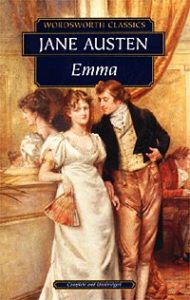
Emma, coverThis points up an important difference between stories and real life.  If we’re reading a story—particularly a genre romance—we can generally be confident that LAFS will lead to a deeper relationship between the characters.  We predict that not from LAFS itself, but from genre and narrative expectations.  This isn’t always borne out:  some tales will start by introducing a romantic interest who doesn’t turn out to be The One, later to be displaced by the real article.  Jane Austen’s Emma is a brilliant example of this twist:  among other comic errors, the heroine thinks she’s in love with Frank Churchill, but it takes the entire novel for her to realize that it’s her longtime friend George Knightley that she really loves.  But as a rule, if the heroine is devastated by the attractions of someone in Chapter the First, that’s who she will end up with in Chapter the Last.

In real life, we have no such guarantee.  Life is a story, but it’s not always constructed according to our narrative rules—at least in the short run.  We cannot know in advance whether the object of desire who’s just swum into our ken is really our destiny.

Conclusion

As the famous sage Wikipedia observes, LAFS fits in neatly with the notion, put forth as far back as Plato, that the beloved is our “other half,” the one who makes us complete—what we might call the theory of complementarity.  In Plato’s dialogue, Aristophanes suggests that meeting our other half leads directly to an intoxicating attachment to the other person.

Would that it were so simple.  If our whole selves were evident at first glance—if our appearance fully expressed our selves—that might work:  who you really are would be “written all over your face.”  But in fact a given moment or aspect expresses something about who we are, but not everything.  Even in the best case, we can’t possibly absorb everything about a person at first sight—which may be a good thing, as it allows us some privacy and reserve.  In worse cases, though, the other may deliberately deceive us or conceal things that would compromise our love.  That’s why love takes time.

Lois McMaster Bujold once said, “The question a romance plot must pose, and answer (showing one’s work!) is not ‘Do these two people get together?’ but rather ‘Can I trust you?’  Which is most certainly not a trivial problem, in art or in life.”  The answer to that question we can only learn by extensive experience—though perhaps that experience can be compressed to some degree by experiences that show our true natures in condensed fashion (the “forged in fire” trope).  Only at length can we really know love at first sight.

The Distilled Adaptation

Shortening

The translation of a story from book to stage or screen always involves some degree of change.  The two arts are different; what works to communicate a story in one medium may not work in another.

A book can accommodate relatively long sequences of events, because we read a book in segments on our own schedule.  But a stage play or movie has to be geared to the limitations of the human body.  Watching a full-scale version of The Wheel of Time, say, at one sitting would require both an IV and a catheter—and a “pause” button for sleep.

Tom Bombadil (from card game)Thus, the live-action rendition of a novel generally has to leave things out, and the ability to condense the story smoothly is vital.  For example, the three-film Lord of the Rings omits the book’s entire side trip through the Old Forest, Tom Bombadil, and the Barrow-Downs.  Even with three long films, something had to be cut.  (This omission, incidentally, was a good choice and well-executed.)

The limitations of time have eased a bit with the introduction of multi-episode and bingeworthy screen formats, along with viewers’ increasing willingness to follow long-running stories (a curious counterpoint to the frequent suggestion that our attention span is eroding).  An eight-season Game of Thrones video production can cover much of what occurs in a very long book series.  But the writer or director must still gauge what can be included and what can be omitted.

Reorienting

Sometimes, when condensing a book for the theatre, the writers may take the opportunity to narrow the focus of the original story—particularly when the novel is a broad, rambling, discursive sort of tale.  In the process, they may also convey a meaning (what we might cautiously call the “moral of the story”) that’s different from that of the original.  Depending on what the rewrite chooses to emphasize, the new version may point in a different, or more definite, direction than the old.

Reorienting a tale this way can improve it—depending on what the new direction is.  Let’s look at a couple of examples.

Man of La Mancha

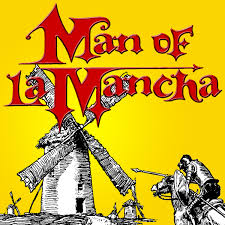
Man of La Mancha posterWe recently looked at the staging of the 1965 play Man of La Mancha; and a couple of years back we talked about what it says to us.  When I first saw the show back in 1970, its basic theme fit right in with what had become a widespread idea back in the 1960s:  that we are too prone to think of ourselves as unworthy of love, and that becomes a self-fulfilling handicap.

To recap:  The fantasy-ridden Don Quixote finds his ideal lady Dulcinea in a barmaid and part-time prostitute named Aldonza.  Aldonza despises herself as well as the men who use her.  She is at first baffled, and then enraged, by Quixote’s persistent attempts to idolize her and praise her ladylike virtues.  She feels she has no virtues; he is refusing to see her as she really is.  (Audio / Movie video)

Against her will, under Quixote’s gentle persistent courtesy, she begins to believe she can be better than the way she’s always thought of herself.  She is promptly and brutally disillusioned when the muleteers attack her.  The play pulls no punches:  being “nice” or showing generosity is no guarantee against mistreatment.  Yet, in the face of all evidence to the contrary, Quixote continues to treat her as a noble lady.

Dulcinea, at Don Quixote's deathbedAt the end of the play (7:42 in the clip), after Quixote’s death, she finally accepts that she is more than a nobody, “born on a dungheap”:  she will honor Quixote’s memory by living his impossible dream.  “My name . . . is Dulcinea.”

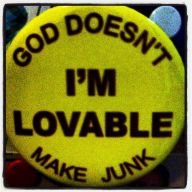
I'm Lovable buttonMan of La Mancha forcefully illustrates what in the ’60s became a truism.  We must see what is potentially lovable in someone before it is evident; and sometimes that premature faith and hope can help the person realize they are lovable—and free them to love.  This is more than the mere psychology of self-esteem; it’s an insight about how human beings work that is still worth recognizing.

Yet this isn’t exactly what Cervantes had in mind.  It’s been a long time since I read his immense rambling novel, but I don’t recall that this theme of convincing people they are lovable was evident there.  The novel speaks to a lot of other issues, such as the interplay of realism and idealism, but it isn’t focused on this.  Rather, the authors of the play selected and adapted material from Cervantes to address a theme characteristic of their own time.

One might complain that the modern playwrights have hijacked an existing story for a purpose the novel’s author never had in mind.  But as I see it, the concentrated, powerful Man of La Mancha is a great deal more interesting than the long and diffuse original.  The adapting writers have distilled a potent new wine from familiar grapes.

Les Misérables

Victor Hugo’s Les Misérables is also a massive novel, covering many years’ time and an array of main characters.  It’s also prone to digression, including among other side trips a chapter on the history of the Paris sewer system (part 5, Book Second, chapter II).  When I read the book, I made myself a whole list of sections that could be skipped, without loss, on a second reading.

Les Miserables (opera) logo

By Source, fair use (Wikipedia)

Obviously, this discursive work can’t be transformed directly into a play or a movie.  Nonetheless, there are quite a few film or stage versions.  The one I find most powerful is the opera Les Misérables by Claude-Michel Schönberg, Alain Boublil, and Jean-Marc Natel, with English libretto by Herbert Kretzmer (1980).  It’s a long show, just under three hours, but of course it can’t begin to reproduce the entire book.

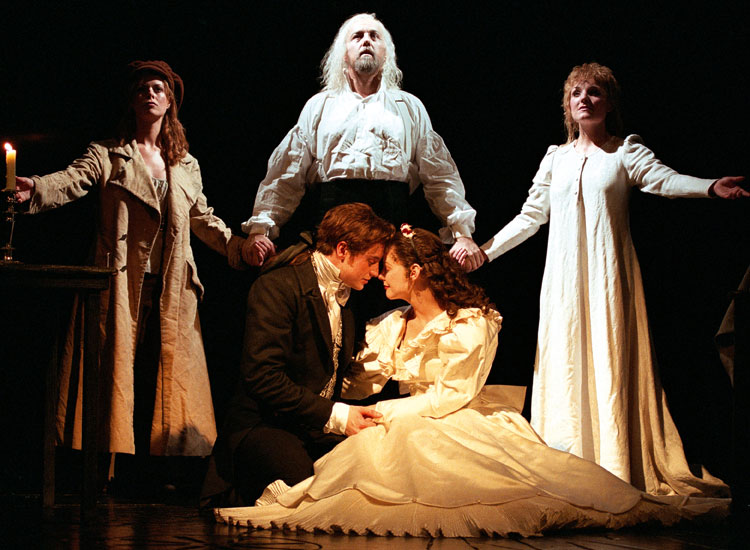
Thus, again, the playwrights are selective.  The novel tells the story of a group of people caught up in the Paris revolt of 1832, extending backward as far as 1815 to depict the backstory of Jean Valjean, the central character.  The play starts almost as far back.  After being imprisoned for nineteen years for stealing a loaf of bread, Valjean is overcome by the mercy of God when a kind bishop refuses to turn him in for a new theft, and resolves to make a better man of himself.  He adopts the orphaned girl Cosette and raises her in secret, avoiding public notice so as not to be imprisoned again.  The grown-up Cosette falls in love with Marius, a young student involved in the short-lived and futile revolt.  To save Cosette’s beloved, Valjean joins the rebels and, as the barricade falls, rescues the fallen Marius.  At the end, with Cosette and Marius married, Valjean dies at peace, received into heaven by the spirits of Fantine, Cosette’s mother, and Eponine, a reformed girl who also loved Marius and died on the barricades.

The music is extraordinarily powerful.  I’ve seen the play twice.  Each time was an intensely moving experience.  The opera was finally made into a movie in 2012, with Hugh Jackman, Russell Crowe, Anne Hathaway, and Amanda Seyfried.

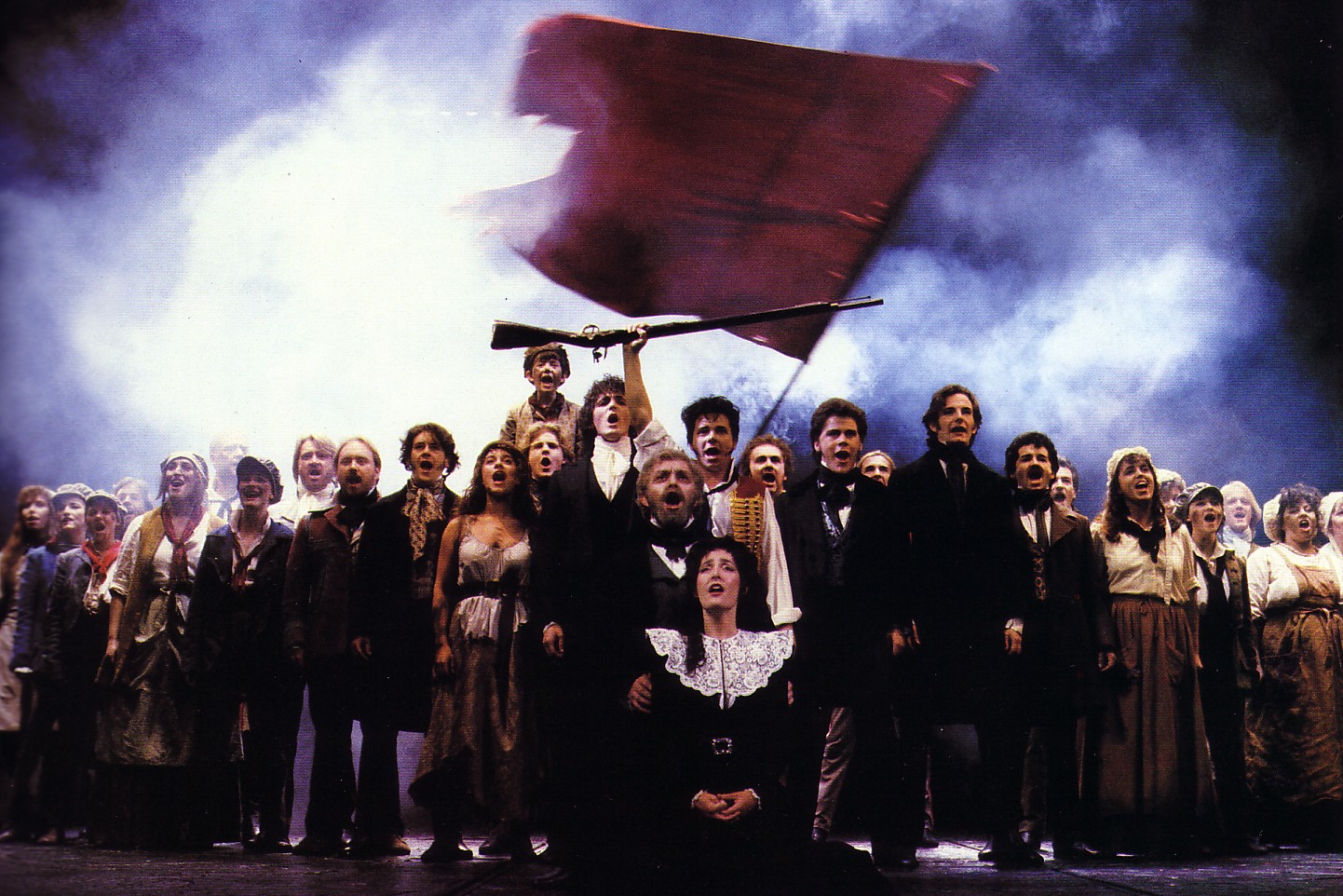
One Day More, from Les MiserablesA political motif is essential to the story—the tragic plight of the poor of France and the injustice that drove them so often to rebellion.  And as a political drama, it’s a bitter tale.  The student activists, confident that the people of Paris will rally to their side, put themselves on the line.  And no one comes to join them.  The revolt is snuffed out at once, barely a footnote in history.  The only triumph that can be found is a visionary one in the indefinite future:


Will you join in our crusade?

Who will be strong and stand with me?

Somewhere beyond the barricade

Is there a world you long to see?

Do you hear the people sing?

Say, do you hear the distant drums?

It is the future that they bring

When tomorrow comes!    (Finale)


Les Miserables - To love another person is to see the face of GodThen why is the play so uplifting?  We don’t care so much about the revolt’s failure because the characters transcend their miseries.  Cosette and Marius marry; they’ve earned their happy ending.  Valjean, Fantine, and Eponine die, but they ascend to eternal bliss.  The revolt accomplishes nothing, but the heroism and love of the principal characters makes that detail seem irrelevant.

The theme of the opera might be summarized as:  ‘Politics comes and goes, but people are forever.’  How we treat other people is vastly more important, in the long run, than the rise and fall of political regimes.  Of course, the two are not unrelated:  the purpose of a sound political regime is to make it possible for people to live good lives.  But this particular story places all its weight on the personal side.

I’m not sure that that’s what Hugo had in mind.  He might have; he certainly does emphasize the heroic compassion of Valjean and contrasts the ironies of the abortive revolution.  But it seems to me Hugo’s novel had considerably more of a political axe to grind than the opera does.  It’s a matter of degree, but I don’t know that Hugo would have sympathized entirely with the adaptation’s relative downplaying of the political.

Conclusion

In both these cases, it seems to me the adaptation has taken a particular thread from a very large original and woven it into a much more condensed, more focused story.  In doing so, the adapters have chosen to bring out themes that may be different from the bent of the original tale.

When it’s successful, such an adaptation gives us a derivative work drawing on untapped potentials in the original.  The relationship is not unlike what I’ve called the “malleability of myth.”  A root story can be reinterpreted in many ways—and some of them may be greater than the original.