Taking a bye this week, due to a death in the family.
A brief intermission
Taking a bye this week, due to a death in the family.
Taking a bye this week, due to a death in the family.
Since advanced weapons are available in much science fiction—the famous “ray gun” is iconic—it’s surprising how often a fight comes down to the humble, and archaic, sword.
You’d think this would be a classic case of “brings a knife to a gunfight.” Why doesn’t the blade-wielding attacker get wiped out immediately by an opponent with, say, advanced automatic weapons? How does a science fiction setting justify the continued usefulness of swords—and why?
Let’s look at some examples.
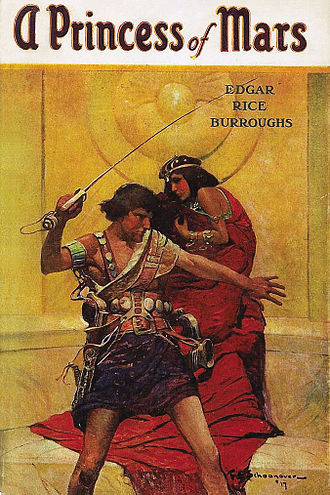 Edgar Rice Burroughs’ Barsoom stories are full of noble heroes engaging in swashbuckling swordfights with the foul villains. (Those who haven’t read the books may have seen the flawed, but underrated, movie adaptation “John Carter [of Mars]” a few years ago.) This is despite the fact that most of these warriors are also equipped with guns firing explosive radium bullets. Why don’t they use their guns?
As the Wikipedia article points out, on Barsoom (Mars) “it is considered unchivalrous to defend with any weapon but the one used in an attack (or a lesser one).” This allows the good guys to stick to their swords, and also let the bad guys show their unchivalrous villainy by trying to use more advanced weapons. Since Burroughs’ characters do tend to behave in ways that reflect what we think of as an archaic code of honor, there’s some plausibility to this explanation. (The first book was published in 1912; there’s been a lot of cultural water under the bridge since then.)
 In Robert A. Heinlein’s tongue-in-cheek Glory Road (1963), a recently-discharged veteran, whose expertise happens to include fencing, is recruited by “the most beautiful woman in any world” for a mission in one of the “Twenty Universes.” In that particular universe, the laws of nature are different: firearms and explosives don’t work. But blades do. This gives us a traditional sword-swinging hero (whom Heinlein can then merrily deconstruct throughout the story).
Heinlein also makes the point that a blade can be useful, no matter how advanced your technology, in close-quarters combat; which is (I assume) why today’s soldiers still occasionally use bayonets.
A similar gunpowder-won’t-work-in-this-universe situation is set up by Roger Zelazny in his Chronicles of Amber, where Zelazny’s immortal hero, Corwin, is among other things a master swordsman. However, in The Guns of Avalon, Corwin solves the problem by finding a universe where there’s a gunpowder analogue that does work where regular firearms do not. Both Glory Road and Amber make it hard to decide whether we’re reading science fiction or fantasy—which is par for the course where SF swordplay is involved.
 The climax of Frank Herbert’s classic Dune (1965)—after atomic explosions, an attack by immense sandworms, and a clash of unbeatable armies—comes down to, you guessed it, a one-on-one fight with blades. Herbert gives us a combination of reasons to work with. His characters learn fencing because their personal force shields stop fast-moving projectiles, such as bullets, but are less effective against relatively slower attacks, such as a sword thrust. This is a clever science-fictional reason to preserve the swordfighting trope. Cultural factors also enter in. The final duel specifically occurs because, as in Burroughs, there are formal rules of vendetta or kanly that allow for such single combat.
You can see the Dune swordfights in video adaptations: the 1984 movie by David Lynch, or a 2000 mini-series on the Sci-Fi (now Syfy) Channel.
 Of course the case with which most of us are familiar is the famous Jedi Knight “lightsaber” in the Star Wars stories. Knights, of course, have to carry swords, and Lucas has made the lightsaber an iconic emblem of his universe. What makes a sword-like weapon useful here is that the Jedi Knights can actually use them to deflect, or even redirect, gunfire (“blaster” bolts). Personally, I’ve always felt that the only way this could possibly work is that precognition allows the Jedi a moment’s unconscious awareness of where and when the next bolt will come. No one’s reflexes or muscles could possibly be fast enough to intercept something that fast without foreknowledge.
We’ve seen several ways to justify the use of swords in a high-tech science fiction environment. It’s a separate question why authors and readers enjoy such scenes.
I think one reason is that sword-to-sword combat allows for a personal engagement more effectively than a gun duel. Much has been said about the depersonalization inherent in the use of long-distance weapons. In a genuine battle, we may pragmatically seek the most effective means to prevail, whether personal or impersonal. But in a story, individual characters, and the drama of their interactions, are at the fore. A person-to-person duel between hero and villain is more viscerally satisfying than wiping out the opponent at a distance.
The sword also has a long history of symbolic and evocative significance. We noted above, for example, that the use of sword can call up in a reader’s or viewer’s mind a whole chivalric or feudal milieu. This is merely one of the deliberately archaic tropes Lucas brought back in the original “Star Wars.”
Using a sword also requires more physical skill, strength, and endurance than using a gun. It’s been pointed out that one of the ways the development of firearms changed the nature of war was by enabling lightly-trained recruits to fight competently, without the lifetime’s training needed to make a good swordsman. If a story wants to show off the physical excellence and expertise of the combatants, a swordfight will do this better than a gunfight.
Of course, pure bare-handed martial-arts combat, or fighting with other melee weapons like staves or maces, can accomplish the same things—which is why we frequently see these, too, making their appearance incongruously in SF contexts.
 Finally, a swordfight may be more prolonged than a gunfight, because blades can do more gradual damage than bullets and thus allow for longer duels, intensifying the drama. This isn’t always the case. In the page on Single-Stroke Battle, TV Tropes observes that “[r]eal sword fights often take only a few seconds or even a fraction of a second, with one solid hit generally being enough to take a man out of the fight (contrast this with Flynning).” One thinks of the powerful scene toward the end of David Weber’s Flag in Exile where Honor Harrington does in fact cut short a lengthy duel with one blow. But this is precisely where an author can set up the desired situation to best advantage.
No matter how much futuristic SF may pervade our storytelling, then, we’re not likely to see the humble sword retired any time soon.
Stories and Endings
We talked last time about SF writers’ fictional histories of the future. There’s another feature of such backgrounds that must be taken into account. One of the downsides about a future history is that it blunts the effect of a happy ending.
Those of us who enjoy traditionally constructed stories like to see a happy ending. It won’t be unreservedly happy, of course. A story is better if, as TV Tropes puts it, the main characters earn their happy ending—which means they will have gone through a lot of trials and tribulations first. And there are likely to be losses along the way: people who die, possibilities that are lost. But it’s more satisfying if some good is achieved, or at least preserved, in the course of a story.
Even those who scorn the happy ending as naïve generally aim for some sort of closure or conclusion. It’s pretty generally unsatisfying to read a tale in which nothing at all is accomplished or resolved, even in part. Such stories exist, but I suspect they appeal mainly to readers so convinced of the meaningless of life that they perceive a pointless story as an affirmation. For purposes of this discussion, I’m going to assume that one of the elements we look for in a good story is at least some degree of favorable outcome.
Of course, defining the ending of a story is always somewhat arbitrary. We decide to stop narrating at a certain point, even though life goes on. (Even in James Blish’s The Triumph of Time, which concludes with the destruction of the universe, new universes are going to be spawned from the death of this one.)
 This is particularly true of love stories. Alasdair MacIntyre once remarked that in Jane Austen’s novels, marriage occupies the place that death occupies in real life. It brings events to a conclusion. So it is with many or most love stories, which focus on the formation of a relationship and how it reaches some watershed moment—frequently the commitment of marriage. Stories about how a healthy marriage proceeds, though exceedingly interesting and valuable, are much more rare—and much harder to write.
And this reflection begins to illuminate our problem. If we go on telling the story after the high point of the marriage, we run the risk that subsequent events won’t live up to that peak of expectation. For example, I’ve seen several sequels to Pride and Prejudice that pick up after Elizabeth and Darcy’s marriage; but they don’t tend to be nearly as interesting as the original.
This is true not only of love stories, but of all stories. At the end of Star Wars IV: A New Hope, victory is declared, the Empire’s plot is foiled, we exit on cheers and applause. But at the beginning of the next episode, the rebels are on the run—again—and by the following installment, even the Death Star is being rebuilt.
 This sort of thing can rather take the bloom off the original victory. Aaron Leitko’s December 2015 article on Star Wars VII makes this point about “franchises” that don’t end: “the galaxy can never truly be saved. It is always in peril. With each victory, a new and greater threat amasses over the horizon. Our childhood heroes are destined to struggle onward until they get old, run out of luck, or are conveniently written out of the script following an unsuccessful contract renegotiation.” One is reminded of Mr. Incredible’s fretful remark at the opening of The Incredibles: “Sometimes I just want [the world] to stay saved.” Don’t we all?
Endings and History
A future history, in effect, equips every story in the sequence (except for the last one) with long-range sequels. This means the problem of stabilizing the happy ending applies not only to the individual characters, but to the story’s large-scale outcome as well, like the struggle against the Empire in Star Wars.
 I mentioned last time that H. Beam Piper’s cyclical future history would ultimately have been thrown out of whack by the happy-ending-inducing Fuzzies. In its original conception, a certain sort of gloom spread over Piper’s future history. As John F. Carr observes in his introduction to the Piper collection Empire (Ace paperback, 1981), each book seems to offer the prospect of a brighter future, but the books that follow never show that result. Rather, the promise of each earlier ending is vitiated by later developments. “At the end of each of these stories it appears as though the self-reliant man has won; however in future stories we learn that while the battle may have been won, the war was lost.” (p. 9)
Not every imagined history has to embrace a deterministic or cyclical theory like Piper’s. But any realistic history has to recognize that things don’t always get continuously better in this life. There are setbacks, reversals, and recrudescences of attitudes and problems we thought we’d disposed of. We can legitimately hope that our favorite characters’ victories will make things better at least for a while—but the betterment will not last forever.
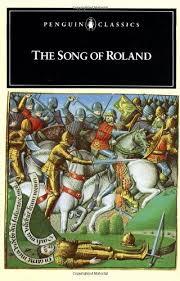 This isn’t a modern discovery. The eleventh-century Song of Roland, one of the legends that surround the mythical court of Charlemagne (France’s answer to the Arthurian Matter of Britain), ends with a victory, avenging the heroic death of Roland, Charlemagne’s nephew. But even this somber triumph is not final. In the very last stanza, Charlemagne is told that he must rally his forces yet again to face a new challenge. “Small heart had [Charlemagne] to journey and to fight; / ‘God!’ says the King, ‘how weary is my life!’”
Happiness in the Moment
We need to be willing to accept a happy ending that is not unqualified. Something can be good without being forever. Subsequent failures do not invalidate genuine achievements.
To enjoy a future history, we have to recognize that the uncertainties of the future do not extinguish the glory of success. Our newly-wedded lovers, for example, will have their ups and downs, but that doesn’t keep their lives from being happy on the whole.
The same is true of civilizations—the large-scale achievements whose fate is frequently at stake in adventure stories. The establishment of a better world can make a lot of people’s lives better for a long time, even if that achievement is eventually superseded by later events.
 Valeria Victrix Matuchek, from Poul Anderson’s A Midsummer Tempest (epilogue), put it this way: “Nothing ever was forever, anyway. Peace never came natural. The point is, it can sometimes be won for some years, and they can be lived in.”
Histories of the Future
A science fiction writer can link diverse stories by setting them in a common “history of the future”—an imagined future that might run anywhere from a dozen years to geological eras. A new tale may not be a direct sequel or prequel, but it can appeal to us in somewhat the same way when it shares a background with a story we’ve enjoyed already.
Using a common future history has great advantages for the writer, as well. It’s easier to continue developing an established background than to invent something entirely new. But this approach also has pitfalls. We may find that later stories evolve to conflict with the background we’ve already set up. We saw off the branch we were sitting on.
SF author H. Beam Piper‘s “Fuzzy” series gives us a particularly interesting example of the perils of success.
Little Fuzzy
Piper’s intense interest in history led him to outline a vast scheme of human progress and space exploration, now referred to as his “Terro-Human Future History,” in that it deals mostly with human beings of Terran descent.
Piper believed in a cyclical theory of history, in which similar patterns of events recur in different ways. His Terro-Human Future History is thus full of analogues to actual events: the Sepoy Mutiny (Uller Uprising), the barbarian invasions of the European Middle Ages (Space Viking). Piper’s historical scheme covered 6,000 years’ worth of rises and falls, empires and interregnums.
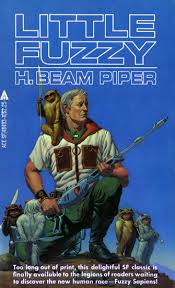 Late in his career, Piper won a permanent place in the hearts of SF readers with the novel Little Fuzzy (1962). Crusty old prospector Jack Holloway on the colony planet Zarathustra discovers a species of small, golden-furred beings, the first of whom he dubs “Little Fuzzy.” The Fuzzies are primitive hunter-gatherers, perfectly capable of tracking down and killing their food. But they are also smart, fun-loving, lovable, and an endangered species.
The Chartered Zarathustra Corporation, which runs most of the planet (an analogue of the historical East India Company), takes an intense interest in these little creatures—because its charter depends on the assumption that Zarathustra was an uninhabited world. When a CZC employee kills one of the Fuzzies, and a company gunman is in turn killed by Jack, it becomes crucial in the subsequent murder trials to decide whether the Fuzzies are truly intelligent persons, or just animals. The resolution of that issue forms the climax of the story.
Equal parts adventure story, courtroom drama, speculation on the nature of intelligence, and heartwarmer, Little Fuzzy was a hit with readers. (And it seems likely, I’ve always figured, that the Fuzzies are one of the literary ancestors of the Ewoks.)
Fuzzies Everywhere
 The subsequent literary history of the Fuzzies is exceedingly complex. Piper published a sequel, Fuzzy Sapiens (or The Other Human Race), two years later. A third Fuzzy novel had been sent to a publisher when, in November 1964, Piper committed suicide. The manuscript of the third book was lost. But reader interest in the Fuzzies led publishers to commission a new Fuzzy sequel by William Tuning, issued in 1981 as Fuzzy Bones. An overlapping prequel taking off from Tuning’s development of the story, Golden Dream, was written by Ardath Mayhar and appeared the following year.
Ironically, no sooner had these continuations come out than the lost manuscript of the third Piper book was found after all. Piper’s Fuzzies and Other People (“F&OP”) appeared in 1984. Unsurprisingly, Piper’s continuation was not consistent with Tuning’s and Mayhar’s, leaving us with two inconsistent, but equally interesting, versions of the Fuzzy mythology.
It’s even worse than that. At least two different reboots or reimaginings of the Fuzzy mythology have been subsequently published. A detailed explanation of the whole mess can be found in a 2007 article by Fred Patten, with further information in a Goodreads review of Fuzzy Bones.
Irresistible Cuteness
The great charm of the Fuzzy stories lies in their mixture of tough-mindedness and tender-heartedness. “Pappy Jack” and a whole series of other tough, no-nonsense characters develop unexpected softer sides as they succumb to the irresistible cuteness of the Fuzzies. In Tuning’s words, “Like many men who were extremely tough, he turned to goo at the sight of those wide, appealing eyes.”
But the Fuzzies aren’t just cute. Arguably, they are better people than humans. Fuzzies share without hesitation. They help each other. They tell the truth (though this particular trait gets complicated in F&OP). They’re not competitive, but they do aspire to excellence. This inherent virtue has its tough side too: Fuzzies applaud the deserved punishment of evildoers.
More important, for purposes of their long-term effect on human affairs, they aren’t simply an enclave of niceness: they influence people. Almost every human who comes in contact with them becomes a better person as a result. Villains in one story are converted to good guys in the next, once they acquire Fuzzy companions.
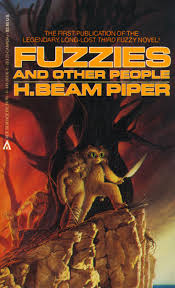 One character observes in chapter 12 of F&OP: “we’re hooked. Hooked on Fuzzies.” The Fuzzies are making a permanent difference in the quality of human behavior on Zarathustra—not by force, not by persuasion, but simply by being lovable. It’s not at all the kind of development one would expect from a hardheaded rationalist of Piper’s type.
It’s not what one would have expected of his future history, either. And that’s the twist I want to point out here.
Can Piper’s Future History Survive the Fuzzies?
When the Fuzzies entered Piper’s future history, it was already well under way. Four novels and a number of short stories were already in print, and Piper had plans for more. Many of these stories were set later in time than the events of Little Fuzzy. And the events of this hypothetical future, as noted above, were built on Piper’s view of cyclical history. A fundamental change in human behavior would have thrown the whole sequence into disarray.
But the advent of the Fuzzies represented just such a change. At the end of F&OP, there are plans to take Fuzzies off Zarathustra. “[E]verybody on Terra will be crazy about them.” Indeed. One visualizes Fuzzies spreading throughout the Terran Federation, disseminating goodness and improving human beings wherever they go.
A good thing for those fortunate humans? Undoubtedly. But Piper hadn’t set out to write a Utopia. His later stories depended on the assumption that humans would continue to be the same difficult, ornery creatures they always have been. The innocent-seeming Fuzzies had endangered the whole basis of the Terro-Human Future History.
Piper’s suicide has always been attributed to a certain moodiness combined with financial and personal difficulties. But I’ve sometimes wondered whether the Fuzzy conundrum might have had something to do with it. Piper had built a carefully planned future history. But the more he worked out the implications of the Fuzzy stories, the harder it must have seemed to keep their influence contained in such a way as not to disrupt that careful plan. With all those stories in print, there was no easy way to resolve the internal contradictions.
We’ll never know about Piper’s personal views. But we can take the peculiar saga of the Fuzzies as a reminder of how tricky it can be when different types of stories—even good and well-beloved stories—inhabit the same imagined history.
Debating what may happen in future Star Wars movies has been a favorite spectator sport since 1980, when we all saw The Empire Strikes Back and spent the next three years madly surmising what would happen in the third episode. Was Vader really Luke’s father? (It’s hard to believe in this era, when “I am your father” is a classic meme, but in 1980 it was a viable theory that he was lying.) Who was the “other” of Yoda’s enigmatic remark, “There is another”?
That last question illustrates the danger of too much speculation. By the time Return of the Jedi came out, we’d debated every possibility, from a complete unknown to Han Solo—including the winning choice, Princess Leia (requiescat in pace). The revelation in Episode VI couldn’t help but be an anticlimax. So I’ve been trying not to spend too much time spinning my wheels over the unanswered questions in The Force Awakens. We’ll find out soon enough.
The title of Episode VIII, though, does bring up an interesting point.
 Disney announced the title The Last Jedi for Episode VIII on January 23, 2017. The fan community immediately went to work to ferret out the implications. It was pointed out, for example, that “Jedi” can be either singular or plural. There might be one last Jedi, or two last Jedi, or an entire academy-full of last Jedi. Still, some sort of finality seems to be indicated.
Comments around the Web as of February 12, 2017, suggest there are at least two major possibilities:
 (1) The film is about the last Jedi who happens to be left alive at the moment. That’s obviously Luke Skywalker, and Rey could reasonably say, on meeting him, that she’s found the last Jedi. It doesn’t necessarily mean there won’t be any more to follow. The Last Jedi might show Luke taking on Rey as an apprentice and making her a new Jedi. If so, the story could well be captioned, from Rey’s point of view, How I Met the Last Jedi and Became the First Recruit in a New Jedi Order. This would simply put us back in the realm of “That boy is our only hope / No, there is another.”
(2) The more interesting, more drastic possibility is that Luke is the last Jedi there will ever be; that Episodes VIII-IX will involve some sort of epoch-making shakeup that will end the Jedi order permanently. That might seem an anticlimax, after taking all that trouble to restore the order in Return of the Jedi. But if it did, what would the future look like?
This possibility raises a question that has long intrigued me: Is the Jedi order as we see it in the prequel series really a good thing?
We had to wait for the prequels (Episodes I-III) to see how the Jedi order actually worked in its heyday. What emerged was rather surprising. The training program is of particular interest, because how you form the next generation of Jedi shapes what kinds of people they become and how they carry out their somewhat hazy galactic peace-keeping responsibilities.
(I should note that I’m referring only to the movies here and not the vast expanded universe of novels and spinoffs, much of which is no longer canon anyway.)
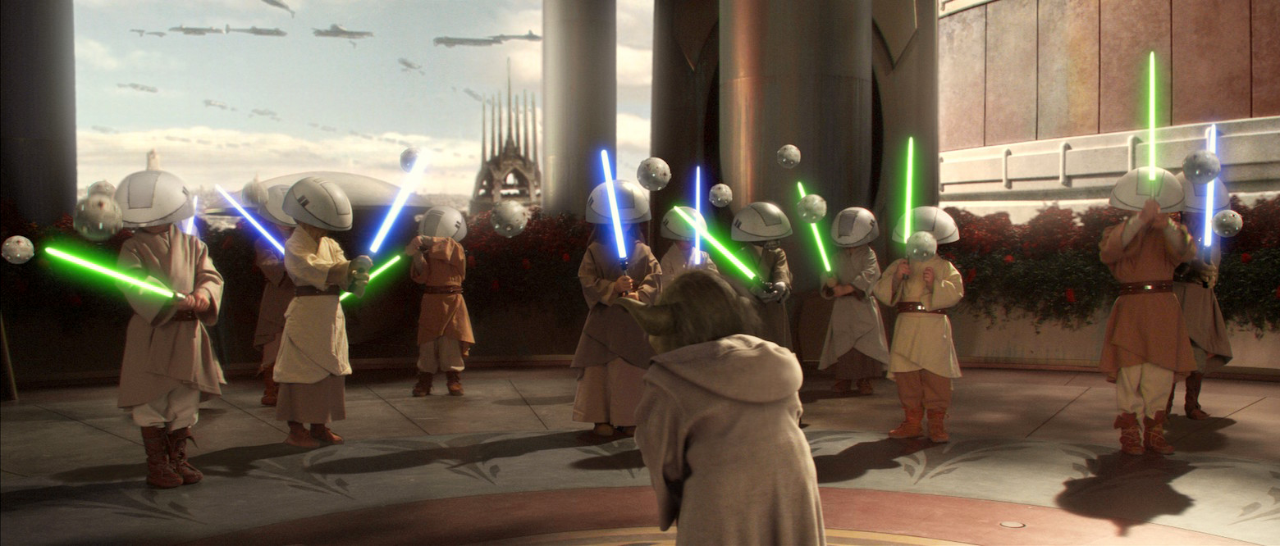 When we meet young Anakin Skywalker at nine years of age in Episode I, he is already considered too old for the normal Jedi training program. This is borne out by the scenes we see of five- or six-year-old “younglings” practicing their Jedi arts. Evidently in the Republic, Force-gifted children were taken away from their families as young as five or six and brought to Coruscant for full-time training. (No wonder Yoda also complained about Luke’s age in Episode V.)
If Anakin’s own experience is any guide, the younglings don’t return to their families, even, say, for summer vacations. They are expected to grow up without normal family interactions, living a sort of monastic existence. This approach might produce an intense concentration on one’s studies, and a sense of fierce fellowship among the Jedi members. But it’s not clear that the resulting Jedi Knights would be especially well-adjusted for dealings with other, normal citizens.
We saw how badly this worked out for Anakin himself. When Qui-Gon Jinn and Obi-Wan Kenobi redeem Anakin from slavery in Episode I, they can’t afford to buy out his mother Shmi as well. But, appallingly, they never go back with more funds to do so; apparently they’re content to leave her enslaved while they concentrate on her Force-enabled son. (This omission itself says something about the mind-set of the Republic and the Jedi in particular.) When Anakin returns in Episode II just in time for his mother to die in his arms, this experience plays a key role in his eventual turn to the Dark Side, with the avowed aim of bringing “order to the galaxy” to prevent such tragedies.
The exclusion of Jedi Knights from normal family and community life extends forward in their lives as well. We find out in Episode II that Jedi are not permitted to marry. (No one seems to have considered that this restriction is a fine way to breed Force-sensitivity right out of the participating species.)
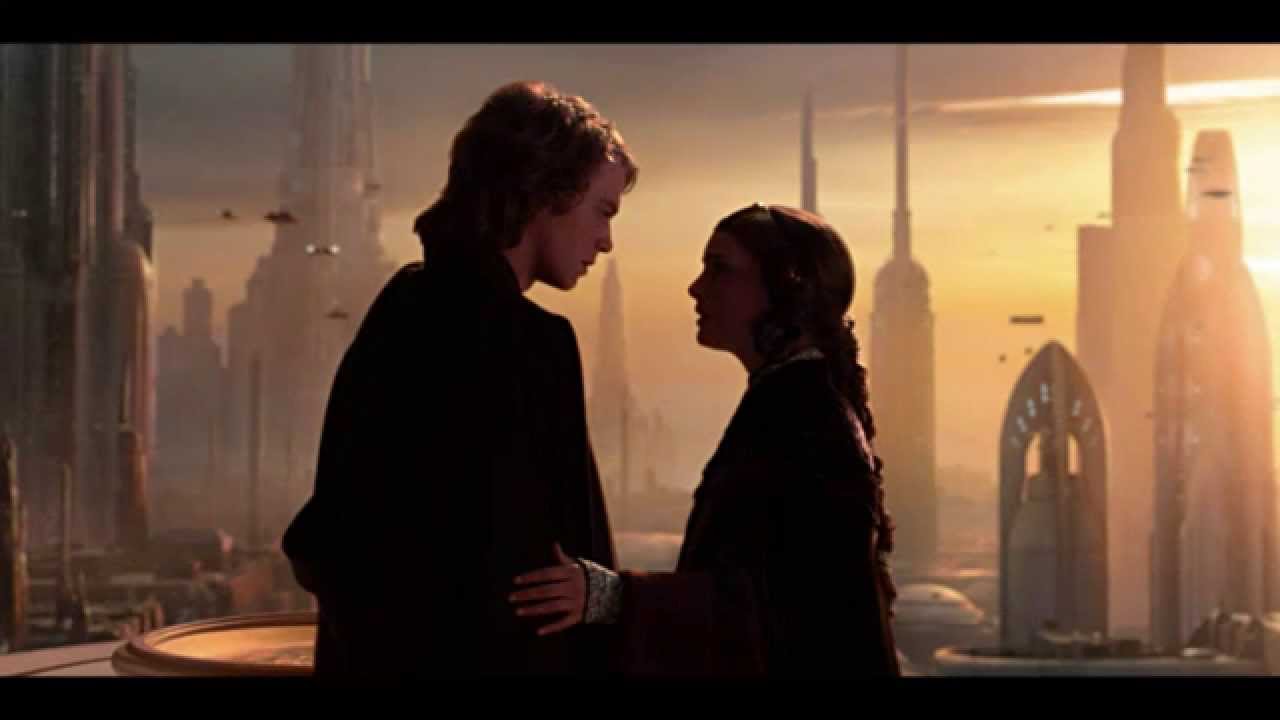 While this barrier may have been set up simply to create a story conflict, it also intensifies the separation of the Jedi from ordinary social interactions. The trope of a celibate monastic order certainly has some narrative power. But it may not be an ideal way to establish the primary enforcement and conflict-resolution arm of a galactic society. In a curious way, the Jedi order resembles the army of familyless clones that the Jedi themselves initially create, and later combat.
With this issue in mind, the whole plot of Episodes I-III looks less like a simple tale of scheming intrigue by Senator Palpatine and more like a civilizational tragedy. A polity falls most easily to a destabilizing force when it is already rotting from within. Palpatine could not have succeeded so easily, one might argue, if the Republic and the Jedi had not already become decadent or dysfunctional.
In fact, the Jedi leaders in the prequels speak uneasily about some sort of failure or lessening of their communion with the Force, which is never really explained. Is it possible that the Jedi ways of cultivating young pupils had become hidebound and ossified in a way that decreased their powers and made them vulnerable to a sneak attack or “phantom menace” from the Dark Side?
This is all speculation, of course. I don’t know whether any such thing was in Lucas’s mind when Episodes I-VI were made, much less in the current screenwriters’ minds now. But these considerations do suggest that it’s not enough just to restore or return the Republic’s Jedi order. A renascence or renovation of the Light Side organization may be needed as well.
We now know that you don’t have to be a Sith Lord like Vader or Palpatine to serve the Dark Side. We’ve also got Kylo’s Knights of Ren, and Snoke, whatever he is. Maybe it’s also possible to serve the Light Side without being a Jedi Knight.
Based on the above thoughts about Jedi training, I’ve always rather hoped that Luke would rethink the historical Jedi practices (which he hardly knows, anyway) and develop a more humane, more balanced cadre. We now know that he tried to train a new group between Episode VI and VII, but from the movies, at least, we don’t know how he went about it. (I haven’t yet read any of the new-continuity novels.)
We do know that Luke’s new Jedi academy was a failure: it produced Kylo Ren and collapsed after his turn to the Dark Side. Perhaps now, after years of meditating on his mistakes, Luke may be ready to try something different. It could be that the new knights of the light won’t be Jedi at all, but a new kind of Force for good. To my mind, that would be a really interesting development.
These idiosyncratic guesses have a pretty low probability of panning out, to be sure. The subtleties of training programs might not appeal to the Star Wars audience as a key plot device. But they’re fun to think about.
The real entertainment value of SWAGs like these is to see how far off they were when the movie actually comes out. We’ll see in December what “The Last Jedi” really means—and probably have a good laugh about this post.
4/14/2017: Here’s the latest trailer.
4/18/2017: Zak Wojnar at ScreenRant has a good commentary today making some of the same points.

