Arthurian Variations (Part I)

A Multitude of Arthurs

Sword in stone, in forestA few months ago I mentioned that the tales of King Arthur and his court—the Arthuriad—make up one of the most adaptable mythologies of all.  We can take a look at some of these variations (Part I), and follow up by considering what makes these legends so endlessly fascinating and malleable (Part II).

Wikipedia hosts two separate pages that enumerate versions of the Arthuriad:  List of works based on Arthurian legends and List of media based on Arthurian legend.  Tendrils of the Arthurian tree reach into such distant nooks as “Indiana Jones and the Last Crusade,” which relies centrally on the Grail legend.

And new branches keep sprouting:  a new film version is coming out from Warner Bros. in 2017.  Even Tolkien worked on one, which I blush to admit I haven’t read:  The Fall of Arthur (composed in the 1930s, published 2013).  The introduction to my copy of The Mabinogion sums it up:  Arthur “is at the centre of British story.”  (Tr. Gwyn Jones and Thomas Jones, Everyman’s Library, 1949, 1974, p. xxv.)

History of the Myth

The Arthuriad grew from many sources.  A number of originally unconnected legends were gradually brought together under one roof—one reason there’s such a plenitude of material in the legendry.  A few brief mentions of Arthur in medieval histories gave rise to tales and poems in England, in France, and in Wales.  Writers like Geoffrey of Monmouth and Thomas Malory assembled these various tales into more or less connected narratives.

The resulting mythology is the central part of the “Matter of Britain”—one of the three subjects that the medievals considered of paramount importance for literary development, along with the “Matter of France” (tales of Charlemagne and his court) and the “Matter of Rome” (the ancient myths that focused on the Trojan War and its ramifications).

It would take a scholarly treatise to deal with this history, not a blog post, even if I were qualified to write such an account.  Here I just want to note a few of the more interesting variations I’ve come across.

The High Road and the Low Road

I like to divide treatments of the Arthuriad into “high road” and “low road” versions.  On the high road we find the kind of setting that we usually think of in connection with the mythical Round Table:  knights in plate mail, ladies in silks and satins, magic from Merlin to the Green Knight round every corner.  This is Malory’s version, which reflected the customs and cultural level of Malory’s own time, rather than the historical setting in which Arthur was supposed to be placed.

The low road takes us to adaptations that hew more closely to actual history.  Here the writer seeks to make an Arthurian chronicle compatible with what we know of the real fifth or sixth century.  Magic and mysticism are minimized, and naturalistic explanations may be given for paranatural features of the original legends, such as the Sword in the Stone.  Contemporary retellings generally prefer the low road, grittier and less idealized than the plate-mail versions.

On the High Road

The high-fantasy Arthur is exemplified by Malory’s Le Morte d’Arthur (The Death of Arthur), which holds a central place:  to quote Charles Williams in The Figure of Arthur (p. 246), “it is Malory’s book which is for English readers the record book of Arthur and of the Grail.”  Traditional versions, particularly in the movies, tend to track Malory—at least in part, because no single novel or movie can possibly touch on the vast trove of material in Le Morte d’Arthur.

The trouble is that Malory is hard to read.  The language is archaic, and the mode of storytelling is far removed from contemporary styles.  Malory spends inordinate amounts of time on things like catalogues of knights at a tournament, and less than we would expect on characters’ thoughts and motivations.  We are thus inclined to search for a version more accessible to the modern reader.

The Once and Future King book coverA leading candidate is T.H. White’s The Once and Future King.  I grew up with White and still think of his as the canonical version.  It generated two popular movies—Lerner & Loewe’s musical “Camelot,” and Disney’s “The Sword in the Stone.”

Personally, I’m not pleased with either of those dramatic offspring.  The treatment of the main characters in “Camelot”is terrible (at least in the movie version), and “The Sword in the Stone” is Disneyfied in the bad sense, written down and trivialized.

There’s a different problem with the book itself:  The Once and Future King is very nearly a spoof of the Arthuriad.  White does a very good job with the main characters, but he fills the book with deliberate anachronisms and doesn’t take the actual quests and missions of the knights very seriously.  He keeps poking fun at Malory’s text.  The spoofery is often justified, and generally good fun.  But it does make White’s fanciful “high road” version a secondary rendering—parasitic, in a sense, on the original—and not really a good candidate for a ‘centric’ version.  (Not to mention the oddity of Part V, the “Book of Merlyn,” which was not published until after White’s death and conflicts in tone and substance, to my mind, with the main novel.)

John Steinbeck began a treatment that can be found under the title The Acts of King Arthur and His Noble Knights.  This might have been a candidate for a canonical modern version, if Steinbeck had ever completed it.  The book starts as a quasi-translation of Malory, but starts to develop more independently as it goes along.  It didn’t get very far, however, before Steinbeck abandoned it—perhaps because he hadn’t decided whether to keep diverging from his source material.

First Knight movie posterOn the screen, the 1995 film “First Knight,” with Sean Connery and Richard Gere, may be the best modern example of the high-road approach.  The main plot of the story is the tragic love story of Arthur, Guinevere, and Lancelot, though in this iteration Lancelot and Guinevere are left alive and apparently free to marry at Arthur’s death—an example of how those who favor romantic happy endings try to sort out the central romantic triangle.  Along with some gritty realism, the film does give us an idealized Camelot, shown more straightforwardly than in most modern adaptations.

On the Low Road

1981’s “Excalibur” may have started the trend toward more realistic versions in the movies.  Based purely on Malory, according to Wikipedia, the movie includes more explicit violence and more primitive settings than in “First Knight” or “Camelot.”  Nonetheless, “Excalibur” does incorporate the Grail theme and the mystical notion of the Fisher-King.

King Arthur movie posterA more recent example of the low-road movie is “King Arthur.”  Here Arthur is a Roman warleader, upholding the last of the fading Roman civilization in Britain, and Guinevere is a Celtic warrior maiden.  In this version, Lancelot dies (without real romantic entanglement) and the movie ends with Arthur and Guinevere’s marriage, stopping short of all the difficult tragic material later in the legend.

On the book side, the low road may be represented by Mary Stewart’s quintet that begins with The Crystal Cave.  In one classic example of a non-magical explanation for a traditional scene, Merlin leaves the sword Caliburn for many years in a cave where dripping water gradually deposits a limestone crust over the blade, from which Arthur breaks it free when he recovers the sword—a neat nod to Malory’s magical sword in the stone.

More Exotic Variants

It really gets interesting when authors start tugging and pulling at the legend to develop stories that depart more strikingly from the Malory-based legends.

Road to Avalon coverOne of my favorites is The Road to Avalon (1988), by Joan Wolf.  This novel takes a low-road approach, with almost nothing in the way of magic or the paranormal.  Here again Arthur is primarily a warleader, Comes Brittaniarum.  But he is also fiercely dedicated to preserving against barbarism the civilized culture represented by Rome—an aspect we shall have occasion to revisit.

Arthur’s task is to unite the British people against the Saxons.  (These Saxons are the invading enemy at this time, but they’ve become the defenders against barbarism by the time of King Alfred, and the underdogs by Robin Hood’s period.  British history is complicated.)

Wolf’s character treatment is what’s most interesting.  Here Morgan (usually “Morgan le Fay,” portrayed as a dangerous fairy or sorceress) is the female lead and Arthur’s real true love.  Gwenhwyfar is sympathetic, if a little shallow, but she never did have much more than a dynastic connection with Arthur, which makes her unfaithfulness with Bedwyr (this version’s Lancelot) more palatable.  In other words, the traditional romantic triangle is skewed—to the good, in this case.

In Wolf,  Mordred, usually the arch-enemy, is a likable boy; Agravaine is the real villain.  There’s a Round Table, for the right reason (to make those who sit at it equals, with no “head of the table” precedence).  But there are no knights in the plate-mail sense.  Religion hardly plays a role, much less the Grail.  But the story is very satisfying, and is followed by two sequels, one set in the generation after Arthur and the other taking up the life of Alfred.

There are lots more.  Marion Zimmer Bradley’s The Mists of Avalon is a feminist version, again with Morgaine as the heroine.  Stephen Lawhead’s five-book Pendragon Cycle starts out in Atlantis—from which we can see how eccentric the plotline has become.  The Last Legion (both book and movie) again stress the Roman connection, with the last emperor of Rome traveling to Britain to found the dynasty that will produce Arthur.  And of course, in the slapstick comedy category, we have Monty Python and the Holy Grail.

The Future King

I’ve seen surprisingly few stories that build on the tradition of Arthur as the “once and future king”—rex quondam rexque futurus.  Arthur is supposed to return; but the tales generally leave him ambiguously ensconced in Avalon.  In C.S. Lewis’s That Hideous Strength, we do see a revived Merlin in the present day, and we’re told in Perelandra that Arthur waits on Venus to come back to Earth for a final battle—but we don’t see that in the stories.

Tim Powers’ oddball The Drawing of the Dark has an eccentric return for Arthur—focusing mostly on beer.  Guy Gavriel Kay’s Fionavar Tapestry promotes a resolution of the Arthurian tragedy that takes place in another world, but draws in characters from our contemporary world.  I remember fondly, for some reason, a 1970 children’s book by Tom McGowen, Sir MacHinery, in which an experimental robot is perceived by a group of present-day Scottish Brownies as an armored knight—the crate is stenciled MACHINERY—where the inventor happens to bear the name Simon Arthur Smith.

But I haven’t run across as many stories about the return of Arthur as one might expect.  Some interesting potential there . . .

The Next Step

This spate of examples illustrates the wide range of variations to which the Arthurian legends are susceptible.  What makes them so adaptable, and so attractive to storytellers of all kinds?  We’ll take those questions up in the next episode.

Offshoots

In the last ten days I’ve seen two new movies spun off from existing fictional universes, but not part of the main story line.  Their success bodes well for the willingness of audiences to welcome independent stories in a common setting—offshoots from the main trunk, you might say.

Fantastic Beasts and Where to Find Them

Fantastic Beasts posterI found “Fantastic Beasts” unexpectedly enjoyable and rather touching—possibly because I came to it with low expectations.  It is, of course, set in the same world as Harry Potter, but focuses on different characters in a different time period (the 1920s).

The Potterverse, to my mind, is not all that compelling in itself.  The HP novels and movies are enjoyable, but that’s mostly because of the events and characters.  There are too many oddities in the worldbuilding of the Harry Potter stories to make that milieu a preferred destination, to my mind.  (Why does the entire wizard culture revolve around a prep school, and do wizards have no purpose other than to protect their own secrecy?).  So “Fantastic Beasts” didn’t exercise a strong appeal just because it was set in the Potterverse.

But I really liked the characters in this one.  For one thing, they were grown-ups, with adult concerns.  There’s nothing wrong with young adult stories, but after a while one yearns for adult companionship.

In particular, the likable Muggle Jacob Kowalski steals the show.  (The HP books are sadly lacking in sympathetic Muggle characters.)  And I was pleased that Queenie, who first appears to be a traditional dizzy blonde, turns out to be loving and sympathetic and competent.  Both the romances in the story were as pleasing as they were unexpected.

Rogue One

Rogue One posterThe newest Star Wars film is not only set in that same galaxy far, far away, but also tied in very closely with the plot of the original Episode IV, “A New Hope.”  Nonetheless, it’s characterized as a “standalone” Star Wars movie.  The characters are almost entirely new (though some familiar faces appear in cameos), and the plot is distinct from that of “A New Hope” right up to the point at which they tie together.

The movie is good, though I’m not quite sure of its long-term pulling power.  I found the character chemistry a bit more uneven than in the iconic original.  One doesn’t become quite as invested in these new characters, for a variety of reasons.  They have dramatic backstories, but for some reason those backstories didn’t seem to emerge on the screen quite as compellingly.  The plot zigs and zags extensively before it straightens out into the crucial track where it needs to connect with Episode IV – at which point it does become pretty gripping.  (Since the movie has only been out for a few days, I’m striving valiantly to avoid spoilers, which is why my observations are intentionally vague.)

The Reception

Both films seem to be doing well at the box office, and with viewers.  “Fantastic Beasts” has had a successful few weeks, and “Rogue One” had a boffo opening this weekend, as reported in the New York Times and Variety.  The Star Wars picture is getting highly favorable audience reviews—currently 84% on Rotten Tomatoes.

TV Tropes refers to this kind of independent offshoot with the term “Metaplot”—multiple independent works coexisting in the created universe other than sequels or prequels, while there is still an overall story arc that affects the plots of those separate stories.  The phenomenon is common in written works, including those science fiction “future histories” with works separated by long distances in time or space.  It’s becoming more common in the movies too.  For example, Erich Schwartzel in the Wall Street Journal (Dec. 15) mentions the parallels in the Marvel Cineverse.

Conclusions

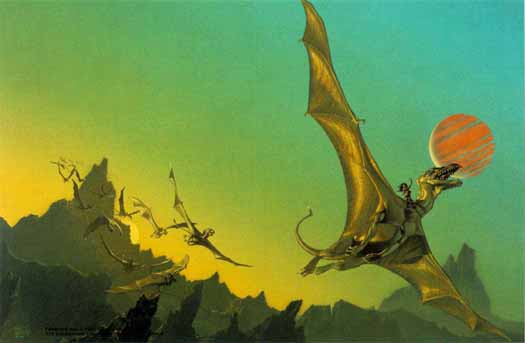
Dragonflight cover artIf we like the “look and feel” of a given universe, we may be glad to revisit that locale, even in the absence of familiar characters and storylines.  For example, Anne McCaffrey’s Dragonriders of Pern has flourished through innumerable sequels, prequels, side stories, and odd departures of all sorts (Dolphins of Pern, Renegades of Pern, The Masterharper of Pern . . .).  People like to spend time on Pern.

Still, this attachment to a location or milieu only takes us so far.  When the original Pern plotline was concluded, and the new batches of characters were not quite as engaging as the first four, I confess that I gradually lost interest.  A well-loved setting can draw a viewer or reader in—but it still takes compelling characters and plots to please the audience in the long run.

That’s the primary lesson I’d take from the success of “Fantastic Beasts” and “Rogue One” so far.  Viewers and readers today seem to be more willing than in the past to invest in expanding universes as well as long story arcs—contrary to what one might call the “ADHD hypothesis” that no one today has an attention span longer than 140 characters.  This is good news for writers who are into worldbuilding.  But building a world people want to visit isn’t enough by itself.  We still need to tell a good story—no matter where it may be set.

Comfort Reading

Reading for Reassurance

Chicken soupYou’ve heard of “comfort food,” right?

In Robert A. Heinlein’s The Number of the Beast (1980), one character asks the others:  “Write down the twenty stories you have enjoyed most. . . . Make them stories you reread for pleasure when you are too tired to tackle a new book.”  (ch. 33, p. 349)

I’d never actually thought about it before I read that passage, but there is such a category.  There are times, especially toward the end of the day, when we want to immerse ourselves in a story, but not an arduous story.  Even if we’re currently reading something new that we like, we may not feel we can fully appreciate it when we’re tired out.  We’d rather relax into something less demanding.

The same can be true when we’re feeling emotionally drained.  Sometimes we pine for what we might call “comfort reading” on the analogy of “comfort food.”

We might be tempted to regard this urge for the familiar and reassuring as craven or self-indulgent.  But there’s nothing wrong with giving way to that impulse—some of the time.  We can welcome a new book as a challenge; but we don’t always have to be challenged.  Sometimes we simply need to recoup our energies for a while.

This is true in general, I think, but especially at Christmastime—so today seemed like a good time to bring up the subject.

Good Comfort Reading

What kind of stories one likes for “cocooning” will vary, culturally and individually—as the Wikipedia article cited above makes clear for comfort food.  In TV Tropes terms, “your mileage may vary.”  By way of example, here’s some of what I find myself looking for.

When I relax, I want something relatively light, not a matter of life and death.  A fan of adventure fiction spends a lot of time embroiled in saving the world, or the galaxy—or at least the imperiled main characters.  And a lot of science fiction deals with world-changing issues and problems.  That’s pretty strenuous.  It’s nice to be able follow a narrative where the stakes are not quite so high.

At the same time, there has to be enough substance to engage our interest.  A story in which nothing is at stake won’t hold our attention.  So pure farce or silliness doesn’t always fill the bill.

And for me, at least, it helps if the story is fairly “warm-hearted.”  Happy endings, sympathetic characters, a certain degree of kindness and encouragement in the air.  A cynic might have a quite different preference here:  a happy ending may not be congenial to his world-view.  But we sentimentalists want some of the milk of human kindness in our chicken soup.  (Well, maybe not literally.)

For this reason, romances make good hunting grounds for comfort reading.  Not necessarily genre romances; I’m put in mind of Chesterton’s Tales of the Long Bow, which is almost uncategorizable (social comedy? political commentary? science fiction?) but incorporates no fewer than seven separate romances in a scant 217 pages, possibly a world’s record.

In a good love story, something that matters very much is at issue—but generally only for the main characters.  This is why P.G. Wodehouse’s comedies are almost always romantic comedies.  His amiable main characters are never in very great danger, but rooting for their love affairs keeps us focused through the plot’s succession of hilarious absurdities.

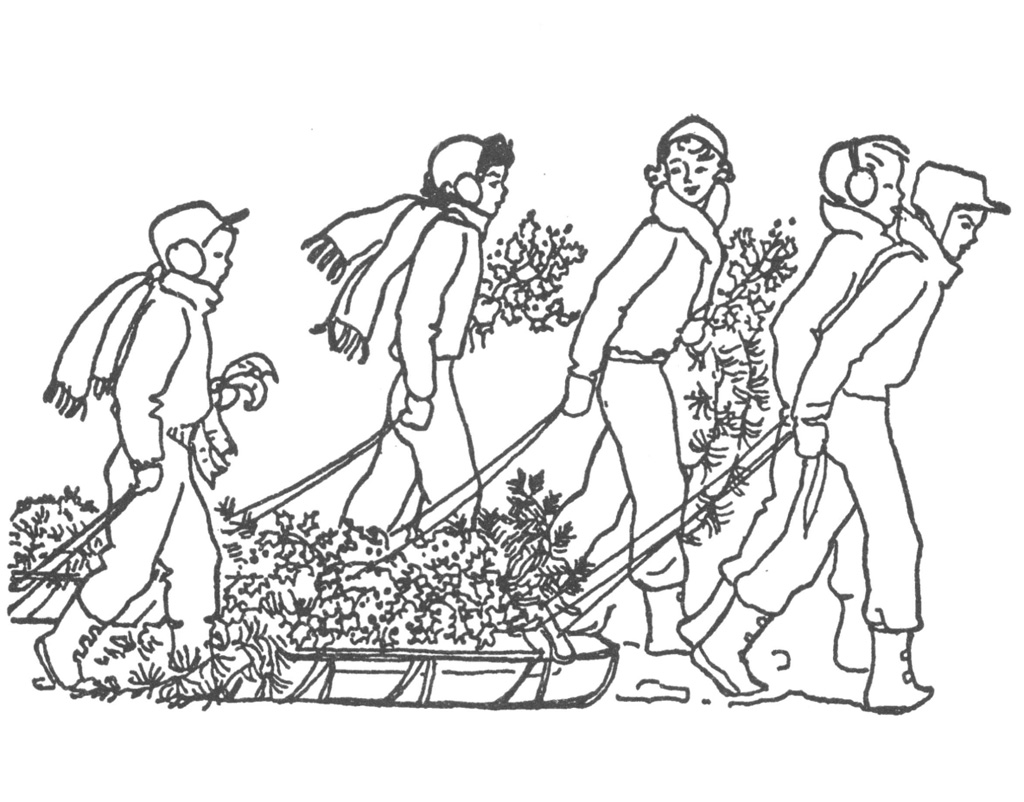
Melendy children with Christmas greensPersonally, I also like children’s stories to relax with.  There’s a category of what I call “family adventures,” where preadolescent children get into a series of scrapes or difficulties that are interesting but never too serious.  Elizabeth Enright’s Melendy Quartet (starting with The Saturdays, 1941) is my paradigm example.  Some of E. Nesbit’s books, such as Five Children and It, have a similar air, but with a fantasy component.  (I’d cite Eleanor Estes and Edward Eager as well, but that would raise the mysterious question of why so many writers in this category have the initials E.E.  Same reason Superman’s girlfriends all have the initials L.L., I suppose.)

Christmastide Reading

Of all the times of the year, the Christmas season may be when one most wants to be reading something engaging but pleasant.  There are probably people who want to stage a “Game of Thrones” marathon on Christmas Day, but I’m not one of them.

There are of course the traditional comforting stories that are specifically about Christmas.  A Christmas Carol is one obvious choice (though the actual book is a bit spookier and more tough-minded than some of the adaptations)

Interim Errantry coverLess obvious favorites of mine include “A good-humoured Christmas chapter” from Dickens’ The Pickwick Papers (ch. 28); “How Lovely Are Thy Branches” from Diane Duane’s Interim Errantry; chapter 5 of The Wind in the Willows (“Dulce Domum”); Madeleine L’Engle’s Dance in the Desert and The Twenty-Four Days Before Christmas; Elizabeth Scarborough’s Carol for Another Christmas; chapters 12-13 of Kate Seredy’s The Good Master; and Manly Wade Wellman’s “On the Hills and Everywhere,” in the collection John the Balladeer.  The only trouble is that some of these are quite short; they’ll barely last you through lunch.

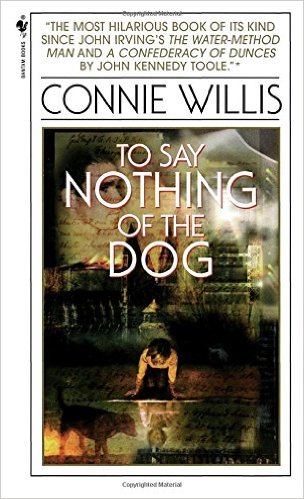
To Say Nothing of the Dog coverBut even at Yuletide, we may not want to marinate in Christmas quite to that extent.  So I also cultivate a selection of books that strike (or encourage) the right mood, but don’t have anything specific to do with Christmas.  I’ve mentioned Wodehouse; Georgette Heyer’s Regency romances have a similar combination of light-heartedness and warm-heartedness (I’ve often thought of her as Wodehouse crossed with Jane Austen).  Other kindly and entertaining tales not specifically about the season include Lois McMaster Bujold’s A Civil Campaign—one of my all-time favorites for all seasons—Connie Willis’s To Say Nothing of the Dog, and Diane Duane’s Omnitopia Dawn.

Have any favorites of your own for Christmastime, or comfort reading generally?

Lost World-Ships

Lost Universes

Suppose it turns out that the world in which you and your ancestors have lived isn’t a natural world at all, but a construct.  All you know of reality is the interior of a vast spacecraft.  If the truth ever becomes apparent, you’re going to be in for a shock:  the universe is vaster and stranger than you ever imagined.

Warp Drive exit signThe immense distances between the stars, and the speed-of-light limit, make this kind of situation a staple of modern science fiction.  Barring some as-yet-undiscovered method for faster-than-light travel, like the Star Wars hyperdrive or Star Trek warp drive, an interstellar voyage is likely to take many years.

The “generation ship” is a common SF assumption.  What I call “lost world-ship” stories, in which the inhabitants have forgotten they are even on a spaceship, form a subset of generation ship stories.  The generation ships, in turn, are a subset of the broader category of what might be called “sealed environment” tales:  people live for generations in an restricted artificial environment, but it isn’t a spaceship (as for instance in the movie City of Ember).  The sealed environment stories can in turn be seen as a subset of “exotic environment” SF tales, where an unnatural situation places unique pressures on the people who live there.


. . . And Where To Find Them

I find the lost world-ship plot particularly fascinating, so I’ve accumulated a number of examples over the years.

The Star Seekers coverMy first exposure to the idea as a child was in Milton Lesser’s The Star Seekers (1953), one of the distinctive Winston Science Fiction publications that introduced so many kids in that era to SF.  I recently obtained a Kindle copy and was charmed to encounter the story again, after all these years.  On a 200-year trip to Alpha Centauri, the four levels of the starship have separated into four different cultures, three of which are no longer aware they are on a spacecraft.  The setup is not entirely convincing; there’s no real explanation as to how most of the inhabitants simply “forgot” their origins.  But the book conveyed to me the mystery of discovering something that changed one’s whole world-view.

Orphans of the Sky coverIn pursuing the stories in Heinlein’s Future History, I ran across the real bellwether of the lost world-ship tale, the two novellas “Universe” and “Common Sense” (1941) that form the book Orphans of the Sky.  It may not be the earliest treatment— Don Wilcox was a year ahead with “The Voyage That Lasted 600 Years” (1940).  But in the Wilcox story, as in The Star Seekers, there was still someone on board who remembered the ship’s purpose.  In Heinlein’s starship Vanguard, no one preserved that memory.  A mutiny long ago had killed off the technically skilled, and their descendants preserved the story of the “Trip” to “Centaurus” only as mythology—which they interpreted as pure allegory, not to be taken literally.

Orphans of the Sky focuses on how hard it is for those raised in the artificial environment even to conceive that there could be an outside.  The escape of a few characters to make landfall on a planet, at the end, is a dramedy of errors.

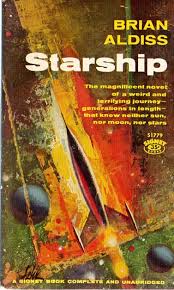
Aldiss Starship coverAnother lost world-ship story that fascinated me in my misspent youth was the Brian Aldiss book Non-Stop (1958), published as Starship in the U.S.  As in Heinlein’s case, Aldiss’s travelers have reverted to barbarism.  The artificial nature of their surroundings is masked by the fact that much of the ship is filled with “ponics” – mutated hydroponic plants that have spread through the corridors.  The real story does not emerge until close to the end, mediated, as in Orphans, by a diary left over from earlier times.  The ship had been ravaged by a disease of sorts, the result of a previously-unknown amino acid picked up on their destination world, from which the ship was now returning.  This plague, and the long unpiloted voyage, has rendered the inhabitants far different from their ancestors, rendering their hopes for escape from the degenerating vessel problematic.

Strangers in the Universe coverI encountered Clifford D. Simak’s Target Generation (1953), originally published as Spacebred Generations, in Simak’s collection Strangers in the Universe.  There’s a well-done summary and analysis of the story by Zachary Kendal on his Web site.  When Simak’s automated starship reaches its destination, it triggers a sequence of events that lead the main character to open a sealed book of instructions that has been waiting for that moment—rather like the instruction page in City of Ember.  He concludes that the builders of the ship had deliberately caused the travelers to forget their origins, except as a vague quasi-religious observance, because that was the only way they could (in Kendal’s words) “survive the journey without terrible psychological trauma.”

All these stories affected me with a sense of vast, brooding spans of time and forgotten lore.  The settings tended to be gloomy, the societies stunted or degraded, the environments worn-down and cramped.  But the tales also raised a sense of hope—that the travelers could somehow break free of their limited universe in the end, and recover the way humans were meant to live.


Other Media and Sources

The lost world-ship trope has turned up in other media too.  The original Star Trek series included a third-season episode (1968) with the cumbersome but evocative title “For the World is Hollow and I Have Touched the Sky,” in which the Enterprise crew discovers that an “asteroid” approaching a Federation planet is actually a generation ship.  There was a mercifully short-lived TV series in 1973 called The Starlost, a decent concept (by Harlan Ellison) with a completely botched execution—an entertaining story in itself.  The Pixar film WALL-E incorporates the idea that the remaining human beings have been living for generations aboard a luxury starship and have almost, if not entirely, forgotten what it’s like to live on a planet.  There was even a 1976 role-playing game called Metamorphosis Alpha set on a generation ship afflicted by an unknown cataclysm.

There’s more.  The Wikipedia and TV Tropes pages on generation ships provide useful lists.  Still more are summarized in a study by Simone Caroti, The Generation Starship in Science Fiction:  A Critical History, 1934-2001 (2011)—though Caroti’s study is a little heavy on the academic Marxist/deconstructionist attitudes for my taste.

For the broader categories I mentioned above, examples of non-spaceborne sealed environments include Hugh Howey’s Wool, James White’s The Watch Below (which pairs an alien fleet of generation ships with a human group trapped in a sunken oceangoing vessel), and Daniel F. Galouye’s Dark Universe.  TV Tropes lists others under the headings City in a Bottle and Small, Secluded World.  Other “exotic environment” stories include Ray Bradbury’s memorable “Frost and Fire” and Christopher Priest’s Inverted World.


Themes

What is it that’s so compelling about the lost world-ship stories as to explain my lifelong love affair with them?

Sense of Wonder.  The strangeness of the environment—the union of familiar human concerns with surpassingly unnatural situations—evokes the “sense of wonder” that is characteristic of F&SF.  But we can point to more specific themes that arise in the lost world-ship setting.

Loss and Forgetfulness.  A sense of loss pervades these stories—a loss not fully appreciated by the characters, but clear to the reader.  The starship inhabitants have lost their history, and with it, their sense of who they really are.  They have lost other kinds of knowledge as well, especially technological knowledge, often existing as barbarians in the ruins of a superscientific construct (again, a wider SF trope).

This sense of loss is like that of another subgenre, the post-apocalyptic story.  The disaster that afflicts the starship is a sort of localized apocalypse; this is what differentiates the lost world-ship from a functioning generation ship.  Pondering the causes—whether mutiny, plague, accident, or even deliberate obliteration of the past—makes us reflect on the fragility of our own histories and societies.

Illusion.  In these stories, the world is never what we think it is.  One need not live on a starship to share that experience; the whole history of modern science can be read as a progressive penetration of appearances.  (Heinlein has a character in Orphans unknowingly echo Galileo as he tries fruitlessly to convince others of how their world really works:  “Nevertheless—Nevertheless—it still moves!”)  The lost world-ship story brings home the way our knowledge is bounded by our experience—or by our assumptions.

The Natural and the Artificial.  This dichotomy can play out in two ways.  Either the inhabitants take their artificial world so matter-of-factly that it seems perfectly natural to them, and they can hardly imagine anything else (Heinlein); or the unnaturalness of their world subtly warps or frustrates them (Aldiss).

The former may seem more plausible to those who prefer “nurture” to “nature” as an explanation.  When you grow up with something, why wouldn’t you take it for granted as normal and natural?  The latter approach may appeal more to those with a strong sense of the natural as fundamental and superior to the artificial.  For example, a character in Non-Stop tries to show his companions that the ponic plants are natural, but corridors are not.  The key question, of course, is how he knows that plants are more natural than walls:  is the difference somehow wired into the human brain?  In Howey’s Dust, part of the Wool series, a knowledgeable character says of their underground sealed environment:  “They don’t know anything beyond their walls, so I guess they don’t have some of the stress about what’s out there that you and I feel.  But I think they have something else that we don’t have, this deep feeling that something is wrong with how they’re living.”

We frequently encounter such nature-nurture arguments in more conventional sociological contexts.  But the lost world-ship story brings us face to face with them in novel ways.

Incongruity.  The lost world-ship is a fertile ground for irony and “cognitive dissonance,” where the reader knows things the characters do not.  In principle this sort of incongruity could be played for light comedy or farce—but I don’t know that I’ve ever seen it done that way, except perhaps toward the middle of The Star Seekers, a young adult novel and thus somewhat lighter in tone.  The starship stories tend to be too grim for farce.

Escape.  The somberness of the classic lost world-ship is alleviated by the possibility of getting out, into a freer and better world.  Once the characters realize there is somewhere else to go, they may be able to escape.

Flammarion cosmos paintingEscape is a major preoccupation in Non-Stop, and contributes much of the story’s emotional force.  It fits in with the fact that we encounter the starships in Target Generation and The Star Seekers just as they arrive at their destinations:  a hoped-for new world, a natural world free of the constraints of the world-ship.

The last generation is in a far better position, in this respect, than their ancestors.  As TV Tropes puts it, commenting on Kim Stanley Robinson’s Aurora:  “A major theme of the book is the fact that while the original generation-ship crew may have consented to their risky mission, their children don’t get a choice.”  The writer of the ancient diary in Non-Stop, facing the beginning of the generations-long return trip, bursts out:  “Only a technological age could condemn unborn generations to exist in [the ship], as if man were mere protoplasm, without emotion or aspiration.”

But the characters we’ve come to know in the story do have the possibility of emerging into something wider and greater.  This hope is not quite the same as what Tolkien means by “Escape” in On Fairy-Stories (a topic for another day), although there is some common ground.

The contrast between the all-too-human characters and the artificial environment has still more resonance, perhaps, with the common human feeling that we don’t really belong in this world.  Some of the twentieth-century existentialists took this reaction as a sign of despair and meaninglessness.  But the notion of escape suggests instead that such emotions may instead point to another place where we do belong, evoking hope rather than despair.  The plight of the lost world-ship traveler may recall Chesterton’s lines in “The House of Christmas”:

For men are homesick in their homes,
And strangers under the sun,
. . . . .
But our homes are under miraculous skies
Where the yule tale was begun.

Meta-reading

The Sign of the Sequel

Ever find yourself approaching the end of a new book—and you realize there’s no way the author can tie up the plot in what remains of the novel?  It’s that moment when you realize:  we’re in for a sequel.

That realization may be awful, or it may be exciting, depending on how much you enjoy the story so far.  But it changes the way you look at the book you’re reading, to know it isn’t complete in itself, but only part of a larger tapestry.  Your sense of the pacing and the shape of the story has to adjust.

Book, fanned openBut the story alone hasn’t told us there will be a sequel.  Rather, we’re drawing on something outside the text itself—our knowledge of how much of the book remains—to tell us something about the story.

Years ago, when I first read Isaac Asimov’s Second Foundation, I almost missed the last chapter altogether.  The conclusion of the novel consists of a series of successive surprises, each overturning the last.  The second-to-last chapter seemed to end so conclusively that I only turned the page because I was in the habit of reflectively turning over the blank endpapers of a book.  —And there was the final chapter!  I could only make that mistake, however, because the last chapter was so short—six pages in my hardcover edition.

It’s harder to make that kind of observation in an e-book, where there are no physical pages to observe.  You can usually find a percentage or “location” indicator, but it’s not quite as obvious as the physical thickness of the pages.

Let’s call this process of drawing on outside information “meta-reading.”

Sources of Meta-Information

There are a number of sources from which we glean this meta-information, consciously or not.

Starting from the broadest case, we get some information from the genre to which the book belongs.  If you find a book in the science fiction section of the bookstore, then no matter how mundane the opening scenes may be, you can be pretty sure that something out of the ordinary is going to turn up at some point.  If you’re reading a genre romance, you can rely on the ironclad rule that a genre romance must have a happy ending:  either “happily ever after,” or at least “happily for now”—HEA or HFN, in the jargon of the trade.  Even if the characters’ relationship seems doomed as you approach the ending, you can be pretty sure it’ll turn out well—which may not be the case in a “mainstream” novel.

Getting to know an author’s habits and preferences is another way to guess what’s going to happen in the end.  If we’ve read a fair sampling of an author’s work, we can gauge fairly well the chances of a happy ending, the likelihood of violence or sex scenes, the kinds of characters you’re likely to meet up with.  It’s a little more tense approaching the end of a book by a new author, because we’re not yet familiar with what kinds of tricks the writer may (or may not) be willing to pull at the denouement.

Then there’s the back-cover blurb, or the flyleaf—often the reason we pick up the book in the first place.  The half-dozen paragraphs or so of teaser text on the flyleaf are designed to tell us just enough to get us interested.  They shouldn’t give away the whole plot, but they do create expectations—which the book as a whole may or may not meet.  Something that comes as a complete surprise to the characters may be something the reader is already primed for, because it’s part of the plot setup that the blurb describes.

Reviews take this principle further.  A review may include spoilers, but even without actual spoilers, it tells is something even before we open page one.

Once we get into the book, there are still more clues.  Chapter titles are out of fashion these days, but if there are such titles, they inevitably tell us something about what’s going to happen.  In my current novel-in-progress, I use temporary chapter titles that remind me what happens in the chapter, but remain obscure enough not to telegraph the outcome to test readers.  Still, when you reach the chapter titled “The Battle of Tremont,” you’re inevitably going to have an idea what to expect.

Finally, in the example I started with, the length of the book tells us something.  As we move through the story, we can measure our sense of pacing with the literal progress through the pages.  There have been a number of cases where it’s looked as if the plot was being wrapped up nicely, and I’ve looked at the mass of material still to come and thought, Something’s bound to come unglued here . . . or we wouldn’t have a hundred pages to go.

Setting Expectations

This kind of insight relies on an awareness of narrative practices.  There are internal necessities to good storytelling.  Guessing the imminence of the climax from the number of remaining pages, for example, depends on our assumptions about how much time after the climax will be devoted to wrapping things up—which, in a long story like The Lord of the Rings, can take quite a while.

Likewise, gauging the amount of space needed to resolve the plot assumes that the plot will be resolved:  good authors, at least, don’t leave things totally dangling.  Our use of meta-reading plays off our assumptions about how stories are told—and can go awry if the author’s views are radically different from the reader’s.

For that very reason, the writer of a story has to take into account the context in which the reader encounters the story, and the expectations raised in that context.  The reader doesn’t come to the story as a blank slate.

If there will be major surprises in the tale, the writer (and publisher) need to make sure they aren’t given away in the blurbs.  If the author wishes to undermine the expectations created by genre classification or advertising, it’s important to be aware of the consequences.  Subverting reader expectations can be illuminating and satisfying to the reader, but it can also be annoying and frustrating. The implicit contract between writer and reader—‘I’m going to tell you a story you will enjoy’—places boundaries on just how subversive one can be without leaving the reader feeling cheated.

The writer’s conversation with the reader, then, extends well beyond the contents of the text itself.  It’s something that’s useful to remember for the writer—and the reader as well.