The Phantom’s Lighting Contractor

I never saw Andrew Lloyd Webber’s musical The Phantom of the Opera on stage.  But I am fond of the 2004 movie.  I can’t compare the two formats, so I’ll have to duck quietly out the back door if people want to debate their relative merits.  But the movie does bring up an entertaining, if minor, point.

Phantom Candles

If you’re not familiar with the story of Webber’s musical, check the Wikipedia link at the top of this post.  What we need to know here is that around 1870, a reclusive villain haunts the Paris Opéra House; he’s obsessed with a young singer named Christine Daae, who is in turn mesmerized by the Phantom’s music; and the partially-masked man lives in extensive caverns under the opera house, which form the backdrop for scenes in the movie.

When I say “caverns,” you may be picturing some dark, gloomy retreat.  Not at all.  The Phantom’s lair is not only pretty plush; it’s brilliantly lit by what seem to be thousands of candles.

Phantom & Christine with many candles

The Phantom’s well-lit lair

My family was watching the movie one time and started speculating about exactly who manages these candles.  To begin with, someone has to have lighted them all before the Phantom spirits Christine away to his hideout.  Did the Phantom himself spend a couple of hours going around with a Bic lighter beforehand?  It’s not as if he has a crew of minions to do it for him.  The Phantom is strictly a one-man operation.

Nor is it enough simply to turn a light on, as might be the case for, say, a gas lamp.  Candles burn down and have to be replaced.  One imagines the Phantom singing the languorous lyrics of “The Music of the Night” while breaking off every few lines to change out a guttering candle for a fresh one.  It would kind of ruin the effect.

It gets worse.  Where do all the candles come from?  Even if we assume the mystery man can afford them (he demands regular protection money from the opera in exchange for not killing people), remember that this is a secret hideout.  If a big lorry pulled up outside the cellar doors every week—“Order of 5,000 candles for Mr. P.”—someone would eventually notice.

Of course, The Phantom isn’t exactly a model of realism, and we don’t begrudge the producers another minor lapse in logic in exchange for the visual spectacle.  It’s an example of what TV Tropes calls “Fridge Logic”: the plot holes that occur to you half an hour after the movie is over, as you’re rooting around in your refrigerator.

Still, it’s surprising how common this particular anomaly is.

Richelieu’s Firepots

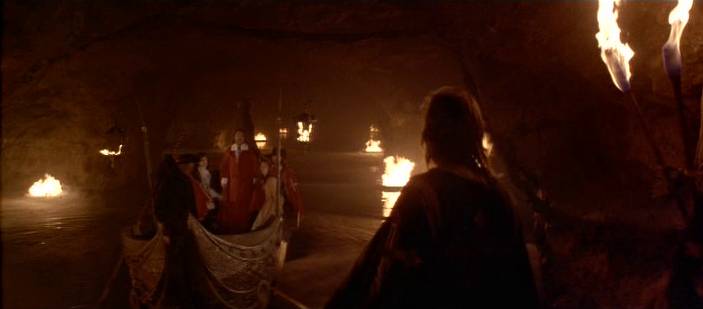
In Disney’s 1993 version of The Three Musketeers (still my favorite version), the primary villain is Cardinal Richelieu, hammed up to the hilt by Tim Curry.  He too has an underground lair:  a dungeon somewhere near the palace, which can only be reached by rowing a boat across a subterranean lake.

The path to the dungeons is lighted by plenty of torches; no doubt the Cardinal’s numerous henchmen can take care of those.  But in addition, there are firepots spaced strategically around the lake, presumably with wood or coal feeding their bonfires.

Cardinal Richelieu's underground lake, with firepots

Cardinal Richelieu’s underground lake

I suppose there must be minions whose sole job is to row around the lake, periodically replenishing the firepots’ fuel.  And I expect they are under strict orders to skedaddle off the lake whenever the Cardinal himself comes to take a boat across, lest their mundane tasks interfere with Richelieu’s august progress.  Still, it seems a rather elaborate, not to mention wasteful, setup.

It might well be more economical, instead, for Richelieu to hire a contractor to come in and handle the job.  That method would solve the minionless Phantom’s problem as well.  Clearly, there’s a market niche here in providing this key service for villains.

But why shouldn’t heroes also get in on the game?

Carroll’s Oil Troughs

In National Treasure (2004), Our Heroes spend most of the film searching for a fabulous hoard of valuable artifacts originally collected by the Knights Templar, passed on to the Masons, and eventually hidden by Charles Carroll, one of the Founding Fathers of America.  They finally discover this treasure in—you guessed it—an underground cavern, this one under Trinity Church in New York City.

This vast array of shining gold would be unimpressive if it were lighted by a single torch.  Fortunately, Our Heroes find that the designers of this particular display hall have run troughs filled with oil down from the entry and across the whole expanse.  All Nicolas Cage has to do is touch his torch to the basin of oil at the top, and flames race along the entire network of open tubes, providing them, and us, with a wonderful view of the goodies.

National Treasure treasure room

Treasure cavern in National Treasure

This neat bit of eighteenth-century construction still works perfectly after all these years, reminding us of the kind of Durable Deathtraps Indiana Jones is always running into; except that this isn’t a deathtrap, just a convenient lighting effect.  At least we don’t have to imagine fires that have been burning continuously for two and a half centuries.  We needn’t worry about plausibility as long as we don’t wonder why the oil hasn’t evaporated or leaked away long since.

If those fridge thoughts do occur to us, however, clearly the answer has to be that Carroll got in touch with the Phantom’s lighting contractors to renew the oil supply every so often.  The movie has already presented us with several secret societies functioning for centuries; what’s one more?

Conclusion

This particulat subtrope seems to occur mainly in the movies, since it’s primarily a matter of visual spectacle.  A verbal description can more easily skate around the problems, though it still wouldn’t be quite as satisfying to write about the wonderful sight of a vast treasure if it were almost entirely shrouded in gloom.

It’s primarily in a historical context that we need the lighting contractor’s services.  A story set in the present or future would face less daunting challenges if it merely had to explain long-lived electric lighting rather than candles or other fires.  And of course it’s in underground settings that we tend to need the light most.

Athos with sword and torch (Three MusketeersA little stretching of the imagination was always needed when visualizing exploration, not to mention swordfighting and such, in underground areas without an obvious source of light.  One could stipulate that Dungeons and Dragons adventurers were carrying torches in one hand while wielding swords in the other—but at best that always seemed like something only a master swordsman could pull off.  I was rather relieved when the players in my D&D campaign came up with the idea of casting Continual Light spells on coins that they could hang around their necks.  The wildly shifting shadows as they darted around in a melee, lanyards swinging, would be headachy to imagine; but at least they could get rid of the dratted torches.

What really justifies (and I use the term loosely) these candles and firepots is what TV Tropes calls the Rule of Cool:  we’re willing to grant some logical leeway to a storyteller to allow a really impressive effect.

But I’m still tempted to add to the traditional Evil Overlord List an additional bit of advice:  If you want cool lighting effects, and the technology level is such that it’s not just a matter of making sure your utility bills are paid up, look up the Phantom’s lighting contractor.

Describing the Indescribable

Showing the Unshowable

In our last exciting episode, we noted that fantasy and science fiction stories often seek to transcend the boundaries of human experience—to show us things beyond our ordinary understanding.  Take it further:  the author may wish to present things that are beyond all human understanding.  How do we get across to human readers, or viewers, something that we’ve just postulated as indescribable or incomprehensible?

We’re not asking whether there can be things the human intellect or senses cannot grasp.  Kant or Aquinas, for example, would have rather complex answers to that question.  Rather, we’re focusing here on how to put the ungraspable into a story.

Beyond the Senses

Doctor Strange casts a spellThere are plenty of things that are impossible, but easy to describe; we can detail how they appear to our senses, though explaining how they can actually occur is another matter.  For example, magic spells cast by Doctor Strange frequently manifest as flat discs suspended in space, generally with symbols or letters inscribed.  Both the comics and (using CGI) the movies can show us these with no problem.  That’s not what we’re interested in here.

What’s intriguing is a sensory experience different from any we normally experience (or, perhaps, can experience).  In James Schmitz’s The Witches of Karres, our hero Captain Pausert, who is just beginning to exhibit witch powers, detects an extra-universal entity called a “vatch.”  His young witch companions have referred to “relling” a vatch, but this is the first time Pausert himself has had the experience:

The Witches of Karres, coverIt was something like smelling a grumble, or hearing dark green, or catching a glimpse of a musky scent.  As Goth had suggested, it was not to be described in any terms that made sense.  But it was quite unmistakable.  He knew exactly what he was doing—he was relling a vatch.  (ch. 9, p. 250)

I tried this same technique of combining nonsensical sensory references to suggest something magical about spell-casting music in my short story The Green Song.

While Schmitz chooses to present this supernormal power as “magic,” such special powers can just as well be described in science-fiction terms (often as “psionic” powers), which is how we normally use words like “telepathy” and “telekinesis.”  Though it’s worth noting that fantasy characters like Gandalf and Galadriel can “speak mind to mind” as well—they just don’t call it telepathy.

I’ve just finished The Pursuit of the Pankera, a recently-discovered earlier version of Heinlein’s The Number of the Beast which takes off in a quite different direction.  In chapter 38, one character, Deety Burroughs Carter, meets a Lensman from E.E. Smith’s Lensman series and tries to describe the famously indescribable Lens itself:  “The nearest I can think of is an enormous fire opal with a light behind it—but take that and cube it.  It’s all colors and the colors keep changing and the lights come from the Lens itself and dance like a color organ but brighter and more alive—and I still haven’t described it.”

Heinlein’s method is instructive.  In this brief passage, we start with a known image—fire opal—and are told to extend it in an unspecfied way (“cube it”).  The second sentence is a run-on, piling image on image in a way that suggests an inability to capture the item in any single description.  She finishes by apologizing that the result is still inadequate (“I still haven’t described it”).

An extraordinary experience like Schmitz’s “relling” is neutral—just an unfamiliar new sense.  But once we’ve postulated the non-natural, it’s easy to transition to the “unnatural,” in the pejorative sense of the term.

The Colour Out of Space, magazine illustrationI recently revisited H.P. Lovecraft’s short story The Colour Out of Space (1927)—the only Lovecraft piece I’ve ever actually read.  According to the story, a meteorite arrives on earth in 1882, in the Arkham area (there’s a reason why the lunatic asylum in Gotham City is called the “Arkham Asylum”).  Weird growths emerge from the meteorite and transform plants, animals, rocks, water, and humans in horrible ways.  The creatures so affected are characterized by an unearthly color, first noticed in globules in the meteorite:  “The colour, which resembled some of the bands in the metetor’s strange spectrum, was almost impossbile to describe; and it was only by analogy that they called it colour at all” (p. 150 in the anthology I have).  Skunk cabbages infected by this influence are described unpleasantly:  “. . . they held strange colours that could not be put into any words.  Their shapes were monstrous, and the horse had snorted at an odour which struck Stephen as wholly unprecedented.”

The notion of extra colors that can be seen with ordinary vision is dubious, given what we now know about neurobiology and the electromagnetic spectrum.  But the notion does communicate a sense of the weird and unnatural.  That’s what Lovecraft was driving at, according to Wikipedia—“to create an entity that was truly alien.”

More important, Lovecraft, like other horror writers of the pulp era, was quick to treat the incomprehensible as evil, or at least destructive to humans.  If you’re writing horror, I suppose that comes naturally.  But it isn’t a necessary conclusion.  Something not naturally perceivable could be neutral, as in Karres—or it could also be incompehensibly good.

The Extraordinary and the Supernatural

An extra sense or a psionic talent would be beyond ordinary human capabilities, but not beyond the range of nature itself.  Those powers needn’t be good or evil—just neutral, like most human abilities, able to be used for good or bad purposes.  Bur we’re especially likely to run into the indescribable when we speak of the supernatural.

The supernatural tends to have an evaluative charge, so to speak:  either good or evil in itself.  Lovecraft’s unnatural horrors tend in that direction; he doesn’t describe them as theological, exactly, but they’re definitely horrible (at least to humans).  Something supernally good, however, may be just as difficult to describe.

At the end of C.S. Lewis’s Perelandra, two eldila—planetary angels of a sort—ask Ransom, the main character, in what form in which they should appear to do honor to the new human masters of the planet.  Their first attempts aren’t very successful:

A tornado of sheer monstrosities seemed to be pouring over Ransom.  Darting pillars filled with eyes, lightning pulsations of flame, talons and beaks and billowy masses of what suggested snow, volleyed through cubes and heptagons into an infinite black void.  “Stop it . . . stop it,” he yelled, and the scene cleared.  He gazed round blinking on the field of lilies, and presently gave the eldila to understand that ths kind of appearance was not suited to human sensations.  (ch. 16, p. 197-98)

Lewis handles the incomprehensible by referring to some familiar things, but placing them in unexpected or incoherent contexts (darting pillars, with eyes; bird imagery and pure geometry).  He also uses Ransom’s reaction, as Lovecraft used the horse’s reaction to an “unprecedented” smell, to evoke the strangeness and unbearableness of the experience.

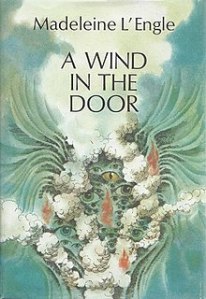
A Wind in the Door, coverMadeleine L’Engle is also talking about angels, more or less, in The Wind in the Door (sequel to A Wrinkle in Time) when she introduces a being called Proginoskes.  The human characters first see—

wings, it seemed like hundreds of wings, spreading, folding, stretching—
and eyes
how many eyes can a drive of dragons have?
and small jets of flame

On a closer look, Meg reacts this way:  “She had the feeling that she never saw all of it at once, and which of all the eyes could she meet? merry eye, wise eyes, ferocious eyes, kitten eyes, dragon eyes, opening and closing . . .”  (ch. 2-3, pp. 53-54)  Again, some familiar things are mentioned, but in unexpected relationships.  The notion that “she never saw all of it at once” acknowledges the inadequacy of her perception, along with the baffled question about which eyes to meet.  (The cover illustration shown on the Wikipedia page attempts to show in pictorial form what Meg is describing.)

These examples occur in a theological context, but they’re not good or evil themselves.  Lewis and L’Engle are showing us that creatures of a different kind may be beyond our perception.  But in some cases there emerges a sense that the very goodness of something may exceed our ordinary knowledge.

Lewis’s The Great Divorce adopts the fanciful notion that souls from Purgatory or Hell (or both) may be allowed a “vacation” in the lower realms of heaven.  Our narrator, one such soul, finds that heaven is not the vaporous or cloudy region we sometimes imagine; on the contrary, it is more solid and more real than lower things.  Blades of grass are so solid that  don’t bend under the feet of the visiting shades (ch. 3, p. 27); the rain so substantial that it penetrates them like bullets; the flowers are hard like diamonds.

The men were as they always had been; as all the men I had known had been perhaps.  It was the light, the grass, the trees that were different; made of some different substance, so much solider than things in our country that men were ghosts by comparison.  (p. 28)

Simply being in this region causes the narrator’s sensory capacity to expand.

. . . something had happened to my senses so that they were now receiving impressions which would normally exceed their capacity.  On earth, such a waterfall could not have been perceived at all as a whole; it was too big.  Its sound would have been a terror in the wood for twenty miles.  Here, after the first shock, my sensibility ‘took’ both, as a well-built ship takes a huge wave.  I exulted.  (ch. 6, p. 49)

Lewis’s evocation of strangeness here is in the service of a theological point:  he wants to demolish our tendency to think of the spiritual as less real than the solid earth and propose that it is more real.

The Ball and the Cross, coverIn a similar way, G.K. Chesterton suggests that ordinary objects can be subtly transformed for us—can appear to a greater degree as what they are—when we are transformed by the dawn of love.

The difference between this experience and common experiences was analogous to that between waking life and a dream.  Yet he did not feel in the least as if he were dreaming; rather the other way; as waking was more actual than dreaming, so this seemed by another degree more actual than waking itself.  But it was another life altogether, like a cosmos with a new dimension.  (The Ball and the Cross, ch. 9, p. 111)

As Lewis’s Heaven reverses our usual reactions to indicate something more substantial than our ordinary world, Chesterton reverses the usual relationship of dream and reality to imagine a vita nuova more awake than waking.

Finally, attempting to show us complete transcendence at the very end of the Narnian books, Lewis can only fall back on very rough metaphors and, again, a confession of inadequacy.

“’The term is over:  the holidays have begun.  The dream is ended:  this is the morning.’ . . . but the things that began to happen after that were so great and beautiful that I cannot write them.  And for us this is the end of all the stories, and we can most truly say that they all lived happily ever after.  But for them it was only the beginning of the real story.”  (The Last Battle, final pages)

Where Lovecraft presents the transcendent as unintelligible, repelling our comprehension, these examples rather seek the superintelligible, something that draws our comprehension deeper.

How It’s Done

From these examples, we can throw together a list of some techniques used to evoke the incomprehensible.

  • Deliberately mix sensory references in a way that’s literally nonsensical, so as to suggest an unknown sensation.
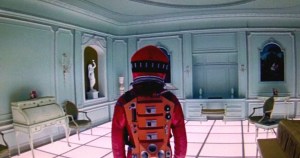
  • Astronaut in bedroom, near end of 2001: A Space OdysseyRefer to ordinary objects, but in a surreal sort of way, as in the ending of the movie 2001: A Space Odyssey.
  • Lead us up to the pinnacle of something that we know, and then point beyond it: the method of “supereminence” that I spoke of last time.
  • Describe people’s reactions to the indescribable thing: horror, exaltation, comfort.  This is particularly appropriate and effective if we’re dealing with supernatural good or evil, as in The Colour Out of Space, or the descent of Venus in That Hideous Strength (ch. 15.1).
  • Acknowledge the insufficiency of our explanation; leave much of the description mysterious and unaccounted-for.

Such methods may be helpful if we want to write about what is beyond description.  They might even be of some use in interpreting our own experience if we should encounter such things ourselves . . . which is never entirely out of the question.

Portraying the Transhuman Character

More Than Human

Kevin Wade Johnson’s comments on my recent post about The Good Place raised a couple of issues worth a closer look.  Here’s one:

Lots of science fiction, and some fantasy, deals with characters who are greater, or more intelligent, or more gifted in some way, than mere humans.  But we the authors and readers are mere humans.  How do we go about showing a character who’s supposed to be more sublime than we can imagine?

It’s one thing to have characters whose capabilities are beyond us.  Superman can leap tall buildings with a single bound; I can’t.  But I can easily comprehend Superman’s doing so.  (I can even see it at the movies.)  On the other hand, if a character is supposed to be so intelligent I can’t grasp their reasoning, or has types of knowledge that are beyond me, that’s harder to represent.  I can simply say so:  “Thorson had an intelligence far beyond that of ordinary men.”  But how can I show it?

Long-Lived Experience

There are a number of ways this can come up.  For example, if a character lived a very long time, would their accumulated experience allow for capabilities, or logical leaps in thinking, beyond what we can learn in our short lives?

I’m thinking of a Larry Niven story—I’m blanking on the name:  maybe one of the “Gil the Arm” stories?—in which a character who appears to be a young woman turns out to be centuries old, and when she drops the deception, she moves with uncanny grace—she doesn’t bump into anything or trip over her own feet, because she’s had that long to train herself in how to move (without the limitations imposed by our bodies’ degeneration from aging).

Of course, a story about long-lived people doesn’t have to take long-lived learning into account.  The depiction of the “Howard Families” in Heinlein’s Methuselah’s Children and Time Enough for Love almost seem dedicated to the opposite proposition, that no matter how long we live, we’re basically the same kinds of personalities; we don’t learn much.

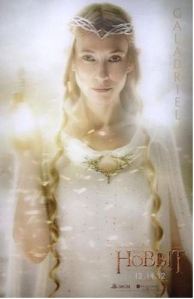
Galadriel, radiantIn a similar way, Tolkien’s immortal elves may seem ineffably glorious to us, but their behavior often seems all too human—especially if you read The Silmarillion, where elves make mistakes, engage in treachery, and allow overweening pride to dictate their actions in ways that may surprise those of us familiar only with LotR.  On the other hand, the books and movies do succeed in convincing us that characters like Galadriel and Gandalf are of a stature that exceeds human possibility.

Logic and Language

There are other ways to have transhuman abilities.  As Kevin observes, Niven’s “Protectors” fit the description.  Niven imagines a further stage of human development—something that comes after childhood, adolescence, and adulthood—that we’ve never seen, because when our remote ancestors arrived on Earth from elsewhere, they lacked the plants hosting the symbiotic virus necessary for transition to that final stage.  The “trans-adult” Protectors are stronger, faster, and more durable than ordinary humans.  They also think faster.  Thus Niven shows them as following out a chain of logic with blinding speed to its conclusion, allowing them to act long before regular humans could figure out what to do.  Because this is a matter of speed, not incomprehensible thinking, Niven can depict a Protector as acting in ways that are faster than normal, but are explainable once we sit down and work out the reasoning.

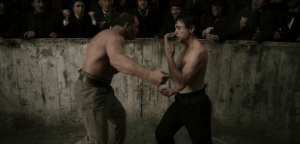
Sherlock Holmes, arena fight sceneA visual analogue is used in the 2009 and 2011 Sherlock Holmes films starring Robert Downey, Jr.  Unlike most other treatments of the character, Guy Ritchie’s version supposes that Holmes’ incredible intelligence can be used not only for logical deduction, but to predict with lightning speed how a hand-to-hand combat may develop.  Holmes thus becomes a ninja-like melee fighter, so effective as to confound all opponents.  The movie shows us this by slowing down the process that to Holmes is instantaneous:  we see a very short montage of positions and moves as they would occur, or could occur, before we see Holmes carry out the final “conclusion” of his martial reasoning.  This allows us to appreciate what the quasi-superhuman character is doing and why, without actually having to execute the same process ourselves.

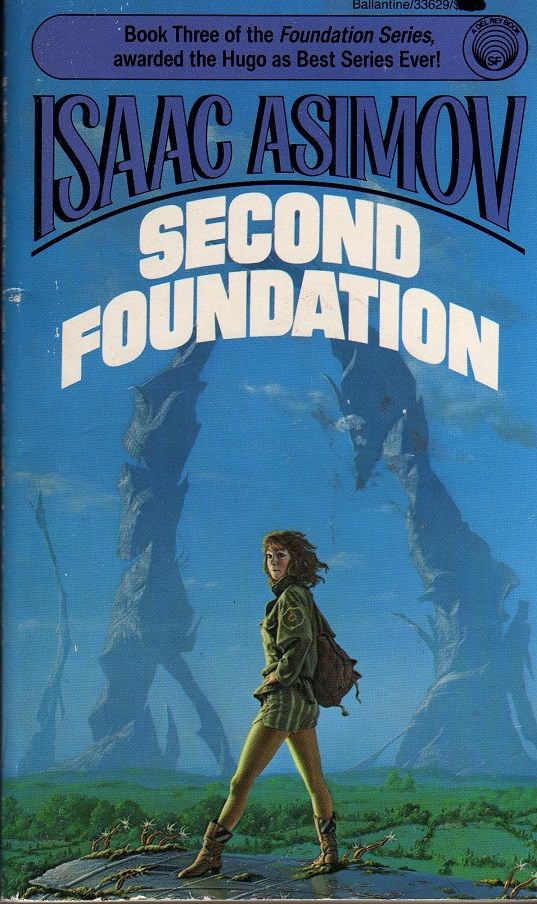
Preternatural intelligence may be more subtle in its effects.  Such a person may, for example, be able to understand things fully from what, to us, would be mere hints and implications.  So, for example, when Isaac Asimov introduces the members of the Second Foundation in his Foundation series, he tells us that their tremendous psychological training allows them to talk among themselves in a manner so concise and compressed that entire paragraphs require only a few words.

Speech as known to us was unnecessary.  A fragment of a sentence amounted almost to long-winded redundancy.  A gesture, a grunt, the curve of a facial line—even a significantly timed pause yielded informational juice.  (Second Foundation, end of chapter 1, “First Interlude,” p. 16)

Second Foundation coverBreaking the fourth wall, Asimov warns us that his account is “about as far as I can go in explaining color to a blind man—with myself as blind as the audience.”  (same page)  He then adroitly avoids showing us any of the actual conversation; instead, he says he’s “freely translating” it into our ordinary language.  This move illustrates one of the classic ways of presenting the incomprehensible in a story:  point out its incomprehensibility and “translate” into something we can understand.  (Note that this is much more easily done in writing than in a visual medium such as TV or the movies.)

A similar technique is used by Poul Anderson in his 1953 novel Brain Wave, which starts with the interesting premise that in certain regions of space, neurons function faster than in others.  When Earth’s natural rotation around the center of the galaxy brings it into a “faster” area, the brains of every creature with a central nervous system speed up, and human beings (as well as other animals) all become proportionately smarter.  Anderson notes that the speech of the transformed humans would be incomprehensible to us and, like Asimov, “translates” it for our convenience.  When a couple of the characters, in a newly invented faster-than-light spaceship, accidentally cross the border back into the “slow zone,” they are unable to understand the controls they themselves designed until the ship’s travel brings them out and lets their intelligence return to its new normal.  (Anderson’s concept may have been the inspiration for the “Zones of Thought” universe later developed in several fascinating stories by Vernor Vinge.)

Showing and Telling

We can glean some general principles from these examples.  If the extraordinary acts don’t actually have to be shown in the medium I’m using, I can simply point to them and tell the reader they’re there.  In a written story, I can say my main character is a world-class violinist without having to demonstrate that level of ability myself.  (Although if I have some experience in that particular art, I’ll be able to provide some realistic details, to help make my claim sound plausible.)  But if the supernormal achievement is something that can be shown in our chosen medium, we have to be able to demonstrate it:  a movie about the great violinist will have to exhibit some pretty masterful violin-playing, or those in the audience who know something about the art will laugh themselves silly.

Flowers For Algernon coverWe should note that there are good and bad ways of telling the audience about a character’s superiority.  In the unforgettable short story “Flowers for Algernon,” which consists entirely of diary entries by Charlie Gordon, the main character, the text vividly shows us the effects of an intelligence-raising treatment on a man of initially lower-than-normal intelligence.  The entries improve so radically in writing competence and understanding that when Charlie describes how his brainpower is beginning to exceed that of ordinary humans, we believe him, because we’re already riding on the curve of rising ability up to our own level that is apparent in the text—a true tour de force of writing.  On the other hand, in the drastically worse movie version, Charly (1968), the screenwriters are reduced to having Charly stand in front of an audience of experts and scornfully dismiss the greatest intellectual achievements from human history—a weak and ineffective technique at best for conveying superiority.

Summary

This quick review of the problem turns up several methods for handling supernormal abilities in a story.


  • If the superior ability is intelligible to us ordinary people in the audience—maybe it’s just doing normal things faster—we can have the wiser or super-enabled person explain it to someone less wise: our last post’s Ignorant Interlocutor.
  • If the advantage is mainly a matter of speed, we can slow it down to a speed at which regular people can follow the action.
  • If we can get away without actually showing the ability in question, we may be able to point toward it, or “translate” it into something we can understand, and convincingly tell the audience about it—if we can achieve the necessary suspension of disbelief.
  • If a character is supposed to be, let us say, preternaturally wise, and there’s simply no way to avoid showing that in the dialogue, the best we can do is to evoke the best we can do—have the character be as wise as possible—and imply ‘like this, only more so.’ This method—like “projecting” a line or a curve—is the method of “supereminence,” which is sometimes employed in theological talk about things that are inherently beyond our full understanding.


Kicking around this question makes us aware that portraying the more-than-human character is only a special case of a more general problem.  When our stories try to incorporate anything that’s indescribable, incomprehensible, how do we handle that?  Our F&SF stories frequently want to reach out beyond the boundaries of human experience, yet in a tale written for ordinary humans.  We’ll talk about the more general question next time.

The Ignorant Interlocutor

The Convenient Newbie

It helps to have someone to explain things to—especially if you’re writing fantasy or science fiction.

How do we introduce our audience to the world where our story takes place?  It’s something we have to think about even in a normal, contemporary setting.  We have to give a sense of where our characters are and what they’re doing there, even if the answers are as mundane as “middle America” and “going to work on a Monday.”  But this task is much more challenging if the setting is in the far future, or the distant past, or some entirely separate reality as in Game of Thrones.  The same problem applies in some degree in a historical novel, or a tale set in a very different culture.  How can we get readers or viewers acquainted with the milieu if much of it is unfamiliar?

Of course we can simply tell them about a setting directly:  “A long time ago, in a galaxy far, far away . . .”  But the audience won’t sit still for indefinite amounts of backstory before the main story gets going.  On the other hand, another time-honored F&SF approach is just to throw the reader into the deep end and let them swim.  But that makes for a steep learning curve, trying to absorb a lot of strange peoples and places and customs all at once.  The throw-them-in approach may discourage readers or viewers not by boring them, but by making them scramble to keep up.  Some will enjoy that challenge; but others may be daunted and close the book (or video).

One way to inform the audience is to make one of the lead characters an inexperienced person who doesn’t know much about their own world.  Other characters will have to explain to this person things that they know perfectly well, but that this character is unfamiliar with.  The “ignorant interlocutor” is a convenient stand-in for the reader, making the necessary exposition seem natural.

Some Convenient Examples

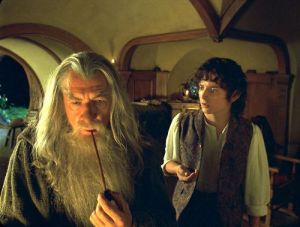
Frodo and Gandalf at Bag EndHobbits might have been designed specifically for this role.  The hobbits of the Shire are back-country unsophisticates, living quietly in a little country without much contact with the rest of the world.  Once they’re taken out of their homely environment into the wider world, Gandalf or Aragorn or someone frequently has to explain things to them, helping the audience get acquainted with Tolkien’s vast world and history—or, at least, with those parts that are important to the story.  (At the same time, we should note that Tolkien also uses other forms of exposition that no new writer could get away with nowadays.  The Lord of the Rings actually opens with a sixteen-page Prologue providing background on such essential matters as pipe-weed—followed shortly in Chapter Two by fifteen pages of explanation in which Gandalf instructs Frodo on the challenge they face.)

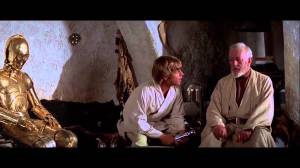
Luke and Obi-WanThe most well-known SF parallel is Luke Skywalker, the unsophisticated farm boy who is catapulted into galactic affairs by the death of his foster parents and the charismatic advice of Obi-Wan Kenobi.  When Obi-Wan tells Luke “You’ve taken your first step into a larger world,” he isn’t merely refering to the Force, but implicitly to Luke’s need to learn many things as he emerges from the backwater planet Tatooine.

We don’t see quite such an inexperienced protagonist in the other trilogies, with Anakin or with Rey.  By the time we see the prequel or the sequel trilogy, we’re already familiar with the Star Wars background, and not as much needs to be explained.  Interestingly, Lucas too adds a more artificial form of exposition, the screen crawl at the opening of each film, perhaps primarily for its nostalgia value.

An Earthly culture of another time period can be just as unfamiliar as an extraterrestrial.  Friday’s Child was the first Regency romance I read, and I found it a particularly good place to start.  The naïve heroine, Hero Wantage, marries the kind-hearted but rakish Viscount of Sheringham and is carried off into the whirl of London society, whose manners and mores are often peculiar to modern eyes.  We are introduced along with Hero to these rather arbitrary rules—if a carriage-race between females is high entertainment at a private country gathering, why is it a terrible social gaffe in public?—where her lack of understanding frequently lands her in a “scrape.”  Similar inexperienced heroines also appear in other Heyer stories, such as Arabella and Cotillion (in descending order of ignorance or naïveté).

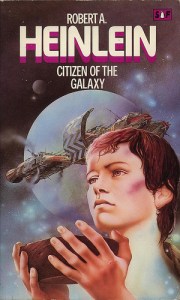
Citizen of the Galaxy coverA science-fiction example of the socially inexperienced character can be found in Heinlein’s Citizen of the Galaxy.  Thorby, the main character, must learn to copy with several unfamiliar environments in succession over the course of the story, but especially with the strict customs followed by the Free Traders, nomadic interstellar merchants.  An anthropologist traveling with the Traders to study their culture is invaluable in explaining these customs to Thorby—and the reader.

The ignorant interlocutor in Heinlein’s Beyond This Horizon, by contrast, is a minor character, “the Man from the Past,” who has been preserved from the present into the story’s centuries-later future by a time stasis field.  He comes into the story only briefly, but long enough for Heinlein to get in some exposition about facets of the future society that are well-known to the other characters, but need to be explained to the archaic survivor.

A more well-known Heinlein story, Stranger in a Strange Land, uses space—and species—rather than time as the cultural differentiator.  Michael Valentine Smith, the “Man from Mars,” is a human being raised from infancy by Martians.  Many of the most interesting parts of the story show Mike trying to grapple with human customs when he arrives back on Earth as a young man—which also allows Heinlein to make satirical commentary on these peculiar creatures, the humans.

Some Storytelling Advantages

Having someone to explain things to is helpful because dialogue is often a better way to present information than authorial lecturing.  A scene in which our puzzled naïf asks questions and gets answers—or makes mistakes and is corrected—is easier to make interesting.  These interactions can accomplish other things at the same time.  The way a conversation goes can reveal character and show relationships developing.  It can be mixed with action—characters talk while they’re hiking, exploring a wrecked spaceship, dancing.

Making one character’s knowledge limited similarly allows us to avoid the dreaded “As you know, Bob” problem, in which characters tell each other things of which they are already well aware, to educate the reader at the expense of in-story plausibility.  (The term comes from the Turkey City Lexicon, a guide to F&SF tropes for use in writing workshops.)  TV Tropes has a particularly good discussion of this whole issue.

Where to Find Them

If we want to include an ignorant interlocutor in a story, what kinds of situations might naturally produce this sort of character?

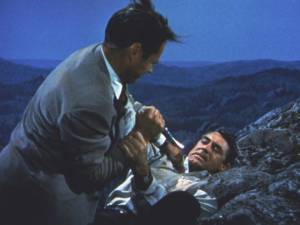
North by Northwest, Mt. Rushmore fightYouth and inexperience tend to go together; and a curious child can serve the purpose (perhaps a precocious child, who is uninformed but capable of grasping the explanation once offered).  TV Tropes’ term is “Little Jimmy.”  But the explainee may also be a competent enough adult who has simply been thrust into a situation or milieu they’re not ready for.  Cary Grant’s character Roger Thornhill in North by Northwest is a good example:  he may be a fine advertising executive, but the world of international espionage is new to him.  Captain Pausert of James Schmitz’s classic SF novel The Witches of Karres is an expert ship-handler and a pretty effective trader, but the young witches need to bring him up to speed quickly when he gets involved in Karres business.

The innocent naïf who needs to be told how the world works is another category, particularly if the story is going to deal with gritty realities.  Several of our examples above count, and we might also mention yet another Heinlein character (he was fond of the trope), Max in Starman Jones, who’s described by Wikipedia as “a farm boy who wants to go to the stars” and learns the ropes from the cynical rogue Sam Anderson.

The uninformed party may also be the student of a new art—the beginner or newbie.  Harry Potter is new to the wizarding world and has to have all kinds of things explained to him, including his own backstory.  In Anne McCaffrey’s YA novel Dragonsong—one of the best of the Dragonriders of Pern books, in my opinion—it’s musicianship that young Menolly is learning as she’s suddenly brought into the Harper Hall’s training program.  Captain Pausert’s induction into Karres witchery reflects some similar elements, in a very different situation—learning on the fly rather than in a structured environment.  The character’s new situation may involve learning the art itself, or the folkways of the school, or both.

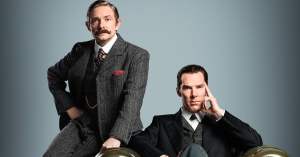
Sherlock Holmes and Doctor WatsonFinally, one of the functions of the sidekick can be as a foil to whom the principal character can explain things.  Robin has played this role for Batman—at least in the wacky 1960s TV series.  A classic case, of course, is Holmes and Watson; TV Tropes even dubs such an character The Watson (“the character whose job it is to ask the same questions the audience must be asking and let other characters explain what’s going on”).  Master detectives, who are supposed to be smarter than the audience, form fertile ground for such relationships:  Archie Goodwin, who is no dummy, regularly receives nuggets of wisdom from his immobile employer Nero Wolfe.

Finally, the person who graciously explains things is often a mentor figure—the wise or knowledgeable one, a Gandalf or an Obi-Wan, the polar opposite of the uninformed interlocutor.  When the mentor’s job is primarily to educate the main character, this may explain why the mentor is around early in the story, but may disappear or become unavailable when the action starts to heat up.

Theological Slapstick: The Good Place

I can’t recall who suggested I start watching The Good Place, which recently released its finale after four seasons.  I do remember being warned not to look up the show on Wikipedia or anything first; and that was good advice.  The series’ twists and turns are entirely unexpected and it would ruin the effect to know they were coming.  So, at the top of this post, I need to point out—

Here Be Spoilers!

The Slapstick Element

The Good Place opening sceneA TV series about the afterlife is, to the best of my recollection, a novel idea.  There’ve been shows that featured regular visitations from the afterlife, such as Topper or My Mother the Car.  But these were’t about the afterlife, any more than My Favorite Martian was about life on Mars.  They were about events here on earth when visitors from the afterlife intruded.  Those who know more than I about the history of TV may be able to provide other examples; but The Good Place’s approach is at least fairly rare.

The second unexpected thing about The Good Place is the transcendent silliness with which Michael Schur and the show’s other writers imbue the series.  Almost invariably, if something seems profound or weighty, there’s a pratfall (verbal or otherwise) waiting just around the corner.  Even when typical afterlife tropes are invoked, such as torture in hell, they are so exaggerated or understated that one can’t take them seriously.  The characters are also drawn very broadly, to the point of caricature—no one could be quite as perfectly airheaded as Jason, as status-conscious as Tahani, as indecisive as Chidi—except for Eleanor, who serves as our Everywoman hero.

The Good Place yogurt shopThis perpetual wackiness makes the show entertaining, but it also accomplishes some other things.  The silliness of the events and characters prevents us from taking the theology seriously.  It would be hard to present a serious visualization of heaven or hell in an era when there is no general consensus about such things.  But we can all laugh along with the notion that a heaven featuring a really, really great yogurt shop is a bit of a letdown—even if you like yogurt.  It’s hard to be offended or galvanized to argument when the theological features are clearly not meant seriously.

In the moments when the show actually does get serious, the surrounding wackiness also keeps it from getting preachy.  The levity of the overall atmosphere lends the genuinely moving moments a sort of innocent sincerity.  (A fan of G.K. Chesterton, of course, will find that sort of atmosphere immediately congenial.)

The Ending

I’ve seen some lively comments online on how the show ended.  Several people have said they hated to see it end.  It’s true that one is always reluctant to say goodbye to favorite characters and situations.  On the other hand, it’s better for a TV series to close before it’s worn out its original premise and goes into that long slow decline.  Exhaustion of the premises is especially likely to occur when the premise is as bizarre as that of The Good Place.  So I was kind of pleased to see the writers were bringing the show to an end after four good seasons.

Is it a good ending?  Dramatically, yes.  I’m content.  That’s the essential criterion for the show’s creator:  “there’s really only one goal ever for a show finale, in my mind, and that’s to make people who have been watching the show and invested time and energy and emotion in the show feel like it’s a good ending.”

However, the completed work does leave some questions hanging.  Appropriately enough, the leftover puzzles are big issues about the fundamental things.  I don’t mean that the show should have tried to deal with them:  it can best to leave some mystery.  However, it’s entertaining to look at what some of these holes were.  I present them, of course, from my point of view; those who approach the fundamental questions differently may see the gaps in somewhat different ways.

(Since I flew the spoiler alert above, I’m going to assume that anyone who makes it this far has a pretty good acquaintance with the series.)

First Cause

The more we find out about The Good Place’s underlying machinery of the afterlife, the more we may wonder:  Who put this madhouse in place to begin with?

Judge Gen

Nobody seems to be in charge of the whole shebang.  The demons who run the Bad Place don’t have complete power, or they’d have simply gone on happily torturing humans indefinitely.  The Good Place, apparently, is run by a committee of nonentities, who show up only once or twice, make some entirely ineffectual remarks, and flee at the first opportunity to abdicate their responsibilities.  Disputes between the two are resolved by Judge Gen, an irritable, easily distracted entity who seems annoyed by the whole business.

We never do find out who dreamed up the point system that’s used to evaluate human actions.  As Sam Adams’ article on Slate puts it, “Introducing a painless exit from the afterlife allowed The Good Place to punt on some of its biggest questions, like who created the universe (the highest-ranking figure we ever meet, the nearly omnipotent Judge Gen, still feels like she’s enforcing someone else’s rules) . . .”

As the setup comes to seem more and more arbitrary, an inquiring viewer is likely to become more and more perplexed about why this particular cockamamie system should exist, rather than any other.  (Much less “why there is anything at all,” the fundamental question of metaphysics.)

These are the kinds of questions addressed by the traditional “First Causearguments for the existence of God.  Why is there this universe rather than some other?  Why is there this universe rather than nothing?  Ordinarily we sail along day to day without bothering much about the matter.  But because The Good Place is showing us (in its own wacky way) the entities that ought to have the answers, the questions become hard to avoid.  Once the main characters get backstage, you might say, the God-shaped hole in the overall system becomes more and more evident.

A related issue appears when at one point the judge proposes to wipe the slate clean and start over—annihilate all humans who have ever lived and start the new system from scratch.  I found myself wondering, what is the judge trying to accomplish?  What are her motives?  If the idea is to find a better way to deal with the ongoing human population, that’s fairly clear.  But if she’s going to eliminate the humans and start something different, why go to the trouble?  Is there some sort of cosmological imperative that there be a human race, or a life-and-afterlife system?  We don’t have any idea what her motives might be, because we have no earthly (or unearthly) idea why the existing framework is there in the first place.

Unintended Consequences

Carbon footprint graphicOne of the most interesting moral speculations in the show turns up when the main characters are trying to figure out why no humans for centuries have succeeded in qualifying for the Good Place.  The reason, it’s suggested, is that the modern world is so complex that an ordinary human can’t know all the consequences of an action.  If I buy a Coke, I have to consider not only the effect on my budget and my waistline, but also the bottle’s carbon footprint, whether it was produced using child labor or unfair business practices, and so forth.  Every choice is laden with unknowable results—and apparently these are mostly bad, bringing people’s point scores down.

It’s an interesting idea, with at least superficial plausibility.  The modern world is more complex than our pre-technological world, and maybe it’s just grown beyond our ability to manage.  Today we are constantly being told that it’s our obligation to take into account all sorts of remote consequences, becoming so scrupulous that the slightest decision is weighted with ponderous political and moral consequences.

This argument itself is based on some significant moral assumptions.  For instance, it takes for granted that actions are to be evaluated on their results—“consequentialism,” of which the most popular form is utilitarianism.  That’s not the only possibility.  Chidi, for instance, apparently embraces a “deontological” or rule-based ethics.  And then there’s the Aristotelian virtue-based ethics.  What actually drives the main characters’ decisions in the end seems to be the worth or importance of persons, which has something in common with Kant’s deontological ethics (every person must be treated as an end in itself) or, more directly, personalism.

One might also wonder whether the problem of unforeseen consequences is really unique to modernity.  Life has always been complex, and actions have always had ramifications stretching out far beyond what we can anticipate.  It does seem plausible, though, that in a highly interconnected world (“the world is getting smaller”), the effects of a given cause propagate faster and further.
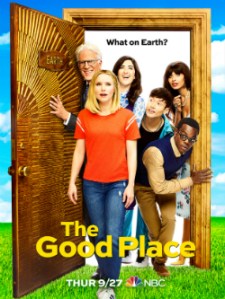
Good Place cast, inquiringThere’s an additional complexity in the The Good Place’s point system insofar as it uses these remote results to judge the person who is acting.  There’s a difference between judging the results and judging the agent.  Traditional axiological (good-based) or consequentialist theories of ethics would not normally hold us responsible for consequences we can’t reasonably foresee.  If someone does something terrible (or, for that matter, something heroic) we take into account the pressures that person was under, which may include their history and experiences; the limits of their knowledge; the effects of outside conditions like drugs or alcohol; and many other factors that might diminish (or enhance) responsibility.

None of this seems to be considered in the point system with which The Good Place begins.  And no wonder:  the point system is presented from the beginning as a caricature of real moral judgment, an oversimplified and somewhat unfair scheme.  But the “new system” we’re given at the end doesn’t really solve that problem either.  Giving the poor humans many lifetimes to become better people is kind, perhaps, but how does it take degrees of responsibility into account (much less resolve the issue of unpredictable consequences)?

Eternity and the Good Life

The driving force of the series’ last episodes is the notion that an eternity of pleasure is itself intolerable.  We get bored, and, we’re told, the tedium gradually degrades our faculties, so that the esteemed philosopher Hypatia of Alexandria shows up as a shallow airhead (“Patty”), to the main characters’ dismay.  The series’ answer is that the system must provide the opportunity to end this eternal lassitude at a chosen time—“die the real death,” as Zelazny might have put it.  The option of ending it all somehow removes the tedium of eternal pleasure and allows us to enjoy the Good Place until we walk through the final door.

The idea of eternity as a bore presents a valid question.  It isn’t a question restricted to the afterlife, either; it points back to the classic philosophical issue of what is a good life for human beings.  The good life, in the classical ancient or medieval sense, isn’t just the absence of wrongdoing or the ability to score arbitrary points; it embodies the idea of a life that is worth living.

For this reason, it’s worth taking a closer look at what The Good Place has to say about the good life.  From the perspective of that question, the show’s final solution looks a bit superficial.  Sam Adams, again, says:  “The idea that going through the door would simply allow a person’s energy to rejoin the universe—as Eleanor took the fateful step, she dissolved into otherworldly fireflies that wafted down to Earth—felt more like New Age goop than moral philosophy, or maybe just a midway point between Immanuel Kant and Dan Brown.”

It’s true that “[t]he way to love anything is to realise that it might be lost,” as Chesterton says (Tremendous Trifles (1909), ch. 7).  But the idea of loving something is curiously muted in The Good Place.  The Good Place as we see it in the show does look boring, but that may be because the writers built it that way.  The focus on simple pleasures like milkshakes lends itself to this—an eternity of sitting placidly and drinking even the best milkshake would be a bore.  With admirable consistency, the screenwriters do apply the same argument to other goods like learning and reading.  But it’s not quite as clear that something like learning is as inherently limited as ordinary (and genuinely good) gustatory pleasures.

Baby kicking its legsEven with respect to the simpler pleasures, The Good Place doesn’t take into account the possibility that becoming bored is a a human weakness—a physiological or psychological failure to continue appreciating something that remains worthwhile in itself.  That weakness isn’t necessarily incurable.  Chesterton remarks:

The thing I mean can be seen, for instance, in children, when they find some game or joke that they specially enjoy.  A child kicks his legs rhythmically through excess, not absence, of life.  Because children have abounding vitality, because they are in spirit fierce and free, therefore they want things repeated and unchanged.  They always say, “Do it again”; and the grown-up person does it again until he is nearly dead.  For grown-up people are not strong enough to exult in monotony. But perhaps God is strong enough to exult in monotony. . . .  It may be that He has the eternal appetite of infancy; for we have sinned and grown old, and our Father is younger than we.  (G.K. Chesterton, Orthodoxy (Image 1959), ch. IV, p. 60)

The one factor in the depiction of the Good Place that seems to be understated, oddly enough, is love and friendship—relationships.  The show does make something of personal interactions, mainly in the two romantic relationships, Eleanor and Chidi and Jason and Janet.  But none of the four main characters becomes involved with any other interesting people—despite the plethora of historical figures that might be called on.  (As we noted above, the interesting Hypatia has been deliberately dumbed down for the episode to make a point.)
Steven Curtis Chapman, from The Great Adventure music videoOutside the central four, together with Michael and Janet, there’s no sense of camaraderie or community.  We do not see the potentially unlimited constellations of True Companions—just the one cluster of main characters.  And of course the one big relationship is missing:  that God-shaped hole.  In traditional Christian thinking, at least, God is infinite, and our relationship with God is one time can never exhaust.  Because The Good Place adroitly sidesteps the whole question of divinity, that line of solution to the problem of eternity can’t be explored.

Moreover, the show cheats a little when it suggests that a final dissolution is the real end.  At least one character uses the conventional phrase “moving on”—which undermines that notion of finality.  And what one commentator refers to as “a complete and unknowable end” isn’t quite what we actually get.

For a while, it seems as if Michael Schur is no more prepared to answer existence’s ultimate question than anybody else. But when it’s Eleanor’s turn, the camera doesn’t cut away. Instead, it pans up to the sky above her, a group of ethereal lights floating up into the frame, suggesting that this is what the person that was Eleanor Shellstrop has become. . . . . What that gorgeous final scene suggests is that the best possible reward would be the ability to continue to touch the lives of those we left behind . . .  (Rolling Stone)

Even the series’ best attempt at agnosticism about the good life seems to recede before a sense of good action as in some sense eternal.

The Good Place cast portraitConclusion

The Good Place has been a great show, and I’ve enjoyed it throughout.  Simply giving us an opportunity to think about such matters as these is way beyond what most TV series achieve.  And to do it in a way that’s consistently entertaining is the cherry on the top of the frozen yogurt.