The Professional Hero

Glory Road

A couple of comments by Kevin Wade Johnson in connection with my last blog post (now a long way back!) triggered a line of thought about heroes and the hero business.

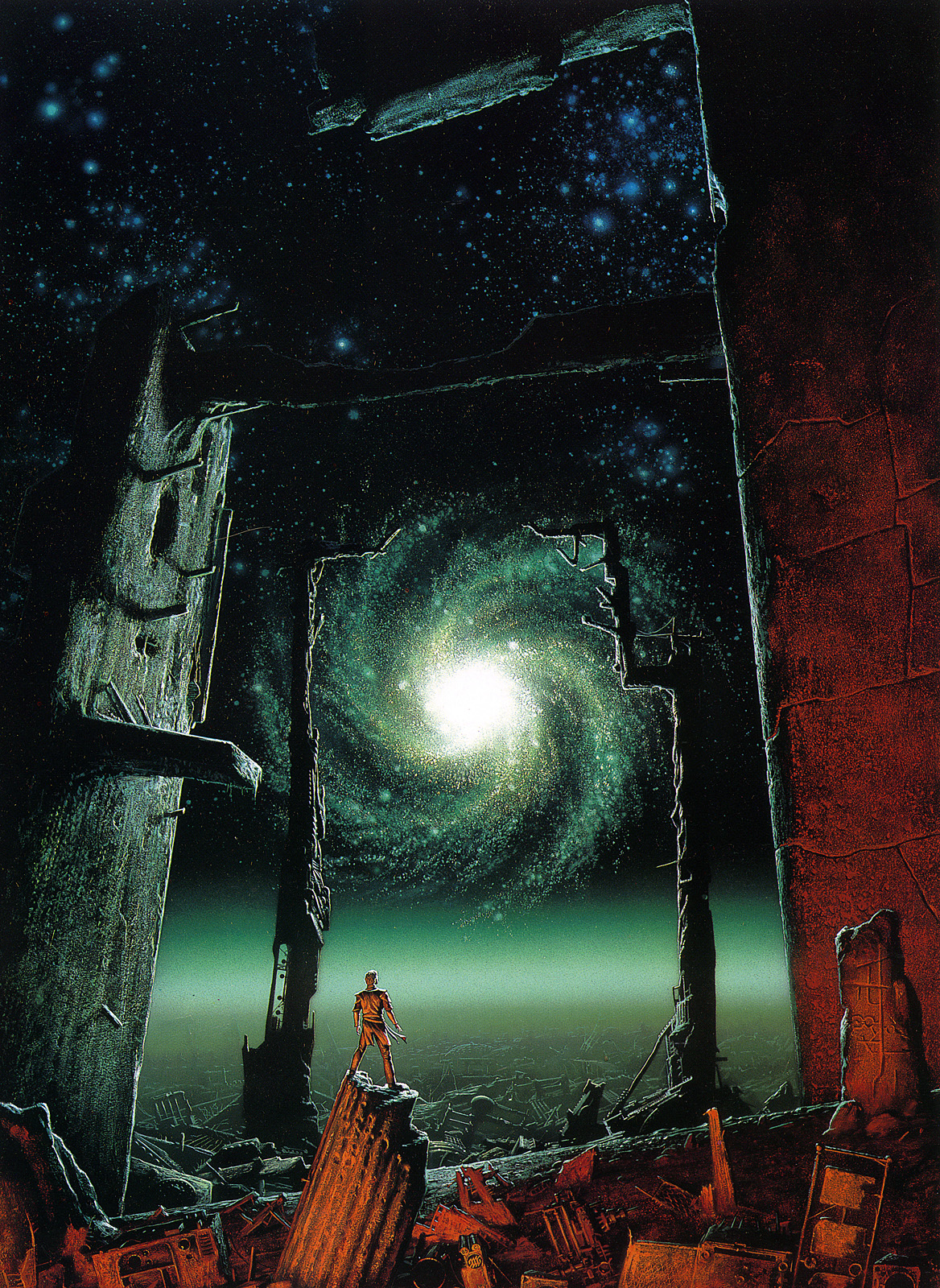
Glory Road cover

Robert A. Heinlein’s 1963 novel Glory Road looks like a swashbuckling fantasy at first blush, but it turns into something entirely different.  Our hero, E.C. “Oscar” Gordon, kicking around the world after leaving the military, is recruited by an incredibly gorgeous woman to assist her with a quest that involves traveling to other universes and swordfighting.  This is just the kind of adventure he was craving.

As Kevin observes, the first three-quarters of the book are action-adventure, with sizable side dishes of comedy, scandalous liaisons, and cynical social commentary.  At that point the quest is fully resolved—at page 208 out of 288, in my copy.  What, then, occupies the rest of the book?

Gordon returns with “Star,” the beautiful woman he’s now married, to her home universe.  It turns out she’s the empress of a multiuniversal polity that is in some respects a high-tech Utopia.  All Gordon has to do is relax, allow himself to be fêted by the population, and sleep with anyone he finds interesting (the late Heinlein’s polyamory is fully on display here).

He hates it.

What Utopia doesn’t satisfy is Gordon’s lust for adventure.  He doesn’t want to be a dilettante or a “kept man.”  He wants wonder, excitement, the stimulus of danger.  He likes being a hero, with all the occasional discomforts and perils of that role. The placid happy ending of a retired hero holds no attraction for Gordon.

It’s unclear whether Star feels the same way.  She’s willing to consider going in on a kind of adventuring “business” with her slightly tarnished knight.  But first, she says, she’d have to train a replacement for her unique position—and that would take many years.

The solution is for Gordon to head off again on the Glory Road without Star.  He’ll pop back in now and then, but not to take up residence in the Twenty Universes utopia on a permanent basis.  He and Star will remain in love with each other, perhaps, in some sense of the term—but not in a sense that requires fidelity on either’s part.  In Heinlein’s polyamorous world-view, passing romantic involvements are just part of the adventure:  “Knights errant spend their nights erring” (p. 271).  Gordon’s happy ending is the continuing adventure.

The Unsettled Adventurer

This idea comes up from time to time in adventure stories:  the hero (or heroine) who seeks out danger and isn’t content without it.  John Carter of Mars displays a little of this, though in the violent world of Barsoom, he seems to be able to get his fill of trouble while still remaining home-based with the enthralling Dejah Thoris in her city of Helium.  There’s something like this idea in the conclusion of The Good Place—boredom with utopia—as we’ve seen.

The really extreme case can be found in an old-time fantasy by E.R. Eddison, The Worm Ouroboros (1922).  The swashbuckling nobles of Eddison’s imagined world fight the good fight against their sinister enemies, the Witchlanders.  At the end of the novel, those adversaries are conclusively defeated.  Cue the victory feast.  And yet . . . Our Heroes are not quite satisfied.  Things just won’t be as interesting without the Witchlanders constantly scheming and warring against them.  At the very end, the heroes’ fanciful wish is somehow granted:  a herald announces the arrival of an emissary from the bad guys—the same event with which the novel opened.  (Hence the title:  the legendary serpent that swallows its own tail.)

The Series Protagonist

I’ve previously expressed some doubts about whether happy endings really need to be static and boring—so let’s not adopt the Glory Road doctrine too hastily.  (In its extreme form, Eddison’s circular epic, one may feel the opposite dissatisfaction in the sense that all the heroes’ striving and suffering has been for nothing.)  But these examples highlight a difference among types of action heroes.

In a long-running action series, unless a hero is improbably falling into one adventure after another against their will, we have to assume that the hero likes what they’re doing.  James Bond seems to be pretty content with his secret-agent life.  Indiana Jones yearns for opportunities to climb out the window of his stuffy professorial office and strike out on some treasure-hunting chase—even at an advanced age, as we’ve recently seen.  Captain Kirk, who’d been promoted to admiral by the beginning of Star Trek II, isn’t suited for a desk job.  At the end of the three-movie cycle he’s demoted to captain again—ostensibly as a punishment for flagrant violations of Starfleet regs, but we’re to see this as a step forward for him, his best destiny.  Yoda accuses Luke of this kind of unrest in The Empire Strikes Back:  “Adventure! Excitement!  A Jedi craves not these things.”

The same is true of almost all superheroes.  Retirement is almost unheard-of.  The occasional counter-example makes for an interesting tale precisely because it runs against type:  Hank Pym in the Marvel Cinematic Universe, Jack-in-the-Box in Astro City.  In a somewhat similar way, continuing campaigns in Dungeons & Dragons or similar games tend to assume the existence of a class of professional adventurers who enter willingly into a life of battle and treasure-hunting, as distinct from an assembled-for-one-purpose group like the Fellowship of the Ring.

This character trait does make things convenient for the writers.  They have a believable rationale for the main character’s continuing adventures.  Otherwise, after a while it would start to seem implausible for one person to keep getting drawn into danger purely by accident.

The Hero By Trade

The Star Trek captains, and other officers, illustrate a type of case where the character really is a professional hero—one who’s taken up a profession or vocation where danger and challenge, and hence the opportunity for heroism, come with the territory.  Anyone pursuing a military or quasi-military career fills that bill.  Honor Harrington, for example, reflects more than once that she’s good at war; it’s her calling, what she was born to do.  Professional police officers, firefighters, or rescue workers—first responders generally—also fall into this category.  (John McClane of Die Hard fame, mentioned above, is in a danger-prone profession, though it’s probably rare for a cop to run into the kinds of major crises he does.)  Unsung heroes like medical personnel may find themselves in the same position.  They may not categorize what they’re doing as heroism (it looks better on them if they don’t); but they are putting themselves “in harm’s way” where acts of heroism are constantly called for.

This is why military SF lends itself so easily to long-running series like Honor Harrington’s.  (The same is true outside the SF genres, as we can see, for example, in Patrick O’Brian’s Aubrey/Maturin sea stories.)  The same is true of private detectives, secret agents, and the like.

The Reluctant Hero

But not all heroes are professional heroes.  An equally perennial favorite is the reluctant or accidental hero—the person who answers the call to adventure, but does wish to return to a peaceful life afterward.

Jim Butcher’s Introduction to Jim Butcher & Kerrie L. Hughes, Heroic Hearts (NY:  Ace Books, 2022), puts it this way:

Real heroes . . . [are] the everyday humans who happen to be standing there when something bad happens, and when there is a sudden need for skill, courage, or intelligence.  They’re the regular people in irregular circumstances who find themselves considering others first and standing up to do whatever needs to be done.”  (p. xi)

Some do manage to go back to their ordinary lives after the crisis has passed.  Cincinnatus, and George Washington, are famous for pulling off the transition:  they took over the reins of the state when they had to, but willingly ceded power afterwards.  On a more modest scale, the “citizen soldier” concept, as in the American National Guard, aims at the same thing.  It’s part of the mystique of the American World War II armies, the so-called “Greatest Generation” model.  You rise up to serve when necessary, but happily return to civilian life when it’s done.  Contemporary discussions are more likely to emphasize post-traumatic stress disorder (PTSD) and the difficulty of the return to civilian life; but it remains an ideal with considerable drawing power.

In fiction, the contrast between heroic acts and ordinary life provides rich soil in which to grow interesting stories and characters.  Tolkien, for example, gives us some characters who do manage the return to everyday existence—Sam Gamgee—and others who find it impossible, such as Frodo.  Of course Frodo does in the end find peace in Valinor, but that requires a literal removal from the circles of the world, a transcendence not available to the average hobbit-in-the-street. 

The situations can become fairly complex.  In the Song of Roland, after the heroic deeds of the story are finished, a weary Charlemagne at the end finds himself called back unwillingly to new conflicts.  In the TV series Chuck, the eponymous Chuck Bartowski is initially appalled to find himself embroiled in spy activities, but the sheer coolness of it all grows on him, and by the fifth season he wants to start his own secret-agent business.  Scott Lang (Ant-Man) at the beginning of Quantumania is resting comfortably on his laurels, and has to be dragged back into action in the name of helping others.

Detectives in mystery stories fall into both camps.  We have professional private eyes like Sherlock Holmes and Nero Wolfe.  But then we also have amateurs like Chesterton’s Father Brown and Agatha Christie’s Miss Marple, who always just seem to be in the right place at the right time.

The Author’s Choice

If we want to write a heroic adventure story, one of the early decisions we have to make is what kind of hero we want to feature.  Sometimes the tale may call for someone who’s automatically in a position to encounter danger, like a military officer.  Sometimes we may prefer to drag the hero into action against their wishes, or by happenstance.  The whole point of Roger Thornhill’s predicament in North by Northwest, for example, is that he has no desire to become involved in skulduggery and is baffled by the strange things that are happening to him.  Like so many other accidental heroes, however, he rises to the occasion.  This is a narrative arc that may be both more interesting and more inspiring than that of the professional hero; because most of us live relatively ordinary lives and can only hope that if called upon, we too could become the kind of hero we admire.
Next Stop—Anywhere

Last time we talked about the sequels to the movie Tangled.  But I didn’t say anything about the music.  One song in particular deserves a comment of its own.

Music in the Movies

Rapunzel and Eugene in boat, in Tangled

“I See the Light”

Disney generally gets good composers to do the music for its major movies.  Tangled was especially productive; I already had on my playlists the charming love song “I See the Light” (video here), and the end-credits song (is there a name for that niche?), “Something That I Want” by Grace Potter.

The theme song for the TV series actually premiered in the short film Tangled:  Before Ever After.  “Wind in My Hair” deftly expresses Rapunzel’s excitement as she anticipates continuing to discover the wide world outside her tower—the “endless horizon.”  And there’s a bit of humor in the title:  who, after all, is more suited to having the “wind in her hair” than Rapunzel?

Put On Your Sunday Clothes (movie) dance number

“Put On Your Sunday Clothes”

“Wind in My Hair” falls into a category that TV Tropes calls “Setting Off Songs,” like “We’re Off to See the Wizard,” or “Put On Your Sunday Clothes” from Hello, Dolly!.  There’s always a certain excitement when people are getting started on a journey, be it an epic trip to the Emerald City or just a Sunday jaunt to New York City.  In keeping with Rapunzel’s character, “Wind” is upbeat and optimistic, adding to its charm.

But Rapunzel has much farther to go than we see in the short movie, or the first season of the series.  Most of those stories remain inside the Kingdom of Corona.  It’s at the beginning of the second season that Rapunzel and company set out into the real terra incognita outside the kingdom.  And at that point we get yet another expeditionary song, one that simply knocked me over.  Hence the inevitable reflection:  why do I love this song?

“Next Stop, Anywhere”

“Next Stop, Anywhere,” by Alan Menken and Glenn Slater, is a Setting Off Song squared and cubed.  It appears initially in Season 2, Episode 1, at about 3:23.

Next Stop, Anywhere:  video

Next Stop, Anywhere:  lyrics

Rapunzel has a mission:  to backtrack the ominous black rocks that began to appear in the short film.  The prologue to S2E1 gives us some rather grim history hinting at what she’s going to find.  But when we flick back to Rapunzel and her True Companions in the present day, she’s mostly excited about venturing into the outside world (“It’s our first big city outside of Corona!”).

Rapunzel leaps from the caravanThe song starts with a fast, steady beat, and a series of flute trills, which suggest movement and vigor along with the sunny lightness characteristic of our heroine.  The visuals of a hummingbird and a field of flowers reinforce the musical cue.  Rapunzel leaps out of their ambling caravan and races around in a montage, observing the heavens, using her hair to climb a giant tree, dashing off her signature paintings, turning cartwheels.  The refrain comes in with a bouncy drumbeat that bears out the lyric:  where might we be going next?  Anywhere!

The steady beat continues throughout the following mix of dialogue and singing.  Rapunzel’s enthusiasm is indomitable.  Her romantic interest Eugene is not quite as keen on following “a bunch of creepy rocks” into the unknown; but at Rapunzel’s wry loving look, he has to admit that of course he’s excited:  “I’m with you!  What else could I be?”  He alternates lines with her in the next verse, and they both participate in the next series of acrobatic misadventures.  The theme of first love is an additional source of excitement.

Cassandra and the wild horsesThe pointy black rocks turn up from time to time as they cross the landscape, but Rapunzel and Eugene ignore them; at this point their grim purpose seems trivial.  That theme of leaping over the difficulties to focus on the adventure is refreshed when the caravan, driven by the wary Cassandra, catches up with them (2:05).  Cass admonishes Rapunzel for running off and warns her that “the real world isn’t all fun and games.”  Doesn’t matter.  The song resumes, and even Cassandra can’t resist singing a line or two.  Rapunzel is going to seek out her destiny, but that will cause her to grow:  “find the best in me.”

The Reprise

As the canny viewer may have expected, Vardaros, the “first big city” they encounter, falls disastrously short of expectations.  One character narrowly dodges death, and another, marriage.  The mystery warrior Adira turns up with more ominous warnings about where they’re going.  They’re not ready to move forward again until the end of the second episode (listed on the Web pages as Part II of Episode 1).  (Actually, they spend another couple of segments in Vardaros anyway, but the reprise of “Next Stop” occurs in the second episode at about 20:50.)

Next Stop, Anywhere (reprise):  video

Next Stop, Anywhere (reprise):  lyrics

Rapunzel and Eugene, hands joinedThe music starts with a tensely suspended organ tone.  Then, over a somber bass note, Eugene begins singing more slowly—but his words are expressing determination to continue.  Rapunzel joins in, and they clasp hands.  As the music speeds up and brightens, they invoke their faith in each other.  By the time we reach the refrain, we’re back to full speed and full strength.  The “with you close to me” line expands visually to include Cassandra and the others:  they can overcome the coming obstacles with not only the power of love, but the power of friendship.  Even the serious aspects of the journey give way to the boundless exuberance with which the original song started.  The music, as well as the lyrics, firmly rejects somberness in favor of joy—like the opening passages of the fourth movement of Beethoven’s Ninth Symphony:  not by ignoring the dangers and difficulties, but by acknowledging and surpassing them.

“Out There”

The theme of exploration and discovery is a favorite of mine, and the Setting Off Songs tend to live and move in that theme.  “Out there . . .” is exactly how “Put On Your Sunday Clothes” begins.  We don’t yet know what’s out there, but we’re eager to find out.

The theme isn’t confined to songs, of course.  The iconic opening of the original Star Trek series and its Next Generation sequel hit exactly that note, invoking the “sense of wonder” SF is famous for:  “The final frontier . . . To seek out new life and new civilizations.”  To my mind, the intro to the “Star Trek:  Enterprise” series is even better, with its sequence of daring steps in exploration (real and fictional) over inspiring music.  Similarly, the best scene in the unfortunate first Star Trek movie occurs at the very end, at about 1:30 in this clip.

Kirk gazes forward, ending of Star Trek IKirk:  Ahead warp one.
Sulu:  Warp one, sir.
Helm:  Heading, sir?
Kirk:  (pauses)  Out there. . . . (motions vaguely)  Thattaway.

‘Let’s see what’s out there.’  That attitude, it seems to me, is highly to be prized:  with the sense of incipient wonder, the expectation of finding amazing things, and some degree of confidence in our ability to deal with them.  (Chesterton said, “Man must have just enough faith in himself to have adventures, and just enough doubt of himself to enjoy them”—Orthodoxy, ch. 7.)

It’s important that we be able to see the trials and perils of life as an adventure, not merely an imposition.  That attitude is one of the essential factors in a mature human personality, and it merits perennial refreshing and reinforcement.  That’s why “Next Stop, Anywhere” is so pleasing:  it hits just the right note.

And besides, it’s a cool song.

Human Extraterrestrials

Introduction

Even though science fiction is often focused on the future, its assumptions are tied to the present.

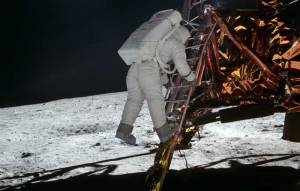
Aldrin descends from Apollo 11In some respects this is obvious.  A story about the near future can become dated by history itself.  Every SF story prior to 1969 that describes the first moon landing in detail (happy 51st anniversary, last week!) is obsolete.  And every story that predicted a smooth reach out into colonizing the solar system directly after that first landing, unfortunately, is also defunct.  Stories can also be rendered unbelievable by scientific advance:  all the delightful tales based on a habitable Venus or Mars are gone with the, er, vacuum.

But there’s also a subtler way.  Even though F&SF specialize in examining our assumptions about the universe, the assumptions that seem plausible shift over time.  Fashions change.  To take a heartening example:  SF stories from the late 1940s and the 1950s tended to take it for granted that there would shortly be a nuclear world war.  (Hence it’s spot-on characterization when the 1955 version of Doc Brown in “Back to the Future” accepts Marty’s recorded appearance in a hazmat suit as logical because of the “fallout from the atomic wars.”)  But for over seventy years, we’ve managed to avoid that particular catastrophe.

One assumption that’s always intrigued me is whether we are likely to meet people like ourselves—and I mean, exactly like ourselves—on another planet.  If we discovered an Earthlike planet of another sun, might we climb down the ladder from our spaceship to shake hands with a biologically human alien?

Not Really Alien

I’m talking about a “convergent evolution” hypothesis—the notion that the human species might have developed independently more than once.  And, incidentally, the standard biological definition of “species” as “interfertile” (a more precise definition can be found on Wikipedia) is what I’m using here; because, obviously, one of the potential uses of the assumption in a story is to make possible a romance between two characters from different worlds, and romance is not unrelated to sex and reproduction.

The Cometeers coverSo we want to set aside, to begin with, a class of stories in which people from different planets are all human because they have a common ancestry.  For example, in Jack Williamson’s classic space opera The Cometeers (1936), Bob Star finds his true love Kay Nymidee among the human subjects of the decidedly nonhuman masters of an immense assemblage of space-traveling planets, the “comet.”  But the reason there are human beings present is that a research ship from Earth was captured by the Cometeers long ago, and these are the descendants of the crew.

It’s not uncommon for the inheritance to work the other way around.  David Weber’s “Mutineers’ Moon” (1991) starts with the eye-opening assumption that our Moon is actually a long-inert giant spaceship—and reveals that the humanity of Earth is descended from the original crew members of that spaceship.  Thus, it’s perfectly plausible when hero Colin MacIntyre falls for a preserved member of the original crew; they’re from the same stock.  Similarly, in at least the original 1978 version of Battlestar Galactica, the human survivors of the “rag-tag fugitive fleet” are human because Earth itself was one of their original colonies, which apparently fell out of touch.

The Era of Planetary Romance

In the early days of modern SF—say, from about 1912 through the 1930s—it was commonly assumed that the answer was yes:  human beings (with minor variations) might be found independently on other planets.  Arguably, this may have been because the early planetary romances—melodramas set on exotic worlds, heavy on adventure and love stories—were less interested in science than in plot devices.  But biology was less advanced in those days; recall that DNA was not identified as the basis of genetic inheritance until 1952.  It’s easy to forget how little we knew about things we take for granted today, even in relatively recent periods.

A classic early case is that of Edgar Rice BurroughsBarsoom.  In A Princess of Mars (1912), Earthman John Carter is transported by obscure means to Mars, called by its inhabitants “Barsoom.”  Those inhabitants include the nonhuman “Green Martians,” but also people identical to humans in several colors, particularly the “Red Martians” among whom Carter finds his lady-love, Dejah Thoris.  As a Red Martian, Dejah is human enough for Carter to mate with, and they have a son, Carthoris, thus meeting the “interfertile” criterion.

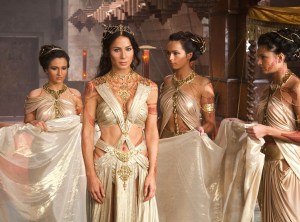
Lynn Collins as Dejah Thoris in John Carter of Mars

Lynn Collins as Dejah Thoris

To be sure, the biology here is a little mysterious.  Dejah looks entirely human, and even, to borrow a Heinlein phrase, “adequately mammalian” (see, for example, Lynn Collins’ portrayal in the loosely adapted movie John Carter (2012)).  But Martians don’t bear their young as Earth-humans do; they lay eggs, which then develop for ten years before hatching.  It’s not easy to imagine the genetics that could produce viable offspring from an individual whose genes direct live birth and one whose genes result in egg-laying.  But that didn’t stop Burroughs.

E.E. Smith, whose initial SF writing goes back just about as far as that of Burroughs, was willing to accept this trope as well.  In The Skylark of Space (published 1928, but written between 1915 and 1921), our intrepid heroes travel to a planet inhabited by two nations of essentially human people—although the double wedding in the story does not involve any interplanetary romances, but is between two pairs of characters from Earth.  Smith’s later Lensman series (1948-1954), which features one of the most diverse arrays of intelligent creatures in SF, also allows for apparently interfertile humans from a variety of planets.  My impression is that this sort of duplication was also true of some of the nonhuman species in the Lensman unverse—there might be, say, Velantian-types native to planets other than Velantia.

This approach wasn’t universal in old-time SF.  The more scientifically-minded John W. Campbell’s extraterrestrial character Torlos in Islands of Space (1930) was generally humanoid in form, but quite different in makeup:  his iron bones, for instance.  It’s been argued that a roughly humanoid form has some advantages for an intelligent species, and hence that we might find vaguely humanoid aliens on different planets—though this is pure speculation.  But “humanoid” is a far cry from biologically human.

Darkover Landfall coverWe see some persistence of this tradition into the second half of the twentieth century.   Marion Zimmer Bradley’s iconic planet Darkover, for instance (first novel published 1958), is populated by the descendants of Terran humans from a colony ship and also by the elf-like indigenous Chieri, who, despite minor differences like six fingers and golden eyes, not to mention the ability to change sex at will, have interbred with the Terran immigrants.

An interesting variation can be seen in Julian May’s Saga of Pliocene Exile (first story published in 1981).  When modern humans are sent on a one-way trip into the distant past, they are enslaved by the Tanu, aliens from another galaxy who have settled on Earth.  The story indicates that the Tanu were specifically searching for a place where the local gene pool was similar to theirs—which might also account for why they came all the way from another galaxy (also a somewhat antique trope) to get here.

It’s slightly odd that, even where basically identical human beings turn up on other planets, other animals never seem to be similarly duplicated.  On Burroughs’ Barsoom, one doesn’t ride horses, but thoats; is menaced not by tigers, but by banths; and keeps a calot, not a dog, as a pet.  In a planetary romance or science fantasy setting, one is less likely to see Terran-equivalent fauna than parallel creatures with exotic names and slight differences—whence the SF-writing gaffe “Call a Rabbit a Smeerp” (see TV Tropes and the Turkey City Lexicon).

At the Movies

The all-too-human trope is carried on into the present day in video media—movies and TV.  Again, this may be partly because the science is often subordinated to the plot; but the cost and difficulty of putting convincing nonhuman characters on-screen is surely another factor.  Filmmakers’ ability to depict exotic creatures, however, has changed immensely in the last forty years, to a point where almost any imaginable creature can be created if the budget is sufficient.  Thus, the original Star Trek series of the 1960s stuck largely to slightly disguised humanoid aliens, perhaps relying on the ‘universal humanoid’ hypothesis mentioned above, while later series were able to branch out a bit.  Similarly, the Star Wars movies could readily give us nonhuman characters like Jabba the Hutt, Chewbacca, and C3PO; they, too, grew in variety as the capabilities of CGI and other techniques expanded.

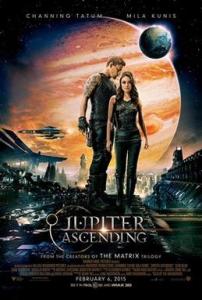
Jupiter Ascending movie posterStill, it may be harder for us to adjust to interactions among characters where we can see their nonhumanity, rather than just reading about it.  So we still tend to see extraterrestrial humans on-screen.  The Kree in Captain Marvel (2019), for example, are indistinguishable from humans—an actual plot point, since this makes it possible for Yon-Rogg to tell Carol that she’s an enhanced Kree rather than a kidnapped human.  The Kree do have blue blood, in the movie; it’s not clear what kind of biological difference (hemocyanin?) might result in that feature.  We also see a number of alien humans in Jupiter Ascending (2015), though I think of that tale as a deliberate throwback to pulpish science fantasy or planetary romance.

A Match Made in Space, fictional coverI keep wanting to cite the fictional novel written by George McFly as shown in the closing scenes of Back to the Future, “A Match Made in Space,” since the cover seems to suggest an interplanetary romance (and one thinks of George as a nerdy romantic); but it isn’t actually clear whether that’s the case.  All we have to go on is the title and the cover, and that could just as easily depict a match between two humans, fostered by an alien matchmaker (or vice versa).

The Modern Era

We don’t see nearly as many extraterrestrial humans in modern SF, and for good reason.

The more we understand about genetics, the less likely it seems that another human species, so closely similar as to be interfertile, could evolve independently.  What we know about evolution suggests that there are just too many random chances along the way—cases where the prevailing mutations might have turned out differently.  Even if we assume that humanoid form is probable, why not have six fingers, or hemocyanin rather than hemoglobin?  While I’m not well enough educated in biology to venture any actual probabilities, I think our growing sense of the complexity of the human body and its workings, over the last seventy years or so, has simply made it seem vanishingly unlikely that an independently evolved intelligence would come out that close to the human genotype.

For example, the scientifically-minded Arthur C. Clarke depicted a galaxy in which each intelligent species, including humans, was unique:  The City and the Stars (1956, developed from an earlier story published in 1948).  In one of the unused story fragments he wrote while working on 2001:  A Space Odyssey (1968), his hero, well along on his journey into mystery, thinks:

He did not hesitate to call them people, though by the standards of Earth they would have seemed incredibly alien.  But already, his standards were not those of Earth; he had seen too much, and realized by now that only a few times in the whole history of the Universe could the fall of the genetic dice have produced a duplicate of Man.  The suspicion was rapidly growing in his mind—or had something put it there?—that he had been sent to this place because these creatures were as close an approximation as could readily be found to Homo sapiens, both in appearance and in culture.  (Clarke, The Lost Worlds of 2001, ch. 39, p. 220)

Contemporary SF writers who are really adept at building interesting and coherent aliens—David Brin and Becky Chambers, to name two of the best—give us a wide range of wildly exotic creatures from other planets, but not humans.

The Uplift War, coverIf we are still fond of the idea of interplanetary romance, we might find a possible work-around in the shapeshifter.  The Tymbrimi female Athaclena in Brin’s The Uplift War (1987) uses her species’ unusual abilities to adjust her appearance closer to that of a human female—but of course she has an entirely different genetic heritage, as that ability itself demonstrates.  The result wouldn’t meet our criterion of interfertility, no matter how close the similarity in physical structure.  To adjust one’s genes in the same way would be another order of change altogether.

Starman movie posterThe 1984 movie Starman, in a way, plays off this idea.  The alien in this case is apparently an entity made of pure energy, without a physical structure of its own.  Using hair from the female lead’s deceased husband, it creates a new body with a human genetic structure.  The two do, eventually, prove to be interfertile.  If we’re willing to accept the notion of an energy being in the first place, this approach is actually more plausible than, say, mating with the oviparous Dejah Thoris.

If one were writing a SF story today, it would be rash to assume that Earthborn characters could run across independently evolved humans elsewhere.  The idea may not be entirely inconceivable.  But it’s out of fashion for good reasons.  Attractive as the notion of interplanetary romance may be, at this point we’d best confine it to the kind of case noted above, where some common ancestry—no matter how far-fetched—can account for the common humanity.

Temporary Death

Back from the Dead

Bringing back the dead is a tricky business, story-wise.  For a major character to die adds gravitas.  It gains our sympathy; it makes us take the story more seriously.

But in adventure stories, characters who die have a pretty good chance of turning up again later.  This has become such a convention that we are often adjured not to assume someone’s dead unless you actually see the body.

There’s a strong temptation for a writer to save a beloved (and sometimes lucrative) character; yet the return undermines the impact of the death.  Are there ways to manage that dilemma?

The White Rider

Gandalf faces Balrog with sword and staffThe theme of one who was dead who turns up alive has a very long history—as we may note particularly in this Easter season.  For the literary trope, however, I think of Gandalf in The Lord of the Rings as the the ur-example.  Gandalf’s loss is appalling for the reader, and his reappearance is a classic example of the sudden turn beyond hope that Tolkien called “eucatastrophe.”

LotR comes early enough in the history of modern high fantasy that it may have been unexpected, at that time, for a character to really die and then come back.  Merely apparent death is much more common—even in LotR.  An article I read once observed how frequently someone is thought to be dead in the course of the story.  For example, Aragorn thinks Frodo has been killed by an orc-spear in the Mines of Moria (Book II, Ch. 5).  Sam assumes Shelob has killed Frodo, when in fact the spider has merely put him into a coma (Book IV, Ch. 10).  Éomer believes Éowyn is dead, but when she’s borne back to the city she is found to be alive (Book V, Ch. 6).  Et cetera.

Gandalf the WhiteGandalf, on the other hand, really does die at the end of his extensive combat with the Balrog.  But this isn’t as fatal as it seems.  Gandalf is a semi-divine spirit, one of the Maiar, and his mission in Middle-Earth is not yet complete.  He says:  “Naked I was sent back—for a brief time, until my task is done” (Book III, ch. 5).  The “naked” is not simply a bodily description.  In passing “through fire and deep water,” he has given up his old self, Gandalf the Grey, and become an elevated version, Gandalf 2.0, the White Rider.

This is perhaps one clue as to what makes a return from death succeed, in a narrative sense.  It isn’t easy, and it isn’t trivial.  Gandalf’s being “sent back” is extraordinary, and it changes him in deep ways.  To my mind, this death-and-reversal add to the depth and power of the story.

The Descent into Routine

Unfortunately, that’s not always the case.  If the return is taken for granted, then we aren’t moved or edified by the dying.  We don’t believe it in the first place.  In fact, reading or watching a death we know is reversible tends to make us cynical.  The writers are playing on our emotions, and we feel manipulated rather than moved.

Batman and Wonder Woman mourn SupermanIn the 2016 movie Batman v Superman:  Dawn of Justice, Superman dies at the end.  Did anyone believe for a minute this death would last?  No one is going to kill off such an iconic character.  If nothing else (here’s the cynical part), the future income stream from Superman stories is an irresistible lure.  Just as with the comic-book “Death of Superman” sequence from which the idea was taken, I suspect my reaction was shared by many:  here’s a cheap trick to get our attention.

To be sure, there are some affecting moments in the transition from BvS to Justice League (2017), in which Superman is revived—partly because reviving him is arduous and difficult, as further discussed below.  But those moments are not easily attained.  The artifice is too transparent.

Westley recovers from death with Inigo and FezzikI have somewhat the same reaction, for a different reason, to The Princess Bride—one of the flaws in that admirable tale.  Goldman’s narrator makes a great deal out of telling his son (in the movie, grandson) that Westley dies (ch. 6).  Really.  He’s not faking.  And naturally, the boy is outraged.  The hero isn’t supposed to die!  Yet he did.  —But no, the author has tricked us.  Westley isn’t really dead.  Miracle Max tells us, “there’s different kinds of dead:  there’s sort of dead, mostly dead, and all dead.  This fella here, he’s only sort of dead . . .” (ch. 7).

That’s cheating.  We may be willing to accept the trick in The Princess Bride because it’s already such a roaring stream of clichés, so enthusiastically devised and appreciated that we never do take the story quite seriously.  But we aren’t really moved.  Our appreciation is of a different order:  we’re laughing fondly at the author’s willingness to indulge with such unreserved gusto in the most absurd fairy-tale stereotypes and gimmicks.

If we’re commenting on Batman v. Superman, we really ought to say something about Avengers:  Infinity War/Endgame.  But it’s too soon—too many spoilers.  Maybe another time.

Variations

Incidentally, the routine return can apply to villains as well as heroes.  A hero’s recurring nemesis may also be an iconic character, and the fact that the nemesis keeps coming back is a convention we rather enjoy.  TV Tropes refers to it as “Joker Immunity.”  Superman’s Lex Luthor, Spider-Man’s Green Goblin, the Fantastic Four’s Doctor Doom:  if any of them appear to be dead in the comic books, we can be pretty sure they’ll be back.  On the other hand, movie series don’t run on forever in the same way that comics series do.  The screen adapters of Spider-Man can thus afford to “expend” the Goblin, or Dr. Octopus, because they’re only going to make three or four films in a given series.  There isn’t time for repeated recurrences of an arch-enemy.

Doctor Doom is rescued by the Ovoids

On the other hand, it’s notorious that we hear Emperor Palpatine’s sinister laughter at the end of the most recent Star Wars IX trailer (4/12/2019). immediately following Luke’s voiceover line, “No one’s ever really gone.”  Some movie series do go on that long . . .

Once revival has become routine, it’s a noteworthy exception when an author is willing to let a main character go permanently (Killed Off For Real; see a list of film examples, and also the trope Deader Than Dead).  J.K. Rowling, for example, killed off Albus Dumbledore for good, well before the end of the Harry Potter saga.  Veronica Roth’s Divergent series allows the heroine herself to die at the end, though this seems to have been omitted from the corresponding movie.

In Star Wars, the regular appearance of “Force ghosts” provides a sort of compromise.  The fallen heroes don’t come back to life, but they do hang around to provide advice, commentary, and snarky explanations.

The Search for Spock

Let’s return to an instance where a temporary death does work to see if we can determine what makes that possible.

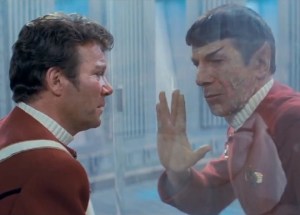
Spock's death in Star Trek 2Along with LotR, my other go-to example is Star Trek II:  The Wrath of KhanWrath is generally considered to be among the best of the Trek movies (for example, here, here, and here), and a sizable part of its draw is the death of the beloved Spock.  Like Gandalf, Spock perishes heroically, subjecting himself to a fatal overdose of radiation to make a crucial repair that saves everyone else on the Enterprise.  And his loss is fully realized by his long-time friends, along with the new characters we’ve just gotten to know.  Maybe I’m sentimental, but Kirk’s eulogy at Spock’s funeral has always struck me as a genuinely moving moment.

At the same time, there was no doubt in my mind when I first saw the film that Spock would be back.  The whole atmosphere of the final scenes in Wrath—hopefulness so intense you can almost taste it—lent itself to anticipating eucatastrophe rather than a final end.  The shiny “casket,” nestled in the burgeoning growth of the Genesis planet, seemed to promise some kind of resurrection.  What made us feel Spock’s death so effectively, even though we were morally certain we’d see him again?

Part of it is that these characters had had such a long history together.  We’d seen their relationship grow over three TV seasons, and we’d been recently reminded of that history in the first Star Trek movie, flop though it was.  To the numerous loyal Trek fans, at least, these were truly iconic characters, and we were emotionally invested in them.  The history had built up a kind of emotional potential that the death sequence could draw upon.

Spock's funeralEven more important, the other characters were visibly affected.  They didn’t know Spock would be back.  We grieved for Spock through his friends.  The screenwriter and director wisely gave us enough time, in the final sequences, to absorb and appreciate that grief with the other characters.  I suspect this, more than anything, is what makes a provisional death effective:  a powerful portrayal of other people’s response to the loss.

Finally, the heroism of Spock’s final acts, and the overwhelming sense of something wonderful that’s been achieved on the Genesis planet at the end, lend depth and further feeling to the event.  We respect his sacrifice, and it means something.  The hope for new life doesn’t necessarily erode the gravity of the death.

Moreover, the sequels navigated the difficulty pretty well.  Star Trek III:  The Search for Spock did unavoidably undercut the resolution of Wrath a bit.  The Genesis planet is unstable; it isn’t quite as wonderful as we thought.  The adversaries in Search are much more mundane than Khan (who had his own history with the Enterprise crew).  And the death isn’t permanent.

Yet the complex, gradual, effortful reconstitution of Spock manages to become something wonderful in itself, rather than just a reversal of the loss.  The notion that Spock’s katra or spirit survives adds an element of the mystical or sublime to the science-fiction texture of the series.  The notion that it survived in McCoy’s head gave the situation humor and irony.  The unconventional expedients the Enterprise crew must use to get McCoy back to Genesis provide both adventure and a maverick sense of, well, enterprise.  Meanwhile, the scenes of Spock’s body re-growing from childhood to adulthood as accelerated by the Genesis effect have their own sense of wonder.

Spock is rebornWhen the Vulcan ceremony of reintegration rejoins Spock’s spirit with his body, the impact of the result is heightened by the fact that Spock is clearly changed by his passage through death.  (The final film of the trilogy, Star Trek IV:  The Voyage Home, continues this theme by showing Spock visibly struggling to get used to life again.)  The return, which takes two whole movies to complete—a quest in itself—is far more than a handwave.  It’s an achievement.

Conclusions

From these examples I think we can pick out some factors that help a story to make good use of a temporary death, as opposed to a routine we-know-they’ll-be-back.

  • The death is heroic; it means something.
  • We care about the lost person—and so do the other people in the story.
  • The other characters experience the death fully, even if the reader or viewer knows that it won’t be permanent.
  • The deceased character is absent long enough to let the loss sink in.
  • The deceased character earns the return. It doesn’t come easy.
  • The returned character is transformed in some way by the experience.

When an author can incorporate these elements, we the audience can extend our “willing suspension of disbelief” to sympathize with the rest of the cast in their loss, even when we are aware in propria persona that the beloved dead aren’t gone for good.

Civilization and Chaos

Last time, we talked about Star Trek and Star Wars—but especially Star Trek—as expressing the ideal of a certain type of civilization.  Now we can broaden the range of examples.  Science fiction and fantasy make an excellent laboratory for thought-experiments here, as in so many things.

Staving Off the Fall

The threat that civilization will fail and collapse is a classic way to create a dramatic situation for a SF story.  The most common historical analogue, of course, is the fall of the Roman Empire in the West.

Foundation's Edge cover artIsaac Asimov’s classic Foundation series (1942-1953) deliberately drew on that model; Asimov had been reading Gibbons’ History of the Decline and Fall of the Roman Empire.  In the Foundation universe, Hari Seldon has developed a science of “psychohistory” that predicts the Galactic Empire’s inevitable decline.  There’s no chance of preventing the fall.  But Seldon’s psychohistory offers a way to cut short the ensuing dark age from thirty thousand years to a single thousand.  The emotional charge of the original Foundation stories centers on the Seldon Plan’s bid to minimize the period of barbarism, with its chaos, violence, tyranny and suffering.  (Later developments of the series, too involved to discuss here, go off in somewhat different directions.)

I’ve mentioned H. Beam Piper’s Terro-Human Future History, which includes at least one such decline-and-fall.  The novel Space Viking (1963) gives us a whole culture of space-traveling barbarians, raiding the decadent worlds of the old Federation.  The events of the story suggest the hope of a return to lawfulness in the formation of a “League of Civilized Worlds.”  But given Piper’s cyclical theory of history, this initiative will yield no permanent resolution; the story has a happy ending, but the history does not.

Poul Anderson wrote a series of stories about Sir Dominic Flandry, a dashing secret agent of the Terran Empire reminiscent of a far-future James Bond (though Flandry first appeared in 1951, Bond in 1953).  When he can spare a moment from chasing women and loose living, Flandry devotes his efforts to shoring up the decaying Empire, though he realizes that in the end the “Long Night” is inevitable.

There’s a certain kind of romance, a mood of grandeur and doom, about these falling empires.  Naturally, they tend toward the somber and the tragic.

Defending Civilization

A more upbeat tone characterizes stories in which the fight to preserve civilization has a chance of succeeding.

Lensman imageIn the Lensman series, E.E. Smith actually refers to the heroes’ multispecies galactic community simply as “Civilization.”  That polity reflects the cooperative, yet freedom-loving, nature of the beneficent Arisians, who have nurtured it in secret over millions of years.  The Lensmen’s opponent is “Boskone,” which originally appears to be a mere conspiracy of space pirates or drug dealers.  When Boskone eventually turns out to be a whole independent culture of its own, based in another galaxy, the conflict becomes one of diametrically opposed cultures, rather than simply of order vs. disorder.

But the Boskonian culture is one of thoroughgoing tyranny, from top to bottom.  At every level, those in power scheme against each other.  Lacking any honor or ethical code, they engage in assassination and undermine each other’s plans.  Those at the bottom are essentially slaves.  The Civilization led by humans, on the contrary, respects human dignity and freedom—although the fact that these cultures have been essentially on a war footing throughout their entire history renders that freedom a little less far-ranging than we might imagine.

The Lensman example reminds us that the defenders of civilization are not always fighting against barbarians.  Autocracy and regimentation bring their own kind of chaos, as lawless warlords battle among themselves, not caring what common folk are trampled in the process.  It’s a particular kind of civilization that’s worth preserving.

This is true whether we’re in the future or the past.  We’ve seen that the power of the Arthurian legend stems partly from the theme of defending order and decency against the chaos that lies in wait.  (We may also mention Arthur’s more historically-based successor, King Alfred, who defended England against the real (not Space) Vikings.)

The embattled Arthurian Camelot is frequently connected with Rome itself, the ur-example.  The Last Legion (book and movie) provides a good example.  The waning Roman presence in Britain, as the Dark Ages set in, is a natural setting for the ideal of the lonely, valiant defender.  One example is brought up indirectly by a character’s name.  As Wikipedia puts it,  “Legio XX Valeria Victrix lends its name to the character Valeria Matuchek in Poul Anderson‘s Operation Chaos and its sequel Operation Luna; her mother is said to describe this legion as the last to leave Britain—‘the last that stood against Chaos.’”

To Valeria’s mother Virginia, “the last that stood against Chaos” is a phrase to conjure with.  That’s true for me, too.

The Right Kind of Order

If civilization represents a certain kind of order—that of the Lensmen, not Boskone—what kind are we talking about?  It’s not always easy to explain.

Thus, if one asked an ordinary intelligent man, on the spur of the moment, “Why do you prefer civilization to savagery?” he would look wildly around at object after object, and would only be able to answer vaguely, “Why, there is that bookcase . . . and the coals in the coal-scuttle . . . and pianos . . . and policemen.”  The whole case for civilization is that the case for it is complex.  It has done so many things.  But that very multiplicity of proof which ought to make reply overwhelming makes reply impossible.  (G.K. Chesterton, Orthodoxy (Garden City, NY:  Image Books, 1959), ch. 6, p. 83)

Chesterton’s random examples do cast some light on the question.  A community that has bookcases has books—implying a continuity of knowledge and literature, as well as the leisure to read them.  Coals to keep one warm in winter suggest both the satisfaction of basic human needs, and the whole machinery of society and technology that brings the fuel from the mine to the fireside.  Pianos reflect art and a developed culture.  And policemen indicate a society in which there is at least some attempt to defend the ordinary citizen against the depredations of the powerful and unscrupulous—the rule of law, of which more anon.

In the particular culture to which I belong, when we hold up a certain sort of civilization as an ideal worth defending, what we have in mind is a good order in which spontaneity and creativity can flourish, and people can live their lives without constant fear or privation.  There’s an order that protects the weak against the strong, but there is also enough looseness for individual variation, experiment, and adaptation.  In the “alignment” terms we discussed last time, you might say the position I’m taking is neutral good, tending to lawful.

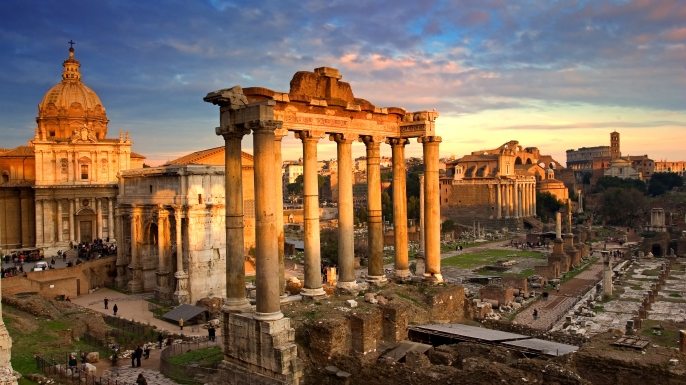
Greco-Roman sceneThe classical roots of this ideal are found in the Greek notion of the polis and the Roman notion of civitas.  But it’s been shaped by the whole history of Western thought into what’s sometimes called the “liberal” ideal of a free society—“liberal” not in the political sense, but the root sense of “free.”

There’s one particular aspect of this ideal, though, that science fiction is peculiarly suited to address.  We’ll talk next time about civilization and science.