The World Around the Corner

The World Premiere

The World Around the Corner coverI’m excited to have my romantic comedy novella The World Around the Corner in print as of last week.  Or in virtual print, at least; it’s out as an e-book from the Wild Rose Press.  (Details are available on the story’s page.)

Uncharacteristically for me, TWATC isn’t science fiction or fantasy.  The only potential SF elements are some very minor advances in gaming technology (and perhaps in automobile design).  Some parts read a little like fantasy, because there’s an online role-playing game (an MMORPG) involved.  In that respect there’s a faint resemblance to Ready Player One (book and movie), where an online game plays a major part in a much more serious SF story.  But TWATC isn’t really about games or technology; it’s all about having fun with the characters.

You’re Who?

I’ve always liked the kind of romance where a character has to make a discovery about who their romantic interest really is.  Jasmine isn’t immediately aware that Disney’s Aladdin, when he visits the palace as a prince, is the same street urchin she’s already met—though she isn’t fooled for long.  In Shakespeare’s venerable Twelfth Night, nobody is quite sure who “Cesario” (Viola) really is.  The same is true in the modernized high-school variant of the Shakespeare comedy, She’s the Man.  Playing around with two ways of knowing the same person is also put to good use in the case of super-heroes (or heroes generally) who have secret identities, from the Scarlet Pimpernel to El Zorro to Superman.

The Shop Around the Corner posterBut in all these tales, one member of the couple has the advantage of knowing the truth.  It puts the couple on more even terms if neither of them is aware of what’s really going on.  There’s a whole series of variations on a single story where the main characters meet indirectly and fail to connect up the two different ways they’re communicating with the same person.  This plot seems to have been invented by Hungarian playwright Miklós László in the form of a play called Illatszertár or Parfumerie (1937).  It was adapted in English into the Jimmy Stewart-Margaret Sullavan film The Shop Around the Corner (1940), which in turn gave rise to a musical treatment with Judy Garland, In the Good Old Summertime (1949), and again with She Loves Me (1963).  In these versions, the main characters are pen pals, and also co-workers.  Nora Ephron updated the treatment by making them e-mail correspondents in You’ve Got Mail (1998).

Romance And—

When we tell the story of a romance, we’re often telling a story about something else at the same time.  To be sure, this isn’t always the case.  In Georgette Heyer’s Cotillion, for example, or in Must Love Dogs, and in a lot of high-school rom-coms, the personal relationships are pretty much all that’s going on.  But generally, we don’t spend our lives doing nothing but looking for love.  We go on about our daily business, meeting our daily challenges, and stumble upon love as we go.

To Say Nothing Of The Dog coverSo a lot of romantic tales also have a storyline dealing with something that brings the couple together.  In Heyer’s The Toll-Gate, there’s an involved plot having to do with a theft of currency.  The main characters in Connie Willis’s To Say Nothing of the Dog are searching for the bishop’s bird-stump.  (It’s a long story.)  Gaudy Night is the Dorothy Sayers novel where Harriet Vane and Lord Peter Wimsey finally get together, but they do it while trying to resolve a crisis at her alma mater.  The redoubtable Amelia Peabody and her future husband Radcliffe Emerson meet in the context of archaeological investigations (Crocodile on the Sandbank).

I like the idea of a couple’s bonding by cooperating in some shared endeavor.  And we may be able to amplify that motif by having it happen twice, in parallel, like the parallel identities in the “Shop” stories.

The Camaraderie of the Quest

One of the things I’ve always enjoyed about the group quests of role-playing games, whether in D&D or World of Warcraft, is the bonding and sense of camaraderie that develops in a group working together for a common purpose.  Most traditional games like chess or Risk have the players competing against each other.  But the role-playing games typically pit a band of True Companions against third-party monsters or other opponents.

This is a whole different dynamic.  And seeing it play out in a game makes the tone both more light-hearted and more detached than, for example, in a real-life business relationship.  But for that very reason, it lacks a certain gravitas.  Suppose a couple used to fighting side-by-side in a game found they had to work together on something important in real life as well?

The Fun of the Shared Adventure

All this contributed to the idea of The World Around the Corner.  Other aspects also played their roles—for instance, a chance to share some favorite music and books.  And let us not forget the occasional opportunity, sheerly by happenstance, to achieve a truly dreadful pun, without even setting it up on purpose beforehand.  You’ll know it when you see it . . .

I hope you’ll have as much fun reading TWATC as I did writing it!

Goddess-Born

Aeneas

Recently I started listening to Mike Duncan’s podcasts on the History of Rome (2007-2012).  It’s interesting that he takes seriously the story of the founding of Rome by Aeneas.  Not that he believes it actually happened that way; but he does recount the tale as if it were history.  Of course, Duncan observes that we don’t have much of anything except legends to go on for the early history.  And it does make a good yarn.

The Aeneid, cover (Penguin)I’ve always had a fondness for Aeneas.  It dates back to when I took fourth-year Latin in high school.  That class—which turned out to be a sort of independent study, since no one else signed up for the course—consisted largely of translating parts of the Aeneid.  As it happened, my encounter with the Aeneid was also the occasion for a kind of epiphany.

So what makes Aeneas, and his story, so cool?

The Poem

The Aeneid is an epic poem, the Romans’ answer to the Greeks’ Iliad and Odyssey.  Unlike the Greek epics, which are attributed to the near-legendary Homer, the Aeneid was composed within recorded history, between 29 and 19 B.C., by Publius Vergilius Maro, generally referred to in English as Vergil or Virgil.  The work was seen as celebrating Roman history and its culmination in the Empire of Augustus Caesar, and became a kind of national mythology of Rome.

Vergil developed his epic out of a scattering of legendary sources, including some mentions of Aeneas in the Iliad.  Wikipedia summarizes the work this way, incorporating some useful cross-references:

Virgil took the disconnected tales of Aeneas’s wanderings, his vague association with the foundation of Rome and a personage of no fixed characteristics other than a scrupulous pietas, and fashioned the Aeneid into a compelling founding myth or national epic that tied Rome to the legends of Troy, explained the Punic Wars, glorified traditional Roman virtues, and legitimized the Julio-Claudian dynasty as descendants of the founders, heroes, and gods of Rome and Troy.

Painting of Aeneas recounting the fall of Troy to Dido

Aeneas tells Dido of the Trojan War (Pierre-Narcisse Guérin)

The Aeneid describes how Aeneas and his followers, escaping from the fall of Troy, set out on extended wanderings about the Mediterranean in search of the new home they are destined to find.  They stop for a while at Carthage (Rome’s traditional enemy), which is actually where the poem begins.  Aeneas tells the story so far to the attentive Queen Dido of Carthage, who is enamored of him.  It’s a classic example of starting a story “in medias res” (into the midst of things).

When he’s reminded that he has not yet arrived at his destined kingdom, Aeneas reluctantly leaves Dido, who kills herself out of frustrated love.  Eventually he arrives in Italy, where his people join forces with the native Latins, sealing the union by the marriage of Aeneas and the princess Lavinia—but first they have to defeat the local Rutuli, to whose king, Turnus, Lavinia had previously been promised.

The Story

Aeneas and his father flee Troy (Vouet)

Aeneas and his Father Fleeing Troy, by Simon Vouet (c. 1635)

The Aeneid is a story of the underdog—something that always appeals.  Rather than seizing on some glorious victor as the founder of Rome, Vergil started with the defeated refugees fleeing from the fall of Troy.  It takes some nerve to proclaim yourself the descendant of the losers.  But it bespeaks a certain humility that’s refreshing in a national epic.


On the other hand, Aeneas is not exactly a common man:  he’s the son of the goddess Venus and his human father Anchises.  Thus, Aeneas is frequently addressed in the poem as “goddess-born” (nāte deā).  Aeneas is in fact a demigod by ancestry—but he’s sympathetically human in character.  So he may be from the losing side in the Trojan War, but he’s definitely the Chosen One.

The Aeneid is not the tale of an essentially pointless war, like the Iliad, or the monster-ridden journey of the Odyssey.  Rather, it has a plot that moves definitely toward an end:  a victorious war (redeeming the defeat of Troy, perhaps) that results in a new beginning, the origin of Rome.  (Wikipedia says rather coyly:  “A strong teleology, or drive towards a climax, has been detected in the poem.”)  This gives the Aeneid a note of hope and uplift that’s harder to find in the Greek predecessors.

The Hero

I like Aeneas better than most of the heroes of Homer.  He makes mistakes; he hesitates at times to step up to his destiny; he has his moments of weakness with Dido; but he’s essentially well-intentioned and honorable.

Vergil depicts Aeneas as an exemplar of pietas, a central virtue for the Romans.  It’s not quite the same thing as the cognate “piety” in English.  The root sense seems to be a kind of filial respect, but read broadly pietas becomes almost equivalent to “justice”—in the equally broad sense often given to “justice” by Plato and Aristotle, where the term encompasses the whole of morality.  Aeneas is a “good guy”—and I always have a weakness for the decent person who strives to do the right thing.

One wouldn’t be far wrong to think of Aeneas as a potential knight of the Round Table.  In fact, the original descriptions of Arthur do make a legendary connection to the family of Aeneas (in the Historia Brittonum).

The Romantic

Another favorable feature, to my taste, is that Aeneas is more prone to romance than most of the Homeric heroes.  (Maybe it’s his mom’s influence at work.)

Aeneas and Anchises in Troy movieOf course, the Iliad does give us Hector and Andromache, and the Odyssey is after all the tale of Odysseus’ attempts to return to his faithful wife.  But romantic love is not the main matter of those works (I read the intrigue of Paris and Helen as more a matter of lust than love).  This is somewhat obscured in the movie Troy, where Hollywood characteristically amps up the romances of Paris and Helen, Achilles and Briseis.  (Incidentally, Aeneas appears in that movie too—for about sixteen seconds; though he does take possession of an heirloom sword to carry forward into mythical history.)

Aeneas is involved in three romances in the course of his voyaging.  To begin with, he’s portrayed as loyal to his first wife Creusa.  When she’s lost in the flight through burning Troy, he goes back at great risk to find her, but he’s too late.  He meets her shade instead, and though he tries to hold her, he can’t.  Instead, she foretells he’ll marry another.

The poem treats the idyll in Carthage as a weakness in Aeneas, because it distracts him from his destiny:  he’s tempted to settle down with Dido and give up all this strife and conflict.  But it’s the kind of weakness we moderns rather sympathize with.  When he leaves Dido, it’s for an irresistible reason—the call of destiny—and Dido’s heartbreak is portrayed as an overreaction (her dying curse provides a mythical explanation for the traditional enmity between Rome and Carthage).

Finally, Aeneas’ destined marriage to Lavinia can be interpreted as a romantic happy ending.  He names a city for her—perhaps not the typical gift to one’s wife, but certainly a grand gesture.  Not that the Aeneid treats of their relationship in any great detail.  But that leaves the field open for improvisation.  Wikipedia observes that “[t]he perceived deficiency of any account of Aeneas’s marriage to Lavinia or his founding of the Roman race led some writers . . . to compose their own supplements.”

I recently read one of those follow-up stories, Ursula K. LeGuin’s Lavinia.  It’s a good story, although it has peculiarly “meta” qualities:  LeGuin depicts Lavinia as spending a lot of time chatting with Vergil himself and pondering whether she’s real or fictional.  We still don’t get to see as much of Aeneas or their romance as I’d have liked, though LeGuin does depict the hero and their love favorably—a step in the right direction.

The Epiphany

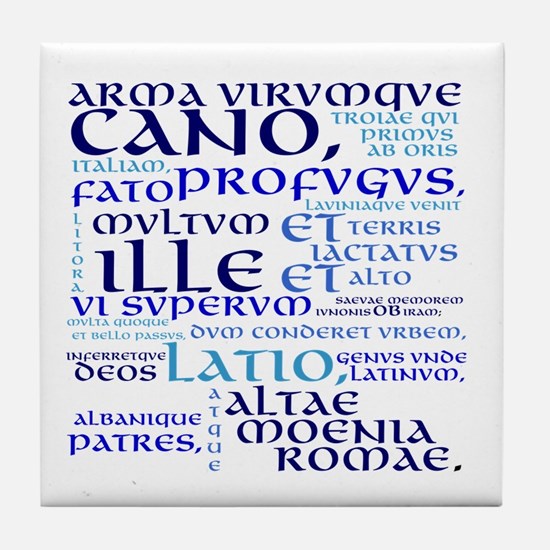
Arma virumque cano, blue tile coasterTranslating something into another language can trigger reflections on language itself.

In high school, I would have said that plot was more important than character in a story—feeling a bit daring and iconoclastic in taking that position, since in those days the doctrine in English Lit classes was that Character Is Everything.  Style, or the handling of language I would have considered a distant third, at best.

But I remember going over my English rendition at one point, and not being quite satisfied.  The lines were accurate enough; but I wanted something more.  The lines didn’t sing.  I wanted them to sound better.  In fact—I was amused to realize—I wanted them to sound like The Lord of the Rings.  It’s an epic, with a heroic sword-and-sorcery setting, right?  Of course it should sound like Tolkien!

That was the point at which I became aware how much the language matters.  You can have a fine plot, you can have wonderful characters, but how that comes through to the reader depends on how you say it.  How you tell the story can be as important, in how it affects the reader, as what story you choose to tell.

Moon Bases

Widespread Lunacy

There’s a lot happening on the Moon, it seems.  In the last several months I’ve read three different novels about the first lunar colony.  And they really are recent:  all three were published in 2017.  “The world is too much with us,” perhaps—but in any case the Moon seems to be very much with us at the moment.

The stories come from very different points of view.  We talked last time about Andy Weir’s Artemis, which gave us a cynical young woman’s view of a thriving lunar city built on tourism, complete with smugglers, mobsters, and mayhem.  As we saw, Artemis illustrates anything but the clean-cut NASA world of its predecessor The Martian.

Walking on the Sea of Clouds, coverGray Rinehart’s Walking on the Sea of Clouds follows two married couples, Stormie and Frank Pastorelli and Van and Barbara Richards, as they train for places at the first Moon base.  The base is bankrolled by the Asteroid Consortium, multinational venture capitalists whose primary interest is in asteroid mining.  The story revolves around the four main characters—how the lunar venture motivates them and affects their relationships.  So much of the book involves training and preparation that it might be called a “science procedural,” on the model of the “police procedural” that focuses on the methodical work of a police investigation rather than the high-profile antics of private detectives.

Moon Beam, coverOur third sample is Moon Beam, by Travis Taylor & Jody Lynn Nye.  This is a middle-grade (MG) novel whose hero, sixteen-year-old farm girl Barbara Winton, is selected to join a group of brilliant young students under the wing of Dr. Keegan Bright, a Carl Sagan-like science communicator with a popular Webcast and a world-wide following.  Bright and his students happen to be based at Armstrong City, the first moon colony.  Barbara ends up taking the lead in a pathbreaking expedition by the “Bright Sparks” to set up a huge telescope on the far side of the Moon.  The young people must cope with unexpected dangers on the way.  (Unexpected by the characters, that is; readers will of course be primed to anticipate something more than mere routine.)

Common Ground

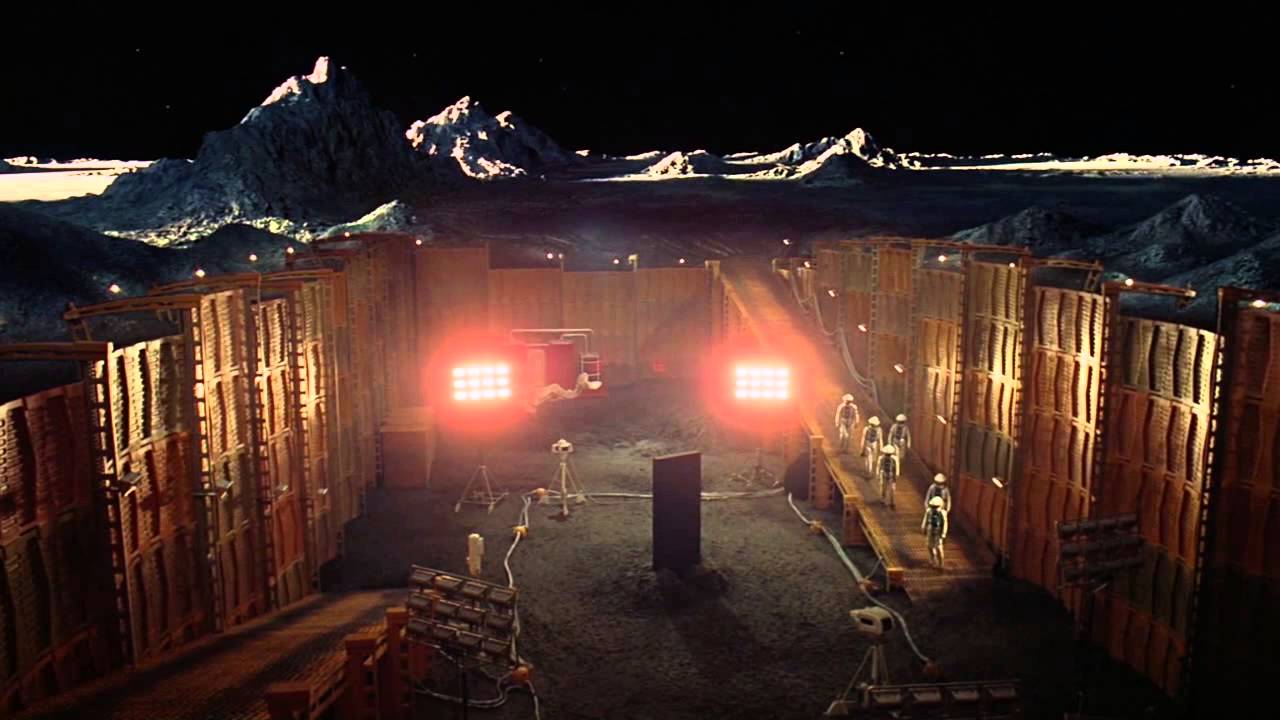
2001 - A Space Odyssey, monolith on the moonDespite their difference in tone, the three books have a lot in common.  There’s a good deal of serious science in each one, though it properly stays in the background and doesn’t slow down the plot.  The science is solid, too:  none of the stories extrapolates far beyond technologies that we can practice, or reasonably predict, today.  Nobody discovers a monolith left behind by mysterious aliens or discovers any exotic principles of physics (unless one counts the hypothetical “E-M” drive mentioned glancingly in Moon Beam).

The stories also share the assumption that private enterprise will play a leading role in creating these moon colonies.  We saw that Weir’s Artemis is founded by the nation of Kenya, but as a venue for private businesses.  Rinehart’s lunar base is funded by private corporations.  Moon Beam doesn’t pay a lot of attention to how Armstrong City as a whole is operated; we spend almost all our time with Dr. Bright and his teenagers, who essentially constitute a private STEM demonstration project.

Enterprising Venturers

What’s with this rash of lunar narratives?  Why is a permanent home on the Moon on our minds at this particular moment?  Three examples is barely enough for a trend, of course.  But half the fun of these observations is the chance to try out a wild extrapolation and see where it leads.

There was a surprising amount of popular interest in last year’s lunar eclipse—but that doesn’t explain why these books were already in the publishing pipeline for 2017.  That astronomical attentiveness probably shares whatever is the cause of the booming market for moon stories.

Nor is the reason likely to be found in the sporadic statements from NASA or the federal government on the subject.  The last several Administrations have been promising us the Moon, or Mars, on a regular basis, and we’re nowhere nearer either planet(oid) as a result.

Dog howls at moonBut one thing has changed over the last five or ten years.  We have a number of private ventures aiming at space travel, spearheaded by wealthy visionaries like Jeff Bezos and Elon Musk.  Bezos’ Blue Origin (whose name “refers to the blue planet, Earth, as the point of origin,” according to Wikipedia) and Musk’s SpaceX (whose full name is “Space Exploration Technologies Corporation”) have made significant strides toward actual human spaceflight.  They suggest a new kind of outward path, driven by private enterprise rather than government projects.  That shift dovetails with the United States’ own policy of relying on private companies (or other countries) for launch services in the post-Space Shuttle era:  space as a business venture looks considerably more promising with the government as an anchor tenant.

There’s plenty of science fiction precedent for private trips to the Moon.  The first moon flights are made by private parties in Heinlein’s novella “The Man Who Sold the Moon” (1951) and its juvenile counterpart, Rocket Ship Galileo (1947).  But it was NASA that carried out the real moon flights.

I grew up thinking of NASA as the natural venue for space exploration.  But that was never supposed to be a permanent role.  NASA’s job is to carry out the experimental work that provides the foundation for commercial aeronautics—and astronautics.  Maybe we have arrived at the moment where the venture of expansion into space can be handed off to ordinary business enterprises.  And maybe that’s turning our thoughts toward seeing the Moon as a place to live and work—not just to reach once upon a time.

From Martian to Moonling: Artemis

Andy Weir took the world by storm with The Martian, both the book and the movie adaptation.  Naturally, there was a great deal of interest in Weir’s second novel, Artemis (2017).  Here’s my take.

Here Be Spoilers!

Artemis, book coverThe book’s been out long enough that the spoilers below won’t occasion a great deal of surprise, but if you haven’t read the story yet, you may want to save these gems of wisdom until you’ve done so.

A New Departure

First, Artemis is not a sequel to The Martian.  As far as I can see, the two stories have nothing to do with each other.  That’s good.  It’s easy to get stuck in a single storyline, especially if it’s a howling success.

Moreover, Weir gets credit for trying out an entirely different kind of story.  The Martian was a classic survival/rescue tale, populated by clean-cut NASA types.  Artemis is more of a caper story, with a cast of crooks, con artists, and wheeler-dealers.  They’re both set in space environments, but aside from that, the books are poles apart.  That was intentional.  As an interview in The Verge (11/14/17) reported, “Weir told me that following The Martian was scary, and that he shifted his expectations with writing it.”

A Motley Cast of Characters

Moving from a single exploratory mission to a thriving city on the Moon allows Weir to deploy a more varied array of characters.  For example, our first-person narrator, Jasmine “Jazz” Bashara, is a small-time smuggler in Artemis, the first city on the moon.  She’s a feisty, cynical young woman semi-estranged from her Muslim engineer father.  Jazz’s ambitions are nothing so noble as exploring new worlds:  she simply wants to make a lot of money so she can improve her hand-to-mouth life.  She’s an engaging main character, if you like a scamp.

Artemis, posterOn the other hand, Jazz is not the charming sort of scamp you might envision—a female Han Solo or Aladdin.  She’s tough, no-nonsense, and rather abrasive.  Weir noted in a Newsweek interview (11/14/17) that readers don’t much like her.  I found that an issue too.  There are a lot of unfortunate character traits to deal with.  Jazz is practically a genius (in ch. 3, she admits nonchalantly that she taught herself electronics from an online tutorial in an afternoon)—but she doesn’t live up to her potential.  She’s promiscuous, she’s materialistic, she sees almost all transactions in terms of money.

Jazz’s main virtue is that she’s an ethical thief:  when she makes a shady deal, she sticks to it.  Actually, this rude sense of justice isn’t a bad place to start respecting a character.  Like the proverbial honest politician (“one who stays bought”), she has some principles.  She’s also daring (if reckless), clever (if hardly infallible), brave, and determined.  Although she wasn’t my most-loved character of all time, I enjoyed hanging out with her enough that I didn’t lose interest in the story.

Other characters are pretty varied:  Martin Svoboda, the geeky engineer lacking social skills; Trond, the slick magnate, and his engaging daughter Lene; Ammar Bashara, Jazz’s considerably more strait-laced but competent and loyal father; law-abiding Rudy DuBois, the city’s entire police force; Fidelis Ngugi, the visionary founder of Artemis; and so on.

There’s no romance in the story, although there’s a faint suggestion at the end that Jazz will eventually get together with Martin—not a combination I would have thought of.

A Land of Liberty and License

Weir pictures the first lunar city as a lightly-governed free-for-all.  It’s been established by Kenya, which in this scenario takes the advantage of its equatorial location for space launches.  Under Ngugi’s leadership, Kenya sets up an attractive, largely unregulated base for businesses on the Moon—mainly businesses connected with tourism.  It’s a logical financial basis for the first moon colony.  The situation reflects Weir’s fascination with economics, an aspect that didn’t have much play in The Martian.

The Moon is a Harsh Mistress coverIn the interview with The Verge, Weir uses the term “libertarian”—and in that connection cites the Robert A. Heinlein novel The Moon Is A Harsh Mistress (1966), which does leap to mind as a predecessor.  Heinlein’s story, perhaps his best single novel, imagines the Moon as a multinational penal colony, just as Australia was for Britain in the eighteenth century.  Since the colony’s administration doesn’t much care what happens to the inhabitants, they’re left to manage their own internal affairs, according to customs and practices that evolve out of the peculiar conditions of lunar life.  The result is a colorful, freewheeling polyglot society that allows Heinlein to make a lot of pithy observations about conventional Earthly manners and mores.

Heinlein’s “Loonies” live in a harsh but in some ways utopian culture.  Weir’s Artemis is not presented in quite so favorable a light.  We do enjoy the chiaroscuro combination of resort-town luxury and shady underbelly in which Jazz operates.  But it’s clearly a hardscrabble life for a considerable part of the population—the service people and human ‘infrastructure’ that make the tourists’ luxury possible.  It’s what Weir, in the interview, calls a “gold rush” setting.

On the other hand, this libertarian polity is seen as a stage in a long progression, not a utopian end in itself.  Toward the end of the story (ch. 17, p. 300), Fidelis Ngugi, the visionary founder, says:  “It’s all part of the life-cycle of an economy.  First it’s lawless capitalism until that starts to impede growth.  Next comes regulation, law enforcement, and taxes.  After that:  public benefits and entitlements.  Then, finally, over-expenditure and collapse.”

Because Artemis is so colorful and well-drawn, the city is almost a character in itself, like Dickens’ London or Nero Wolfe’s New York City.  I wouldn’t mind seeing more stories set in Artemis as it develops.

Science Capers

One thing the book does have in common with The Martian:  science.  Weir frequently drops into detailed explanations of How Things Work, and the conditions of the lunar environment play key roles in the plot, as the Martian landscape did in the prior book.  I find this fascinating.  I’m not sure whether every reader will—but the success of The Martian (in both its incarnations) suggests there’s a sizable audience that does.  More on that point in a later post.

But the science here is at the service of a very different plot.  With the prospect of a vast payoff, Jazz evolves a complex plan to undermine one business so that another can take over.  She then has to devise an even more involved scheme to keep gangsters from effectively taking over the city.  Readers of The Martian can find a common form of enjoyment here, in watching these plans play out, even though the characters’ purposes and contexts are rather different.

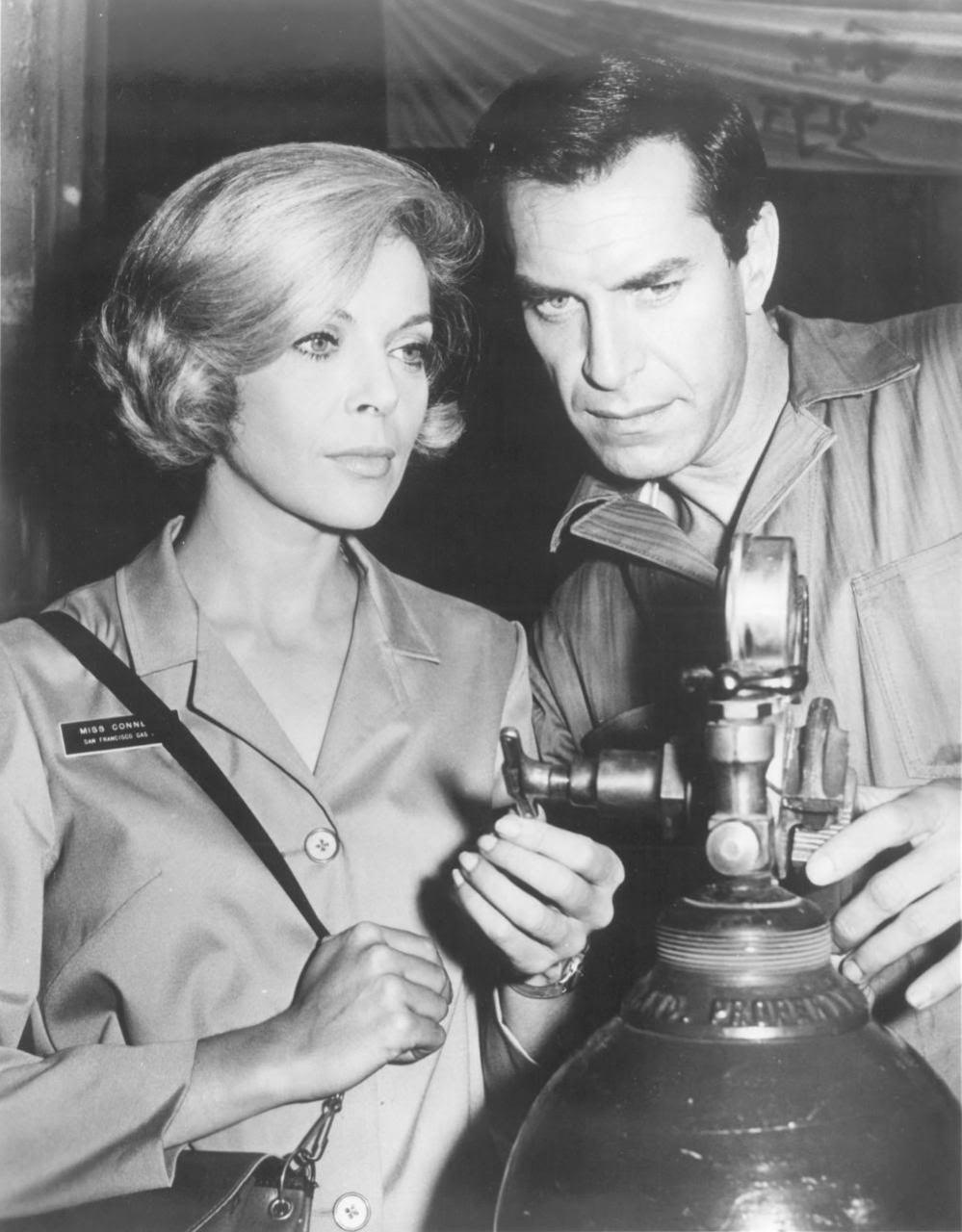
Mission Impossible - Barbara Bain and Martin LandauThere’s actually a good deal of precedent for this “science caper” type of story.  The old “Mission Impossible” TV series typically displayed an elaborate scheme deployed by the mission team to outwit and bamboozle the bad guys.  (Not so much the more recent movies, which tend to be more general-purpose thrillers.)  The 1985–1992 series “MacGyver” also turned on the technical wizardry of the lead character, a consummate engineering improviser.

In fact, there’s a whole category of techno-thrillers about using complex plans and technology to break into something or make off with something.  Sometimes the emphasis is on the trickery, as in The Thomas Crown Affair (I saw the 1999 version).  Sometimes it’s more on the techniques, as in Entrapment or the early part of National Treasure.  Many of the James Bond films invoke this trope.

Much of The Martian consisted of scientific problem-solving, though on a more low-key, continuing basis.  (Mark Watney remarks that he’s going to have to “science the s— out of this” to survive, though given the way he fertilizes his crop, maybe he should have said “science the s— into this.”)  Only at the end does the techno-wizardry move into crisis mode.

In Weir’s Verge interview, he says, “My approach was pretty similar to The Martian. There was a lot of problem-solving . . .”  The difference is that Jazz’s science schemes in Artemis face hostile human opposition, not just a dangerous universe.  The suspense is more focused and urgent.

The Next Movie

Artemis seems even more cinematically apt than The Martian.  It’s no surprise that the movie rights have already been sold and directors chosen.  We can monitor developments here at IMDB.

I don’t know whether Artemis will be as successful as The Martian at the theaters.  The abrasive heroine might turn out to be less of a crowd-pleaser than the amiable Watney.  But that’s just the kind of nuance that a movie could easily adjust.  It’ll be interesting to see them try.

Cities in Flight

Now that we’re in the future (as it seemed to us in the 1950s), it’s become conventional to ask plaintively, where’s my flying car?  My rocket pack?  But for my part, now that it’s 2018, I’m asking:  where’s my spindizzy?

Year 2018! novel coverThe term comes from James Blish’s Cities in Flight, a sprawling science fiction series published between 1950 and 1962.  The first volume, which details how interstellar travel began, was in some versions titled Year 2018!  So the year we’ve just entered is permanently fixed in my head as a memorable future date—just as for many of us, 2015 was memorable as the year to which Marty McFly traveled in Back to the Future II.

Going Okie

Blish imagines a future in which faster-than-light travel is made possible by a device formally titled the Dillon-Wagoner Graviton Polarity Generator, but nicknamed the “spindizzy.”  The more massive the object, the more efficiently a spindizzy field accelerates it.  While you can use the drive in a small spaceship, it really works best for something bigger.  In addition, the spindizzy creates a force field or screen around the spacecraft, which can keep in air as well as keeping out meteoroids and such.  And it has no problem maintaining artificial gravity inside the craft.  The spindizzy is thus perfectly adapted to lifting an entire city off the ground and sending it hurtling through space:  New York, or Scranton, or Budapest.

The idea of walking down Fifth Avenue or stopping by the Empire State Building while voyaging among the stars is irresistibly cool, to my mind at least.  (I used to play at building spindizzy-powered spacecraft out of construction sets as a kid.)  But what makes the story really distinctive is the way Blish depicts the society in which this migration occurs.  Cities don’t leave Earth as part of some glorious exploratory venture.  Rather, they pull up stakes and go elsewhere because Earth has fallen into a permanent depression, and the cities have no choice but to seek economic opportunity among already-existing interstellar colonies, providing established industrial capacity to these still-developing worlds.

Okies in truck (photo)Traveling from planet to planet, offering their services, the flying cities are essentially migrant workers, like the “Okies” in America’s 1930s.  For a city to “go Okie” is an indicator of desperation, rather than of success.  The migrant cities are regarded with suspicion and contempt by the planets they serve, just as the original Okies were.  It’s not your average space opera scenario.

The four volumes, in chronological order, are:

A Patchwork History

The Cities in Flight stories have a rather complicated publication history.  Initially Blish didn’t intend to write a series at all.  In a 1964 author’s note to the third volume, he describes how John W. Campbell pointed out the full potential of “an idea of Wagnerian proportions” that Blish had been willing to throw away on a 10,000-word novelette.  The expanded project took him fifteen years to “realize properly.”

As the publication dates show, Blish didn’t go at this in a neat sequential way.  First he produced the contents of the main volume, Earthman, Come Home, interspersed with the two overlapping stories that make up the first volume, They Shall Have Stars.  The concluding (and I do mean concluding) book, The Triumph of Time, followed a few years later.  Blish then went back and for some reason wrote a young adult novel in the same universe, A Life for the Stars, telling the “origin story” of a character briefly mentioned in Earthman.

A Mix of Genres

One of the most peculiar things about Cities in Flight is how different the four books are from one another.  Many series make up a single continuous storyline; even in those that don’t, the stories generally are at least the same kind of read.  But Cities gives us four quite different types of tale.

They Shall Have Stars (or Year 2018!) is character-focused.  Paige Russell, a disillusioned spaceman (space travel within the Solar System was taken to be well-developed by 2018, sigh) and Anne Abbott, a suspicious pharmaceutical employee, become involved in developing the life-prolonging drugs or “anti-agathics” that also turn out to be necessary for interstellar flight—because you can go faster than light and still need decades to cross interstellar distances.  Space is big.  Paige and Anne have a thorny love story that’s rather touching.

Meanwhile, Robert Helmuth and Eva Chavez (who have a more perfunctory romance) are part of a team building an apparently pointless “Bridge” by remote control in Jupiter’s atmosphere.  The Bridge’s top-secret purpose is to conduct the final tests for the theory that result in the spindizzy.  Along the way, there’s a good deal of acerbic political commentary (Blish’s 2018 is a close analogue of the McCarthy era) and a lot of soul-searching as the characters search for a purpose greater than their own lives.

A Life for the Stars, illustrationA Life for the Stars is a classic Bildungsroman, a coming-of-age story.  Teenaged Chris deFord is accidentally shanghaied on board the city of Scranton when it lifts off.  Through a series of misadventures and adventures, he gains maturity, finding his purpose in life when at the end he’s offered the job of City Manager under John Amalfi, New York’s legendary mayor.  Though there’s a good deal of interesting discussion about sociology and the theory of education, the tone is distinctly lighter than in the other books.  (In my own home library, I filed Life with the “all ages” books suitable for children, and the other three in the “adults only” collection, despite the inelegance of splitting up the series.)

Earthman, Come Home would be a lot like a traditional space opera if it didn’t contain so much brooding and angst.  There’s more high-tech action than in any of the other books.  But the characters (the last two volumes are told from Amalfi’s point of view) are somewhat gloomy.  While Amalfi’s intricate plans and schemes generally allow New York to prevail, the victories are generally ambiguous and not without cost.  This story is also more episodic than the others; the fact that it’s composed of several shorter pieces shows.  Earthman ends with the City of New York relocating permanently in the far-off Greater Magellanic Cloud.  It looks as if this group of Okies may finally cease their wanderings, a contented ending if not exactly a happy one.  Until—

In the Author’s Note to The Triumph of Time, Blish observes that “I had already put my very long-lived characters through nearly every other possible test.”  He now confronts them, not only with certain death, but with the certain death of everything.  The spindizzy-driven planet of “He,” last seen shooting off into intergalactic space at the end of one of New York’s escapades in Earthman, returns with evidence that the entire universe will soon be destroyed—“the imminent coming to an end of time itself” (Triumph, ch. 3, p. 50).  The vast cosmological forces involved cannot be affected by human beings; this is not the sort of space-opera scenario where our doughty heroes somehow manage to avert catastrophe.  The only sort of survival possible is that if the characters can be in the right place in the right time, they can ensure that the new universe that will re-form after the catastrophe will be kind of like our own.  But they’ll never see it themselves.  The main drive of the story is in how the characters cope with the end of the world.

It’s a bit of a downer, right?  But Blish was a gloomy guy.

Conclusions

Cities in Flight book coversCities in Flight is a genuine future history:  a set of varied stories set at different historical periods in the same imagined universe.  There is no overlap between the characters in They Shall Have Stars and those in the other stories, and only limited overlap between A Life for the Stars and the last two.  Since the series gives us a set of snapshots of the Okie cities from their inception to The End, one might say there’s a single long narrative arc.  But essentially, each book has an independent plot.

As we’ve seen, Cities in Flight shows us that these varied stories can be of quite different types—so much so that they won’t necessarily all appeal to a single reader.  On the other hand, the Okie universe is so fascinating, and the characters’ exploits so enjoyable, that I’m willing to read them all, with each different “take” on the future history enriching the others.

Finally, the series reminds us that in depicting the future, it’s usually better, if you can get away with it, to avoid mentioning actual dates.  Fiction of the future inevitably dates itself; after a while real history diverges enough from the imagined history that an old-time SF story becomes a sort of cultural artifact.  But the inconsistency is even harder to hide if you tell us straight-out that starflight was invented in the annus mirabilis 2018.  We can’t avoid being disappointed when the year rolls around and the wonderful thing hasn’t happened yet.

On the other hand, the year is still young.  Maybe some super-secret project will surface before December 31 that allows our cities to start taking flight?  (You wouldn’t have to shanghai me aboard . . .)