Rings and Death Stars

Death StarWhy is Star Wars so fond of Death Stars?  What’s the mysterious attraction of this plot device?  (And no, it isn’t a tractor beam.)

Vast Plots and Concentrated Resolutions

The trouble with galaxy-spanning conflicts is that their resolution tends to be spread across years of time and vast regions of space, with armies of characters involved.  No single battle won World War II, though one can while away enjoyable hours debating the importance of this or that engagement.  No single hero won the American Revolution.

But in a story, we focus on certain characters, and a limited series of events.  We can’t cover every fight and everyone’s contributions (though some authors seem determined to  try).  This is so even in a series of doorstopper novels; it’s even more true of a two-hour movie.  How, then, can we give readers or viewers the satisfaction of seeing the overall conflict resolved?

One answer is to give up telling the whole story of the war or conflict, and just trace the tale of a few characters through the tapestry of events.  This is the technique of Gone With the Wind or Titanic, and it works very well.  We gain an appreciation of the whole through the experiences of a few people.  But we don’t get the additional satisfaction of seeing the entire campaign come to a climax.

To show the audience that climax, we need to focus the storyline so that the campaign can get resolved in a single concentrated set of actions, ideally carried out by a few individuals.  If we can rig things so that everything turns on a single crucial event, we can enjoy the overall resolution and enhance the achievements of Our Heroes.

Turning Points
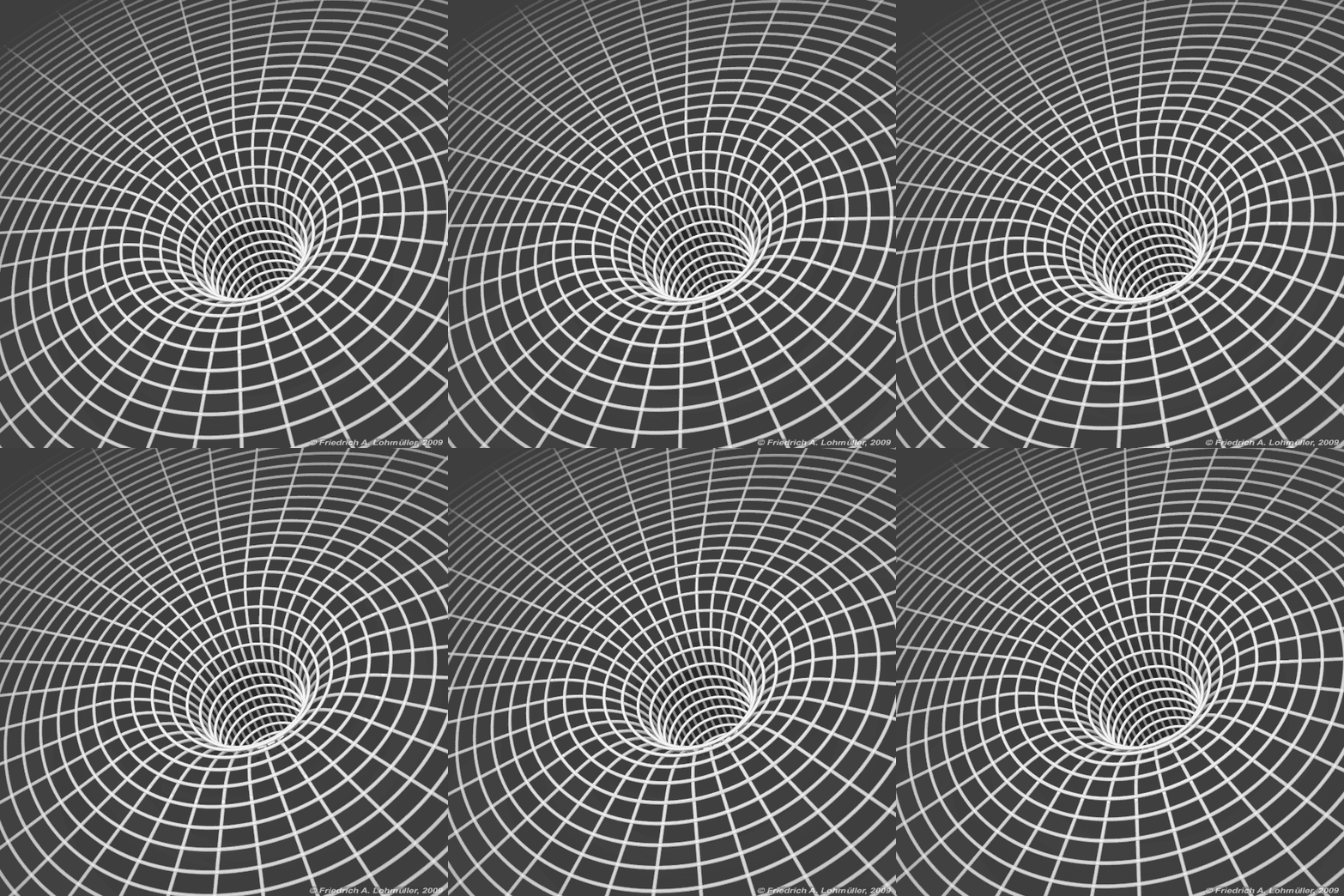
Black hole wireframe, converging linesI don’t know what the best term is for this kind of crux or turning point.  I keep thinking of it as a “bottleneck,” or a gate that all the plot lines have to pass through—but “bottleneck” suggests a blockage, which isn’t the idea at all.  The military notion of a “choke point”—a narrow passage through which an armed force must pass—is closer.  Science fiction sometimes uses the term “Jonbar hinge” (named after an old SF story) for a crucial point at which the past can be changed—but that’s in a time travel context, rather than in the story’s present.

Whatever we call it, this is the action, almost always constituting the story’s climax, that solves the key conflict and lets everything wrap up neatly.  Concentrating the whole burden of the plot into one critical event has an effect similar to that of Aristotle’s dramatic unities of time, place, and action.

Let’s look at some examples.

Star Wars

In three of the Star Wars movies (IV, VI, and VII), blowing up one Big Object forms the climax.  We’re given to believe that if the original Death Star is operational, the Rebellion is doomed; destroying the Death Star doesn’t give the Rebellion a permanent victory, but at least the good guys can continue fighting.  The second Death Star’s destruction (Return of the Jedi) has more far-reaching effects, because the Emperor is on board and dies as part of the same action.  Starkiller Base in The Force Awakens is a similarly crucial danger.

There’s another “single point of failure” in the first prequel, The Phantom Menace.  The irresistible invading army of droids is run from a single control ship in orbit.  Once Our Heroes destroy the control ship, the droids all go dead.  In one stroke, the invasion is ended.  And we can still get home from the theatre before bedtime.

Geography and Control
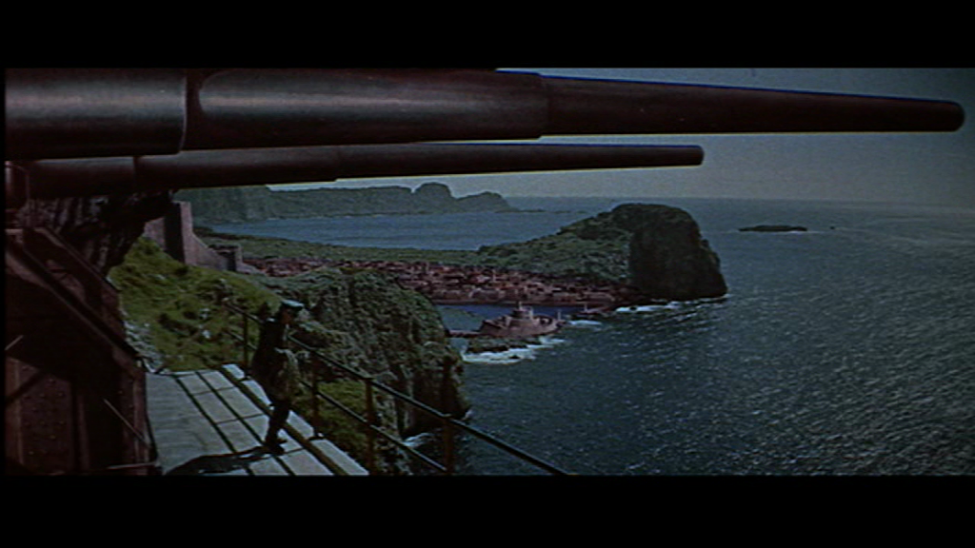
Guns of Navarone, cannon & seascapeThis kind of blow-it-up plot isn’t restricted to F&SF.  Terrestrial geography makes it even easier to position a crucial fortress or facility in a key spot.  The World War II classic The Guns of Navarone turns on just such an installation.  The whole story is about destroying that one fortress.  (Well, and about the characters involved—but that’s true of most good fiction.)

In fact, it’s much harder to create a spatial choke point in featureless three-dimensional space—which is why the original Battlestar Galactica’s rip-off of Navarone (the double episode “Gun on Ice Planet Zero”) is so implausible.  The Wikipedia summary begins:  “Herded into a confined area of space by the Cylons” —but confined by what?  This is why space adventures typically turn on something other than geography.
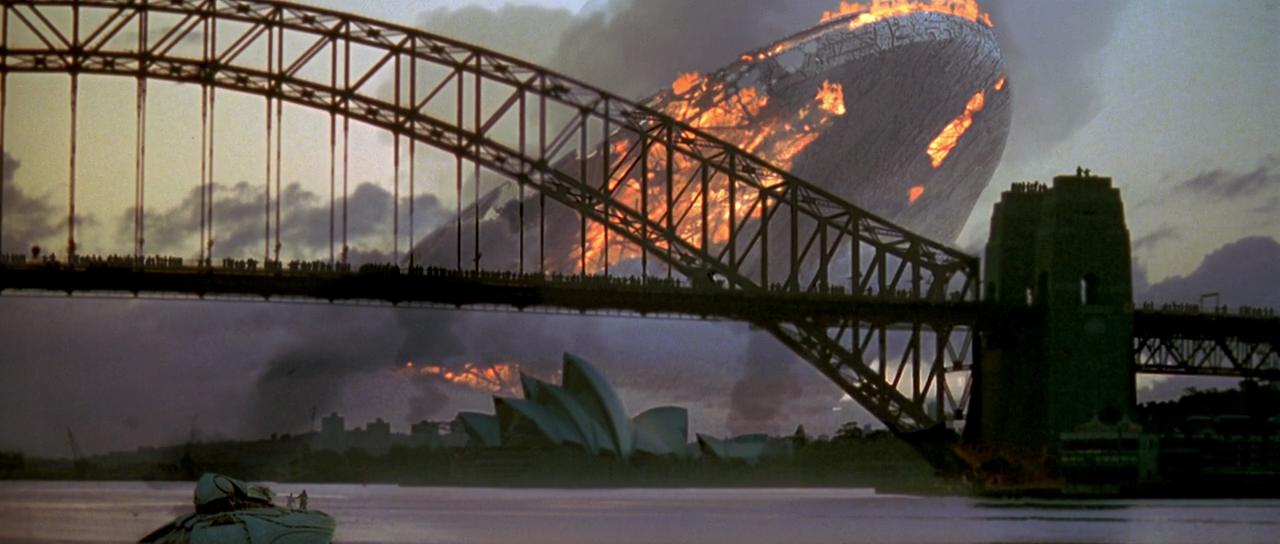
Independence Day, crashed city destroyerA more mobile fortress can be a plot bottleneck if it serves a critical function—say, power or control.  We saw that in The Phantom Menace.  The same device is used in Independence Day, where everything depends on the immense mother ship.  You can use its computer system to lower the force shields on the city-destroyers thousands of miles away; and when Our Heroes deliver a single A-bomb to blow it up, all the other invader craft fail as well.  Convenient.

Hive Minds

If we’re dealing with an imaginary science fiction or fantasy opponent, we can also fall back on the classic trope of the hive mind—a culture centered around a single queen or other crucial individual, as in an ant colony.  Kill the queen, and the other ants are no longer a problem.  As TV Tropes observes:  “This plot device is handy as it allows a handful of heroes to win the war without having to depict them fighting off the entire enemy force.”

Star Trek’s Borg fall into this category—at least, as depicted in the film First Contact.  The Borg Collective has a Queen; destroying the Queen apparently disposes of the Borg menace as a whole.

One can see the intrusion of the hive-queen idea in the 1994 movie version of Robert A. Heinlein’s 1951 novel The Puppet Masters.  In the novel, Earth is invaded by “slugs” from space, which attach themselves to humans and take over their minds.  To defeat the slugs, the defenders use a disease that kills the slugs without immediately killing their human hosts.  But since this is a specific infection, not the generalized bacteria of The War of the Worlds, a massive operation involving thousands of people is required to distribute the disease to the whole slug-ridden population.  Heinlein specifically notes that even after the victory, “there is no way to be sure that the slugs are all gone” (ch. 35)—adding a sobering note of realism.

The movie, along with numerous other changes, introduces the entirely un-Heinleinian notion of a hive and a “mother slug.”  The whole slug invasion is kept so confined and centralized that a single quick operation can get them all.  The resolution seems too facile, too easy, especially if you’re familiar with the book.  (A fascinating article by screenwriter Terry Rossio details how the original story for the film, which stuck close to the novel, was hijacked by the Hollywood movie-making process and turned into something quite different.)

One Ring to Rule It All

Fall of Sauron (Ted Nasmith)

Tolkien illustration by Ted Nasmith

The classic example of the crucial plot hinge is the One Ring in The Lord of the Rings.  Tolkien handles it well:  he builds up the Ring throughout the story to make it the one thing on which victory or defeat turns.  We learn that Sauron has placed much of his power in the Ring, which means that if it’s destroyed, much of his power will vanish.  The Tower of Barad-Dûr and other structures were made with the One Ring’s power, and fall with its destruction.  The Ringwraiths were given their power by Sauron’s control of the nine human rings through the One (“One Ring to rule them all”).  Sauron’s armies of orcs and humans are evidently held to a single purpose by Sauron’s will.  Sauron himself, and all his works, are destroyed with the Ring.  The groundwork for this crux has been laid so thoroughly that we accept the completeness of the destruction, and the victory, as the proper consummation of the epic narrative.

Tolkien, like Heinlein, adds a note of realism.  There will be orcs hiding in remote places long after the end of the War of the Ring, though they will never be the threat they were under Sauron.  And the end of Sauron is by no means the end of all evil, as depicted especially in the chapter titled “The Scouring of the Shire.”  The heroes’ victory is satisfying, but it’s not absolute.

The LotR climax is only one example of the trope in which killing the final enemy causes his works to fail as well.  This is the assumption TV Tropes calls “No Ontological Inertia”:  the villain’s creations depend on the villain for their existence.  Kill the Big Bad, and his lair collapses, his minions flee, and his deeds may be undone.

Conclusion

We see the Death Star-like plot bottleneck especially in fantasy and science fiction, where the author can design species and mechanisms to create the dependencies that make the plot solvable in a single event.  But it can also appear in mainstream works, as The Guns of Navarone demonstrates.

The choke point is a great plot convenience.  Real life tends to be messier.  For that reason, the author has to take care to make the bottleneck believable, so the result is a concentrated climax and not an artificial, deus ex machina solution.
The Master Contriver

Some stories—especially comedies—include a character who seems to have the job of making sure everything comes out right in the end.  Let’s call them the Master Contrivers.

“I manage things a little”

The Contriver doesn’t force things into place.  Rather, she pulls strings.  A good deal of finagling, a certain amount of chicanery, and a talent for talking people into things are generally involved.

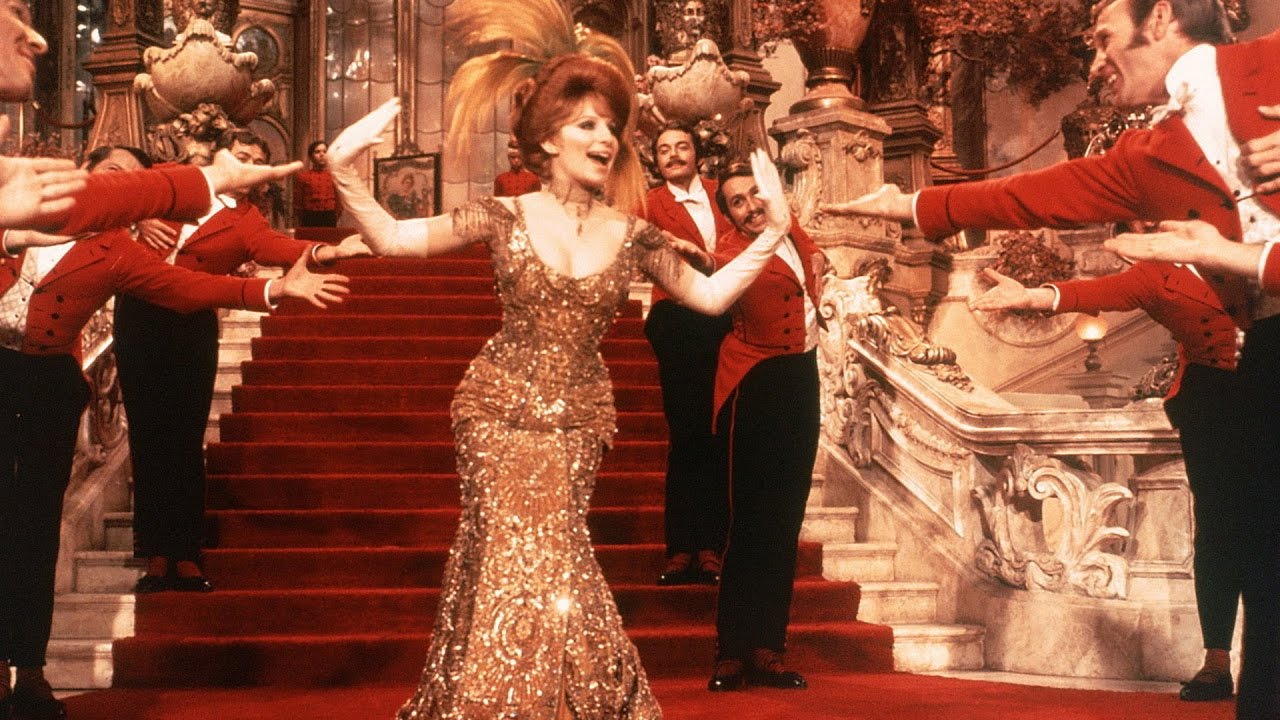
Dolly Levi dances with waitersDolly Levi of Hello, Dolly! is a familiar example.  The show starts with an array of dissatisfied characters.  Horace Vandergelder wants a wife.  His niece Ermengarde wants to marry impecunious artist Ambrose Kemper.  Horace’s clerks, Cornelius Hackl and Barnaby Tucker, want to escape their humble jobs for a day—and maybe fall in love.  Their opposite numbers, Irene Molloy and her assistant Minnie Fay, are also eager for a spree and a romance.  Dolly herself, a self-proclaimed meddlesome widow, is ready to settle down with a new husband.

With magnificent confidence, the ebullient Dolly takes on the task of resolving all these plotlines.  She suggests, cajoles, misdirects, confuses, and manipulates until everything works out.  We enjoy how all this frivolity and chaos converges magically to a neatly satisfying outcome, like a sleight-of-hand trick.

Hardly anyone else knows quite what they’re doing at any given time, but Dolly has everything under control.  Even where she lacks a specific plan, she is an expert improviser.  The other characters can safely rely on her to solve all problems.

Wodehouse’s Maestros

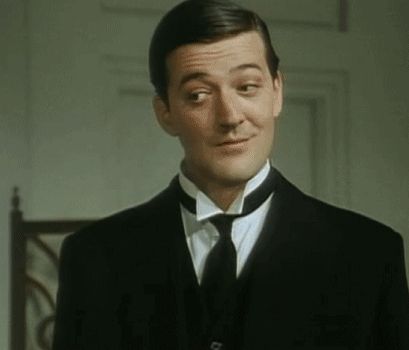
Stephen Fry as JeevesThe Master Contriver frequently pops up in P.G. Wodehouse’s comedies.  The best-known example is the imperturbable gentleman’s gentleman Jeeves.  No matter what sort of absurd scrape Bertie Wooster gets into, Jeeves can always find a way to get him out again.  Half the fun is watching to see exactly how Jeeves will pull it off this time.  (The other half is simply listening to Bertie narrate, which is a joy in itself.)

But Jeeves is far from the only Wodehouse example.  At Blandings Castle, the fiftyish but dapper Galahad Threepwood lives up to his name by spreading sweetness and light in the form of good fun, lovers united, and overbearing aunts thwarted.  The lively and irreverent Uncle Fred (Earl of Ickenham) plays a similar role in other tales, to the alarm and embarrassment of his nephew Pongo Twistleton; sometimes these adventures also take place at Blandings.  (It’s too bad Wodehouse never brought Gally and Uncle Fred onstage at the same time—ideally with Bertie and Jeeves as well.  The mind boggles at what wackiness might develop with three Master Contrivers simultaneously at work.)

All the above examples are middle-aged men or women.  The sublime Rupert Psmith (“The p . . . is silent, as in phthisis, psychic, and ptarmigan”) represents a rare younger version of the merry manipulator.  He actually becomes a protagonist, with his own romantic plotline, in Leave It To Psmith (1923)—at Blandings, naturally.

SF Contrivers

Science fiction abounds in exceedingly clever manipulators, but most of them fit the mold of the trickster-hero rather than the master contriver:  they are frequently the protagonists, and their stories tend to be more serious.  Miles Naismith Vorkosigan, Salvor Hardin, Gandalf the Grey (in The Hobbit), and Seth Dickinson’s Baru Cormorant are good examples.

But the comic contriver is not unknown.  In Heinlein’s rollicking family yarn The Rolling Stones (1952), Hazel Stone, the superficially crusty grandmother figure, is often the one who “arranges things”—including appearing in court to get her grandsons off the hook in a tax case on Mars.

Masters and Matchmakers

The Grand Sophy, coverThe Master Contriver is perhaps most at home in romantic comedies.  Georgette Heyer’s Regency romances feature a few such characters.  Sometimes they’re the romantic interests of female protagonists, since genre romances are fond of dominant “alpha male” heroes.  But one of the most enjoyable is the titular female lead in The Grand Sophy (1950).  Like Psmith and Dolly, young Sophy cheerfully arranges a romance for herself at the same time as she resolves other characters’ star-crossed affairs.

In the musical Oklahoma! we have Aunt Eller, the spiritual counterpart of Uncle Fred.  She’s perfectly capable of pulling a gun to halt a burgeoning brawl (see this clip at about 3:05), but her main job is to guide her niece Laurey to a happy resolution of her uneven romance with the expansive cowboy Curly.

The Warrior's Apprentice, coverAs the third-party plot manager for a romantic comedy, the Master Contriver often functions as a matchmaker.  Hello Dolly! was based on a Thornton Wilder play literally titled The Matchmaker.  Even Miles Vorkosigan, in a gently comic scene in The Warrior’s Apprentice, briefly burlesques the role of a traditional Barrayaran matchmaker for his own lifelong crush Elena and the man she’s fallen in love with.  (Miles’ own romance does not develop until several novels later.)

The Character of the Contriver

A third-party Master Contriver naturally falls into the niche of the benevolent uncle or aunt—a kindly older person who isn’t typically a player himself, but an enabler of other characters’ fulfillment (though we’ve seen some counter-examples above).  In fact, this position is not unlike the role of the fairy godmother in Cinderella.

The role resembles that of a mentor, although, unlike the Missing Mentor of whom we’ve spoken before, this mentor-manager is generally very much present, in the thick of the action.  Yet the Contriver is a little detached, not as directly involved as the principals; she can take things a little lightly.  She can thus be more jolly, less earnest.

Since the Contriver is generally working toward other characters’ happy endings, not her own, she lends the story a sense of generosity.  This is why we don’t mind a character who might otherwise seem manipulative.  We typically think of “maniuplative” as a troublesome trait, not an appealing one.  But an avuncular figure who can be trusted to manipulate people only for their own good becomes an asset rather than a problem.

The Atmosphere of the Story

It helps make a comedy pleasant when there are people disinterestedly spreading sweetness and light.  This is why the Contrivers play so well in comedies of manners and romantic comedies, where the plots have to be intricate, but light-hearted.

Since we’re typically dealing with interpersonal relations, not slam-bang action plots, Master Contrivers achieve much of their effectiveness by influencing other people.  For this reason, they generally possess considerable personal magnetism or “charisma.”  This, again, adds to the general air of genial good-fellowship in a comedy.

But the greatest effect on the atmosphere of the story, I think, is that it’s reassuring to have someone around who can be trusted to untangle all plotlines to a happy ending:  “till by turning, turning we come ’round right.”  We come into a comedy expecting things to turn out well.  The more the happy ending is in question, the more the story begins to look like a thriller rather than a comedy.  If Dolly or Gally is on the scene, we can rest easy on that score, and enjoy the ride.

Civilization and the Rule of Law

We’ve talked about how the Star Trek-Star Wars divide reflects preferences for a more lawful or more chaotic world; how F&SF stories often show us a defense of civilization against chaos; and how civilization makes science possible and rests in turn on human technology.  But both order and technology can be oppressive.  The missing element is the rule of law.

Universal Laws

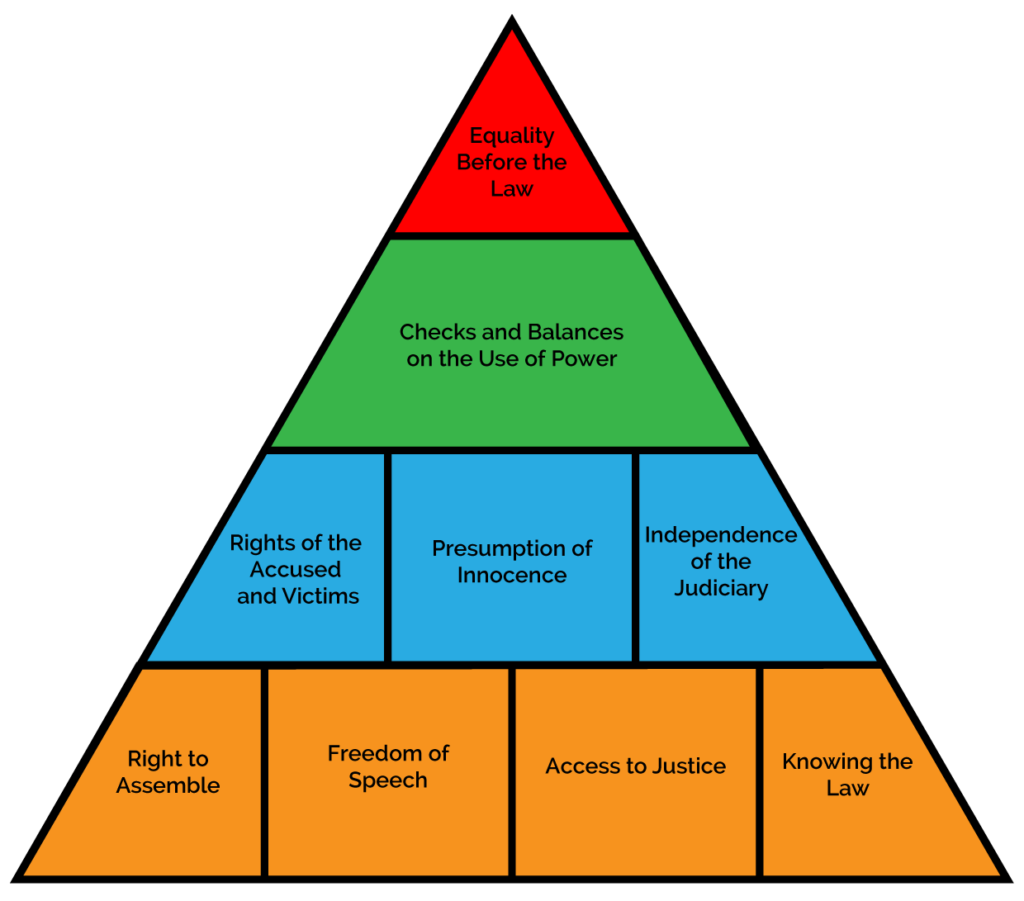
It’s a crucial element of right governance that there are rules applying to everyone, as opposed to the arbitrary wishes of a dictator, who can make decisions based on favoritism, political preferences, or personal relationships.  The Wikipedia article describes rule of law as “the legal principle that law should govern a nation, as opposed to being governed by decisions of individual government officials.”

Rule of Law pyramid

(Rule of Law Institute of Australia)

As we saw in The Good King, the concept of the rule of law goes back at least to Aristotle.  It became a central principle of the American founders via the English tradition of John Locke.  “Rule of law implies that every citizen is subject to the law, including lawmakers themselves” (Wikipedia again).  It is thus in tension with kingship, where rule is almost by definition arbitrary and personal.  But one can have mixed cases—kings who are bound by certain laws, as in the British constitutional monarchy.

Without the rule of law, we depend on the good behavior of those who have power of some sort—physical, military, economic.  We slide toward the “war of each against all,” where might makes right and the vulnerable are the pawns of the strong.  Autocracy soon follows, as people look for any means to find safety from those who are powerful but unscrupulous.  Hence the quotation from John Christian Falkenberg, which I’ve used before:  “The rule of law is the essence of freedom.”  (Jerry Pournelle, Prince of Mercenaries (New York:  Baen 1989), ch. 21, p. 254.)  Strength itself, a good thing, is only safe under laws.

Test Cases

It’s easy to miss the importance of the rule of law.  We’re typically born into a society with better or worse laws, and criticize them from the inside.  It’s less common to find ourselves in straits where lawfulness as such has collapsed.  Regrettably, sizable numbers of people are exposed to such conditions in the world today.  But many of us are fortunate enough not to see them ourselves.  As always, fantasy and science fiction provide useful “virtual laboratories” for examining the possibilities.

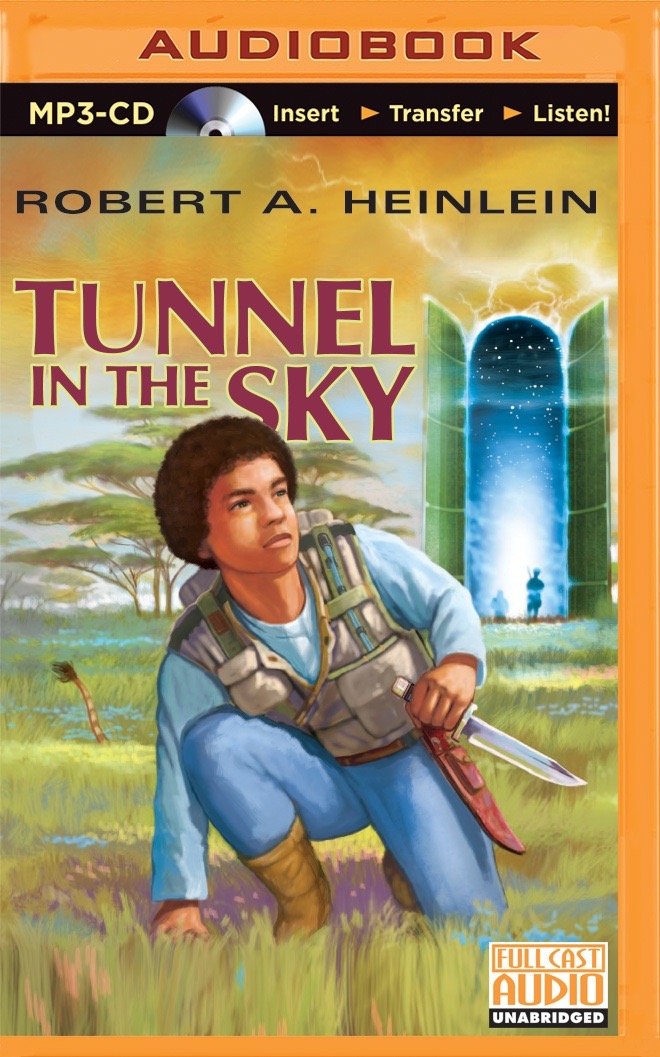
Tunnel in the Sky (audiobook) coverA classic SF case is where a group thrown into a “state of nature” attempts to set up a lawful society.  For example, in Heinlein’s Tunnel in the Sky (1955), students from a high-school class on survival techniques are given a final exam in which they are dropped onto an unspecified planet to survive for up to ten days.  When an astronomical accident leaves them stranded, they need to organize for the long term.  Rod Walker, the hero, becomes the leader-by-default of a growing group of young people.  The tension between this informal leadership and the question of forming an actual constitution—complete with committees, regulations, and power politics—makes up a central theme of the story.

David Brin’s post-apocalyptic novel The Postman (1985), later made into a 1997 movie with Kevin Costner, illustrates the power of civil order, the unstated practices of a culture, as recalling—and perhaps fostering—the rule of law.  The hero, a wanderer who happens to have appropriated a dead postman’s uniform and mail sack, presents himself as a mail carrier for the “Restored United States of America” to gain shelter in one of the isolated fortress-towns, ruled by petty tyrants, that remain.  His desperate imposture snowballs into a spreading movement in which people begin to believe in this fiction, and this belief puts them on the road toward rebuilding civilization.  The result is a sort of field-test not only of civil order and government, but of what Plato famously imagined as the “noble lie.”The Postman movie poster

Last time, I cited Niven & Pournelle’s Lucifer’s Hammer (1977), where a small community headed by a United States Senator hopes to serve as a nucleus for reconstructing civilization after a comet strike.  We see at the end the strong pull of personal rule or kingship:  as the Senator lies dying, the future of the community will be determined by which of the competing characters gains the personal trust and endorsement of the people—and the hand of the Senator’s daughter, a situation in which she herself recognizes the resurfacing of an atavistic criterion for rule.  Unstated, but perhaps implicit, is the nebulous idea that deciding in favor of scientific progress may also mean an eventual movement back toward an ideal of rule by laws, not by inherited power.

Seeking a Balance

The “laboratory” of F&SF is full of subversions, variations, and elaborations on the rule of law.  In particular, we should note the counter-trend previously discussed as “chaotic good.”  Laws can be stifling as well as liberating.

The Moon is a Harsh Mistress coverHeinlein’s The Moon Is A Harsh Mistress (1966) imagines how the “rational anarchy” of a lunar prison colony is mobilized to throw off autocratic rule.  The healthy chaos of the libertarian Loonies is hardly utopian, but the story does make it seem appealing.  Interestingly, Heinlein returned to this setting with a kind of critique twenty years later in The Cat Who Walks Through Walls (1985), where the post-revolution lunar anarchy seems much less benign, seen from an outsider’s perspective.

While fantasy seems to concern itself with this issue much less than science fiction, consider the region called the “Free Commots” in Lloyd Alexander’s Chronicles of Prydain.  When protagonist Taran visits this area in the fourth book (Taran Wanderer), he finds a society of independent villages, where the most prominent citizens are master-craftspeople.  They neither have nor need a lord to organize them.  The Commots contrast favorably to the feudal or wilderness regions through which Taran travels.  A kind of anarchic democracy, as an ideal, thus sneaks into what otherwise seems to be a traditional aristocratic high fantasy.Taran Wanderer book cover

One way of managing the tension between a government of laws and a culture of liberty is the principle of subsidiarity:  the notion that matters should be governed or controlled at the lowest possible organizational level where they can be properly handled.  It’s frequently illustrated in G.K. Chesterton’s ardent defenses of localism.  In The Napoleon of Notting Hill (1904), extreme localism is played for laughs—“half fun and full earnest,” to borrow Andrew Greeley’s phrase.  The more mature Tales of the Long Bow (1924), which might qualify as a sort of proto-steampunk story, treats the idea more seriously, in the form of an oddly high-tech (for 1924) revolt of local liberty against overweening and arbitrary national rule.

The Fragility of Civilization

When we grow up taking for granted the rule of law, we can fail to see how vulnerable it is—along with the civilization that it reflects and makes possible.

“The Establishment,” as they used to say in the 1960s, seems vast and invulnerable.  When we’re trying to make a change, it seems insuperable, so rigid that nothing can be done about it.  But this is an illusion.  The structure of civilization, good and bad, is fragile.  It’s easier than we think to throw away the rule of law, so painfully constructed (as Rod Walker found), in favor of shortcuts or easy answers to our problems.

One thing F&SF have brought us is a better sense of this vulnerability.  The spate of post-apocalyptic tales in recent years—zombie apocalypses, worldwide disasters, future dystopias like The Hunger Games, going all the way back to the nuclear-war stories of the 1950s—do help us appreciate that our civilization can go away.

But that collapse doesn’t require a disaster.  Civilization, and the rule of law, can erode gradually, insidiously, as in the “Long Night” stories we talked about earlier.

Historically, the Sixties counterculture fostered anarchists who felt “the Establishment” was invulnerable.  Often with the best of intentions, they did more to undermine civil order than they expected.  Those who now see no better aim than breaking up the structures of democratic government and civil life—whether from the side of government, or from the grass roots—also fray the fabric of civilization.  The extrapolations of science fiction and fantasy illustrate why eroding the rule of law should not be taken lightly.

Near the bottom of David Brin’s Web home page, he places the following:

I am a member of a civilization

It’s good that we have a rambunctious society, filled with opinionated individualists. Serenity is nice, but serenity alone never brought progress. Hermits don’t solve problems. The adversarial process helps us to improve as individuals and as a culture. Criticism is the only known antidote to error — elites shunned it and spread ruin across history. We do each other a favor (though not always appreciated) by helping find each others’ mistakes.

And yet — we’d all be happier, better off and more resilient if each of us were to now and then say:

“I am a member of a civilization.” (IAAMOAC)

Step back from anger. Study how awful our ancestors had it, yet they struggled to get you here. Repay them by appreciating the civilization you inherited.

It’s incumbent on all of us to cherish and defend the rule of law.  Give up civilization lightly, and we may not have the choice again.

Civilization and Science

The Stars Are Ours!

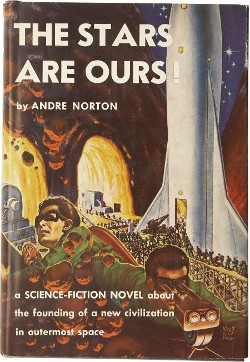
Andre Norton’s The Stars Are Ours! (1954) was one of my favorite books in early childhood.  Dard Nordis, his young niece Dessie, and her crippled father Lars eke out a living on an impoverished farm under the tyranny of the ironically named “Company of Pax.”  Pax came to power after nationalist forces seized the space stations built by independent-minded Free Scientists and used them to devastate much of the Earth.  Turning people against scientists in a bloody purge, Pax imposed a worldwide dictatorship.  Lars is a former scientist, and the family is suspected by neighbors and “Peacemen” alike.

The Stars Are Ours! coverDard discovers that Lars has been secretly developing a form of suspended animation as the final step in a project carried out by renegade Free Scientists.  Under the current world order, their only hope is to escape Earth altogether.  When Lars is killed, Dard and Dessie make the perilous journey to the Cleft, bringing the secret of Lars’ discovery to the hidden Scientists.  Dard helps fight a desperate rearguard action to hold off attackers while the star ship is prepared.  He is bundled aboard at the last moment and the refugee Scientists take off into the unknown.

And that’s just Part One.

The Defense of Reason

What makes this tale so gripping, for me, is seeing characters with their backs against the wall, defending freedom, human decency, and rationality:  civilization.  The ideal of civilization in this story specifically includes the freedom of inquiry that makes science possible.  That underlying alliance between reason and virtue is all the more powerful because the characters’ means of escape itself involves dramatic scientific advances.

The motif of scientific civilization is, of course, a natural fit for science fiction.  But it’s well-grounded in basic humanity.  Science and technology are what humans do:  not the only thing, but a key element.  Hannah Arendt, among others, spoke of Homo faber, humanity the maker.

The idea of humans as makers and builders is not limited to what we think of advanced technology.  Blacksmithing is technology.  Agriculture is technology.  Using spears against mammoths is technology.  It’s a matter of degree.

As noted above, science is not everything.  We are not only homo faber but also organic beings, the animal laborans, as well as acting persons who relate to each other in uniquely personal ways.  (Not to mention philosophers.)  But in building a civilization, the scientific and technical mind is of great importance.

Science on the Run

Stories that play out the relationship between science and civilization can be tremendously moving.

Fallen Angels book coverLarry Niven, Jerry Pournelle, and Michael Flynn collaborated on a novel called Fallen Angels (1991), in which the few humans living and working in space stations like the ISS become exiles from an Earth controlled by an essentially anti-scientific government, like Norton’s Pax.  In Chapter Sixteen, “The Last Shuttle,” a character tells the story of the final group of refugee scientists and engineers that made it into orbit.  As in The Stars Are Ours!, they make their escape under attack:

“. . . Mission Control kept feeding corrections to the main computer.  They’re the real heroes, the NASA ground crew.  I never knew their names.”

“Why them?” asked one of the young fans.

“Because they stayed at their posts.”

“But—”

“The mob broke through.”

“Oh.”

“The fighting in Mission Control was hand to hand . . . The crew held on, nobody left, nobody left a console until Enterprise Two was up.”  (pp. 291-92)

Niven and Pournelle called on a similar idea in Lucifer’s Hammer (1977), where isolated groups struggle to hold onto civilization after a disastrous comet impact.  Part of the climax involves the fight to sustain a nuclear power plant, the only remaining source for electricity—and all that electricity makes possible, from hot showers to antibiotics.  Many of the survivors are reluctant to risk their precarious security for this “luxury”—until one of the remaining astronauts shames them into it.

“So.  We’ll live. . . . As peasants! . . . But . . . don’t we want to hope for something better?

“And we’re going to keep slaves,” Delanty said.  “Not because we want to.  Because we need them.  And we used to control the lightning!”  (p. 636)

The Appeal of the Primitive

Of course this high regard for scientific civilization is not the only side of science fiction.  It isn’t even the most prevalent.  All sorts of SF stories preach the dangers of technology instead.  Many of them show a common yearning for a simpler, pre-technological age.

I’ve mentioned that Edgar Rice Burroughs’ Mars—Barsoom—has a peculiarly archaic flavor, as exemplified in the stories’ fondness for swordfighting even when more effective combat technologies are available.  Burroughs’ idealization of the primitive is even more prominent in his more famous creation, Tarzan.  Tarzan is a paradigm of the “natural man,” with an instinctive decency and even chivalry that belies his savage habits.  The Tarzan tales play into a widespread fascination—I’ve got it too, right alongside the enthusiasm for technology—with the ideal of living close to nature and putting aside artificiality.

The Word for World is Forest coverBack-to-nature paradises are endemic in SF, especially when ecological advocacy gets mixed in.  Ursula K. LeGuin’s The Word for World is Forest (1972) is a classic example of such a story, as the title alone makes clear.  The movie Avatar (2009) hews to a similar plotline.  Even Norton’s sequel to The Stars Are Ours!, published three years later as Star Born (1957), pits the Terran colonists, now reverted to a more natural lifestyle, against the suspect technology of “Those Others,” in a contrast more characteristic of Norton’s later work.

Sometimes a group seeks to colonize another planet in order to “get away from it all” and return to a more natural lifestyle.  Anne McCaffrey’s Pern was settled in exactly that way.  In Christopher Stasheff’s Warlock series, the original colonists of the quasi-fantasy world of Gramarye actually belonged to the Society for Creative Anachronism and aimed to set up a society modeled on an idealized Middle Ages.

The subgenre of desert island or castaway stories such as The Swiss Family Robinson frequently showcases an opportunity to live a more primitive life in an island paradise—though “Robinsonades” as a whole include a variety of attitudes toward the primitive.

The Mysterious Island coverYet such desert-island excursions can also provide an opportunity to build your own civilization from scratch, technology and all.  In Jules Verne’s The Mysterious Island (the 1874 novel, not the maladapted movies), a band of energetic American castaways, headed by a capable engineer, construct a remarkably sophisticated settlement, with such modern conveniences as telegraph lines.  Heinlein’s Tunnel in the Sky (1955) shows a group of young people stranded on a far planet creating a new society that includes such technology as they can muster—together with close attention to the structure of society and form of government, of which more anon.

Science and Civilization

These latter examples, in contrast to the pull of the primitive, remind us that humans are by nature makers and builders.  For us, technology is natural.  And science, which underlies technology, helps satisfy the fundamental human drive to understand the universe.

In a civilization, science ranges itself on the side of order.  It involves rigorous thought and discovery as a method, and gives rise to reliable technology and innovation as results.  It’s not opposed to a modest degree of chaos—which fuels innovation—but it relies on cultural features like free communication and freedom of speech that are enabled by good organization.

Lest we think of science and reason in terms of Mr. Spock, we need to keep in mind that science and technology do not exclude passion, freedom, or nature.  When rightly carried out, science and reason deliberately provide a place for these goods.  (When wrongly carried out, they can lead to the kinds of cautionary dystopias regularly featured in the back-to-nature subgenres—and all these types, pro and con, are good science fiction.)

When we consider the preconditions of doing science, or of beneficial technologies, we begin to see the connections between scientific civilization and certain kinds of social arrangements.  This leads naturally to our topic for next time—civilization and the rule of law.

Civilization and Chaos

Last time, we talked about Star Trek and Star Wars—but especially Star Trek—as expressing the ideal of a certain type of civilization.  Now we can broaden the range of examples.  Science fiction and fantasy make an excellent laboratory for thought-experiments here, as in so many things.

Staving Off the Fall

The threat that civilization will fail and collapse is a classic way to create a dramatic situation for a SF story.  The most common historical analogue, of course, is the fall of the Roman Empire in the West.

Foundation's Edge cover artIsaac Asimov’s classic Foundation series (1942-1953) deliberately drew on that model; Asimov had been reading Gibbons’ History of the Decline and Fall of the Roman Empire.  In the Foundation universe, Hari Seldon has developed a science of “psychohistory” that predicts the Galactic Empire’s inevitable decline.  There’s no chance of preventing the fall.  But Seldon’s psychohistory offers a way to cut short the ensuing dark age from thirty thousand years to a single thousand.  The emotional charge of the original Foundation stories centers on the Seldon Plan’s bid to minimize the period of barbarism, with its chaos, violence, tyranny and suffering.  (Later developments of the series, too involved to discuss here, go off in somewhat different directions.)

I’ve mentioned H. Beam Piper’s Terro-Human Future History, which includes at least one such decline-and-fall.  The novel Space Viking (1963) gives us a whole culture of space-traveling barbarians, raiding the decadent worlds of the old Federation.  The events of the story suggest the hope of a return to lawfulness in the formation of a “League of Civilized Worlds.”  But given Piper’s cyclical theory of history, this initiative will yield no permanent resolution; the story has a happy ending, but the history does not.

Poul Anderson wrote a series of stories about Sir Dominic Flandry, a dashing secret agent of the Terran Empire reminiscent of a far-future James Bond (though Flandry first appeared in 1951, Bond in 1953).  When he can spare a moment from chasing women and loose living, Flandry devotes his efforts to shoring up the decaying Empire, though he realizes that in the end the “Long Night” is inevitable.

There’s a certain kind of romance, a mood of grandeur and doom, about these falling empires.  Naturally, they tend toward the somber and the tragic.

Defending Civilization

A more upbeat tone characterizes stories in which the fight to preserve civilization has a chance of succeeding.

Lensman imageIn the Lensman series, E.E. Smith actually refers to the heroes’ multispecies galactic community simply as “Civilization.”  That polity reflects the cooperative, yet freedom-loving, nature of the beneficent Arisians, who have nurtured it in secret over millions of years.  The Lensmen’s opponent is “Boskone,” which originally appears to be a mere conspiracy of space pirates or drug dealers.  When Boskone eventually turns out to be a whole independent culture of its own, based in another galaxy, the conflict becomes one of diametrically opposed cultures, rather than simply of order vs. disorder.

But the Boskonian culture is one of thoroughgoing tyranny, from top to bottom.  At every level, those in power scheme against each other.  Lacking any honor or ethical code, they engage in assassination and undermine each other’s plans.  Those at the bottom are essentially slaves.  The Civilization led by humans, on the contrary, respects human dignity and freedom—although the fact that these cultures have been essentially on a war footing throughout their entire history renders that freedom a little less far-ranging than we might imagine.

The Lensman example reminds us that the defenders of civilization are not always fighting against barbarians.  Autocracy and regimentation bring their own kind of chaos, as lawless warlords battle among themselves, not caring what common folk are trampled in the process.  It’s a particular kind of civilization that’s worth preserving.

This is true whether we’re in the future or the past.  We’ve seen that the power of the Arthurian legend stems partly from the theme of defending order and decency against the chaos that lies in wait.  (We may also mention Arthur’s more historically-based successor, King Alfred, who defended England against the real (not Space) Vikings.)

The embattled Arthurian Camelot is frequently connected with Rome itself, the ur-example.  The Last Legion (book and movie) provides a good example.  The waning Roman presence in Britain, as the Dark Ages set in, is a natural setting for the ideal of the lonely, valiant defender.  One example is brought up indirectly by a character’s name.  As Wikipedia puts it,  “Legio XX Valeria Victrix lends its name to the character Valeria Matuchek in Poul Anderson‘s Operation Chaos and its sequel Operation Luna; her mother is said to describe this legion as the last to leave Britain—‘the last that stood against Chaos.’”

To Valeria’s mother Virginia, “the last that stood against Chaos” is a phrase to conjure with.  That’s true for me, too.

The Right Kind of Order

If civilization represents a certain kind of order—that of the Lensmen, not Boskone—what kind are we talking about?  It’s not always easy to explain.

Thus, if one asked an ordinary intelligent man, on the spur of the moment, “Why do you prefer civilization to savagery?” he would look wildly around at object after object, and would only be able to answer vaguely, “Why, there is that bookcase . . . and the coals in the coal-scuttle . . . and pianos . . . and policemen.”  The whole case for civilization is that the case for it is complex.  It has done so many things.  But that very multiplicity of proof which ought to make reply overwhelming makes reply impossible.  (G.K. Chesterton, Orthodoxy (Garden City, NY:  Image Books, 1959), ch. 6, p. 83)

Chesterton’s random examples do cast some light on the question.  A community that has bookcases has books—implying a continuity of knowledge and literature, as well as the leisure to read them.  Coals to keep one warm in winter suggest both the satisfaction of basic human needs, and the whole machinery of society and technology that brings the fuel from the mine to the fireside.  Pianos reflect art and a developed culture.  And policemen indicate a society in which there is at least some attempt to defend the ordinary citizen against the depredations of the powerful and unscrupulous—the rule of law, of which more anon.

In the particular culture to which I belong, when we hold up a certain sort of civilization as an ideal worth defending, what we have in mind is a good order in which spontaneity and creativity can flourish, and people can live their lives without constant fear or privation.  There’s an order that protects the weak against the strong, but there is also enough looseness for individual variation, experiment, and adaptation.  In the “alignment” terms we discussed last time, you might say the position I’m taking is neutral good, tending to lawful.

Greco-Roman sceneThe classical roots of this ideal are found in the Greek notion of the polis and the Roman notion of civitas.  But it’s been shaped by the whole history of Western thought into what’s sometimes called the “liberal” ideal of a free society—“liberal” not in the political sense, but the root sense of “free.”

There’s one particular aspect of this ideal, though, that science fiction is peculiarly suited to address.  We’ll talk next time about civilization and science.